Showing posts with label Frank O'Conner. Show all posts

Friday, September 23, 2016

Secret recordings of Edward Saint revealed


In the 1930s and 40s, Edward Saint recorded private phone conversations while he and Bess lived in Hollywood. Magician John Booth first discussed Saint's secret recordings in a 1966 issue of The Linking Ring. Later Booth said, "Across the years, I have tried fruitlessly to find out who obtained these recordings from the Houdini estate. No one can tell me what happened to the voice records: they simply disappeared."

Well, they did not disappear entirely. Because today I'm excited to reveal two of them!

These remarkable recordings are owned by our good friend Mark Willoughby, who for years didn't know himself what these records contained. But now the recordings have been heard and Mark has graciously allowed me to share the details here.  While these do not include Bess, what they do contain is pretty wild!

The recordings themselves were made on "Howard Home Recording Discs." Each side contains approximate four minutes of conversation. Each record is labeled with the name of the person being recorded.

The first (undated) record contains a remarkable phone conversation between Edward Saint and a man identified on the label as "Great Alexander's Press Agent." I'm not sure of the man's real name, but at one point Ed appears to call him "Mr. Runny"? Alexander was a famous mentalist and magician who also authored books on the paranormal. At the time of this recording, Alexander was retired and living in California. [For the life of Alexander, read David Charvet's Alexander The Man Who Knows.]


Incredibly, the press agent is pitching Saint on the idea of holding a fake Houdini séance in which Alexander will appear to have made contact and Bess would concur. Saint asks him for specifics:

SAINT: Well how would you have him receive this message, through crystal or clairvoyance or...

PRESS AGENT: Mr. Saint, I haven't even gone into that. That is something that I'd have to first get your okay, then I'd broach the subject to him, if only to bring him something to him unless I knew I could go through with it. And then have the two of you sit down -- I understand you are a very smart publicity man yourself, or along research lines that is I've been told so -- and then sit down and figure out a way in which it could be done, you understand?

SAINT: Yeah.

PRESS AGENT: And the only thing that would be necessary for Mrs. Houdini in the matter would be to say, "Well, at last it came!" And there wouldn't be any public demonstration or anything of the kind of it.

SAINT: I see. Other words all you would need is a signed statement that it was...

PRESS AGENT: Yes, and have nothing public because the minute you make it a public thing it would look like publicity. This has to come at an opportune time, or you might term it an inopportune time. That Alexander didn't do it while the $10,000 that was offered -- I think that was the publicity at the time, is that right? Well whether or not it was makes no difference.

The press agent goes on to explain how he'd first like to "set a lot of things all around" Los Angeles, New York and London, but before he gets too deep into his scheme, Saint interrupts him and decides to shoot the idea down entirely:

SAINT: Well, I'll tell you, Mr. Runny[?], I know that the legitimate angle that Mrs. Houdini has carried from the time of Houdini's death all the way through the present moment would prohibit even broaching such a thing, and is to pervert or falsify or prostitute such a, well, I'd say almost a sacred thing as an occasion of Houdini... [the recording cuts off].

When the conversation is resumed on the second side of the record, the press agent is telling a story of how he once helped arrange (fix?) a jail escape for Houdini himself. The recording comes on as he's discussing a police jailer in Indianapolis named, as far as I can tell, Saul Bear:

PRESS AGENT: He was a very sour man toward show business because he had been a rank failure at it. And he laid in wait for anyone to come along with a handcuff act. He had lever cells which are unbeatable as you know.

SAINT: Aha.

PRESS AGENT: And so, Martin Beck... I happened to be doing, during the summer, I happened to be handling the publicity for Springfield and Terre Haute, Indiana. And I got to talking to Saul Bear here. And I dropped in and happened to see Harry at the Penn Hotel in Philadelphia. I met him there and I said, "I see you're into Indianapolis at the Orpheum there." He says, "Yes." I said, "Well, they got the new county jail there." He says, "Well I don't have to take..." He was doing some cabinet escape, I forgot what they called it, upside down in water or something. You probably remember.

SAINT: Aha. Yeah.

PRESS AGENT: I said, "Would you like to beat that jail?" Well he says, "Not necessarily." Well I says, Saul Bear's a friend of mine, and I said if you want to beat him, then I'll take care of that for you. Well he says, "I'll take care of you." And I says, "You don't need to take care of me." I don't know if Mrs. Houdini remembers it or not. But when he got there, everything was all perfectly arranged. Now that was ace publicity.
The conversation ends with:

PRESS AGENT: But I don't want to try and convince you of anything, Mr. Saint, you're probably much older than I am and know all the answers and all the angles. The thought just came to me and there is no harm in everyone giving vent to what their real feelings are when they got the nucleus of a good idea.

SAINT: [laughing] Surely, surely.

While the idea of Alexander faking a Houdini seance is wild enough, evidence of an arranged jail escape is even more intriguing. However, I wasn't able to find any mention of an Indianapolis jail escape, and according to Bill Kalush, Houdini did his last jail escape in 1912. As Houdini was doing the Water Torture Cell at this time (the escape the press agent couldn't recall), this jail break would have to have been after 1912. But it's possible. Recently there's been a suggestion of a Houdini jail escape as late as 1923.
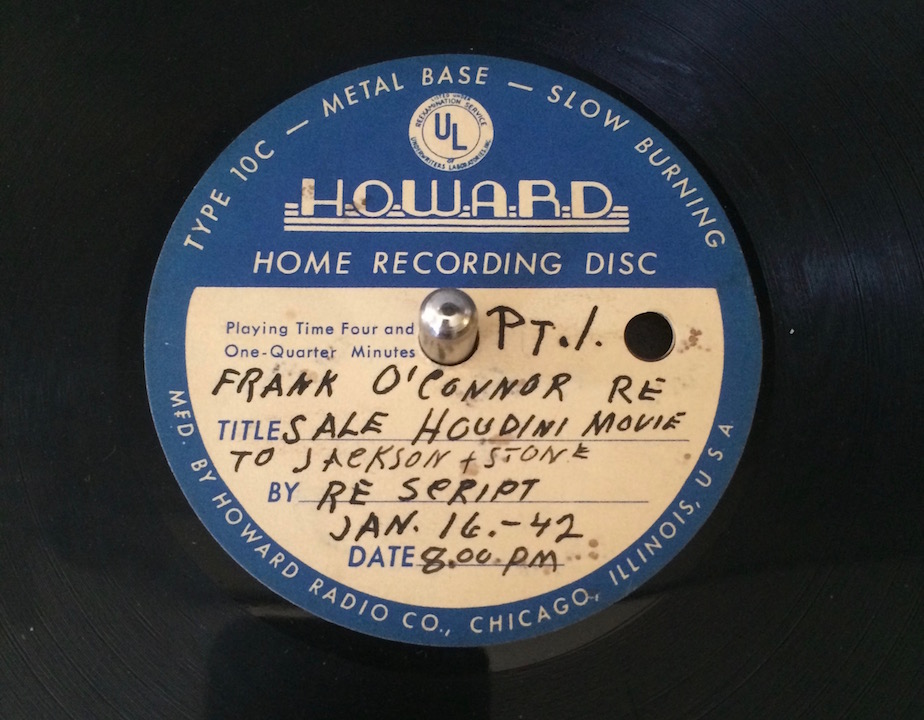

The next record is dated Jan. 16, 1942 and contains a conversation between Edward Saint and Frank O'Conner. O'Conner was an actor and director who was involved in many of Bess and Ed's Hollywood dealings. He wrote and directed Religious Racketeers. (He's also the great grandfather of actor Wil Wheaton who played Houdini in Young Harry Houdini.)

O'Conner had helped Bess and Ed set up a Houdini biopic at Paramount and had even worked on the script. But by 1942, nothing had come of the Paramount project, so O'Conner was looking for a new studio and a new angle.

On this recording, O'Conner is discussing with Saint a deal that would allow a pair of independent producers named Jackson and Stone to pitch a "life of Houdini" project to RKO Studios. O'Conner states that actor Paul Muni "is eager to do the thing, not just because of his knowledge of Houdini, but what can be done with the character."

However, O'Conner is very insistent that it needs to be a fictional version on Houdini's life. He explains his reasons thus:

O'CONNER: Of course, everybody in the show business knows Houdini, they know what he stood for and what he'd done, and it's merely a matter of devising a fictional treatment, see. They are not concerned with biographies at all, such as the Paramount thing is concerned, you see? Biographies are a dead issue. All the biographies have failed at the box office. That goes for all of them, including Pasture. That was a terrible flop by reason of it being a biography.

Saint agrees with a fictionalized approach. "That's okay. That's entirely okay," he says. O'Conner then lays out RKO's desire for a name screenwriter to pen the final script:

O'CONNER: The story has to be written by a top flight writer, such a Dudley Nichols or John Steinbeck. In other words they want something to exploit in the publicity. Life of Houdini by John Steinbeck. Steinbeck the author of Mice and Men, Tortilla Flats and numerous others. Or Hemmingway, somebody like that, see? He'd probably do very little of the work, but his name will be used. All of which they call box office insurance.

At one point Saint broaches the subject of his own creative involvement in the writing process "to safeguard the thing." For that exchange, Mark has graciously allowed me to share a 30 second clip from the actual recording itself. Saint is the first man heard and O'Conner, much lower audio, is on the other end of the line. Enjoy.


Nothing ever came of the Jackson and Stone Houdini project at RKO. Possibly the would-be producers were unaware that RKO had already tried and failed to come up with their own fictional take on Houdini's life in the 1930s [read: RKO 589: Discovering Hollywood's first Houdini film].

Edward Saint would die the year this recording was made. But what incredible artifacts to have survived, and what a thrill to share them here today.

A very big thanks Mark Willoughby.

UPDATE: Since posting this I've learned that the full names of the producers were Ben Jackson and John Stone, and their 60 day option agreement was written up and signed on January 26, 1942. The agreement contained this interesting provision:

Such motion picture photoplay may be fictionalized, but may not contain any claim that either Beatrice Houdini or Harry Houdini, believes in, or advocates Spiritualism.

Related:

Thursday, June 4, 2015

REPORT: The Midwest Magic History Weekend 2015

Recently I had the great pleasure of attending the Midwest Magic History Weekend in Marshall, Michigan. The event was organized by David Charvet in conjunction with the American Museum of Magic, which is located in Marshall. It proved to be a full 5-days packed with magic history, good friends, and Houdini (of course).

May 26
My multi-day Houdini odyssey began the night before I left for Marshall with a screening of Young Harry Houdini at the Magic Castle in Hollywood. This "Castle Perk" was hosted by Steve Valentine; in attendance was star Wil Wheaton. Wil hadn't seen the movie since it was first broadcast way back in 1987, and said of all the film and TV work he's done, this is the one project he thinks about most often. He also said there is family lore that his great grandfather, Frank O'Conner (director of Religious Racketeers), did some ghostwriting for Houdini. It was a terrific perk and great way to kick off a week full of magic!

May 27
On Wednesday I flew to Michigan, arriving in Detroit in the afternoon. I had done research and part of my weekend plan was to visit some famous Detroit Houdini locations. I was tempted to hunt those down right away, but I figured I'd stick to my plan and save them for the end of the trip. Marshall was still an hour and a half away by car.

Arriving in Marshall, I met up with Houdini mega-collector Arthur Moses and Derek Kennedy. We enjoyed dinner and gossip at the historic Schuler's Restaurant & Pub. I must say, I wasn't prepared for the sheer beauty of Marshall. It's an historic town with beautifully preserved Victorian homes and a main street from the 1900s. It was like time travel! I'm not sure if Houdini himself ever visited Marshall (it's equidistant between Chicago and Detroit), but if he did, the streets he walked still look exactly the same.


DAY 1 - May 28
The weekend officially kicked off on Thursday, May 28, with noon registration at The Franke Center For The Arts in Marshall, a beautiful old church converted into a theater space. Everyone agreed this was an excellent facility for the convention, and the theater size was perfect for the approximately 150 attendees.

After getting my registration materials and taking a quick pass around the dealers room, I decided to walk over to the American Museum of Magic and get an early look (the next day would be the official tours). The American Museum of Magic was founded by magic collector and historian Robert Lund on April 1, 1978. It's famous in the world of magic, and ever since I first become interested in Houdini, I've longed to visit. Now here I was at the front door.

I was warmly greeted by the museum staff who were very excited to have the convention in town. The museum and its Research Center (located across the street) were open free to all convention attendees. Museum administrator Keli Hindenach and her son, Alex, really rolled out the red carpet for me. I purchased some Houdini paperbacks in perfect condition that the museum had recently discovered in a box that had remained untouched probably since the 1980s.

Of course, I spent a good amount of time in front of the museum's central Houdini display. There before me was the Houdini-Hardeen Milk Can (more about that later), a spirit trumpet, a pack of Houdini's Needles ("with his DNA on it") and a nice Coast to Coast advertising sign which I'm guessing was for his 1926-27 tour. But what I think is the most impressive item in the entire museum -- yes, even more so than the Milk Can -- was his overboard box. The staff and I spent a lot of time looking it over very carefully, comparing it to the photos on display. It indeed appears to be the same box Houdini used in both his 1912 and 1914 overboard box escapes in New York harbor. It's extremely heavyweight and there's something about the wood that seemed to hold the spirit of Houdini. I was mesmerized.


I then toured the rest of the museum, which is jam-packed with amazing artifacts from great magicians of all eras (it even has suits worn by Penn & Teller). I told the staff that I wrote letters to the museum when I was 15-16, and they said there was an excellent chance that Robert Lund had saved those letters in his files. Traveling across the street to the Research Center, Alex brought me out a file marked: Cox, John. It was strange and moving to re-read my letters from so long ago. I especially loved that I had to wear gloves to handle the file.


It was then back to the Franke Center to set-up my "Houdini in Hollywood" talk, which I would be giving as part of the opening night events. It took a little doing to figure out how best to screen the "Top Secret" Houdini movie I had brought along to show. But David Charvet had brought in an excellent A/V staff, and soon everything was ready to go.

Following a nice reception with food in the Franke lobby, the night kicked off with a few words from Marshall's Mayor, Jack Reed. Then a video of Dan Waldron remembering his friend Bob Lund and the opening of the American Museum of Magic was shown. Susan Collins, the incoming chair of the museum board, then spoke. Diego Domingo then gave a talk about his first visits to the museum.

Next was Bill Spooner who presented a fascinating and funny talk about the infamous "Sex Detector." Then came David Meyer who blew my socks off with a slide show presentation on his 1900-05 Houdini scrapbook called: "What I bought when I was seventeen." Every image he showed was new to me! Even Arthur Moses was drooling beside me. (This weekend I learned just how much unseen Houdini material is still out there.)

After a short intermission (and popcorn), it was my turn to give my talk. Knowing this was a savvy crowd, I modified the talk and tried to show film clips they might not have seen before. Based on the many nice compliments I received throughout the rest of the weekend, I think the talk went really well.

Photo by Wayne Wissner.

My original plan was to screen Terror Island or an episode of The Master Mystery following my talk. But a few weeks before the convention, I decided to go for broke and contacted TCM's Charles Tabesh and distributor Park Circus to see if there was any way I could show the new TCM restoration of The Grim Game. To my great pleasure, they gave me permission to do so!

I kept this largely a secret -- it was not mentioned in any of the convention materials -- and I revealed it as dramatically as I could during my talk. So the first night closed with The Grim Game on the big screen, which was only the third public screening ever. Everyone seemed to enjoy the film. In fact, more than a few people over the course of the weekend told me the movie had changed their minds about Houdini's appeal as a cinema star.

The Grim Game in Marshall. (Photo by Wayne Wissner.)

DAY 2 - May 29
Friday kicked off with official tours of the American Museum of Magic. While I had gone through the museum the day before, it was a blast to be there with magic luminaries such as: William Kalush, John Gaughan, Mike Caveney, David Ben, Julie Eng, and many others. The museum had opened a storage closet where they kept Doug Henning's original Zig Zag Girl illusion. The museum is unable to publicly display the prop because the paint is peeling, and it was a thrill to see this important piece of magic history (you know I'm wild about Doug!). Attendees later gathered in the Research Center to discuss the health and future of this great institution of magic.


The afternoon talks at the Frank Center began with host David Charvet interviewing Adele Friel Rhindress, who worked as Harry Blackstone's Elusive Moth in his big touring show. Adele did card flourishes she learned 67 years ago from fellow assistant, Del Ray, and she was an absolute joy both onstage and off. (She sent me a nice text after my talk saying how much she enjoyed it.) Bill Smith then presented a fascinating and funny talk about working with Harry Blackstone, Jr.

Blackstone's "Elusive Moth" Adele Friel Rhindress.

Keith Stickley, a.k.a. Dr. Scream, gave a talk on the history of "Spook Shows Past and Present." During the talk a gorilla suddenly burst from behind the curtains and chased one of his assistants who let off one of the best and most bloodcurdling screams I've ever heard. Just a taste of what was to come that night.

The last speaker of the afternoon was the great Mike Caveney, who presented a riveting talk on "America's Zig Zag Scandal" of the late 1960s. Hearing Mike lecture is always a highlight of any gathering.

After a quick rest and dinner, it was back to the Franke for the Friday night events. First up was Gabe Fajuri who presented a talk on the history of Abbott's Magic Company, which we would be visiting the next day. He then moderated a nostalgic discussion about Abbott's with Tim Wright, Gordon Miller, and current owner Greg Bordner. Magician and author Al The Only then gave a moving talk on the The Magic Graveyard in Colon, Michigan.


The evening concluded with Dr. Scream's Spook Show Revival. It had all the classic spook show elements: magic (including a nice Cremation illusion); lovely girls (Dr. Scream's own "Devil Dolls"); and a signature "Blackout" in which spooks and bugs invaded the audience in the dark. In the tradition of the spook show, a film was then shown, Monsters Crash the Pajama Party, which has to be seen to be believed.

After the show, I got a quick photo with the Devil Dolls, because a man cannot live on magic alone!


DAY 3 - May 30
The third day opened with a trip to Colon, Michigan, the "Magic Capital of the World." Colon is home to the famous Abbott's Magic Company, which has been in continuous operation since 1934. It was great to see the store and workshop, and a hoot to watch Tim Wright perform vintage Abbott's magic tricks as a store pitchman.


Abbott's supplied props to the Tony Curtis Houdini movie in 1953, and there were several posters for the film on the walls, including two large U.S. 2-sheets that I had not seen before. These were even new to Arthur Moses who could not find them in the pressbook. (I posted pics of these in my live tweets.) Abbott's also built props for the 1966 London stage production, Man of Magic, including a working recreation of the famous De Kolta expanding die, which was never used in the production.

Outside I also noticed that Abbott's had an authentic Siberian Transport Prison Van, still in amazing condition! At least that's what I think it was.


Oh, maybe not...


We then visited nearby Lakeside Cemetery ("The Magic Graveyard"), which holds dozens of magicians, including the great Harry Blackstone Sr. and Blackstone Jr. While Thurston tends to be celebrated as the second most famous name in magic, I've always believed that title actually belongs to Blackstone. Robert Lund is also buried here, and I love that his headstone reads: "Among Friends."


Al The Only tries on his plot for size. Perfect fit!

Following lunch at the beautiful River Lake Inn, we headed back to Marshall. After resting up (during which time the Milk Can was transported to the Franke Center, which I'm sorry I missed), we all gathered at the 176-year-old Trinity Episcopal Church for a dinner served by the generous Rev. Anne Schnaare. It was delicious home cooking (I'd forgotten how much I like Swiss Steak), and I was honored to be sitting at a table with John Gaughan and Edward and Adrian Dawes.

It was now time for the big show! Mike Caveney emceed what was billed as "The International Stars of Magic." This was open to the public and there was a full house. The show kicked off with Gene Anderson performing his amazing paper cutting act. David Ben and Julie Eng of Magicana then performed classic and elegant magic.

After a short video explaining the history of Houdini's Milk Can escape, the curtains opened to reveal the Houdini-Hardeen can from the collection of the American Museum of Magic. As advertised, the museum had given special permission for the historic prop to be used this night, which just happened to be the 70th anniversary of Hardeen's last performance of the escape on May 30, 1945. The escape was performed by Hatari (Joseph Patire), and I was thrilled to be invited on-stage to help lock the can. (Read more about this historic performance here.)

Hatari in the Houdini-Harden Milk Can. (Photo by Wayne Wissner.)

After intermission, Skilldini (Tim Wright) did his brilliant magic comedy act. I always enjoy seeing Tim when he performs at the Magic Castle, so it was a real treat to see him here. Throughout the evening, emcee Mike Caveney performed tricks, including a routine with a young volunteer from the audience that was truly hysterical. David Charvet, assisted by Lisa Patire, closed the show with some classic magic.

Following the show, the performers signed autographs in the Franke lobby. We then all gathered in the dealers room for dessert reception.

May 31
While the big show was the official end of the weekend, it was not over for those who stayed on for an extra day (including me). From the stage of the Franke Center, Potter & Potter held their auction of "Old and Rare Magic Books." It was exciting to be there with all the heavy hitters, both in the room and on the phone (two phone bidders took most of big ticket items). One lot I was watching was a rare Russian Houdini book, which sold for an estimate busting $7000. (Read more about that here.) The highest price realized was an astounding $45,600 for a copy of Discoverie of Witchcraft, considered to be the first book on magic.


Before I left town, I made one last stop at the museum archives. Alex had told me he found some more Houdini material that I could look through if I liked. Yes please! Waiting for me was a table filled with file folders, and I plunged in. I came across some real treasures that even the museum didn't know they had. One discovery is of major historical significance, but I will leave it to the museum to reveal it when and how they want. Before I left, Alex made me copies of a few rare photos and letters, some of which I will be sharing here on WILD ABOUT HARRY. (Watch for: "The photo Houdini didn't want you to see.")

My heroes Alex and Keli Hindenach of the American Museum of Magic.

It was late afternoon when I left Marshall, but I still had time for my planned photo safari of Houdini's Detroit before I had to catch my flight home.

My first stop was the site of Grace Hospital, where Houdini died on October 31, 1926. The old Grace Hospital was torn down in 1979 and replaced with the Harper Professional Building at 4160 John R St., which is part of the larger Harper University Hospital complex. It struck me that, unless the streets have changed, Grace probably sat in what is now the parking lot.


After taking a few pics, I slipped inside and had a look around. In the main lobby of the larger hospital I chatted with a friendly and helpful security guard. He told me that a Staff Only area had on the wall some historical information about the building being Grace and Houdini's death. I quipped, "This is the only place he never escaped." That cracked him up, and something tells me that's not the last time that joke will be told there.

Just a few blocks away is the building that once housed Wm. R. Hamilton's Funeral Home where Houdini was embalmed. That building is still standing at 3957 Cass St., although it appears to be abandoned and may not be standing for long. Recent pics of the funeral home show it from Cass St. But if you walk around the corner, you get a better perspective on the building and can see what was most likely the main business entrance in 1926.


I was running short on time, so I decided to skip the Garrick Theater, which stood on the site of what is now the David Stott Building at 1150 Griswold St. Instead I made a dash for the MacArthur Bridge, which in Houdini's day was the wooden Belle Isle Bridge. This is where Houdini made his 1906 bridge jump, but the location has become more famous as being the supposed site of his fabled entrapment under the ice.

I was now in big trouble time-wise, so I only had time for a quick photo of the bridge before I had to race back to the airport and catch my flight home (I just made it).


The Midwest Magic History Weekend was one of the best magic conventions I've ever attended, and these five days proved to be an amazing Houdini vacation for me. Congratulations to organizer David Charvet and the American Museum of Magic. I'm very honored to have been included in this magical event.

Related:

Tuesday, April 12, 2011

When Madame Houdini spoke

In 1937, having successfully set up a Houdini biopic at Paramount, Bess Houdini and Edward Saint turned their attentions to developing a second movie that would be starring vehicle for Bessie herself.

The film was to be called Madame Houdini Speaks. The idea was, having fulfilled her ten year "imposed silence", Bess would finally sound off on her views about spiritualism in a dramatic feature film. Saint claimed the film "will go into immediate production" and promised:

"The sensational picture will be packed with ghostly dynamite that will blast the fakes, frauds and humbugging religious racketeers hiding behind the cloak of spiritualistic superstition. Madame Houdini will play the part of herself on the screen and her long experience in tracking down the miracle mongers will be vividly portrayed in the spooky and mystic-laden production."

This is quintessential Edward Saint -- press agent-cum-carnival barker. However, there was more to this project than bluster. The film had a real producer in Fanchon Royer, "one of Hollywood's outstanding independent women producers", and a director in Frank O'Conner, who was also writing the Paramount Houdini biopic. A friend of the family, O'Conner was said to have performed with Houdini in vaudeville and "knew the great magician well."

Madame Houdini Speaks would eventually be released as Religious Racketeer (sometimes referred to as Religious Racketeers and later retitled Mystic Circle Murder). It was filmed in March of 1938 at The Grand National Studios in Hollywood, which was located on the southwest corner of Poinsettia Street and Santa Monica Blvd. next door to the United Artists Studio. As announced, the film was produced by Fanchon Royer and directed by Frank O'Conner (whose Houdini biopic was never made). However, Bess would only appear at the beginning and end of the film as "Madame Houdini." But she did indeed "speak out" and proclaim her belief that communication with the dead was impossible.

The film was given a special "Magicians Preview" on April 12, 1938, where it received an especially positive (polite?) review from Richard Frohmann in Goldston's Magical Quarterly. Said Frohmann:

"Although Religious Racketeer makes no pretense at being a million dollar production, it tells a good story in an arresting and memorable manner. Mrs. Houdini plays an outstanding part in the story, and it is clear that her stage experience has stood her in good stead. The film is undoubtedly good-class entertainment for discriminating filmgoers, and never once borders on bathos or unreality."

Religious Racketeer premiered at Shea's Century Theater in Buffalo, New York on July 7, 1938. It then played limited engagements, typically as part of a double bill. In 1940 it was reissued as Mystic Circle Murder.

Predictably, the film sparked controversy in spiritualist circles. According to a report in Genii, the film was "hissed down by believers from Lillydale" (a "spirit camp"), who packed the Buffalo theater for its first showing. They later denounced the film in their journal, Psychic Observer, reproducing a letter from Bess "in her own hand" in which she states she had received a genuine message from Houdini (I expect they were talking about this letter).

The only available print of Religious Racketeer -- which was released on DVD in 2006 by Alpha Video as Mystic Circle Murder -- runs only 68 minutes, a far cry from its originally reported 90 minute running time. Unfortunately, in this print, the epilogue with Bess is abruptly cut off. Did she have more to say? It appears so. In fact, she may have delivered a fairly lively last word. Evidence for this exists in a review in The Jinx, which quotes Bess in the epilogue as calling mediums "those leeches."

Hopefully, the cut epilogue will one day be rediscovered and restored so we can hear Madame Houdini speak.

Thanks to Marc Wanamaker of the Bison Archives for the information on the Grand National Studio.

Want more? You can see an opening day "World Premiere" newspaper ad for Religious Racketeer as a member of my Patreon.

Translate