Showing posts with label Fact check. Show all posts

Friday, March 27, 2026

When did Houdini and his mother go to Budapest?

This week seems to be all about Budapest, so let's finish on theme and head down an early Easter rabbit hole.

In my upcoming book, Handcuff King: The Conquests of Harry Houdini, 1900-1909, I'm hoping to provide the most complete and accurate chronology of Houdini's life during his peak "Handcuff King" days. I'm pretty confident my facts are confirmed and correct. But there's still one thing driving me crazy!

When exactly did Houdini and his mother travel to Hungary and have the "Queen for a day" reception at the Grand Hotel Royal in Budapest?

Every biography that includes this event puts it between Houdini's engagement at the Hansa-Theater in Hamburg and his opening at the Colosseum in Essen. That places it at the very end of April 1901.

However, this timing is problematic, if not impossible. Houdini closed at the Hansa on April 30 and opened at the Colosseum the next day, May 1 (after doing a police station test). So there's no time for a two-day excursion to Budapest.

I think it's more likely that it happened at the end of August 1901. Houdini himself said that at the end of the Budapest trip, he escorted his mother "en route to America." I take this to mean that he took her to her ship. And according to a letter Houdini wrote to Fredrick Roterberg (brother of Gus), his mother sailed for home on August 22.

Where does the April date come from? As far as I can find, the primary source for the entire Budapest story is Harold Kellock's Houdini: His Life Story. Kellock writes that it happened "at the close of his engagement" (implying Hamburg, but not saying that explicitly). What was Kellock's source? A clue can be found in this sentence:
"After listening patiently to his remonstrances," Houdini wrote in an autobiographical fragment, "I revealed to him my plot to crown my little mother and allow her to be Queen Victoria for a few fleeting hours."
I trust Kellock really did have an account of this written by Houdini, likely an unpublished document. However, I don't know where that document is today, and I don't believe any other biographers saw it. This is likely why Ken Silverman omitted the story entirely from his own book, Houdini!!! The Career of Ehrich Weiss, but I think that's going too far. I believe it happened.

Milbourne Christopher in Houdini: The Untold Story goes with the April date, even adding the specific detail that Houdini closed on a Saturday. But Houdini's Hamburg engagement ended on a Tuesday. Christopher also says his mother returned to America before the end of Houdini's engagement in Essen in May. That's not correct either. So Christopher was working from a flawed chronology.

If I'm going to revise Houdini history and challenge the likes of Milbourne Christopher, I'd better have proof! Otherwise, I feel like I have to stick with the conventional placement of the trip at the end of April and add a caveat that it may have happened later. But, man, I'd sure like to know for sure!

My book is still a few months away from going to the printer, so my hope is that someone out there might have the Kellock document or anything that provides evidence for exactly when Houdini and his mother took their famous two-day trip to Budapest. April or August 1901? Or maybe some other time entirely???

If you have anything to share, feel free to comment below or shoot me an email.

Thanks to Dr. Steffen Taut for helping me nail down Houdini's German performance dates. Top image from the McCord Stewart Museum.

Tuesday, March 24, 2026

The marvelous Hungarian magician turns 152


Let's celebrate Houdini's 152nd birthday today by discussing a widely held assumption. This is the idea that Houdini always claimed to be an American. Of course, Houdini was born in Budapest, Hungary, on March 24, 1874. But during his lifetime, no one knew this, right? Well, not exactly.

In my first book, Escaping Obscurity: The Travel Diary of Harry Houdini 1897-1899, I showed how, during his struggling years, Houdini not only freely admitted to being a European, he exploited it! This made him exotic. Sometimes he would say he was from Budapest, but more often he would say he was from Austria (Hungary was part of the Austro-Hungarian Empire at this time). A few newspapers said he was Australian! But I believe this was just a mistake by the reporters. Try saying Austria with Houdini's accent and over pronunciation, and you can see how someone might hear it as "Aus-tral-ia." But most importantly, I have never seen him claim to be an American at this time. Born in Wisconsin? Boring!

But that's just his struggling years. When he became a success, he became all-American, right? Again, not exactly. Below is an image from my upcoming book, Handcuff King: The Conquests of Harry Houdini, 1900-1909. (I like long titles.) This is from January 1900, at the start of his all-important tour of the Keith's vaudeville circuit. Houdini had already found success on the Orpheum circuit out west. Now he was making his East Coast vaudeville debut. As you can see, he's billed here as "the marvellous [sic] Hungarian Magician."

Boston Evening Transcript, Jan 15, 1900.

Houdini continued to acknowledge his Hungarian birth for this entire tour. So, combined with his Orpheum tour, this means Houdini played the entire U.S. as a (sometimes) headliner for a full year as a Hungarian. But then it was off to Europe, where being an American was the exoticism to exploit. Born in Wisconsin? Wild! The identity stuck.

However, as late as 1902, Houdini told Ottokar Fisher that he was born in Hungary (check out Joe Notaro's own birthday post for more on this). I think this is suggestive. I'm betting that, at this time, his Hungarian birth was not unlike William Robinson's real nationality. If you knew him, you knew the truth. It wasn't a big deal. It was just showbiz. Certainly, everyone who knew Houdini from the 1890s -- and that included some very big names in magic like Howard Thurston, T. Nelson Downs, and Samri Baldwin -- knew his real birthplace.

It was later that Houdini worked to bury his Hungarian birth. People like Walter B. Gibson, who came to know Houdini in the 1920s, never knew of his real birthplace and had trouble accepting the truth when it came out. I don't know exactly why Houdini became so dogmatic about this aspect of his biography. Maybe that's something I'll discover when I start work on my next book.

However, even when Houdini claimed to be American, he always acknowledged that his parents came from Hungary and showed pride in that heritage. Here's something he told a reporter in Australia in 1910.
"You will think that I am vain to tell you these things. But I am a Magyar, and Magyars are vain. American born. Magyar descended; my parents came from Austria; my father was a clergyman in Wisconsin."
So here's a happy birthday to Houdini, the marvelous Hungarian Magician!


Cake image AI-generated.

Related:

Tuesday, September 2, 2025

Reviewing the Ghost Adventures Houdini Séance

Here's an excellent video by our new friend Kenny Biddle, Chief Investigator for the Committee for Skeptical Inquiry, dissecting the recent Houdini Seance episode of Ghost Adventures (which I happened to be on). Kenny debunks it piece by piece, and even has a special guest star explain his boneheaded comment that "Houdini believed in Spiritualism." You can view it below or check it out on YouTube


Wednesday, May 28, 2025

Houdini window display at the Culver Hotel

Last night I enjoyed seeing The Living Daylights in Culver City as part of a series of classic James Bond film screenings co-organized by our friend Neil McNally of The Doug Henning Project. But I can never escape Houdini, and after the screening, I went and took a look at this curious window display at the historic Culver Hotel.


The display was a hodgepodge of "vintage" items, so I'm unsure what to make of it. Are we to believe this is Houdini's top hat? I do know that two authenticated Houdini top hats exist in the collections of John Hinson and Roger Dreyer.


The Culver Hotel was built in 1924. Houdini briefly visited Los Angeles that year to give his spiritualism lecture, but he stayed at the Biltmore Hotel. It's unlikely he ventured outside of the downtown area as this was a quick whistle stop on his lecture tour. So I'm not aware of any Houdini connection to the Culver Hotel.

Of course, if we ask Google's A.I., we get a very different answer:

WRONG

Sorry, Knickerbocker, our A.I. overlords have spoken. The Final Houdini Seance took place on the roof of the Culver Hotel. And that's Houdini's top hat.

If you're interested in catching a Bond movie and viewing the display for yourself (the hotel sits directly across from the Culver Theater), here's the current film lineup with more to come.


Thanks to Dr. Larrian Gillespie for the tip about the display and Bob Mitsch for the above photo.

Related:

Wednesday, January 15, 2025

The Haunted Mystery of Waterbury's Palace Theatre

Here is a very well-researched video from Dr. Daryn Reyman-Lock at the Barnum Museum exploring the story of Shirley the Elephant and Houdini's connection to the Palace Theater in Waterbury, Connecticut. I'll let you discover it yourself by clicking below.


Be sure to give the video a Like. For more, check out the Barnum Museum on YouTube and its official website. After all, Houdini was an admirer of Barnum!

Friday, February 2, 2024

Houdini A.I. is inaccurate, artless, and everywhere


Gaze above at what A.I. thinks Houdini looks like. As with almost everything A.I. generates in regards to Houdini, it's wrong and weird. And the deeper you look, the more wrong and weird it gets. Note the three legs on the man in the photo above his shoulder.

But here's the thing. This distinctive A.I. Houdini is now showing up everywhere. I can't do a Google search without seeing this face. Even the A.I.-generated "books" that flood Amazon these days are using this face on their covers.


With the hundreds of public domain images or Houdini out there, why would anyone feel the need to generate an image that is so bizarrely wrong? But I'm actually happy about this. Why? Because when you see this face, you'll know whatever it's attached to is A.I.-generated slope. It's the tell of a con man.


Okay, so A.I. doesn't yet have a handle on Houdini's image. I'm sure it will get better. But what about A.I.'s handle on Houdini information and facts?

Not long ago, a reader emailed saying he was trying to date the film of Houdini doing a suspended straitjacket escape in St. Paul. He asked ChatGPT, and it told him:

"Harry Houdini performed one of his famous suspended straitjacket escapes in St. Paul, Minnesota, on September 30, 1915. The event took place in front of a crowd of thousands of spectators who gathered near the St. Paul Athletic Club."

Wow, amazing, right? Except it's wrong.

On September 30, 1915, Houdini did a suspended straitjacket escape from the Tribune Building in Minneapolis, not St. Paul. Houdini's St Paul suspended straitjacket escape happened during the week of February 12, 1923, from the Daily News building. That is the escape we see in the film. (I confess I don't yet know the exact day.)

Why did ChatGPT mention the St. Paul Athletic Club? Heck if I know. The reader suggested maybe it was close to the Daily News building. But if ChatGPT knows that, then it should have just told you the actual location! As far as "a crowd of thousands," sure, that's a given for any Houdini outdoor escape.

So, apart from getting the date wrong, the location wrong, and confusing it with another escape entirely, it did a great job!


As far as entire articles about Houdini written by A.I., even the ones that get their facts right are, to my eye, just a rambling string of sentences and paragraphs that repeat the same thing in different ways with little shape or structure. They have no point of view and no art to them. For me, they are as wrong and weird as these A.I. Houdini images.

I hope I don't sound like a stick in the mud and that I'm just resisting the inevitability of A.I. I like technology and I like new tools. I use Grammarly as my copy editor and love it. And when A.I. finally figures out what Houdini looks like (and how many limbs a person has), it could be a nice way to whip up an image of him doing, say, the cannon challenge, for which we have no known photo. But, for now, I think Houdini is in better hands when they are human.

And now a few words about A.I. from Adam Conover.


Below are examples of some more Houdini A.I., both good and bad.

Related:

Friday, January 26, 2024

Revenge of the beach boy

Remember that scene in the 2008 film Death Defying Acts that shows Houdini posed like a preening beach boy atop his Water Torture Cell at the conclusion of the escape? It's even in the trailer.


I've always seen this as an abomination of how the real Houdini would conclude the escape. By all accounts, when the tension was at its height, Houdini would come crashing through the front of the curtains out of breath as if he had just made his escape in the nick of time. That's how the real Houdini did things, Hollywood!

And then I found this illustration from Houdini's performance at the Cleveland Hippodrome in 1915 and now I need to shut up. 

Cleveland Plain Dealer, March 30, 1915.

Okay, maybe this is just the illustrator placing Harry atop the cell as his own artistic interpretation. Or maybe this is what he saw. Which would mean Hollywood can occasionally get things (accidentally) right.

"Told ya."

Related:

Tuesday, January 23, 2024

Siskel & Ebert on Houdini (1953)

Critics Gene Siskel and Roger Ebert talk about movies they loved as kids on a special episode of their famous television show in 1991. Guess which movie makes the list? I've cued this one up to their discussion about, yes, Houdini (1953).


Thanks to Bill Schmeelk.

Thursday, November 30, 2023

The enduring mystery of David Blaine

I'll just share this here without much comment. It speaks for itself. I was perplexed when David said this back in 2018, and I remain perplexed that he's still saying it today.


David is an admirer of Houdini, so he must know this isn't true, right? Or could the drama of the Tony Curtis movie somehow be stuck in his head? I guess David Blaine is just doing what David Blaine does best. Baffling us!

Thanks to Dave Thomen for this clip.

Related:

Tuesday, August 8, 2023

When AI generates your Houdini facts (update)

I don't know if AI really generated the below "list of Houdini's famous underwater escapes." But I don't know how any human could get so much so bizarrely wrong. This accompanied an article published last month at poolmagazine.com. Enjoy!

Click to enlarge.

Here's the depressing part. If you Google "Houdini," this article will show up in your news feed before any post here on WILD ABOUT HARRY. In fact, none of my posts will ever show up in Google's news feed. Maybe because the algorithm knows I'm human.

Or am I?


UPDATE: The good folks at Pool Magazine reached out for some help and the article has now been updated with, if I say so myself, a darn good list of Houdini's underwater escapes. Score one for humans! Check it out here.

Related:

Monday, August 22, 2022

Misquoting Dumb Houdini

Recently I discovered the sardonic magic blog The Jerx (a take off on The Jinx). It's pretty funny and now a blog I follow. Of course, I had to see if Houdini had even gotten The Jerx treatment, and he certainly has! In fact, they have somewhat regular series called "Dumb Houdini".

In their initial post, "How Dumb was Houdini?", they point out that his oft-quoted, "My brain is the key that sets my mind free" is pretty dumb and makes no sense. But they correctly point out this is NOT what Houdini said. What Houdini actually said was, "My brain is the key that sets me free." That is much less dumb.

They also point out that people are selling merchandise online featuring the incorrect quote. This inspired The Jerx to launch their very own Dumb Houdini Store. That isn't a joke. Well, it is a joke, but the merchandise is real. At least I think it's real?

Speaking of quotes... 

Another quote you will frequently see attributed to Houdini is: "What the eyes see and the ears hear, the mind believes." It's a good quote and it sounds like something Houdini would say. I've never questioned it. But recently someone contacted me asking if I could verify that the quote really was from Houdini.

I did a little research and found a page at Goodreads that attributes the quote to Houdini's A Magician Among The Spirits. I figured it came from one of his books, so that tracks. However, when I did a keyword search of my PDF of the book, I turned up nothing.

I then searched Miracle Mongers and Their Methods, Houdini's Paper Magic, The Right Way to Do Wrong, The Unmasking of Robert-Houdin, the Margery pamphlet, even Elliott's Last Legacy. Still nothing. The closest I came was the quote, "Has your brain deceived your eyes, or your eyes your brain?" (Unmasking p 308).

I then plugged the quote into newspapers.com and the earliest hit that came up was from 2008 when a Durham Academy valedictorian named it as his favorite quotation. A search of Ask Alexander turned up a single mention in a 2015 Genii. So not only can I not find this quotation during Houdini's lifetime, I can't even find it before the 21st century!

Then I found this clip from the 2001 film Swordfish.


So there's the quote. At the moment, this is the earliest utterance that I've been able to find. But is it even a quote? It's not all that clear if John Travolta's character is actually quoting Houdini or if this is his own definition of misdirection. But even if he is quoting Houdini here, this is a movie, which is under no obligation to be factual. So it's possible these words are entirely the creation of the screenwriter.

I'm still holding out hope that Houdini did say this. There is still a lot of his written material that I haven't searched. Like I said, it's a good quote and it sounds like something he might say. I really don't want to believe that we've been quoting John Travolta all this time. Because as The Jerx might say, that would be really dumb.


Related:

Wednesday, July 6, 2022

Houdini freezes the Detroit river in 1912


Recently I came across this intriguing article from the February 11, 1912 Washington Post. The quotes here come from an interview Houdini gave while appearing at the Maryland Theater in Baltimore. It's short so I'm sharing the entire thing, but it's the last part that interests me the most.

The Washington Post, Feb. 11, 1912.

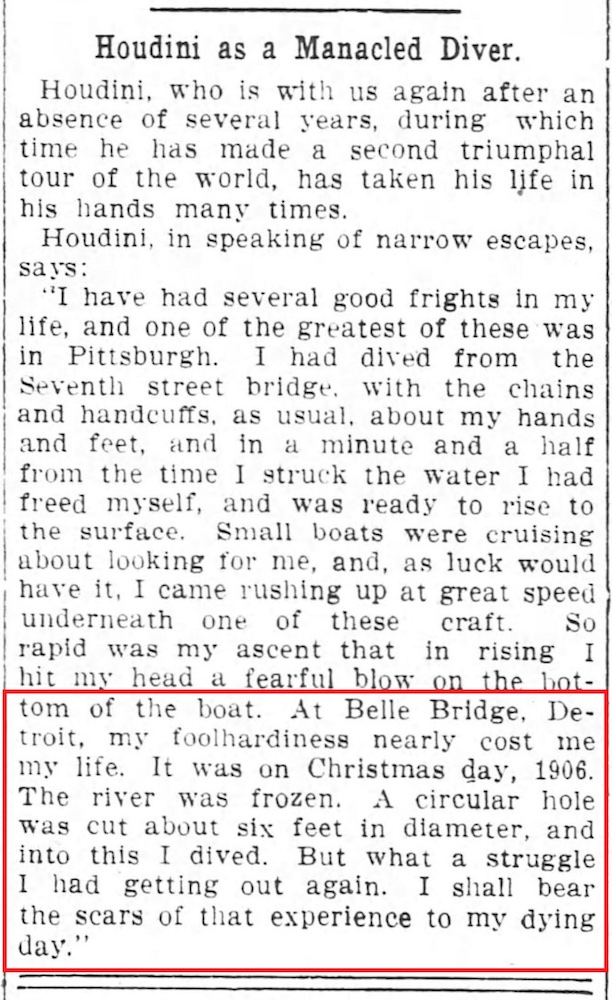
While I've not done an exhaustive search, I believe this might be the first mention of any bridge jump into a frozen river through a hole cut in the ice. Here it's the Belle Isle bridge in Detroit in 1906. That was a real jump, but the river was not frozen nor was it Christmas day. Still, this appears to be the genesis of the famous myth of Houdini being trapped under the ice of a frozen river.

Houdini would tell that story in full for the first time (as far as I know) in an article he wrote for the September 1918 issue of The American Magazine called "The Thrills in the Life of a Magician". But now he relocates the action to Pittsburg and doesn't provide a specific date. It's also become an overboard box escape instead of a handcuffed bridge jump.

The dramatic story was picked up by newspapers at the time, including the Boston Sunday Post below (click to enlarge):

Boston Sunday Post, Sept. 1, 1918

Houdini told the tale again in his 1919 article for Hearst's magazine, "Nearly Dying for a Living". But it's interesting to note that this story, as with other Houdini mythology, does not appear in any of his pitchbooks. It seems to me that Houdini made a distinction between disposable media, such as newspapers and magazines, and what he considered to be the official record. His pitchbook does record that he had to "break through the ice" during a bridge jump in Breman, Germany, which is likely true. That jump was made during a snow storm.

Later biographies made no such distinction, and the full under the ice drama became part of the official record with the publication of Houdini His Life Story by Harold Kellock in 1928. Interestingly, Kellock moves the action from Pittsburg back to the Belle Isle bridge in Detroit in 1906.

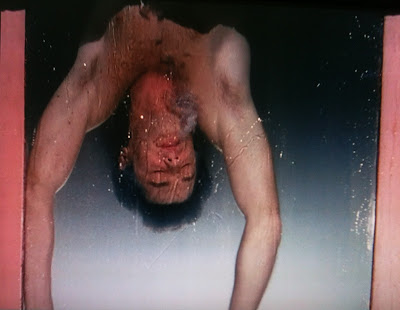
Then, of course, the 1953 biopic Houdini starring Tony Curtis dramatized the incident (beautifully) and cemented it in the minds of the public. In the movie the location remained the Detroit river, but the day was changed to Halloween(!). Also, as in Houdini's telling, it's an overboard box escape.

Houdini (1953)

The first doubt was cast on the story by William Lindsay Gresham in his 1959 biography Houdini The Man Who Walked Through Walls. Ironically, Gresham had been one of the recent propagators of the myth, publishing an account with fresh embellishments in SAGA magazine the previous year. But Gresham credited Robert Lund with tracking down the original newspaper accounts of the Belle Isle stunt and calls out the inconstancies, namely that the Detroit river was not frozen. He writes:

The river was not frozen over, Houdini had a rope tied around him all the time, he got out of two pairs of cuffs and was picked up by a boat! As for escaping from under the ice—as Tom Sawyer would say, "He just let on he done it."

The story largely disappears from Houdini books after that.

However, Hollywood doesn't let the truth get in the way of a good story, and the full under the ice drama was resurrected in the 2014 Houdini miniseries biopic starring Adrian Brody, this time relocating it to the Eads bridge in St. Louis. But by this point no one was fooled.

It's fun to see how this all appears to have started in Houdini's mind back in 1912 as a way to add some color to an interview. He understood what reporters wanted!


Below are some more posts related to Houdini's adventure under the ice.

Clipping source: Newspapers.com.

Wednesday, May 11, 2022

Taking aim at Houdini's abandoned bullet catch


Most Houdini biographies contain the story of how Houdini announced he would perform the infamous bullet catch trick shortly after the onstage death of magician William Robinson, a.k.a. Chung Ling Soo, in 1918. But magician Harry Kellar wrote Houdini a heartfelt letter talking him out of it and Houdini cancelled the performance. Turns out that scenario isn't strictly accurate. But we will get to that.

Milbourne Christopher in Houdini The Untold Story was the first to identify the event at which Houdini proposed to do the trick as a gala S.A.M. benefit for the Showmen's Hospital Fund at the New York Hippodrome on April 21, 1918. It's said the bullet catch was widely advertised. However, I've never been able to find any advertisement that confirms this. Below is a typical advert for the benefit that mentions "his new death defying sensation." But this could be the Water Torture Cell.

The New York Sun, April 20, 1918.

Likewise, the program for the event itself--an original of which is in the Harry Ransom Center--makes no mention of the bullet catch. It only shows that Houdini would perform his Water Torture Cell that evening.

I began to consider the possibility that famous cancelled bullet catch might have been a back engineered Houdini myth. But while searching for something completely unrelated, I finally found the smoking gun!

New York Tribune, April 21, 1918.

So, yes, it appears Houdini did intend to do the bullet catch at this Hippodrome show. A fantastic new detail here is that Houdini's firing squad would be made up of real doughboys from the 71st Regiment using regulation army rifles. What a terrific modern piece of staging. I'm actually sorry this didn't happen. But why didn't it happen?

Here's where the truth diverges from the familiar telling. While Kellar did indeed write a heartfelt letter of warning to Houdini, he wrote that letter after the benefit (on May 1st). So the reason Houdini dropped the bullet catch wasn't Kellar. He dropped it on the request of the Hippodrome management.

The following is from an account of the benefit that appeared in the April 1918 issue of MUM:

Houdini had been advertised in the leading newspapers through reading notices, as intending to do the Bullet Catching Act. He was dissuaded by management of Hippodrome from taking up this dangerous feat, for he announced his famous Chinese water torture cell, which is probably just as, if not more, dangerous than the bullet catching business, as in either, the slightest error means a tragedy.

(To give credit where it is due, Bill Kalush in The Secret Life of Houdini was the first and so far only biographer to present the correct chronology of the bullet catch and Kellar letter.)

It's been suggested that Houdini never actually intended to perform the bullet catch and that he just announced it for the publicity. Maybe. But Houdini felt strongly about doing what he advertised and not "breaking faith" with his audience (a prime example here). Also, this was a prestigious S.A.M. event for charity that Houdini himself emceed. Doesn't seem like the kind of event in which you would want to be disingenuous in any way. But it is a possibility.

It's also worth pointing out that in the weeks following Chung Ling Soo's death there was gossip in magic circles that the magician may have been murdered. Joe Hayman, who informed Houdini of Robinson's death, offered some dark speculation that Houdini shared with Harry Kellar. Hence Kellar's warning that the same fate could befall Houdini -- "some dog might 'job' you." But an inquest into Soo's death discovered faulty equipment was the culprit.

So there we go. We've confirmed when and where Houdini planned to do the bullet catch. We've learned how he intended to stage it. And we know why he didn't. There's also the possibility that Houdini did the effect early in his career, but that's another story.

Thanks to Joe Fox at the Magic Castle Library for the MUM clipping and Eric Colleary at the Harry Ransom Center for a look at the original program.

UPDATE: Could this have has something to do with the cancelation of the stunt? Read: Accident at the Hippodrome

Monday, January 10, 2022

Sunday, October 31, 2021

Hollywood kills Houdini

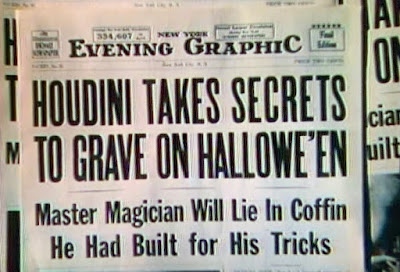
Today is the 95th Anniversary of the death of Harry Houdini in Detroit. How did Houdini die? Let's take a look at what Hollywood tells us.


When a Houdini biopic was being shopped around Hollywood in the 1930s, Columbia Picture's head Harry Cohen passed on the project, complaining Houdini's life lacked romance and "needed a better ending than a punch in the solar plexus." Hollywood never seemed to get past this, and over the course of five biopics has tried to add drama to Houdini's death. Here's how Hollywood killed Houdini.

Houdini (1953)
The classic biopic Houdini starring Tony Curtis and Janet Leigh decided to have Houdini die onstage inside his "Pagoda Torture Cell." It's plenty dramatic and for many decades people believed this is how Houdini really died (and some still do). The idea that Houdini is suffering the early stages of appendicitis is established in an earlier scene. And before he performs the fatal escape he runs into the handle of prop sword in his dressing room, presumably rupturing that problematic appendix.


The Great Houdinis (1976)
By 1976 the belief that Houdini died onstage in his Water Torture Cell was so wide spread that Hollywood couldn't resist doing it all over again. Give the people what they want! But this time the dressing room punch is also nicely dramatized for the first time. And Houdini doesn't actually die onstage. Over a freeze frame we hear Mini's voice explaining that he died a week later in Grace Hospital. So they were able to have it both ways. I do love Mini's final line: "We all knew he was waiting for Halloween. Made such a nice headline."


Houdini (1998)
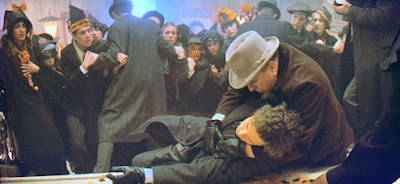
Despite striving for more accuracy on several fronts, this 1998 movie from TNT decided to once again trap Houdini inside his Water Torture Cell. But he doesn't actually drown this time. Instead he dies in the hospital on what appears to be the operating table. The punch is also part of the chain of events, but it's a blink and you'll miss it moment.


Death Defying Acts (2008)
By the 2000s most people knew Houdini didn't die in the Water Torture Cell and that his death had something to do with a punch to the stomach. That was good enough for this indie feature which depicts Houdini being punched in the stomach in the lobby of a Montreal hotel and dropping dead on the spot.


Houdini Miniseries (2014)
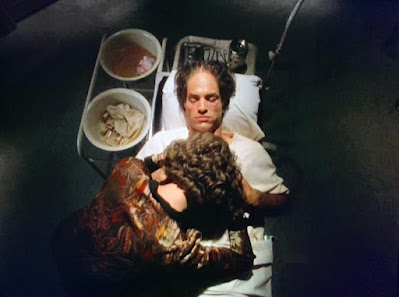
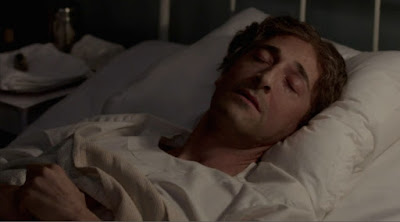
For once Houdini's final days and death are portrayed largely accurately. But despite fine performances by stars Adrian Brody and Kristin Connolly, Harry Cohen might have been right. It's a little anti-climatic. As for Harry being kissed by Mama's in a sexy nurse outfit...what a weird movie this was.


I'm sure Hollywood isn't done killing Houdini in their own creative ways. What does the future hold? We'll find out!

Remembering
HARRY HOUDINI
on the
95th ANNIVERSARY 
OF HIS (REAL) DEATH
October 31, 1926

Wednesday, May 5, 2021

Deconstructing Houdini '53: Dime Museum

Today I continue my scene by scene deconstruction of Paramount's 1953 biopic, HOUDINI, in which I'll attempt to make the case that it's much more historically accurate than it is given credit. Also anything else that comes to mind. Last time we examined the Main Titles. Today we FADE UP on...

Chapter 2: Dime Museum

The sequence that opens Houdini (1953) is a delight on many levels. While a fabrication from start to finish, it nevertheless still contains many elements from Houdini's real life. It's also just good old fashioned Hollywood storytelling that sets up the movie and our main characters beautifully. But let's tackle it beat for beat.

We open with a group of uniformed school girls passing "Schultz's Dime Museum," ignoring the busking of the mustachioed owner Mr. Schultz (Sig Ruman) at the door. But then one of the girls, blonde-haired Bess (Janet Leigh), encourages her classmates to slip in for a quick look. "The man said it was educational, didn't he?"

Something to consider here is the association of a school uniform with a Catholic school education. Is Houdini slyly establishing that Bess is Catholic as she was in real life? (Harry's Judaism will later be slyly established.) Irregardless, meeting Bess as a schoolgirl nicely comports with the "approved mythology" of the Harold Kellock book and Bess's own colorful version of events. But in reality, Bess was a performer like Harry when they met. Of course, with her long blond hair and full figure, Janet Leigh looks nothing like the real Bess Houdini. But I don't think Bess would have objected being portrayed by such a glamours movie star.


Inside the girls step up to the first exhibit, Bruto The Wild Man, who snarls and carries on like, well, a wild man! Showing courage and compassion, Bess steps in to stop Mr. Schutz from whipping him. "Treat him like a beast and he becomes one," she says. If we didn't already love Bess, we do now. (Notice how Bruto casually leans on the bars during this exchange.) We then reveal backstage that the Wild Man is actually Harry Houdini (Tony Curtis). In case we need help with that, a passing showgirl conveniently says, "Hi Harry."

This is all rooted in fact. Houdini did play "Projea The Wild Man of Mexico" during his tour with the Welsh Bros Circus in 1895. Harry and Bess were already married at this point and the Wild Man had nothing to do with a dime museum, but using the Wild Man here works wonderfully well and is one of the best examples of how Houdini builds its master narrative using select facts. No need to invent fictions when Houdini's real life provides such great dramatic clay.


The girls now approach the platform for "The Great Houdini" (billing he never used, incidentally). Like the main title, this should send a thrill of recognition through any Houdini buff as the production took great care in bringing to life the famous photo of "Mysterious Harry" from 1897. Even the costuming matches -- note the loosely rolled-up sleeves. No future biopic would attempt anything close to this level of accuracy, and it's a treat.


It's also worth pointing out that Houdini appearing in a dime museum is also entirely accurate. This was his bread and butter for many years. In fact, Houdini played dime museums so often he earned the nickname "Dime Museum Harry." As far as I know there was never a "Schultz's Dime Museum." Huber's located at 106 East 14th Street was Houdini's go-to dime museum in New York City.


While we're on the topic of the dime museum in general, this scene also contains uncredited appearances by Tor Johnson as a strong man; Marion Dempsey as the sword swallower; contortionists Audrey Washburn and Betty Yeaton are the Pretzel Twins; and little person "Mr. Bigger" is played by A.J. Buster Resmondo.

The Great Houdini begins his magic act with a milk pitcher trick. Here the movie establishes how it will present its magic. Tricks are performed by the real actors start to finish with few if any cuts. During these moments the movie very much stops and becomes a magic show. In fact, when I've seen Houdini with an audience they instinctively applaud the conclusion of each trick. The magic in Houdini is also almost all contemporary, or at least performed in a 1950s style. As far as period goes, Houdini has a light touch. It is filled with deliberate anachronisms, starting with Tony Curtis's hairstyle which is the actor's own. But all this is meant to keep Houdini a breezy entertainment for audiences of the day, and the anachronisms are likely not even noticed by modern audiences as the 1950s now seem pretty old-timey as well!


As the magic show continues, we take a beat with the sour Schultzs. Business-minded Mrs. Schultz (Connie Gilchrist) complains that the magic act "slows up the turnover." Mr. Schulz agrees, but says Harry has refused to play the popular Wild Man unless he's allowed to do his magic, thus establishing magic as Harry's true love. "That boy's got something," growls Mr. Schultz. "If only he'd forget the magic."

Of course, this is meant to play as high irony as Houdini will show Harry rising to the ranks of a Master Illusionist. But this beat actually reveals an inadvertent truth. Schultz's words echo the real life Martin Beck who famously advised Houdini to "drop the magic." Schultz, like Beck, can see Houdini is a natural with larger dramatics (such as the Wild Man) and that standard magic is not his strong suit. In fact, this movie suggests that Houdini's early struggles are largely due to his clinging to traditional magic instead of embracing his larger (and darker) destiny. Destiny and fate are huge themes of this movie as we shall explore.


Harry now invites Bess on stage to assist in a trick (notice how he ignores the man in the front row who raises his hand -- funny). We now get a trick from the 1890s. In fact, it comes right out of Bess's own real-life recollections in Kellock. In the book Bess related how, shortly after their marriage, Houdini divined the name of her deceased father, Gebhard, from a burned piece of paper rubbed on his arm. (This actually terrified her and the only way Harry could calm her down was to explain how the trick was done.) Here we see the same trick, but this time Harry divines Bess's own name. Again, this is a beautiful way to use something from real Houdini history to create a fictional "meet cute" moment. The only thing that mars the scene is Harry's extended hand rubbing "vibrations" beat, which now plays as inappropriate and generally slimy.

Things then take a turn for the worse. As his act ends and Bess tries to leave the stage, the smitten Harry comes on a little too strong and good girl Bess soundly rejects him.


Looking to salvage the situation, Harry puts back on his Wild Man mask and re-approaches Bess out in the museum. However, the patrons think the Wild Man has escaped and pandemonium ensues. Harry is fired and Bess vanishes into the city streets. I like how Bess calls Harry a "Fake!" when he reveals he's the Wild Man, thus establishing that she, like Houdini later in life, is personally offended by fakery. I might also add that the real Bess did not care for dime museums, sometimes forcing Harry to perform in them solo.

As far as I know, Houdini was never fired from a dime museum, so there is no correlation to Houdini history here. But it's a great way to conclude the sequence. We love both these characters and can see they have chemistry. If only they could meet again...


Related:

Saturday, April 10, 2021

Deconstructing Houdini '53: Main titles

The 1953 Paramount biopic Houdini with Tony Curtis and Janet Leigh is what ignited my interest in Houdini. While beloved by many, the movie is often criticized for being wildly inaccurate. But I feel differently. While the movie does inject Hollywood fabrications to be sure, I'd argue that the overall plot is generally faithful to Houdini's life and every scene contains elements rooted in reality, or at least the "approved mythology" of the book on which it is based.

I've always dreamed of providing a DVD commentary where I could make my case for the greatness and accuracy of this movie. I've even considered recording my own for upload to YouTube (and still may do). But I've not quite figured out the technology. So I've decided instead to launch a new series here on WILD ABOUT HARRY in which I will "deconstruct" the movie scene by scene, showing where and how it is rooted in Houdini history...and anything else that comes to mind.

So with that, let's begin at the very beginning!

Chapter 1: Main Titles

The Main Titles for Houdini are designed to look like a vaudeville playbill on the outside of a theater. This would have been recognizable to audiences of the 1950s, but it may be lost on a modern viewers today. Topping the bill is, of course, the name of HOUDINI. Right off the bat we have an image rooted in fact. Not only would Houdini's name always top a vaudeville bill, but the multi-color letters match a real Houdini playbill from the era (below). Maybe this match is coincidence. But for a Houdini buff, it offers the first thrill of recognition and is an excellent start to the movie.


It's also satisfying to see the Paramount name and logo at the head of the film as it brings to mind Houdini's own movies The Grim Game and Terror Island, which were distributed by the studio. In a way, one can almost think of Houdini (1953) as Houdini's third Paramount picture.


Now begins the clever effect of moving down the playbill to the other players and contributors in this "HOUDINI" headlined show. Stars Tony Curtis and Janet Leigh are the first names we see. It's interesting to note that Janet Leigh was the bigger star at this time. Houdini was actually Curtis' first lead role. Leigh was under contract to MGM and had to be loaned out at the expense of Paramount. But the studio was eager to feature the newly married couple in their nostalgic and romantic biopic, and Leigh's star-power would bring a name to the movie. It certainly worked out!


With a screenplay by Philip Yordan, Houdini was "Based on a book by Harold Kellock." For our purposes, this may be the most important credit on the bill. The book in question is 1928's Houdini His Life Story, a collaboration between author Harold Kellock and Beatrice Houdini. It was the first Houdini biography and is packed with popular mythology, some of which will find its way into Houdini and later movies. In the 1930s, Bess and her partner/manager Edward Saint shopped the film rights, eventually landing a deal at Paramount. For those who fault Houdini for inaccuracies, you should read those earlier scripts!

That first film was never made and the rights to the book drifted around Hollywood for decades. At one point Gone With The Wind producer David O. Selznick wanted to make the movie with Cary Grant and Alfred Hitchcock. But Paramount reacquired the rights when producer George Pal showed interest. A new script was commissioned and the result is the movie we have today.


A prominent credit for Technicolor was common at this time time as Hollywood was eager to differentiate movies from television and the transition to color was key. But there is also a nice Technicolor connection to the real Houdini. Daniel Comstock, who co-founded Technicolor in 1916, was one of Houdini's allied members on the Scientific American committee during the Margery investigation. In fact, it was Comstock's control device, not Houdini's infamous "Margie Box," that finally prevented the medium from producing her phenomena. Oh, and the color in this movie is gorgeous!


Joseph Dunninger receives a prominent credit as Houdini's Technical Advisor. Dunninger was one of the most famous names in magic at this time and his inclusion in the credits would certainly be noticed by audiences. He was also good friends with Houdini. While Dunninger loaned some props to the production (such as the iron overboard box), the true technical advisor to the film was magician George Boston who taught stars Tony Curtis and Janet Leigh to do magic and oversaw the magic sequences. But Dunninger's name in the credits gave the film its magical gravitas and a nice personal connection to the real Houdini.


Houdini was produced by George Pal, who was one of Paramount's top producers at the time. Like his subject, Pal was Hungarian. He graduated from the Budapest Academy of Arts and made his early movies for Hunnia Films in Budapest. It's interesting to note that Pal was working on his sci-fi classic The War of the Worlds at the same time Houdini was in production. Tony Curtis and Janet Leigh, in costume, were even photographed with Pal and one of the famous Martian flyings saucers.


The playbill ends with a final credit for director George Marshal and the title sequence fades out. When the picture fades back up, we've transitioned to...


Translate