Showing posts with label 1900. Show all posts

Wednesday, July 22, 2026

Seeing Houdini's first scrapbook


One of the highlights of my recent trip to Appleton, Wisconsin, was visiting the History Museum at the Castle and being given the opportunity to page through Houdini's very first scrapbook. I can't stop thinking about it. This scrapbook pairs perfectly with Houdini's first diary in the Bruce Avebook collection, which I annotated in Escaping Obscurity: The Travel Diary of Harry Houdini, 1897-1899. So what I saw in these pages was both familiar and new to me. It was very exciting.

The scrapbook covers the years 1894 to mid-1900. Houdini has written on the spine, "HOUDINI PRESS BOOK 1894-1899." This was not a book of memories when he was making it. It was a tool. Houdini would carry this with him and show it to prospective managers and bookers. Scrapbooks were the resumes of variety performers, proving when and where they appeared and providing reviews. Scrapbooks were essential in career building, and Houdini took his scrapbooks very seriously. In fact, there are mentions of Houdini in England "with a large book of press clippings under his arm." This is that book.

After his breakout success in Europe, when he didn't need to prove himself to managers, scrapbooks were less of a marketing tool for him, but she still kept them. However, I think it's fair to say this scrapbook is the one he used the most. Along with his diary, this scrapbook is also how biographers have pieced together his early career.

The scrapbook on temporary display.

It's all here, starting with the "Risey in the Box" article from the Coney Island Clipper dated June 22, 1894 (the day of his marriage). This not only places the "Hunyadi Brothers" in Coney Island in June 1894, but it also gives us the first mention of Bess ("one of the Floal sisters, 'neat song and dance artists'"). This is on one of the very first pages, and while I've seen copies, seeing it in the flesh was a thrill.

Houdini also annotates this scrapbook. Some of the annotations are made in the same blue pencil he used in his diary to record the signing of his first Orpheum contract (see Escaping Obscurity page 316). This is another nice link between the scrapbook and diary. One note in particular really stood out. On a clipping about a police station test in Lancaster, PA, in 1898 ("Clever Sleight-of-Hand Trick"), Houdini writes in his blue pencil:

The only notice Newton did not write
I earned it.

This is very revealing. Clinton M. Newton was the Welsh Bros. Circus ringmaster and press agent. This tells us the majority of the circus's reviews and notices were press releases written by Newton. Not really a surprise, but good to get confirmation. But here Houdini proudly reports that this wasn't a press release. He "earned" this story himself with his handcuff escape. I love this, and so I wish I had had this when I did the diary book, as I would have mentioned it for sure.

There are other Houdini notes in black ink that appear to have been made later, some noting when fellow performers died. This is something Houdini would do in all his scrapbooks and even his diaries. I love the idea of Houdini revisiting these books many years later and making these notes.

This scrapbook also contains some rare photos, including a group shot of the 1895 Welsh Bros. Circus troupe that differs from the one we are familiar with. This one shows the performers in their street clothes, including Harry and Bess. Harry is wearing a bowler hat. The famed "Mysterious Harry" image is in here, but it is uncropped and shows much more of the image than I've ever seen, including an American flag and what may be Houdini's egg bag on a side table.

There are also some inclusions in the back from earlier in his life, including an 1890 letter regarding Ehrich Weiss's participation in a foot race, and another letter that dissolved his partnership with Jacob Hyman. Very little is missing, which is not always the case with scrapbooks. However, one image, noted as being Coney Island in 1898, appears to have fallen out of its souvenir frame. What could this image have been? A tantalizing mystery.

Despite the 1894-1899 title, the scrapbook includes a fair amount of material from the first half of 1900, when Houdini made his first tour on the Keith's vaudeville circuit and return tour on the Orpheum circuit. Most biographies omit this and jump right to Europe. But I cover this in detail in my upcoming book, Handcuff King: The Conquests of Harry Houdini, 1900-1909, and I'm in the process of licensing some of these scrapbook images for the book. One is a two-page spread that will melt your eyeballs!

So how did the museum come to have this scrapbook? Sidney Radner acquired the scrapbook from Hardeen, presumably in the 1940s. (There are "S.R." notes in the scrapbook, which I'm pretty sure denote Sid Radner.) Sid allowed select researchers, such as Milbourne Christopher, to examine it, but limited access to just a few hours. But he did allow some pages and images to be reproduced in Houdini: His Legend and His Magic (1977) by Doug Henning and The Original Houdini Scrapbook (1976) by Walter B. Gibson.

In 1988, Sid put the scrapbook on loan to the Appleton museum's new "Houdini Historical Center." In 1991, he donated it with the understanding that the museum would conserve it. The donation was reported in the First Quarter 1992 issue of the HHC's newsletter (image right). This is why the scrapbook did not leave the museum when Sid pulled his collection and ultimately sold it in 2004.

True to their word, the museum has done a beautiful job with the conservation. The pages have been de-acidified and repaired, and each page is housed in a plastic sleeve. This makes looking through it possible. I've paged through some scrapbooks that haven't been conserved, and you don't want to know what happens!

The History Museum at the Castle has two more very important Houdini scrapbooks donated by Tad Ware, spanning 1900-1913. These are currently unviewable as they are awaiting a similar conservation effort. This is an expensive process, and these are tough times for all museums. But the History Museum at the Castle is committed to its Houdini collection, and this is something they plan to do. When these scrapbooks are available, you can bet I will return to Appleton!

Thank you to Dustin Mack and all the terrific staff at the History Museum at the Castle for this amazing experience.

History Museum Director Dustin Mack with the scrapbook.

Want more? I've uploaded a PDF of the First Quarter 1992 Center Stage newsletter for Scholar members of my Patreon.


Related:

Tuesday, March 24, 2026

The marvelous Hungarian magician turns 152


Let's celebrate Houdini's 152nd birthday today by discussing a widely held assumption. This is the idea that Houdini always claimed to be an American. Of course, Houdini was born in Budapest, Hungary, on March 24, 1874. But during his lifetime, no one knew this, right? Well, not exactly.

In my first book, Escaping Obscurity: The Travel Diary of Harry Houdini 1897-1899, I showed how, during his struggling years, Houdini not only freely admitted to being a European, he exploited it! This made him exotic. Sometimes he would say he was from Budapest, but more often he would say he was from Austria (Hungary was part of the Austro-Hungarian Empire at this time). A few newspapers said he was Australian! But I believe this was just a mistake by the reporters. Try saying Austria with Houdini's accent and over pronunciation, and you can see how someone might hear it as "Aus-tral-ia." But most importantly, I have never seen him claim to be an American at this time. Born in Wisconsin? Boring!

But that's just his struggling years. When he became a success, he became all-American, right? Again, not exactly. Below is an image from my upcoming book, Handcuff King: The Conquests of Harry Houdini, 1900-1909. (I like long titles.) This is from January 1900, at the start of his all-important tour of the Keith's vaudeville circuit. Houdini had already found success on the Orpheum circuit out west. Now he was making his East Coast vaudeville debut. As you can see, he's billed here as "the marvellous [sic] Hungarian Magician."

Boston Evening Transcript, Jan 15, 1900.

Houdini continued to acknowledge his Hungarian birth for this entire tour. So, combined with his Orpheum tour, this means Houdini played the entire U.S. as a (sometimes) headliner for a full year as a Hungarian. But then it was off to Europe, where being an American was the exoticism to exploit. Born in Wisconsin? Wild! The identity stuck.

However, as late as 1902, Houdini told Ottokar Fisher that he was born in Hungary (check out Joe Notaro's own birthday post for more on this). I think this is suggestive. I'm betting that, at this time, his Hungarian birth was not unlike William Robinson's real nationality. If you knew him, you knew the truth. It wasn't a big deal. It was just showbiz. Certainly, everyone who knew Houdini from the 1890s -- and that included some very big names in magic like Howard Thurston, T. Nelson Downs, and Samri Baldwin -- knew his real birthplace.

It was later that Houdini worked to bury his Hungarian birth. People like Walter B. Gibson, who came to know Houdini in the 1920s, never knew of his real birthplace and had trouble accepting the truth when it came out. I don't know exactly why Houdini became so dogmatic about this aspect of his biography. Maybe that's something I'll discover when I start work on my next book.

However, even when Houdini claimed to be American, he always acknowledged that his parents came from Hungary and showed pride in that heritage. Here's something he told a reporter in Australia in 1910.
"You will think that I am vain to tell you these things. But I am a Magyar, and Magyars are vain. American born. Magyar descended; my parents came from Austria; my father was a clergyman in Wisconsin."
So here's a happy birthday to Houdini, the marvelous Hungarian Magician!


Cake image AI-generated.

Related:

Friday, October 10, 2025

The search for Stella

For the past few weeks I've been down a rabbit hole searching for the death date of Bess's sister Stella Bartholmes (née Rahner). But Stella is as elusive as the Tatler cuffs! She is not listed among Bess's siblings on Ancestry.com. It's also possible "Stella" was not her birth name. But we know she existed.

Stella and Bess were very close. They shared a room growing up and shared superstitions. When Bess was estranged from her mother, it was Stella and her husband William Bartholmes who provided Bess with her only family connection. Stella is the sister that Houdini and Bess are visiting in Bridgeport in 1897, where Houdini so enjoyed outrunning "all the bike cops" on his "Wheel" (which I discuss in Escaping Obscurity: The Travel Diary of Harry Houdini 1897-1899).

According to sister Marie Hinson, Stella died at a young age. Her only child, Beatrice Bartholmes (born in 1893), was raised by the Rahners from the age of seven, which suggests Stella's death occurred in or around 1900. Curiously, I do see the death of a William Bartholmes of Bridgeport on June 30, 1900. Is this Stella's husband? Did they die together? That would explain why their child went to grandma.

Stella's death would have greatly impacted Bess, so I'd really like to know precisely when it occurred so I can see where the Houdinis were at the time. To make it more frustrating, I recall reading about the death of one of Bess's sisters somewhere, but I can't find it.

So if anyone wants to take up the challenge and find any record of Stella and her death, you'll be my hero!


UPDATE: It appears Stella's birth name may have been Pauline and she's buried in Brooklyn, but no birth or death date available.

Sunday, October 29, 2023

Banner day for Houdini at auction

A large banner poster (42¼ × 108¾") advertising Houdini's "3 Shows in One" sold yesterday at Potter & Potter's Ricky Jay Collection Part II auction for $14,400 (with buyers premium). A reasonable price for a Houdini poster. I've always loved this artwork as the Halloween imagery makes it eerily prescient.


Another standout was a 4-page flyer from early 1900 advertising Houdini "Assisted by Mme. Beatrice Houdini," which sold for $9,600 (with buyers premium). The auction notes it as "the first example we have encountered." 

Friday, October 20, 2023

LINK: Harry Houdini Amazes the Cleveland Police

Here's a very well-researched article by Cleveland Police Historical Society and Museum Executive Director Mazie Adams about Houdini's appearances in Cleveland and the police officers who took part in his stunts. It includes many rare images from The Averbook Magic Art Museum & Library (including the image on the right).

Some of this I covered in my own overview of Houdini in Cleveland earlier this year, but here's how a grown-up handles it. 😉 Click the headline link above and enjoy.

Thursday, May 25, 2023

A tour of Houdini's Cleveland


Two weeks ago I gave a lecture on "Houdini in Cleveland" at the Magic Collectors Expo 2023. After the conference I spent a day visiting many of the locations I featured in my talk. While it's all still fresh in my head, here's my fact-finding tour of Houdini's Cleveland.

Houdini's first appearance in Cleveland was the week of March 12, 1900. This was during his first Keith's vaudeville tour before he traveled to Europe. He appeared at the Empire Theater which stood at 750 Huron Road. Today Cleveland's beautiful art deco AT&T Building stands at that address.


During his 1900 engagement Houdini escaped from manacles at the Central Police Station on Champlain Street. This was one of his nude tests. That station was razed in 1925 to make way for Terminal Tower which still stands today in downtown Cleveland.


Houdini returned to Cleveland in 1905 and 1908 playing B.F. Keith's Theater at 619-625 Prospect Avenue. In 1908 he was more than a little chagrined to find he was not the headliner. Instead Julius Steger & Co. in the skit "The Fifth Commandment" was the featured performer. "Is this week the first step toward oblivion?" Houdini wrote in his diary.


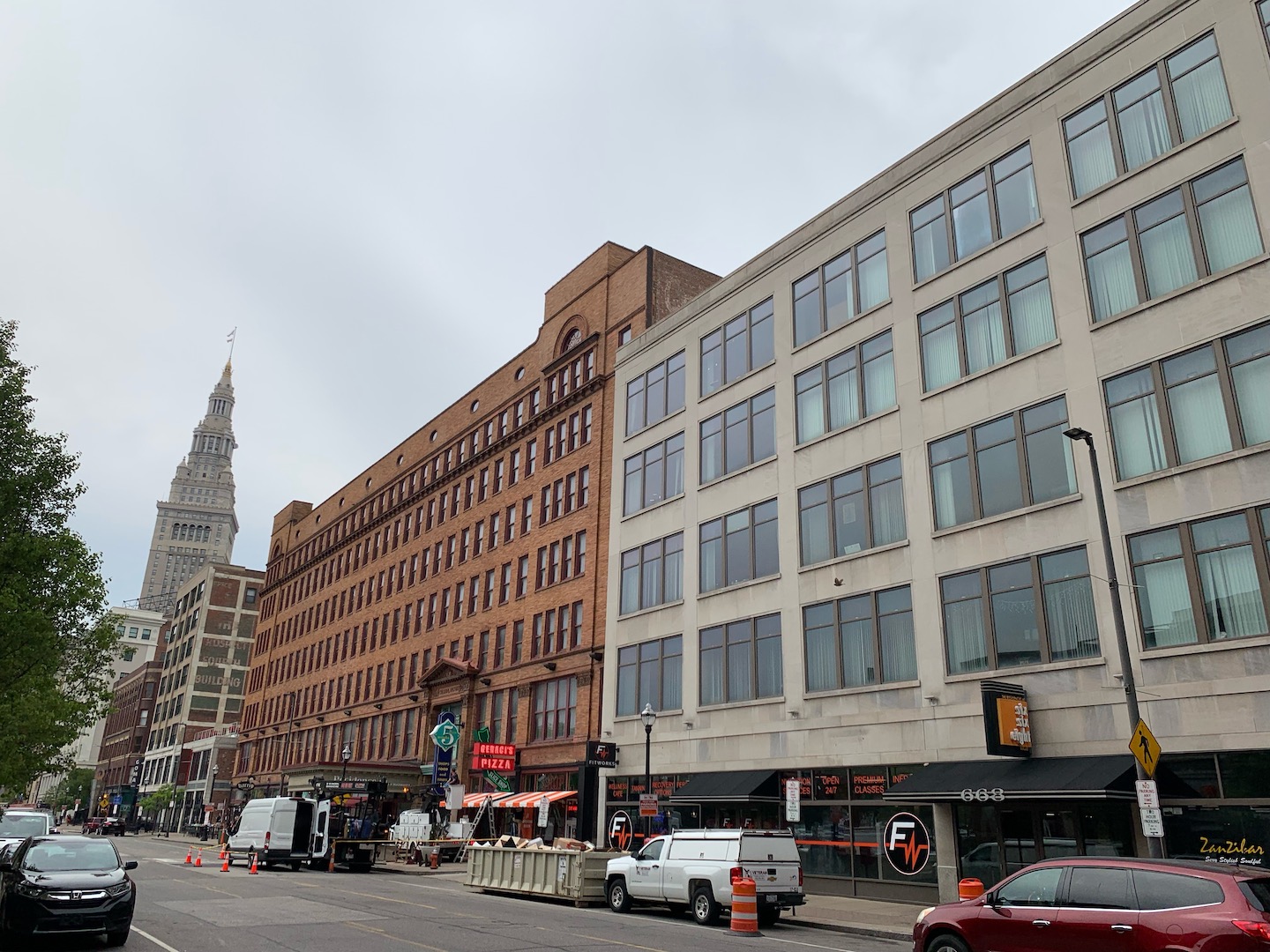
The Prospect Avenue Keith's closed in 1923 and today a modern office building stands on the site. Or at least that's what I thought. When I visited, I could see that the "modern" building was a facade fronting what appears to be the original building that still shows the profile of a theater. The building beside it, which in Houdini's time was the Colonial Hotel, is still there and very recognizable.


Houdini cancelled his 1911 appearance in Cleveland when he broke a blood vessel in his kidney in Detroit (an injury that never properly healed and gave him pain the rest of his life). But he was back in 1915, this time playing the magnificent Hippodrome Theater at 720 Euclid Avenue. This was the second largest stage in the world at this time. Houdini would play the Hippodrome three times in 1915, 1916, and 1922. Among his escapes at this theater was a challenge from the Cleveland & Sandusky Brewing Co. to escape from a cask of their famous Gold Bond Beer.


The Hippodrome stood until 1981 when it was razed to make way for a parking garage. Today the new City Club Apartments are rising on the site of the theater.


A survivor in downtown Cleveland is the beautiful May Company building. The May Co. challenged Houdini to escape from a packing case made by their shipping department three times in 1905, 1908 and 1915. Houdini beat them every time. In 1925 they left it to their competitor the Baily Co. to challenge Houdini with their own packing case. He beat that one too!


In 1915 Houdini performed one of his more untypical outdoor stunts in Cleveland. He was strapped into a straitjacket atop a railway boxcar and escaped while spectators watched from the Cleveland viaduct bridge above. For more details on this unusual escape, check out THIS POST.


Houdini performed two suspended straitjacket escapes in Cleveland. The first was from the John Harkness Brown Building at 1019 Euclid Avenue on December 20, 1916. Happily, the building still stands today as the Euclid Grand apartments.


Houdini's second suspended straitjacket escape was from the Cleveland Press building on February 3, 1922. The building stood on the NW corner of East 9th and Rockwell. A terrific photo of the escape ran in the paper the following day.


Today the Press building is long gone, and even the Dunkin Donuts that now stands on this corner was out of donuts when I visited. So a double let down at this location! But at least we know Houdini hung here.


In 1924 Houdini barnstormed the country with his spiritualism lecture. Cleveland was one of his tour stops. Houdini appeared at Engineers Hall on February 27, 1924. Engineers Hall was located inside the Engineers Building on St. Clair Ave. It was demolished in 1989 and today is the Marriott Key Tower. By the way, I didn't know the location of Engineers Hall when I gave my talk. Fellow expo attendee Jim Kopco found it for me. Thank you, Jim!


Tickets for Houdini's lecture were sold at the Korner & Wood bookstore located at 1512 Euclid Avenue. This was a popular store that stood until 1963. Both Houdini and Blackstone are remembered to have been customers. Today the store and building are long gone.


If there was ever a time to be a Houdini fan in Cleveland it was 1925. Houdini performed in the city twice that year. But don't take it from me. Let's hear from someone who was there!


Houdini performed at the Palace for two weeks beginning March 9, 1925. The first week he featured his escape act. The second week he devoted to spiritualist exposes. The Palace is inside the magnificent B.F. Keith Building at 1615 Euclid Avenue. The good news is the Palace survives along with several other beautiful theaters in Cleveland's Playhouse Square.


While the theater was closed during my visit, I was still able to find my way into the lobby. It's a beautiful space and I could imagine Houdini as the prince of this palace.


During Houdini's 1925 run he exposed the well-known trumpet medium George Renner. Houdini attended Renner's seance at 2650 Superior Ave. in disguise and secretly smeared his trumpet with lampblack. When the lights came on, Renner's hands and face were cover in the soot, proving that the trumpet manifestations were the work of the medium and not the spirits. Renner was arrested and charged with fraud. Houdini had ten minutes to make it to the Palace for his performance. Newspapers reported he did his act with his hands still covered in the lampblack.


While Houdini's exposures drew headlines and large crowds to the theatre, it made him at least one enemy. Check out the below from the March 10, 1925 Cleveland Plain Dealer:


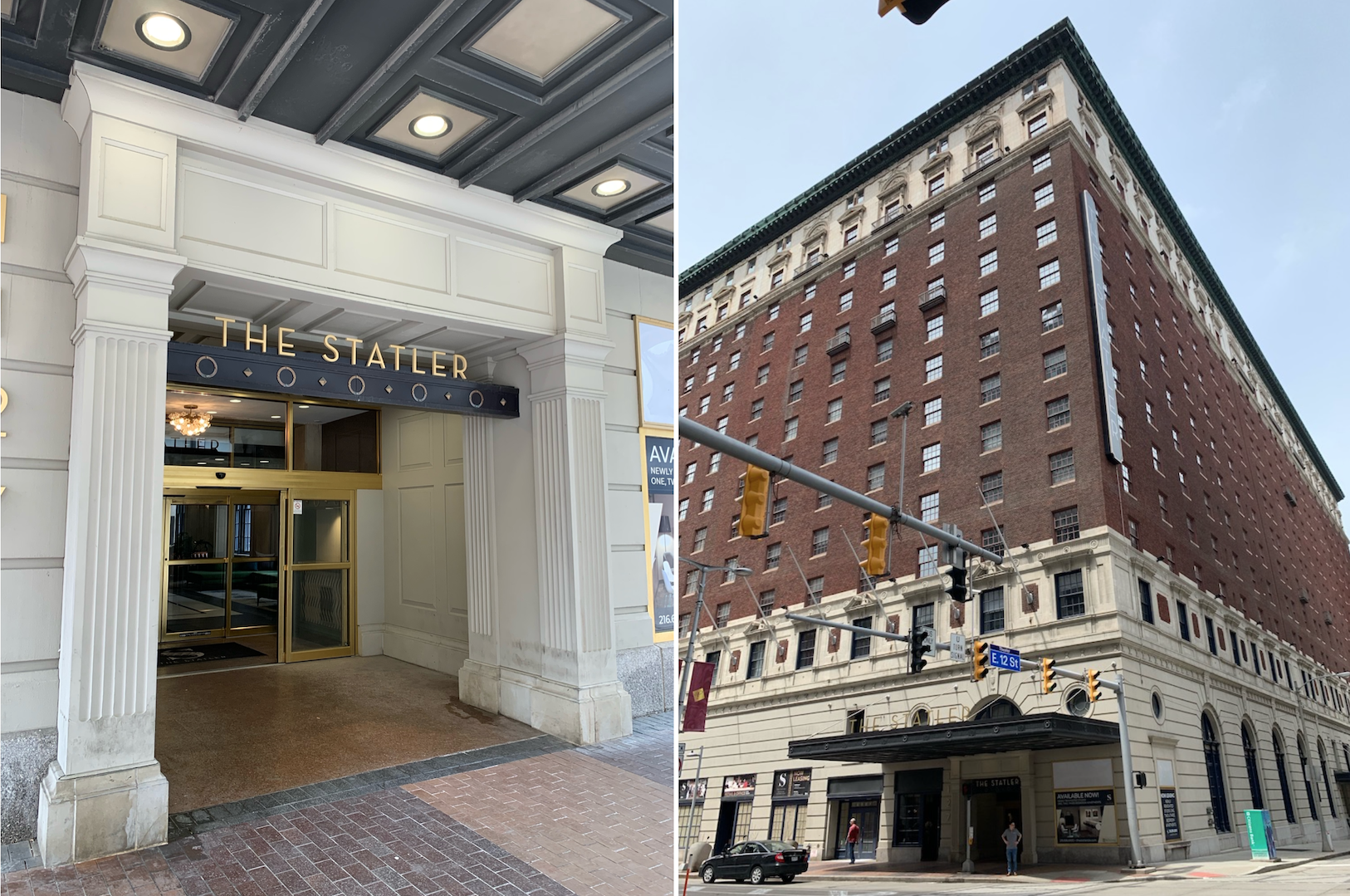
While in Cleveland Houdini stayed at the Hotel Statler at 1127 Euclid Avenue. The Statler is still there (it's now apartments), and from the outside appears just as it did in Houdini's time. A bonus is that the building stands beside the former John Harkness Brown building where Houdini did his 1916 suspended straitjacket escape. It's a great block for Houdini location seekers!


Houdini returned to Cleveland in November 1925 with his "3 Shows in One." This time he performed at the Hanna Theater located at 2067 East 14th Street, just a block over from the Palace. The Hanna still stands today. I couldn't get inside, but I did find the old stage door and could feel Houdini's spirit on that spot.


During his final Cleveland appearance, Houdini performed for handicapped children at the Sunbeam School. Below is a terrific photo of Houdini performing for the kids. An account of this show in the November 6, 1925 Cleveland Plain Dealer details Houdini's performance of the die box. The original school building was razed for the new Sunbeam School located at 11800 Mt. Overlook Ave.


Houdini was booked to return to the Hanna for the week of November 9, 1926. This was to be his next stop after his two week engagement in Detroit. He didn't make it. As we know, Houdini died in Detroit on Halloween of that year.

There's one last Houdini Cleveland connection. In 2017 the city played host to the Official Houdini Séance inside a bank vault. Houdini was a no show, but his memory proved to be alive and well in Cleveland -- a five star Houdini city!


Want more? You can see an exclusive photo of Houdini in Cleveland from the collection of Dr. Bruce Averbook and download the research I did for my lecture as a "Scholar" member of my Patreon by clicking the image below. 


Very special thanks to Aimee LePelley of the Center for Local & Global History for helping me find Houdini in Cleveland.

Friday, April 7, 2023

Deconstructing Houdini '53: Metamorphosis

Continuing my scene by scene dissection of Paramount's classic 1953 biopic Houdini. Last time Harry and Bess had a blow up that sent them to Europe. Today we join them in London...

Chapter 11: Metamorphosis

"Ladies and gentlemen, my latest invention, the Metamorphosis."

So begins the next sequence of Houdini (1953). Harry could be talking about himself here. Last time we saw him he was working as "Oscar the Sea Serpent" in a Coney Island sideshow. Now he's standing proudly on the stage of the Alhambra Theatre in London performing one of his most famous feats of magic. Metamorphosis!

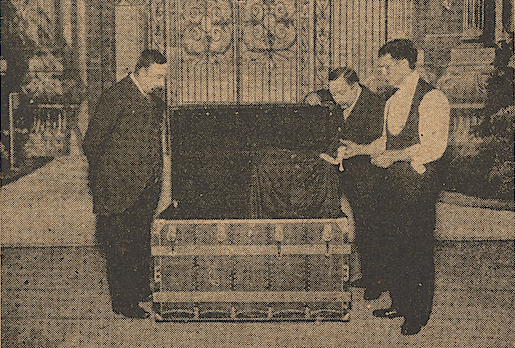
This sequence actually begins with an establishing shot of London and the exterior of the Alhambra Theatre. Once again the movie is pulling from real Houdini history. Houdini's first engagement in London was at the Alhambra and Metamorphosis was part of the act. Although it was hardly a new invention. Houdini had been performing it from the start of his career.

The real Houdini performs Metamorphosis at the Alhambra.

The only historical fumble is the billing we see on the Alhambra playbill: "The Great Houdinis." By the time Harry and Bess arrived in England, the act had been well established as "Houdini, King of Handcuffs." But that's a quibble.

Real Alhambra playbill for July 2, 1900.

As with all the magic in the film, Metamorphosis is performed beginning to end with minimal cuts. It's also presented in a contemporary way. The real Harry and Bess made their three second switch inside of a cabinet. Here a collection of fan dancers shield the trunk as Harry stands on top. 

Standing atop the trunk is how Metamorphosis is done today and it's surprising to see this presentation as early as 1953. It's also a modern approach to have the assistant locked in the trunk first. It's said this is so the magician is the one to receive the final applause. But it is certainly not how Houdini did it. Presenting it this way also robs Houdini of an "escape" which is important to what follows. (In case you've never noticed, Houdini escapes his handcuffs during the applause.)


Amidst the applause we suddenly hear a cry of "fake" from the audience. A man (Michael Pate) stands and identifies himself as Dooley from the London Examiner. He believes "that's a trick trunk" and challenges Houdini to "get out of something real." Of course, Houdini did not get out of the trunk. Bess did, so...


After exchanging barbs, Houdini throws out a £100 challenge "to anyone who can lock me in anything I cannot escape from." This challenge was a big feature of Houdini's first UK tour so once again the movie is on target. Dooley notes that Inspector Marlick (Barry Bernard) of Scotland Yard is in the audience and challenges Houdini to try and escape from one of their jails. With a bit of prodding from Houdini, Marlick agrees to the contest, but insists Houdini remained locked up for 24 hours if he fails to escape. Houdini invites the audience to come back and see him tomorrow. "You won't be here!" shouts Dooley.

Confrontations and challenges hurled at Houdini from the audience were a regular occurrence. In fact, on Houdini's opening night at the Alhambra he was challenged from the audience by another Handcuff King, Cirnoc. It's also true that Houdini's challenges were frequently "bets" with some sort of humiliating consequence for Houdini should he fail. (When challenged to escape from a mail bag in Los Angeles, he would need to be "delivered" to the post office to be set free.) Just another great example of how this movie dramatizes Houdini's exploits using established facts.

Following the performance, Dooley comes backstage to the Houdinis dressing room. Turns out their confrontation was staged. No other Houdini biopic has dramatized his close and sometimes complicit relationship with the press. But while the drama behind Houdini's challenges might be staged, the escapes themselves were legit, which is also established here. "My end of the bargain was to get you into jail," says Dooley. "You promised me two pounds. I want it now because tomorrow you might not be here to pay me."


Houdini pays Dooley and has complete confidence he will escape. "I can open the locks of these old English jails with a button hook," he assures Bess. But then Dooley says, "Oh, by the way, I forgot to tell you. But in our jails the cells are built differently than in the states. The locks aren't in the doors. Good luck, yank!"

The reporter leaves Harry now looking far less confident. Has he bitten off more than he can chew? Can he escape? We'll find out next time.

Translate