Showing posts with label Disguises. Show all posts

Thursday, November 28, 2024

Houdini's greatest outdoor stunt determined!


Recently, I asked my patrons to vote on which regular Houdini publicity stunt was their favorite. By this, I mean a stunt that Houdini did off-stage, typically outdoors, that was strictly about getting newspaper coverage. Here are the scientific results.

#1 Suspended straitjacket (42%)
Can't say I'm surprised to see this one reach #1, as it would be my choice as well. Houdini first started doing the suspended straitjacket in 1915 and continued it until the end of his career. Not only could the escape be viewed by a maximum number of spectators, but it always drew headlines along with photos of the incredible crowds. It was also an escape that looked much more dangerous than it actually was. It was a winner in Houdini's day and still a winner today!

#2 Bridge jumps (24%)
Houdini began bridge jumping in 1906, and it quickly replaced jailbreaks as his go-to publicity stunt. Unlike jailbreaks, a bridge jump could be witnessed by the public, and provided dramatic images that always made the papers. However, it was dangerous. Houdini could hit the water wrong or collide with underwater objects, both of which happened. One can understand how Houdini would turn to the lower-risk suspended straitjacket. But bridge jumping remains a classic, and it's the stunt that introduced Houdini as a death defier.

#3 Jailbreaking (15%)
A nice ranking for Houdini's earliest publicity stunt of breaking out of jails after being stripped and searched. He became so associated with the stunt that he was sometimes billed as just "The Jail Breaker." But jailbreaking had its drawbacks. It could not be witnessed by the public; Houdini had to rely on newspapers to tell the story. And while not dangerous, it was high risk as far as exposure or failure was concerned. There was no stopping reporters from sharing any embarrassing moments, which did happen. But these escapes, especially when he swapped prisoners around the cells, were spectacular.

#5 Seance busting (9%)
Contrary to popular belief, Houdini only did a few exposures of mediums during seances themselves. But when he did, it drew headlines as large as any escape. Houdini would attend a seance in disguise, typically with an undercover reporter and policeman. At the right moment, he would dramatically reveal himself and the methods of the medium. Apart from a potential lawsuit, there was little risk, and the reward in publicity was well worth it. However, news of such encounters made mediums reluctant to give him sittings, so there was a cost.

#4 Overboard Box (6%)
I'm surprised to see the Overboard Box, in which Houdini would be nailed into a packing case and lowered into a river, rank this low. It's one of his most iconic escapes. However, it does overlap with bridge jumps, so maybe that skews the results. Like a bridge jump, the Overboard Box could be witnessed by the public, it would draw huge crowds and had little risk of exposure. But it was also dangerous and logistically difficult to perform, requiring a crane or a tugboat or both. This might be why, of all of Houdini's outdoor escape stunts, the Overboard Box was the one he did the least.

#5 Feats of strength and endurance (3%)
Houdini occasionally did publicity stunts that had nothing to do with escapes or exposure. I'm calling these "feats of strength and endurance." The most famous of these was his remaining in an air-tight casket submerged in the pool of the Hotel Shelton for over an hour. Had Houdini lived longer, I believe we would have seen these feats become his standard outdoor stunts, replacing the suspended straitjacket escape. Being frozen in block of ice was definitely something he was planning.

#6 Other (0%)
No patrons opted for this, so it looks like we pretty much covered it!

These are the results as of today. However, the poll is still active, so if you want to have your say and maybe move your favorite up a notch, you can still vote as a member of my Patreon. I'm currently offering a special Black Friday sale of 10% off all new memberships by using the promo code BESS.

Friday, August 4, 2023

Deconstructing Houdini '53: Mirror images

Continuing my scene-by-scene dissection of Paramount's classic 1953 biopic Houdini. Last time we experienced Harry's career Metamorphosis. Today he faces two challenges...

Chapter 12: Mirror images

Houdini became famous throughout Europe in the early 1900s as "The Handcuff King and World Champion Jailbreaker." In the next two scenes of Houdini '53, we see him earn these titles with two spectacular challenge escapes. One challenge builds on a foundation of myth while the other builds on fact. But you might be surprised which is which.

In the preceding sequence. Houdini was challenged to escape from a Scotland Yard jail. Now he arrives onsite and meets the warden (Malcolm Lee Beggs). The warden performs a search of his new "prisoner." This is not a strip search that the real Houdini would endure. Bess is not present, which seems like a missed opportunity, but it may be accurate. Despite what we see in other biopics, I've never heard of Bess attending any jailbreak, and it's possible women would not be allowed in a cellblock. (So much for passing the key in a kiss.)

Houdini is handcuffed and the door is locked. He instantly escapes the cuffs and hands them to the warden who blusters, "We'll see who has the last laugh, Mr. Houdini!"

Once the men are gone, Houdini retrieves a length of wire from his waistband and goes to work on the lock that extends outside the cell, a complication he learned about only after he had agreed to the challenge. Across from him a prisoner (Ralph Peters) watches with fascination and begins to mirror Houdini's actions with a bent spoon. But it isn't going well and Harry even drops the wire. The prisoner likewise drops his spoon.


Houdini's all-or-nothing escape from Scotland Yard is told in almost every major biography. In these colorful accounts, it's a handcuff escape in the lobby of Scotland Yard with the man doing the cuffing none other than Superintendent William Melville himself. So the movie is basing this on fact. Or is it?

I don't believe the Scotland Yard escape ever happened. At least not as described in any biography. Houdini did visit Scotland Yard during his first weeks in England but as a tourist. (You can read my full case HERE.) So while the filmmakers might think they are drawing on real Houdini history here, they're actually building upon a myth, and it won't be for the last time. But I don't fault them as the Scotland Yard escape has long been considered fact.

While Houdini continues to struggle we fade away to the next day at the Alhambra Theater. The audience is chanting "We want Houdini!" as Bess tries to placate them with magic. The warden is sitting smugly beside Inspector Marlick (Barry Bernard). It's clear Houdini has not escaped.

Bess then enacts an improbable plan. She announces to the audience that while Houdini is unable to appear in person, "He will send his alter ego from the spirit world." She backs into the cabinet, the movie's version of Houdini's "ghost house," and quickly dons a tuxedo and Houdini mask (or many I should say a Tony Curtis mask). She then steps from the cabinet as "Houdini," much to the astonishment of the audience.


This is the third time we've seen disguise used in this movie. That could be why this doesn't seem as improbable as it should. But what I especially love here is the mention of "the spirit world." It nicely foreshadows what's to come and pulls from reality. The Houdinis performed a spiritualism act early in their careers. While this was never established in the film, we can still imagine Bess, in desperation, reaching back to her knowledge of spirit trickery to once again deceive an audience. It's also the second time in this sequence that we've seen someone "mirroring" the real Houdini. And speaking of mirrors...

A man in the audience (Tudor Owen) suddenly stands and challenges "Houdini" with a special pair of handcuffs that he made himself. He marches on stage and manacles the magician, saying the only way to get the cuffs off is to saw them off. The audience laughs heartily as the disguised Bess tumbles back into the cabinet and a new struggle commences. Handcuffs rigged to never open were something the real Houdini had to contend with.


That's when we see the real Houdini, finally free of the jail, arriving backstage. He sneaks inside the cabinet and helps the handcuffed Bess get free of her disguise and tuxedo. Houdini himself then emerges from the cabinet, torn jacket in hand, having apparently escaped the inescapable handcuffs. When the challenger asks what happened to his cuffs, Houdini shows they are now on Bess. Metamorphosis!

Some might view all this as pure Hollywood fiction. But I see a conscious echo of Houdini's very real escape from the Mirror Handcuffs in London in 1904. Think about it. It's a custom-made super cuff brought on stage by an aggressive challenger. Houdini's coat is sacrificed in the course of the drama. And one of the many stories about the Mirror challenge is that Bess saved Houdini by securing the key. What did we just witness but Bess saving her husband? So this super cuff challenge mirrors the Mirror!

With these two triumphs, we've reached the halfway point in Houdini '53. It seems the only question now is how high can The Great Houdini climb?

I feel a montage coming on...

Wednesday, August 25, 2021

Deconstructing Houdini '53: Tony Pastor's

Today, I continue my scene-by-scene dissection of Paramount's 1953 biopic Houdini, in which I attempt to make the case that it's much more historically accurate than it is given credit. And anything else that comes to mind. Last time we witnessed a death-defying escape at Coney Island. Today we head to...

Chapter 4: Tony Pastor's

Tony Pastor's is a familiar name to Houdini buffs and an important part of theater history, so seeing its marquee at the start of this sequence is a thrill. However, what we see inside is not the Tony Pastor's of history. Tony Pastor's was New York's first vaudeville house and a typical theater experience. What we see in Houdini '53 is more of a dinner club. Once again the movie is fusing past and present, evoking the nostalgic name of Tony Pastors (sans apostrophe), but showing an entertainment venue that would have been very familiar to audiences of 1950s (less so today).

The real Harry and Bess performed at Tony Pastor's at least twice during their early years (more here). This is well documented in the Harold Kellock book, which is probably why it gets a nod in the movie. But here it is the setting of Harry of Bess's third fateful meeting.

Once again Bess in on a date with the unfortunate Fred (Peter Baldwin). However, an old man keeps leering at her from another table, much to her annoyance. The dinner show begins with a Professor Allegari (Hungarian actor Ernö Verebes) who promises to "rejuvenate" a willing audience member. The leering old man is the volunteer. With the help of a special potion, a circle of showgirls, and some smoke, the old man transforms into the young Houdini! (Notice his suit has also somehow "rejuvenated".) He then proceeds to chase the showgirls off the stage Harpo Marx style. End of show.

While all this might seem like pure Hollywood invention, there is some real Houdini history embedded in this odd performance. During their early years Harry and Bess traveled with the California Concert Company, a medicine show headed by a Dr. Hill. One of Houdini's many jobs was to play the embedded audience stooge who would be first to buy a bottle of the magic elixir being offered by Hill. So here we see the same thing--although a sanitized version--in which Harry is playing the stooge to a medicine show huckster throwback.

Houdini being disguised as an old man is also familiar territory. Houdini would frequently don disguises to challenge rival Handcuff Kings and later to ensnare fraudulent spirit mediums. This is the only Houdini biopic to date that shows his fondness and skills at disguise.

Fred notices this is the same man they saw at Coney Island and suddenly becomes suspicious and accusatory. Bess says she had "no idea he'd be here" and asks to leave. When Harry comes out, he once again finds Bess gone. "They didn't even order anything," says the headwaiter played by character actor Torben Meyer.

As the dejected Houdini turns, he suddenly comes face to face with a radiant Bess. It's a beautiful moment. On the soundtrack, we hear "Meet Me Tonight in Dreamland," which will reoccur several times. Bess says she doesn't know why she came back this time. But Houdini says he does and explains, "Everything happens to me in threes. This is the third time we've met."

This idea of things happening in threes is not from Houdini history nor does it ever come back again in the film. But it is an important character-building block, showing Houdini is a man who is aware his life is guided in ways that he doesn't entirely understand but has come to trust. The real Houdini frequently stated that he was a "fatalist," believing he was living a life that was predetermined. Hence, he had little fear. Houdini (1953) is the only biopic that depicts this key philosophy.

Bess has also now experienced this same strange pull of destiny, and she will now trust her instincts. The idea that the Houdinis lives are guided by mysterious forces is something that will come back several times.

That's when Fred comes back to reclaim his date. Bess refuses to leave and Fred is ejected from the club (and the movie) for causing a disturbance. 

"I've only got one more show to do, then where would you like to go?" asks Harry.

"Wherever you go," answers Bess.

Sunday, March 7, 2021

More amazing AI brings Ehrich Weiss to life

I had planned on holding this back until Houdini's birthday. But I've decided to run with it today as the reaction to my first post featuring these AI animations by MyHeritage was so popular. (I also fear this viral sensation might be played out by March 24.) My approach has been to create animations that have no possible film equivalent. So below are three combined images showing the young Ehrich Weiss from ages 8 to 18. And this time in color!


Here's a bonus. Who is this stranger you ask? Well, let's just say if you are a fake medium you definitely don't want to see him in your seance chamber!


If you want to animate your own photos, MyHeritage offers a 14 day free trial.

UPDATE: I do know Houdini's eye color is wrong. His eyes should be blue. But I don't have any control over that. I just upload pics to the app and it makes it own color decisions unfortunately.

Wednesday, October 14, 2020

The Cecil M. Cook exposé

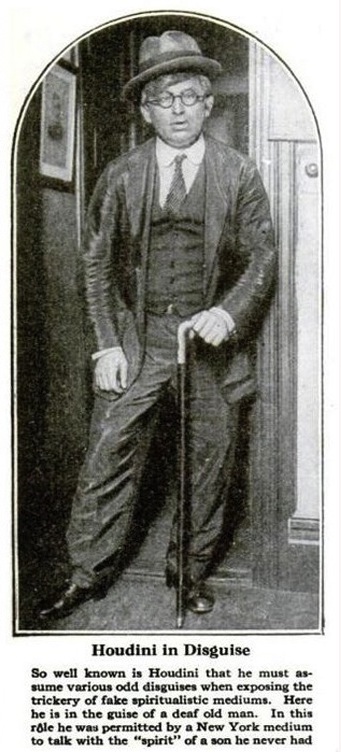
One of Houdini's most famous spirit exposés was that of the trumpet medium Mrs. Cecil M. Cook at her home at 41 West 88th Street in New York City on July 1, 1925. Houdini attended the seance in disguise. Here's an AP account from The Ithaca Journal that briefly explains what went down.


The building where this took place still stands and my guess is it doesn't look all that different, at least on the outside, than it did on the day of that fateful seance. 


Below is a photo of Houdini in his medium catching disguise. Houdini was no stranger to disguises. During his Handcuff Kings days he would attend performances of rival escape kings in disguise and wait for an opportune moment to reveal himself and challenge them. One wonders if he drew his inspiration for disguises from the Sherlock Holmes stories, of which he was fan.


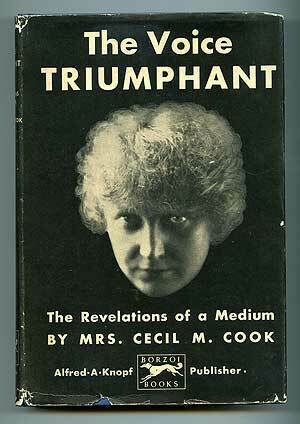
Despite Houdini's high profile exposé, Mrs. Cook continued her spiritualistic career, and even wrote a book called The Voice Triumphant: The Revelations of a Medium. A search of the contents via Google Books doesn't turn up any mention of Houdini. This probably shouldn't be a surprise. That was one time the Voice certainly wasn't Triumphant!


Related:

Saturday, August 1, 2020

Five original Houdini glass negatives sell on eBay

A remarkable set of original Houdini glass negatives sold on eBay yesterday. They show Houdini being bound to a chair by young girls ($781.00); Houdini and trumpet medium Annie Benninghofen ($1,150.00); and two photos of Houdini at the South Clark Street courthouse in Chicago ($402.00 and $159.50). The look on Houdini's face in the last photo is priceless! All the images are from 1926 and taken by noted photojournalist Henry Schaefer of Acme Newspictures for the Chicago Herald-Examiner.


But there was actually a fifth negative that the seller had mistakenly identified as being Annie Benninghofen. Nope, that's Houdini! The auction was at only $2 with ten seconds to go and I was hoping to get a bargin. But in the last seconds it shot up to $187.50, so it appears not everyone was fooled.


Don't believe this is Houdini? Check out the below from The Tao of Houdini by Patrick Culliton. This appeared in the Chicago Herald-Examiner.


Related:

Sunday, July 14, 2013

A Rose by many names

These wonderful 7 X 9 press photos of Rose Mackenberg sold on eBay yesterday. Mackenberg was a chief member of Houdini's "Secret Service" -- one of his agents who went to seances to gather information on mediums he would later expose onstage. Even though they are dated 1937, they are said to show Rose in some of the different disguises she wore for her Houdini work.

Roses' undercover personas included: "Credulous Servant Girl," "Believing Semi-Invalid," "Smartly Garbed Widow," "Rustic Schoolteacher," "Small Town Matron," "Vamp from the Country," "Woman Seeking Lost Relatives," and "Tipsy Consultant."

They seller was Vintage Image Photos, which has one of the largest collections of original AP, UPI and other news service photos from the past.


Back in 2011 an unpublished manuscript written by Rose herself was offered in a lot of Mackenberg material on eBay. It never sold. Here's hoping some day that manuscript will surface as if would be wonderful to read about Roses' adventures among the spirits.

Speaking of spirits, make sure you check out WILD ABOUT HARRY tomorrow when I will reveal a remarkable artifact from Houdini's own ghostbusting days.

Saturday, September 29, 2012

Harry Houdini - master of disguise

One of my favorite things about Houdini's anti-spiritualism crusade is the fact that he would don disguises to gain access to seance rooms. Mid-way through the seance he would leap up and reveal himself. Houdini actually started using disguises early in his career to gain access to theaters featuring rival Handcuff Kings. In his raucous exposé of Hilbert in Cardiff, he even wore a false nose fashioned out of wax.

Houdini's favorite character was that of a bespectacled old man with a cane. According to Christopher Sandford in Houdini and Conan Doyle, Houdini called this character F. Raud -- Fraud. (This name was also used by Houdini's agent, Rose Mackenberg, who went undercover as the Reverend Francis Raud). Houdini may have also used the names "Mr. Smith" and "Mr. White". Interestingly he also "hid" behind the name of White -- the anglicized form of Weiss -- during his days as a runaway.

Below are photos of Houdini in full disguise. Eat your heart out, Sherlock Holmes.


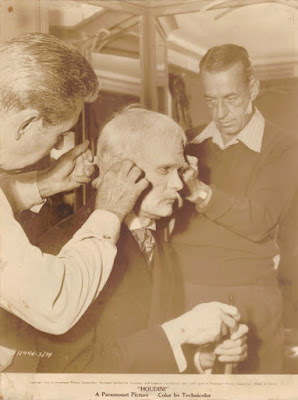
I'm surprised Houdini's adventures in disguise have yet to be dramatized in any of the films made about his life. Certainly this was one of his most cinematic activities. Although the 1953 Paramount film HOUDINI does show Harry playing an old man as part of a performance at Tony Pastor's dinner theatre, so this could be seen as a nod to Houdini's abilities as a master of disguise.

Tony Curtis in makeup for HOUDINI

Translate