Showing posts with label Walford Bodie. Show all posts

Monday, June 15, 2020

Houdini's forgotten agent: Jenie Jacobs

We all know about Martin Beck's involvement in managing Houdini's early career. We also know about Harry Day who booked Houdini on his UK tours. But I recently discovered there was another agent in Houdini's life: Jenie Jacobs.

Jacobs has an interesting story herself. She grew up in a Syracuse orphanage and was "cast adrift" at age 13. She came to New York and worked her way through law school at New York University while learning stenography at night. She then entered the agency business and in time distinguished herself as one of only two female booking agents in the business (the other was in Russia). She lived with her life-long partner Pauline Cook of the vaudeville sharp-shooting team "Cook and Clinton." The two later formed their own agency.

It not clear exactly when Jacobs first entered Houdini's orbit, but to hear her tell it, it was early in his career. In a syndicated 1922 profile ("A Creator of Footlight Careers") she claimed to be responsible for Houdini's high salary. Her story doesn't quite comport with known facts, but you gotta love her last line, as I'm sure Houdini did.


It's more likely Jacobs represented Houdini after his return to the U.S. in 1905. She definitely represented Hardeen when he returned in 1907. Her name is featured prominently on Hardeen's trade advertisements, referring to her as "Miss Jenie Jacobs, The Hustling Agent." She also represented Houdini's boyhood friend and one-time Houdini Brother Joe Hayman. Joe played Vaudeville with Mildred Franklin as "Hayman and Franklin." Another familiar client was Dr. Walford Bodie, "The Famous Bloodless Surgeon and Electric Wizard."


Jacobs relationship with Houdini appears to have soured, and in 1908 she sued the magician for $2,250 in commissions owed.
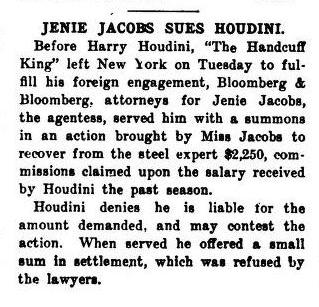
Variety, Aug. 22, 1908

It may be a testament to her skills of persuasion that she was able to reconcile with Houdini a few years later and once again act as his agent.*
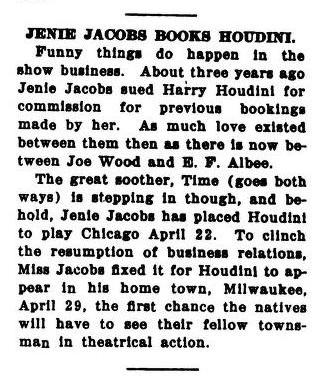
Variety, April 13, 1912

It speaks well of Houdini and Hardeen that in this male dominated age they entrusted their careers to a woman (and an apparent gay woman at that). But it's clear Jacobs had no problems asserting herself in a "mans world." She offered this advice to women:

"[This] is the particular warning I would like to hold up to women: not to let their own timidity and men's boldness bluff them into feeling that they are unable to carry on business on their own account. We must bluff a little too and keep awake."

In 1921 Jacobs launched a successful career as a theatrical producer, clocking several hits on Broadway. She also sued the all-powerful United Booking Office (UBO) for "oppression and discrimination." She continued to represent top talent, including Jack Benny, and soon branched into radio. In the 1930s she became closely affiliated with the RKO circuit. It's possible she may have again booked Hardeen at this time.

Jenie Jacobs died of cancer on February 21, 1933 at age 55. She is buried in Cypress Hills Cemetery in Brooklyn.


* UPDATE: I've since learned that Houdini and Jacobs settled their lawsuit for $1.

Related:

Tuesday, April 12, 2016

Houdini's electric chair - the shocking truth

Today we have the answer to the question of what happened to the electric chair Houdini purchased from Huber's Dime Museum in 1910 and kept in his New York home (read: Houdini and his electric chair). I can also now show you exactly what the chair looked like.

Reader Richard Lane, who's specializes in researching hypnotic performers, shared with me information he uncovered at the Harry Ransom Center at the University of Texas at Austin. The university houses a massive Houdini collection, including correspondence with Dr. Walford Bodie, a Scottish hypnotist and stage magician famous for his mock electrocutions. (Bodie was not a real doctor, the M.D. stood for "Merry Devil," he explained.)

Bodie, who counted Charlie Chaplin among his admirers, wrote to Houdini on April 8, 1920, asking if he did indeed own the first electric chair from "Sing Sing", and that he would love to see it. By the end of the month, Houdini gave Bodie the chair. Bodie displayed the chair in theater lobbies in the UK with a sign that boasted not only its grisly history, but that it was a gift from the "Great Houdini."

Below is a photo Bodie sent to Houdini as thanks. This photo finally reveals Houdini's electric chair.

Harry Ransom Center The University of Texas at Austin.

While this answers the question of what happened to Houdini's chair, it creates new questions. The world's first electric chair, the one used to execute Kemmler, was housed at Aubun State Prison, not Sing Sing. And the Bodie photo reveals that the chair was clearly not the same chair from Auburn, nor is it the chair seen in Houdini's The Master Mystery.

The chairs from Auburn Prison (left) and The Master Mystery (right).

It's possible Huber's advertised the chair as coming from Sing Sing because that was the more infamous and recognizable name to the general public. In a Dime Museum, exaggeration and hype was the name of the game. It's also possible this was just Bodie's mistake and Houdini never corrected him. "He'd had Sing-Sing rattling around his brain for 23 years," says Richard.

But I also think we need to consider the possibility that the Huber's chair may have been a fake from the start. Maybe the museum mocked it up and Houdini was fooled. Or maybe the young Houdini, who was performing at Hurber's the week the chair arrived, had a hand in creating the chair himself. He could have even suggested the idea. This is why he felt "sentimental" about it and bought it in the 1910 liquidation auction. This also explains why he let it go so easily in 1920. It wasn't a true historical artifact, just a bit of fun, and Houdini might have been happy to see it once again play the role for which it was created in the first place.

You'll notice that Bodie offered a £1000 Reward to anyone who could prove this was not the first electric chair or "furnish information contrary." He was lucky no one collected on that bet.

Today the whereabouts of the Huber-Houdini-Bodie chair is unknown, so that's still a mystery to uncover. But it wouldn't surprise me at all if it's still sitting on display somewhere, teasing people with its grisly (and questionable) history.

Thanks to Richard Lane for sharing his info on Bodie, and to Chelsea Weathers of The Harry Ransom Center for her help securing the Bodie photo. Also thanks to Dorothy Dietrich and Dick Brookz at the Houdini Museum in Scranton who first alerted me to the Bodie connection.

UPADTE: Our friends Dorothy Dietrich and Dick Brookz at the Houdini Muesum in Scranton have uncovered more information about Houdini's chair in the book, Old Sparky: The Electric Chair and the History of the Death Penalty by Anthony Galvin, which includes this revealing paragraph:


Related:

Translate