Showing posts with label Milk Can (Double Fold). Show all posts

Wednesday, February 15, 2023

Houdini's copper Milk Can?


In the Houdini Collections at the Harry Ransom Center there is a thick file of letters written to Houdini by Montraville M. Wood. Wood was a Chicago inventor and associate of Thomas Edison who worked with Houdini on his Milk Can escape and other effects.

One letter offers up a surprise and a new mystery. It appears that Wood was making Houdini a COPPER Milk Can. On Sept. 10, 1909 Wood writes to Houdini saying:

I have received fifty from the Doctor and have placed the order for the Copper Can; but owing to the small sheets of copper (being tinned on one side) which is carried in stock, it will be necessary to have two seams in the body part of the can instead of one.
This whole can will be tin plated on the inside, so it will be perfectly safe, and it will be copper polished on the outside. I cannot say any particular time this will be done; but I am rushing it as fast as I can.

Wood goes on to say that the hasps would be brass and the can's collar would be 1/2" higher than Houdini's regular cans. He also says staples on the collar would be removable.

Unfortunately, there is no other correspondence related to this particular can, so I don't know if Wood ever delivered his copper can to Houdini. But the idea is a good one. So if anyone ever encounters a copper Milk Can out there, it just may be Houdini's!

Want more? You can read M.M. Wood's full letter as a member of my Patreon by clicking below.


Thanks as always to Eric Colleary and the Harry Ranson Center.

Related:

Monday, June 6, 2022

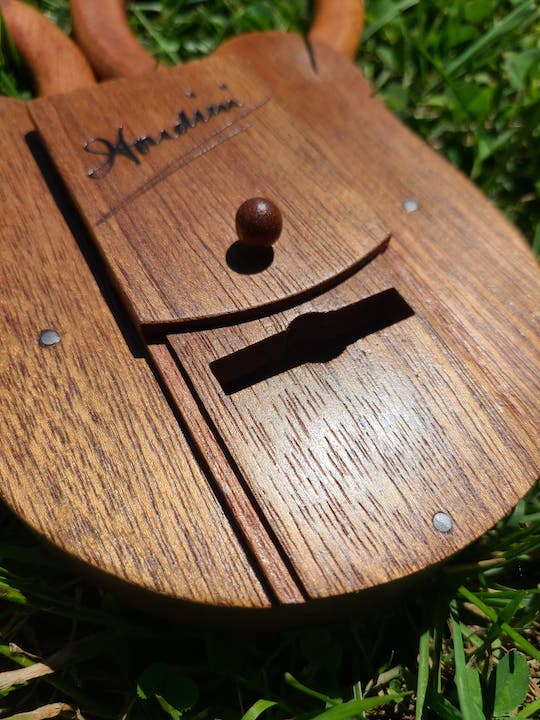
Barry Spector recreates Houdini's Russian Manacle


Our friend and master woodworker Barry Spector has produced another amazing work of Houdini art. This time he has crafted a working replica of the famous Russian Manacle, one of Houdini's more elusive "super cuffs." The cuffs are made from mahogany and the key is made from the 278 wood Barry acquired back in 2019. I actually never realized until I saw this recreation that a panel slid down over the keyhole. Check out the images provided by Barry below.


The real Russian Manacle survives and is currently housed in the collection of The Society of American Magicians Hall of Fame and Museum. That collection was last displayed at the Whittier Historical Society & Museum, but has been out of view since 2014.

Barry also recently made a small-scale replica of Houdini's famous Double Fold Death Defying Mystery box. He even built into it what he believes is the secret (but we can't show you that). The real Double Fold box is owned by David Copperfield.

Sunday, November 14, 2021

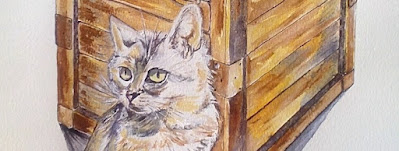
LINK: Cats in Juxtaposition

Houdini and cats? Yes please!

Click the headline to see this full original artwork by Dyanne Brown juxtaposing Houdini's Double Fold Death Defying Mystery with an American Bobtail.


Thanks to Barry Spector for this find. Barry has also found inspiration in the Double Fold box and is currently working on a new Houdini house wood creation.

Related:

Tuesday, August 31, 2021

Two rare props come home to the Houdini Estate

On Saturday I had the pleasure of attending a charity event benefiting Rescues Rock, a nonprofit animal welfare, education and rescue organization, at the Houdini Estate in Laurel Canyon. The "Hootenanny at Houdini" was an evening of fun and music with performances by Billy Gibbons, Lisa Loeb, as well as magician Kayla Drescher. I also had the pleasure of spending time with owners José Luis Nazar and Kathleen Martínez who shared a new house mystery with me...but I'll get to that.

Whenever I get a chance to enter the estate I'm always excited to see what might be new. Last week I reported on the beautiful new monument that now stands just outside the gates. On this night I was in for another surprise. The main house now has on display the famous Iron Box and a Houdini Milk Can. You might recall these were auctioned in March of last year. Now we know where they went!


The Iron Box is best known for its appearance in the classic biopic Houdini (1953) starring Tony Curtis. The box features in what Houdini expert Patrick Culliton (who was also at the event) calls "the best scene in the movie" when Houdini gets trapped under the ice of a frozen river. The box was supplied by Dunninger who always claimed it had belonged to Houdini himself. 

We've yet to be able to draw any firm conclusions as to its life before the movie. But as a standout feature of Houdini '53 it is a wonderful piece of cinema history and it seems fitting that it is now home in Hollywood.


The Milk Can continues to be an intriguing mystery. This was the can that was on display for many years at the Houdini Magical Hall of Fame in Niagara Falls, Canada. After the museum fire and closure it took a strange detour and wound up on display--along with the Iron Box--in a coin shop in Santa Monica (where I got a look at it in 2016).

The distinctive ring on the bottom of the can and the rectangular hasp on the collar suggests this could be the can Houdini used in the Double Fold Death Defying Mystery. Unfortunately, the lid is not the original. It was made by John Gaughan for the previous owner. The original lid was said to have been "lost" at the Niagara Falls museum. But I suspect it's still out there and I'm sure José would be interested in uniting the lid with the can. So if you have a lead, please get in touch.

Patrick Culliton and I examine the Milk Can as homeowner José Nazar looks on.

I couldn't be happier that these two gems are now part of the Houdini Estate where they can be enjoyed by guests and further studied. And, yes, that Milk Can poster on the wall is a mockup from the recent Adrian Brody miniseries. That will be replaced with a reproduction of the original in the Harry Ransom Center. The bust on top of the can is a modern creation and a beauty.

Okay, so what about this new mystery? While strolling the gardens, Kathleen and José pointed out to me what appears to be a sealed doorway. This was walled up when José acquired the property and they have no idea what it is, where it could lead, nor what might be inside. So on the spot we hatched the idea to crack it open on Halloween 2022. (We can't do this year as Kathleen with be in Egypt on her own excavation.) 


What might we discover? Houdini secrets? The old elevator to the fabled tunnel under Laurel Canyon? I don't know, but it will surely be another Houdini Hootenanny!


Thanks to José and Kathleen for inviting me to join the fun. And if you are interested in pet adoption or helping in animal rescue, please visit the Rescues Rock website.

Related:

Friday, March 6, 2020

Milk Can and Iron Box surprise at auction


The Iron Box seen in Houdini (1953) and a Milk Can that might be the can Houdini used for his Double Fold Death Defying Mystery sold in auction at Bonhams in New York today. The Milk Can sold for $50,075 and the Iron Box for $6,325 (both prices include premium).

I admit I find both these prices surprises. The Milk Can sold for more than I expected and the Iron Box for far less (although I knew the 50,000 - 70,000 estimate on the Iron Box was astronomically optimistic). Try as we might, we could never quite authentic either of these as ever having been used by Houdini himself, although they have interesting history nevertheless.

The real mystery now is who the new owners are. If you're the lucky winner, or know who the winner is, please drop a comment below or shoot me an email. I'd love to know where these intriguing pieces of Houdini history will now reside. [See update.]

My thanks and congratulations to the good folks at Bonhams who allowed me to examine these up close a few weeks back.


UPDATE: It appears the Milk Can has found a new home at the Houdini Estate in Laurel Canyon, CA.

Related:

Sunday, February 16, 2020

Houdini Milk Can and Iron Box at auction March 6


The famous Iron Box seen in Houdini (1953) and a Milk Can that just might be the can Houdini used for his Double Fold Death Defying Mystery will be auctioned by Bonhams in New York on March 6, 2020. Both these props come with a fair amount of mystery attached, but the folks at Bonhams have done their homework, as you can see by the detailed auction descriptions below.

LOT 60: A HARRY HOUDINI TRICK STEEL CRATE USED IN THE 1953 PARAMOUNT FILM, HOUDINI
 
Magician's steel crate with hinged lid, 28 x 28 x 36 inches, sides perforated with half-inch round holes, trap bottom, exterior painted green. 
Constructed of steel with a solid lid designed to be padlocked to the body, small holes on each side, and a sliding "trap door" on the bottom through which the illusionist can make his escape, this crate boasts an amazing pedigree and history. While on exhibit at the Houdini Magical Hall of Fame, the piece was identified as having been used by Houdini in his underwater escape trick, though the museum claimed it was only used twice, as the weight of the steel made it far too dangerous. We have not been able to confirm its use in performance by Houdini, unfortunately. All of the other references to Houdini's underwater trick, both in actual waterways and onstage in the Hippodrome tank, refer to the illusionist being nailed into wooden crates or packing crates (though some are reported to have been reinforced with steel or lead).

We can say with confidence that it was part of Houdini's estate (it appears on an inventory listing of property sold by Bess Houdini to Joseph Dunninger shortly after Houdini's death). 
Joseph "The Amazing" Dunninger was a popular "mentalist" who specialized in illusions and debunking mediums, also a passion of Houdini's. He was reportedly close to Houdini and his wife Bess, and purchased a quantity of property from the widow after Houdini's sudden death in 1926. As early as 1930, Dunninger published an advertisement to sell props and other material in The Linking Ring, the official publication of the International Brotherhood of Magicians, offering the steel crate for sale: 
"IRON BOX ESCAPE. Will stand lobby inspection. Used by Houdini. Worth $400. Tremendous bargain ......... $175." 
In 1938, the iron box again appears in a Dunninger ad in the same publication offering items for sale: 
"IRON BOX ESCAPE. Sensational for overboard or stage presentation. Belonged to Houdini." 
The 1938 ad also mentions the Houdini Trunk of all Nations illusion and the Houdini Lattice Cabinet (with Houdini's name mentioned in all caps) both of which made their way to the Houdini Museum in Niagara Falls along with the steel trunk in the 1960s. 
The steel crate does appear in the 1953 film Houdini starring Tony Curtis. The Amazing Dunninger was hired as creative consultant on the film, and many items from his Houdini collection made their way into the final cut, including the collection of handcuffs sold in these rooms on December 5, 2018 (lot 244). The crate is clearly visible in the overboard escape sequence in the film, the perforations on the steel crate making for a dramatic scene as the water pours out in torrents while the crate is pulled up from the bottom of the river. 

An unusual theory has been floated about the origin of this steel crate, inspired by a blind item in a 1939 issue of the magic periodical The Jinx, edited and published by Theodore Annemann from October 1934 to December 1941 (thanks to mymagicuncle.blogspot.com for the clue). For some backstory, Houdini and fellow illusionist Harry Blackstone, Sr. nursed a bitter feud in the early part of the 20th century which apparently dates from the introduction of the overboard box escape. Houdini always accused Blackstone of copying him, but the truth may be the opposite. From issue #68, November 25, 1939, page 468, Annemann writes: 
"Years ago there were two rival conjurors, one specializing in escape work, the other making a feature of it but not in entirety. Around 1907 there was published in Popular Mechanics an escape from a barrel after being submersed in water. By an amateur magician it was first known (as far as can be found) escape to be made under water. The barrel, its halves held together with bayonet catches, was meant to be practically kicked apart under water and let sing. H.B. then built a metal box with a sliding panel unlocked with a forked pick. He refused to sell this to H.H. so the latter did the 'overboard' box with a packing case instead. Later , H.B., seeing the psychological effect of a locally built case over a special iron box, stored the thing away in N.Y. with other illusions. Time marches on. H.B. now stands accused of under water escape larceny by H.H. We can allow that in regards to the packing case but not in priority to the general effect itself. H.B. needs the iron box to prove his point. It has disappeared! Time marches on some more. H.H. winds up a spectacular life. Into the picture comes J.D. who acquires some of the H.H. stage properties. In the cellar he finds a large iron box which no one knows anything about. Suspecting a trap, J.D. toils and finally locates a sliding panel. H.B. still has the pick for the box he found gone from the storehouse. J.D. has an iron box he found in the H.H. cellar ... on the sidelines, we suggest that H.B. and J.D. patch up their feud or declare a three hour truce while they check the finis to a truly rugged individualistic story of magicians at work and play." 
To summarize, Annemann suggests that the present steel box was actually made by Blackstone, not Houdini. Houdini wanted to buy it from Harry Blackstone, and when the latter refused, Houdini created his own underwater escape using wooden crate boxes built on site (which Blackstone then copied). An intriguing theory: is this the actual first "overboard box," designed by Blackstone and suppressed by Houdini? 
Provenance: Estate of Harry Houdini. Sold by Bess Houdini to the Amazing Dunninger [Joseph Dunninger, 1892-1975], c.1927. Loaned by Dunninger to Paramount for the production of the 1953 film Houdini, in which it appears as the "underwater crate." Sold by the Amazing Dunninger to Henry Muller in 1967. On exhibition at the Houdini Magical Hall of Fame in Niagara Falls, Canada 1968-1997. Sold to Tom Thayer, 1997. Sold to the present owners, 1999. 
Estimate:
US$ 50,000 - 70,000
£ 38,000 - 54,000

LOT 61: HOUDINI'S (DOUBLE FOLD?) MILK CAN 
White metal vessel, 35 inches high by 26 inches in diameter at widest, bottom 22 inches in diameter, welded "milk jug" with tapered neck, 3 (of 4) wing nut screws at bottom at north, south and east, and two faux hasps at either side of the neck. WITH: trick lid featuring domed top and four padlock hasps connecting to vessel (lid supplied later).
For nearly two decades, this vessel remained on display at the Houdini Magical Hall of Fame in Niagara Falls, Canada as an example of the illusionist's famous "milk can" escape, in which he was locked inside a metal can which was then filled with water, giving him only a short time in which to escape before drowning. The blogspot Wild About Houdini theorizes that this can is actually the mate to the "Double Fold Death Defying Mystery" box sold at auction in July of 2014 at Potter & Potter in Chicago, which is plausible given the unique characteristics of this can.

The Double Fold Death Defying Water Mystery, introduced c.1911, took the milk can escape and ratcheted up the drama. In the earlier escape, Houdini was padlocked into a large milk can which was then filled with water, from which he would escape while hidden behind a screen (the milk cans had "trick lids" or necks that could only be opened from inside, allowing him to escape). In the double fold mystery, the milk can was hidden inside a larger wooden crate, making the escape that much more difficult.

The strongest argument that this milk can is the Double Fold can is the hasp on the neck. Measuring 3 1/2 by 5 inches, the hasps, which appear on either side, appear to be decorative only. In an image located in the Harry Ransom Center's Harry Houdini Papers titled "Milk Can and Box used in the Double Fold Death Defying Water Mystery" (container 13.17), the hasp is clearly visible on the neck of the can sitting inside the box. Additionally, no other Houdini milk can appears to have this decorative hasp. The hasp can also be matched to images of the can as it sits on display at the Houdini Magical Hall of Fame.

Another piece of evidence: the diameter of the can's bottom is 22 inches, which will just fit inside the circular inset at the interior bottom of the Double Fold box sold in 2014. And finally, the height of the current can sans supplied lid is 35 inches, which, if the original short lid were added, would just fit inside the 38 1/2 inch ceiling of the Double Fold box. 
Though Hardeen likely acquired the Double Fold Box and its can at the same time, at some point the two were separated. The box was sold by Hardeen to Jack Lawain of Monmouth, Illinois, who used it in performance himself, before offering it at auction in 2014. The can was sold by Hardeen to Sidney Radner, who then placed it on exhibition at the Houdini Hall of Fame.  
Provenance: Estate of Harry Houdini to his brother, the Magician Hardeen; sold by Hardeen (along with other items of Houdini material) to Sidney Radner; on exhibit at the Houdini Hall of Fame, 1968-1997; sold by Radner to Tom Thayer, 1997. Sold by Thayer to the present owner. 
Estimate:
US$ 25,000 - 35,000
£ 19,000 - 27,000

In case it isn't clear, the lid on the can is not the original lid, nor does it resemble the original (which was said to have been "lost" at the Houdini Magical Hall of Fame). The owner had this lid made. And while the neck hasp referred to in the Ransom Center's Double Fold photo is indeed the same type of hasp as seen on this can, the can itself is not an exact match.

You might recall this post from 2016 in which I reported that these were displayed in a coin shop in Santa Monica where they were treated with a fair amount of indignity (customers sat on the iron box while waiting to be served). I'm very happy to see these treasures liberated at last. Here's hoping they will land in a good home.

Related:

Monday, February 18, 2019

Houdini gives the all clear to his imitators???

We all know Houdini was ferociously protective of his original inventions, going to great lengths to copyright and protect them. We also know he hated imitators and would not hesitate to go after them for infringing on his act. So how on earth do we explain this!?

Click to enlarge.

This is a half page ad Houdini took out in Variety on October 7, 1911. As you can see, he's giving the all clear to his competition to perform his latest invention without consequences. Note that he also uses this ad to announce he's giving up his latest passion: "P.S.–I have given up Aviation, because there are so many Aviators and Only One Houdini."

The invention he's talking about here is the Double Fold Death Defying Mystery, a dramatic improvement to his Milk Can escape. In fact, conventional thinking has always been that this was his way to deal with the many imitators who had copied his Milk Can. But here he is inviting them to copy it?


This wasn't the only inexplicable thing Houdini did this week. He was playing Keith & Proctor's 5th Ave. Theater in New York, and for reasons that aren't clear, he took himself out of the star position, which his contract guaranteed. Instead he played sixth on the bill, and he seemed to enjoy it! Variety reported:

"The experience is a delightful one," said Houdini. "I never imagined how 'soft' it was in the middle of the show. Monday afternoon I rushed out and commenced to talk fast, to keep them from walking out on me. But I didn't see anyone with their hats on and the audience looked so restful, I took my time."

So what is wrong with Houdini? Was he having some sort of breakdown? Or was he crazy like a fox?

At this time, Houdini has already developed and copyrighted (via playlet) his Water Torture Cell. But he would not debut it for another year. So maybe this was a way to get the competition to invest in Double Fold boxes and managers to book their houses full of Double Fold knocks offs. And then Houdini brings out the Torture Cell. Boom!

I should say I don't know of any imitators who actually did copy the Double Fold Mystery. It was an expensive and complex piece of apparatuses. In fact, the Double Fold chest can still effectively hold its secrets, as I discovered last year. So maybe Houdini is simply daring his competition to try and figure it out his latest invention and this is really just a sly bit of advertising.

Whatever was going on here, Houdini never ceases to amaze!

Related:

Friday, April 13, 2018

Hardeen's Double Fold debut was almost his last

Today I discovered this photo and a fresh account of Hardeen's 1935 accident in the Double Fold Death Defying Mystery. Interestingly, it was Dash's first time performing the escape.


Saturday, February 24, 2018

Into The Copperfield Zone, Part II

On Tuesday, February 13, I had the extreme honor of visiting David Copperfield's International Museum and Library of the Conjuring Arts in Las Vegas. In PART I, we went as far as the famous Houdini display, and this is normally the grand finale. But then David said, "Just wait. You haven't seen anything yet." He was so right...


Leaving Houdini behind (not an easy thing to do!), David and I entered what is to be the expansion of the museum. Here two assistants and the tireless Mikayla were at work sorting what appeared to be a recently acquired magic collection (or perhaps just unsorted items of David's own collection). Racks of magic books stood on one side of the room and select piles of ephemera covered the floor. This was the "mess" David had warned me about, but I thought it was glorious! I was seeing items being discovered and shown to David on the spot. One item that caught his eye was a program for Man of Magic, which he directed to the "Houdini stuff." There was also an original UK playbill featuring the Water Torture Cell, and David was excited to point out that the illustration was unlike any other -- the monster holding down the stocks was not the "giant" we normally see.

David then showed me where the new Houdini area will be. It's probably three times the size of the old section. He pointed out where Houdini's bookcase and "ice-filled" bathtub from 278 will sit (these are not yet in Vegas). Sitting against that wall at the moment were several gigantic Houdini posters, including the only known Overboard Box Escape poster, which came from the Norm Nielsen collection. This is a poster that has never been reproduced in color and it's a beauty! There was also a gigantic straitjacket poster [remember David Copperfield has a big one], a poster for The Grim Game, and a French poster for The Master Mystery. There may have been more which I overlooked, if you can believe that!

Also sitting against the wall was something I noticed was conspicuously absent from the Houdini display; the Double-Fold Death Defying Mystery chest. Next to the Water Torture Cell, I'd rank this as the most important piece of surviving Houdini escape apparatus. But unlike the USD, it's all still original! David acquired the chest at auction in 2014 for a cool $55,000. I was dying to see inside, so I asked David if this was possible. His answer: "Of course!"


David called over Mikayla and she and I lifted the heavy lid. Inside was the canvas transport sack. There was also a ring stain on the bottom where Houdini's Milk Can once sat. This was exactly what I had hoped to see. (I still contend the Double-Fold Milk Can is currently sitting in an uncaring Santa Monica coin shop.)

Now, I have to be careful because I don't reveal secrets on WAH, but I explained to David that while I knew in principle how the effect worked, I didn't know how it worked in practice (and if that's confusing, good!). We were missing a certain something that would help reveal the secret, but certainly we could discover it on close examination, right? Well, David, Mikayla and I poked and prodded and searched all sides, turning everything upside down and sideways, and we could NOT discern any means by which Houdini escaped from the chest, let alone a Milk Can at the same time. We were all on our hands and knees at one point! We actually had to give up, and this delighted me. Here a 108-year-old piece of Houdini-Collins apparatus had held its secret against the ultimate committee. Bravo!

During the tour, David hadn't told me what I would see. I simply followed him room to room. Now I followed him beyond this work area into a private office, and then beyond that into a small side room. In here were several huge safes, the kind Houdini himself would escape from. This was by no means part of the normal tour, and I held my breath as David stepped up to an enormous vault door at the end of the room. He didn't even ask me to look away as he keyed in the combination, but I looked away anyway--I don't need to know such things!

The vault door swung open and we stepped inside. Now I understood why David kept saying, "You haven't seen anything yet." Here were racks filled with foot high stacks of original Houdini posters, photos, and challenges. I recognized one photo that had recently sold in auction sitting on top. Rows of file boxes filled an entire wall, each neatly labeled with their precious contents: "Houdini Letters," "Houdini Scrapbooks," "Houdini Bibles", "Conan Doyle Correspondence", etc. Somehow I wasn't able to commit to memory, or even read, all I was seeing. I was just too overwhelmed. Houdini's own words came to me when he described seeing the collection of Henry Evans Evanion: "I remember only raising my hands before my eyes, as if I had been dazzled by a sudden shower of diamonds."

I now kick myself for not taking a photo, even just one to illustrate this blog or to later read what was written on those file boxes. But one doesn't take photos inside Fort Knox. And I was clearly inside a Fort Knox of magic.

David then pointed to a small square black box sitting in the corner and asked if I knew what that was. The first thing that leapt to mind was De Kolta's Cube (a.k.a. The Expanding Die). But just as quickly, I dismissed that as impossible. If David Copperfield owned De Kolta's Cube, we would all know about it. It would be discussed in the same breath as the Water Torture Cell and written up in magic journals. And it would not be in here. It would be sequestered in it's own isolation chamber, guarded like Hannibal Lecter or the Hope Diamond. Far too dangerous and valuable to be within the reach of humans. So this was not De Kolta's Cube. But it would be something cool. So I answered, "No."

"It's De Kolta's Cube," said David.

Remember that scene in Jaws when Sheriff Brody sees the Kitchener boy eaten by the shark in one bloody gulp, and Spielberg uses a special camera move called a dolly-counter-zoom that warps the world around Brody and isolates him in a vortex of pure and utter shock? That was me.


Okay, time out for a quick bit of history. Buatier de Kolta was a French magician and a brilliant illusion builder who died in 1903. One of his last creations was an effect in which a cube (or die) would be sat on a table, and then on command would instantly and visibly expand to many times its size. De Kolta would then lift the cube to reveal his wife inside. By all accounts it was a masterpiece in both presentation and construction, and it became a legend in it's own time. Even today it is praised as one of magic's finest creations.

Houdini purchased De Kolta's Cube in 1913 to feature in his Grand Magical Revue the following year. It would be a standout effect of his first attempt to get away from escapes and establish himself as a master magician -- "The Supreme Ruler of Mystery." But Houdini only performed De Kolta's Cube a few times (Gresham claims only once). It isn't exactly clear why, but the complex mechanics took a full hour to prepare, and if not prepared precisely right, it might not expand. Or maybe it would expand when you didn't want it to! Still, Houdini kept the effect in his collection as an important piece of magic history. I like to think of it as the trick that even intimidated Houdini. And now here it was in front of me.

"You can open it if you want," said David.

The idea of opening this Pandora's box spooked me. If it was unpredictable when new, what would it be like 100+ years later? But how could I not! So I got down on my knees and flipped open the latch and lifted the hinged lid. Inside was a leather case nested tightly within. There was a handwritten note sitting on top saying the case was made by Houdini himself. I wasn't sure how best to get that out, but David said to just lift it by the handle. A new wave of apprehension came over me as I could imagine the aged handle ripping off in my hand. But I took hold and lifted. One revelation I'll share about De Kolta's Cube, it is HEAVY!

I had to turn around in the small space and sit the case down on the floor between David and I. I was a bit too timid with the hasp on the front, so David knelt down and undid it for me. The case is made in such a way that the lid lifts and the front falls forward, so you can see the cube without having to extract it fully from the case (thank you, Harry). I folded it open and there before me was De Kolta's Cube, black with white dots, held in its tightly compressed state by a few old straps and hatpins. Who knows how long it had been since this had been opened, and I had a real fear that it would suddenly expand, crushing both David and I and destroying all the precious Houdini artifacts in the room. I looked up and saw David's eyes were as big as mine, and I had a feeling he might have been thinking the exact same thing! I asked if he had ever performed it. He just shook his head and said he hadn't, he was too afraid it would "blow apart."

With some relief, I closed it back up and returned it to its case. (A full explanation of the cube and its workings can be found in Will Goldston's Exclusive Magical Secrets, the publication of which infuriated Houdini.)

I was still reeling when David reached up and plucked down a file box from the shelf. He opened it and slid from within a smaller box containing a spirit slate complete with a chalk written message in Houdini's own hand. I just couldn't handle it anymore and I blurted out (hopefully not too rudely), "No way. That can't be real!" David just smiled and returned it to its box and said, "There's a whole story behind it."

We then started sifting through the stacks of posters, retrieving a beautiful poster for the Grand Magical Revue to see if it included a mention of De Kolta's Cube (this one did not). David then said he'd be happy for me to come back sometime so I could go through all this vaulted material. He'd even set up a few tables for me out in the work area.

Once again, I was Sheriff Brody.

Oh, did I mention the bound set of all of Robert-Houdin's personal diaries and Michael Curtiz's Oscar for Casablanca? Yeah, those were in here too.

After locking up the vault, we returned to the normal museum and David showed me one last surprise. Until his show, I didn't know David had started as a ventriloquist. "A bad one," he admits. Now we entered a room filled with vintage ventriloquist dummies, some of which were quite famous, such as Edgar Bergen's Charlie McCarthy and Wayland Flowers' Madame. But what really caught my attention were the original dummies from one of my favorite episodes of The Twilight Zone. It's the episode in which a ventriloquist played by Cliff Robertson is driven mad by his own dummy, and in the end he becomes a dummy himself. David not only has the abusive dummy, but he has the dummy that Robertson became in the end. The artist forever imprisoned within his obsession.

So there I was, standing in a Las Vegas warehouse at 1:30 AM beside the world's most famous living magician, surrounded by hundreds of grinning ventriloquist dummies. I had truly entered...The Copperfield Zone.

I woke up the next morning in my room at the MGM Grand, with the massive visage of David Copperfield staring in at me through the window. Was it all a dream? It very well could have been! But now it was time to get back to the real world.

As I showered, all I could think about was De Kolta's Cube. That seemed to sum up the whole experience for me. I was allowed to go as deep as I dared into a special world of magic and mystery to see something very few have ever seen. I still don't know what I did to deserve such trust from David and his team, but I'm eternally grateful.

I fired off a short thank you email to David and Chris Kenner, then packed up my computer and bag and left.

But I had one last stop to make. I had resolved to visit the "showroom" location of Houdini's Magic Shop on Dean Martin Drive. Inside was a display case of nice Houdini artifacts, including a letter from Hardeen talking about Bessie's funeral (finally I was able to add that date to my A.D. chronology). But not unlike my visit to New York and 278, after being inside Houdini's bathroom, there wasn't much that could wow me the next day.


After taking a few photos and chatting with the friendly magician at the counter, I climbed back into my car. But before hitting the road for the drive back to L.A., I quickly checked my email and saw I had received a reply from David himself. It was just a single line...


Related:

    Sunday, January 10, 2016

    Houdini relics resurface in Santa Monica


    Recently I visited Wilshire Coin in Santa Monica, California, where I've long heard that two "lost" pieces of Houdini history are on display. Just how historic we will discuss (and maybe debate), but both are instantly recognizable and have been off the radar for many years. Let's tackle them one at a time.

    The Steel Overboard Box

    The steel overboard box will be familiar to anyone who's seen Houdini (1953). This is the box that Tony Curtis frees himself from under the ice of the Detroit river. The steel box was provided to the production by Joseph Dunninger who claimed it was an original Houdini escape prop. According to his daughter, Dunninger always kept the box in the garage of his home and not with his other warehoused magic props.


    The box was ultimately acquired along with the rest of Dunninger's memorabilia by the Houdini Magical Hall of Fame in Canada. The museum's souvenir booklet described what it called "The Steel Trunk" like this:

    Houdini's Steel Trunk was used by the master escapist for the presentation of his most dangerous underwater escape.

    Houdini only used the steel trunk twice. His limited use of such a spectacular escape can be acredited to the extensive weight of the steel and the apparent threat it posed to the success of his escape. On each occasion that Houdini undertook the Steel Trunk escape, he came extremely close to losing his life. Unlike the wooden packing cases he often used for these escape, the steel trunk descended in the water very rapidly and handicapped his ability to free himself before the trunk before it became lodged in the silt at the bottom.

    Houdini's Steel Trunk although it only enjoyed limited use during his life was used by Paramount Pictures in their production of the film "Houdini," which starred Tony Curtis in the feature role.

    Unfortunately, there is no photo of Houdini with this Steel Box, nor any newspaper clipping or advertisement (that I could find) for the times he might have performed it. I'm wondering if he maybe used the Steel Box when he did the onstage version of the overboard box escape in the water tanks at Hammerstein's Victoria and the Hippodrome in New York?

    It's unclear how long the Steel Box remained on display at the Houdini Magical Hall of Fame (I did not see it when I visited in 1990), but at some point it made its way to Santa Monica where it sits today.


    While I don't expose Houdini secrets on this blog, I will tell you that the box is gaffed (the store pointed it out to me). This shows it was a working escape device and not just a movie prop. However, to my mind, it's gaffed in such a way that makes the escape surprisingly dangerous, which is maybe the real reason Houdini only used it twice, if at all.

    The steel box in action in Houdini (1953).

    The (Double Fold?) Milk Can

    Wilshire Coin's second Houdini artifact is a Milk Can which also came from The Houdini Magical Hall of Fame by way of Dunninger. This particular Milk Can might be more important to Houdini history than has ever been understood. But I'll get to that in a minute.


    You'll immediately notice the lid is unlike any other Houdini Milk Can lid. I believe this is not the original. In 1998, Sid Radner told me Henry Muller had "lost" the Milk Can lid. So this appears to be a replacement made by someone who didn't know what the original looked like or just wanted to create a dramatic new design. The replacement lid is extremely heavy. In fact, it's so heavy, my fear is it might slowly be damaging the can.


    Now, why do I think this is such an important Milk Can? As I first theorized in this post in 2014, I believe this was the Milk Can used in Houdini's Double Fold Death Defying Mystery. In the one photo of the Double Fold Box with the Milk Can inside (below), you can see a distinctive rectangular lock or hasp on the neck. The hasp is clearly visible in photos of the Milk Can at the Houdini Magical Hall of Fame and on this Can in Santa Monica. I've never seen this hasp on any other Milk Can.


    Another reason I think this was the Double Fold Can is because of the curious base. The Can has a ring around the base with wing-nuts. It seems logical that this would be used to secure the can to the bottom of the Double Fold box. (That box sold in 2014 for $55,000 and now sits in the David Copperfield collection.)


    As with the Steel Box, the Milk Can is sitting out on the open floor of the store accessible to all. (When I was there a customer even sat on the box while waiting to be served.) While Wilshire Coin advertises their Houdini artifacts and even invites customers to take photos (here's some), know that they are also a serious business -- to enter you need to be admitted through two locked doors. So showing up strictly as a Houdini looky-loo might not be entirely appreciated. (They didn't seem overly thrilled with me.)


    So what does the future hold for these? As far as I know, they are not for sale, although I did not speak with the owner himself. But it's nice to know these important Houdini artifacts still exist and that there's a little bit of Houdini history sitting in Santa Monica.


    UPDATE: Chuck Romano on his blog My Magic Uncle has more information on the "Iron Box" and its origins. Check out his post: Whose Box is it? Houdini's or Blackstone's?

    UPDATE 2: Houdini Milk Can and Iron Box at auction March 6.

    Related:

    Wednesday, January 7, 2015

    Hardeen's close call (updated)


    In 1935 Hardeen had an accident while doing the Double Fold Death Defying Milk Can escape in New York. [See update.] He was saved by the quick actions of Jim Collins. Here is an account of the incident from The Gettysburg Times, May 6, 1935.

    Click to enlarge.

    UPDATE: I've now found a second account of this incident and, unless this happened twice, it appears this actually took place on March 30, 1935, during a matinee performance at the "Grand Congress of Magicians" at the Lyric theater in Allentown, PA. What's even more interesting is this was Hardeen's very first performance of the Double Fold Death Defying Mystery.


    Related:

    Saturday, August 23, 2014

    Potter & Potter's Houdiniana auction results

    Potter & Potter's massive auction of Houdiniana has just concluded in Chicago, and it was every bit the mega event that it promised to be! Here's a quick rundown of a few choice items.

    As expected, the Double Fold Death Defying Mystery box was the star of the show. The custom made chest beat its estimate of $20,000 - $25,000 to top out at $55,000 (before 23% buyers premium). I think that is a very good price for both the seller and buyer. And before anyone asks, I do not know if the buyer was David Copperfield, although I hope that it was. I think his International Museum and Library of the Conjuring Arts in Las Vegas would be the perfect home for this important Houdini artifact.

    I'm thrilled to say the second highest selling item in the auction was the lost spiritualism scrapbook that WILD ABOUT HARRY had a major hand in helping uncover last year. The scrapbook blasted past its auction estimate of $15,000 - $20,000 and topped out at $36,000 (before premium). A very big congratulations to our friend Mike!

    The Cologne Papers fell within their estimate and fetched a very respectable $26,000. Possibly what held it back from going even higher was the fact that the papers are mostly in German and the buyer will have to incur the expense of having these translated to discover what secrets they may hold. Let's hope that happens.

    SOLD for $11,000.
    Houdini's sweat-stained punishment suit took in $11,000. I think that number could have been higher if we knew those stains belonged to Houdini and Hardeen instead if Sidney Radner, who used the suit extensively in his own performances as Render the Escape Artist (he also memorably escaped from it in the 1971 BBC documentary The Truth About Houdini). And speaking of Sid and Hardeen, the lot of 64 letters of their correspondence sold for $7,500.

    The Houdini/Morritt plans for the Black and White illusion conjured $10,000. The unfurnished manuscript to Houdini's last book Witchcraft came in at $15,000. Houdini's heavily corrected revised manuscript for A Magician Among the Spirits grabbed $16,000.

    Bessie's tailcoat took $9,500 (estimate $7,000 – $9,000). An early Houdini bust grabbed $10,000. The 16mm film of Hardeen doing the overboard box escape in Atlantic City fetched $1,300. Even though this blew away the estimate of $300 - $400, I still feel like it's a deal considering this film has never been shown before. (Overall, it seemed the best deals were on Hardeen and Bessie items).

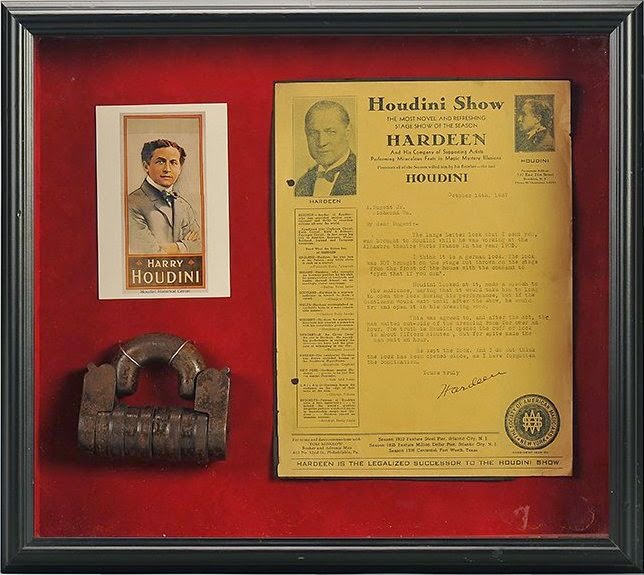
    What might have been the biggest surprise of the auction was a single combination padlock with an terrific letter of provenance from Hardeen that took away $16,000 (estimates was $7000 - $9000). Another surprise was a photo of Houdini leaping from a ferry that was estimated at $800 - $1000, but made a splash with $4,200.

    SOLD for $16,000.

    Speaking of photos, the image of Houdini in Russia grabbed $1,400, and the candid pic from Bess's birthday party inside 278 fetched $4000.

    SOLD for $8,500.
    Posters came in mixed. A 1905 German Art Nouveau poster found a buyer at $8,500, falling within its estimate of $8000 - $12,000 (but I thought it might do better). Buried Alive, which might be the only Houdini item in existence that seems to be decreasing in value, grabbed $8000 (estimate was $8000 - $12,000). But a King of Cards poster did unusually well at $17,000. Like Buried Alive, King of Cards has had trouble breaking above $10,000, but not today. It could be because this was the exact poster that magician Tommy Windsor used to create the first popular King of Cards reproduction in the 1950s.

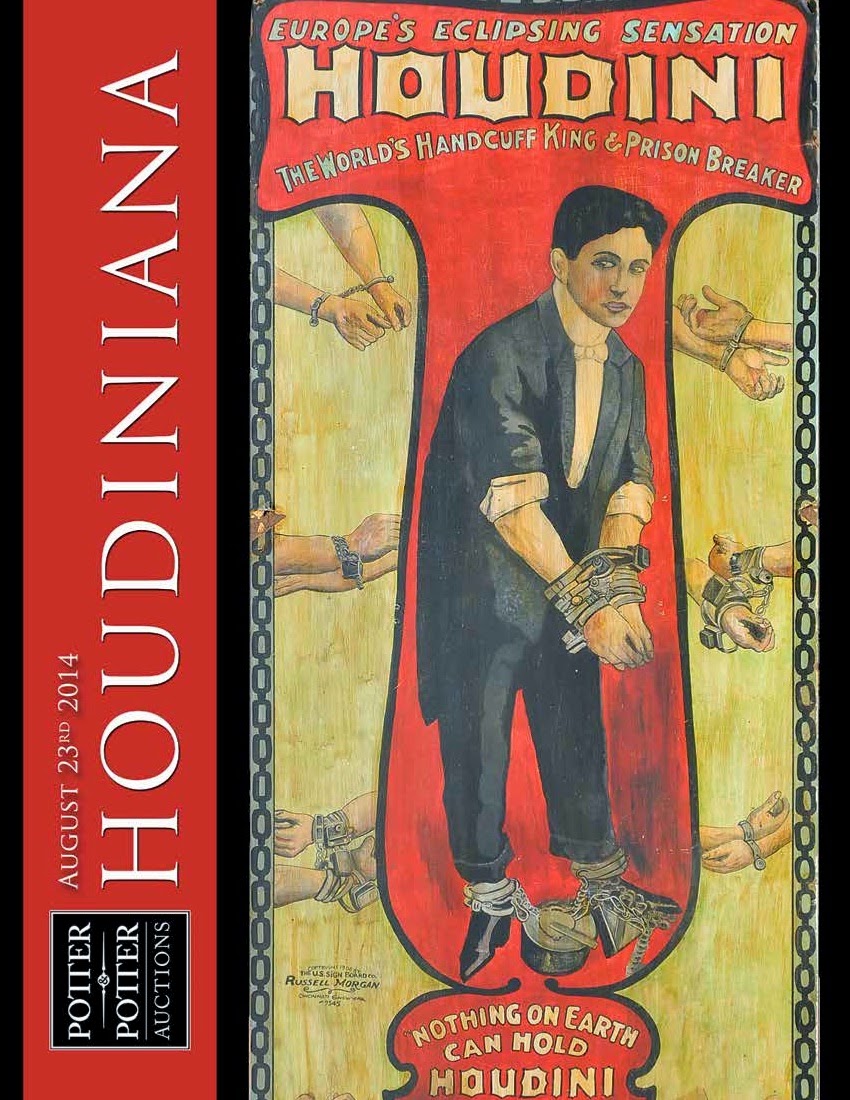
    The only pass in the auction (that I witnessed) was the large Europe's Eclipsing Sensation advertising board. Ironically, this is the item that graced the cover of the auction catalog. It had a whopping $25,000 - $35,000 estimate with a $15,000 opening bid; even higher than the Double Fold box!

    Overall, the auction was beautifully managed by Potter & Potter. Estimates were accurate and realistic, and many items met or beat their high end estimates. There were both breakouts and deals. (I'm kicking myself for flinching and not getting a terrific handwritten Bessie letter that went for only $250.)

    Congrats to all the buyers and sellers and to Gabe Fajuri at Potter & Potter Auctions. This will go down as one to remember!


    Related:

    Translate