Showing posts with label Ice exploits. Show all posts

Saturday, November 16, 2024

Deconstructing Houdini '53: Under the Ice

It was 49 years ago today that I first saw Houdini (1953), and it changed my life. What better day to continue my scene-by-scene dissection of the movie. Last time, Harry became an American sensation. But has he gone too far...

Chapter 18: Under the Ice

The following scenes are linked as one sequence, so I will treat them all in one post. This is arguably the most memorable sequence in the entire movie. It's certainly the most harrowing! But did any of it ever happen? Let's dive in.


We open with a procession of bellboys delivering buckets of ice to Houdini's hotel room. A strategically placed sign informs us this is Halloween Eve. The bellboys go into Houdini's bathroom and empty their buckets into the tub where Houdini lies in freezing water under a mound of ice. Otto tells the curious bell captain (Mike Mahoney) that Houdini is "going to jump into the Detroit River tomorrow."

Detroit? Halloween? This is starting to sound ominous.


Houdini in a tub of ice is a strange sight but a perfectly accurate one. Houdini did take extremely cold ice baths to prepare himself for his outdoor water escapes. However, Houdini did them at home under the watch of his doctor brother (Leopold) instead of in a hotel room. It's also unlikely that Houdini's baths had this much ice, but it's a great visual.

A flustered Bess enters and is taken aback by the entire scene. Notice Bess is dressed in all black -- a widow before the fact. She pulls Harry from the tub (or, rather, she tells Otto to pull him from the tub) and tells him the Detroit River is frozen over and he will have to cancel the stunt. Harry looks to Otto, who says casually, "We'll cut a hole in the ice."

Once again, we see Otto as a dark enabler, finding ways for Houdini to push into the higher realms of magic and death defiance. Bess is mortified by the idea, but Harry is delighted and even jokes about it. "If I had you with me under that ice, I bet we could set a new record." But then Bess cautions him that tomorrow is Halloween. "That's not your day." Houdini steels himself and says, "To me, it's just another Thursday."


This is a significant moment and a big change in Houdini's character. In his youth, Harry recognized the role fate played in his life, telling Bess, "Something strange always happens to me on Halloween." Now Bess is warning him that fate may be trying to send him a message. But Harry ignores them both. 

Is his skepticism due to hubris, or has he simply outgrown his youthful beliefs? The real reason may be expressed in his line, "The theater has advertised it for weeks; I can't back out now." He doesn't want to disappoint his audience. But we can't help but feel Houdini is entering into a stunt that is reckless in more ways than one.


We now dissolve to a beautiful shot (or rather, a beautiful matte painting by Jan Domela) showing the frozen Detroit River and what is, presumably, the Belle Island Bridge. Despite Otta saying Houdini would "jump" into the river, we see he's being manacled and locked into a steel box. Technical advisor Dunninger provided this box and claimed it was used by Houdini himself. However, there is no record of Houdini ever using a steel case for his overboard box escapes. (This box survives and is today displayed at the Laurel Canyon Houdini Estate.)

A construction crane hoists the box up and out over the bridge. But as it is being lowered, the chain breaks and the box plunges through the hole in the ice with no safety line attached. This was all staged in the water tank on the Paramount backlot, and it's sensational!


While panic ensues on the surface, we see the steel box land on the river bottom. After a moment's beat, Houdini emerges from behind it. This is similar to footage of the real Houdini escaping from an underwater box in The Master Mystery and Terror Island. This isn't by accident. The filmmakers had access to a print of Terror Island in the Paramount archives and studied it. Houdini producer George Pal even showed the scenes back to back on the television show You Asked For It.


Houdini swims to the surface only to find that he has been swept downstream under the ice sheet. He can not find the exit. He is trapped under the ice! He swims with growing panic until he finds a pocket of air. He takes a few merciful breaths, then plunges down and continues his search for the hole. This is every bit as frightening as it sounds!


Meanwhile, on the surface, Bess tells Otto, "I know he's in trouble. He should have been out by now." Otto orders hooks to be dropped into the water. The hooks snag the box and haul it to the surface. But when the box is opened, Houdini is not inside. Bess faints as Otto orders the lines dropped back into the water in the hopes that "he might see them."

We dissolve to several minutes later when it is clear Houdini has not been found. Reporters are leaving the scene with one saying forlornly, "Guess we got a headline." Another dissolve takes us to Otto, now standing alone by the hole in the ice, waiting for a miracle as the cold wind blows his coat. A magnificent shot.


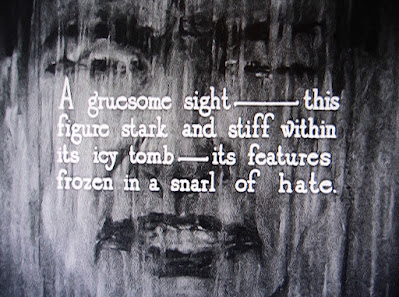
Okay, a quick fact check. Houdini did jump handcuffed from the Belle Island Bridge in Detroit in very cold temperatures in November 1906. But the river wasn't frozen. Houdini himself created the myth of being trapped under the ice. When Houdini (1953) was made, the story was believed to be true. It's in the Harold Kellock book, Houdini: His Life Story, on which this movie is based. It wasn't until 1959 that the true facts of the Belle Island Bridge jump came to light. So we can't fault the filmmakers for including this and embedding it into people's minds to this day. It's just so dang powerful!

Too bad Houdini is dead and our story is at an end.

Tuesday, November 12, 2024

Breaking the ice in 1959


On the eve of the publication of Houdini: The Man Who Walked Through Walls, this article appeared in the Detroit Free Press. I think we can classify this as the first public debunking of the famed trapped under the ice story. I like that the article credits the man who did the research for Gresham, the great Robert Lund (above), best known for his American Museum of Magic in Marshall, Michigan.

Detroit Free Press, Aug. 2, 1959.

Ironically, this article ends with a new myth about how Houdini may have escaped from the Mirror Handcuffs. It's Houdini myth whack-a-mole!

Of course, the best depiction of the under-the-ice myth is in the 1953 Houdini biopic starring Tony Curtis and Janet Leigh. Coincidently, that sequence is the topic of the next "Deconstructing Houdini '53," which I will be posting this Saturday.

Related:

Wednesday, July 6, 2022

Houdini freezes the Detroit river in 1912


Recently I came across this intriguing article from the February 11, 1912 Washington Post. The quotes here come from an interview Houdini gave while appearing at the Maryland Theater in Baltimore. It's short so I'm sharing the entire thing, but it's the last part that interests me the most.

The Washington Post, Feb. 11, 1912.

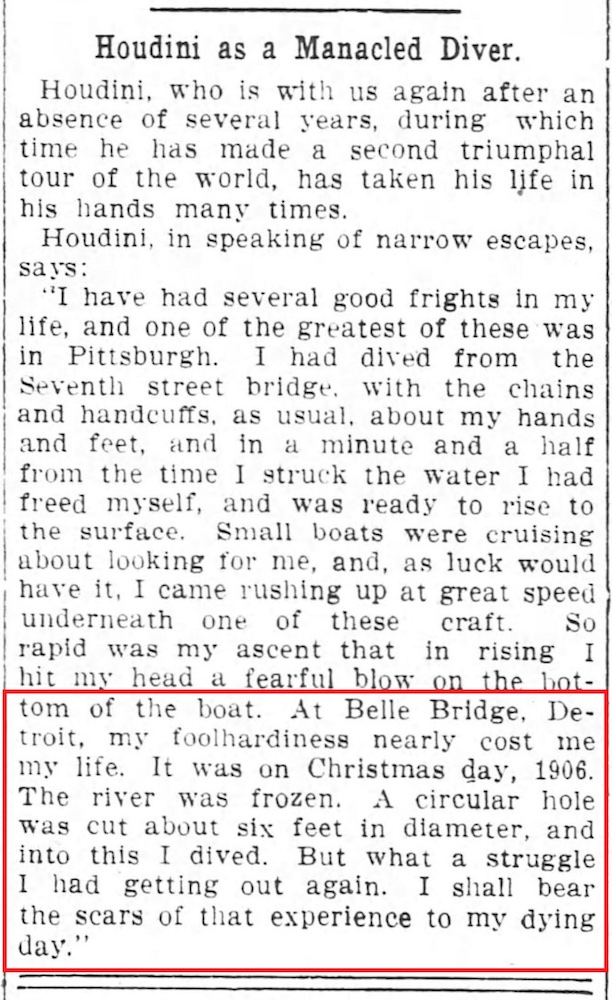
While I've not done an exhaustive search, I believe this might be the first mention of any bridge jump into a frozen river through a hole cut in the ice. Here it's the Belle Isle bridge in Detroit in 1906. That was a real jump, but the river was not frozen nor was it Christmas day. Still, this appears to be the genesis of the famous myth of Houdini being trapped under the ice of a frozen river.

Houdini would tell that story in full for the first time (as far as I know) in an article he wrote for the September 1918 issue of The American Magazine called "The Thrills in the Life of a Magician". But now he relocates the action to Pittsburg and doesn't provide a specific date. It's also become an overboard box escape instead of a handcuffed bridge jump.

The dramatic story was picked up by newspapers at the time, including the Boston Sunday Post below (click to enlarge):

Boston Sunday Post, Sept. 1, 1918

Houdini told the tale again in his 1919 article for Hearst's magazine, "Nearly Dying for a Living". But it's interesting to note that this story, as with other Houdini mythology, does not appear in any of his pitchbooks. It seems to me that Houdini made a distinction between disposable media, such as newspapers and magazines, and what he considered to be the official record. His pitchbook does record that he had to "break through the ice" during a bridge jump in Breman, Germany, which is likely true. That jump was made during a snow storm.

Later biographies made no such distinction, and the full under the ice drama became part of the official record with the publication of Houdini His Life Story by Harold Kellock in 1928. Interestingly, Kellock moves the action from Pittsburg back to the Belle Isle bridge in Detroit in 1906.

Then, of course, the 1953 biopic Houdini starring Tony Curtis dramatized the incident (beautifully) and cemented it in the minds of the public. In the movie the location remained the Detroit river, but the day was changed to Halloween(!). Also, as in Houdini's telling, it's an overboard box escape.

Houdini (1953)

The first doubt was cast on the story by William Lindsay Gresham in his 1959 biography Houdini The Man Who Walked Through Walls. Ironically, Gresham had been one of the recent propagators of the myth, publishing an account with fresh embellishments in SAGA magazine the previous year. But Gresham credited Robert Lund with tracking down the original newspaper accounts of the Belle Isle stunt and calls out the inconstancies, namely that the Detroit river was not frozen. He writes:

The river was not frozen over, Houdini had a rope tied around him all the time, he got out of two pairs of cuffs and was picked up by a boat! As for escaping from under the ice—as Tom Sawyer would say, "He just let on he done it."

The story largely disappears from Houdini books after that.

However, Hollywood doesn't let the truth get in the way of a good story, and the full under the ice drama was resurrected in the 2014 Houdini miniseries biopic starring Adrian Brody, this time relocating it to the Eads bridge in St. Louis. But by this point no one was fooled.

It's fun to see how this all appears to have started in Houdini's mind back in 1912 as a way to add some color to an interview. He understood what reporters wanted!


Below are some more posts related to Houdini's adventure under the ice.

Clipping source: Newspapers.com.

Thursday, January 27, 2022

Houdini's Frozen in Ice escape of 1911


Our friend Joe Fox, Assistant Librarian at the Magic Castle, recently made an intriguing discovery in the January 25, 1911 issue of The Magical World, a British weekly publication. In a column by editor Max Sterling is following item:

Harry Houdini, of handcuff and other fame, who has been appearing at the Nottingham Empire with huge success, has been confiding with a correspondent of the "Encore" that he "has another big surprise to spring up on the public." He avers that his tank act will be a "pup" to his new show, and I believe him. Clad in a diving suit––the helmet will contain an air enough to last him 10 minutes––he proposes with the aid of a glass box, to allow himself to be frozen solid. The freezing plant will be on the stage in full view of the audience. The squares of glass, brass fitted and jointed, constitute the box, and when the wily one is thoroughly frozen, the entire outfit is placed in his cabinet, and he does the rest by releasing himself, yet leaving the ice intact. How it is going to be done Houdini himself only knows, but he has tried it and accomplished the seeming impossible, I presume there will be no "frost" as far as he is concerned. The above show he proposes springing upon London in five or six weeks' time.

I always believed Frozen in Ice was a concept Houdini was working on near the end of his career. But here it is in 1911! While Houdini never did "spring" this upon London (as far as I know), this is still an exciting find as it offers the first and most detailed description of any frozen in ice escape that I'm aware of.

The use of a diving suit is entirely new. I also can't help but wonder if the glass box, "brass fitted and jointed", is the Water Torture Cell. The debut of the USD was still a year away (the "tank act" referred to here is the Milk Can), but the cell was likely in construction at this time. Could Houdini have been considering a very different use for the cell? Or could this all be a ruse to conceal the actual escape Houdini had in mind?

Houdini's Escapes by Walter Gibson contains a chapter on a "Frozen in a Block if Ice" escape. But that is a very different concept and Gibson offers no history behind it. The version that finally did make it to the stage was performed by Bess in 1927 but, again, a very different concept.

Gibson illustration (left) and Bess version (right).

Thank you Joe!

UPDATE: Joe Notaro of Harry Houdini Circumstantial Evidence has found another description in the January 15, 1911 "The Umpire" that provides a few more performance details:

The performer, having dressed for the part, will take his place in the water in a glass tank, the sides of which fit into brass sides, and the freezing process will be effected in sight of the audience by means of a special plant installed on the stage. When the refrigerator has got in its fine work, the glass slides will be removed, and the block of ice, with Houdini inside, will be placed under the canopy. A few seconds later the performer will reveal himself in kind friends in front, and the iceberg will be shown intact.

Fred Pittella of Houdini and Escapes Museum sends over a detailed look at how Bess's 1927 freezing effect operated. This sounds very similar to the "plant" as described in the 1911 clippings. I'm wondering if it was the same apparatuses?

Science and Invention, September, 1928.

Friday, July 1, 2016

Punching a new hole in the ice story

(First off, I find coming up with headlines the most difficult part of doing this blog. But this one is a masterpiece, if I do say so myself! Okay, moving on...)

Before he published his biography Houdini: The Man Who Walked Through Walls, William Lindsey Gresham penned a lengthy article about Houdini for the July 1958 issue of SAGA magazine. Titled "The Incredible Saga of Harry Houdini," it's a well-done piece, even though it contains more than a few dramatic enhancements, which I'm sure Gresham felt was necessary to fit with the style of this men's adventure magazine.

Among the episodes Gresham recounts is the entire story of Houdini being trapped under the ice of the Detroit River during a bridge jump. This, of course, is today considered Houdini mythology. But at the end, Gresham adds a surprise twist to the story that I've never heard before. He writes:

An old diver from Grand Rapids tells another variation of the story:

"Harry swore me to secrecy but I guess by this time he wouldn't mind it if I revealed the truth. The day before he was to dive into the frozen river, Harry and I went out there and cut a hole in the ice. Right there, at a spot just west of Woodward Avenue in Detroit, there was a lot of concrete piling submerged. Harry had me go down and anchor a big tin can upside down to a good heavy chunk of concrete. Then we filled the can with compressed air.

"The next day when he dived through the hole, he swam straight down, found the can and ducked up into it, breathing the air trapped inside it. He stayed down a good long time–the papers said eight minutes. Finally, when Harry figured that the reporters had gone back into town with the news of his death, he took one last good breath, slipped down out of the can and made for the hole in the ice. Later he spread that malarkey about those air bubbles. Harry would never get into anything dangerous unless he covered all the angles first."

While Gresham embellishes his Houdini antidotes in this article, he doesn't make anything up whole cloth, so I believe he may have actually heard this story from an "old diver." However, Gresham (with the help of Robert Lund) would go on to debunk the under ice story in his Houdini biography published just a year later. Maybe that's why he makes no mention of this twist in his book. The Tom Sawyer quote Gresham uses to describe Houdini's telling of the under ice drama could also apply to the old diver: "He just let on he done it."

The under ice drama as depicted in Houdini (1953).

A big thanks to Arthur Moses for providing me with the July 1958 SAGA article. Arthur owns the largest and most complete collection of Houdini periodicals in existence. In 2015, he published an updated edition of his Houdini Periodical Bibliography, which is a must have for anyone serious about Houdini research.

UPDATE: It looks like Gresham was NOT the original source for this diver's story. According to a post at One Tube Radio, in 1944, an annoymous letter was sent to Milwaukee radio station WTMJ after the station broadcast an account of the under ice drama. The writer stated that he was an "expert diver" and "one of Harry's accomplices on that day" and that he was paid $350 for his part. The writer added that "Harry rehearsed the trick in a brewery somewhere in the east" and that the anchored can "is probably still at the spot." You can read most of the letter HERE. Thanks to Joe Notaro.

Related:

Tuesday, June 14, 2016

REVIEW: Houdini & Doyle (ep. 7): Bedlam

Houdini & Doyle episode 7, "Bedlam", largely belongs to Doyle. The episode takes us not only inside the infamous insane asylum, but also inside Doyle's mind. Houdini remains on the outside.


A possible case of demonic possession is what brings Houdini, Doyle and Adelaide Stratton into action. The clues lead them to the Bedlam insane asylum, which we learn once held Doyle's mentally ill father (in reality, Doyle's father was in Sunnyside in Scotland).

This is one wild episode in which reality and hallucination mix as Doyle is put through a Shock Corridoor-type ordeal when he finds himself committed to the asylum under the control of a sadistic doctor. A highlight is that Doyle meets Sherlock Holmes himself, well-played Scottish actor Ewen Bremner. Of course, this is a mental institution and "Sherlock" is a patient who only believes he's the great detective...or is he?

Doyle meets Sherlock Holmes.

On the outside, Houdini engages in a race against time to save Doyle, while also trying to help Adelaide unravel the mystery of her deceased husband. Turns out he was involved with Polish anarchists who might be targeting Adelaide next.

The climax has Doyle coming to terms with the memory of his alcoholic and mentally ill father. It's too bad show creator David N. Titcher, who wrote this episode, couldn't contrive to get Houdini into a straitjacket. Seems like this wouldn't have been too difficult in an episode set in an insane asylum. But we do get a fun line of dialogue when Houdini meets a confined patient.

"Nice jacket. I have one just like it at home," he says.

Just the Facts

As I said, this episode largely focuses on Doyle, so there isn't as much Houdini history for us to chew on this time. But there is some. Early in the episode, Houdini mentions his "Lake Michigan stunt" in which he was trapped beneath the ice of a frozen river. Check out that moment below:


Of course, this is a reference to a famous bit of Houdini lore, said to have occurred at the Belle Isle Bridge in Detroit in 1906. But the trapped under the ice story, so memorably depicted in Houdini (1953), is a myth. While the waters of the Detroit river were icy cold that day, the papers make no mention of an ice sheet or a dramatic accident. [Although I'm currently corresponding with someone who might have evidence to the contrary. Stay tuned!]

Another fact worth mentioning is in regards to Houdini and Doyle's father. In the 1920s, Houdini won in auction a portfolio of artwork done by Charles Doyle. After Houdini's death, Bess returned it to Sir Arthur, prompting the author to write her back:

"The book arrived and filled me with surprise... It really seems like a series of miracles–first that it should exist still, then that it should cross the Atlantic, and finally that it should come back home. I accept it as a peace-offering from your husband, and I thank him as well as you."

Artwork by Charles Doyle.

This episode once again has Houdini make a statement that suggests he's an atheist. This was something I tackled in my fact check of episode 3. [Quick answer: he wasn't.]

Finally, as far as Sherlock Holmes is concerned, Houdini himself has had many fictional encounters with the great detective, starting in the 1908 German dime novel, Auf den spuren Houdinis, and most recently in the 2015 graphic novel Sherlock Holmes vs. Houdini. But in 1908, Houdini wrote a letter to Holmes as if he were a real person.

Click to enlarge. (Source: Houdini The Key)

Is this letter just for fun, or did Houdini belong in Bedlam? I'll leave that up to you to decide.

Next Monday: Houdini & Doyle meet Bram Stoker in "Strigoi."

Related:

Friday, January 22, 2016

Duffy Hudson brings Houdini to life in South Pasadena


Last night I had the pleasure of attending Duffy Hudson's one man performance as Houdini at the annual meeting of the Friends of the South Pasadena Public Library in beautiful South Pasadena (where Houdini once visited the Huntington Library). It was a terrific show. His hour plus performance was extremely well researched and structured, delivering equal amounts of magic, drama, and information about Houdini's life in a unique way. Duffy clearly gave it his all and received standing ovation for his efforts.

The Community Room in downtown South Pasadena was jam-packed with people of all ages (the event was advertised as "free and family friendly"). Duffy made his entrance as "Harry Houdini" bound in a period straitjacket. As he struggled to escape, he recounted the early days of Ehrich Weiss. When he spoke of how Ehrich one day poured coins into his mother's lap, coins sprung from his straitjacket as he finally broke free. Nice.

Hudson is an actor who specializes in one man shows (he also does Einstein, Edgar Allen Poe and George Burns), so all his "recollections" where infused with dramatic flair. His description of the torturous Hodgson challenge was a standout for me. He pantomimed the entire ordeal; his vivid depiction of how Houdini was thrust up in shackles by the strong man would have made Patrick Culliton proud (Pat's the great authority on the Hodgson challenge). By the time he bounded free, it was as if I was there in Blackburn applauding Houdini's escape.

Hudson also brought to life the Mirror Challenge (including liberating himself from his coat while cuffed), the Buried Alive, and his ordeal being trapped under the ice of a frozen river. Yes, this last one is a fiction, but Houdini himself would tell this story, so you can't really fault him for including it. And I was impressed that he located the escape in Pittsburg, as Houdini would tell it, instead of Detroit as established in Kellock (and Curtis). This told me Duffy knew his subject and really took pains to be Houdini that night.

Duffy also performed magic as part of the show. He teased out a terrific card trick and did the Needles as part of his finale. At one point he invited the whole audience to hold their breath as long as he, Houdini (3 minutes). Incredibly, one man in the audience did it!

Missing from the evening were mentions of Houdini's aviation and movie careers. Also, being Houdini, he couldn't necessarily recount his the details of his own death. But nothing felt lacking. There were many young people in the audience, and unless their parents explained to them the nature of the show, it's amusing to think how may will carry forward a memory of once "seeing Houdini."

Afterwards, people lingered and there were pockets of conversation about Houdini. I introduced myself to Duffy and was flattered that he was familiar with my blog and it had aided in his research. Up close, I could see he was wearing a Masonic pin on the lapel of his tuxedo jacket. Like Houdini, Duffy is a Mason, so this was a nice authentic touch.

I learned about this show last minute, so I felt lucky to have attended, and was happy to come away with one of the show posters the library was handing out. I didn't get great photos, but there was a photographer there from South Pasadena Now, so maybe some better images will show up online.

Here's hoping we will be seeing more of Duffy Hudson as Houdini.

Related:

Thursday, February 19, 2015

The Belle Isle Bridge jump

On Tuesday, November 27, 1906, Houdini leapt manacled from the Belle Isle Bridge in Detroit, MI, freeing himself from two pairs of handcuff beneath the cold waters. The Belle Isle Bridge jump is one of Houdini's most well-known feats, largely because of a fiction created about this escape.

In later accounts, it was claimed that the Detroit river was frozen and a hole had to be cut in the ice. This provided Houdini with an additional horrifying dilemma when he found himself trapped under the ice. This dramatic version appeared in the first major Houdini biography, Houdini His Life Story by Harold Kellock, and passed as fact for many years.

When I was a young Houdini enthusiast in 1980, I did my first primary research on the Belle Isle Bridge jump. I wrote to The Detroit News and received this front page from November 27, 1906, which records the details of the actual escape. The first thing to notice is that while the weather report shows it was cold enough for snow flurries, it was not freezing, nor was the river frozen over. But this was still an especially chilly jump for Houdini, and while not the dramatic fiction, it still has several points of interest.


One piece of surprising information this newspaper account provides is that the jump was provoked by an encounter with a rival handcuff king identified only as "Grose" (possibly Russell P. Grose). Apparently, Grose boasted that he could escape from the Wayne Country Jail. Houdini, who was appearing at the Temple Theatre at the time, said the jail was "too strong and too perfectly locked for any man to get out without a confederate inasmuch as a man placed in the center cell is 20 feet from any possible lock." Houdini offered Grose $300 if he could free himself. The paper reported Grose was unable to secure permission to attempt the escape.*

Houdini then offered to demonstrate his own skills by making a jump from the Belle Isle Bridge, a 2193 foot span that connects the city of Detroit to Belle Isle Park. Houdini arrived at 1pm with the Secretary of Police, Charles A. Nichols; the Temple Theater Press Agent, John H. Finn; and several reporters. Houdini admitted that while he had made jumps like this before, he had never done one in such cold weather. He was then cuffed with "two of the best and most modern handcuffs" and tethered with a 113 foot safety line ("used solely to save Houdini's life should he get cramps"). Houdini then climbed over the railing, looked down at the water 25 feet below and said, "It's pretty far. Come what will", and jumped.

The paper reported that Houdini stayed near the surface and even came up for air once before freeing himself from the cuffs in just under a minute -- "in spite of the handicap of a cramp that paralyzed his left hand when he struck the icy water." Houdini then swam to a waiting life boat, "safe, but half frozen."

Curiously, the paper makes no mention of crowds of onlookers. It's possible this jump was performed solely for the newspapermen and not advertised in advance. The safety line is another curiosity as it is the only time I've ever heard of Houdini taking such a precaution during a bridge jump. Again, maybe the cold was the reason for this.

So why would Houdini do what appears to have been an impromptu bridge jump in poor conditions? This is only speculation, but it could be he wanted to avoid taking on the Wayne County Jail himself, but still wanted to give the Detroit press boys a story. He might have also wanted to do something that Grose would be reluctant to imitate. In both regards, it worked like a charm. Houdini received nice front page news coverage and Grose vanished from magic history.

As far as I know, there are no photos of Houdini's Belle Isle Bridge jump. Even the Detroit News elected to use a standard Houdini publicity shot. However, today the AP credits a photo of Houdini's 1912 overboard box escape in New York as being the Belle Isle Bridge, so that image repeatedly shows up online as such. But we know better.

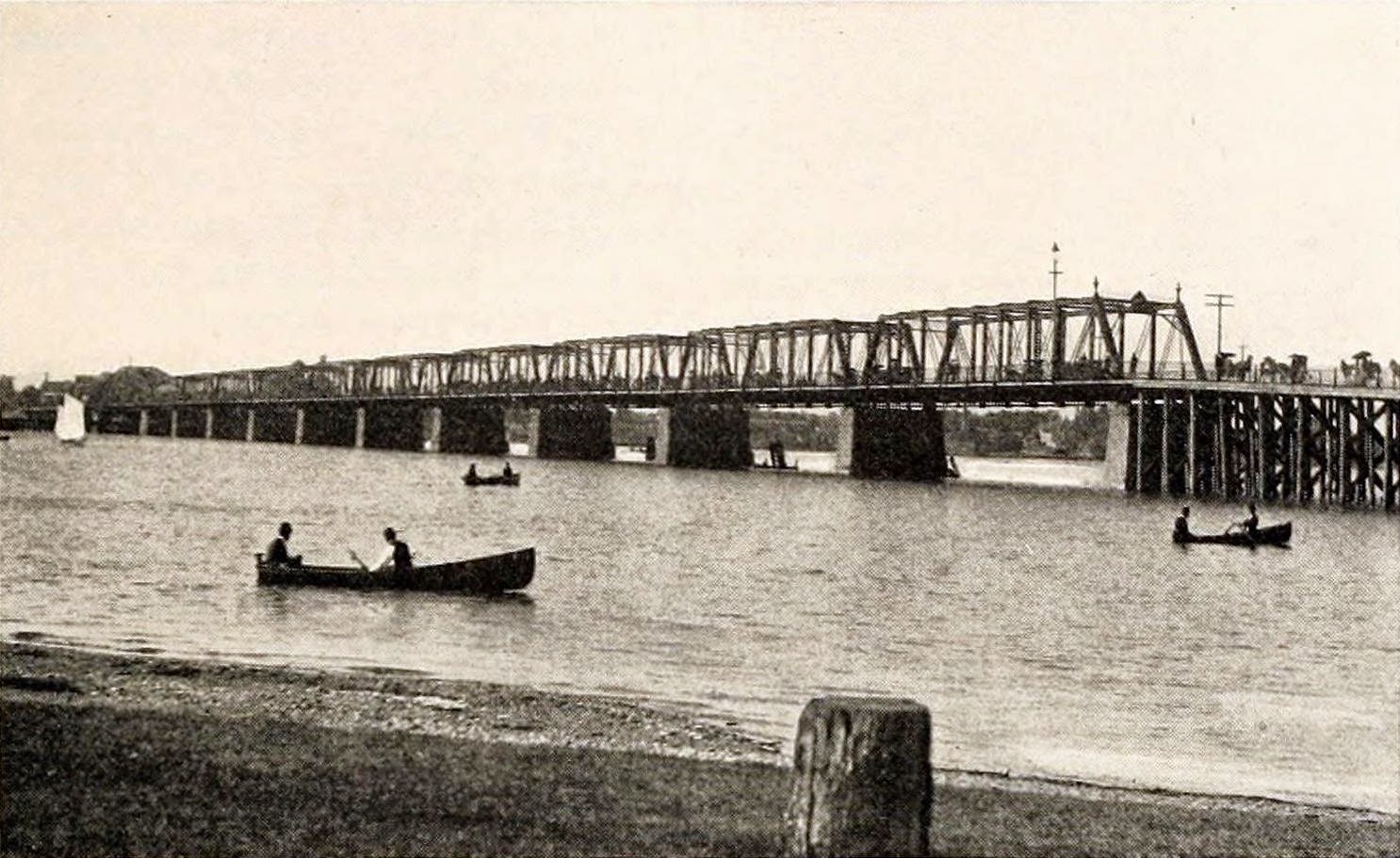
The current Belle Isle Bridge (renamed the MacArthur Bridge in 1942) is not the same bridge Houdini jumped from in 1906. Houdini jumped from the first Belle Isle Bridge, which was constructed in 1889 and was a steel and wood bridge for pedestrians. That bridge burned down in 1915 and was replaced with a temporary structure. The current bridge, made of reinforced concrete, opened in 1923. It underwent a major restoration in 1986.

The original Belle Isle Bridge from which Houdini jumped in 1906.

The Belle Isle Bridge today.

*UPDATE: It looks like Grose did attempt an escape in a story not yet told. Stay tuned!

Thursday, December 11, 2014

Extreme Escapes escapes reality

The second episode of REELZ Extreme Escapes aired last week. During the show, magician and escape artist Spencer Horsman, who did a pretty thrilling underwater box escape, said something utterly perplexing.

Spencer appears to have said there was "debate" whether Houdini ever actually performed his Water Torture Cell -- that he might have only ever had a poster made because the escape itself was "too dangerous."

Now, there's no way Spencer doesn't know that Houdini performed his Water Torture Cell for half his career. What I think happened is that Spencer was talking about Houdini's Buried Alive, and the show editors cut together his words to make it seem as if the Water Torture Cell was the subject. This is the danger of "reality" shows. They create whatever reality they require.

In other segments, our friend David Merlini performed a spectacular frozen-in-ice escape. This was an escape Houdini wanted to do but could never work out with the technology of his day. David's version seemed to be everything Houdini could have imagined, and I truly have no idea how he survived.

Michael Turco did a cleverly staged mine shaft escape. Escape artist Jan Rouven performed an inventive "Jaws of Death" suspended straitjacket, although I'm afraid it gets a thumbs down from me as Jan employed a blatant straitjacket fail.

Extreme Escapes airs every Friday on REELZ TV.

Related:

Friday, November 28, 2014

AHC separates Houdini facts vs. fiction


Houdini is the subject of a new episode of America: Facts vs. Fiction called "Masters of Illusion" (Season 2, Episode 8). The episode also features P.T. Barnum and premiered November 25 on AHC (American Heroes Channel).

The episode primarily debunks the myths that physical abnormalities aided Houdini's escapes (such as the ability to dislocated his shoulder), that he was trapped under ice during a bridge jump, and the belief that he died in his Water Torture Cell. However, their conclusion that the Whitehead punch did not cause Houdini's fatal appendicitis is still debatable.

Houdini is portrayed in the reenactments by James Christopher Crooke (above). The episode also features clips from Haldane of the Secret Service, The Man From Beyond, Terror Island, and Houdini (1953).

The show was well done and the focus on facts is a welcome change from the shameless myth-making of shows like Brad Meltzer's Decoded and, of course, that recent effort by our friends at HISTORY.

You can buy America: Facts vs. Fiction: Masters of Illusion as a download on Amazon.

Related posts:

Monday, September 1, 2014

Fact checking HISTORY's Houdini - Part One


After one night, HISTORY's Houdini miniseries starring Adrien Brody is on track to be the least accurate Houdini biopic ever made, and that's saying something. Nicholas Meyer's screenplay freely jettisons fundamental facts to make room for complete fictions. (More on that in my review on Wednesday.) Unfortunately, people believe what they see on TV -- especially when the network is called HISTORY -- so here are some points of clarification:

Did Houdini get trapped under the ice of a frozen river?
Even though Houdini himself would tell the story of being trapped under an ice sheet during a bridge jump, there is no evidence that it ever happened, and Houdini would alter the location and details in various tellings. But he never claimed his mother's voice or any supernatural power led him to the opening in the ice. He found his own way to freedom. (Read: Trapped under the ice with Houdini.)


Did Houdini have issues with his father?
Houdini spoke very highly of his father and honored him his entire life. Any suggestion of "daddy issues" is purely speculative. It is true that Rabbi Weiss lost his job in Appleton for being too "old world" (he didn't speak English), and this plunged the family into poverty. The story of him having to flee Budapest after killing a man in a duel was told by all the Weiss children. Some biographers doubt it as being too far fetched, but duels in Hungary were not unusual in the 1870s. (Read: Who was Houdini's father? New insights.)

Did Houdini run away from home and work with a traveling magician?
While it's true that Ehrich Weiss (the miniseries misspells it as Erich - grrrr) ran away from home when he was 12, he did not work with a traveling magician. This is a fiction seemingly lifted from a 1987 Disney movie called Young Harry Houdini. However, it is true that his interest in magic was inspired by the autobiography of Robert-Houdin, and that he took his name from the famous French conjurer. (Read: Homeless Houdini.)


Did Houdini live in Brooklyn?
The Houdini miniseries shows Harry growing up and later buying a large home in Brooklyn, NY. Not true. The Weiss family lived in a tenement in mid-town Manhattan, and Houdini later bought a large brownstone in Harlem. Likewise, the Weiss family plot is located in Queens, not Brooklyn. (Read: Discovering the home of Houdini.)

Did Houdini meet Bess when they were both performers in Coney Island?
While there are several romanticized stories of how Houdini and Bess met, screenwriter Nicholas Meyer opted for the truth here. Houdini did indeed meet his wife Bess at Coney Island while she was performing as part of an act called The Floral Sisters. They had a whirlwind courtship and married only a week after they had met. (Read: When Harry Met Bessie.)


Did Houdini create the challenge handcuff escape act in a brothel?
Houdini worked to perfect his challenge handcuff act over several years, and may have gotten the idea from an Australian magician named Lewis Paul. While Harry and Bess performed in Dime Museums, Beer Halls, Circuses, and traveling Burlesque shows, there is no record of them ever performing in a brothel. Besides, aren't brothels their own entertainment? UPDATE: Turns out this is based in fact. Read: The Houdinis in the bordello.

Did Houdini perform escapes as The Wild Man from Borneo?
While Houdini did briefly appear as "Projea The Wild Man of Mexico" in the Welsh Bros. circus, it had nothing whatsoever to do with his magic or escape act. Harry and Bess took on many side jobs during their travels with the circus. Houdini quit the Wild Man when he got hit in the eye with a piece of meat thrown into his cage by Clint Newton, ringmaster of the Welsh Bros. Circus.. (Read: Freaks of Octoberfest.)

Did Houdini achieve fame after escaping from a "Johnson County" jail in 1896?
Houdini performed handcuff and jail escapes in various cities across the U.S. in the late 1890s, they did not bring him recognition beyond that city. The idea that Houdini was "the most famous man in America" by the turn of the century is wildly incorrect. While he had achieved a measure of success in America by 1900, his true breakout success came in Europe. Houdini did not really become a star in America until his return in 1905. (Read: Houdini at the Colonial.)


Did Houdini do escapes in the nude?
To prove he concealed no keys or lockpicks, Houdini would strip nude and submit to an examination by a doctor during his jail escapes. But Houdini would also sometimes strip nude on stage during handcuff challenges, and even advertised himself as "Positively the only conjurer in the world who strips stark naked." He once even performed his Milk Can escape au naturale. He had a powerful physique and wasn't afraid to show it off. (Read: Ebay auction dates Houdini's first 'nude')

Did Houdini hire a magic store clerk named Jim Collins to create his effects?
Houdini's chief assistant and mechanic was named Jim Collins and he did have a genius for designing magic and escape effects. However, Houdini did not impulsively hire him out of an Ohio magic store, and Collins was not an American from Georgia. Jim Collins was born in England, possibly Portsmouth, and it was there that Houdini hired him to be his assistant. (Read: The man who kept Houdini's secrets.)


Was the Water Torture Cell Houdini's first major stage escape?
The Water Torture Cell was not Houdini's first major stage escape and certainly not invented in 1900 as shown in the miniseries. The USD, as Houdini called it, was the culmination of many escapes that came before it (including the Milk Can) and was first performed in Germany in 1912. Also, the idea that Houdini would be revealed as one of his own axe-wielding assistants at the end is not accurate. This "magical" spin on the Water Torture Cell was first performed by Doug Henning in 1975. (Read: The Chinese Water Torture Cell at 100.)

Was Houdini a spy?
Houdini was friendly with law enforcement and took great interest in the methods and practices of criminals and con-men. He even penned a book on the subject in 1906 called The Right Way To Do Wrong. While he might have communicated with William Melville of Scotland Yard about what he was observing in Germany and Russia (and even the "evidence" for this is paper thin), to show him working as a full-blown spy and using his magic act as "cover" is ludicrous. In fact, MI5 didn't even exist during Houdini's first tour of Europe. Of all the fictionalizations in the Houdini miniseries, this is by far the worst, and trying to work this fiction into the story is one of the reasons the movie so badly mangles the facts of his early career. (Read: Experts weigh-in on 'Secret Life' spy revelation.)


Did Houdini do the bullet catch for Kaiser Wilhelm II?
While it's possible Houdini might have done the bullet catch early in his career, he never did it during his fame, and certainly not for Germany's Kaiser in a private performance, as shown in the miniseries. After his friend Chung Ling Soo (William Robinson) was killed onstage doing the catch in 1918, Houdini announced that he would attempt it himself. But he was talked out of it by magician Harry Kellar. This gave the Bullet Catch an even more ominous reputation as being a trick so dangerous even Houdini wouldn't try it. (Read: Did Houdini do the bullet catch in the 1890s?)


Did Houdini ring the bells of the Kremlin?
Like the hole in the ice, this story comes from Houdini's time, but no verifiable source (such as a newspaper account) has ever surfaced to prove that it actually happened. It also tends to change from teller to teller, one of whom was Orson Welles, a great teller of tall tales. And while Houdini did perform for members of the Russian Royal Family in Moscow, the idea that Rasputin was among the gathering is not possible. Houdini toured Russia in 1903 and Rasputin did not meet the Russian Royal Family until 1905. (Read: Orson Welles remembers Houdini.)

Did Houdini give his mother a royal reception in Budapest?
It is true that Houdini brought his mother to Europe and gave her a lavish "royal" reception with relatives in Budapest. The dress Houdini had purchased for her was said to have been designed for Queen Victoria before her death. However, Houdini did not pour gold coins into his mother's lap on this occasion. He did this privately when he asked for his salary in gold coins so his could fulfill a childhood promise to his mother that one day he would pour gold into her lap.


Did Houdini fall apart when we saw Bess sitting on the lap of another man?
This is actually true. Bess purposely planted herself on the lap of a young Colonel to see if she could make her husband jealous. It worked. However, showing Houdini getting drunk is not accurate. Houdini was a well-known teetotaler. But for months, Houdini would be thrown into a deep funk if anyone around him used the word "Colonel."

Did Houdini engage in bondage sex with Lady Butler?
Houdini did not have an affair with British painter Elizabeth Thompson aka Lady Butler, nor is there any indication that they ever even met. And as far as we know, Houdini didn't indulge in any sexual fetish. He was quite puritanical in matters of sex. However, there is evidence that he did have at least one affair with Charmian London, the widow of Jack London. (Read: The illicit loves of Harry Houdini.)


Did Houdini own and fly his own airplane?
In 1909, Houdini became fascinated with aviation and purchased a Voison biplane. He flew in exhibitions in Germany and became the first man to ever fly a plane in Australia. However, the depiction of Houdini barnstorming across Europe with Bess on board is fiction. As with almost all planes at the time, Houdini's Voison could only hold a pilot and was not capable of sustained and reliable flight for travel. (Read: Houdini was the 25th person to fly.)


Did Houdini resent and resist early cinema?
Houdini embraced cinema almost from the start of the medium. He made a short film in Paris in 1909 and also filmed many of his outdoor escapes which played before his vaudeville act. Seeing Houdini frequently meant seeing a film. He was actually a pioneer of the medium. (Read: 'Houdini Defeats Hackenschmidt' and other revelations.)

Did Bess Houdini smoke pot?
The same biography that gave us the "spy" theory also claimed that Bess Houdini smoked pot. This comes from a 1927 note in which she mentions that she dined out with "no drink and no weed." However, "weed" was slang for tobacco, so it's more likely she is talking about cigarettes (she did smoke). While Bess enjoyed her champagne and did have trouble with substances after Houdini's death, the extent of her drinking during their marriage is unknown, and the suggestion that she was an alcoholic is speculative. (Read: Did Bess Houdini smoke pot?)


Did Houdini's career falter in 1914?
Houdini's audience never tired of escapes. If anything, it was the opposite. The audience expected and demanded escapes from Houdini even when he tried to mount a straight magic act. Houdini's fame and career was actually at a pinnacle in 1914. (Read: The untold story of Houdini's 1914 Battery Park escape.)

Still watching? The good news is Part Two is a big improvement over Part One as far as the facts are concerned. I will post a Fact Check of Part Two tomorrow. And if there's a question that I haven't answered above, please post it in the Comments section below and I will answer you there.

Wednesday, July 9, 2014

Producers talk Houdini miniseries

World Screen News has posted this clip of executive producer Gerald W. Abrams and Sandra Stern, the COO of television at Lionsgate, discussing the upcoming Houdini miniseries. Abrams confirms that it will be a "cradle to grave" biopic, that it will included almost 300 special effect shots, and that it will open with Houdini's (fictional) hole in the ice bridge jump.


Houdini stars Adrien Brody as Houdini and Kristen Connolly as Bess. The 4-hour miniseries is directed by Uli Edel and will air over the course of two nights on HISTORY starting September 1, 2014.

Monday, April 14, 2014

LINK: Is Hardeen full of ice?

Our good friend Joe Notaro of Harry Houdini Circumstantial Evidence has uncovered Hardeen's very own version of being "trapped" under ice during a bridge jump, as told in his pitchbook, The Life and History of Hardeen. Hardeen's version isn't quite as dramatic as his brother's harrowing adventure, but that's the story of Hardeen's life, isn't it?

One wonders if Hardeen's story is any more true than Houdini's. It would be interesting if Hardeen's story is what inspired Houdini to create his own far more dramatic version. Or maybe the brothers shared stories just as they shared props and poster art, etc.

Click on over to Joe's blog and read all about Hardeen's own under-the-ice exploit.

Translate