Showing posts with label Dai Vernon. Show all posts

Tuesday, April 14, 2026

Bonkers About Bessie!

Our friend Dean Carnegie at The Magic Detective Podcast has an episode devoted to Bess Houdini. Some stories here I've not heard. Enjoy.


Dean also has a lengthy post about Bess on his Magic Detective blog: The Life of Bessie Houdini. As Dean says, we're "Bonkers About Bessie" for this month! 


Tuesday, July 11, 2023

Michael Albright to design the Houdini diary book

I have some exciting news today about the upcoming Houdini diary book. Michael Albright has come onboard as the book's designer. If you check out Michael's official website, you'll see why this is such great news. He is an artist and a superstar in the world of design.

Michael designed the Dai Vernon book Revelation for Mike Caveney, who is also publishing the diary book. Says Mike, "I have published over 50 books on the history and practice of Magic but the one Michael designed has been called not just the most beautiful book I have ever published, but the most elegant book in the magic world."

This book will reproduce every page of Houdini's very first travel diary from the collection of Dr. Bruce Averbook, along with annotations written by myself and images from major collections. How all those elements come together is a design challenge, so it's in the right hands! I can't wait to see what Michael Albright does with Houdini.

UPDATEEscaping Obscurity: The Travel Diary of Harry Houdini 1897-1899 is now available exclusively from Mike Caveney's Magic Words.

Sunday, February 6, 2022

The Professor fooled Houdini 100 years ago today

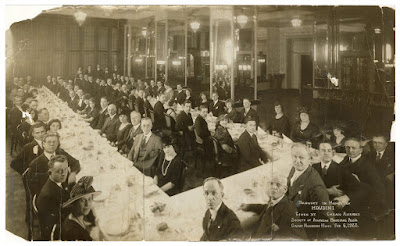
It was 100 years ago today that Dai Vernon fooled Houdini with his Ambitious Card at an S.A.M. banquet at the Great Northern Hotel in Chicago. To mark the occasion, here's video of The Professor himself doing that very trick. This is from a 1976 Canadian show, Celebrity Revue, hosted by Carol Taylor and Peter Pit.


Vernon did the trick for Houdini seven times and, it's my understand, varied his method each time. He would forever pride himself on being "The Man Who Fooled Houdini." Vernon's own mementos from that night sold last year at a Potter & Potter auction, including the group photo below.


What I'd love to know is what happened to the signed four of diamonds?

Thursday, January 6, 2022

Houdini in 1922

Let's kick off 2022 with a deep dive into what Houdini was up to 100 years ago.


Houdini had a foot in two worlds in 1922. He had returned to vaudeville with his tried-and-true escape act while also preparing to release his first solely produced motion picture. But it was a visitor from England who would set Houdini on the path to a remarkable third act of his life and career.

The new year began with Houdini playing the Palace Theater in New York's Times Square. To herald his return, he performed a suspended straitjacket escape from the theater's facade on January 5. Just like old times, he ran afoul of the New York City police who tried to stop the escape. But Houdini got into the air before the police could push their way through the crowd. On his assent Houdini yelled down to an irritated officer, "Talk to the theatre manager. I'm busy." Before the week was out, Houdini and press agent Walter J. Kingsley found themselves at the West Side courthouse facing a charge of blocking traffic.

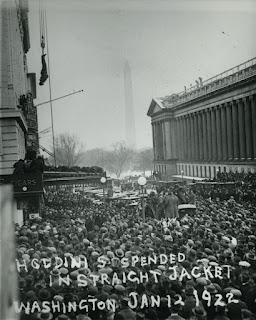
The next stop was Washington D.C. where a suspended straitjacket escape from the Albee building at 15th and G Streets drew a massive crowd. Houdini and Bess met President Harding at The White House, and former President Woodrow Wilson saw Houdini escape his Water Torture Cell at Keith's. The Maryland Theater in Baltimore followed. A review in the Evening Sun complained: "Houdini spends about 10 minutes telling of his greatness...performs two tricks that he has been showing for years." But the old tricks seemed to be just what audiences wanted, and Houdini's suspended straitjacket escape from the Munsey Bldg. in downtown Baltimore drew the usual throng.

The tour continued at a pace with Houdini playing the major Keith houses in Philadelphia, Cleveland, Chicago, St. Louis, and Pittsburgh. In almost every city he performed a suspended straitjacket escape and drew sold out houses. Houdini credited the publicity generated by his films as the reason for his continued popularity on stage. He was right. Even though he had been absent from American stages for three years, his name was never out of the newspapers and the Jazz Age had embraced him as a cultural icon. Flappers even adopted his name into their vernacular; "A Houdini" meant to be on time for a date.

The tour also brought Houdini into contact with the local chapters of a thriving S.A.M., and many would host banquets for their Most Illustrious President. While attending one of these "Houdini Nights" at the Great Northern Hotel in Chicago, Houdini was fooled by a young Canadian sleight of hand artist who employed a clever manipulation of the Ambitious Card. The incident didn't warrant further mention from Houdini, but the young magician, Dai Vernon, would for the rest of his life tout himself as "The Man Who Fooled Houdini."

That same week Houdini attended a monkey gland transplant operation on an 80-year-old man. The procedure, pioneered by Dr. Serge Voronoff, involved inserting thin slices of monkey testicles into a man's scrotum where the graff would fuse with human tissue. Voronoff promised his treatment would restore vitality, enhance libido, improve eyesight, and even prolong life. Houdini's interest in the procedure and its surgeon, whom Houdini playfully called "Transplantor," isn't entirely clear. Was he merely investigating a modern "miracle monger", or was he considering having the procedure to restore his own flagging vitality? After the operation Houdini wrote to a friend: "It looks as simple as rolling off a slippery log."

While performing at the Davis Theater in Pittsburgh, Houdini was saddened to learn of the death of Harry Kellar in Los Angeles. Kellar had become a mentor and father figure to Houdini. Unable to attend the funeral, Houdini sent a telegram of condolence to Kellar's niece and arranged to have the funeral filmed. He also wrote a eulogy for the magician on the train back to New York where he would wrap his tour with an engagement in Brooklyn. That month also saw the release of his new book, Houdini's Paper Magic, a collection of magic tricks and puzzles largely compiled by his late secretary, John Sargent, for whom Houdini dedicated the book.

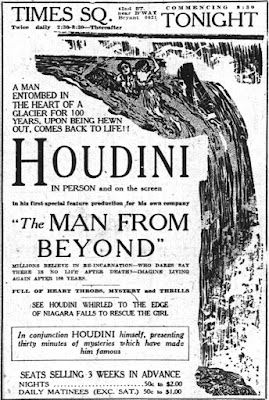
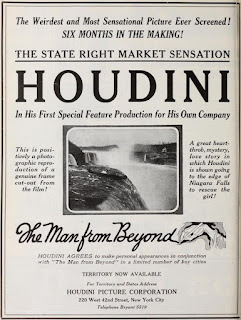
Houdini wasted no time in surging to his next venture. Having failed to entice Paramount into releasing his first Houdini Picture Corporation production, The Man From Beyond (filmed in 1921), Houdini decided to distribute the movie himself. To generate awareness, he booked an exclusive engagement at the Times Square Theatre, which stood across the street from the Houdini Picture Corporation offices. To ensure packed houses, Houdini developed 30 minutes of stage magic that he would perform after each showing. He even revived the vanishing elephant which had so thrilled New Yorkers back in 1918.

The day of the premiere, April 2, Houdini paraded his two Ringling Bros. elephants, Lucy and Fannie, along Broadway. But in an oversight that betrayed his inexperience as a distributor, Houdini was informed that the film still lacked the necessary certificate from the New York Censor Board. The premiere went ahead as planned, but Houdini was unable to charge admission. (The film received its certificate the following day.) The elephants also proved to be harder to handle than the affable Jennie from the Hippodrome. One of the elephants spooked when a loading dock ramp cracked beneath its feet and refused to enter the theater. Faced with an unbudging elephant on 42nd Street, a new door was cut in the theater wall which the elephant found acceptable. While both elephants were smaller, Houdini reportedly still used his gigantic Hippodrome cabinet to do the vanishing.

The Man From Beyond with "Houdini in Person" would run three weeks at the Time Square. Reviews of the movie were mixed. Many questioned how Houdini's 100-year-old man could remain blissfully unaware of the passage of time until he was told, despite riding in an automobile. However, there was wide agreement that the climatic action at Niagara Falls was thrilling and in league with the climax of the D.W. Griffith hit, Way Down East. They were right. For all the film's flaws, Houdini and his editor had created a powerful piece of cinema magic with a skillful combination of footage shot at various locations. Houdini showcased the reviews in a half-page ad in Variety as "The greatest praise ever accorded any screen production."

That same month Sir Arthur Conan Doyle arrived in America for a lecture tour proselytizing Spiritualism. Doyle showcased spirit photographs and spoke of his own personal experiences with the Other Side. Audiences packed his lectures and gasped as his slides flashed across the screen. Houdini attended one of the first lectures at New York's Carnegie Hall. Doyle, in turn, saw The Man From Beyond at the Times Square and gave the film a glowing endorsement. On May 10th Sir Arthur and Lady Doyle visited Houdini at 278 and had lunch. Houdini took great pride is showing Doyle his library. As he saw them off in a cab, Houdini performed his thumb racket trick. For Doyle it was further evidence that his friend possessed supernatural powers. For Houdini it was evidence that his friend could be fooled by anything.

But Doyle had some tricks of his own. Houdini invited him to attend an S.A.M. banquet at the McAlpin Hotel in New York. There Doyle ran test footage from the upcoming movie adaptation of his book, The Lost World, which showed dinosaurs in action via the magic of stop motion photography. Doyle believed he had fooled the magicians into thinking he had somehow captured film of real dinosaurs. "I left them, as I had intended, utterly mystified," Doyle would chortle. This seems unlikely. Special effects photography was pioneered by magicians such as George Méliès, and Houdini had used camera trickery in all his films. But, as always, Houdini indulged his honored guest from England. The evening also saw Harry and Bess performing Metamorphosis using Doyle's mammoth coat.

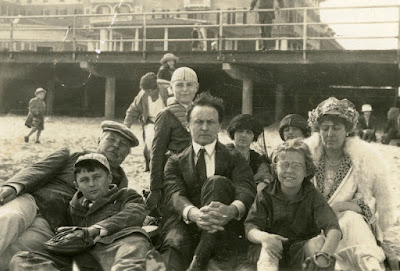
That same month the Doyles invited the Houdinis to join them for a weekend in Atlantic City. "Why not come down–both of you?" wrote Doyle. "The children would teach you to swim ! and the change would do you good." The Houdinis accepted and joined the Doyles at the Ambassador Hotel on June 17. The couple relaxed on the beach and Houdini taught the Doyle boys to dive in the hotel pool. That evening they attend a swimming contest that dragged on interminably.

The following day came an event that would forever have an impact on their friendship. Lady Doyle, herself a medium who communicated via "automatic writing", offered to give Houdini a private seance to contact his mother. Bess was kept from the proceedings, but she reportedly gave her husband a warning (via their old mind reading code) that Lady Doyle had been peppering her for information about Mama the day before. The three settled into Doyle's Ambassador suite where Lady Doyle quickly contacted Cecelia Weiss and dashed off several pages of communications in English instead of Mama's native German. Houdini did not betray his skepticism and Sir Arthur firmly believed his friend had been convinced and converted. But what Houdini had experienced was just more Doyle dinosaurs.

Besides attending a 4th of July party at the Seacliff home of his lawyer Bernard Ernst--where he inexplicably commanded a rain storm to stop and start (he later called this "the most remarkable coincidence that ever happened to a mortal man")--there is no record of Houdini's activities in July. Did he decide to go under the knife of "Transplantor" and receive his monkey gland enhancement?

Whatever he did, it's likely Houdini had time to reflect. If he compared himself to Doyle, and he most certainly did, Doyle was having the career Houdini coveted. He was a respected author drawing sold out houses with a lecture showcasing his intellect. And on a topic that Houdini felt he knew far more about! Here Houdini was stuck in a cycle of turning out melodramas and books of magic tricks while occasionally having to dip back into the fading world of vaudeville to make ends meet. And despite expanding and installing new equipment at his Film Developing Corporation that year, the business continued to operate at a loss. It's therefore not surprising that when Houdini did reappear after his mid-summer disappearance, he does so with a new identity and ambition.

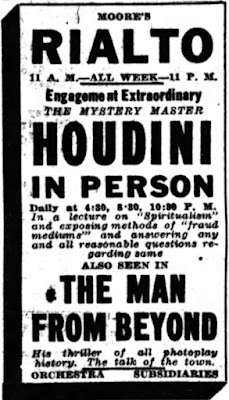
In August Houdini brought The Man from Beyond to the Rialto Theater in Washington, D.C. Once again the show would feature "Houdini in Person". But he left the elephants and magic behind. Instead when Houdini took the stage on Sunday, August 20, he gave a lecture on spiritualism. It was the inverse of Doyle's lectures, exposing the methods of fraudulent mediums, and offered audiences their first look at a new Houdini. Variety carried the news on its front page ("Houdini on Spiritism in Personal Appearance") and the Washington Times reported: "He doesn't intend to go back to Jail-breaking or other forms of escape until he has won a victory over ignorance and delusion in the world of spiritualism."

The Rialto lectures also prompted his first attacks. In a letter to the Washington Herald, a member of the audience, N.H. Holmes, wrote: "Houdini's picture, The Man From Beyond, is beautiful, thrilling and most wonderful. His exposure of séances and mediums are ridiculous, unscrupulous and preposterous." 

The battle was on. 

The Rialto run grossed an impressive $9000. The next engagement in Detroit brought in $12,000 (aided by a suspended straitjacket escape in Grand Circus Park). Having found the formula for success exhibiting his movie along with a live show, Houdini created several roadshow units called The Houdini Wonder Show. These were headed up by magicians Fredrick Eugene Powell, Mystic Clayton, Virginia Carr, and the escape artist Gemester. Houdini would make special one-day appearances at select theaters. In Hoboken a crowd gathered to greet him at the stage door. When Houdini appeared in a straw hat, some boys shouted that straw hats were out of fashion. Houdini removed his head gear and tossed it into the crowd where it was shredded by souvenir seekers.

Houdini then went about the business of selling The Man From Beyond via the independent State Rights market. This general release version was cut down from seven reels to six. (This is the only version that survives today.) Houdini had long feuded with theater managers whom he felt tried every trick in the book to withhold proper payment from talent. Now he would need to collect from cinema houses where managers were largely unchecked in their reporting on box-office receipts. But having just won his latest lawsuit against Octagon Films for unpaid salary on The Master Mystery totaling $32,795.18, Houdini may have felt confident that he could swim with sharks.

In October newspapers began serializing a new book by Sir Arthur Conan Doyle titled, My American Adventure. In it he spoke openly about the Atlantic City seance. That same month Houdini denounced the danger in psychic phenomena at an S.A.M. dinner in Boston. His statements received national coverage. But he also found himself in hot water with the organization over an exposure he supplied to Popular Radio magazine. The article portrayed The Talking Tea Kettle as a tool of fraudulent mediums and revealed its workings. But The Talking Tea Kettle was the invention of magician David P. Abbott who performed it as a spooky stage illusion. Houdini had once forced an S.A.M. member to resign over exposing his Milk Can escape. Now Abbott's local assembly in Omaha voted for Houdini's resignation as President. The controversy swept the S.A.M.

Houdini claimed Popular Radio had added the exposure to his text without his consent and threatened to sue the magazine for damage to his reputation. To prove his case, he published his correspondence with Popular Radio's editor in MUM. He then went out of his way to patch things up with Abbott personally. Houdini's presidency survived and the S.A.M. formed a committee to decide on a formal code of conduct that would govern the exposure of secrets, devoting a special section to spiritualist trickery. "The Magicians Code" remains in force to this day.

On Halloween Houdini gave a mock séance at the home of Sophie Irene Loeb at Harmon-on-Hudson which included a spirit message from the late Jack London. That
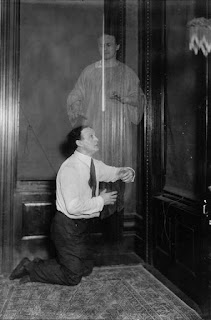
night he wrote in his diary: "I must put on record that it was done wholly by dexterity." He also tried his hand at a new medium by taking part in a debate on spiritualism live on WOR Radio in Newark. When the Scientific American magazine offered $2000 to anyone who could take a spirit photograph under test conditions, Houdini took a series of photos in the parlor of 278 showing him conjuring his own ectoplasmic spirit. The photos were syndicated in an article by Heward Carrington which quoted Houdini as saying, "Spirit pictures—yes—I make them almost every night."

Doyle and Houdini kept up their steady correspondence, but the dinosaur in the room was Atlantic City. Doyle would finally ask Houdini directly how he could continue to express public skepticism of Spiritualism when he had experience the real thing via Lady Doyle?

On December 15th Houdini sat down to confess his doubts about the seance to his friend. He cited his mother's use of English and also that a cross had been drawn at the top of the page, which one would not expect from the wife of a rabbi. He concluded as delicately as he could: "I trust my clearing up the seance from my point of view is satisfactory, and that you do not harbor any ill feeling, because I hold both Lady Doyle and yourself in the highest esteem." A few days later he wrote and had witnessed a document entitled: "THE TRUTH REGARDING SPIRITUALISTIC SEANCE GIVEN TO HOUDINI BY LADY DOYLE."

By entering into the spiritualistic arena Houdini had caught a new and popular wave. The press lauded him as an authority on the subject, which no doubt gave him great pleasure. But it was not going to pay the bills. Not yet at least. So by the end of the year he was once again headed back into vaudeville. Also released in time for Christmas was The Stag Cook Book—A Man’s Cook Book for Men. Inside was a recipe for "Scalloped Mushrooms and Deviled Eggs" by Harry Houdini.

Related:

Thursday, April 29, 2021

Dai Vernon does the trick that fooled Houdini

There are no shortage of videos on YouTube of magicians demonstrating Dai Vernon's famous "trick that fooled Houdini." One of the best is by Steve Cohen. But here's a video of The Professor doing it himself! I don't know what show this is from and it's too bad we don't have the lead up to the trick, but it's still pretty great as Vernon references Houdini throughout.


Vernon performed this for Houdini during an S.A.M. banquet at the Great Northern Hotel in Chicago on February 6, 1922. Vernon did the trick for Houdini three times and, it's my understand, varied his method. While I don't doubt this happened, I've never heard an account from anyone who witnessed it. Vernon's own mementos from that night recently sold at a Potter & Potter auction. 

What I'd love to know is what happened to the signed four of diamonds?

UPDATE: Our good friend Joe Fox has identified this as the Canadian show Celebrity Revue hosted by Carol Taylor and Peter Pit. Also, the guest in the tuxedo who we briefly see applauding near the end is none other than Steve Baker aka Mr. Escape! The below appeared in the December 1976 Genii.


Saturday, February 27, 2021

Soo's Unmasking bullseyes $26,400

In what must be a record for a signed Houdini book, a copy of The Unmasking of Robert-Houdin inscribed by Houdini to his friend Chung Ling Soo blew past its $4,000 - $8,000 estimate and sold for a whopping $26,400 (including 20% commission) in this weekend's Potter & Potter magic auction.


All the Houdini lots were red hot. A signed playing card sold for a stunning $11,400. A pair of gaffed Peerless handcuffs from the Wresch collection took in $13,200. A production baby said to have belonged to Houdini in his early days sold for $7,800. A collection of Dai Vernon's own mementos of the night he famously fooled Houdini at the Great Northern Hotel in Chicago sold for $6000.


The auction also included a program for Houdini's last appearance at the Garrick Theater in Detroit in October 1926. That topped out at $7,200. This is likely another record for an unsigned program.

Related:

Friday, January 22, 2021

Houdini's final show program at auction

Potter & Potter have posted their February 27 magic auction listings and among the Houdini rarities is a true bombshell! It's an original program for Houdini's "3 Shows in One" at the Garrick Theater in Detroit for the week of October 24, 1926. Of course, this was the final engagement of Houdini's life and October 24 his last show. I've never seen a program for his appearance at the Garrick, so this is pretty wild.


Inside the program there is an ad announcing the week of October 31 as Houdini's final week (confirming Detroit was scheduled as two week run). It's a bit eerie to have the two days, October 24 and October 31, both mentioned prominently in the program.

Other notable lots include: "Houdini's Production Baby" (companion to the doll seen in this photo maybe?), a copy of The Unmasking of Robert-Houdin inscribed by Houdini to his friend Chung Ling Soo (found at last), and Dai Vernon's own mementos of the night he fooled Houdini.

Potter & Potter's Select Secrets: Rare & Important Magicana auction will be held Saturday, February 27, 2021 at 10 AM CST. You can view the full online catalog HERE.

UPDATE: The program sold for $7,200 (including 20% commission) in what was a red hot auction.

Friday, December 6, 2019

Mystifier, Second Quarter 2000

Continuing my issue by issue look back at the Mystifier, the newsletter of the Houdini Historical Center that ran from 1991-2003.


The second quarter 2000 Mystifier kicks off with an article by curator Kimberly Louagie about Dai Vernon. Louagie states that "by far the most popular question asked in the last few years is––who fooled Houdini?" (Really?) That man was, of course, Dai Vernon, "The Professor", who never had a good thing to say about Houdini himself. So we'll leave it at that!

The second major article of the newsletter is about the history of 278 by Dr. Morris Young. Young recalls his own visits to Houdini's brownstone, including being the participant in a Houdini radio seance broadcast from 278 by Long John Nebel. (Young dates this as 1944, but from what I find, the Nebel seance happened in 1971.)

In his time, Dr. Young was also a recognized expert in the use of mnemonics and codes, and he closes his article with this curious application of mnemonics to Houdini's address:

So motivated by Houdini's often expressed interest in mentalism, codes, cypher and coincidence, I became impelled to submit "278" to its phonetic numeral mnemonic implications. Suddenly, "278" resounded in my ears as "han(d)cuff" or alternatively, uncuff. In the system, numerals are given the sound of consonants. 2 equals N; 7 equals hard C or K; 8 equals F or PH, Trying out the system on "113" (the street number), I equals T or D or TH; 3 equals M. In making up words, vowels have no mnemonic value and may be used liberally. W, H and Y are "neuters". Accordingly, "278 W. 113" becomes "Uncuff We Tie Them", the address of the house.

In "Backstage with Sid Radner", Sid reports that S.A.M. president Harry Monti and past presidents George Schindler and Frank Daily visited the HHC following that year's S.A.M. national convention in Milwaukee. He then plugs the HHC website and museum shop. Sid also announces that the new Houdini Museum at the Venetian Casino in Las Vegas will be open by the time this newsletter arrives.

Sid closes with the story of how he fooled Dai Vernon twice in 1942 with a left-handed peek and one-handed bottom deal. Sid says, "Perhaps I should have billed myself as the 'gambling expert who fooled Vernon', but much of the general public didn't know who Vernon was." Mic drop.

Mystifier
Volume 10, Number 2
Second Quarter, 2000
6 pages

Contents:
Who Fooled Houdini?
New Members
History, Numbering Coincidence Surrounds Houdini's "278"
Special Thanks
Backstage with Sid Radner


Related:

Tuesday, January 3, 2017

Houdini gets fooled on 'Mysteries at the Museum'

The Travel Channel's Mysteries at the Museum will once again feature a segment about Houdini. The new episode will air January 12. No firm details yet, but from the description, I'm guessing this is about Houdini and Dai Vernon.


This marks Houdini's fifth appearance on the show. Other episodes have explored the Mirror challengeMargery, Conan Doyle and Eleanor Fletcher Bishop. Hey, that's enough to put together a full Houdini episode, isn't it? Ideas.

Related:

Friday, August 26, 2016

Houdini by Vernon

Potter & Potter's auction of "Old & New Conjuring" is set to go live tomorrow at 10AM CST. As always, there are several Houdini lots, including this scissor-cut silhouette portrait of Houdini by Dai Vernon from 1920 (Lot 393). This was probably done from life and is an excellent likeness. Estimate is $4,000- $6,000.


Vernon prided himself as being "the man who fooled Houdini" with a card trick. He later taught magicians such as Doug Henning, and provided silhouettes for the title page of Henning's Houdini His Legend and His Magic. Today he's venerated one of the all time great sleight of hand masters. Looks like he was pretty handy with the scissors as well!

Click here to view and bid on all the lots at Bidsquare.

UPDATE: Sold for a whopping $10,455!

Related:

Wednesday, August 10, 2016

The imposter

In 1946, Maurice Zolotow penned The Great Balsamo, a novel about a famous magician and escape artist. Even though the author states in his introduction that his character "is not a lightly doctored version of any famous magician," the similarities between Barney Balsamo and Harry Houdini are hard to escape.

First edition hardcover (1946).

The Great Balsamo was first published in hardcover by Random House in 1946. It later appeared as an abridged paperback edition from Pyramid in 1954. I admit I've never read the book cover to cover. I've only scanned it. But even a scan tells me that Houdini was first and foremost on Zolotow's mind, and that he intended Houdini to be on the mind of the reader as well. Consider his description of Barney Balsamo in the first chapter:

He was not of commanding height, but when be began to speak in a firm, harsh voice, ungrammatical, but pervaded with unanswerable conviction, he could project any illusion about himself which he wished.

At the high point of his fame, Balsamo was a stocky muscular person with a large round face, curly black hair, and eyes of a murky marbled grayness, that fixed you with an immobile translucency. You were unable to escape from the eyes. They captured you like and insect on a scientific pin. You were lost in the eyes, like round, superbly polished stones in a ring, cloudy chrysophrase stones. Before an interview or a stage appearance, he placed a few drops of belladonna in his eyes to heighten the staring intensity.

The similarities continue. Balsamo, who doesn’t drink or smoke, performs with his wife Lami as The Balsamos. Their signature trick is the substitution trunk. When times get hard, they do a spiritualistic mind reading act that uses a word/number code. Zolotow spells out their code on pages 184-185 in a way that is very reminiscent of how the first Houdini biography, Houdini His Life Story by Harold Kellock, spelled out Harry and Bessie's own secret code.

In fact, it's pretty clear that Zolotow used the Kellock biography as a source in ways that border plagiarism. Compare these two passages from Kellock and Zolotow:

Houdini His Life Story (page 90):
Toward the end of the week he came home one evening with a whole packing-box for the fire. It was so complete that he obviously hated to break it up, and before tackling it he sat for a long time staring at it. At last, with a sigh, he began to wrench it apart.

"Bess," he said, "I have a new idea for a packing-box escape. I think I can get out without using a trick box. I'll work it out some day, and it will help make us famous.

In this curious fashion the idea of his famous packing-case escape had it's inception.

The Great Balsamo (page 207-206):
Lami could not help giggling when she saw what an absurd figure he made hauling the crate. It was the first time he had ever secured a box in such unbroken condition. He seemed to be reluctant to break it up and throw it into the stove. For a long time he stared at the box, and thumped its sides, examining the way the slates were nailed together. Finally, he began to dismantle the box.

"Lami," he said, thoughtfully, "I have a new idea for a packing-box escape. I think I can get out without using a trick box. I think I know a way where I can get a committee of carpenters to come on stage and build a box right on stage and nail me into it and I can escape and still leave the box it its original condition.

This was the germ of Balsamo's celebrated packing-box escape...

The similarities continue. Advised by vaudeville manager Sam Blitzer to focus on handcuffs escape, Balsamo hits it big as "The Handcuff King and Jail-Breaker." He travels to Europe and escapes handcuffs at Scotland Yard -- yes, his hands are locked around a pillar -- and experiences his own Hodgson-like challenge. (Both these sections again lift whole passages from Kellock). Back in the U.S., Balsamo performs suspended straitjacket escapes, vanishes an elephant, and is devastated by the death of his mother. In the end, Balsamo dies in an overboard box escape gone wrong.

Abridged paperback (1954).

The Great Balsamo is peppered with mentions of classic era magicians such as Thurston, Blackstone, T. Nelson Downs, and Horace Goldin. Zolotow also identifies S.W. Erdnase as being Edward Samuel Andrews. The name "Houdini" is conspicuously absent until near the end of the book when he warrants one quick mention (his photo is named among others on the wall of a magic shop).

It's also worth noting that Houdini himself used the name "The Marvelous Balsoma" for a fictional magician in his short story, "The Magician's Christmas Eve." Houdini was no doubt drawing the name from Cagliostro, who also happens to be a hero to Barney Balsamo.

So there's no question Zolotow is offering is a veiled portrait of Houdini in The Great Balsamo. However, it's not always a flattering one. Consider this passage near the end of the novel:

"Balsamo, growing older, resembled Cagliostro more and Balsamo less. In both, cunning and evil had gradually come to dominate and corrupt the physiognomy."

So who was Maurice Zolotow and what were his feelings toward Houdini?

Born in 1913, Maurice Zolotow was a prolific show business biographer. He penned the first biography of Marilyn Monroe, as well as biographies of John Wayne and Billy Wilder. He was also a magic buff who claimed to have seen Houdini perform at Coney Island. Later in life, he became friends with magician Ricky Jay.

In his psychological study, Houdini A Mind in Chains (1976), author Bernard C. Meyer (father of Houdini miniseries screenwriter Nicholas Meyer) repeatedly references Zolotow and Balsamo, stating, "it is clear that in fashioning the erotic aspect of his novel, Zolotow drew freely upon elements in Houdini's past."

Indeed, the erotic aspect of Houdini's life appears to have fascinated Maurice Zolotow. It was Zolotow who famously said, "Houdini loved only two women, his mother and Daisy White." (In Balsamo, Daisy is Myra Wilcox.) I don't know this for a fact, but I suspect Zolotow might have also influenced Melville Shavelson's 1976 biopic, The Great Houdinis.

In October 1979, Zolotow wrote a profile of Houdini for Los Angeles Magazine. It's surprisingly negative. He starts with an account of the Jess Willard confrontation and concludes: "All of Houdini's biographers relate this and similar stories about him, as if to prove what a heroic guy he was. To me, it suggests he was an arrogant bastard."

Zolotow goes on to quote conversations with Dai Vernon, a Houdini hater of the first order, which might account for the article's negative tone. And despite excellent sources, such as Manny Weltman, the article contains several factual errors.

Zolotow's Los Angeles Magazine profile of Houdini (1979).

In the same issue, Zolotow provided a short article about "The Houdini Gary Gilmore Connection" in which he spells out the claim by murderer Gary Gilmore that he was the illegitimate grandson of the famous magician. So it's clear Zolotow liked to dish dirt on Houdini.

Maurice Zolotow died on March 14, 1991.

The Great Balsamo stands as a curiosity. It's not a great novel, nor does it really work as a "veiled" Houdini biography. The real Houdini and his life remians just so much more compelling than any fictional version. But I still think it's an interesting book and a worthy addition to any Houdini bookshelf.

Other selections from the WILD ABOUT HARRY bookshelf:

Sunday, October 13, 2013

Vernon now bashing Houdini from beyond

The October 2013 Magic Castle Newsletter has launched a new column, "Storytime with The Professor", featuring memorable tales told by the late Dai Vernon. The inaugural story is about, what else, Houdini, and in it Vernon recounts how S.A.M. members once "tricked" Houdini into going into a closest at the New York Hippodrome and locked him inside. "We pulled this trick on him because he was such a terrible egotist," said the man who's own ego was pretty well developed.

Of course, this Houdini locked in a closet story is told numerous times and always the teller is the one who managed the deed. The location changes as well. It's sometimes a closet, sometimes a phone booth, sometimes a pay toilet, and sometimes an automobile. The best evidence for a "Houdini locked in" tale is a newspaper account of a man named E.P. Wilkins locking Houdini in a phone booth at the Savoy Hotel. This is reproduced in The Original Houdini Scrapbook by Walter B. Gibson (page 166).

So either locking Houdini inside closets was a regular activity, or the old Houdini hater Vernon metamorphosed Wilkins story with himself in the lead role. One wonders if the famous story of Vernon fooling Houdini with a card trick might have also been an self-aggrandizing invention (or, at least, exaggeration). For all the scrutiny given to events in Houdini's career, this Vernon story gets a big pass. But did anyone actually witness it? Did Vernon ever tell this story when Houdini was alive? And would Harry Houdini really have been fooled by The Ambitious Card?

The October newsletter also contains a brief about Kristen Connolly's visit to the Magic Castle with Tom Interval and myself last month. Kristen is playing Bess in History's 4-hour Houdini miniseries currently shooting in Budapest. At least we know that story is true.

Monday, February 18, 2013

Watch Houdini Never Died

Here is the entire 1979 documentary Houdini Never Died. This was produced by John Watson and Pen Densham who later wrote and directed TNTs Houdini. It intercuts Houdini's story with footage of contemporary magicians including Doug Henning. It also has nice footage of James Randi performing a suspended straitjacket escape over Niagara Falls, and the 50th Anniversary Official Houdini seance held at the Houdini Magical Hall of Fame. Definitely a product of its time, but that's what makes this great.


Houdini Never Dies was released on VHS by Brighton Video in 1987 (it can still be found on Amazon). I suspect this is the source of the YouTube video. I have no idea if the YouTube user has the copyright, so you might want to watch this one before it disappears.

Saturday, October 13, 2012

Genii & Houdini: The lost decade

The aim of this series has been to focus on issues of Genii that have featured Houdini on the cover. From the time Genii was founded in 1936, these have numbered at least two per decade, and many have been Special Houdini Issues. That's why it was so surprising that after November 1975, Houdini vanished from the cover of Genii for the remainder of the 1970s and never once appeared on a cover in the 1980s! That's right, the '80s are a lost decade for Genii & Houdini. Well, kinda.


Technically, Houdini did appear on the cover of Genii in the '80s many times. That's because in 1982 Genii did a cover redesign that featured a background montage of famous magicians, including a nice image of Houdini (hopefully I don't need to point him out). But apart for this, Genii showed little love for the Master Mystifier during the "Me Decade."

Dai Vernon
So why did Genii snub Houdini throughout the 1980s? It's hard to know for certain, but as I noted with the October 1972 issue, a certain hostility toward Houdini seemed to emerging as Dai Vernon became part of Genii and the West Coast magic scene. While Vernon was happy to trade on Houdini's name for his own purposes ("The Man Who Fooled Houdini"), he dismissed him as a magician and sniped at him in his Genii column. Not that Vernon actively suppressed Houdini in Genii, but the environment he fostered was that real magicians should discount Houdini as a publicity seeker and instead emulate true craftsmen like...Dai Vernon! (It's an attitude that still exists today.)

But it could also be that there were no seismic Houdini events in the 1980s as there had been in the 1970s with a wave of books and tributes commemorating the 50th Anniversary of his death. In fact, the '70s were so Houdini packed, the magic world might have been suffering a bit of a Houdini hangover in the '80s.

Genii, May 1980
Still, Houdini was missed. Many Houdini and magic fanatics--like myself--were born of the '70s boom, and Genii not producing even a single Houdini issue or cover to pull in these new, younger fans might have been a strategic mistake (even I let my subscription lapse). Newer magic publications like Hocus Pocus and Magicol happily filled the void, featuring Houdini on the covers of early issues, just as Genii had done with issue #2 when it was challenging the dominance of The Sphinx back in 1936.

However, the tradition of a Houdini Special Issue would be revived in the 1990s, and by a familiar champion.

Coming next: November 1993


Thursday, September 20, 2012

Genii & Houdini: October 1972

In October 1972, Genii The Conjurors' Magazine produced a beautiful "Special Houdini Issue." It started with a cover that featured a terrific unpublished photo of Houdini in handcuffs. However, a certain poison was starting to course through the Genii editorial offices regarding Houdini, and that can also be sensed in this issue.


The force behind this issue was Houdini collector, Manny Weltman, who provides photos and articles from his formidable collection. The magazine also reprints Weltman's article from the February 1971 issue of Westways, "Houdini The Man From Beyond...or waiting for Harry".

The issue also reprints Houdini's article about his straitjacket escape from a 1908 Conjurers Monthly Magazine (also reprinted in The Original Houdini Scrapbook by Gibson in 1976), and an autobiographical article written by Houdini reprinted from The Magician Annual 1909-10. An article by William Larsen, Sr. on "The Great Handcuff Escape Act" is also included with photos from the Weltman collection, including the famous nude photo of Houdini emerging from a jail cell.


The first hint of trouble appears in Bill Larsen's The Genii Speaks column. Larsen writes:

The fact that HOUDINI is a household word today speaks well of the man no matter what people say about him. By this I mean I've heard so many stories about Houdini over the years that one really doesn't know what to believe. Undoubtedly he was a great showman and fine performer. He died two years before I was born and therefore I cannot talk about the man.

This is certainly a tonal change from past Houdini issues in which Larsen paid great homage to Houdini as the man who "has done more to popularize magic than any living magician." So what's going on?

Well, by this time Dai Vernon was deeply involved in the West Coast magic scene. Known as The Professor, he was a fixture at The Magic Castle and contributed a regular column to Genii called "The Vernon Touch." He was also a well-known and very vocal Houdini hater. Vernon doesn't conceal his feelings even in this Special Houdini Issue. He opens his column with:

Although Houdini was, without doubt, the world's greatest handcuff king and also a great showman, he was not one of the "greats" that I admired by any stretch of the imagination. He was a supreme egotist, true, but we must be honest and say that it was this egotism that made Houdini the famous person he was and still is today!

Vernon goes on to talk about Hardeen, whom he enjoyed as being more "down to earth" than his brother, and also notes that Bess Houdini was godmother to his eldest son, Edward.

I suspect it's the influence and reverence for Dai Vernon that is responsible for Genii becoming a little gun shy in regards to Houdini from this point on. In fact, there would not be another issue devoted to him for over 20 years.

Coming next: November 1975


Friday, May 18, 2012

REPORT: Houdini haunts The 43rd Magic Collectors Weekend

Click here to see cover #2
Last week I had the extreme pleasure of attending Magicana's 43rd Magic Collectors Weekend in Chicago, which this year offered an embarrassment of riches for the Houdini buff.

I knew this was going to be my kind of event when I saw that the official program featured Houdini on the cover. Actually, there were two programs printed with two variant Houdini covers. As you only got one in your convention pack, a weekend challenge was tracking down that second variant! Inside the program is the recently discovered Water Torture Cell photo from Scotland. This program marks the first in-print publication of this incredible photo.

I flew in late on Thursday afternoon, so I unfortunately missed the dealer show hosted by Tom Ewing. This is too bad, because from the photos I've seen, the show appeared to be filled with fun and magic. But I was there for the lively interview with the weekend's Guests of Honor, Richard Kaufman (editor of Genii and publisher of many books) and James Hagy.

A nice cocktail reception followed where I was able to meet and greet my fellow collectors. Some, like the legendary Mario Carrandi Jr., I was meeting in person for the first time after having corresponded with them for years. Speaking of Mario, at his dealer table he had Houdini's walking stick. The stick is inscribed to Houdini as a gift from Will Goldston. Price: a cool $25,000. Well, at least I got to touch it!

DAY 2

Arthur Moses with Houdini's
walking stick
Friday morning kicked off with James Hamilton giving a talk on the Herrmann dynasty. James is THE man when it comes to all things Herrmann. He even sports Herrmannesque facial hair. James spoke about Houdini's connection to the Herrmann family (via Blanche Corelli), and said that he thought it odd that Houdini never played up his relation to this famous magic family in his own publicity. (I agree. It is odd.) After the talk, James gave me his booklet about Herrmann and Jesse L. Lasky. Lasky produced Houdini's two Hollywood features, so it's interesting to learn about a Lasky-Herrmann connection. Following James was Will Houstoun, editor of The Magic Circular, who gave a very well researched and informative talk on the influence of magic playlets, including Prof. Hoffmann's King Koko.

After a short break, it was my turn! Now I can finally reveal the nature of my talk. A few months ago I was contacted by MCW organizer David Ben and the tireless Julie Eng who asked if I would like to give the attendees a look at a remarkable Houdini artifact they had unique access to. This was the actual guestbook which sat inside Houdini's home at 278 W. 113th St, and later Bessie's residence at 67 Payson Avenue, from 1919 to 1975. Inside are an amazing collection of some of magic’s most famous names; Thurston, Dunninger, Powell, Horace Goldin and many, many more. There are also some intriguing historical gems, like Houdini's sister Gladys signing her name as "Gladys Houdini" and the revelation of a hitherto unknown séance! (I'm going to blog more about this mysterious séance at some point).


Armed with a copy of this amazing guestbook, I worked up a presentation called "Guests & Ghosts of 278." To introduce the book, I first showed photos of Houdini's New York home, including photos of the inside of 278 today (the story of how I got these and why I can't post them here on my blog got a nice laugh). I then paged through the book via a big screen Keynote presentation, showing some of the famous names and offering some background and speculations, etc.

I've gotta say, I've never done anything like this before. Two months ago I had no idea how to use Keynote. I didn't know if it would work, if I would freeze and forget everything, or even how much time I was allotted or I would take. But I think it went wonderfully well, and I was moved that so many of my fellow attendees went out of their way to tell me how much they enjoyed it afterwards. Whew! I really appreciate David and Julie giving me the chance to do this talk. This is something I'd love to do again, as I tweeted immediately after the presentation:


After lunch we returned for a terrific lecture by David Charvet on "Emil Jarrow: The Humorist Trickster". One of the reasons I love attending events like the MCW is that I get to learn about magicians other than Houdini. I admit I had never heard of Jarrow until this weekend. Again, terrific stuff!

David Ben than gave a fascinating talk on Max Malini, "Uncited Sources - The Rise & Fall of Max Malini". Now, I had heard of Malini, but I really didn't know much about his life and work, which turned out to be very interesting indeed. This was followed by a special screening of a filmed panel discussion about Charlie Miller "by those who knew him best". Unfortunately, this was the only event that I missed as I was crashing after all the pent up energy I had for my own talk, and I had to sneak back to my room for a quick nap before dinner. Besides, I wanted to be fresh for the BIG night.

That BIG Friday night kicked off after a dinner break with the great William Pack giving a taste of his acclaimed Houdini lecture, complete with props. Bill puts on these talks in libraries and schools across the country. His presentation is very entertaining and dramatic, and I was grateful for all the advice Bill gave me on doing Houdini lectures (as I now have the bug). Bill has also published a 130-page book that he sells at his talks, The Essential Houdini, which of course I had to snap up!

Following Bill's talk was a screening of a remarkable archival copy of Houdini! - Witness to Yesterday. Witness to Yesterday was a half-hour Canadian series featuring Patrick Watson interviewing famous people from history. In this episode he interviews "Houdini" portrayed by Teller of Penn & Teller. It was really very well written (by Thomas Baxter) and performed, and I've yet to talk to one person -- including "Handsome Jack" Lovick who is THE Penn & Teller expert -- who even knows about the existence of this program. I respected the convention rules and did not snap any photos of the screen -- but I'll tell you that Teller looked pretty good in his Houdini wig. I really hope this sees the light of day at some point as it was a real treat.

Then came the highlight of the evening (and maybe the weekend itself). Arthur Moses took the stage and offered up his "game changer." In a talk called "Have You Heard It All?", Arthur played the complete Houdini voice tapes. I've already blogged about this here, but I'll just say again that hearing the full voice recordings was incredible! In essence, what we heard was over five minutes of Houdini's voice that is not available to the public and has only ever been heard by a handful of people.

A private listen
Afterwards I got a more intimate listen as I helped Arthur and his crew double check the transcriptions. I was struck by how Houdini's voice was even more heavily accented and his English even more broken than what we hear in the familiar 1:20 version (which is an edited combination of both recordings, as Arthur was able to demonstrate). The major difference between the two versions seemed to be that in one Houdini issues his $1000 challenge "to anyone who can prove it is possible to obtain air inside of the Torture Cell" and in the other he didn't; although there were changes in phrasing throughout. In the non-challenge version (I think) he signs off by saying, "This record spoken by Harry Houdini."

Unfortunately, I don't think Arthur will be able to release these recordings in any major public way. The same goes for the 278 guestbook and the Teller film. But that's why there are events like the MCW. Some things can only be shared in this way.

DAY 3

Saturday kicked off early with an open forum discussion moderated by David Ben. Here the future of the MCW was discussed, including the possibility of it becoming a bi-annual event and moving to different cities. After this, Loren Pankratz gave a very interesting talk on Reginald Scot's Discoverie of Witchcraft, which is the first English language book to describe the methods of magic.

"Magicienne" Dell O'Dell
Next up was magician (or "Magicienne") Julie Sobanski with her well-crafted talk on "Women in Magic". Julie is currently writing a book on her topic, and I really enjoyed her presentation, especially as I had just been to the Magic Castle's own celebration of Women in Magic Week. Why aren't there more female magicians? Julie got the biggest laugh of the convention when she proposed one theory: "Early maturity steers most girls away from magic."

Julie, by the way, is president of the Houdini Club of Wisconsin and an escape artist in her own right. She even performs a straitjacket escape in rollar skates!

After Julie came my friend and fellow Angelino, Diego Domingo, who gave a wholly unique talk called, "The Prophet, the Assassination, the Cult of Doom, and Top Hat Magic" (featuring Arthur Moses doing his best "hick" voice). It was a terrific talk that had the room laughing and gasping at the artifacts Diego has collected during his on-going quest to expose religious hucksters -- some of whom use store bought magic tricks to prove their divinity. Fantastic stuff!

After a short break, the mighty Max Maven presented his talk on "Magical Jews - By One of Them." This was the same talk Max gave at the Skirball Cultural Center last year during the Houdini Art and Magic and Masters of Magic: Jewish Magicians of the Golden Age exhibitions. As I missed that, I was thrilled to catch it here. Needless to say, it was excellent, even though Max warned us up front that he wouldn't be talking much about Houdini as "he has his own press."

After a lunch break came Trevor Dawson from the UK who gave a very well researched and informative lecture on "Charles Dickens: Conjurer, Mesmerist, and Showman". This was followed by Bill Spooner's "Remembering Rex Slocombe" which included his own personal recollections at just how talented and funny Slocombe was. And speaking of voice tapes, Bill played the only known recording of Slocombe doing his famous comedy magic act.

Next came a special drawing for five copies of "The Shroud of Vernon." These are numbered pieces of cloth "Cut from the Shroud of Vernon" containing the phantom image of Dai Vernon's favorite card, the Ace of Clubs. I never win things like this, so it was a great surprise when I won! I think Houdini was looking after me this weekend.

The Shroud of Vernon

Then came a screening of a documentary about Mark Wilson's groundbreaking The Magic Land of Alakazam, followed by a Q&A with Mark and Darnell Wilson themselves. It was a real thrill to see and hear one of the great magicians of my childhood, and a true pioneer of magic on television.

After a dinner break, it was back to "The McVicker's Theater, circa 1912" for "An Evening of Mystery: Magical Varieties". Here David Charvet MC'd the evening as Jarrow, and also performed an amazing spirit painting effect; David Ben did a terrific magic performance with cards; Mark Wilson surprised the attendees with a performance; and Max Maven closed the show doing card and mind reading that absolutely blew my mind!

A final dessert reception was held after the big show. And with that the 43rd Magic Collectors Weekend came to a close. What a magical time it was!


*MCW photos by Wayne Wissner. Magicana © 2012 All rights reserved.

Translate