Showing posts with label Franz Kukol. Show all posts

Wednesday, May 22, 2024

Deconstructing Houdini '53: Genie in a Bottle

Continuing my scene-by-scene dissection of the 1953 biopic HOUDINI starring Tony Curtis and Janet Leigh. Last time, Houdini defended himself in court. Now, he completes a strange pilgrimage.

Chapter 15: Genie in a Bottle

The next scene in Houdini '53 takes us to the home of the elusive Herr Von Schweger and begins the movie's turn to a somewhat darker tone. While one might think this scene is pure fiction, it is actually rooted in reality.

The scene opens with Harry knocking on a door marked Johann Von Schweger. We realize he has finally been given an audience with the reclusive conjurer. Eerie music plays on the soundtrack as Houdini enters what appears to be an empty house. The rooms are not filled with mementos of a Music Hall career as one might expect. Instead, we see items from the Far East and other mysterious lands and religions. There's even what appears to be a seance table. Von Schweger has clearly gone deeper into the realms of magic and mystery than a typical magician.


Houdini calls out "hello" several times. Finally, a voice sounds from behind him, saying, "You're too late. Von Schweger died two days ago." The voice belongs to the mystery man from the courthouse, Otto (Torin Thatcher).


As first noted in Chapter 13, I see Von Schweger as analogous to the real-life Wiljalba Frikell. This scene just enforces that idea. But this is a rare case where real life was even more dramatic than fiction.

In 1903, Houdini was finally invited to the home of the reclusive Frikell, only to find the magician had died two hours before he arrived. In fact, Frikell's body was still laid out in the parlor, surrounded by mementos of his career. A macabre scene. Maybe too much so for a 1953 film? Or maybe it would have been too awkward to continue with the scene that follows with a corpse in the room. Still, reworking Houdini's famous Frikell visit is another way this movie respectfully pulls from real Houdini history in building its fictional narrative.

Houdini at Villa Frikell, the real "Von Schweger" home.

Otto says he was asked to follow Houdini's career very closely. Finally, Von Schweger decided he "was worthy." We then get the following exchange:

Harry: Do you know what he wanted to tell me?
Otto: He had nothing to tell you. He wanted to ask you if you had learned the secret of how to dematerialize.
Harry: Me? But I heard he had already done it.
Otto: It happened before I became his assistant. I asked him. He would neither admit it nor deny it. But one thing I am sure of, he was never able to repeat it. I know because I helped him spend the rest of his life trying.

This idea of "dematerialization" is also rooted in Houdini history. Sir Arthur Conan Doyle believed it was how Houdini made his escapes. Doyle cited as evidence the testimony of a friend who had witnessed Houdini's Double Fold Milk Can and claimed to have felt the dematerialization happening. By the way, I have one minor quibble here. Houdini says he was "in Switzerland" when he received Von Schweger's cable. Houdini never played Switzerland. I would have suggested Vienna.

Otto then retrieves from a box a model of a man in a pagoda-like bottle, presumably a scale model of Von Schweger's dematerialization illusion. "He intended to give you this," he says as he hands it to Houdini.


The camera pushes into the bottle for a nice close-up with the eerie music resuming. Notice the figure in the bottle is wearing a suit similar to Houdini's. Also notice when the shot returns to Houdini, he is holding the bottom upside down, an idea already forming in his head...


The eerie music ends and the mood lightens. Otto, having retrieved his hat and suitcase, turns to Harry and says, "Now I am working for you."

Otto is an interesting character. He definitely echoes Franz Kukol, Houdini's real-life chief assistant, hired during his first European tour. While Otto's nationality is never established, he speaks with a German accent and has a military bearing, just like Franz. And like Otto, Franz returned to America with Houdini and remained his loyal assistant.

The real Otto, Franz Kukol.

However, Otto's role in Houdini '53 is larger in a dramatic sense. He is somewhat Mephistophelian in appearance and behavior. He becomes not just Houdini's assistant but his enabler, guiding him deeper into the more dangerous realms of magic, which we know Houdini can't resist. He is the opposite of the cautious Bess.

Houdini doesn't object to Otto's self-hiring. He seems to understand and accept this strange turn of events. He simply smiles and says, "Looks like Von Schweger left me with more than just a man in a bottle."

He did indeed. Von Schweger, via Otto, has handed Houdini his fate.

Wednesday, November 29, 2023

Barbara's Vaudeville Scrapbook

I recently stumbled upon a remarkable Facebook page called Barbara's Vaudeville Scrapbook where the relatives of George Channing Eggleston, an electrical engineer and stage lighting man from the vaudeville era, share photos from a scrapbook they inherited.

In 1907, Eggleston traveled with the O Hana San & Co. and shared the bill with Houdini in San Francisco and Los Angeles. While there are no photos of Houdini himself, there are many photos of Franz Kukol and the Houdinis dog, Charlie (with a fresh haircut). I've never seen any of these images! Below is a sample shot of Franz and Charlie.


You can see more photos on the page itself. Unfortunately, it hasn't been updated since 2021. I reached out to page owners but haven't heard back. I've also shared all the Houdini-related images on my Patreon.

Related:

Tuesday, March 7, 2023

Houdini hangs with Franz

The Facebook page for Houdini Unlocked, the new traveling exhibition from Appleton's History Museum at the Castle, shared this image yesterday. It has me excited for a few reasons. First, I've not seen it before. Also this appears to be Houdini's suspended straitjacket escape in Washington D.C. on April 19, 1916. I just did a post about this escape and said I had never seen a photo. Well, I have now!


But there's another aspect to this photo that has me excited. You can clearly see Franz Kukol among the men (he's in the bowler hat and holding a camera). This is two years after Franz was supposed to have left Houdini and returned home to Austria to serve in the military. Just further evidence that he did not leave. It's also interesting to see that he's still sporting his Kaiser Wilhelm-style mustache. This is the only time I've ever spotted Franz in any photo or film of a suspended straitjacket escape.

According to the great Patrick Culliton, Franz remained with Houdini to the end using the name Frank Williamson. You can catch up on that story via the related links below. And if you want to see film of this escape, check out my Patreon.

For more information on Houdini Unlocked visit the official website.

Monday, December 7, 2020

Franz and Frank


For many years the great Patrick Culliton, a.k.a. Houdini's Ghost, has expressed his belief that Houdini's first chief assistant Franz Kukol did not leave Houdini's employment in 1914 to go fight for his native Austria during World War I, as was reported by newspapers at that time (some saying Houdini dismissed him because of his nationality). Patrick believes Houdini helped Franz "disappear" by fabricating the story and changing his name to Frank Williamson. As Williamson, Franz continued to assist Houdini for the remainder of his career.

As evidence, Patrick cites a letter written by Houdini in September 1924 to the Roosevelt Memorial Association. This is ten years after Kukol's supposed dismissal, yet in the letter Houdini states:

Mr. Frank Kukol will call you personally and give you further details about the group photographs in question.

This is pretty solid proof that Kukol is still around and going by the name of Frank in 1924. So he either never went to war or had returned. So this part of Pat's theory is, to my mind, confirmed.

But what evidence do we have that he became Frank Williamson? There are plenty of people named Frank in the world, and the 1924 letter still calls him Kukol. This part of Pat's theory had remained unconfirmed for me. But now a document has surfaced that that I believe provides the proof!


The above legal statement witnessed and signed by a collection of Houdini associates sold yesterday at Heritage Auctions for a healthy $718 (including buyers premium). It relates to Houdini's lawsuit with medium Arthur McNally in March 1926. The document is interesting in itself, but what caught my eye is that one of the 11 signatures is Frank Williamson (who gives his address as 38 Marcy Place, NYC).

I checked Williamson's signature against some known signatures of Franz Kukol. It you put them together, the similarities are striking! Especially the "F" and "r" in both names.


This is petty good evidence that Franz and Frank are indeed the same man. So I'm now happy to accept this second part of Patrick's theory. Franz Kukol became Frank Williamson.

The third part of Pat's theory is his identification of the man below as Frank/Franz. This man shows up in many photos assisting Houdini and is even in Haldane of the Secret Service. He's most clearly seen in the famous monk rope tie footage shot on the Haldane set in 1921. Thanks to the recently uncovered Sherman Grinberg footage, we can now see his features in detail.


I admit I'm still struggling to see Franz in this man, so I'm not yet 100% convinced of this last part of Patrick's theory. But the way things are going, I will not be surprised when we find evidence that proves Patrick correct once again. Because he's not just "Houdini's Ghost." He's also Franz!


Tuesday, September 1, 2020

Opening Mysto's coffin


Contrary to popular belief, Houdini did not go after each and every imitator of his act. Theaters were awash in Houdini wannabes, and to have tangled with them all would have left no time for his own act and just brought them publicity. So unless an imitator made false claims about Houdini or used his name in their advertising, he largely ignored them.

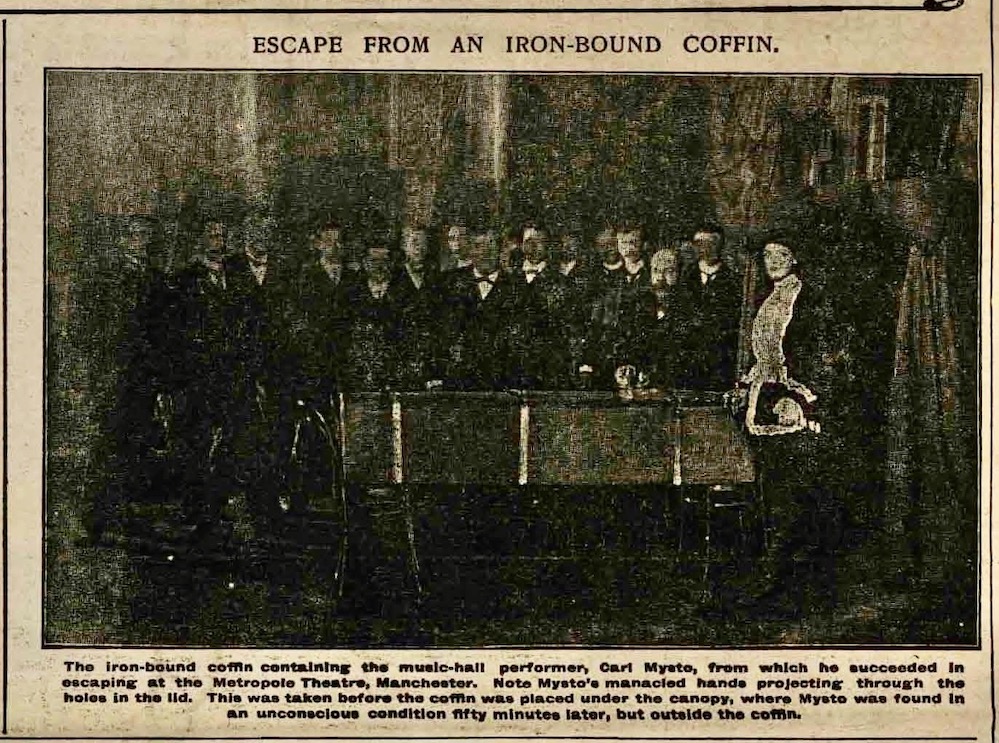
In 1903 an escape artist who called himself Carl Mysto began performing challenge escapes in the UK. This was not typical of other Houdini imitators who largely confined themselves to the handcuff act. One of Mysto's feats was to escape from an "iron-bound coffin" with his hands manacled through holes in the top. The escape was a good one and it drew a fair amount of attention, even landing Mysto a photo spread in the Houdini friendly London Daily Illustrated Mirror (above and below).


Houdini had first met Mysto in October 1902 when the budding magician wrote asking if Houdini could arrange an audition. Houdini remembered: "Carl Mysto at the time was working in pubs, doing magic and passing the hat. He was a tramp. I gave him a pair of pants and a few old shirts and half a dollar. He gave a trial show and did not make good. He was a common bum and a dirty one at that."

In September of 1904, both Handcuff Kings found themselves playing opposite theaters in Salford near Manchester. Houdini was at the Regent Theatre of Varieties and Mysto at the Hippodrome. Mysto ran into trouble during his first week. On September 21 he was summons to the Salford police court on a charge of stealing a pair of handcuffs from a challenger, Thomas Skellington. The case was dismissed. 

Did Houdini have a hand in this? If so, it could help explain why the Hippodrome's manager, Broadhead, felt compelled to take a swipe at Houdini during a manager's meeting, saying Mysto gave a better show and did not "talk endlessly of his triumphs." Furthermore, at £10 a week, Mysto made a better profit than Houdini at £150 a week. Houdini's hatred of imitators was matched only by his hatred of unscrupulous managers, and when he learned of Broadhead's words the gloves came off.

Instead of challenging Mysto to a coffin breaking contest as one might expect, Houdini took an approach wholly bent on ruining his signature feat. He paid the man who made Mysto's coffin, Reuben Shaw, to make him a duplicate. He then exposed the escape on the stage of the Regent for two straight nights. The London Daily Illustrated Mirror ran a story complete with photos showing Franz Kukol and Hardeen (presumably standing in for Shaw) assisting in the exposure.

Unlike the stories of Houdini undoing Kleppini with the French Letter Cuff or Frank Hilbert with a crafty disguise, the Mysto affair doesn't present Houdini in an especially heroic light. It's an out-and-out exposure of another magician's original invention and a clear breech of the Magician's Code. Local magicians were said to be "blazing with anger", and at least one reader of the Mirror found Houdini's behavior unsportsmanlike:


Houdini portrayed his actions as providing a public service, saying the use of a coffin was "entirely out of place" and that after his exposure "no coffin will ever again be used as an accessory to a public amusement." Privately he told local magician Harry Whiteley that he regretted exposing the coffin trick, but his fight was with Broadhead, not Mysto. The incident did not hurt Mysto, who suddenly found himself in demand. But it also opened the door to exposure acts, many of which would target Houdini.

Despite Houdini's claim to have made the theatrical world safe from coffins, in January 1907 he presented his own coffin challenge escape at the Boston Athletic Association. That coffin is on display today at the Houdini Museum of New York along with an original poster from the 1904 Mysto exposure.


Thanks to Joe Fox for helping me uncover the Harry Whiteley letter and the name of manager Broadhead. For more on Mysto in Salford check out Harry Houdini Legend & Legacy by Brian Lead and Roger Woods, 1993.

Tuesday, November 19, 2019

Here is that remarkable Houdini mystery footage

Earlier this year our friend Leo Hevia discovered 30 minutes of largely unseen Houdini footage buried in a YouTube video of random magic clips. It was an exciting find! A few weeks ago the clip and channel disappeared. It's still not clear who ran this channel, nor where this footage originated.

But this footage was just too remarkable to let vanish, so I've taken the liberty of uploading four of the most complete and interesting clips to my own YouTube channel. (Hopefully I'm not stepping on any toes by doing this.) I have also embedded the clips below along with a description of what they show. As you can see, the quality is poor, but the content is incredible. Enjoy!

1. Visiting sister Gladys: This appears to be unedited home movies of Houdini visiting his sister Carrie Gladys on a snowy day. After several shots outside of Houdini leaving the house (the footage is not in sequence), we cut inside the house to find Gladys playing the piano as Harry and Bess enter. Gladys then greets Houdini's assistants one by one: Franz Kukol, James Vickery, Jim Collins, and an unidentified assistant. Two more men are greeted by Gladys and Houdini, but I don't know who they are. After everyone leaves, Houdini returns to pick up and kiss a photo of his mother. We then see Houdini hugging and kissing Bess outside in the snow. Incredible.


2. Houdini Coin and Card handling: A real mystery is this one minute of footage showing Houdini doing coin sleights and card manipulations in slow motion. It's tempting to think this is a lost fragment from Velvet Fingers, but Houdini is dressed in a suit instead of a tuxedo, so this appears to be something entirely different. Whatever it is, it's a remarkable minute of film and breathtaking to watch Houdini's hand movements.


3. Monk Table Tie Escape: This footage shows Houdini doing an escape on the set of Haldane of the Secret Service. But this is not from the movie itself. The scenario here appears to be that he's being challenged by monks (played by actors and his assistants). This footage has appeared in documentaries, but it always cuts off as Houdini is being tied. Here the footage is complete and uncut, showing the full escape and Houdini being raised up on the shoulders of the ecstatic monks.


4. The Man From Beyond cliff stunt: While maybe not as spectacular as the above clips, this is every bit as interesting. This shows Houdini filming his cliff fight and his stunt of hanging off the edge. Shot from a distance, we can see the cameraman and also the geography of the stunt, showing Houdini was not as high off the ground as it appears in the movie. A rare piece of behind the scenes.


Also part of the original clip was the first few minutes of Houdini's 1909 movie, Les merveilleux exploits de Houdini à Paris. But this is something I'm going to save for a later time as part of a larger restoration project.

Related:

Monday, May 13, 2019

Houdini secrecy oath sells on eBay

A handwritten Houdini oath of secrecy signed by locksmith Gilbert Dawes and witnessed by Franz Kukol sold on eBay over the weekend for $988. The oath is dated February 10, 1911 when Houdini was performing at the Empire Theater in Leeds. Below is a photo and the auction description.

Click to enlarge.

This rare and famous letter was a oath of secrecy from Harry Houdini's Locksmith; in the letter Mr. Gilbert Dawes agrees to not to disclose the secrets of Houdini. The second individual in the letter is Houdini's apprentice. We contacted the current living relatives of Gilbert to learn that the famous living magician Edwin Dawes is a relative of the late Gilbert Dawes and found records of his existence. Dated 1911. 
Henry Muller (1930 –2017), was the founder, owner and curator of the Houdini Magical Hall of Fame in Niagara Falls, Canada. Mr. Muller purchased this letter in 1967 along with other Houdini original locks, keys, illusions and paraphernalia from Joseph Dunninger. Dunninger had acquired them from Houdini’s wife Beatrice and his brother Hardeen, to whom Houdini had bequeathed the collection. The Houdini Magical Hall of Fame existed from 1967 to 1991. In 1991, a fire consumed much of the museum. This item was on display in a part of the museum that was not consumed by the flames. The keys are now is custody of the late Mr. Muller’s son David. David is offering a COA and will field any questions about the keys' chain of custody for authentication purposes. I also encourage you to do your research on the Houdini Magical Hall of Fame to validate my information. These are museum pieces of history and would be a exciting item to own! (see attached photos)

Does anyone recall seeing this letter on display at the Houdini Magical Hall of Fame (because I don't)? It will be interesting to see if more Henry Muller rarities surface on eBay. Muller died in 2017

Thanks to Kevin Connolly for the alert.

Related:

Sunday, March 3, 2019

LINK: Franz and friends

Reader Perry Reed alerts me to a website called Lost Vaudeville that features the postcard collection of costume designer Blanche Townsend. Among the cards is one that shows Houdini's assistant Franz Kukol. It's an image I've never seen. The card is from March 1907 when Houdini was playing two weeks the Valentine Theater in Toledo, Ohio.

Click the headline to see the full Franz and friends at Lost Vaudeville.

Thank you Perry.

Related:

Saturday, March 2, 2019

When Franz kept the faith


Today marks the anniversary of Houdini's hiring of Franz Kukol on March 2, 1903. So what better day for a Franz-themed post! But this story has a story behind it.

When I was a young "Houdini Enthusiast" [a moniker I should really start using again], I corresponded with various magicians, and even wrote a column for a small magic magazine called The Magician Again. Recently I discovered some letters from that time, and one from Magician/Mentalist Ron Oliver from New Lowell, Ontario, contained a curious story about Houdini and Franz Kukol that I had completely forgotten about.

The story concerns a gold watch that Houdini presented to Franz on the stage of the Finsbury Park Empire in London on March 2, 1913, as a gift for 10 years of service. But Ron's story suggests there might have been more to this gift.

 Below is an excerpt from the letter Ron wrote me on December 16, 1980.


The story of the Kukol watch was told to me by a man whose father worked at the Finsbury theater in London from 1910 to 1915. He was a stage manager for the various acts that came in and, several times, saw Houdini. The full story is like this: 
"One afternoon, after the matinee performance, Kukol received a telegram from his Mother, saying that she was very ill and wanted to see him. He conferred with Harry, who allowed him to go. Kukol left the theater, headed for the train. No one saw him again for about eight days. 
When he finally returned, Harry was somewhat incensed at the fact that Franz had been gone so long. They retired to Harry's dressing room and a rather loud quarrel ensued. Apparently, Kukol wouldn't reveal where he had been, but did say that his mother was well. That was a week before the anniversary. The next day, Harry received a telegram from the Austrian army, from some high ranking official, asking for military help. The Austrians had heard that war was in the air, but in the future. They wanted Harry to give some of his secrets so they could be prepared....ie: handcuff slipping, cell escapes, etc. 
As to whether or not Harry divulged the secrets, no body knows. But Franz and Harry had a long talk behind closed doors and emerged very good friends again. Everyone assumed the argument was over, but the guy I spoke to said that his father always felt that Franz had been asked to reveal the secrets of his boss to his old employers, the Austrian army, and refused. The would explain his being missing for almost a week. It would also explain the inscription, in Austrian, on the back of Kukol's gift watch...roughly translated, it supposedly says "To Franz Kukol...for keeping faith....Houdini." 
How much of this is true, I really don't know. The guy says that his father used to tell the story whenever someone would bring up the name Houdini. He delivered all the telegrams and kept tabs on who came and went in the theater, so it seems logical that he would know. 
Franz Kukol was, as you know, an ex-army officer. And the Austrian army was correct in its assumption that a war was coming soon. About 17 months after the little thing with Kukol, Franz was called back into active duty with the army. War had begun.

Of course, we now believe Kukol never returned to Austria and instead continued to work with Houdini under the name of Frank Williamson, but that is another story.

Thank you Ron Oliver for this story and memory from the past.

Related:

Saturday, July 7, 2018

Houdini first went overboard 106 years ago today

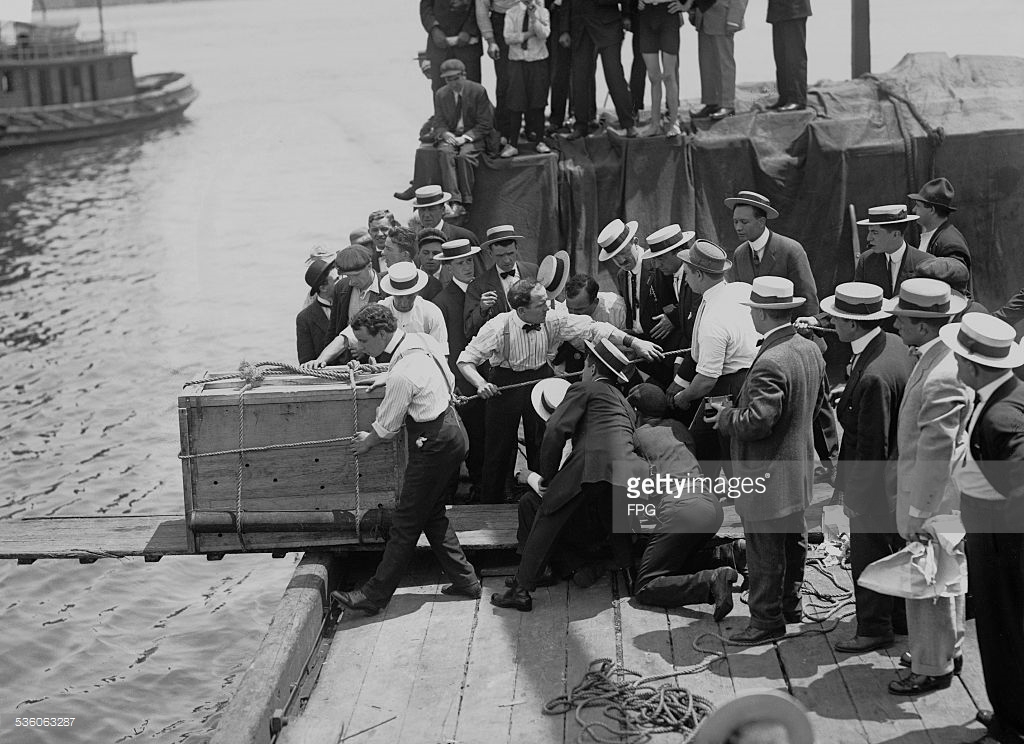
On July 7, 1912, Houdini performed his first overboard box escape in New York. He had planned on doing the escape off the East River's Pier 6, but police stepped in and forbid the stunt. So Houdini, who had arrived with his assistants and equipment via the tug boat Catherine Moran, loaded reporters onto the tug and turned it toward Governors Island, which was federal land and therefore outside the jurisdiction of the New York City police.

The escape, in which Houdini freed himself from handcuffs, leg-irons and a nailed and roped packing crate "thrown" into the water, is well documented in biographies and in photos. The New York Times reported that at least 20 photographers were present, as well as a "cinematograph operator." But below are several photos from Getty Images that are not among those generally reproduced. What I love about these is they show us some different moments and fresh details from this famous feat.


This first shot shows the packing crate being prepped by Houdini's assistants. Notice that James Vickery and Jim Collins are attaching weights to the side of the box, meant to help sink it below the waterline. This did not entirely work. According to the Times, the top of the box remained visible. Also notice a fully dressed Houdini standing off to the side watching the preparations. We can also see the camera man. What happened to that footage, I wonder?


This next photo shows the packing crate, now containing Houdini, being nailed shut. One detail I like is that you can see Franz Kukol standing at the head of the case with a gentleman who appears to be handling something. Perhaps a volunteer selected to examine and hold the nails?


This photo shows the box being lowered into the water via a plank which would tip down into the water as the box was pushed toward the end. In later overboard box escapes Houdini would use a block and tackle. (But you can see this same plank method being used in The Master Mystery.)


This last shot shows Houdini after the escape. One has to imagine that getting the waterlogged box back onto the tug boat was no easy task. But there are photos of Houdini beside the box after the escape, so they did it somehow!

Houdini had a large lithograph created commemorating the feat, transforming the tug Catherine Moran into an ocean liner and showing the box sinking below stormy seas among circling sharks. (This rare poster is currently on display at the New-York Historical Society's Summer of Magic: Treasures from the David Copperfield Collection.) Below is a syndicated news account of the escape with some more nice images. This ran in newspapers across the country.


History currently records this as being Houdini's very first overboard box escape. He would go on to perform the escape as an outside stunt at least seven more times, and also developed an indoor version that he performed at the New York Hippodrome and Hammerstein's Victoria Theater. The overboard box also appears in two of his movies, The Master Mystery (1918) and Terror Island (1920).

Today one of Houdini's original overboard boxes can be seen at the American Museum of Magic in Marshall, Michigan.


Related:

Thursday, June 21, 2018

To Gladys from Franz Kukol

Fifteen years ago Bill Bremer, a postcard collector in Texas, unearthed a cache of 36 postcards sent to Houdini's sister, Carrie Gladys Weiss. All this week I am sharing select cards from this remarkable collection. [Read the full story of Bill's find here.]

Today's card is unique among Bill's collection and one of the most remarkable of the entire batch. This card was sent to Gladys from Houdini's trusted chief assistant Franz Kukol while he was on vacation in Austria in July 1911. Seems everyone loved Gladys! What's especially interesting here is that he addresses her as "Miss Gladys Weiss Houdini."

JULY 3. 1911. 
Am spending my vacation with my familiy at home the weather is very bad rain every day, so am indoors all day long.
On Friday I'm going to my mother to Vienna & shall stay a few days & expect to be back in London July 15 or 16th.
With kindest regards to all. 
I beg to remain
Respectfully yours
Franz

Tomorrow I'll conclude my look at this incredible collection with three knockout cards from Bess Houdini herself. You won't want to miss these!

Related:

Thursday, November 23, 2017

Houdini in 1903

By 1903, Houdini had established himself as a very successful performer with a wildly popular specialty -- the handcuff act. But had he retired at this time, as he often threatened to do, he would not be known to us today. But in 1903, he would perform feats and cement his image in a series of famous photos that still resonate more than a century later. It could be said 1903 was the year Harry Houdini became an icon.

This post is now retired. But you will be able to enjoy the story of Houdini in 1903 in my upcoming book

    Saturday, November 11, 2017

    Read HOUDINI UNBOUND's original framing story

    David Saltman is offering on his website The Houdini File the original "framing story" for his just released novel, HOUDINI UNBOUND: Espionage in Russia. According to David, the framing story was popular among editors, but ultimately deemed too complex and unnecessary, so it was cut.

    I would have loved to have seen this stay in as I think it very nicely establishes the "true fiction" approach of the book. It tells the story of David's discovery of the manuscript for this "untold tale" by way of Harry Houdini Kukol, the son of Franz Kukol. This reminds me of how many Sherlock Holmes pastiche novels open with the discovery of some long lost manuscript written by Dr. Watson. David even consults with Milbourne Christopher!

    As with the rest of the novel, it's great fun, and it's loaded with Easter eggs for the true Houdini buff, so click to read the original framing story PART I and PART II.

    HOUDINI UNBOUND: Espionage in Russia can be purchased as a hardcover, paperback and eBook from at Amazon.com (U.S.) and Amazon.co.uk (UK).

    Related:

    Saturday, March 25, 2017

    Houdini Torture Cell photo escapes with $889

    A terrific original photo of Houdini inside his Water Torture Cell sold for $889.20 (including 17% buyer's premium) at Haversat & Ewing's "Houdini's Birthday Auction" today. The photo shows the cell on stage flanked by assistants Franz Kukol, Jim Collins and James Vickery. (The fourth assistant is unknown to me.)


    What makes this shot extra special is we see Houdini inside the inner cage, or what he called "the steel grill." This appears to have been later removed from the escape. I believe this photo has only ever appeared in Milbourne Christopher's' Houdini A Pictorial Life, and that image does not have the clarity seen here.

    This latest Haversat & Ewing auction contained several other nice Houdini lots. A two-page letter on rare stationary with excellent content ("Do you know in my hardship days I NEVER borrowed a single dollar!!!!!!!!!") went for $6,142. A pair of vanishing umbrellas owned by Houdini took $1,099. Even I was able to land a 1925 "Beware" pitchbook (I've been after one of these).

    Related:

    Sunday, January 1, 2017

    Houdini in 1917

    Welcome to another year of WILD ABOUT HARRY. Let's kick off 2017 with a look back at what Houdini himself was up to 100 years ago.

    Quick! Name a significant Houdini escape, piece of magic or performance associated with the year 1917?

    One can easily do this for nearly every year of Houdini's life: 1903/Carette; 1908/Milk Can; 1914/Walking Through A Brick Wall. But 1917 is tricky. That's because for the first time in many years, Houdini didn't invent or perform any new escape or feat of magic. In fact, his act was basically the same one he had been doing since returning to the U.S. in 1914. Of this period Silverman writes: "Much of what had brought Houdini to this height he was now preparing to downplay or abandon."

    This post is now retired. 
    You will be able to enjoy the story of Houdini in 1917 in my upcoming book.

      Saturday, November 12, 2016

      Master Mystery episode 3 poster sells for $28,080

      An original poster for episode 3 of Houdini's The Master Mystery sold for $28,080 at today's Haversat & Ewing Galleries November magic auction.

      The poster came from the collection of Dorothy Dietrich and Dick Brookz of the Houdini Museum in Scranton, who own a complete set of all 14 posters from the serial. An Episode 3 ("The Water Peril") has never come up for auction before.

      The auction contained several unique and desirable Houdini rarities. A cabinet photo of Houdini and his mother fetched a remarkable $16,380. This appears be an all-time record for a Houdini photo at auction. A "King of Cards" poster brought in $11,700. A letter on unique stationary in which Houdini talks about his bi-plane in Australia went for $10,852. A letter to Will Goldston in which Houdini discusses an early injury took in $7,575.

      One item that I had my eye on was a business card for Houdini's first chief assistant Franz Kukol. But it looks like it caught the eye of others as well. It beat the auction estimate of $250-$300 and went for $2,661. (All prices include the 17% buyers premium.)


      As always, congratulations to the buyers and sellers and to Haversat & Ewing Galleries for another stellar auction.

      Related:

      Wednesday, July 13, 2016

      Houdini vs. the Siberian Transport Cell Part I: The escape


      Houdini's escape from the Siberian Transport Cell or "Carette" in Russia on May 10, 1903 is one of his most famous and celebrated feats. No account of his life goes without a mention of it. But like the Mirror Handcuff challenge, the carette is an escape steeped in mythology and controversy over how Houdini managed to escape. So today we head to Moscow to unlock the mysteries of this famous challenge.

      Houdini traveled to Russia in May of 1903. [For an account of his adventurous entry, read Breaking into Russia.] Houdini opened at the Yar, a popular Moscow dinner theater frequented by high society (where a drunken Rasputin once exposed himself). Houdini was an instant hit with his handcuff act, but he still wanted to perform an attention getting outdoor escape. He found his opportunity at Moscow's centrally located Butyrskaya Prison.

      Butyrskaya prison in Moscow, site of Houdini's 1903 escape.

      There's an amusing story of how Houdini was arrested while practicing his stage patter in an open Moscow park (some accounts say it was a deserted racetrack). As he recited in Russian how he "defied the police of the world to hold him," he suddenly found himself surrounded by police who feared he was a madman.

      At police headquarters, the Yar theater manager explained things as Houdini endeared himself to the police by performing cards tricks. He then asked the Chief of Police, identified as "Lebedeff," if he could attempt to free himself from one of their prison cells. Lebedeff felt the locks on the Butyrskaya cells, which dated back to 1771, would be too easy for the jail breaker, and instead suggested their Siberian Transport Cell, a rolling "safe on wheels" used to send prisoners to Siberia. Lebedeff insisted it be a private test. Houdini agreed under the condition that Lebedeff provide an affidavit should he be successful.

      Houdini arrived at Butyrskaya on May 10 with his newly hired assistant, Franz Kuklol. (It's worth noting that the Russian date was April 27, Russia still being on the Julian calendar at this time.) The police were ready for him. After having him remove all his clothes, they conducted the most thorough search of his career, as Houdini recalled:

      All my clothes were taken from me and I was thoroughly searched, but, perhaps the word "searched" is too mild to describe what chief Lebedeff's spies did to me. I was laid on a table and one man started from my head and searched down to my feet, while another man started at my feet and worked up to my head. I was then turned round and about, being rather roughly handled. No doubt the spies wanted to impress their superiors, but they found nothing.

      In a private letter to a friend (Don Turley) he added...

      Talk about getting the finger, well I received it three times, but Mr. Russian spy found nothing.

      Houdini was then led nude across the cold prison courtyard, manacled in heavy irons, and locked inside the transport cell after it had been thoroughly searched. Lebedeff then told Houdini that if he failed to escape, he would have to travel 21 days to Sackolin near Siberia where the only key that unlocked the door was kept. Houdini requested that the van be backed up against the prison courtyard wall so he could work out of sight of the police. This was agreed to. However, Lebedeff ordered two men with binoculars to spy on the escapist at work.

      Artist rendering of the Carette escape (Ray Abel).

      Within an hour, Houdini walked into Lebedeff's office free. He was drenched in sweat, despite the cold. The police rushed to the carette and found it still locked with the shackles inside. Lebedeff's spies had, apparently, witnessed nothing.

      But instead of applause, Houdini was seized and again searched. When nothing was discovered, the police turned on Franz Kukol and subjected him to the same vigorous search. Finding Kukol's house key, they tried it on the carette door lock, much to Houdini's amusement. "They have a swell lock on the cell and the house key is a cheap lodging house lock, so you can imagine how little it fitted," he said. The police then photographed Houdini, "In case I turn out crooked."

      Despite his promise, Lebedeff refused to provide an affidavit, and no Russian newspaper reported the escape. Nevertheless, word of the feat spread among the populace, and Houdini's Russian tour was extended. He even performed for the Grand Duke Sergei Aeksandrovich and the grand duchess at Palace Kleinmichel. (The duke was later killed when a revolutionary threw a bomb into his carriage.)

      Houdini left Russia never to return. He recorded in his diary that he felt the country itself was "some sort of mild prison" from which he had "managed to escape." While he had no news clippings or affidavit for his successful carette escape, he later had a lithograph printed in Leipzig showing the dramatic scene that had played out in the courtyard of Butyrskaya prison.

      Houdini's 1903 lithograph.

      A similar view today.

      So how did Houdini escape from the Siberian Transport Cell? We will tackle that in PART II.


      Top illustration by Peter Burchard from Saga, July 1958, courtesy of Arthur Moses. Houdini in van sketch by Ray Abel from Escape King: The Story of Harry Houdini (1975) by John Ernst. "Houdini in Russia" lithograph from the Nielsen Collection, MUM Nov. 2006.

      Related:

      Wednesday, November 21, 2012

      Latest updates in the mystery of Franz Kukol

      Back in December 2009 Houdini expert Patrick Culliton put forth the intriguing theory that Franz Kukol, Houdini's first chief assistant, did not leave Houdini's employment in 1914 as history has recorded and Houdini himself claimed. According to Patrick (who played Kukol in the ABC TV movie The Great Houdinis), Houdini transformed Franz into "Frank" and he continued to work with Houdini right up to the end of the magician's life.

      Part of the evidence Patrick cited was a privately held letter written by Houdini in 1924 to The Roosevelt Memorial Association stating that "Frank Kukol" will come and swear that he took the famous photo(s) of Houdini and the former President aboard the Imperator in 1914.

      Now David Saltman has published that very letter on his website, The Houdini File. It's a remarkable artifact that does indeed prove that Kukol was working with Houdini during the 1920s.

      Also on the Franz front, recently a gentleman named Rolf R. Safferthal, a retired German electronics engineer, has come forward with the claim that Franz Kukol was his maternal grandfather. Rolf has joined the discussion on this very topic at the Genii Forums and has even posted rare unseen photos of Kukol.

      Click here to read the Houdini/Frank Kukol letter at The Houdini File.

      Click here to read the posts by Rolf R. Safferthal at the Genii Forums.

      Tuesday, May 1, 2012

      Franz Kukol guestbook page on eBay

      A guestbook page signed by Houdini's assistant Franz Kukol, complete with a nice photo of Kukol that I've never seen, is currently up for auction on eBay. This is from the week of May 24, 1909, when Houdini was performing at the Portsmouth Hippodrome in Southsea, Hampshire, UK.


      The auction starts at £999 ($1,622) with £82 ($133) shipping and insurance. Top dollar for a Kukol item to be sure (heck, it would be top dollar for a Houdini item). I'll be curious to see if it sells.

      Friday, December 11, 2009

      The mystery of Franz Kukol

      Houdini buffs are well aware of Franz Kukol, Houdini’s first chief assistant who served the great magician from 1903 to 1914. As the story goes, with the outbreak of World War I, the Austrian-born Kukol returned to his homeland to serve in the Army. Some say Houdini fired him because of his nationality. Either-way, Kukol abruptly leaves the Houdini story at the mid-point of Houdini’s career.

      I’ve always found this a rather sad end to what must have been a very close personal and professional relationship. Afterall, Kukol thought enough of his boss to name his son Harry Houdini Kukol (born May 24, 1909 in Austria).

      But now Houdini expert Patrick Culliton has uncovered what he believes to be a new chapter in the Franz Kukol story. According to Patrick, Kukol never left Houdini’s employee or his side (right to the grave). Houdini simply turned him into a new person: Frank Williamson.

      In a detailed posting on the Genii Forums, Patrick (who has the ironic advantage of having played Kukol in the ABC TV movie The Great Houdinis), states; “On August 25, 1914, ‘Frank’ Kukol applied for naturalized citizenship. He renounced all foreign governments and signed an oath of allegiance to the United States. His application was rejected: ‘not enough information.’ In it, he documented that his wife Anna and their two children, Marie and Harry were living in Austria.”

      Following this, the Conjuring Record for Sept 3, 1914 reported that Kukol left Houdini’s employee. In a story headlined, OBEYS CALL TO WAR; HOUDINI LOSES ASSISTANT it’s reported that “Mr. Franz Kukol, one of Harry Houdini's chief assistants, was called by his country, Germany, to the front. He left at once to fight for the cause of the Fatherland. Kukol assisted Houdini in his escape from the water cell and other experiments.”

      Franz Kukol at work. Photo from Houdini Unlocked by Patrick Culliton.

      However, Patrick notes there is some clear evidence that Kukol continued to work with Houdini, at least until America entered the War. While Houdini was playing the Maryland Theatre in 1916, a newspaper article noted: "Three of Mr. Houdini's assistants are Englishmen. The fourth is a German. 'I do not have to read the newspapers to learn about the war,' he said. 'Every once in a while I have to rescue the German from the Englishmen. They actually get to the coats-off stage in some of their arguments. It's all very funny to me, but they are not joking about it.'"

      Furthermore, on Sept 12, 1918, both Harry Houdini and Frank Kukol registered for the draft at the same New York office. It’s at that moment that Franz AKA Frank Kukol disappears.

      Patrick continues:

      “I was told that the $500 bequest that Houdini left to Franz Kukol was sent to a New York address. If Franz was in New York when Houdini died, he would have to have been a pallbearer. Unless, perhaps, he was afraid of being picked up. Franz wasn't a pallbearer, but, Frank Williamson was.
      I thoroughly believe that Frank Williamson was Franz Kukol.
      After the funeral, Frank Williamson disappears from history -- so far. I think Houdini made Franz disappear. That rejected application for naturalized citizenship along with the signed loyalty oath kind of made Franz a man without a country.”

      Patrick points to two photos of Houdini performing his 1925/26 full evening show which show an assistant who resembles Kukol without a mustache. Says Patrick, “He is standing by the Morritt Hello Summer illusion in the Big Show Photo in the Henning book; and he is holding Vickery's severed arm in the Paligenesia photo in the Kellock book.” That assistant is identified as Frank Williamson.

      Is this Franz Kukol in action in Houdini's 1925/26 show?

      Interestingly, this is not the first time this name shows up as an alias. In Houdini’s Conjurers Monthly Magazine there is a letter from a Frantz Williamson of Elberfeld, Germany (Houdini frequently misspelled Franz as Frantz) questioning the origin of the packing case trick (and allowing Houdini to establish a claim on the effect).

      Patrick Culliton as Kukol in
      The Great Houdinis (1976)
      Also, in 1924, when a photo of Houdini and Teddy Roosevelt was disputed, Houdini states in a letter to R.W.G. Vail (now in the collection of Frank Saltman) that Franz will personally come to The Roosevelt Memorial Assoc. in N.Y.C. to swear he took the photos. This proves that Franz was still in the U.S. and a part of the Houdini organization well into the ‘20s.

      Patrick concludes, “As to Frank Williamson being Franz Kukol, this is Culliton talking, I don't say this lightly, you can take it to the bank. The photos don't lie. Frank Kukol worked the full-evening show as Frank Williamson. Then they both REALLY disappear. So far. I never thought we'd come this far.”

      UPDATE: Latest updates in the mystery of Franz Kukol.

      Translate