Showing posts with label Spy. Show all posts

Friday, December 13, 2024

My thoughts on Disney's Houdini project news

I know I'm on a holiday break, but I felt I had to drop back in to comment on the news of a Houdini project in development at Disney. According to a report at DeadlineBecoming Houdini is a "spy thriller" about "Houdini’s undercover work for his adopted homes of Britain and America." 


Here's the comment I've left on the story. It doesn't appear to have been approved, so I will share it here. Feel free to quote, copy, or steal:

While Houdini was friendly with law enforcement and did advise police at times, the idea that Houdini was some sort of super spy is an idea that has little grounding in fact.

It is true that Houdini was friends with William Melville of Scotland Yard, who is said to have operated an informal, early version of British Intelligence. Houdini appears to have provided Melville with two "reports" while he was in Germany in 1900 and 1902. Does that make him a spy? Kinda! But that's it. Everything beyond this is pure speculation, with no secret missions, assassins, and no connection to U.S. intelligence whatsoever. 

Houdini had a brilliant career as the world’s foremost magician, escape artist, and debunker of fraudulent spirit mediums. It’s a shame to see Disney forgoing his fascinating real life in favor of salacious pseudo-history that is more the stuff of the History Channel.

Good title, though!

It might not be all bad. The article states that the film is "set to be written by Michael Finch and Alex Litvak," which means this was likely just a pitch sale and a long way from becoming an actual movie. Plenty of time for them to find a better approach.

Okay, back to the hot tub.

Related:

Wednesday, July 13, 2022

Houdini meets Mata Hari

Agentes H: Enemigo en Nueva York is a Spanish language pulp style adventure by Paulo César Ramírez Villaseñor. Below is the cover and plot description (via Google translate).

Harry Houdini and Mata Hari team up to work on a special mission, set against the backdrop of 1918 New York. Under the codenames "Double Ax" and "H21", the two investigate a strange robbery of an exhibition of Egyptian archaeological pieces at the Metropolitan Museum of Art, in particular, the disappearance of a mysterious mirror. After a series of heinous murders with clear occult overtones, they discover a horrible plan that they must stop before it's too late.

A thriller that combines Alternative History, Espionage Fiction, Detectives of the Occult and a few slight drops of Lovecraftian Horror, all written in pulp code.

Believe it or not, this is not the first fictional pairing of Houdini and Mata Hari. The famous spy joined Houdini and Sir Arthur Conan Doyle in the 1978 play The Houdini Deception. The 2010 book Dear Sweet Harry offered a poetic take on the couple, as did a 2010 concert in Wellington, New Zealand (poster below). As far as I know, the real Houdini and Mata Hari never met.


You can purchase Agentes H: Enemigo en Nueva York at Amazon.co.uk.

Tuesday, April 26, 2022

The Moosers wild memories of Houdini

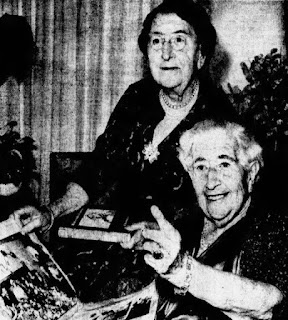
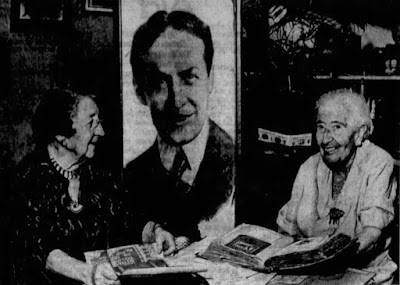
Recently I came across an article in the February 17, 1967 Oakland Tribune about Hattie and Minnie Mooser and their memories of their friend, Houdini. I've read other articles about the Mooser sisters and Houdini, but this one contains stories that I have not read before...and they are pretty wild!

The article kicks off with the Moosers familiar claim that their brother, Leon, discovered Houdini in a "tent show" and booked him at the Palace, literally pushing the young magician out onto the stage. "Houdini didn't even have a tuxedo. My brother lent him his own and Houdini almost didn't go on," says Hattie.

None of this comports with any known facts about how and were Houdini got his start, and he certainly had a tuxedo from his earliest days. But I think we can blame the brother for this. The Moosers are just telling a story that has been told it to them. Leon did discover and introduce Ching Ling Foo to the U.S., so it's possible some of the Foo stories might have morphed into Houdini stories over the years?

It's when the Moosers tell of their own first-hand experiences of Houdini that things get really interesting. Following are some choice excerpts:

    Whenever the Houdinis were in the Bay Area they made their headquarters at the Aladdin Studio, a restaurant operated by the Mooser girls.
    And often Hattie would substitute for Bess in Houdini's stage performances.
    But most of the memories are of the man himself, and not the feats he performed.
    Miss Hattie recalls one damp night when Houdini ushered her quickly into a cab and directed the driver to the waterfront:
    "Not many people knew it but Houdini helped the Coast Guard round up a ring of rum runners. They often asked him to assist in an investigation because he was such a good swimmer and he trained himself to withstand cold. He would swim out to a suspected rum runner's boat, look around, and report back to the authorities."

This is certainly fodder for people who enjoy the idea of Houdini as a spy. In fact, this rum runner "mission" is presented as fact in The Secret Life Houdini. But the only source is this article. I'm more intrigued by the suggestion that Hattie would sometimes substitute for Bess onstage. And this:
    Miss Hattie recalled joining Houdini in leading a pack of newspaper man through the Winchester Mystery House one dark night. She said:
    "There were no lights in the house and we carried flashlights. Houdini was interested in the house because of his psychic research."
This is first I've heard of the Moosers being with Houdini on that midnight tour in 1924. But a pack of reporters as well? No newspaper accounts followed, so not sure what to make of this.
    Miss Hattie also remembered the time she was able to get Houdini into the Tower of Jewels at the 1915 Worlds Fair.
    "We went to dinner afterwards and he asked when my sister and I would observe our birthdays," Miss Hattie said. "I asked him why and he reached into his pocket and pulled out a handful of jewels. You know nobody took their eyes off him when he was in the tower and I have no idea how he got them."
    The jewels, of course, were glass.
Houdini was indeed in San Fransisco in 1915 and even did an overboard box escape within site of the Worlds Fair. The stories continue from Minnie:
    Miss Minnie recalled that they employed college students at their restaurant and had a difficult time keeping any silverware.
    "One day Houdini came in with a mysterious looking package," Miss Minnie said. "He called us aside and opened it. It was filled with cheap knives and forks from the five and dime. 'If you are going to let them get away with the silverware, make certain it's only the cheap stuff,' he said."
Hattie, who appears to have been the sister who was closer to Houdini, takes over with this:
    Miss Hattie also recalled a day when she sat in a darkened movie theater with Houdini to watch his first movie.
    In it he played a superman who had been frozen in ice for 300 years.
    "It was awful, just awful," she said. "And I asked him how he had ever been talked into investing in such a terrible film.
    "He shook his head sadly. He had poured most of his savings from his career in the theater into the film and lost every cent of it."
I could not find a theater playing The Man From Beyond in San Fransisco in 1923 or 1924. It would have been fun to have put Houdini inside a specific movie theater. 

Finally, there's this gem:
    "He was a brilliant man," Hattie said. "But he was very serious. He never played and he never relaxed. He had unbelievable strength and he could control every muscle in his body. He could put his foot on the floor and break the strings in his shoe without anyone knowing that he had moved his foot."
This has to be one of the best details about Houdini's strength that I've ever read.

Thank you Hattie and Minnie!


Images: Newspapers.com

Saturday, May 22, 2021

The two Harrys

Mark Cannon has published a new book about magician and Civil War veteran Harry Cooke called Lincoln's Scout: The Diary of Horatio Cooke Soldier, Spy, Escape Artist

Houdini greatly admired Cooke and the two men became friends in 1919. The book covers their friendship and includes images of Houdini's letters to Cooke, Cooke's inscribed copy of A Magician Among the Spirits, Cooke's presentation padlock and case constructed for Houdini, photos of Houdini and Cooke together at Cooke's home in Los Angeles and more.

You can purchase Lincoln's Scout: The Diary of Horatio Cooke Soldier, Spy, Escape Artist at Amazon.com and Amazon.co.uk.

Houdini and Cooke pic from The Magic Detective.

Thursday, May 7, 2020

Choosing Houdini

Last week saw the release of Choose Your Own Adventure SPIES: Harry Houdini by Katherine Factor. This is a spy-themed spinoff of the popular Choose Your Own Adventure series of books, and the first to feature the Handcuff King.

I have mixed feelings about this one as I'm generally put off by anything that furthers the notion that Houdini was a spy (check out my FAQs for my take on this). However, the cover art by Mia Marie Overgaard is fantastic, as are the interior illustrations by Eoin Coveney, and the author is a nice person who has crafted a fun and unique reading experience. So I'm happy to add this to the shelf.

Choose Your Own Adventure SPIES: Harry Houdini by Katherine Factor puts YOU in the shoes of America’s first famous magician, Harry Houdini, also known as “The King of Cuffs.” 9-12 year old readers will enchant audiences across the United States with death-defying stunts, live escapes, and thrilling face-offs with local police. 
Choose Your Own Adventure SPIES: Harry Houdini is an interactive adventure book in which YOU decide what happens next. 
You are a famous magician. You are known to challenge local police to defy your skills by locking you up. Reporters follow this story, and so do jealous rivals. But one follower of your magic act has a serious request: with all of your sleight of hand and intelligence, will you, Harry Houdini, the famous magician, become a spy to learn information abroad and help the United States? 

You can purchase Choose Your Own Adventure SPIES: Harry Houdini at Amazon.com and Amazon.co.uk.

Related:

Monday, August 19, 2019

Houdini gets the Biographics treatment

Houdini is the subject of a new video at the popular Biographics YouTube Channel. This compressed biography is hosted by Simon Whistler and written by Arnaldo Teodorani. A few errors creep in, but overall it's well done. And the fact that they debunk the idea that Houdini was a spy gets a thumbs up from me and a share.


Below are a few more made-for-YouTube Houdini treats.

Related:

Tuesday, July 16, 2019

'Before Houdini' by Jeremy Holt released

Today sees the release of Before Houdini, a new graphic novel by Jeremy Holt with art by John Lucas. This is a followup to his 2018 book, After Houdini.

The exciting second volume of the After Houdini saga explores the origins of the elusive master of magic, the man who would become…Houdini.

London, 1888. A shadowy killer stalks the streets of London, his appetite for blood unleashed upon the city’s lower classes. To defeat him, MI6 turns to its most top-secret team: four teenage agents with extraordinary gifts—including a young American immigrant with a talent for illusion . . .

After Houdini began the story of Josef Houdini, son of the famous Harry Houdini—brilliant illusionist, acclaimed escape artist, and top-secret covert operative. Now we turn back the clock and meet Ehrich Weiss, a young man whose skill at picking locks is about to land him the adventure of his dreams, and pull him into a war that will affect his life—and his son’s—for years to come. This is the story of Ehrich’s strange beginnings, from before he was a world-famous magician. Before he was a master of espionage. Before he was...Houdini.

A special exhibition called Before Houdini: The Making of a Graphic Novel will be on show August 9 to September 22 at the Jackson Gallery at Town Hall Theater in Vermont. Details here.

Purchase Before Houdini at Amazon.com (U.S.) and Amazon.co.uk (UK).

Related:

Tuesday, February 26, 2019

Two new comic books spy Houdini this week

Two new comic books released this week take Houdini into the realm of master detective and international spy, because we've apparently not had enough of that! The first is a graphic novel called Houdini: International Spy by Philip Landa with art by Marco Cosentino. Here's a taste.

Houdini is enlisted by the US Ambassador to Great Britain to locate a missing American doctor and discovers a plot by a fanatical scientist hell-bent on unleashing a modern-day Black Plague on Vienna.

The book runs 64 (pen and ink) pages. At $12.99 it's a bit pricey for you get, but if you're so inclined, it can be purchased now at Amazon.com and Amazon.co.uk.

The next book is called Houdini: Master Detective by Jonathan Kendrick, Jamie Allan Nicklin and Simon Mark Wheeler, with artwork by Rafael Broseta and David Belmonte. Sounds like it could be a sequel to the above (or visa versa).

A mystery criminal is committing a rash of diabolical crimes plaguing the city, so Scotland Yard reaches out to Harry Houdini and his wife, Bess Houdini, are called upon by Scotland Yard to help figure out who the evil perpetrator is. But no sooner are they on the case then the villain kidnaps Bess!

I'm not sure how to buy Houdini: Master Detective online, but according to Previews, it will be in stores on February 27.

While I normally enjoy flights of Houdini fiction like this, I'm starting to wonder if books like these are actually doing harm. By consistently presenting Houdini as some sort of crime fighter, are they slowly undermining the facts of his real life and obscuring his true legacy? Or are they just harmless fun that only enhances his legend?

Related:

Monday, January 21, 2019

Houdini's Last Secrets episode 3 unlocks the Carette


The third episode of Houdini's Last Secrets investigates the Siberian Transport Prison Van escape in Moscow in 1903. This is an ideal subject for this type of series, and it was the episode I was most looking forward to.

Unfortunately, the history in this episode is as misleading as its title: "Siberian Prison Conspiracy." It's a jumble of fact, fiction, and speculation, all twisted together in support of the central idea that Houdini was in Russia working as a spy. Yes, we're back to that. This is a heart breaker after the very good episode 2 which stuck to the facts and showed what this series can be.

But if we set the pseudohistory aside, there are aspects of this episode that are very enjoyable, and it may have even helped settle a controversy about the carette escape that has lingered for decades.

Once again, a highlight are several fine interviews with fresh faces. We get to visit Ken Trombly who shares a rare original Russian playbill from his incredible collection. David Saltman talks about Houdini in Russia and offers some speculation about spy work. It's especially nice to see Rebecca Taylor, whose father, David De-Val, repeated many of Houdini's jail breaks. I love how they teased but didn't show her father's all-important "Gimmick X". And master locksmith Steve Sharp provides some interesting insight into lock picking. Getting into the mechanics of lock picking was one of the aspects of this episode I enjoyed the most.

Meanwhile, Steve Wolf at Stunt Ranch reconstructs a carette for Lee Terbosic to attempt an escape. It's exciting to see this legendary vehicle take form, although I would have expected there to have been some debate about the window size, which is key to the escape and a controversial aspect of the famous poster. In fact, there are a several things the show sidesteps to make their theories work, but that's fine.

In the end, Lee attempts the escape, and here's where the show might have provided a service to Houdini history. Houdini himself admitted that he picked the lock on the carette door. But the 1931 book, The Secrets of Houdini, claimed he actually cut through the zinc floor. This dramatic escape method became popular with biographers and appears in many books, although it was always doubted by the best, such as Milbourne Christopher, Ken Silverman, and Pat Culliton.

Now here we get to see the theory put to the test as Lee attempts to cut through the same zinc floor with his smuggled tool. He quickly discovers it's impossible in the allotted time. It would take hours or maybe days to accomplish. So at least this episode puts one myth to rest. Houdini did not cut his way out of the carette.

But how then does Lee escape? Or did he escape? I will leave that for you to discover.


Houdini's Last Secrets airs on the Science Channel and the SciGO app. You can also stream episodes at their website or purchase the series at Amazon and iTunes.

If you're interested in more information on Houdini's Siberian Transport Van escape and other topics touched on in this episode, check out the below links:

    Sunday, January 6, 2019

    No, that's NOT the secret of Houdini's Water Torture Cell


    The first episode of Houdini's Last Secrets aired tonight on the Science Channel. Based on what it offered, it looks like this 4-part series might be a mixed bag. While there are some good interviews and peeks inside some nice collections, there's also the typical reality TV hokum about spy work and murder theories. But the real hot button is the show's promise to reveal Houdini's secrets. So do they?

    This first episode, "The Torture Escape", investigates Houdini's Water Torture Cell, and in the end you are led to believe that they've discovered and exposed the secret of Houdini's most famous escape. But they actually did no such thing. They created their own luxuriously large cell and their own means of release which is not how Houdini's cell looked or worked. And as far as learning the secret from David Haversat's two page Houdini design (an incredible artifact!), know that the production had already built their cell and filmed their escape sequence before they ever saw that document, which doesn't reveal the real secret anyway.

    So this is really a faux exposure of the Water Torture Cell in the tradition of R.D. Adams and others. Does that make it okay? That's something to debate, but I admit I'm relieved. I knew the production had Patrick Culliton's book Houdini The Key, so they could have gone all the way and didn't. For that I'm thankful.

    For me the greater offense was devoting a good chuck of the episode to the notion that Houdini was a spy. You may have even gotten the impression from my own interview that I'm somewhat onboard with this idea, which I am absolutely NOT. In fact, I recall giving a very clear and strong repudiation of the entire theory, but that hit the cutting room floor. It's a shame to see this pseudohistory once again getting attention, but Hollywood just can't resist a spy story.

    Speaking of inaccuracies, in my interview I said Houdini never did a diving suit escape. This is not strictly true. He did once accept a non-submerged diving suit challenge, and he escaped from a diving suit in The Master Mystery. So I'm sorry I said that.

    On the upside, the series has a cool title sequence, George Hardeen is a natural (must run in the family), and seeing John Magic's museum and his excellent Water Torture Cell replica was a treat. And who knew former CIA Director John McLaughlin was a Houdini buff? I also liked the swimming pool test when they were working with dimensions similar to Houdini's cell, which shows just how constricting it really was. Of course, they don't mention the inner cage Houdini used that constricted the inside of the cell even more, and would have made turning around in the way magician Lee Terbosic did so impossible.

    So it looks like this series will ride an ethical razors edge. While not revealing Houdini's actual methods, they are technically still doing exposures, so I can see them getting some heat for this. But at least the first episode is behind us and the secret of the Water Torture Cell is safe. We'll see what comes next!


    Houdini's Last Secrets airs on the Science Channel and the SciGO app. You can also stream the episodes at their website. I've launched an Episode Guide HERE.

    If you're interested in more information on Houdini's Water Torture Cell, check out these links:

    Tuesday, October 9, 2018

    'After Houdini' released today

    Today sees the release of After Houdini, a new graphic novel by Jeremy Holt with art by John Lucas. Below is the terrific cover art and plot synopsis.

    Harry Houdini, master magician and covert spy for the United States, has been kidnapped. The only man who can save him is his estranged son Josef, who, like his father, knows the power of magic—and how it can be more than just an illusion.

    Josef Houdini takes after his father: A gifted escape artist, there’s not a jam he can’t get himself out of. Then again, when your father is one of the greatest illusionists of all time, that comes as no surprise. What does come as a surprise is the fact that Harry Houdini is not only the world’s greatest magician, but also a top-secret operative for the US government during World War I. In rare form he finds himself trapped—stuck on a mission he is unable to escape from. That’s why the government needs his son to fill his shoes and complete the mission—but does Josef have the wherewithal to do it? Or is the possibility of success just an illusion?

    Packed with intrigue, suspense, and fantasy, After Houdini is a revisionist look at one of history’s most mysterious figures that is sure to take readers on a journey they’ll never forget.

    Purchase After Houdini at Amazon.com (U.S.) and Amazon.co.uk (UK). Next year will see a follow-up volume, Before Houdini.

    Related:

    Tuesday, March 6, 2018

    Brad Meltzer is out peddling the myth that Houdini was a spy


    The last time we heard from Brad Meltzer was when he "investigated" whether Houdini was murdered on his show Decoded. Among the many, many untruths perpetuated in that episode was the allegation that Bess Houdini murdered her husband because he suppressed her own show business ambitions. It was preposterous and offensive, but typical of the conspiracy-laden pseudo-scholarship of "reality" TV which is Meltzer's specialty.

    Now Meltzer is back with a new novel, The Escape Artist, in which he once again wraps Houdini with conspiracy. This time he's reviving the idea that the great magician worked as a spy. Now, I don't mind having Houdini doing spy work or even fighting vampires in fiction. And as with David Saltman's recent Houdini Unbound, which also features Houdini as a spy, I was going to do a post today recommending Meltzer's book as a fun new bit of Houdini fiction.

    However, on Late Night with Seth Meyer, Meltzer said "it's true" that Houdini was a spy, and even trotted out the specific details that he was recruited into the Secret Service by John E. Wilkie in 1898. I expect he will continue to say this in promotional appearances, so I now feel compelled to a write a different kind of post to help clear the air about where this whole spy idea came from and why people like Meltzer continue to perpetuate it. I really hope this doesn't offend people I respect, but it's time I say here what I've been saying in private when this topic arises, so here it goes.

    The notion that Houdini worked as a spy comes entirely from the 2006 biography The Secret Life of Houdini: The Making of America's First Superhero by William Kalush and Larry Sloman. Among some excellent new research, the book also resurrects long ago discarded Houdini mythology (ringing the bells of the Kremlin) and conspiracy theories (Houdini poisoned by his doctors). But the spy angle was new and was touted as the sensational revelation of the book. So was it?

    It is true that Houdini was friendly with law enforcement and took a great interest in the methods and practises of criminals and con-men. He even penned a book on the subject in 1906 called The Right Way To Do Wrong. It's also true that he had a relationship with Superintendent William Melville of Scotland Yard, who did operate an early version of British Intelligence (formal intelligence agencies as we know them did not exist at this time). Houdini appears to have written Melville on two occasions when he was performing in Germany in 1900 and 1902, which Melville called "reports." If Houdini was indeed providing intelligence information, even just gossip, then technically this would classify him as a "spy." But two vague mentions of "reports" by someone with the initials "HH" isn't much, yet that's the entire factual foundation of the Houdini spy theory and industry.

    Now, I don't know the authors hearts and minds, but I do know that the economics of writing non-fiction are not great (it's one of the reasons I've yet to produce a Houdini book myself). A sale to Hollywood is pretty much the only way a non-fiction work makes money for the author and publisher. So tickling Hollywood's buying bone can become a corrupting influence. There can be pressure to showcase a sensationalistic and cinematic angle, and turning Houdini into 007 certainly fit that bill, even if the facts were not really there to support it

    So it's possible the authors felt compelled to enhanced the spy idea using broad speculation and generate fanciful scenarios in which Houdini interfaces with famous figures in intelligence, like Wilkie. Upon publication, most Houdini buffs largely rejected the spy theory as unfounded, and felt it undermined what should have been a great new Houdini biography. At the time, the authors said more evidence would come forward. It never did. But in 2009, the book sold to Summit Entertainment and a franchise of movies featuring Houdini as "part Indiana Jones and part Sherlock Holmes" were announced (they've yet to appear). So the publisher achieved their economic goal, but the Houdini world was left with a gigantic new piece of mythology to contend with.

    Okay, I should stop here and say that I know and greatly respect Secret Life author Bill Kalush, as does everyone in the magic world. With his Conjuring Arts Research Center and Ask Alexander online archive, he has done extraordinary things for magic history and researchers. My own conspiracy theory is that he was led down this path by his writing partner and publisher Simon & Schuster. I also have a mad dream that one day Bill will write a wholly fact-based Houdini biography for a specialty magic publisher like Mike Caveney's Magic Words. If he did, I have no doubt it could be the finest and most accurate Houdini biography of them all.

    Happily, the Houdini spy theory hasn't had the same traction as other myths. Yes, Hollywood now has their teeth into it, and even the 2010 Houdini Miniseries with Adrien Brody featured Houdini doing spy work. But reviews uniformly qualified this as speculative, and even the filmmakers admitted the spy portion of the story was dramatic fiction.

    But now here comes Brad Meltzer, reviving this idea in his own work which, again, I don't object to in itself. But to go on Late Night and state unblinkingly that it is "true" shows Meltzer has not done his research or facts don't matter to him. And after what he did on Decoded, I suspect it's the latter. Meltzer trades in the world of pseudo-history and "fake news" -- a conspiracy theorist historian peddling half-truths and titillation. I'm sure the goal here, once again, is to sell a book to Hollywood, and I'm sure he will.

    But that doesn't mean we have to buy any of it.

    Related:

    Tuesday, November 7, 2017

    David Saltman's HOUDINI UNBOUND is inbound

    David Saltman's eagerly awaited historical novel HOUDINI UNBOUND: Espionage in Russia is published today Hudson River Books. This novel is set during Houdini's 1903 tour of Russia and finds Harry engaged in espionage on behalf of the U.S. government.

    It's 1903; America is besieged by a rapacious Russia and a power-mad Germany. President Theodore Roosevelt has just learned that the Russians have stolen the U.S. diplomatic code, and that the Germans have a nest of spies in the Russian royal court. Into this maelstrom steps the young and innocent Harry Houdini. His brilliant illusions have convinced Nicholas and Alexandra, the Russian royals, that he has genuine magical powers. When they invite Harry and his wife Bess to become their spiritual advisers, Roosevelt enlists Houdini as a spy for the U.S.A. Suddenly, Houdini is performing on a world scale, and the stakes are much higher than even his own life: the life of his wife and the peace of the world hang in the balance.

    This story, never told before, is based on true events.

    David had created an extremely entertaining novel that nicely blends fact and fiction. The first chapters of the book dramatize Houdini's tour of Russia quite accurately, including his performances at the Yar and his famous escape from the Siberian Transport Prison Van (David elects to go with the sawing through the floor method). The book then heads into it's fictional narrative when Harry and Bess join the Russian Royal Court, and President Roosevelt seeks to make the Handcuff King his own secret agent. Lots of intrigue and Master Mystery-like escape action ensues, with Harry finding himself in dungeon chains and even a Spanish Maiden.

    Throughout the book David interjects accurate details about Houdini's life and character. He even includes a nod to his possible claustrophobia. And unlike other recent Houdini spy fiction, David keeps Houdini's activities rooted in his character and profession -- his primary "assignment" being to expose the (real-life) medium Philippe, who appears to be driving the superstitious Tsar into war. Houdini even uses the name Heath Haldane at one point!

    David also nicely parallels the backstory of Mayer Samuel, Houdini's father, whose own encounter with royalty led to him fleeing his home country. Bess and Franz Kukol play large parts in the story, as do characters out of history such as Gorky and Chekhov.

    In his afterward, David pegs his novel at being 98% factual. I'm not sure I'd place the number that high (for starters, Bess is a blonde), but I'll leave it to the reader to formulate your own percentage, and enjoy a darn good piece of Houdini fiction while you're at it.

    HOUDINI UNBOUND: Espionage in Russia can be purchased as a hardcover, paperback and eBook from at Amazon.com (U.S.) and Amazon.co.uk (UK).

    Related:

    Tuesday, November 15, 2016

    Houdini spies Pirate Utopia

    Houdini appears in the new novel Pirate Utopia by Bruce Sterling. The official description on Amazon doesn't mention Houdini, so here's a review from Publisher Weekly that gives an idea of how Harry (and H.P. Lovecraft) fit into the story:

    “Cyberpunk progenitor Sterling’s alternate history novella is bizarre, chock-full of famous people in improbable situations, and wildly entertaining, even when the world-building seems to go a little off the rails. Lorenzo Secondari, a veteran of the recently ended Great War and forever changed by it, is the head engineer of the titular utopia, the Italian free state of Fiume. He and his compatriots build flying boats and fight communism while dealing with American secret agents, including Harry Houdini and Howard Lovecraft (who’s now working as Houdini’s publicity agent after going into advertising). Hitler died saving another man’s life in a bar fight, Wilson was poisoned, and Mussolini’s been disabled by a pair of bullets aimed “where a man least likes to be shot,” so the Europe in which Secondari is attempting to create his radio-controlled airborne torpedoes and other gizmos is already massively different from ours. An introduction by Warren Ellis and an interview with Sterling sandwich the novel, both bearing an air of false gravitas, but the actual story is wacky and fun what-if-ing at its finest.” —Publishers Weekly

    Pirate Utopia is released today and can be purchased on Amazon.com.

    Tuesday, January 20, 2015

    Mind reading

    Today HISTORY aired an 8+ hour block of Houdini and magic-themed programing. This included their first repeat of the Houdini miniseries starring Adrien Brody and Kristen Connolly. This drew triple the normal traffic to WILD ABOUT HARRY. So what are people thinking after watching the miniseries? Below are the top Google search keywords that drew in traffic today. Kind of an interesting way to see what aspects of Houdini's life as shown in the miniseries sends people to their computers.


    Related:

    Thursday, September 4, 2014

    LINK: Houdini, My Father and Me

    In my review of the Houdini miniseries, I certainly had some things to say about screenwriter Nicholas Meyer's work. So I thought it only fair to share Meyer's own thoughts on Houdini and his approach to the writing the miniseries. This is an article he wrote for the The Jewish Daily Forward late last month. Read by clicking the headline or link below.

    "There is unsubstantiated speculation that he also toiled in the clandestine world of espionage on behalf of the United States and Great Britain. Like so much of his mythopoesis, the Italian expression se non è vero è ben trovato ("even if it is not true, it is well conceived") seems to apply."
    - Nicholas Meyer

    Monday, September 1, 2014

    Fact checking HISTORY's Houdini - Part One


    After one night, HISTORY's Houdini miniseries starring Adrien Brody is on track to be the least accurate Houdini biopic ever made, and that's saying something. Nicholas Meyer's screenplay freely jettisons fundamental facts to make room for complete fictions. (More on that in my review on Wednesday.) Unfortunately, people believe what they see on TV -- especially when the network is called HISTORY -- so here are some points of clarification:

    Did Houdini get trapped under the ice of a frozen river?
    Even though Houdini himself would tell the story of being trapped under an ice sheet during a bridge jump, there is no evidence that it ever happened, and Houdini would alter the location and details in various tellings. But he never claimed his mother's voice or any supernatural power led him to the opening in the ice. He found his own way to freedom. (Read: Trapped under the ice with Houdini.)


    Did Houdini have issues with his father?
    Houdini spoke very highly of his father and honored him his entire life. Any suggestion of "daddy issues" is purely speculative. It is true that Rabbi Weiss lost his job in Appleton for being too "old world" (he didn't speak English), and this plunged the family into poverty. The story of him having to flee Budapest after killing a man in a duel was told by all the Weiss children. Some biographers doubt it as being too far fetched, but duels in Hungary were not unusual in the 1870s. (Read: Who was Houdini's father? New insights.)

    Did Houdini run away from home and work with a traveling magician?
    While it's true that Ehrich Weiss (the miniseries misspells it as Erich - grrrr) ran away from home when he was 12, he did not work with a traveling magician. This is a fiction seemingly lifted from a 1987 Disney movie called Young Harry Houdini. However, it is true that his interest in magic was inspired by the autobiography of Robert-Houdin, and that he took his name from the famous French conjurer. (Read: Homeless Houdini.)


    Did Houdini live in Brooklyn?
    The Houdini miniseries shows Harry growing up and later buying a large home in Brooklyn, NY. Not true. The Weiss family lived in a tenement in mid-town Manhattan, and Houdini later bought a large brownstone in Harlem. Likewise, the Weiss family plot is located in Queens, not Brooklyn. (Read: Discovering the home of Houdini.)

    Did Houdini meet Bess when they were both performers in Coney Island?
    While there are several romanticized stories of how Houdini and Bess met, screenwriter Nicholas Meyer opted for the truth here. Houdini did indeed meet his wife Bess at Coney Island while she was performing as part of an act called The Floral Sisters. They had a whirlwind courtship and married only a week after they had met. (Read: When Harry Met Bessie.)


    Did Houdini create the challenge handcuff escape act in a brothel?
    Houdini worked to perfect his challenge handcuff act over several years, and may have gotten the idea from an Australian magician named Lewis Paul. While Harry and Bess performed in Dime Museums, Beer Halls, Circuses, and traveling Burlesque shows, there is no record of them ever performing in a brothel. Besides, aren't brothels their own entertainment? UPDATE: Turns out this is based in fact. Read: The Houdinis in the bordello.

    Did Houdini perform escapes as The Wild Man from Borneo?
    While Houdini did briefly appear as "Projea The Wild Man of Mexico" in the Welsh Bros. circus, it had nothing whatsoever to do with his magic or escape act. Harry and Bess took on many side jobs during their travels with the circus. Houdini quit the Wild Man when he got hit in the eye with a piece of meat thrown into his cage by Clint Newton, ringmaster of the Welsh Bros. Circus.. (Read: Freaks of Octoberfest.)

    Did Houdini achieve fame after escaping from a "Johnson County" jail in 1896?
    Houdini performed handcuff and jail escapes in various cities across the U.S. in the late 1890s, they did not bring him recognition beyond that city. The idea that Houdini was "the most famous man in America" by the turn of the century is wildly incorrect. While he had achieved a measure of success in America by 1900, his true breakout success came in Europe. Houdini did not really become a star in America until his return in 1905. (Read: Houdini at the Colonial.)


    Did Houdini do escapes in the nude?
    To prove he concealed no keys or lockpicks, Houdini would strip nude and submit to an examination by a doctor during his jail escapes. But Houdini would also sometimes strip nude on stage during handcuff challenges, and even advertised himself as "Positively the only conjurer in the world who strips stark naked." He once even performed his Milk Can escape au naturale. He had a powerful physique and wasn't afraid to show it off. (Read: Ebay auction dates Houdini's first 'nude')

    Did Houdini hire a magic store clerk named Jim Collins to create his effects?
    Houdini's chief assistant and mechanic was named Jim Collins and he did have a genius for designing magic and escape effects. However, Houdini did not impulsively hire him out of an Ohio magic store, and Collins was not an American from Georgia. Jim Collins was born in England, possibly Portsmouth, and it was there that Houdini hired him to be his assistant. (Read: The man who kept Houdini's secrets.)


    Was the Water Torture Cell Houdini's first major stage escape?
    The Water Torture Cell was not Houdini's first major stage escape and certainly not invented in 1900 as shown in the miniseries. The USD, as Houdini called it, was the culmination of many escapes that came before it (including the Milk Can) and was first performed in Germany in 1912. Also, the idea that Houdini would be revealed as one of his own axe-wielding assistants at the end is not accurate. This "magical" spin on the Water Torture Cell was first performed by Doug Henning in 1975. (Read: The Chinese Water Torture Cell at 100.)

    Was Houdini a spy?
    Houdini was friendly with law enforcement and took great interest in the methods and practices of criminals and con-men. He even penned a book on the subject in 1906 called The Right Way To Do Wrong. While he might have communicated with William Melville of Scotland Yard about what he was observing in Germany and Russia (and even the "evidence" for this is paper thin), to show him working as a full-blown spy and using his magic act as "cover" is ludicrous. In fact, MI5 didn't even exist during Houdini's first tour of Europe. Of all the fictionalizations in the Houdini miniseries, this is by far the worst, and trying to work this fiction into the story is one of the reasons the movie so badly mangles the facts of his early career. (Read: Experts weigh-in on 'Secret Life' spy revelation.)


    Did Houdini do the bullet catch for Kaiser Wilhelm II?
    While it's possible Houdini might have done the bullet catch early in his career, he never did it during his fame, and certainly not for Germany's Kaiser in a private performance, as shown in the miniseries. After his friend Chung Ling Soo (William Robinson) was killed onstage doing the catch in 1918, Houdini announced that he would attempt it himself. But he was talked out of it by magician Harry Kellar. This gave the Bullet Catch an even more ominous reputation as being a trick so dangerous even Houdini wouldn't try it. (Read: Did Houdini do the bullet catch in the 1890s?)


    Did Houdini ring the bells of the Kremlin?
    Like the hole in the ice, this story comes from Houdini's time, but no verifiable source (such as a newspaper account) has ever surfaced to prove that it actually happened. It also tends to change from teller to teller, one of whom was Orson Welles, a great teller of tall tales. And while Houdini did perform for members of the Russian Royal Family in Moscow, the idea that Rasputin was among the gathering is not possible. Houdini toured Russia in 1903 and Rasputin did not meet the Russian Royal Family until 1905. (Read: Orson Welles remembers Houdini.)

    Did Houdini give his mother a royal reception in Budapest?
    It is true that Houdini brought his mother to Europe and gave her a lavish "royal" reception with relatives in Budapest. The dress Houdini had purchased for her was said to have been designed for Queen Victoria before her death. However, Houdini did not pour gold coins into his mother's lap on this occasion. He did this privately when he asked for his salary in gold coins so his could fulfill a childhood promise to his mother that one day he would pour gold into her lap.


    Did Houdini fall apart when we saw Bess sitting on the lap of another man?
    This is actually true. Bess purposely planted herself on the lap of a young Colonel to see if she could make her husband jealous. It worked. However, showing Houdini getting drunk is not accurate. Houdini was a well-known teetotaler. But for months, Houdini would be thrown into a deep funk if anyone around him used the word "Colonel."

    Did Houdini engage in bondage sex with Lady Butler?
    Houdini did not have an affair with British painter Elizabeth Thompson aka Lady Butler, nor is there any indication that they ever even met. And as far as we know, Houdini didn't indulge in any sexual fetish. He was quite puritanical in matters of sex. However, there is evidence that he did have at least one affair with Charmian London, the widow of Jack London. (Read: The illicit loves of Harry Houdini.)


    Did Houdini own and fly his own airplane?
    In 1909, Houdini became fascinated with aviation and purchased a Voison biplane. He flew in exhibitions in Germany and became the first man to ever fly a plane in Australia. However, the depiction of Houdini barnstorming across Europe with Bess on board is fiction. As with almost all planes at the time, Houdini's Voison could only hold a pilot and was not capable of sustained and reliable flight for travel. (Read: Houdini was the 25th person to fly.)


    Did Houdini resent and resist early cinema?
    Houdini embraced cinema almost from the start of the medium. He made a short film in Paris in 1909 and also filmed many of his outdoor escapes which played before his vaudeville act. Seeing Houdini frequently meant seeing a film. He was actually a pioneer of the medium. (Read: 'Houdini Defeats Hackenschmidt' and other revelations.)

    Did Bess Houdini smoke pot?
    The same biography that gave us the "spy" theory also claimed that Bess Houdini smoked pot. This comes from a 1927 note in which she mentions that she dined out with "no drink and no weed." However, "weed" was slang for tobacco, so it's more likely she is talking about cigarettes (she did smoke). While Bess enjoyed her champagne and did have trouble with substances after Houdini's death, the extent of her drinking during their marriage is unknown, and the suggestion that she was an alcoholic is speculative. (Read: Did Bess Houdini smoke pot?)


    Did Houdini's career falter in 1914?
    Houdini's audience never tired of escapes. If anything, it was the opposite. The audience expected and demanded escapes from Houdini even when he tried to mount a straight magic act. Houdini's fame and career was actually at a pinnacle in 1914. (Read: The untold story of Houdini's 1914 Battery Park escape.)

    Still watching? The good news is Part Two is a big improvement over Part One as far as the facts are concerned. I will post a Fact Check of Part Two tomorrow. And if there's a question that I haven't answered above, please post it in the Comments section below and I will answer you there.

    Thursday, August 14, 2014

    David Calder is Conan Doyle in Houdini

    A major piece of Houdini miniseries casting has finally been revealed. Classically trained British actor David Calder will be playing Sir Arthur Conan Doyle in the 4-hour production from HISTORY and A+E Studios. Australian born actress Linda Marlowe plays Lady Doyle.

    The role of Sir Arthur Conan Doyle is typically a stand-out in Houdini films. Peter Cushing (fresh off Star Wars) played the famous author in the 1976 ABC biopic The Great Houdinis. In TNT's 1998 Houdini he was played by David Warner. The great Peter O'Toole played Sir Arthur against Harvey Keitel's Houdini in the 1997 feature film, FaiyTale: A True Story.

    Also recently reveled is the casting of another classically trained British actor, Tim Pigott-Smith, who's role was somewhat mysterious. At first I thought (hoped!) that he might be playing Harry Kellar, but now it appears he'll be playing Houdini's "spy master" William Melville of MI5. While I knew the miniseries would include the dubious notion that Houdini worked as a spy, getting confirmation of this makes my heart sink somewhat. But I am happy to see two such fine actors added to the cast.

    Houdini stars Adrien Brody as Houdini, Kristen Connolly as Bess, and Evan Jones as Jim Collins. It premiers September 1 at 9/8c on HISTORY. Watch the trailer.

    Friday, April 18, 2014

    Stephen Saracco plays Andy Rohan in Houdini miniseries

    IMDb has revealed a new character and cast member for the Houdini miniseries. Actor Stephen Saracco will play Andy Rohan, the Chicago police Lieutenant who in 1899 manacled Houdini with handcuffs and irons in his Chicago headquarters. Houdini remained good friends with Rohan, who later arranged for Houdini to give private performances for his Chicago detectives during which he acted as Houdini's MC.

    Born in the Bronx, Saracco is currently based in Hungary where the production filmed last year. The actor says he's "very happy" to be part of the miniseries.

    In the 2006 book, The Secret Life of Houdini, much is made of the fact that Rohan was friends with U.S. Secret Service chief John E. Wilkie, and this is used to bolster the idea that Houdini worked as a spy (a theory I don't support, despite my epic respect for author William Kalush). Possibly Rohan's presence is a sign that the miniseries is going down this spy route? Or it could be that the 1899 Chicago escape, which garnered Houdini some of his first press, will feature prominently in the miniseries.

    Houdini stars Adrien Brody as Houdini and Kristen Connolly as Bess. The 4-hour miniseries is directed by Uli Edel from a script by Nicholas Meyer.

    By the way, shouldn't we be seeing some promotion on this by now? It's been reported that the miniseries will air next month. Let's get this party started, HISTORY!

    Thursday, November 14, 2013

    Did Houdini return to Russia in 1913?

    Author and Houdini aficionado David Saltman has a very interesting post on his blog The Houdini File about the possibility that Houdini could have returned to Russia in 1913, and may have even been involved in an effort to "undermine Rasputin." David has uncovered a Russian theater ticket from 1913 with Houdini's name on it, as well as a letter from Houdini to the U.S. Ambassador to Russia suggesting that they meet up in "Petersburg."

    This is pretty wild stuff. Is it possible Houdini went back to Russia in the middle of his career without it ever being chronicled? I hate to say it, but it makes me wonder if there's something to the whole "Houdini was a spy" thing after all. I'm not ready to completely climb aboard that theory just yet, but I would recommend reading what David has uncovered below:


    UPDATE
    : According to Andrey Fedorov, chief historian of the Russian Society of Magicians, this was just a Houdini imitator.

    Translate