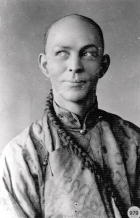
Showing posts with label Chung Ling Soo. Show all posts

Monday, January 27, 2025

Zabrecky conjures OUR MAGIC

Check out this terrific video by magician and musician Rob Zabrecky. It starts off with Houdini and continues with other magic masters and some pretty wild imagery. I love it! Watch it below or on YouTube.


You can pre-order OUR MAGIC as a 7-inch record from In The Red Records.

Wednesday, June 21, 2023

Accident at the Hippodrome


On April 18, 1918, a terrible accident occurred on the stage of the New York Hippodrome during a performance of Cheer Up. While Houdini wasn't involved in the accident, he was in the theater at the time. Below is a report from the New York Sun.

The New York Sun, April 19, 1918.

The day after the accident, Houdini wrote to Harry Kellar describing what he saw and also the panic backstage, which was not covered in the newspapers. This letter is housed at David Copperfield's International Museum and Library of the Conjuring Arts and reads in part:

I was out in Mark Lueschers office when I heard awful screaming. Mark and I rushed out into the auditorium, and what an awful site. We arrived when the damage in sight of the audience has been done, then two fool firemen passing me rushed downstairs and they must have lost their head. 

Houdini goes on to explain, with a fair measure of disgust, that the firemen panicked the chorus men who then "stampeded" the chorus girls waiting in the wings. "Then there was a hellavu time," says Houdini.

Houdini volunteered to go onstage to fill the gap in the show, but "things were in too disturbed a state" and his offer was not accepted. He did express relief that the flying car did not go into the audience.

According to Houdini, the stagehand, Henry Casey, died on the way to the hospital. This was not reported in the papers. In fact, it hard to find any followup on the accident. But Axel Mirano survived and the brothers were back performing their "Flying Torpedo" act by the end of the year. The advert below from the Palace shows what their apparatus looked like.


The timing of this accident is interesting. This was within a month of the accidental shooting of magician Chung Ling Soo on the stage at the Empire Theater in London. This was also the very week Houdini planned to perform his own version of Soo's bullet catch at the Hippodrome. 

As I covered in this post, the Hippodrome management requested Houdini cancel the dangerous trick and he did. I wonder if this accident had anything to do with that? I also wonder if being in such close proximity to two stage tragedies might have spooked Houdini. He didn't want to be number three!


Want more? You can read more details about the Hippodrome accident as a "Scholar" member of my Patreon.


Thanks to David Copperfield.

Monday, February 6, 2023

Houdini at the Alhambra 1900 brochure sells on eBay

A beautiful 4-page souvenir brochure for Houdini at the Alhambra Theatre in London sold on eBay this weekend for the not unreasonable price of $1,036.

This is not an unknown piece as all 4 pages are reproduced in Milbourne Christopher's Houdini A Pictorial Life. However, what's makes this one so exciting--apart from it being an original--is it contains a smaller tipped in program for the patriotic playlet "Soldiers of the Queen."

"Soldiers of the Queen" was a feature of the Alhambra bill when Houdini made his debut there in July of 1900. That suggests this is from Houdini's famous two month breakout run at the theater. "Soldiers of the Queen" was still playing at the Alhambra when Houdini returned in December, so it's possible this comes from that later engagement. But the play left that month, so this can only be from 1900. That makes it a pretty exciting and significant piece of early Houdini history.


Below is an ad from the July 4, 1900 Pall Mall Gazette showing Soldiers of the Queen, Chung Ling Soo, and Houdini all playing the Alhambra.


Congrats to the winner of this gem!

Related:

Wednesday, May 11, 2022

Taking aim at Houdini's abandoned bullet catch


Most Houdini biographies contain the story of how Houdini announced he would perform the infamous bullet catch trick shortly after the onstage death of magician William Robinson, a.k.a. Chung Ling Soo, in 1918. But magician Harry Kellar wrote Houdini a heartfelt letter talking him out of it and Houdini cancelled the performance. Turns out that scenario isn't strictly accurate. But we will get to that.

Milbourne Christopher in Houdini The Untold Story was the first to identify the event at which Houdini proposed to do the trick as a gala S.A.M. benefit for the Showmen's Hospital Fund at the New York Hippodrome on April 21, 1918. It's said the bullet catch was widely advertised. However, I've never been able to find any advertisement that confirms this. Below is a typical advert for the benefit that mentions "his new death defying sensation." But this could be the Water Torture Cell.

The New York Sun, April 20, 1918.

Likewise, the program for the event itself--an original of which is in the Harry Ransom Center--makes no mention of the bullet catch. It only shows that Houdini would perform his Water Torture Cell that evening.

I began to consider the possibility that famous cancelled bullet catch might have been a back engineered Houdini myth. But while searching for something completely unrelated, I finally found the smoking gun!

New York Tribune, April 21, 1918.

So, yes, it appears Houdini did intend to do the bullet catch at this Hippodrome show. A fantastic new detail here is that Houdini's firing squad would be made up of real doughboys from the 71st Regiment using regulation army rifles. What a terrific modern piece of staging. I'm actually sorry this didn't happen. But why didn't it happen?

Here's where the truth diverges from the familiar telling. While Kellar did indeed write a heartfelt letter of warning to Houdini, he wrote that letter after the benefit (on May 1st). So the reason Houdini dropped the bullet catch wasn't Kellar. He dropped it on the request of the Hippodrome management.

The following is from an account of the benefit that appeared in the April 1918 issue of MUM:

Houdini had been advertised in the leading newspapers through reading notices, as intending to do the Bullet Catching Act. He was dissuaded by management of Hippodrome from taking up this dangerous feat, for he announced his famous Chinese water torture cell, which is probably just as, if not more, dangerous than the bullet catching business, as in either, the slightest error means a tragedy.

(To give credit where it is due, Bill Kalush in The Secret Life of Houdini was the first and so far only biographer to present the correct chronology of the bullet catch and Kellar letter.)

It's been suggested that Houdini never actually intended to perform the bullet catch and that he just announced it for the publicity. Maybe. But Houdini felt strongly about doing what he advertised and not "breaking faith" with his audience (a prime example here). Also, this was a prestigious S.A.M. event for charity that Houdini himself emceed. Doesn't seem like the kind of event in which you would want to be disingenuous in any way. But it is a possibility.

It's also worth pointing out that in the weeks following Chung Ling Soo's death there was gossip in magic circles that the magician may have been murdered. Joe Hayman, who informed Houdini of Robinson's death, offered some dark speculation that Houdini shared with Harry Kellar. Hence Kellar's warning that the same fate could befall Houdini -- "some dog might 'job' you." But an inquest into Soo's death discovered faulty equipment was the culprit.

So there we go. We've confirmed when and where Houdini planned to do the bullet catch. We've learned how he intended to stage it. And we know why he didn't. There's also the possibility that Houdini did the effect early in his career, but that's another story.

Thanks to Joe Fox at the Magic Castle Library for the MUM clipping and Eric Colleary at the Harry Ransom Center for a look at the original program.

UPDATE: Could this have has something to do with the cancelation of the stunt? Read: Accident at the Hippodrome

Saturday, February 27, 2021

Soo's Unmasking bullseyes $26,400

In what must be a record for a signed Houdini book, a copy of The Unmasking of Robert-Houdin inscribed by Houdini to his friend Chung Ling Soo blew past its $4,000 - $8,000 estimate and sold for a whopping $26,400 (including 20% commission) in this weekend's Potter & Potter magic auction.


All the Houdini lots were red hot. A signed playing card sold for a stunning $11,400. A pair of gaffed Peerless handcuffs from the Wresch collection took in $13,200. A production baby said to have belonged to Houdini in his early days sold for $7,800. A collection of Dai Vernon's own mementos of the night he famously fooled Houdini at the Great Northern Hotel in Chicago sold for $6000.


The auction also included a program for Houdini's last appearance at the Garrick Theater in Detroit in October 1926. That topped out at $7,200. This is likely another record for an unsigned program.

Related:

Friday, January 22, 2021

Houdini's final show program at auction

Potter & Potter have posted their February 27 magic auction listings and among the Houdini rarities is a true bombshell! It's an original program for Houdini's "3 Shows in One" at the Garrick Theater in Detroit for the week of October 24, 1926. Of course, this was the final engagement of Houdini's life and October 24 his last show. I've never seen a program for his appearance at the Garrick, so this is pretty wild.


Inside the program there is an ad announcing the week of October 31 as Houdini's final week (confirming Detroit was scheduled as two week run). It's a bit eerie to have the two days, October 24 and October 31, both mentioned prominently in the program.

Other notable lots include: "Houdini's Production Baby" (companion to the doll seen in this photo maybe?), a copy of The Unmasking of Robert-Houdin inscribed by Houdini to his friend Chung Ling Soo (found at last), and Dai Vernon's own mementos of the night he fooled Houdini.

Potter & Potter's Select Secrets: Rare & Important Magicana auction will be held Saturday, February 27, 2021 at 10 AM CST. You can view the full online catalog HERE.

UPDATE: The program sold for $7,200 (including 20% commission) in what was a red hot auction.

Saturday, April 11, 2020

10th Anniversary: Golden Age in bronze

In 2010 Mike Elizalde's special effects house Spectral Motion launched their amazing "Magicians Series" of bronze busts. I discovered these by surprise at Monsterpalooza and blogged about them 10 years ago today.


TEN YEAR UPDATE: Spectral Motion has thus far created busts of Houdini, Robert-Houdin, Kellar, Thurston, Chung Ling Soo, Alexander Herrmann, Adelaide Herrmann, Blackstone, Dante, and Cardini. All are on display at the Magic Castle. I've heard talk of mini busts and a new series of contemporary magicians. Mike Elizalde recently teased Ricky Jay on his Twitter. As for Houdini, I've never pulled the trigger on one of these (they are $2650), but I remain tempted and they still have a few in stock. My dream is they'll one day do a second Houdini bust at his older "Master Mystifier" age.


Related:

Thursday, April 25, 2019

Houdini in 1905

For Houdini, the year 1905 was split into two distinct halves. The first half saw him as an established superstar in Europe. But the second half found him back in America, where in some ways he had to prove himself all over again. It was a fascinating transitional year, and one of his most combative.

This post is now retired. But you will be able to enjoy the story of Houdini in 1905 in my upcoming book

Sunday, January 13, 2019

Houdini's Last Secrets episode 2 hits the mark


The Bullet Catch is the subject of the second episode of Houdini's Last Secrets. This might seem odd as the Bullet Catch is known as the one trick Houdini didn't do. (He announced he would in 1918 after the death of Chung Ling Soo, but was talked out of it by Harry Kellar.) However, there is some evidence that he might have done the trick very early in his career, and that leads the team into their investigation.

I think this second episode, "To Catch A Bullet", is a big improvement over episode one. This time the focus remains on the Bullet Catch--no nonsense about Houdini being a spy--and the show does a nice job investigating its history in interviews with Ben Robinson, author of Twelve Have Died, and Stephen Fenton, a Chung Ling Soo collector and expert. We also get to see the great Kevin Connolly surrounded by his magnificent Houdini collection.

I also pop up again (last time, I promise!) to "reveal" Houdini's own account of doing the Bullet Catch in the October 1936 issue of The Sphinx. This appears to corroborate a mention by Jack Hyman as related by Edward Saint in the April 1937 Genii. And then there's that "horse pistol", just as Houdini describes, clearly visible in a famous early photo of him with his magic apparatus (right).

What didn't make the cut was me saying that I wouldn't conclude Houdini did the Bullet Catch based on just this. I'd need to see something independent of Saint and Houdini, such as a newspaper account from the time. So we're not there yet.

But the show kinda used my interview to tip the scales toward the idea that Houdini did in fact do it, and that's fine. I think they did a good job of presenting the evidence and making it seem plausible. In this way, I think they've captured the real fun of investigating the puzzle that is Houdini's life, and it makes me look forward to upcoming episodes on the Carette and Buried Alive, of which there is much more to chew on.

Structurally the show is split between two investigative paths. As George Hardeen looks into the history of the Bullet Catch, Steve Wolf at Stunt Ranch tries to engineer his own version for magician Lee Terbosic to perform. It's all very Mythbusters-like. They even have their own Kari Byron in Salina Cram.

I confess I don't know how the Bullet Catch is done (apart from Chung Ling Soo's method, which the show does explain), so I'm not sure what lines if any they cross in regards to exposure. But this episode makes it clear they are engineering their own methods, and apart from the pig cadaver silliness, I found the these sections pretty captivating. I'm especially surprised to learn how deadly blanks can be even from a distance.

Everything about this episode works, including having genuine tension at the end when Lee does the deadly trick himself. Does he survive? I'll leave that for you to discover.


Houdini's Last Secrets airs on the Science Channel and the SciGO app. You can also stream episodes at their website, or purchase the series via Amazon and iTunes.

If you're interested in more information on Houdini and the Bullet Catch, check out the below links:

Friday, June 29, 2018

Bill Kalush has been to the mountaintop


It's official. William Kalush now knows more about Houdini that anyone living (if he didn't already). That's because Bill, who co-wrote the 2006 biography, The Secret Life of Houdini, was recently granted unique access to Houdini's private diaries.

Last weekend Bill gave a talk about the diaries at the Cincinnati Magic Collectors conference (aka "Gathering of the Vultures"). I've only heard snippets about what Bill shared, but what I've heard has blown my mind!

The diaries start in 1904 and are handwritten with some typed inserts. Houdini appears to have added to his original entries over time. Bill showed several photos from the diaries, many that featured images of unknown posters. One photo shows Bess sitting at wheel of Houdini's Voisin bi-plane. Bill also showed ads that Houdini placed trying to sell the plane in 1910. There was also photo of a cabinet that Bill described as a possible precursor to the Water Torture Cell.

The diaries also revealed the existence of two hitherto unknown assistants; Thomas Clarke Pendrigh, who worked with Houdini for two years, and Harry Wittaker, who stole Houdini's secrets and went out on his own (and failed miserably). Houdini supported a female escape artist known as Oceana. He had gaffed cuffs made by Froggatt & Company. He once struggled 80 minutes inside a U.S. Navy boiler. And Bess once left £40,000 worth of jewelry in a cab in England. (Later recovered.)

One bombshell was the revelation that Houdini might have had a half sister named Peppi (possibly a daughter of Mayer Samuel before his marriage to Cecilia). Also, Chung Ling Soo told Houdini he had three wives, including a Jewish one.

During the Q&A, someone asked Bill if the diaries contained any information about Houdini being a spy. They did not.

While Bill said he could not reveal who owns the diaries, it's pretty well known that the family of Bernard M.L. Ernst, Houdini's lawyer, have held a collection of diaries since Houdini's death. So I'm assuming that's what Bill saw. The family have only provided limited access to select researchers in the past. In fact, Bill could not even get access to the diaries when he was writing his own book.

Here's hoping Bill will share what he learned in some larger way, perhaps in an upcoming issue of Gibecière, the journal of his own Conjuring Arts Research Center. But, for now, I'm perfectly happy knowing that someone has been to this particular mountaintop, and confirmed it is indeed a place of special knowledge.

Thanks to an attendee tipster, Bill Kalush, and Phil Schwartz at the excellent Thayer Magic forums for the info.

Related:

Friday, March 23, 2018

The death of Chung Ling Soo

It was 100 years ago today that magician Chung Ling Soo was shot on stage at the Wood Green Empire Theater in London during his famous bullet catch routine. He died the following day (Houdini's birthday).

Ching Ling Soo was actually William Ellsworth Robinson, an American who performed under the guise of a Chinese conjurer. Amazingly, he kept his real identity and nationality a secret from the public. He was also good friends with Houdini. In fact, Chung Ling Soo was on the same bill as Houdini during his first historic week at the London Alhambra in 1900.

In 2005 Jim Steinmeyer published the excellent biography, The Glorious Deception: The Double Life of William Robinson, aka Chung Ling Soo, the Marvelous Chinese Conjurer, probably the best non-Houdini magician's biography I've ever read. Today David Copperfield owns one of the rifles used in Soo's tragic act 100 years ago.

Below is a clip from YouTube that purports to be the only known footage of "Chung Ling Soo."


Related:

Saturday, March 10, 2018

The Great Illusionists by Derek Tait released in UK

Derek Tait's new book The Great Illusionists has been released in the UK by Pen & Sword. You'll recall Derek's last book was about Houdini in the UK. Now he expands the story of Golden Age magic in Great Britain.

In a time before television, radio and cinema, entertainment was found at the many music halls and theatres up and down Great Britain. Acts were varied and included singers, comedians, acrobats, dance acts, animal acts, magicians and escapologists as well as male and female impersonators. Shows played to packed audiences.

Many people escaped their hum-drum lives, working in cotton mills, coal mines or factories up and down the country, by visiting the local theatre or music hall. Magicians and illusionists attracted huge crowds all over the country. This book includes the stories of some of the best illusionists as well as speciality acts such as Datas and The Human Fly. Some are still well-known names today, while others will be unheard of by many. Marvel at the feats and lives of the Davenport Brothers, the Great Raymond, David Devant, Carl Hertz and Harry Kellar. Relive the tragedies such as the deaths on stage of Chung Ling Soo and the Great Lafayette.

The performers of the late 1800s and early 1900s made way for the many great illusionists and stage artists that we have today. Acts such as David Copperfield, Siegfried and Roy and David Blaine are all influenced by the likes of Houdini, The Great Lafayette and Robert-Houdin and without the innovations of the early artists, the modern performers might not exist - how different would entertainment be to this day?

 Purchase The Great Illusionists now at Amazon.co.uk (UK) and pre-order at Amazon.com (U.S.).

Related:

Thursday, February 22, 2018

Into The Copperfield Zone, Part I

Last week I had the extreme honor of visiting David Copperfield's International Museum and Library of the Conjuring Arts in Las Vegas. David's collection is staggering. Imagine the world's largest magic collection, and then triple it. And when it comes to Houdini, well...in two hours I saw more authentic Houdini props and memorabilia than I've seen in my lifetime. But to share this experience right, I need to share it from the beginning.

A few weeks ago I had a telephone conversation with David and his Executive Producer Chris Kenner about Houdini's bookcase from 278. [I shared details here.] During the conversation, David invited me to Las Vegas to see his collection. He warned me "it was a mess" because he's currently working on a major expansion. But he was eager for me to see it now, and then come back when it is finished. Well, you don't say no to an invitation like that!

So on Tuesday, Feb. 13, I hit the road to Las Vegas where a room had been arranged for me at the MGM Grand Hotel & Casino. The view from my window was my first clue that I had entered The Copperfield Zone.


The plan was for me to attend David's 7:00 pm show. As I had a few hours to kill, I hopped over to the New York New York Hotel & Casino and paid a visit to Houdini's Magic Shop. This was the first store to carry the "Houdini's" name, and it's still my favorite. Not only do they have a life-size mannequin hanging from the ceiling in a straitjacket, but they also have Houdini (1953) playing on a loop out front. Houdini posters and photos cover the walls, and several display cases contain authentic memorabilia from owner Geno Munari's collection. Unfortunately, there's far less on display than in the past.

I was told by the helpful magician working the counter that the larger Houdini stuff was now at their main headquarters store on Dean Martin Drive. This was a location I wasn't aware of, so I resolved to see it before I left town. That's when I noticed high atop a shelf a slim wooden case stamped with Houdini's name. I was told this was the case that held the glass for the Water Torture Cell. It wouldn't be the only one of these I would see this day.


Show time came and I took my excellent seat inside the MGM's David Copperfield Theater. Now, David's Las Vegas show requires a full blog in itself, so I'm not going to be able to do it justice here. Suffice to say, it was awesome! The last time I saw David perform live was in 1997, so I was struck by the evolution of his show. It was surprisingly informal and very interactive--almost every trick involved the audience in part or whole--and even downright raucous at times! The pace of the show was breathtakingly fast and David's team of assistants were a marvel to watch. His climatic BLU production was quintessential David Copperfield in its mix of storytelling, magic, music and emotion. This is the stuff I really love. And, of course, there were several jaw dropping moments that have to be seen to be believed. A full alien spaceship appearing in the center of the showroom? Yep, that happened.

After the show, I went backstage with a small group of VIPs (you can get a ticket that allows you to meet David and take a photo). David's very nice assistant, Mikayla, told me to hang back, and after everyone left, I met David and Chris Kenner. Everyone seemed excited for me to see the collection, and the plan was for me to return to the theater after David's second show (meet at the lobby statue at 11:10 pm).

After dinner, I was in place at the statue, and with the same clockwork precision I enjoyed watching during the show, one of David's assistants whisked me back through the now empty theater and out through a stage door. There I joined David and Mikayla for the short drive to the museum. Along the way, David and I talked Houdini (what else!?). He asked how I became interested in Houdini, and we chatted about various collectors and collections (anyone's ears burn?). We discussed the merits of various biographies, and even some of the questions of the day, such as the notion that Houdini may have worked as a spy. I gotta say, I was instantly comfortable with him. He's a Houdini guy!

We arrived at the museum around 11:30 and entered via a false front made up to look like the tailor shop of his father. After seeing his show -- BLU is a moving tribute to his father -- I understood how much David loved his dad and understood the symbolism of how the entrance to his dreams would be via his father's work. That's when I realized how the museum itself was a massive David Copperfield production, combining magic with personal biography, meant to awe and inspire. Even more so than his show, I was entering a special world of his creation, and I understood why he's so proud of it and excited for someone to experience it for the first time. [The museum is not open to the public, but David gives private tours.]

Now, I should say up front that I took no photos inside (okay, one, but we'll get to that). This was not because I couldn't. I quickly discovered David would deny me nothing. I was able to handle and open anything I wanted (make sure you come back for Part 2 for more about that!). So I'm certain I could have taken photos had I asked. But I didn't want to. This was about experiencing the museum, not photographing it, and I wanted to give everything my full attention. But that means I have nothing to illustrate this blog going forward, so I've plucked down a few online photos to help, starting with one that shows the "shop" entrance.


We then entered the warehouse itself via the tailor shop's dressing room -- pull down on a shirt tie and the mirror pops open. Very cool. We then stepped into what could be considered the David Copperfield area. This is a massive open space housing all his famous illusions. Here stands the massive rack of spikes from his "Fires of Passion" escape. There's even a helicopter! The entrance to David's offices and museum are through an unmarked and innocuous side door. Inside I waited as David and Mikayla turned on the lights and display cases of the museum. Yes, this was all being opened just for me!

To explain all that I saw inside is just not possible, even in a two-part post like this. It was truly overwhelming! The entire museum is structured as a journey. It starts at the small magic counter from Macy's department store where David bought his first magic trick (which he performed for me). It then opens up and one travels deeper and deeper into the special world of magic. Room after room is filled with amazing artifacts. There's a room devoted to magic kits and apparatus in general, with ceiling high racks holding every version of every magic trick ever created by legendary magic manufacturers like Owens, Abbotts, and Thayer. I even spotted the magic table I had as a kid. There's a full size reproduction of the back room theater of Martinka's Magic Shop in New York with the original store cases filled as they were in the days of Al Flosso.

Every major magician is represented with displays made up of posters, props and personal memorabilia. David guided me through the worlds of Herrmann, Kellar, Thurston, Carter, Alexander, Blackstone, and even Doug Henning. Orson Welles has his own area, complete with the sub trunk he used with wife Rita Hayworth. The Chung Ling Soo display has one of the rifles used during his bullet catch. David doesn't know if it's the rifle that killed the magician, but it is one of them that Soo stood in front of on that fateful night in 1918. An unrestored 8-sheet Kellar poster bewitched me for some reason, and I was surprised when David told me it had belonged to Houdini and came from inside 278.

Robert-Houdin has his own standalone room filled with clocks, props, and automata from this earliest age of magic. I believe it's the only closed room devoted to one magician. This was one of my favorite rooms as it seemed to hold a special energy, not unlike how the Houdini Séance Room at the Magic Castle feels like a world apart. Here are the very seeds of modern magic; beautiful and exquisite apparatus that Houdini himself revered as treasures from the past. David said this will all be moved into an open area behind the new Houdini section, so I'm glad I got a chance to experience this room as is. There's something magical going on here.


Eventually we arrived at the famous Houdini area, and it's everything we've seen in photos and more. Here I was able to examine and touch Houdini's custom traveling library case, his Milk Can, Metamorphosis, straitjacket, iron gibbet, and Water Torture Cell. I was inches away from the Mirror Cuffs and Houdini's baby shoe. A stage jacket worn by Bess is so small you'd think it was made for a large doll. One-of-a-kind posters towered over me, and David paged through a scrapbook filled with photos I've never seen. The famous Houdini-Keller correspondence are in a book that one can flip through. And here too was a case made to carry the Water Torture Cell glass, identical to the case in Houdini's Magic Shop. (This is explained by the fact that Houdini always traveled with an extra pane of glass.)

The Water Torture Cell looks much like it did when I saw the unrestored original at the Houdini Magical Hall of Fame in 1990. That's because after buying the restored cell at auction, David and his team stripped it back to its original surviving elements (namely all the metal) and rebuilt it using antique wood and period accurate hardware. They also aged it so it appears exactly as if it had never been cleaned since Houdini's final performance. David and I seemed to share the philosophy that it's not always necessary to restore things to look brand new. Age and signs of travel are part of their stories.

David then showed me a rejection letter sent to the young Houdini from John Nevil Maskelyne dated March 24, 1898. He also had a small display devoted to the artist who created many of Houdini's posters, including his beautiful but perplexing 1911 Buried Alive poster, which stands behind the Houdini exhibit (I didn't even know David owned this poster until that moment).

For whatever reason, I did not think to play the snippet of Houdini voice recording that David has set up beside the original wax cylinders and Edison player. But David and I had a conversation about the recordings. I learned that he has not yet transferred all the cylinders to another media, but he plans to. He actually wasn't sure himself what's contained on all six cylinders, and that made me wonder if there's content on these yet to be discovered? [Watch for a dedicated post on this soon.]

It was here I decided to be a fanboy and asked if we could take a picture together. How could I not? David was very obliging and even took the selfie himself, working to get a good Houdini image in the background.


Now, you might think this was the grand finale, and it typically is. But then David said, "Just wait. You haven't seen anything yet."

Yes, I was about to go off the normal tour and deeper into this very special place to see things very few people have seen. But I'm going to save that for PART II (GO NOW).

Related:

Sunday, March 12, 2017

The Secret Life of Houdini screenplay reviewed

Here's one that's a spoiler if Lionsgate's The Secret Life of Houdini movie ever gets made. If not, then we have a record of what might have been. Either way, if you're curious to know what the Hollywood brain trust has cooked this time (at least as far as a draft dated May 13, 2011), here's a taste from the website Scriptshadow:

Houdini starts out like you think any biopic would start out. We get one of those oft-used cross-cuts between the present (Houdini trying to salvage a buried-alive trick gone wrong) and the past (Houdini as a child stealing a loaf of bread for his starving family). I figured I was in for one long biopic retread. 
But then things get weird. President Woodrow Wilson calls Houdini and tells him that his 28 year-old daughter, Margaret, has been kidnapped by someone in France. Wilson believes Houdini’s unique talents make him the perfect agent to go and retrieve his daughter. 
Looking for a new challenge, Houdini teams up with Wilson’s stuffy lackey, Andrew Day, and the two seahorse their way to La Francoise. Once there, Houdini calls upon old friend (and rival) Chung Ling Soo, a famous magician who’s been known to publicly roast Houdini. But no worries, it’s all for show, as is Chung himself, who’s actually, under all the make-up, a white American!

If you want to read on, then check out the full review at Scriptshadow HERE. The site also has a review of a 2003 script called The Book of Magic that teams Houdini and H.P. Lovecraft.

Related:

Friday, May 27, 2016

Houdini in 1900

This Memorial Day marks the 116th anniversary of Houdini's first trip to Europe on May 30, 1900. To mark the occasion, here's a look back at that all-important
year.
This post is now retired. But you will be able to enjoy the story of Houdini in 1900 in my upcoming book

Tuesday, January 19, 2016

If not Soo or Foo then who?

Click to enlarge.
The eBay mystery seller who listed a treasure trove of early Houdini rarities earlier this month is back with what he says is the last Houdini item from the scrapbook of magician Charles Dunbar of Boston. This time the item being offered is a terrific hand-written postcard that is already up to $1,125 with 9 days still left to go.

Normally, per my somewhat loose auction reporting policy, I wouldn't post about this until after the auction had ended. However, these rarities have created quite a stir among collectors and just their appearance has been news. Also, in this case, I think I can help correct the auction listing.

You'll notice that on this card Houdini has written: "A new Chinese magician is expected over here soon." The seller, who is a non-magic antiquarian dealer, speculates that Houdini could be talking about Chung Ling Soo, and includes this in the auction heading and description. It would certainly add interest and value to this item as Soo is the most famous "Chinese" magician of them all.

However, this was written in December 1900, and William Robinson had already established himself as "Chung Ling Soo" earlier that year. In fact, Houdini and Soo shared the bill at the Alhambra in July of 1900. So this is not a reference to Chung Ling Soo.

It's also unlikely this is Ching Ling Foo, a genuine Chinese conjurer who was responsible for making "Oriental magic" all the rage at this time. Foo actually returned to China in 1900 and would not reappear in the UK until 1904, at which time Houdini helped arrange a showdown between Foo and Soo -- which is one of the wildest stories in magic. (If you haven't read Jim Steinmeyer's brilliant Chung Ling Soo biography, The Glorious Deception, it's a must.)

So who this "new Chinese magician" might be is a mystery to me, although I admit I haven't tried very hard to suss it out. If you have any ideas, drop a comment below. And let's all enjoy watching this last beauty sell.

UPDATE: Final sale price was $2,150 with 20 bids.

Related posts:

Tuesday, January 12, 2016

Spectral Motion reveals Dante bust

Spectral Motion will add Dante (Harry Jansen) to their series of bronze busts of great magicians. Dante joins Houdini, Harry Kellar, Alexander Herrmann, Chung Ling Soo, Howard Thurston, and Robert-Houdin.

It's become sport to recommend magicians to Spectral Motion owner and Magic Castle member, Mike Elizalde. I've been pushing for Blackstone and Doug Henning myself.

You can see all the famous magicians busts and pre-order the Dante bust at the Spectral Motion website.

Related:

Tuesday, October 27, 2015

Chung Ling Soo is a True Nightmare

The Discovery program True Nightmares hosted by Todd Robbins recently aired a segment about Chung Ling Soo and his fatal accident while doing the bullet catch. In the reenactments, Soo is played by magician Frederick Falk and his wife Dot, a.k.a. Suee Seen, is played by my good friend Callie Cleaves (below).


The segment also features Jim Steinmeyer, who wrote the definitive biography of Chung Ling Soo, The Glorious Deception.

Houdini and Chung Ling Soo (actually magician William Robinson) were close friends. In fact, the week Houdini had his career breakout at the Alhambra in London, Chung Ling Soo was on the same bill. Dot and Bess Houdini were also close friends. When Soo was killed doing the bullet catch in 1918, Houdini announced plans to do the trick himself. But he was talked out of it by magician Harry Kellar.

The True Nightmares episode is called "Too Rich, Too Thin" (Season 1/Episode 2) and is streaming at the Investigation Discovery website (the Soo segment starts at 18:15). It also repeats on the Discovery ID channel.

Related:

Thursday, May 22, 2014

Houdini, Chung Ling Soo, and Woody Allen walk into a bar...

Woody Allen has frequently featured magicians and magic in his films. Now here is the trailer for his new film, Magic in the Moonlight, with Colin Firth playing a magician who is clearly a cross between Chung Ling Soo and Houdini. The plot might also seem a little familiar.


Magic in the Moonlight will be released on July 25, 2014.

Friday, February 8, 2013

The secret of Sony's Houdini movie

After a flurry of reports in 2011 about the hiring of screenwriter Scott Frank and director Francis Lawrence, news on Sony Pictures' Houdini movie has all but dried up. This certainly wouldn't be the first time a Houdini project has become trapped in Development Hell, especially at this studio. I suspect this movie isn't going to get made.

So today I'm going to spill a little tidbit about the project that didn't find its way into any of the news reports. In fact, there seemed to be an effort by the studio to misdirect people in regards to the plot, which was reported to be about Houdini falling in love with a beautiful spiritualist (shades of Death Defying Acts). Not true.

The real plot is about Houdini and Chung Ling Soo working together to break a man out of prison. According to my secret sources, Chung Ling Soo plays as big a roll in the movie as Houdini. The script also includes a large element of the supernatural.

Chung Ling Soo was actually William Ellsworth Robinson, a skilled American magician who gained fame posing as a Chinese conjurer. Amazingly, the public never knew his true identity or nationality. Houdini and Robinson were good friends. In fact, they shared the bill at the Alhambra Theatre in July 1900 and both catapulted to fame at the very same time. Chung Ling Soo was later killed onstage performing the bullet catch.

I like the idea of a movie featuring a newly famous Houdini (a Hungarian posing as an American) and Robinson (an American posing as Chinese) becoming involved in some sort of adventure in the early 1900s. Of course, I would rather see it played straight. But you know Hollywood; if it isn't an action movie they don't understand it.

Other Houdini projects languishing in the pits of Development Hell: The Secret Life of Houdini (Lionsgate); The Houdini Box (20th Century Fox); Voices from the Dead (DreamWorks); Among The Spirits (NBC); The Arcanum (Gold Circle); and Carter Beats the Devil (Warner Bros). There are also untitled Houdini projects being developed at Walden Media and Ron Howard's Imagine Entertainment.

Translate