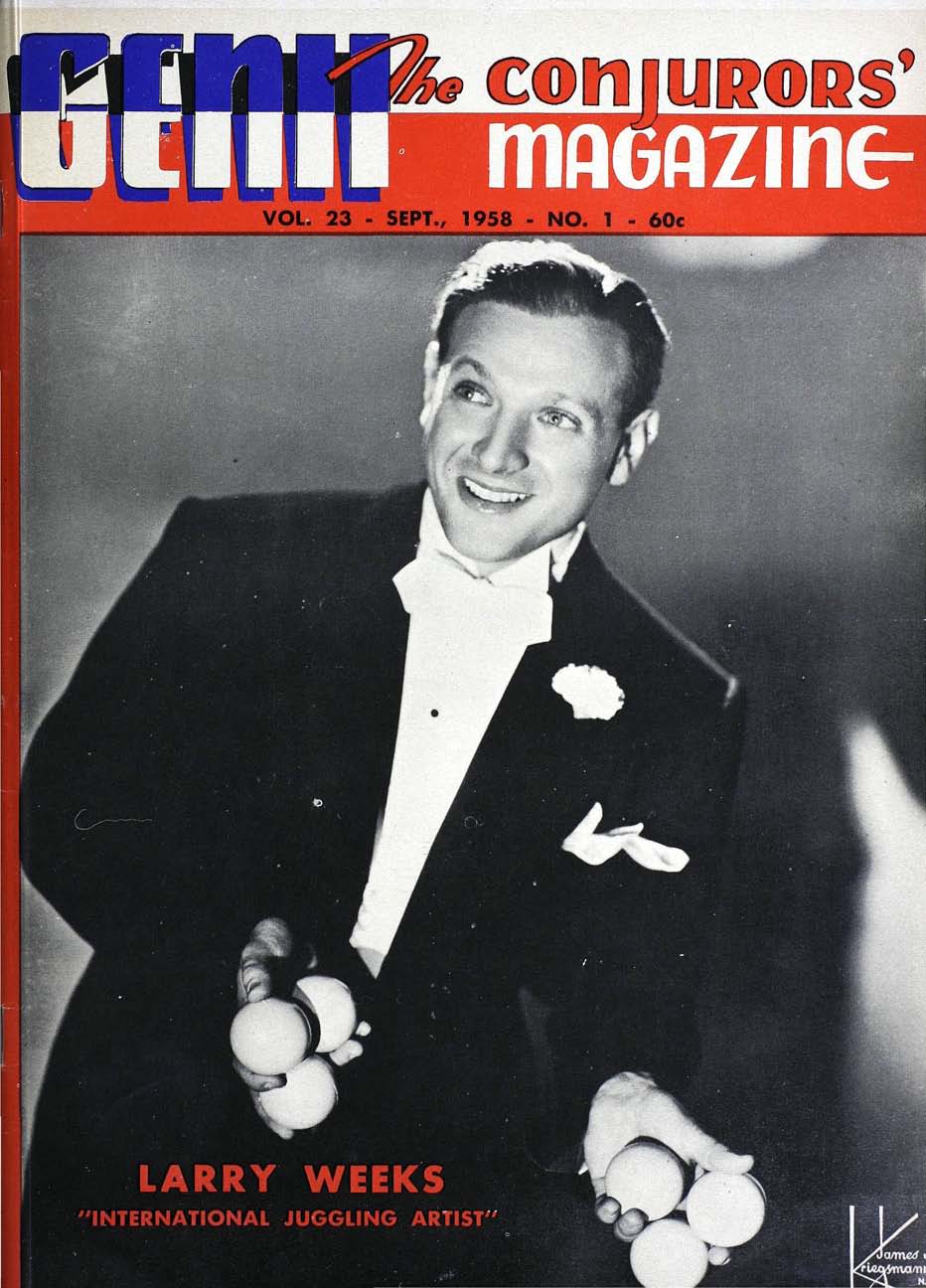
Showing posts with label Larry Weeks. Show all posts

Sunday, April 4, 2021

Watch The Magic of Houdini with Alan Davies

Here is the full documentary The Magic of Houdini with Alan Davies. This first aired in the UK on Easter Sunday, 2014. It's well done and features some familiar faces. Enjoy.


Thanks to Greg Edmonds.

Sunday, February 14, 2021

Houdini's Needles pin down $2,574

A packet of 24 T. Hessin & Co nickel plated Darners Needles that Houdini used in his popular East Indian Needle Trick sold in Haversat & Ewing's latest magic auction for $2,574 (including buyers premium). Below is the auction description.

In this famous trick, Houdini swallows a number of needles along with yards of thread and brings them all up threaded. The needles passed from Bess to Houdini's niece Ruth Kavanaugh. Houdini collector Larry Weeks acquired the packets directly from the family in the 1960's. This fact has been confirmed by Houdini's Great Nephew John Hinson who was also a benefactor of needles given to him by his Aunt Ruth. The lot includes Houdini's needles ONLY.

It's interesting to see that Houdini used nickel plated needles. Possibly because these offered the best reflection on stage? But one wonders if he ever experienced ill effects from having nickel in his mouth so often.

This is the fourth set of Houdini Needles of which I'm aware. 

Thursday, November 12, 2020

S.A.M. wand breaking ceremony 2020

The Society of American Magicians held their annual wand breaking ceremony Tuesday at Houdini's grave in Queens. The members wore masks due to Covid. This year one of Barry Spector's wands made of wood lath from Houdini's 278 was used for the ceremonial breaking. The broken wand will be sent to the Houdini Museum in Scranton.


This year the assembly also paid respects at the nearby grave of Larry Weeks.


Thanks to Rene Clement for the photos.

Tuesday, May 12, 2020

Days of Thrills and Harry Houdini

While the big boys were slugging it out in last week's Potter & Potter auction, spending thousands on some important Houdini lots (and some that didn't seem that important), I was happy to snap this up on eBay for a $15 Buy It Now. No, it's not rare, and you might not even understand exactly what this is. But I've always wanted one of these "Houdini dangles from a cliff!" lobby cards from Days of Thrills and Laughter because I've long considered this movie an important part of Houdini's amazing afterlife. But I'll get to that.


Released by 20th Century Fox on May 5, 1961, Days of Thrills and Laughter was a feature length documentary made up of extended clips from silent movies. It was the third such film from producer Robert Youngson after The Golden Age of Comedy and When Comedy Was King. The original New York Times review of the movie at the Sixty-eighth Street Playhouse states:

Since he is concerned not only with comedy but also with thrills, Mr. Youngson has included bits by Douglas Fairbanks ("Wild and Woolly") and some mad material from the likes of such serial experts as Pearl White ("The Perils of Pauline," etc), Ruth Roland, Warner Oland, Boris Karloff and, believe it or not, Harry Houdini, rescuing a somewhat foggy damsel from taking the distressing drop over Niagara Falls.

The Houdini segment runs about 5 minutes and shows more than just the Niagara Falls rescue from The Man From Beyond. We also see the entire cliff fight (as shown on the lobby card, although obviously not in color) and the coat rack escape from The Master Mystery. But what will be of most interest to Houdini buffs is rare behind the scenes footage of Houdini and Bess visiting producer Al Christie at Universal Studios in 1915. It's a remarkable piece of film that I don't believe has appeared anywhere else. All the Houdini footage is excellent quality and is credited as coming from the Larry Weeks collection.


I consider Days of Thrills and Laughter important because it was the first such documentary to establish Houdini and his film work as "essential nostalgia" from this era. Along with television clip shows like Fractured Flickers, these went a long way in flagging to a new generation what was worth remembering. They also anticipated the cable biographies of the 1990s and beyond. So it's interesting that Houdini film career, generally considered a failure, affords him a place beside cinema giants like Fairbanks and Chaplin in this early work. Houdini always said he was making his movies for "future generations." So maybe not such a failure after all?

Days of Thrills and Laughter was released on DVD in 2010 and can still purchased at Amazon.com. But it can also be streamed for free via Amazon's Prime Video.

Related:

Friday, October 13, 2017

Guest Blog: The Bobby Handcuffs come home

Today our good friend Fred Pittella shares the story of a special pair of handcuffs that were precious to both Houdini and their long time owner Larry Weeks (who passed away three years ago today). Here's the strange tale of the Bobby Handcuffs.

There are good people out there...

It has been three years since Larry Weeks has passed “Houdini’s Biggest Fan”.

Amongst the many items missing from Larry Weeks apartment was the famed “Bobby Handcuffs” if you weren’t aware the Bobby handcuffs were named after Houdini’s fox terrier dog Bobby the only Handcuff King Dog. Houdini was said to have had trained Bobby to escape from ropes, handcuffs and even a miniature straight jacket. In 1918 Bobby performed for the Society of American Magicians Annual dinner escaping from a specially made pair of an English model Darby handcuffs (see photo above). According to a Houdini quote “He was a Dog-gone Hit”. Those handcuffs today are referred to as the Bobby handcuffs.

The Bobby handcuffs are featured in the 1996 Houdini Documentary “Houdini: People Came to See Him Die” where Larry had trained his fox terrier “Spanky the Wonder Dog” to Escape from the very same pair of handcuffs used by Houdini’s dog Bobby.

Larry was very proud to have in his collection these very rare and special handcuffs. Larry had brought the Bobby handcuffs to a few of Sid Radner’s “Official Houdini Séances” and to the many interviews he had done.

Larry was distraught when the Bobby Handcuffs one day turned up missing from his apartment.

Larry didn’t know who to blame, he was beside himself, he confronted a magician and a juggler who were his so called friends with no results. At the time Larry didn’t really trust them in and out of his apartment but had no choice his health was failing and he needed some help I had been traveling a lot. So I had worked hard fighting with an agency to hire someone to take care of Larry when I was out of town. Who knew this decision I would later come to regret.

After Larry had passed and it became public knowledge that I was to inherit his estate I received a strange call from a blocked phone number the gravel voice on the other end saying that if this was really true and if I was the true owner of these special handcuffs they will be returned to me. It took a very long time for the court to grant Larry’s last wishes. I had forgotten all about the anonymous phone call but one day to my surprise in my mailbox was the only stolen thing returned and that was the Bobby handcuffs.

So in this small collecting world of ours there are some decent people. Who know how to do the right thing!

Not knowing who this person is I just wanted to take this opportunity to thank them publicly being that I never had the chance to extend my gratitude!! So Thank You!! And of course Larry Weeks for always being there for me thank you!

-Fred Pittella

Related:

Thursday, August 10, 2017

LINK: The Grim Game's Disappearing Act

The Paris Review has a well-researched article by Will Stephenson about the reappearance in 2014 of Houdini's lost silent film The Grim Game. Nothing all that new for those of us who followed the blow by blow that year (some links below), but it's a good overview of the story with fresh quotes from Dick Brookz, Rick Schmidlin, and Jon Oliver. (Click the headline above to read.)

One thing this piece does not observe is that The Grim Game has not been shown on TCM since its one airing in 2015, nor has it been released on DVD or streaming. In some ways, The Grim Game is once again Houdini's lost film.

Related:

    Thursday, February 23, 2017

    The first great Houdini documentary

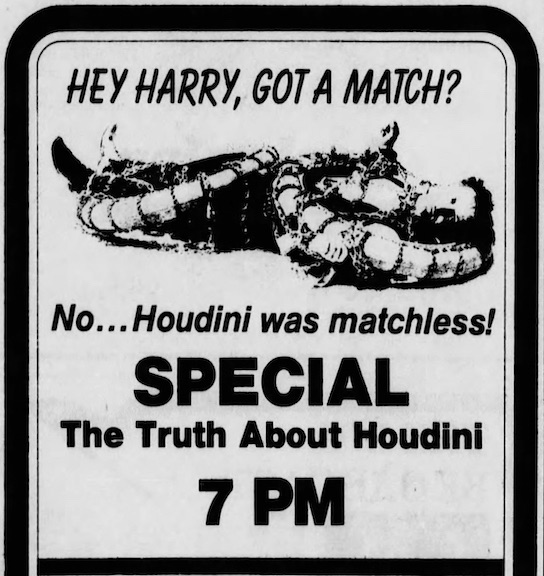
    On May 15, 1976, the BBC documentary The Truth About Houdini aired on American television for the first time. The film footage in this well-made documentary was for many (including myself) their first look at the real Houdini in action. Along with the new books, the Doug Henning specials and The Great Houdinis, the airing of this first major Houdini documentary in the U.S. was part in the great "Houdini renaissance" of the 1970s.

    Original TV Guide ad for the May 15, 1976 U.S. airing.

    The Truth About Houdini was originally produced for the BBC in 1970 by David C. Rea and Patria Pictures Ltd. It first aired on BBC One on Tuesday, November 10, 1970 at 9:20 PM (it was following by Monty Python's Flying Circus). It repeated on December 29, 1970, April 25, 1973 and December 18, 1973.

    The very first screening in the U.S. was at Ulster County Community College in Kingston, NY, on November 9, 1975. Curiously, newspaper accounts record the title as "The Great Escape Artist." The screening was attended by Walter B. Gibson and Sidney Radner who introduced the film and participated in a Q&A.

    Following its U.S. television premiere on May 15, 1976, which was local to Southern California, The Truth About Houdini aired on local televisions stations across the country. In Tampa, Florida, WTOG-TV aired it back to back with the Tony Curtis biopic Houdini over the Halloween weekend. It remained in circulation until 1979.

    Ad for an October 1977 airing on WTCN in Minneapolis.

    In addition to the rare film footage (credited as coming from the collection of Larry Weeks), The Truth About Houdini contains interviews with Milbourne Christopher, Walter B. Gibson, James Randi, and Sidney Radner. Radner's demonstration of Houdini's full body punishment suit escape was cut for time in some later airings. Today it's quite horrifying to behold Radner thoroughly abusing this valuable Houdini artifact. (It sold for $11,000 in 2014.)


    It's not generally known that the producers of the documentary secured permission to use the Houdini voice recordings discovered in 1970 from the widow of John Mulholland. They even acquired high quality reproductions of both Water Torture Cell speeches. But for whatever reason, Houdini's voice was left out of the final cut.

    While now dated, The Truth About Houdini is still a fascinating documentary and must watch for all Houdini buffs. While it has never been commercially released on home video, a bootleg version under the title "The Magic of Houdini" (not to be confused with the Alan Davies doc of the same name) has appeared from time to time. Currently Amazon has it available as a streaming video.

    So did The Truth About Houdini play a role in your own coming to Houdini? Share your memories in the comments below.

    Wednesday, January 18, 2017

    Lives of the Conjurers, Volume Three

    Houdini is one of four performers profiled in the new paperback Lives of the Conjurers, Volume Three by Professor Solomon. The book also contains a profile of Larry Weeks. Here's the description:

    * Houdini (Part I)--The story of the escape artist who became the highest-paid performer in vaudeville. From his early days as a newsboy, to his years struggling in beer halls, sideshows, dime museums, and other lowly venues, to his success as the Handcuff King, to his rise to international fame. 
    * Larry Weeks--A master juggler, he dwelt amidst a chaotic collection of magic memorabilia--including the sole surviving copy of "The Grim Game," Houdini’s lost film.
    * Martin Sunshine--Every summer for 35 years, he donned a fez and performed at a resort as Kismet the Magician. 
    * Lung Tung--Once the Court Magician to the Empress of China, he had been reduced to passing the hat in hotel lobbies. But he could still hear the sounds of the court and the reverberations of the gong.

    You can purchase Lives of the Conjurers, Volume Three at Amazon.com (U.S.) and Amazon.co.uk (UK). Free PDF downloads of the first two volumes are available at professorsolomon.com.

    UPDATE: With this now in hand, I can say it's well done. I was also interested to see that tells in detail the story of Rick Schmidlin's acquisition of The Grim Game from Larry Weeks. The book nicely credits my interview with Rick as the source.

    Related:

    Wednesday, October 26, 2016

    Fred Pittella inherits Larry Weeks estate

    Some important news in the word of magic today. Houdini collector and all around good guy Fred Pittella has inherited the estate of Larry Weeks who passed away in 2014. That's the good news. The bad news is a large portion of Larry's collection, including many important Houdini artifacts, vanished from his apartment following his death. Now that legal hurtles have been cleared, Fred could use some help. Below is the full press release.

    Fred Pittella with Larry Weeks and Houdini assistant Dorothy Young.
    It’s official. After a two-year long, legal proceeding, Fred Pittella of Queens Village, New York will now inherit the entirety of the Larry Weeks estate.

    Unfortunately, there were many items removed from Larry Weeks’ apartments that shouldn’t have been, just as Mr. Weeks was taken ill, in the hospital, and during Mr. Pittella’s battle to have Mr. Weeks laid to rest.

    At this time, no one is accusing anyone of anything directly. It could be understood why people may have removed items from the apartment in order to save them from being lost to the State or even thrown in the garbage by the landlord because people did not know Larry Weeks’ had documented his last wishes.

    There are quite a number of items missing from The Larry Weeks estate that belong to and are now the sole property of Fred Pittella. These items mysteriously vanished from Mr. Weeks’ apartment. Some of the missing items include, but are not limited to the entire 16mm and 35mm film library which included many historic films (many were Houdini related / over fifty cans of films), The Houdini Spiritualist slide show, a part of the handcuff and key collection (the lineage of this collection will be lost forever, unless it is returned), Houdini books (some signed), Houdini Photos (some signed), other Harry Houdini and Bess Houdini autographs, two Houdini scrapbooks (one oversized and one small), and countless pieces of personal jewelry.

    Before the Brooklyn District Attorney’s office gets involved again in a full scale investigation, this would be an opportunity to send anything back anonymously. If anyone has any information or any of the items that were removed from the apartment there will be no-questions-asked policy and no legal action will be taken.

    A plea to the magic community for your help to choose not to deal in, purchase, or put up for auction any of these items. Please contact The Supervising Detective Investigator of the Brooklyn District Attorney’s office regarding any information:

    Robert Addonizio · 350 Jay Street Brooklyn · NY 11201-2908 · 718.250.2444

    Mr. Weeks only sold or gave items after consulting with Mr. Pittella. Please use this address to send back items: Forum Novelties Inc. · c/o Fred Pittella · 1770 Walt Whitman Rd. Melville · NY 11747. If you wish to remain anonymous, please put the above address as the return address as well as the delivery address.

    Among the films now missing are said to be complete prints of Terror Island and The Mastery Mystery. Larry sold his print of The Grim Game (the only known print in existence) to TCM shortly before his death.

    Related:

    Sunday, September 4, 2016

    'The Magic of Houdini' now streaming on Netflix

    If you're looking for something to watch this Labor Day, I have great news for you. The 2014 documentary The Magic of Houdini with Alan Davies is now available to stream on Netflix. The documentary was produced for ITV in the UK. This marks its first availability in the U.S. (It has not been released on DVD.)

    In The Magic of Houdini, Alan Davies, a UK comedian and personality, travels to various Houdini locations in the UK and U.S. Along the way he talks with: Roger Dreyer, David Copperfield, Ruth Brandon, Ken Silverman, Kevin Connolly, Richard Sherry and Dayle Krall, and 93-year-old Larry Weeks (his last interview). As I wrote in my original review, it offers up a nice time capsule of the Houdini world in 2014.


    Thanks to London Ervin for the alert.

    Related:

    Monday, August 8, 2016

    Larry Weeks had a complete print of Terror Island

    The Grim Game restorationist Rick Schmidlin dropped a bombshell comment at Joe Notaro's "Harry Houdini Circumstantial Evidence" blog. According to Rick, shortly before Larry Weeks passed away, he said he had a complete print of Terror Island, Houdini's second film for Famous Players-Lasky Paramount released in 1920.

    This is huge news. Until now, the only known print of Terror Island was the one in the Library of Congress, and that print is missing two reels that contain two signature Houdini escapes. Also missing are the original Paramount title cards. This is the print that has been used to release Terror Island on DVD, with descriptive cards filling in the missing reels.

    We all knew Larry had The Grim Game, so there was always hope we'd one day see it (that dream came true last year). But the existence of Terror Island was unknown (at least to me), so the possibility of one day seeing the complete film seemed remote at best.

    But it's not all good news. The Terror Island print was among items stolen from Larry's apartment after his death. Also stolen was Larry's print of The Master Mystery, which also may be complete. Rick says the police do "have a lead."

    Let's hope the stolen prints can be recovered and Rick can do for Terror Island what he did for the The Grim Game. Might 2017 be the year of Terror? Fingers crossed.

    In the meantime, Joe Notaro is piecing together the lost Terror Island scenes using photos and script excerpts from the Margaret Herrick Academy Library. You can read his first installment, which reconstructs the Rosemary Theby "vamp" scene, HERE.

    Related:

    Friday, June 24, 2016

    Larry Weeks now "Houdini's Biggest Fan" for eternity

    Colleen Bak, our girl in Queens, took a stroll through Machpelah Cemetery today and noticed that Houdini collector Larry Weeks now has a beautiful headstone that identifies him as "Houdini Biggest Fan." Larry purchased the plot expressly to be near Houdini own gravesite. He died in 2014.


    Speaking of Houdini's plot, Colleen reports that the S.A.M. restoration appears to be underway. She says, "HH's grave looks really amazing...like it has been power washed, and a glass piece placed over the mosaic...awesome work on the restoration for sure."

    Thanks Colleen.

    Related posts:

    Tuesday, April 26, 2016

    The curious case of the incomplete Houdini scrapbook


    In the recent Potter & Potter auction of Houdiniana, a major Houdini scrapbook sold for a whopping $43,000 (not including commission). This was, I believe, the high price of the auction. Who won it and what will become of it, I have no idea. But according to David Haversat, who runs Haversat & Ewing Galleries, the scrapbook was incomplete. Therein lies an interesting story.

    The complete scrapbook was originally acquired by the late Larry Weeks (of Grim Game fame) in 1948. Larry held in his collection for half a century. Then in the late 1990s, Larry invited David to have a look at the scrapbook. Larry said he felt it was time to do something with it. When David returned, he discovered Larry had cut it up!

    "He said he wanted to let everyone have a chance on getting a piece of Houdini from the book," says David. "While some would have been really upset, I understood Larry and could not entirely disagree with his logic. The scrapbook was falling apart and Larry's place was jammed with stuff. If the scrapbook was lost or destroyed, then all the historical items would be gone as well."

    David handled the sale of the individual items for Larry between 1999 and 2000. Many items sold on eBay and fetched record prices at that time. Among the items sold were at least 20 Houdini challenges, annotated photographs, letters written to Houdini, postcards, tickets for his movies, photos of Bess and Houdini on vacation, and a receipt for parts for Houdini's airplane. With each item came a note from Larry explaining that it had come from Houdini's scrapbook.


    Collector George Daily acquired a good number of the challenges and had them restored. Other major collectors who benefited were Arthur Mosses, Ken Trombly, Sid Radner, Roger Dreyer and Pat Croce (whose own collection was sold in 2014).

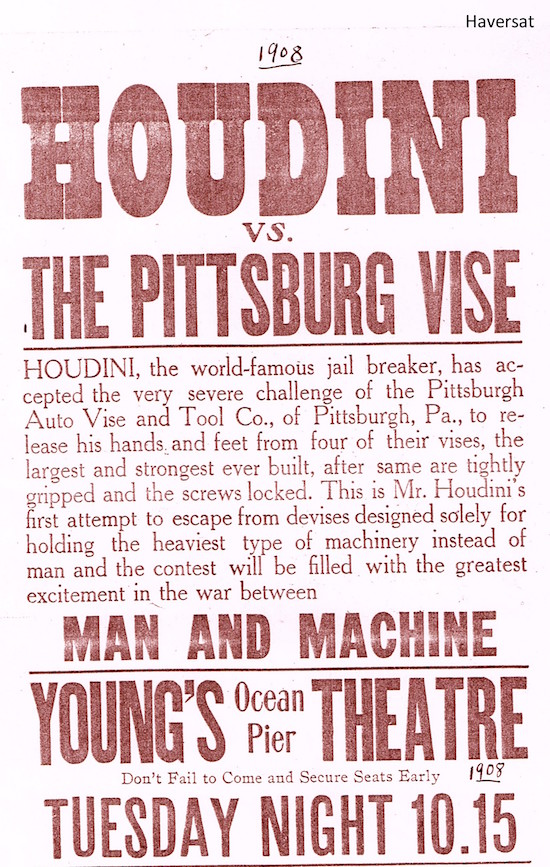
    Below are a few choice items from the original scrapbook, including a terrific challenge from The Pittsburg Vise that I've never seen before ("The War Between Man and Machine"). There's also an signed affidavit from Houdini to the Pan Pacific Exposition of 1915 assuming all responsibility during his overboard box escape in San Fransisco Bay. I'm excited to share these gems here today.


    So do you think Larry did the right thing in cutting up his Houdini scrapbook so more collectors could own a piece? Or did he destroy an important Houdini artifact? Sound off in the comments below.

    Thanks to David Haversat.

    Related:

    Saturday, November 28, 2015

    Teller on Houdini and The Grim Game

    Teller of the great magic duo Penn & Teller has posted his thoughts on The Grim Game at EatDrinkFilm.com, and when Teller talks Houdini (or talks at all), we listen! Teller calls Houdini "a sexy Jewish Schwarzenegger with more substance" and remembers collector Larry Weeks as a "wiry, goateed leprechaun with a beret and a wicked grin." It's a terrific article, so click below to read:

    Monday, November 23, 2015

    Page through a Houdini scrapbook

    Here's an intriguing YouTube video showing each page of what appears to be an original Houdini scrapbook. Inside are newspaper clippings from Houdini's time, many I recognize as being from 1914-16.

    UPDATE: Looks like the video has been removed.


    I'm afraid I don't have any information on this scrapbook or the owner. I've talked to a few collectors, and it appears this might be a scrapbook that once belonged to Larry Weeks and was sold in 2011. I expect this won't be the last we see of this.

    Thanks to Richard Bachman.

    UPDATE 2: The scrapbook sold for $43,000 at Potter & Potters 2016 auction of "Houdiniana." The scrapbook did belong to Larry Weeks. You can read more about it HERE.

    Related:

    Friday, April 24, 2015

    Rick Schmidlin (Bonus): Where did Larry Weeks get The Grim Game?

    Last week I had the pleasure of interviewing Rick Schmidlin who produced the TCM restoration of Houdini's The Grim Game. I posted my Q&A with Rick in two installments: Finding The Grim Game and Saving The Grim Game.

    Today I have a BONUS excerpt in which Rick and I discuss the mystery of the original 35mm nitrate print. This was said to be the last surviving print of The Grim Game, and it was disposed of in 1959 when Larry had the film transferred to 16mm safety film. But where did he get it?

    WAH: Did Larry tell you how he got the original nitrate print?

    RICK: He said he got it from Bess. I don't... Where would Bess have been in 1943?

    WAH: Dead. Well, she died in early 1943, she was in Hollywood before that.

    RICK: Exactly. So I don't think he got anything from Bess. He kept on saying that he got it from Bess. But Larry was just a kid, he wasn't even in the army in 1943. He definitely wasn't in Hollywood and he definitely didn't go to Hollywood to get this stuff.

    WAH: Right.

    RICK: Now, my guess is this. And this is just educated. Houdini had the lab in New Jersey. And when The Grim Game and his other film projects came they went to the lab. Basically it was like, "I've done the projects, and, by the way, guys, can you give me a print, I want to keep it for myself." Because he was an archivist, he saved his books, he saved his scrapbooks, he's gonna save his films. He was interested in films and he had the facility to keep it. Now when the lab closed...what year was that?

    WAH: It's unclear when he closed to lab, but it was by mid '20s.

    RICK: 1922, wasn't it?

    WAH: Well, Haldane of the Secret Service was released in 1923, so I've always thought the lab closed down around that time. It took a while for Houdini to unravel his movie businesses.

    RICK: Right, so the lab closes down, and the film elements of his negatives go to...probably Hardeen's Estate?

    WAH: Hardeen ran the film lab, so, yes, he might have taken possession of a lot of that stuff.

    RICK: That's what I'm thinking. So he took the films. Now if you look at what was said on the Kino, and you look at the history of the film, which makes perfect sense, around 1947 all this nitrate film is sitting in New York, and they have their house inspected. And they have a young Larry Weeks who's been in This Is The Army trying to buy everything he can. He may have bought a bookshelf [Larry had a Houdini bookshelf in his apartment], he may have gotten a scrapbook, he had a little money. Remember, he had been in an Irvin Berlin play on Broadway.

    WAH: Now when you say this, you mean he's at Hardeen's home, correct?

    RICK: Yes, that's what happened.

    WAH: And Hardeen died in 1945, so Elsie Hardeen was unloading stuff.

    RICK: Right. Again, this is where the detective works comes in, and where we think logical.

    Film reels showing nitrate decomposition.

    So the film is sitting in New York, and the insurance man comes in to inspect the house, knowing nitrate in this day...people are watching it. I know many people who in the 1940s had to throw away many great nitrate films because, you know, they could explode an entire city block. So they have to get rid of them. And they were probably told they had to bring them somewhere that would have cost them money. So they call this kid who been pestering them for anything he can get on Houdini, and ask if he wants them. And he was up there like a flash. So Larry in 1947 obtains the films. That's my hypothesis. But if you think about it -- lab, Hardeen, the location...that's why I say "Houdini heirs" in the beginning. Does that make sense to you?

    WAH: It makes sense to me. When Bessie sold 278, much of her stuff went with her to her sister's house -- the Hinsons. A lot of it remained with them when she went to Hollywood. The Hinsons did have a great many Houdini movies, and they were visited by the insurance man. That's where that story comes from. Marie Blood tells it. So when Larry said he got his stuff from "Bess", I always felt what he was saying was that he got it from the Hinsons. But the Hinsons say they threw out all their films after the visit from the insurance man and that Larry did not get The Grim Game from them. They are clear on that to this day. So, like you, I think Larry could only have gotten it from Elsie Hardeen, especially at that time. I heard that's what happened. And then he later acquired some things from the Hinsons because I do know that he visited them in 1956. And eventually it just all sort of melded together. That's why there's a confusion of when and where he got what. It all just became one collection of artifacts from the "Houdini family."

    RICK: Right.

    ***

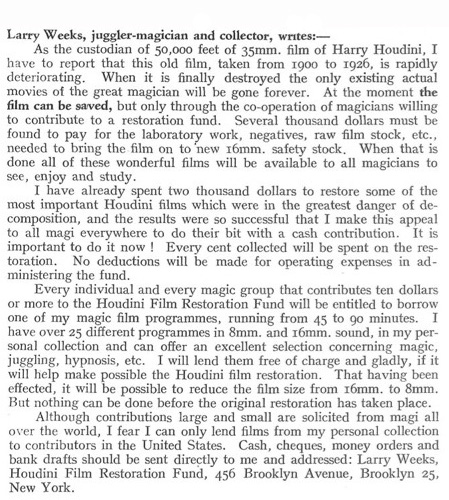
    As a postscript, in 1958 Larry Weeks formed the "Houdini Film Restoration Fund." Larry knew that his nitrate prints were in danger of decay (recall that Rick said The Grim Game probably only had six months left). Check out this item written by Larry himself in a 1960 issue of Abacradabra:


    Reading this 55 years later, one thing becomes clear. A lot of people were involved in this effort to find and restore The Grim Game, and a lot of people deserve credit. But the person who truly saved The Grim Game, the person who is most responsible for us now being able to see and enjoy Houdini's best film, is the late Larry Weeks, "Houdini's Biggest Fan."


    Related:

    Sunday, April 19, 2015

    Rick Schmidlin (Part II): Saving The Grim Game

    Today we continue our interview with Rick Schmidlin, the man who produced the restoration of Houdini's The Grim Game. From the first hint of its existence to the Hollywood premiere, Rick oversaw every aspect of the project. Now he tells us of his remarkable journey.

    When we left off in Part I, Rick had confirmed the only known print of the film in the home of collector Larry Weeks, and had arranged for TCM to buy it. But then 2 days before Rick was due to return to Brooklyn to close the deal, Larry Weeks called to inform him that he was in the hospital and that "he might not get out"...

    RICK: So that sunk everyone’s heart. I had sent him a copy of the paperwork so he could review it before, so it wasn’t just put in front of his face. But I did not want to pressure him. Fred [Pittella] was there when I talked to him on the phone, but Larry wanted to do everything himself. He was worried very much that somebody was going to steal the limelight. He was completely worried that somebody else would claim credit for something that he had found and that he had kept safe all these years. That was his biggest fear at that point.

    So I called [TCM] and cancelled the entire trip, the hotel, the air, everything else, and we waited. We waited for about two or three weeks. Then I called Larry and he said, “Okay, I’m home, I feel better,” and then he told me about his whole hospital ordeal, and I felt for him because it sounded like he was going through hell.

    We had put the film in the closet in a safe place before I had left, so we knew where it was. The plan was I’d meet with him and go over all the paperwork. So at the end of June, I was there again in Larry’s apartment, and the nurse kept on telling Larry, “They’re going to make millions of dollars off of you.”

    WAH: Oh my. Oh no.

    Larry Weeks
    RICK: But Larry at this point was happy about what was going on, and he wanted to make it to the premiere. He really wanted to be at the premiere for TCM. And they had agreed that they would fly him and his nurse there. He was excited about a Hollywood premiere.

    So now what I had to do was get him to sign the paperwork, then immediately after meeting with him, scan it and send it to TCM who had to turn around a check in 48 hours, because Larry would not wait for a check. That was a hard thing. Studios don’t do things that quick. But there was a guy there, Lee Tsiantis, he worked with Charlie [Tabesh] and he moved mountains. He was excited, so he deserves credit for what he did. Without his help the deal may have fell through!

    So I made sure when Larry signed his paper, with the nurse who was basically watching him, that he did everything in a sound mind. There was no manipulation of any kind. Again, it was just the nurse, Larry and I. Larry signed everything, the nurse left and we talked for about 2 more hours. He showed me a scrapbook he had which he opened and it was falling apart.

    WAH: That was the Houdini scrapbook?

    RICK: Yeah. But you got to remember that Houdini’s scrapbooks were only for about six months worth of time. He was a meticulous archivist. Most of his scrapbooks are at the Harry Ransom Center in Texas. So Larry always eluded that he had "Houdini’s Scrapbook." But he had one of Houdini’s scrapbooks.

    WAH: Do you recall what was in it? What time period it might have been from?

    RICK: I believe it was from around 1924. And then he showed me a film can that said, “Mrs. Houdini doing laundry.” But Larry kept on saying, “It doesn’t look like her. I don’t think it’s her. I don’t know why it’s labeled that.” So that was kind of a strange thing.

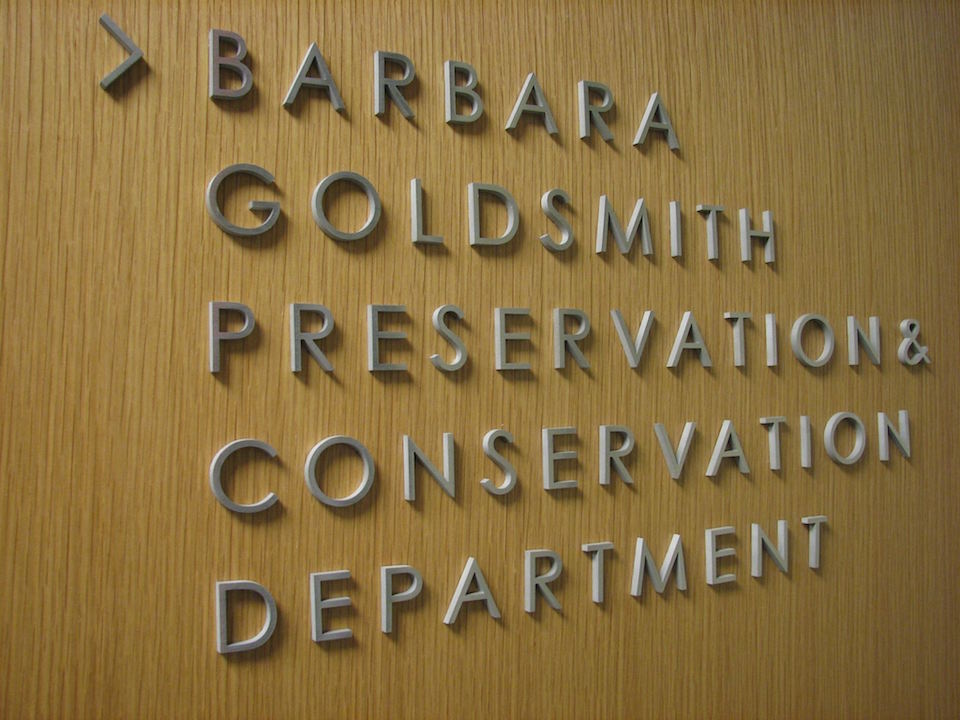
    So that following Friday, I met Larry with a limousine that took him and the nurse to NYU. I sat in the front seat with film cans in my lap. When we got there [the Barbara Goldsmith Preservation & Conservation Department] we were greeted by Ben Moskowitz who brought Larry down to Special Collections. There was a girl named Viv who was also there. Larry wanted to have her there. She had no real interest in Houdini or magic, she was interested in Larry because of his juggling. She was a Harvard graduate who became a juggler and a clown in New York. She wanted to talk to him about all his juggling stuff. That was a whole different part of Larry’s world, and I was getting into Larry’s world.


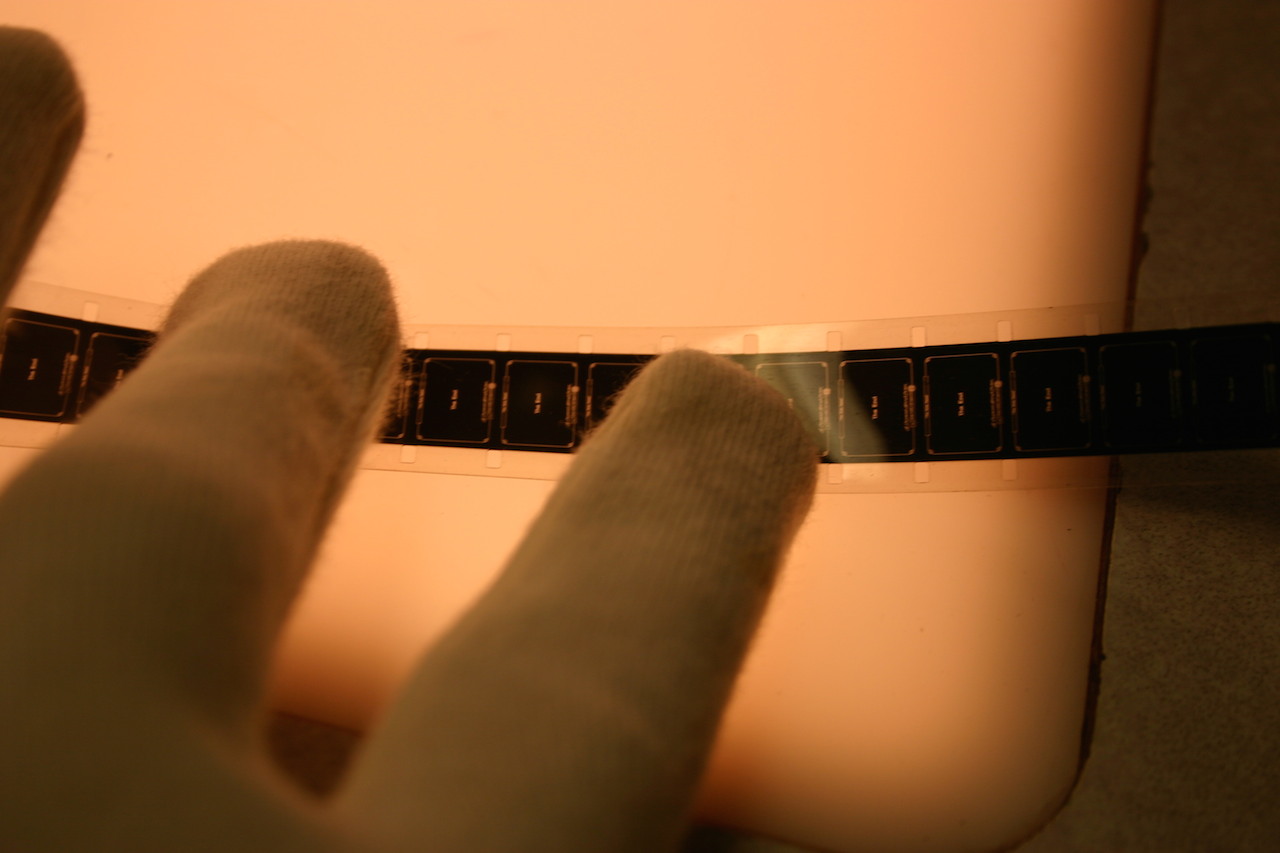
    So went down and Ben cleaned the film, inspected the film, made sure there weren’t any tears in it, and that it could be put on a flatbed. It was an oversized reel so it was a little difficult. And we looked at it on a flatbed. We looked at the whole film. Viv was not interested, so they gave her a tour of the facilities while we watched the film. There were jitters and this and that, but the whole film was there. And that’s when we knew we had a remarkable thing. It was intact, and it was a half a reel longer than reported. But running it at 24 frames per second seemed very fast. Twenty-two seemed fast. Twenty was perfect. That was what we realized right there.

    WAH: What was the frame rate in 1919?

    RICK: Between 18 and 20.

    WAH: Was there a standard, or was it just however fast the cameraman or projectionist cranked it.

    RICK: It was how they cranked it. But you’ve got to remember, when you see Houdini at the gate, he's cranking it so the action is slow and meticulous. When you see the comedy sequence between the maid and the butler, also when you see Houdini going up the stairs when he’s escaping from the asylum, they are going faster. So in 24 frames per second, he would be flying up those stairs. Also, theaters in those days, if they didn’t like the film, would run them fast too. So a film would be reported at one length, but because the distribution company didn’t believe in it, they made it a faster movie.

    WAH: Oh, that’s interesting. You always hear conflicting runtimes of movies, and I’ve never considered it could be because of that.

    RICK: You've got to remember, I’m coming from it as a person who understands it’s Houdini, and it’s the best Houdini, and having seen by this point The Master Mystery and Terror Island and everything else – but I’m a person who coming at it as a silent film historian. That’s what separates me from the others in the Houdini world. I’m interested in silent film. And that’s what made Larry interested. I was not a Houdini fan trying to claim Larry’s glory. I was somebody who was interested in silent cinema. He could talk about silent cinema and he liked that. He was interested in a lot of silent cinema. He said his favorite film was The Cat and Canary with Lon Chaney and it still gave him nightmares.

    WAH: Had you researched the film before? Was there anything in that surprised you – such as Mae Busch being in it?

    RICK: The whole thing is it was an A-cast. An A-cast 100% throughout. It was like an A-film of today. They gave him great villains. Tully Marshall is in it, he was a great villain. Mae was becoming a major star and would be a major star through the 1920s. So you’ve got people who are going places and would work all throughout the 1920s and some into the 1940s.

    WAH: It’s also a very well made film for the time, that’s what really struck me.

    RICK: It’s a well made film. One of the things you have to remember -- and you can think of it in today’s market -- is if you are a fan of movies in 1919, you’re watching a young Chaplin, a very young Keaton, and Douglas Fairbanks is happening. The Victorian melodramas of even Griffith were waning. Houdini was not the young Fairbanks that caused the girls to go pitter patter over. He came from a different kind of generation and that was why the film was probably a little less well received. It was a well made movie, but he wasn’t a teen idol.

    WAH: That seems to be especially true of some of is other films. They do seem Victorian.

    RICK: They’re melodrama. And that’s what happened with some of these actors. When you look at D.W. Griffith, you see melodrama, in a day when DeMille is going bonkers. It’s the Jazz Age. And Houdini was not a member of the Jazz Age. The turn of the century was Houdini’s big day. Houdini was part of the melodrama. But today when we look at it, we’re forgiving because the Jazz Age is old too. So that’s the biggest thing have to remember when going into a project like this. I’m looking at Lasky, I’m looking at Willat the director, I’m looking at all the actors. I’m looking at a great silent lost film. And it is a Houdini film, which make it even more exciting. But it’s still a lost film and you have to realize that to the audiences who will see on television and at festivals and other locations around the world, they’re going to see a lost silent film and then they are going to be excited about Houdini as the star. The majority of the people in the audience are into silent cinema. That's what makes it exciting. Now, it introduces them to Houdini, and it gives them a great star, but the interest is lost silent cinema. And that’s where I came from.

    WAH: Let’s go back now to the restoration itself. You said Larry’s print was showing signs of vinegar syndrome?

    Kimberly Tarr
    RICK: This is what happened. Kimberly Tarr comes into the picture, and Kimberly inspects the entire movie. She looks at the edge codes of the negative and the print and sees they were done at the same time, and that was 1959.

    WAH: So 1959 was when the 16mm negative and print were made?

    RICK: Right.

    WAH: And those were made from a 35mm nitrate original?

    RICK: Exactly. It came from the nitrate. What Larry did was he made a new 16mm negative. He could not afford a 35mm negative. And off the 16mm negative he made a print. And that was the print we had. All that survived of the negative were two reels. My guess is the rest of it just shriveled and died.

    WAH: And the original 35mm nitrate print was probably tossed by the company who made the dupes?

    RICK: It was probably tossed at the time. It had bad cancer going into it, which you can see in reels 4 and 5. It was going to disintegrate and it was highly flammable. And Larry knew this. He knew he was dealing with danger and he was dealing with something that was going to fall to dust.

    So Kimberly Tarr does a complete inspection on the film frame by frame. And she does a meticulous job. They have a nice vault down there, which is where the film now permanently sits. And she said there is a little vinegar syndrome in it. Just a slight bit of vinegar, not much. But it if it had sat there for five more years it would have fed in and just stunk.

    WAH: So you think the film only had about five more years left?

    RICK: And that’s being very liberal…. So Kimberly inspects it, cleans it and prepares it. The next step is it goes to Metropolis Post, where they now digitize it and make the first transfer at 22 frames per second. And we see it’s out of registration, which is not rare.

    WAH: And what does “out of registration” mean exactly?

    RICK: It means a little of the top is at the bottom of the fame. When it was transferred [in 1959], it was transferred very quickly and it wasn’t registered correctly. There were actually four reels out of registration, it was happening constantly.

    So we screened it, and at that screening were Dick and Dorothy, Metropolis, Brane, and Kimberly Tarr. Also the colorist, who was there to do the black and white, just to make it look as good as we could. We all looked at it for the first time. Then I made solid deals with Metropolis. Dick and Dorothy were paid as consultants. And that’s when we posed for the photos. Now, if you look at the title card there, you see that the Paramount logo is on the top of the screen and The Grim Game title is underneath it. If you look at the picture that was taken at the premiere, the Paramount is below. That’s the registration change.

    Title card at first screening (top) and premiere (bottom) shows registration change.

    WAH: And you were able to correct that?

    RICK: Yes. That was a ton of work. That was work that Thomas Eberschveiler at Metropolis spent hundreds of hours on. So that night after the screening, we all went to dinner. It was Brane, Kimberly Tarr, and Dick and Dorothy. And that was the night that we all talked about the film and were happy and cheerful.

    After that screening, I learned that Larry had passed away. At that point everyone was worried about what was going on in his apartment, if there was anything else there, and I was getting alarming emails. So, through Viv, this girl I met at the screening, I got Fred Pittella’s email. And Fred filled me in on everything that was going on. And Fred and I started good communication. He helped a lot when it needed to be done and was part of the process.

    Thomas Eberschveiler
    So from that point on we just went on into the project and into the restoration. Thomas Eberschveiler worked every day. Metropolis let him work as many hours as he needed. It was like a week before Thanksgiving and we all met in New York again. It was Paula [De Stefano], Ben, Kimberly, Brane, Fred, and Dick and Dorothy. So with Brane’s score on it, we all watched the film and everybody likes it. Then Charlie Tabesh and another executive from TCM come and they watch The Grim Game, and they love it.

    Then Jack Rizzo, who owns Metropolis Post, comes in after we watched it and said, “Rick, I’d like to put in two or three more weeks of work on it just to make it perfect.” And that was not on the clock. They went beyond. They worked on it very hard through the nights and I got the final around December 1st. And from that point on we started doing the mastering and everything else.

    WAH: So all the restoration work was done digitally, not on film?

    RICK: Digital. Yes.

    WAH: And what exactly was the restoration work – cleaning and...

    RICK: There was a lot of cleaning, there was a lot of picture adjustments, we were timing, getting it perfect. There were a lot of washed out faces, especially with Old Banks. There were some jitters in the picture that needed to be smoothed out. Basically just a lot of clean up. Remember, this was a film that was processed in ’59 and run through a projector several times.


    WAH: I also noticed there were these distinct white plus signs that appear throughout…

    RICK: Those are the reel changes.

    WAH: But they are not in the corner like changeover marks, they are sometimes in the center of the screen.

    RICK: Exactly. In the teens they did it like that. They just put them wherever. They didn’t care. They just punched.

    WAH: Did you ever consider fixing the nitrate damage?

    RICK: To fix the nitrate damage you’d have to spend hundreds and hundreds of hours. But it did not interfere with the story and it did not interfere with the picture, so why alter it? No action was lost and no title was lost. I wanted to persevere what is there. And it’s a good history lesson for schools because it shows you how close that film was in 1959 to having those scenes 100% lost. I would say within six months they would have been gone.

    WAH: Six months it would have been gone? Wow, that’s terrifying. It’s seems this movie was rescued at the last minute several times, wasn’t it?

    RICK: Yes.

    WAH: So it was it always the plan to debut the film at the TCM Festival?

    RICK: From day one. Charlie said, “This would be great to premier at the Festival”, and I agreed. And I also said wouldn’t it be great to also show the Janet Leigh, Tony Curtis film there. That came from me.

    Rick Schmidlin with Grim Game music composer Brane Živkovic.

    WAH: I think the premiere came off wonderfully well. It was packed and the audience really responded to the movie. Have you received feedback from TCM? Are they happy they got into the Houdini business?

    RICK: Oh yes. TCM is totally happy with it.

    WAH: What’s the future hold for the film?

    RICK: It’s going to be on TCM. They’re still deciding what date, and that’s all we know right now.

    WAH: A lot of people are asking me if there will be a DVD release?

    RICK: That has not been announced.

    WAH: Finally, would you ever become involved in another Houdini film restoration project, possibly restoring Terror Island or The Master Mystery if the lost footage could ever be located?

    RICK: Yes, I would love to be involved in more Houdini projects. Again, Houdini is a fascinating subject. Houdini is someone who should be explored more, and my interest in silent film has a burning passion.

    Thank you, Rick!


    Related:

    Friday, April 17, 2015

    Rick Schmidlin (Part I): Finding The Grim Game


    Today I'm thrilled to offer the first of my two part interview with Rick Schmidlin, the man who produced the restoration of Houdini's The Grim Game. From the first hint of its existence in April of last year to the Hollywood premiere last month, Rick oversaw every aspect of the project. Now he tells us of his remarkable journey and what it took to bring Houdini's best film back to the silver screen.

    WAH: First off, were you aware that Houdini made silent films before you became involved in The Grim Game project?

    RICK: The interesting thing is, like yourself and others, when I saw the [Tony Curtis] Houdini film on television when I was young, I loved Houdini. And then later on, it was the '60s, I got the Kreskin ESP set and the Blackstone magic set. But I found out I wasn't a good magician. I always enjoyed magic, but I decided I was a good audience for it, not a practitioner. Years later in Hollywood in the ‘80s, I used to go to the magic store on Hollywood Boulevard [Hollywood Magic], and at one point I started buying little magic tricks. But, again, with the rings and the tricks I bought, I was not good. When people would ask me to do it again, I would and would sometimes get caught. So I decided I was not a very good magician.

    What made me also very interested in Houdini was that I lived for a short time in the ‘70s at the corner of Lookout and Laurel Canyon in a massive log cabin which had a lot of Frank Zappa alumni living in it. The house next door was empty. It was the big white house with a big pool, and we used to hang out there sometimes. So when I lived in Laurel Canyon over the years -- and I lived in the ‘80s on Kirkwood -- when I would go to Universal or go over the hill to the valley, I would pass that house everyday. So I always knew as I passed the big white ghost, that that was where Houdini had been once. So in regards to Houdini, I was familiar with him since a child in the ‘60s watching on television, and he stayed with me throughout.

    Now, like the rest of you, I have other areas I go into, which is partly silent film. I produce restorations of silent film and I’m considered for my work in silent film restoration and preservation, a historian. So that's what draws the interest and the connection.

    WAH: So how did The Grim Game adventure begin for you?

    RICK: I was in Colorado for a week doing some work cataloging an art collection for a group in New York, and I had been invited to speak on my film Touch of Evil by Brane Živkovic at NYU -- once for the students and once for faculty. In route, I stopped at Scranton, Pennsylvania to visit my mother who was there. She was in a home and I spent the whole day with her. Before I went, I asked her if there was anything I could do in Scranton, and she said, “You know Dick and Dorothy from the Houdini Museum?” I said yes, because I had given lectures on The Doors at Keystone College back in the ‘80s, and that’s where I had met them. I called them and asked if they would like to get together for dinner.
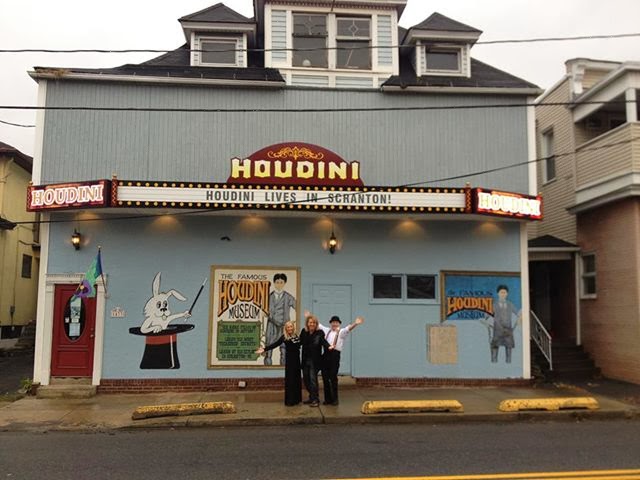
    The Houdini Museum in Scranton, PA.

    So I met them and took them out for dinner. During dinner we chatted about different things, the social issues of the times, and I told them that I was now involved in film preservation and restoration. It was the first nice day of spring, I’d say it was around April 14 or so. We went to the Houdini Museum, it was so nice, we went on the outside patio and we talked, and they told me about The Grim Game. What they told me was a man in Brooklyn -- and they didn’t say Larry’s name at the time – had it, but he was holding out for a lot of money. Everyone was after him, and he was not allowing it to be sold. Also, they were not sure if he even still had it. They were very clear that they weren’t sure that he had it, that he had possibly loaned it to somebody and they had never returned it and maybe the wrong film was in the can. So that was how that started.

    Grim Game Godfather, Charles Tabesh
    When I got to New York, I wrote an email to Charlie Tabesh, the senior VP of programing at Turner, and said there’s a possibility that we may have found the lost Houdini film, The Grim Game. Is there any interest for TCM? In my original pitch, I sent him links to your site, including the Everson article. He read all that. So you were involved, but didn't know it. And he said, “Yes, find out what you have, create a budget, and investigate further and get back to me.”

    WAH: If TCM wasn’t interested, would you have still pursued it?

    RICK: Of course, yes. But I knew this was the only place that would have been a slam-dunk. And I know this is where the slam-dunk was because I had done Greed and London After Midnight for them. So I had done those projects for them and I knew they were the right avenue and would have enough to fund it. So I wrote Dick and Dorothy and said, “Give me more information, TCM may be interested.”

    Then I did my lectures, met Brane [Živkovic], and had a wonderful time in New York. Then I went back to Stratford, Ontario where I was living at the time. I had not heard from Dick and Dorothy for almost two weeks. I finally sent them a email asking, “What’s going on – TCM is interested and I hadn’t heard?” And one evening, I remember vividly, I got a phone call from both of them and they said they talked to Larry. They said, “He won’t talk to us about any kind of deal or anything, but he’s willing to talk to you.” They said they had talked about my work. I asked if they wanted to set everything up and they said, “No-no, you have to talk to him. We just set the introduction up for you.”

    So I called Larry up on the phone, and Larry’s hearing was not great, as anyone who’s spoken to him in recent years knows. I told him who I was, and all he wanted to talk about was, “How much?” “How much?” I told him I was in Ontario, but I could fly down immediately and meet with him and talk to him. TCM had agreed to that. He knew the name Warner Bros., but he had never heard of Turner Classic Movies. But he said he would like to meet with me.

    WAH: At his home in Brooklyn?

    RICK: Yes. So it was arranged in a week that I would fly down. I stayed in a hotel in midtown, right across from Radio City Music Hall, where the NFL draft was going on. Everyone else was concerned around me with media and the NFL draft, and I’m wondering about The Grim Game. Have I found a lost film? Because for people in my field, that’s very important. It happens maybe once in a lifetime.

    The next day I took a cab to Larry’s. I got there early, so I walked around the neighborhood a little bit. At the appropriate time, I walked up the five floors to his apartment where I was greeted by Larry and his nurse – a woman who had been working with him and taking care of him. We sat down, and for about the first 1 1/2 hours we did not discuss The Grim Game. We discussed everything else under the sun. He told me his stories of Irvin Berlin. He told me his stories of the war years, because he was very much interested in that. He had been to the veterans hospital recently and he had his little veterans hat on. He told me about his juggling and showed me brochures of his juggling, and pointed out in the room -- "this is one of Houdini’s bookshelves, this is his brass shaving urn…" He told me he had scrapbooks, which he had one, and it was in very bad shape. And we just chatted for a while. I talked to him about Dick and Dorothy and he said, “Yeah, yeah, I know them. Is that how we got in touch?” He wasn’t sure how the loop had gone in. He said, “Yeah I knew Dick as a kid.”

    So what happened then was that I eventually mentioned the name of man named Zinn Arthur, whom I knew. Zinn Arthur had been a big band leader in New York in the 1930’s, and was big in the Borsht Belt back in the pre-war years. And Larry lit up like a Christmas tree. All the magic connections, studios, everything else were just like, "Okay, I’ve heard it before." But here I know somebody that was from his past. Who was a contemporary. And Zinn Arthur has done some home movies with Larry during This Is The Army. So that was the connection: Zinn Arthur. When you do something like this, you have to remember that sometimes the littlest name is the biggest key. And that was the key. I was a buddy of a buddy of his, and that made me good.

    He then pulled out a few film cans. Now, what had happened that I did not know prior to my visit was Fred Pittella, who was a close friend of Larry’s, had been there a couple days prior to search through Larry’s closet to see what was there was on The Grim Game. Larry didn’t pull the film out. He had a closet full of film and The Grim Game was buried somewhere in there. So Fred prepared that for Larry so when Larry sat with me he could say, take a look at this.

    WAH: So Fred Pittella was involved.

    RICK: Fred was very involved. But I didn’t realize that until late, near the end. I did not know Fred’s name at that time.
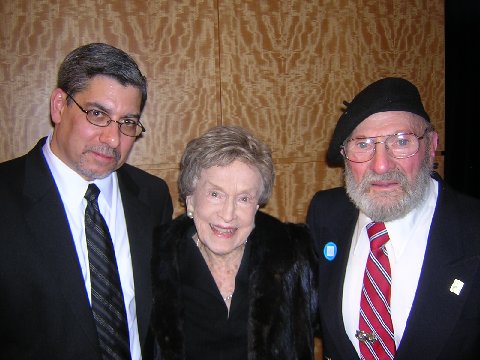
    Fred Pittella with Larry Weeks and Dorothy Young (Houdini's assistant).

    WAH: So what did Larry have exactly?

    RICK: There was one short reel I couldn’t inspect because it looked a little fragile. But there was another reel that was an oversized reel. It was a sunny day in Larry’s apartment, and it said on the can, “Possibly The Grim Game.” It did not say The Grim Game. It was a label that would have come from even maybe the ‘60s that was kind of falling off. So I open that up and there was an oversized reel. I had to by hand very carefully unspool it, and at first I wasn’t sure because the first thing you see is the end, and the next thing you see is them reading the newspaper, which is not what I had seen on the Kino video segment. That scene did not exist.

    WAH: Yeah, that Kino short ends after the plane crash.

    RICK: So, of course, my heart went down. So then I looked a little further, and it was 16mm so very small, and I saw fields and then I saw them [Houdini and Ann Forrest] again, and they were dressed differently. Hmmm. It might be. Then I went a little further and I could see the plane coming down. Because it was tails out, which was lucky.

    WAH: That was your eureka moment?

    RICK: That was the moment I know I had a major big reel that was bigger than even five reels. It was on one reel.

    WAH: Oh, the whole movie was on one reel?

    RICK: On one reel. And that was when I had the moment where it was like, okay, yes, this is the film.


    WAH: So what you saw on that one reel was a 16mm positive print, correct?

    RICK: Yes. The other was negative – it was heads up but very fragile and so I couldn’t tell what it was. There were two cans. One had two reels and one was a full.

    After that, Larry and I went through everything -- the kind of money we’re talking -- and agreed to get together after I talked to the studio. He was excited and he almost didn’t want me to leave. He enjoyed talking about the war years and he enjoyed talking about Zinn Arthur. He said, “Don’t you want to project the film?” I told him I had to arrange for a facility. We didn’t want to put it on his little projector and just run it. So I said I would be back. And he said, “You promise?” And I said, “Yes.” And that was how we left it. He stood by his little door after about 4 hours and waved.

    WAH: That's great.


    RICK: Then I met with Brane, and he told me Kimberly Tarr had given a tour of the Barbara Goldsmith Preservation & Conservation Department at the NYU library. So we went there and I met with Paula De Stefano, because Kimberly wasn’t there, and I told her about finding The Grim Game. I said my plan would be to bring it there as soon as I could and put it on a flatbed with Ben Moskowitz, and that we could bring Larry and inspect the film. They all agreed 100%, and I asked if they would come onboard and help on the project and they said yes. That night I had dinner with Brane and I said, “You’ve been teaching for 26 years composition for film and television at NYU, you would be great for the score.” So Brane agreed. Then I went back to Ontario.

    I called TCM and they were very excited. I told them the money we had talked about with Larry, and they said that was fine, and that they would arrange for another visit. I asked them to make it a simple bill of sale, because that explained all rights. I didn’t want to give Larry a 10-page studio contract. He didn’t need that. He was selling something. So I called Larry and made arrangements and booked the whole thing for the first part of June.

    And then I got a phone call from him 2 days before I was supposed to leave. He was in the hospital. He was sick. And he didn’t know if he was going to get out.

    Watch for the next installment on Sunday: Rick Schmidlin (Part II): Saving The Grim Game.

    Related:

    Translate