Showing posts with label Vanishing elephant. Show all posts

Saturday, January 24, 2026

Dive into Shark Tank, January 28

Ari Siegel of History By Mail has posted the following on his site:

On Wednesday, January 28 at 10pm ET/PT on ABC, History By Mail will be featured in a Shark Tank update segment. If you have followed our journey for any amount of time, you know this is a milestone we do not take lightly. 

This update is a look at what has happened since our original appearance. It highlights how the company has grown, where we are today, and what we are building next. It is also a moment to step back and appreciate something that is easy to forget when you are busy running the day to day. None of this happened in a vacuum. It happened because thousands of curious people chose to support an unusual idea and keep showing up for history. 

There is also a special celebrity cameo in the segment, and it is one you will not want to miss.

Who could this celebrity be? Well, if Ari isn't saying, then I won't either. But considering History By Mail's latest Houdini-themed offering, you may be able to guess.🗽

Wednesday, December 3, 2025

The Dream Big Folio: Houdini’s Illusion That Inspired David Copperfield

Here's a nice holiday gift idea. "The Dream Big Folio: Houdini’s Illusion That Inspired David Copperfield" is a new release by History By Mail. Below is a photo and details.

Step into the moment that redefined what humans believe is possible.

Dream Big Folio – Houdini’s Illusion That Inspired David Copperfield brings you inside the legendary 1918 Vanishing Elephant performance at the New York Hippodrome—an act so audacious it later inspired a young David Copperfield to imagine making the moon disappear.

This folio is built around one extraordinary centerpiece: a replica of Houdini’s original letter to Harry Kellar, preserved exclusively in David Copperfield’s International Museum and Library of the Conjuring Arts, the world’s largest private collection of magic memorabilia. Kellar, widely known as the “Dean of American Magicians,” was the most celebrated magician in the United States before Houdini and one of Houdini’s early heroes and mentors. The original letter resides only in Copperfield’s museum.

Everything in the folio is designed to give you the same spark Copperfield describes in his letter—the spark that later helped fuel some of the most iconic illusions in modern history.

You can purchase "The Dream Big Folio: Houdini’s Illusion That Inspired David Copperfield" at the History By Mail website.

Related:

Monday, June 2, 2025

The Vanishing Elephant will appear in Oxford

The Vanishing Elephant will run at the Oxford Playhouse in Oxford, England, from June 11 to June 14. The play is produced by Northern Irish theatre company Cahoots, written by Charles Way, and directed by Cahoots' artistic director, Paul Bosco McEneaney. The story is inspired by Houdini's famed vanishing elephant, Jennie.

Monday, March 10, 2025

The Vanishing Elephant appears in Providence

The Providence Performing Arts Center will present a "Sensory Friendly Performance" of The Vanishing Elephant this Saturday, March 15 at 2pm. The play, which premiered in New York in 2023, tells the story of Houdini's vanishing elephant Jennie (or Jenny, as the play spells it).

Tickets are only $5 and can be purchased at the Providence Performing Arts Center website. And before someone asks what a "Sensory Friendly Performance" is, here's a link that explains.

Related:

Friday, December 6, 2024

Off to see Harry...


I'm going to wrap up 2024 with a speculative journey. I often think about time travel. Well, more specifically, I think about time traveling to see Houdini. I know I'm not alone in this. So if time travel were possible, and, say, you could select 3 specific days in the past in which to see Houdini, what days would those be? Here are the 3 days I would program into my flux capacitor:

Saturday, May 14, 1898
On this day, the Welsh Bros. Circus was playing in Harrisburg, Pennsylvania. The young Harry and Bess Houdini were traveling with the circus performing Metamorphosis in the circus concert tent, where Bess would also do her seriocomic songs. It's also possible I could find Harry doing his King of Cards act in the sideshow. While all this would be enough, this day marked Houdini's debut as a "clown on bars" in the Big Top show. "Went big and funny," he wrote in his diary. So, yeah, a chance to see so many aspects of the young Houdini and Bess and experience the entire Welsh Bros. show... What a day! Also, if the rules of time travel allow, it would be easy to approach and talk to him.

For my second date, it's very hard to not select March 17, 1904, as that was the day of the famed Mirror Handcuff Challenge in London. Very hard! But the Mirror Challenge was just one performance, and I want to maximize my Houdini time. Besides, I know Joe Notaro will choose the Mirror Challenge, so I can learn all about it from him. Instead, I'm going to...

Saturday, March 2, 1918
This time, I'm landing in New York City to see Houdini vanish his elephant and escape from an underwater packing case at the Hippodrome. In fact, I could see it twice as the Hippodrome had a matinee (at 2:15) and an evening show (at 8:15). After the evening show, I could zip over to Martinka's magic shop and, using a 1918 S.A.M. card borrowed from one of my collector friends, I could attend the 174th regular meeting of the S.A.M. which Houdini presided over as President. But there's more! This was the week Houdini was giving World War I soldiers lessons on how to escape from German handcuffs. So, disguised as a soldier, I could get a lesson in escapes from the Handcuff King himself! Although, a 60-year-old private might seem a bit suspicious. He might think I'm an imitator come to steal his secrets! Maybe I need to rethink this one.

My last choice has to be a performance of the 3 Shows in One. But which one? While it is tempting to see Houdini's final show in Detroit, I think it would be too upsetting. So I'll leave that to others. Instead, I'm going to...

Thursday, September 30, 1926
This was when Houdini was playing his 3 Shows in One in Worcester, Massachusetts. This is also the day of the Summerfield's Department store test, in which he was sealed in a glass casket for an hour propped up on view. Unlike his other outdoor stunts, which were over relatively quickly, this is one I could savor. I'd get to stand and look at the 52-year-old Houdini for an hour! Heck, maybe I could even strike up a conversation with Jim Collins. Maybe get a backstage pass to the show that night! And speaking of that show, Houdini was doing the onstage Buried Alive in Worcester at this time. So I can see exactly how he presented this still largely mysterious escape. Yes, this means I would not see the Water Torture Cell, but I want to learn during each jump. I would also get to see all the new and improved magic for the 1926-27 season, including Slicing a Girl. And how poetic to see Houdini at age 52 doing his King of Cards routine, just as I had seen him do it three days and 28 years earlier.

How about you? What would your three days with Houdini be? Let us know in the comments below. I've also launched a POLL on my Patreon.

Thank you for your patronage and support this year. It was a big year for centennials and celebrations, and I expect more of the same in 2025. Happy holidays. I'll see you all in the future!
The Houdinis 1924 Christmas Card.

2024 in Review:
January (23 posts)
February (20 posts)
March (20 posts)
April (20 posts)
May (21 posts)
June (19 posts)
July (11 posts)
August (18 posts)
September (19 posts)
October (22 posts)
November (19 posts)
December (8 posts)

Most Viewed New Post of 2024

Wednesday, September 11, 2024

Deconstructing Houdini '53: America's Sensation

Continuing my scene-by-scene dissection of the 1953 biopic HOUDINI starring Tony Curtis and Janet Leigh. Last time, Houdini returned to America only to find himself ignored by the press. That's about to change.

Chapter 17: America's Sensation

We start in the bedroom of an unknown woman (Maxine Gates). She's in a nightgown and is clearly just waking up. The sound of a band in the street briefly draws her attention, but she shrugs it off. As a New Yorker, she's seen it all. She then raises her blinds to find Harry Houdini hanging upside-down in a straitjacket outside her window and flips out.

We then cut outside to the scene of a classic Houdini suspended straitjacket escape. There's a crowd watching as Houdini struggles high above what is later identified as Times Square. It's worth noting that Houdini is using the same style of straitjacket from the Magician's Club dinner scene. It's also fun to know that this was shot on the Paramount backlot on Halloween (1952).

In the crowd, a policeman on horseback briefly blocks Bess and Mama's view. I'm not entirely sure of this policeman's purpose. Are we supposed to be worried he will stop the performance? Houdini did famously have trouble with the New York police during two such stunts, so this might be a way to express the idea that New York police kept a close eye on Houdini street stunts. Or maybe it's just a way to draw our eye across the crowd.


The policeman moves on once Houdini sheds his straitjacket and the crowd applauds. Among them is a reporter, Simms (Douglas Spencer), who tells his companion, "Remarkable fellow. I'll interview him today."


The suspended straitjacket escape became Houdini's go-to outside stunt in 1915 and continued until the end of his career. Houdini only did the escape in North America, so its use here as Houdini's first big American outdoor stunt is perfect.

Houdini doing the suspended straitjacket in Times Square has its own interesting history. Houdini first attempted to do the stunt in Times Square in 1916, but police stepped in and stopped the performance. Not wishing to "break faith with the public," Houdini did the escape unannounced in Bowling Green Park the next day.

Houdini finally received permission to do the stunt in Times Square in 1917 to promote a war benefit at the New York Hippodrome. In 1923, he repeated the escape in front of the famed Palace Theater in Times Square. He got into the air before police could stop him and was later fined.

The movie now dissolves into a montage of Houdini's American success. This is the second montage of the film, and as I said in Chapter 13, I love a good Houdini movie montage! So let's break this one down.


We begin with a shot of B.F. Keith's Palace Theater in New York, where we see Houdini is held over for his "26th week." Houdini certainly played the Palace, but no vaudevillian would be held over 26 weeks! Houdini's longest engagement was 19 weeks at the New York Hippodrome with his Vanishing Elephant. And speaking of the Vanishing Elephant...


Houdini's most famous feat of magic is represented on the front page of Variety. We see two photos of the elephant vanish with Tony Curtis inserted into an actual photo of Houdini (see below). The date on the paper is August 12, 1919, which is a year after the vanishing elephant, but still close. This also re-establishes an in-movie chronology that I will track as we continue.


The montage continues with Houdini and Bess doing a levitation. The Houdinis did do a Trilby levitation early in their careers, but it wasn't a trick Houdini was ever known for. But it's another nice uncut magic trick for the actors to perform. However, Tony makes a small mistake that reveals the trick if you know what to look for.


Other material was shot for this montage that never made it into the finished film. This includes Houdini's plane-to-plane transfer from The Grim Game (shot in black and white and undercranked to look like a silent film), a cremation illusion (again, not something Houdini was known to perform), and the Milk Can escape. It's a shame to lose The Grim Game clip, as it would have been a nice nod to his film career. (Houdini's movies would not get acknowledgment until the 2012 Houdini Miniseries.)

However, the true heartbreaker is the loss of the Milk Can escape, which still did make it onto posters and promotional material. Photos from the scene show Houdini performing it at the Orpheum Theatre in Harrisburg, PA. At the start of the montage, we saw the B.F. Keith's name on the Palace marquee. This name-checks the two primary American Vaudeville circuits of Houdini's day. These names would have been familiar to 1953 audiences, and it's a great way to show that Houdini was a vaudevillian for much of his career. 


The montage concludes with a shot of Mr. and Mrs. Schultz (Sig Ruman and Connie Gilchrist) from the Dime Museum opening sequence sitting among Houdini's appreciative audience. They have a short and one-sided argument about who exactly fired him. It's a nice callback and a great way to end the scene.


Up to this point, Houdini has been a light, colorful, and celebratory movie. But it's about to shift tone and travel into darker waters with its most famous and frightening sequence.

Want more? The poster we see in the cut Milk Can scene is based on an actual poster from Houdini's appearance in Harrisburg in 1912. You can see that, as well as a review of his Milk Can escape, as a "Scholar" member of my Patreon below.


Related:

Thursday, October 19, 2023

The Vanishing Elephant reappears in New York


The story of Jennie the elephant is being dramatized at The New Victory Theater's Stage 42 in New York in The Vanishing Elephant. The play opened on October 14 and runs through October 29, 2023.

Pack your trunk for a jumbo journey as Jenny the elephant is captured and taken from India to America, far from her family and her forever friend, Opu. Swept up in the circus, she makes magic and history as The Vanishing Elephant with Harry Houdini himself, but Jenny never stops thinking of home. Watch in wonder as this puppet pachyderm grows from tot to teen to towering adult in an unforgettable tale from the imagination of Cahoots NI.

You can buy tickets to The Vanishing Elephant at The New Victory Theater website. Here's a preview.


The website warns the play depicts animal cruelty. For the record, Houdini loved animals and had very strong feelings about animal cruelty. I've read a moving letter he wrote to Harry Kellar (in the David Copperfield collection) in which he bemoans what he has seen during his career and expresses his opinion that there should be laws against such mistreatment. As for Jennie, Houdini said, "I never allowed a hook to be used, relying on block sugar to make her go through her stunt, and she certainly is very fond of me."

Friday, November 25, 2022

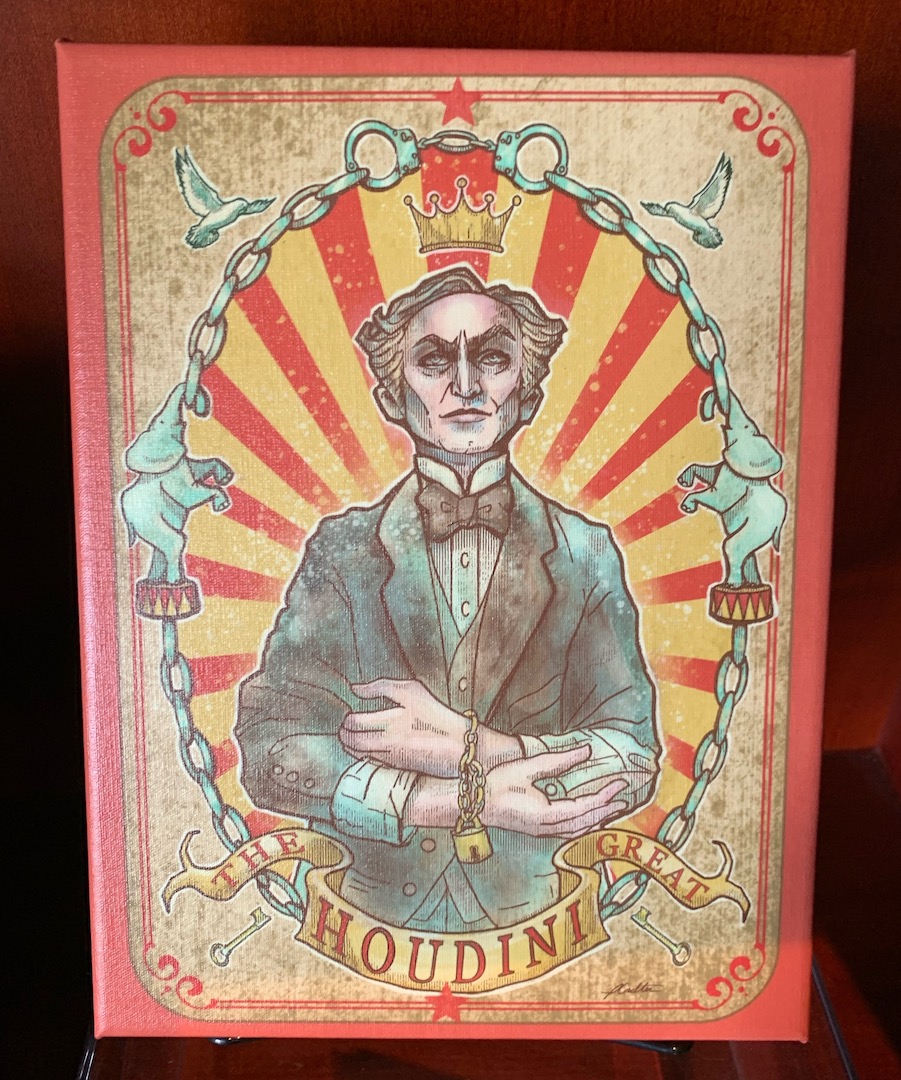
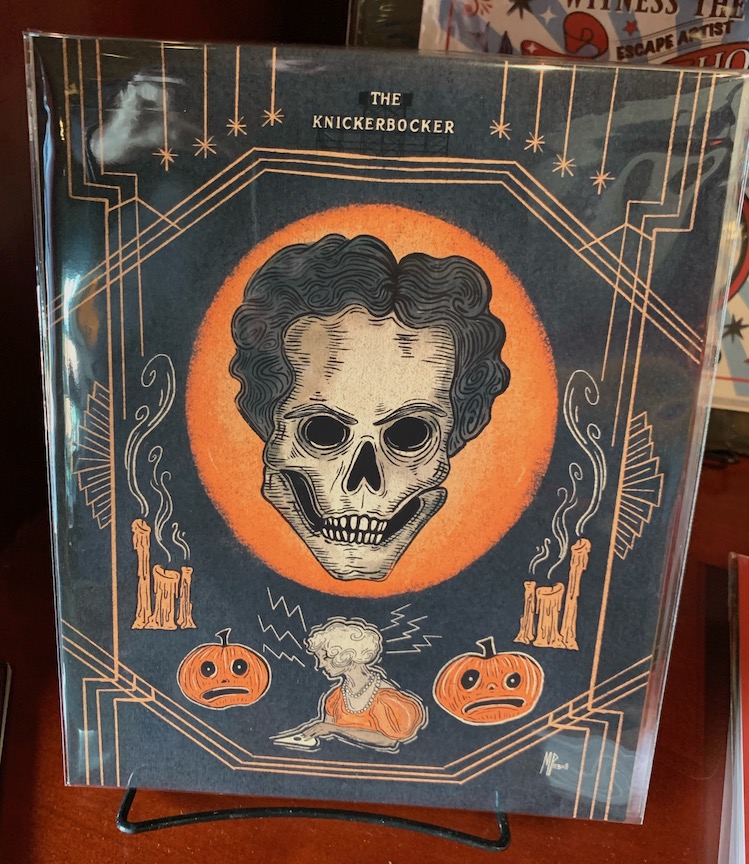
'Houdini Unchained' original art and merchandise


The Christmas shopping season is upon us, so I thought this was a good time to showcase some of the original merchandise created for Houdini Unchained: The Legacy of Harry Houdini at Muzeo Museum and Cultural Center in Anaheim, CA. The museum commissioned several artists to create original Houdini pieces. That artwork is on display and also available as prints in the gift shop.

I snapped these photos inside the gift shop last time I was there. Muzeo doesn't have an online store, so it appears the only way to buy these is to visit in person. Or perhaps you could try contacting the artists direct. I've linked them all below.

"The Handcuff King" by Chris Kawagiwa.

"The Handcuff King" by John Coulter.

"Close Call with the Sea Monster" by Justine Prebich.

"Halloween Seance" by Michelle Prebich.

Vanishing Elephant lenticular by Melissa Chan Stone.

"The Key to his Heart" by Olivia Faust.

"Asleep in the Deep" by Vincenzo Savastano.

"Great Escape" by John Coulter.

"Lil Houdini Magic Set" by We Are Pretend Friends.

Houdini patch by Badaboöm Studio.

Muzeo is located at 241 S. Anaheim Blvd., Anaheim, CA 92805. Normal hours are Wednesday through Sunday from 11am to 5pm. Houdini Unchained: The Legacy of Harry Houdini will be on show until January 22, 2023.

Thursday, August 18, 2022

Yes, there was a Vanishing Elephant poster


It's one of the great white whales of Houdinidom. Was there ever a poster for his Vanishing Elephant illusion? This has long been the stuff of dreams and April fools jokes. But while doing research at the Harry Ransom Center last week, I discovered that, yes, there absolutely was a Vanishing Elephant poster!

The proof is found in a letter from Birchet "Kit" Clarke to Houdini dated March 7, 1918. The 85-year-old Clarke was a former press agent, Harry Kellar's manager, and a real character (I'll have more on him in time). His letter begins:

My dear Houdini:-

        The red poster came along this morning and is now decorating the wall before my easy chair where I can easily gaze upon it and see Jennie vanish into the upper air like "the baseless fabric of a vision."

There can be no doubt about what Clarke is talking about here. A great deal of Clarke's correspondence at this time references the Vanishing Elephant, and the name of Jennie cinches it. Clarke's description of a "red" poster with Jennie vanishing "into the upper air" brought to my mind the prototype Vanishing Elephant posters also held by the Harry Ransom Center (below). I posted about these a few years back and at that time wondered if they ever became real posters. I think we now have our answer!


Unfortunately, we still don't know what this finished poster looked like. But maybe one day one Clarke's copy or another might surface like "the baseless fabric of a vision."

Want more? You can read Kit Clarke's full 3-page letter, which includes an epic takedown of the Williamson Brothers, as a Scholar on my Patreon.

Saturday, April 2, 2022

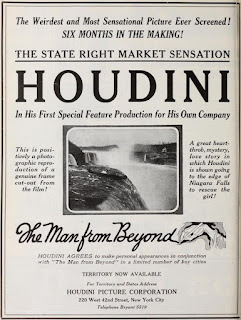
The Man From Beyond arrived 100 years ago today


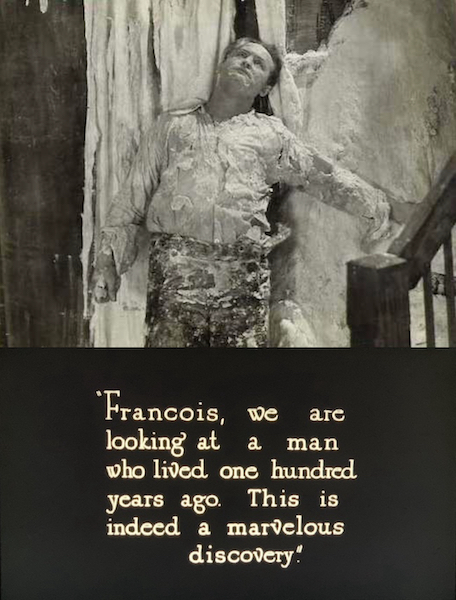
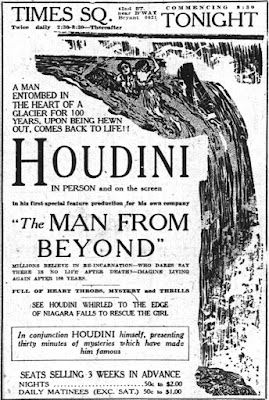
It was 100 years ago today that Houdini's first solely produced motion picture, The Man From Beyond, premiered at the Times Square Theatre in New York. This was the start of an exclusive engagement and to ensure packed houses Houdini developed 30 minutes of magic that he would perform after each showing. He even revived his vanishing elephant which had so thrilled New Yorkers back in 1918. 

New York Tribune, April 2, 1922.

The day of the premiere Houdini paraded his two Ringling Bros. elephants, Lucy and Fannie, along Broadway. While both elephants were smaller, Houdini reportedly still used his gigantic Hippodrome cabinet to do the vanishing. He also performed Goodbye Winter, Arrival of Summer, the Needles, and his straitjacket escape. At the last minute Houdini learned the film lacked the necessary certificate from the New York Censor Board. Because of this he was unable to charge admission on opening day. (The film received its certificate the following day.) 

The New York Tribune gave the film a rave review -- "the theater resounds with applause when he finally dragged his release from the raging torrent." But the New York Herald gave the film a much more mixed review, pegging some of the issues that are obvious today. Below is that review in full.

New York Herald, April 3, 1922.

A dandy detail here is that Houdini's co-star Jane Connolly assisted Houdini with his magic. This is the only mention of Connolly being part of the premiere that I've read.

The Man From Beyond with "Houdini in Person" played for three weeks at the Times Square Theatre. That theater still stands today and is currently undergoing a major renovation.


The Man From Beyond is available on DVD, YouTube, and streaming. I plan to pop in the Blu-ray tonight to celebrate this milestone and remember Houdini's frozen man. Still alive after 100 200 years!


Clippings: Newspapers.com
Photo: John Hinson Collection

Thursday, January 6, 2022

Houdini in 1922

Let's kick off 2022 with a deep dive into what Houdini was up to 100 years ago.


Houdini had a foot in two worlds in 1922. He had returned to vaudeville with his tried-and-true escape act while also preparing to release his first solely produced motion picture. But it was a visitor from England who would set Houdini on the path to a remarkable third act of his life and career.

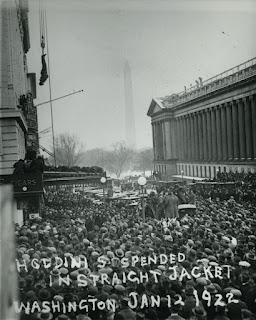
The new year began with Houdini playing the Palace Theater in New York's Times Square. To herald his return, he performed a suspended straitjacket escape from the theater's facade on January 5. Just like old times, he ran afoul of the New York City police who tried to stop the escape. But Houdini got into the air before the police could push their way through the crowd. On his assent Houdini yelled down to an irritated officer, "Talk to the theatre manager. I'm busy." Before the week was out, Houdini and press agent Walter J. Kingsley found themselves at the West Side courthouse facing a charge of blocking traffic.

The next stop was Washington D.C. where a suspended straitjacket escape from the Albee building at 15th and G Streets drew a massive crowd. Houdini and Bess met President Harding at The White House, and former President Woodrow Wilson saw Houdini escape his Water Torture Cell at Keith's. The Maryland Theater in Baltimore followed. A review in the Evening Sun complained: "Houdini spends about 10 minutes telling of his greatness...performs two tricks that he has been showing for years." But the old tricks seemed to be just what audiences wanted, and Houdini's suspended straitjacket escape from the Munsey Bldg. in downtown Baltimore drew the usual throng.

The tour continued at a pace with Houdini playing the major Keith houses in Philadelphia, Cleveland, Chicago, St. Louis, and Pittsburgh. In almost every city he performed a suspended straitjacket escape and drew sold out houses. Houdini credited the publicity generated by his films as the reason for his continued popularity on stage. He was right. Even though he had been absent from American stages for three years, his name was never out of the newspapers and the Jazz Age had embraced him as a cultural icon. Flappers even adopted his name into their vernacular; "A Houdini" meant to be on time for a date.

The tour also brought Houdini into contact with the local chapters of a thriving S.A.M., and many would host banquets for their Most Illustrious President. While attending one of these "Houdini Nights" at the Great Northern Hotel in Chicago, Houdini was fooled by a young Canadian sleight of hand artist who employed a clever manipulation of the Ambitious Card. The incident didn't warrant further mention from Houdini, but the young magician, Dai Vernon, would for the rest of his life tout himself as "The Man Who Fooled Houdini."

That same week Houdini attended a monkey gland transplant operation on an 80-year-old man. The procedure, pioneered by Dr. Serge Voronoff, involved inserting thin slices of monkey testicles into a man's scrotum where the graff would fuse with human tissue. Voronoff promised his treatment would restore vitality, enhance libido, improve eyesight, and even prolong life. Houdini's interest in the procedure and its surgeon, whom Houdini playfully called "Transplantor," isn't entirely clear. Was he merely investigating a modern "miracle monger", or was he considering having the procedure to restore his own flagging vitality? After the operation Houdini wrote to a friend: "It looks as simple as rolling off a slippery log."

While performing at the Davis Theater in Pittsburgh, Houdini was saddened to learn of the death of Harry Kellar in Los Angeles. Kellar had become a mentor and father figure to Houdini. Unable to attend the funeral, Houdini sent a telegram of condolence to Kellar's niece and arranged to have the funeral filmed. He also wrote a eulogy for the magician on the train back to New York where he would wrap his tour with an engagement in Brooklyn. That month also saw the release of his new book, Houdini's Paper Magic, a collection of magic tricks and puzzles largely compiled by his late secretary, John Sargent, for whom Houdini dedicated the book.

Houdini wasted no time in surging to his next venture. Having failed to entice Paramount into releasing his first Houdini Picture Corporation production, The Man From Beyond (filmed in 1921), Houdini decided to distribute the movie himself. To generate awareness, he booked an exclusive engagement at the Times Square Theatre, which stood across the street from the Houdini Picture Corporation offices. To ensure packed houses, Houdini developed 30 minutes of stage magic that he would perform after each showing. He even revived the vanishing elephant which had so thrilled New Yorkers back in 1918.

The day of the premiere, April 2, Houdini paraded his two Ringling Bros. elephants, Lucy and Fannie, along Broadway. But in an oversight that betrayed his inexperience as a distributor, Houdini was informed that the film still lacked the necessary certificate from the New York Censor Board. The premiere went ahead as planned, but Houdini was unable to charge admission. (The film received its certificate the following day.) The elephants also proved to be harder to handle than the affable Jennie from the Hippodrome. One of the elephants spooked when a loading dock ramp cracked beneath its feet and refused to enter the theater. Faced with an unbudging elephant on 42nd Street, a new door was cut in the theater wall which the elephant found acceptable. While both elephants were smaller, Houdini reportedly still used his gigantic Hippodrome cabinet to do the vanishing.

The Man From Beyond with "Houdini in Person" would run three weeks at the Time Square. Reviews of the movie were mixed. Many questioned how Houdini's 100-year-old man could remain blissfully unaware of the passage of time until he was told, despite riding in an automobile. However, there was wide agreement that the climatic action at Niagara Falls was thrilling and in league with the climax of the D.W. Griffith hit, Way Down East. They were right. For all the film's flaws, Houdini and his editor had created a powerful piece of cinema magic with a skillful combination of footage shot at various locations. Houdini showcased the reviews in a half-page ad in Variety as "The greatest praise ever accorded any screen production."

That same month Sir Arthur Conan Doyle arrived in America for a lecture tour proselytizing Spiritualism. Doyle showcased spirit photographs and spoke of his own personal experiences with the Other Side. Audiences packed his lectures and gasped as his slides flashed across the screen. Houdini attended one of the first lectures at New York's Carnegie Hall. Doyle, in turn, saw The Man From Beyond at the Times Square and gave the film a glowing endorsement. On May 10th Sir Arthur and Lady Doyle visited Houdini at 278 and had lunch. Houdini took great pride is showing Doyle his library. As he saw them off in a cab, Houdini performed his thumb racket trick. For Doyle it was further evidence that his friend possessed supernatural powers. For Houdini it was evidence that his friend could be fooled by anything.

But Doyle had some tricks of his own. Houdini invited him to attend an S.A.M. banquet at the McAlpin Hotel in New York. There Doyle ran test footage from the upcoming movie adaptation of his book, The Lost World, which showed dinosaurs in action via the magic of stop motion photography. Doyle believed he had fooled the magicians into thinking he had somehow captured film of real dinosaurs. "I left them, as I had intended, utterly mystified," Doyle would chortle. This seems unlikely. Special effects photography was pioneered by magicians such as George Méliès, and Houdini had used camera trickery in all his films. But, as always, Houdini indulged his honored guest from England. The evening also saw Harry and Bess performing Metamorphosis using Doyle's mammoth coat.

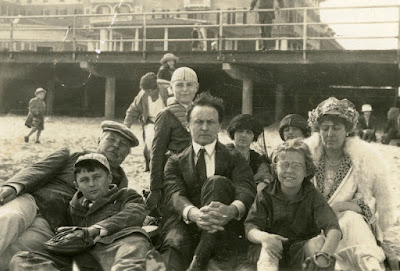
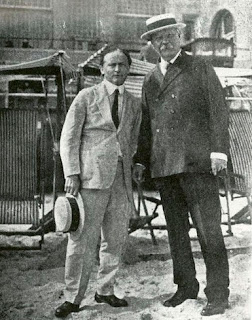
That same month the Doyles invited the Houdinis to join them for a weekend in Atlantic City. "Why not come down–both of you?" wrote Doyle. "The children would teach you to swim ! and the change would do you good." The Houdinis accepted and joined the Doyles at the Ambassador Hotel on June 17. The couple relaxed on the beach and Houdini taught the Doyle boys to dive in the hotel pool. That evening they attend a swimming contest that dragged on interminably.

The following day came an event that would forever have an impact on their friendship. Lady Doyle, herself a medium who communicated via "automatic writing", offered to give Houdini a private seance to contact his mother. Bess was kept from the proceedings, but she reportedly gave her husband a warning (via their old mind reading code) that Lady Doyle had been peppering her for information about Mama the day before. The three settled into Doyle's Ambassador suite where Lady Doyle quickly contacted Cecelia Weiss and dashed off several pages of communications in English instead of Mama's native German. Houdini did not betray his skepticism and Sir Arthur firmly believed his friend had been convinced and converted. But what Houdini had experienced was just more Doyle dinosaurs.

Besides attending a 4th of July party at the Seacliff home of his lawyer Bernard Ernst--where he inexplicably commanded a rain storm to stop and start (he later called this "the most remarkable coincidence that ever happened to a mortal man")--there is no record of Houdini's activities in July. Did he decide to go under the knife of "Transplantor" and receive his monkey gland enhancement?

Whatever he did, it's likely Houdini had time to reflect. If he compared himself to Doyle, and he most certainly did, Doyle was having the career Houdini coveted. He was a respected author drawing sold out houses with a lecture showcasing his intellect. And on a topic that Houdini felt he knew far more about! Here Houdini was stuck in a cycle of turning out melodramas and books of magic tricks while occasionally having to dip back into the fading world of vaudeville to make ends meet. And despite expanding and installing new equipment at his Film Developing Corporation that year, the business continued to operate at a loss. It's therefore not surprising that when Houdini did reappear after his mid-summer disappearance, he does so with a new identity and ambition.

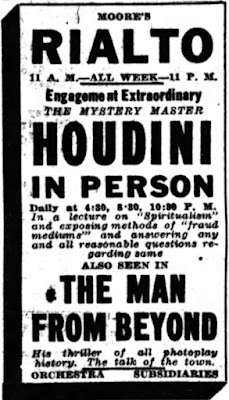
In August Houdini brought The Man from Beyond to the Rialto Theater in Washington, D.C. Once again the show would feature "Houdini in Person". But he left the elephants and magic behind. Instead when Houdini took the stage on Sunday, August 20, he gave a lecture on spiritualism. It was the inverse of Doyle's lectures, exposing the methods of fraudulent mediums, and offered audiences their first look at a new Houdini. Variety carried the news on its front page ("Houdini on Spiritism in Personal Appearance") and the Washington Times reported: "He doesn't intend to go back to Jail-breaking or other forms of escape until he has won a victory over ignorance and delusion in the world of spiritualism."

The Rialto lectures also prompted his first attacks. In a letter to the Washington Herald, a member of the audience, N.H. Holmes, wrote: "Houdini's picture, The Man From Beyond, is beautiful, thrilling and most wonderful. His exposure of séances and mediums are ridiculous, unscrupulous and preposterous." 

The battle was on. 

The Rialto run grossed an impressive $9000. The next engagement in Detroit brought in $12,000 (aided by a suspended straitjacket escape in Grand Circus Park). Having found the formula for success exhibiting his movie along with a live show, Houdini created several roadshow units called The Houdini Wonder Show. These were headed up by magicians Fredrick Eugene Powell, Mystic Clayton, Virginia Carr, and the escape artist Gemester. Houdini would make special one-day appearances at select theaters. In Hoboken a crowd gathered to greet him at the stage door. When Houdini appeared in a straw hat, some boys shouted that straw hats were out of fashion. Houdini removed his head gear and tossed it into the crowd where it was shredded by souvenir seekers.

Houdini then went about the business of selling The Man From Beyond via the independent State Rights market. This general release version was cut down from seven reels to six. (This is the only version that survives today.) Houdini had long feuded with theater managers whom he felt tried every trick in the book to withhold proper payment from talent. Now he would need to collect from cinema houses where managers were largely unchecked in their reporting on box-office receipts. But having just won his latest lawsuit against Octagon Films for unpaid salary on The Master Mystery totaling $32,795.18, Houdini may have felt confident that he could swim with sharks.

In October newspapers began serializing a new book by Sir Arthur Conan Doyle titled, My American Adventure. In it he spoke openly about the Atlantic City seance. That same month Houdini denounced the danger in psychic phenomena at an S.A.M. dinner in Boston. His statements received national coverage. But he also found himself in hot water with the organization over an exposure he supplied to Popular Radio magazine. The article portrayed The Talking Tea Kettle as a tool of fraudulent mediums and revealed its workings. But The Talking Tea Kettle was the invention of magician David P. Abbott who performed it as a spooky stage illusion. Houdini had once forced an S.A.M. member to resign over exposing his Milk Can escape. Now Abbott's local assembly in Omaha voted for Houdini's resignation as President. The controversy swept the S.A.M.

Houdini claimed Popular Radio had added the exposure to his text without his consent and threatened to sue the magazine for damage to his reputation. To prove his case, he published his correspondence with Popular Radio's editor in MUM. He then went out of his way to patch things up with Abbott personally. Houdini's presidency survived and the S.A.M. formed a committee to decide on a formal code of conduct that would govern the exposure of secrets, devoting a special section to spiritualist trickery. "The Magicians Code" remains in force to this day.

On Halloween Houdini gave a mock séance at the home of Sophie Irene Loeb at Harmon-on-Hudson which included a spirit message from the late Jack London. That
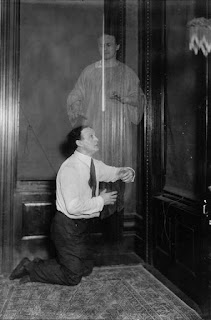
night he wrote in his diary: "I must put on record that it was done wholly by dexterity." He also tried his hand at a new medium by taking part in a debate on spiritualism live on WOR Radio in Newark. When the Scientific American magazine offered $2000 to anyone who could take a spirit photograph under test conditions, Houdini took a series of photos in the parlor of 278 showing him conjuring his own ectoplasmic spirit. The photos were syndicated in an article by Heward Carrington which quoted Houdini as saying, "Spirit pictures—yes—I make them almost every night."

Doyle and Houdini kept up their steady correspondence, but the dinosaur in the room was Atlantic City. Doyle would finally ask Houdini directly how he could continue to express public skepticism of Spiritualism when he had experience the real thing via Lady Doyle?

On December 15th Houdini sat down to confess his doubts about the seance to his friend. He cited his mother's use of English and also that a cross had been drawn at the top of the page, which one would not expect from the wife of a rabbi. He concluded as delicately as he could: "I trust my clearing up the seance from my point of view is satisfactory, and that you do not harbor any ill feeling, because I hold both Lady Doyle and yourself in the highest esteem." A few days later he wrote and had witnessed a document entitled: "THE TRUTH REGARDING SPIRITUALISTIC SEANCE GIVEN TO HOUDINI BY LADY DOYLE."

By entering into the spiritualistic arena Houdini had caught a new and popular wave. The press lauded him as an authority on the subject, which no doubt gave him great pleasure. But it was not going to pay the bills. Not yet at least. So by the end of the year he was once again headed back into vaudeville. Also released in time for Christmas was The Stag Cook Book—A Man’s Cook Book for Men. Inside was a recipe for "Scalloped Mushrooms and Deviled Eggs" by Harry Houdini.

Related:

Monday, September 13, 2021

Ransom Center Milk Can poster reproduction

The Harry Ransom Center at the University of Texas in Austin is offering a reproduction of the authentic Houdini Milk Can poster in their collection. While you can find many reproductions of this poster online, the Ransom Center's is the only one that is faithful to the original, showing the accurate colors, etc. This is the only one I would ever buy. In fact, I think I will! Here's hoping this might open to door to some more poster reproductions from the HRC.


Speaking of the Harry Ransom Center and posters, at the recent TAOM convention--which featured a presentation by Curator Eric Colleary--attendees received this special reproduction of the two Vanishing Elephant poster prototypes in the Ransom Center's collection. These are not available to buy and will certainly become collectors items.


You can purchase the Harry Ransom Center's Houdini Milk Can poster at their online store.

Related:

Translate