Showing posts with label Exposures. Show all posts

Friday, March 21, 2025

Deconstructing Houdini '53: Come in, spirits

Continuing my scene-by-scene dissection of Houdini (1953). Last time, we discovered what Houdini had been doing in seclusion for two whole years. Now, we join him in his strange quest to reach the Beyond...

Chapter 21: Come in, spirits

Most people fault Houdini (1953) for creating the myth of (spoilers!) Houdini dying in the Water Torture Cell. But the far more pernicious myth to come out of the film is the idea that Houdini's mother's death is what led directly to his involvement in spiritualism. The truth is Houdini's interest in spiritualism goes all the way back to the beginning of his magic career, and his crusade against fraud mediums came ten years after his mother's death. As far as I know, he did not attend any seances immediately after her demise.

However, his mother's death provides such a perfect narrative link to spiritualism that screenwriter Philip Yordan fused the two, and later screenwriters and documentarians all followed suit. Thus, the idea is still ingrained in the minds of the public today.

Having got that bit of business out of the way, let's go to a séance!


We drop into the scene mid-séance as Harry, Bess, and reporter Simms sit around a table with an unnamed medium played by Mabel Paige. She intones, "Come in, spirits. Come in, spirits." And they do! Spirit hands, a tambourine, and a spirit trumpet all float through the air. A veiled entity whips past the sitters. Mr. Simms looks ready to bolt, but Bess tells him to remain steady.


Suddenly, the French doors burst open, and the spirit of a woman floats just outside the window. The strains of "The Golden Years," which we first heard when Harry and Mama danced in Germany, mysteriously plays in the room. This manifestation is the grand finale as the medium wavers and then faints, her head falling atop the table with a thunk.

After the lights come on, the attendees discuss what they saw. Bess says the spirit in the garden "did bear a resemblance to Mama," and Houdini notes that the waltz they heard was his mother's favorite song. The medium tells them they are fortunate, as most first sessions produced nothing. "It usually takes several before the receptive vibration is established."


I always found it amusing that they only discuss the music and apparition in the garden and not the far more baffling manifestations that preceded this. Of course, those were done via optical effects in post-production. I would be interested to know if they even appear in the script. They may have been added after the fact to provide the séance with some more spooky thrills.

The French doors burst open again. This time, Otto comes in holding a man, Kit Guard, who has the "Mama" spirit apparition on his head. Houdini then pulls a microphone down from the chandelier. He then fishes under the table with his foot until he finds the trigger that starts the music, which is supplied by a phonograph hidden in a chair. Busted!


A bemused Simms asks Houdini if all mediums are fakes. Houdini quickly answers, "No, I'm sure there are those who are sincere and believe what they're doing. I just haven't found them yet."

This sentiment isn't too far from Houdini's real statements. However, I sense this line is in the movie to head off potential controversy. If so, it worked. As far as I know, Houdini (1953) did not draw any ire from the Spiritualism community.

As they depart, the medium looks to her accomplice and whacks him hard, barking, "Take that thing off!" Funny.


So did this kind of thing happen? Absolutely. However, it happened far less than most people think. While Houdini attended hundreds of séances, he rarely exposed mediums on the spot. He would generally thank the medium but say that he hadn't seen anything "evidentiary" and depart. However, there were a few high-profile exposés that did play out on the spot and drew headlines as a result.


Speaking of headlines, we now get Montage #3, beginning with the "What's become of Houdini?" layout now filled in with his spirit exposures. Notice there are dates visible on these newspaper pages. The first is dated March 2, 1922, which is pretty accurate to the start of Houdini's public activities related to Spiritualism. 


If you look closely, you can see three illustrations from Houdini's Margery pamphlet on the page below. So, technically, the famous Margery does appear in Houdini '53!


We then see a headline touting Houdini's $25,000 challenge for proof of contact with the spirit world. This one is dated August 28, 1924, and is generally accurate, although Houdini's personal bounty was $10,000.


We end with a headline in Billboard dated September 11, 1925: "Houdini Returns to Magic: Goes on Tour." Notice the cigar in the astray and the shadow of the telephone, suggesting this is the desktop of a showbiz bigshot. Martin Beck or E.F. Albee maybe?


While the date here is accurate to the launch of Houdini's first "3 Shows in One" tour, spiritualism remained a big part of his life and act. But as far as Houdini '53 is concerned, his time among the spirits is now over.

Want more? I have a special epilogue to this installment on my Patreon. Click below for a quick trip to the afterlife.


Tuesday, March 18, 2025

No love for The Truth


For me, the documentary The Truth About Houdini was as important as the Tony Curtis film in fueling my excitement for Houdini. It certainly helped shape my understanding of Houdini and introduced me to the major Houdini players at that time. It's still my favorite Houdini documentary. 

That's why I'm so surprised to read this review in the December 30, 1970 Northern Echo that excoriates it! But the doc did generate controversy, at least in the UK. The Magic Circle objected to what it believed were exposures. However, apart from the cross escape (which was removed at some point), there are no significant exposures.

Anyway, this is a fun read, and I can't condemn someone for defending Houdini, even though, in my opinion, it was unnecessary.


Want more? You can view the cut cross escape footage as a Scholar member of my Patreon below.


Related:

Friday, January 3, 2025

Houdini comes out swinging


Houdini spent much of 1924 making his case against the practices of fraudulent spirit mediums as an author, scholar, and lecturer. But at the start of 1925, he came out swinging as a skeptic, crusader, and showman. He went from puffing a pipe to breathing fire! It started with an exposure of "Margery" at Symphony Hall in Boston on January 2nd and 3rd. Houdini told his audience, "This is not only a lecture, but a very important night in my life."

Below are some clippings related to Houdini's important night.


Symphony Hall in Boston still stands today and doesn't look all that different from how it looked when Houdini took the stage one hundred years ago.


Want more? You can read a detailed account of Houdini's Symphony Hall exposure as a "Scholar" member of my Patreon.


Related:

Wednesday, February 21, 2024

Houdini, the Magician's Code, and the Talking Tea Kettle scandal revisited

Recently, magician Murray Sawchuck has been posting magic exposure videos on his social media. Scott Wells posted an
interview with Murray in which he defends his actions. Scott also posted an interview with David Sandy, Bill Smith, and Mark Holstein explaining why magicians should protect magic secrets. I thought this was a good time to update this post from 2012 about when Houdini found himself embroiled in his own magic exposure scandal.

The Magician's Code is no joke. Houdini once said that exposing tricks is "taking bread and butter from honest hard working ambitious magicians." But even Houdini once found himself in the hot-seat for exposing secrets. In fact, the scandal is partially why there is a formal Magician's Code today.

The problem erupted when Houdini published an article in the October 1922 issue of Popular Radio exposing The Talking Tea Kettle. This is an effect in which one can ask a question and hear the answer via a ghostly voice inside a tea kettle. Houdini claimed it was a tool used by dishonest mediums "for getting money from their credulous followers," and he exposed it as he did with other spiritualistic trickery "as a public duty."

The trouble was The Talking Tea Kettle was the invention of magician and author David P. Abbott. Abbott created the illusion in 1907 as a "spooky" stage effect, not one for use in the séance room. To many, there was a difference between a spiritualist stage act, like The Davenport Brothers (respected even by Houdini), and one-on-one séance room bunko artists like Margery. With his article, Houdini had clearly exposed a stage effect. What made it worse is Houdini purchased his tea kettle from a magic dealer and not from the estate of a deceased medium as the article claimed.

Abbott suspected this was payback for his support a year earlier of Eugene Dennis, the Omaha "Wonder Girl," who assisted police officers in solving crimes using her alleged psychic abilities. Houdini believed she had informants who fed her the details of crimes. Abbott dismissed the idea, saying, "I don't think [Houdini] ever investigated a medium in his life."

Now he lambasted Houdini's explanation of the Tea Kettle. "Houdini is a publicity seeker," Abbott told the Omaha Daily. "He's talking about something that he knows nothing whatever of, just to get his name in the paper. He borrowed the teakettle that I made for Keller, had his picture taken with it, and drew those wire coils in from his own imagination. I wouldn't mind his guessing the secret if he guessed it right."

Abbott's local S.A.M. assembly in Omaha took up the matter and, according to The Houdini-Price Correspondence by Gabriel Citron, "voted for Houdini's resignation as President of the S.A.M. over the affair." A letter published in The Sphinx pointed out that Houdini had once forced a member to resign for exposing his Milk Can effect. It's incredible to think that even Harry Houdini could be run out of a magic fraternity for violating the Magician's Code.

Houdini argued that he did not expose the method of the kettle in his original article. The magazine added the explanation to his text and the photographs without his consent. In MUM, Houdini reproduced correspondence between himself and the magazine editor, Kendall Banning, that proved this was the case. Nevertheless, even the title of Houdini's article, "Ghosts that Talk by Radio," could be considered an exposure.

Houdini remained president of the S.A.M. and went out of his way to personally patch things up with Abbott. However, the controversy only died down when the S.A.M. formed a committee to decide on a formal code of conduct that would govern the exposure of secrets. They determined what was allowed and what was not (devoting a special section to spiritualist trickery) and also laid out punishment for those who broke the rules. A version of those rules stands to this day.

David Abbott revealed the secret of the Talking Tea Kettle in his book, David P. Abbott's Book of Mysteries. The book showed that Houdini had indeed gotten the method wrong. Abbott's Tea Kettle was far more subtle and clever.

I'd tell you what the real method was, but...


Want more? I've uploaded the original "Ghosts that Talk by Radio" article from Popular Radio for Scholar members of my Patreon below.


Thanks to Joseph Pecore for providing me with the pages in MUM that show the Houdini-Banning correspondence.

Wednesday, June 1, 2022

The Benninghofen confession

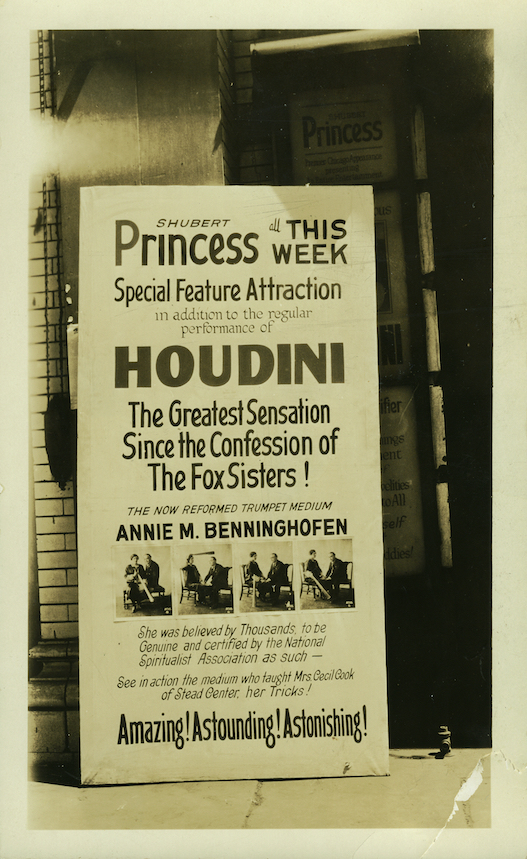
Let's return to the front of the Princess Theater in Chicago with another terrific image from the collection of the McCord Museum. This captures a sidewalk stand advertising a very special week during Houdini's record 8-week run at the Princess in 1926.

Photo: McCord Museum

The confession of acclaimed trumpet medium Annie M. Benninghofen was a major coup for Houdini and a real blow against spiritualism. On April 15, 1926, Houdini held a press conference at the Hotel Sherman in Chicago with Benninghofen who admitted that she had practiced fraud for 30 years. Houdini and the medium then gave a demonstration seance for the gathered reporters exposing her techniques.

"My father was a spiritualist. He was devout in his belief," explained Mrs. Benninghofen. "He was an educated man, but he was duped just like all the others. Although I now admit the work I did was a fraud, I must say that at the time I was sincere. I really believed I was helping the spirits. But I never fooled my mother. And on her deathbed, she asked me to give it up. I refused, but I got to thinking about it, and finally I quit."

Houdini added, "They are all just alike. I have yet to meet a real medium. Mrs. Benninghofen is the greatest of all of them I have met, and she admits that her work was a fraud."

Mrs. Benninghofen appeared with Houdini onstage during his 3 Shows in One on the evening of April 16. Houdini then featured her as part of his show for the entire following week (April 19-25). That's the week we see advertised above. I love that it promotes it as "The Greatest Sensation Since the Confession of the Fox Sisters!" Also notice the mention of Cecil Cook. Houdini had busted her a year earlier.

Houdini and Mrs. Benninghofen took a series of photos together at the Butler studio in Chicago. You can see several of those photos affixed to the sidewalk stand. Below is another less common photo from the McCord collection.

Photo: McCord Museum

When Mrs. Benninghofen completed her week with Houdini at the Princess, she gave him her spirit trumpet along with sworn statement that it was used for fraud. Today there are several Houdini owned spirit trumpets in private collections, but I'm not sure which is the famous Benninghofen trumpet. If anyone has any info on that, I'd love to hear it.

Thanks to the McCord Museum for helping unlock these stories with their magnificent images.

UPDATE: Brandon Hodge of The Mysterious Planchette has come forward with what he believes to be the Benninghofen trumpet, and I think he's right! Brandon writes:
I know lots of folks make big claims about Houdini items, but I have long suspected I own the Benninghofen trumpet. I have two trumpets acquired from the Dunninger estate (which had many Houdini-associated items), and one is not only the same configuration as the Benninghofen trumpet (the fully rolled bell-edge is a rare feature on historical trumpets), but has the same slightly darker/mis-matched pieces.

Related:

Monday, May 16, 2022

The Truth About Houdini's mysterious missing scene

I'm happy to see how many people enjoyed re-watching (or watching for the first time) the great 1970 BBC documentary The Truth About Houdini, which I've uploaded to my WILD ABOUT HARRY YouTube Channel.

One thing that came up in the comments was the cut scene of Sidney Radner demonstrating a wooden cross escape. The scene was originally in the film at 00:13:06, right before James Randi talks about the safe escape. But it is no longer in any existing print that I've ever seen.


The scene runs just over a minute and a half and after Sid escapes he exposes the method. Could this be why it was cut? I have read that The Magic Circle was upset by exposures in this doc, so perhaps it was cut after the initial UK airing? Or maybe it was cut from the U.S. version for fear that the quasi-religious imagery might offend in some markets?

If anyone knows the story of this missing scene, I'd love to hear it!

By the way, I've yet to find any account of Houdini actually doing a cross escape during his career. So there's that mystery as well!

UPDATE: You can now watch this clip as a member of my Patreon by clicking the image below.


Related:

Tuesday, January 4, 2022

Houdini on BBC's The Forum

The BBC World Service program The Forum with Rajan Datar takes a look at the life of Houdini with Adam Begley (Houdini: The Elusive American); Dr Matthew Solomon (Disappearing Tricks: Silent Film, Houdini, and the New Magic of the Twentieth Century); and Dr. Katharina Rein. Disappointing to hear Begley expose Metamorphosis.

The Forum's Houdini episode was first broadcast on December 30th. You can listen to it via the BBC World Service Website and on Apple Podcasts.

Speaking of podcasts, the Not Past It podcast was named one of The 50 Best Podcasts of 2021, and their Houdini episode received special mention. You can listen to that via the top related link below.

Wednesday, October 14, 2020

The Cecil M. Cook exposé

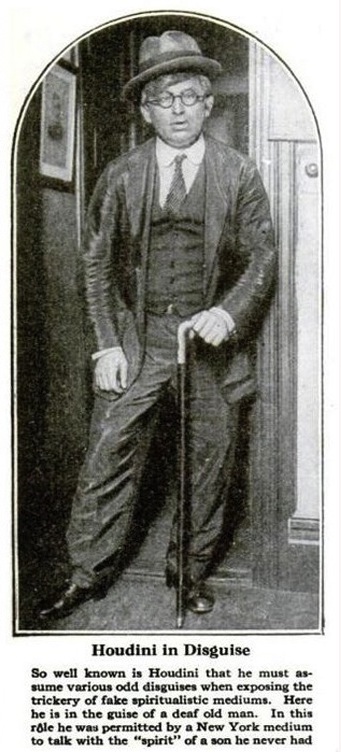
One of Houdini's most famous spirit exposés was that of the trumpet medium Mrs. Cecil M. Cook at her home at 41 West 88th Street in New York City on July 1, 1925. Houdini attended the seance in disguise. Here's an AP account from The Ithaca Journal that briefly explains what went down.


The building where this took place still stands and my guess is it doesn't look all that different, at least on the outside, than it did on the day of that fateful seance. 


Below is a photo of Houdini in his medium catching disguise. Houdini was no stranger to disguises. During his Handcuff Kings days he would attend performances of rival escape kings in disguise and wait for an opportune moment to reveal himself and challenge them. One wonders if he drew his inspiration for disguises from the Sherlock Holmes stories, of which he was fan.


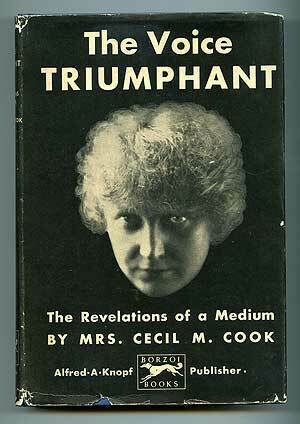
Despite Houdini's high profile exposé, Mrs. Cook continued her spiritualistic career, and even wrote a book called The Voice Triumphant: The Revelations of a Medium. A search of the contents via Google Books doesn't turn up any mention of Houdini. This probably shouldn't be a surprise. That was one time the Voice certainly wasn't Triumphant!


Related:

Tuesday, September 15, 2020

Mystifier, Fall 2003 (final issue)

Concluding my issue by issue look back at the Mystifier, the newsletter of the Houdini Historical Center that ran from 1991-2003.


It seems fitting that the final issue of the Mystifier consists of a single article about Houdini's Last Will and Testament by Curator Kimberly Louagie. As with all of Louagie's work, it's well researched and thorough.

Sidney Radner did not provide his regular "Backstage" column this time. Instead, the back page contains a letter from Executive Director Terry Bergen explaining the current situation and future of the HHC.

I'm sure many of you have heard rumors about the changes at the Houdini Historical Center. It has been a most interesting and enlightening year! 
For fifteen years, we have been fortunate to be able to lease the Radner collection of Houdini artifacts. This opportunity has allowed the Outagamie Country Historical Society to develop the Houdini exhibit, as well as temporary exhibits, and the Houdini Historical Center. The original contract expires at the end of this year, and the economy has conspired to prevent us from extending the lease. Our county appropriation was cut 25% in 2003 and another 25% will be cut in 2004. The county funding is what has paid for the Houdini lease for the past 15 years.

Mr. Radner and other generous donors have provided the museum with a number of artifacts which will allow us to create a new exhibit about Houdini called "a.k.a. Houdini". The new exhibit will open in June 2004, and will be double the size of the current Houdini! exhibit. The Society plans an exhibit that will be a dynamic and exciting as the man Harry Houdini. The new exhibit will display fewer artifacts that the one which has featured Mr. Radner's extensive collection, but it will tell the story of Houdini's life images, interactives and artifacts.

Many of our HHC members have asked about the future of the Houdini Historical Center, now that the Radner Collection will be leaving the museum in Appleton. The Houdini Historical Center will continue, however, due to loss of staff caused by budget cuts, the Mystifier will be discontinued for 2004.

Bergen goes on to say that a new HHC website with a special "Members Only" section will be created. If this happened, it was only temporary. With the end of the Mystifier came the end of the Houdini Historical Center and the museum was renamed The History Museum at the Castle. And when the much touted new Houdini exhibit opened in 2004, magicians were shocked to see it exposed Houdini's Metamorphosis.

Despite criticism from magicians such as David Copperfield, the museum refused to change the exhibit, and any hope of the Radner collection ever returning to Appleton was dashed. (Sid said he was planning to bequeath his collection to the HHC.) Sid singled out Bergen for the turn of events, telling the New York Times, "She doesn't know Houdini from Liberace. She just knows dollars."

Sid's collection was auctioned in 2004. Terry Bergen remained director of The History Museum at the Castle until 2013. The a.k.a. Houdini exhibit can still be visited today.

I hope you enjoyed my look back at all 48 issues of the Mystifier. You can start all over or select an issue of your choice via the links below.

Tuesday, September 1, 2020

Opening Mysto's coffin


Contrary to popular belief, Houdini did not go after each and every imitator of his act. Theaters were awash in Houdini wannabes, and to have tangled with them all would have left no time for his own act and just brought them publicity. So unless an imitator made false claims about Houdini or used his name in their advertising, he largely ignored them.

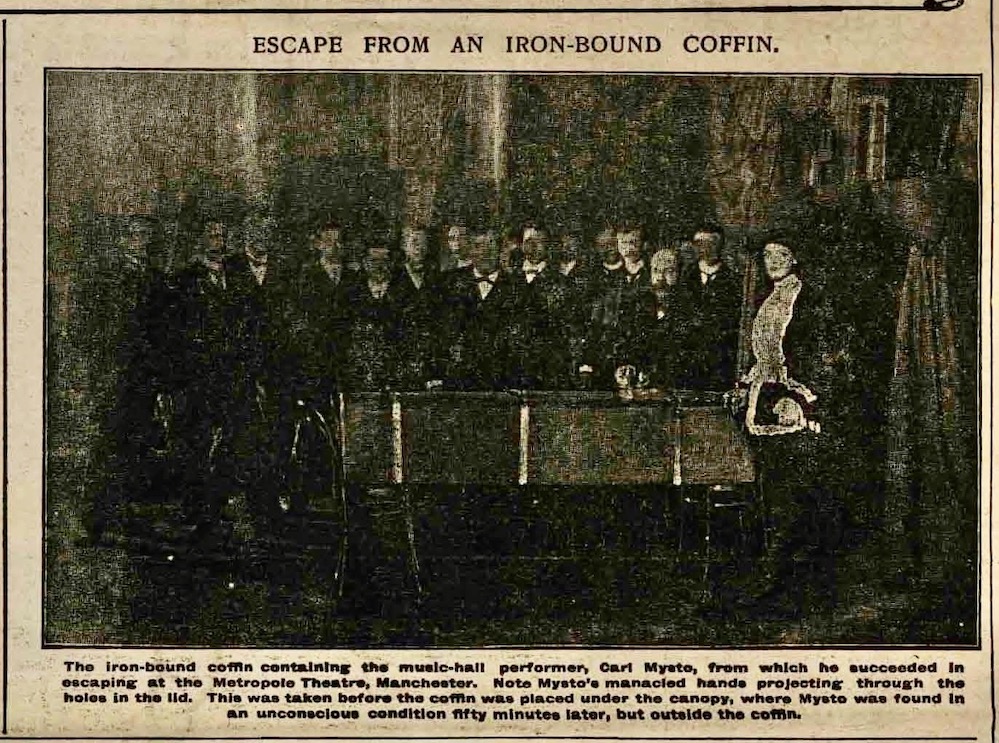
In 1903 an escape artist who called himself Carl Mysto began performing challenge escapes in the UK. This was not typical of other Houdini imitators who largely confined themselves to the handcuff act. One of Mysto's feats was to escape from an "iron-bound coffin" with his hands manacled through holes in the top. The escape was a good one and it drew a fair amount of attention, even landing Mysto a photo spread in the Houdini friendly London Daily Illustrated Mirror (above and below).


Houdini had first met Mysto in October 1902 when the budding magician wrote asking if Houdini could arrange an audition. Houdini remembered: "Carl Mysto at the time was working in pubs, doing magic and passing the hat. He was a tramp. I gave him a pair of pants and a few old shirts and half a dollar. He gave a trial show and did not make good. He was a common bum and a dirty one at that."

In September of 1904, both Handcuff Kings found themselves playing opposite theaters in Salford near Manchester. Houdini was at the Regent Theatre of Varieties and Mysto at the Hippodrome. Mysto ran into trouble during his first week. On September 21 he was summons to the Salford police court on a charge of stealing a pair of handcuffs from a challenger, Thomas Skellington. The case was dismissed. 

Did Houdini have a hand in this? If so, it could help explain why the Hippodrome's manager, Broadhead, felt compelled to take a swipe at Houdini during a manager's meeting, saying Mysto gave a better show and did not "talk endlessly of his triumphs." Furthermore, at £10 a week, Mysto made a better profit than Houdini at £150 a week. Houdini's hatred of imitators was matched only by his hatred of unscrupulous managers, and when he learned of Broadhead's words the gloves came off.

Instead of challenging Mysto to a coffin breaking contest as one might expect, Houdini took an approach wholly bent on ruining his signature feat. He paid the man who made Mysto's coffin, Reuben Shaw, to make him a duplicate. He then exposed the escape on the stage of the Regent for two straight nights. The London Daily Illustrated Mirror ran a story complete with photos showing Franz Kukol and Hardeen (presumably standing in for Shaw) assisting in the exposure.

Unlike the stories of Houdini undoing Kleppini with the French Letter Cuff or Frank Hilbert with a crafty disguise, the Mysto affair doesn't present Houdini in an especially heroic light. It's an out-and-out exposure of another magician's original invention and a clear breech of the Magician's Code. Local magicians were said to be "blazing with anger", and at least one reader of the Mirror found Houdini's behavior unsportsmanlike:


Houdini portrayed his actions as providing a public service, saying the use of a coffin was "entirely out of place" and that after his exposure "no coffin will ever again be used as an accessory to a public amusement." Privately he told local magician Harry Whiteley that he regretted exposing the coffin trick, but his fight was with Broadhead, not Mysto. The incident did not hurt Mysto, who suddenly found himself in demand. But it also opened the door to exposure acts, many of which would target Houdini.

Despite Houdini's claim to have made the theatrical world safe from coffins, in January 1907 he presented his own coffin challenge escape at the Boston Athletic Association. That coffin is on display today at the Houdini Museum of New York along with an original poster from the 1904 Mysto exposure.


Thanks to Joe Fox for helping me uncover the Harry Whiteley letter and the name of manager Broadhead. For more on Mysto in Salford check out Harry Houdini Legend & Legacy by Brian Lead and Roger Woods, 1993.

Saturday, October 26, 2019

You can still get Houdini The Key by Patrick Culliton

If you've read Joe Posnanski's The Life and Afterlife of Harry Houdini then you are now keenly aware of Houdini The Key by Patrick Culliton (and Houdini's Ghost). Joe spends a good chunk of his own book in search of this all-important work that reveals Houdini's most closely guarded secrets, including the Water Torture Cell.

But Joe made a few mistakes. First, the slipcase and cover of the book is not made of vinyl. It's made of a "bulletproof library cloth" called buckram. (That looks a lot like vinyl!) But more importantly, the book is not as hard to get as Joe believed. Patrick initially produced only 278 copies. But as those sold out, he quietly produced another 113, available only to those who missed the first run. Some of those are still available to buy direct from Patrick for the cover price of $195 (plus $12 postage), which is well below what the book sells for in auction. And Patrick will even sign it for you!

So if want Houdini The Key all you need to do is CLICK HERE.

Related:

Monday, June 10, 2019

Mystifier, First Quarter 1998

Continuing my issue by issue look back at the Mystifier, the newsletter of the Houdini Historical Center that ran from 1991-2003.


The controversial "Masked Magician" television specials continued to stir up the magic world at the start of 1998. This inspired the HHC to create a special display, as curator Margaret Ehr explains in the First Quarter Mystifier:

The ongoing discussion about revealing the secrets behind magic effects provides a focus for the latest installation in the Houdini exhibit's document case. Fueled by the Fox television network's two recent magic expose programs, the latest wave of controversy prompted the Houdini Historical Center to explore Houdini's own revelations during his career.

The display includes Houdini's Ladies Home Journal article on "How I Get Out of A Strait-Jacket" as well as excerpts from his book Handcuff Secrets beside various shackles. While the display sounds interesting, eventually Sid Radner and the HHC would have a falling out over exposure displays. One wonders if the seeds of that conflict were first planted here?

Speaking of handcuffs, this newsletter contains a true gem. It's a very well researched article by Mark Lundblad and Bill Liles that dissects Houdini's famous 1906 "Europe's Eclipsing Sensation" poster, identifying the various makes of handcuffs depicted on it.

The images included in the "Handcuff King" poster range from a very simple, single handcuff (Left 1) to a complex combination of multiple handcuffs (Left 3, Right 2 and Right 4). These cuffs may have been selected just for an appealing artistic balance or for other reasons. Perhaps Houdini intended this poster to be not only a sensational advertisement for upcoming performances, but also a personal commemoration of events from the many stages of his long and varied career.

The newsletter continues with the museum shop announcing it now has straitjackets in stock. (!) There's the announcement that Sidney Radner will give a lecture about "Jeanette Chapman: Houdini's Undercover Girl" on April 27. Chapman worked with Houdini in 1925 as one of his spiritualist agents. Intriguingly, it says the lecture will include an 18 minute video interview with Chapman. I've never seen this video, but I would love to share it here!

Sid kicks off his "Backstage" column by noting that a clip from The Man From Beyond was shown on the Academy Awards during a segment celebrating 70 years of special effects. He also reveals that a new Houdini biopic will be produced by cable network TNT starring Johnathon Schaech. This bit of news, Sid notes, was sent in by John Cox "who always forwards Houdini news from Variety and other entertainment publications." Indeed I did!

Sid then announces that in the next issue of the Mystifier he will expose a man who calls himself "Harry Houdini Hardeen." The man is not a member of the family and is using a social security number of a deceased family member. "Let Houdini fans and historians be warned," says Sid. This would not appear in the following issue, nor do I recall it ever appearing. But I believe I encountered this character still working his con at the Houdini Walk of Fame Star ceremony in 2008.

Sid concludes with the "scoop" that Tom Thayer of Universal is planning to produce a movie about Houdini and Margery from a script by Edithe Swenson with "some very interesting new material involved." This project never surfaced, but I've met Tom and he still aspires to make his Houdini/Margery movie.

Mystifier
Volume 8, Number 1
First Quarter, 1998
6 pages

Contents:
Tools of the Trade
Member News
The Labors of Houdini
From the Museum Shop
Backstage with Sid Radner


Related:

Saturday, May 25, 2019

Mystifier, Fourth Quarter 1997

Continuing my issue by issue look back at the Mystifier, the newsletter of the Houdini Historical Center that ran from 1991-2003.


The Fourth Quarter 1997 Mystifier begins with the first article by new curator Margaret A. Ehr. In it, she addresses the controversial Fox television special Breaking the Magician's Code: Magic's Biggest Secrets Finally Revealed, which was running at this time. Ehr condemns it--along with the rest of the magic community--but she notes Houdini himself exposed his own secrets from time to time. She then explores two articles Houdini wrote for The Ladies Home Journal in 1918: "How I Get Out of a Strait-Jacket" and "How I Get Out of My Rope Ties". Near the end she states:

Perhaps Houdini had no fear that others, even knowing his exact techniques, could ever hope to truly challenge him. Houdini himself realized that he was physically exceptional. He understood that his short stature worked to his advantage, as did his impressive strength and flexibility. Few could match Houdini's claims of a double-dislocation at will, or six-inch chest expansion, either. Even knowing precisely what Houdini did to achieve his escapes, few if any magicians would ever be capable of Houdini's success. 

An article by Houdini scholar and regular Mystifier contributor Morris N. Young called "Defending Rabbi Weiss" follows. Young begins:

Too many attempts have been made to malign the reputation of Houdini's father, Mayer Samuel Weiss, especially regarding whether or not he was ordained as a rabbi. It is my purpose to show how unjust those accusations are.

Young goes on to explain how one went about becoming a rabbi in the days of Houdini's father, and how no official paperwork did not mean he was not a rabbi. Young doesn't name names, but this doubt was first cast by Manny Weltman in his 1993 book, Houdini: Escape into Legend, The Early Years: 1862–1900. (Rabbi Weiss's Certificate of Ordination was discovered by David Saltman in 2016.)

The museum shop announces pre-orders for four upcoming videos: Mystic Circle Murder, Houdini The Life of the Worlds Greatest Escapolgist, The Truth About Houdini, and a 2-set VHS of The Master Mystery. The announcement of The Master Mystery was a bombshell as it marked the first release of this movie. A familiar name listed in the "New Members" column is David Byron.

In his "Backstage" column, Sid Radner again sings the praises of the Goodspeed Opera House's Houdini musical. He also gives a detailed report on the Official Houdini Seance, which that year was held on the stage of the Goodspeed. A very special attendee was Anna Crankshaw (Thurlow), great-granddaughter of Margery. Also around the table were: Patrick Culliton, Tom Boldt, Gene Gamache, Larry Weeks, Geno Munari, and Susan Postal, the actress who played Margery in Goodspeed play. The medium was Elaine Kuzmeskus assisted by Barbara Dryden-Masse. Harry, as always, was a no show.

Sid concludes with a mention of a new series by Canada's Discovery TV on the history of magic set to premiere in Fall 1998. Sid says the crew spent 5 1/2 at his home shooting material for the Houdini episode.

[It's surprising this newsletter fails to mention the movie FairyTale: A True Story which was released in October '97.]

Mystifier
Volume 7, Number 4
Fourth Quarter, 1997
6 pages

Contents:
Revealing Houdini's Secrets–Again
Society of Young Magicians Program Update
Defending Rabbi Weiss
New Videos in Museum Shop
Member News
Backstage with Sid Radner


Related:

Monday, January 28, 2019

Houdini's Last Secrets ep. 4 unearths Buried Alive


Houdini's Last Secrets goes out on a positive note with an investigation of Buried Alive. This was a good choice of subject for the final episode. Apart from two posters, very little is known about this feat, so it was not only interesting to see how Houdini might have accomplished the escape, but it was interesting just to see how he might have presented it in the first place!

One can easily get buried in the history of Buried Alive as there were multiple versions. The show does a nice job of separating Houdini ill-fated outside buried alive stunt and his later stage-bound version. (They avoid the Shelton Pool Test.) The episode sticks with the conventional wisdom that Houdini never performed his stage-bound version. But in recent years, evidence has surfaced that shows he actually did perform it at least twice at the start of his 1926-27 season.

Interviews are again a highlight. This time George Hardeen visits Antony Britton in England, who attempted the outdoor casket-free buried alive and, like Houdini, nearly died. Roger Dryer shows us his magnificent Houdini Museum of New York which holds a casket Houdini escaped from in 1907 (unburied). It's a treat to see David Merlini and his own House of Houdini museum in Budapest, Hungary. I don't believe David has appeared in a Houdini documentary before, but his knowledge of Houdini history and his first hand experience with escapes--including being buried alive--make him an ideal interview subject. Finally, we get to see the mighty Arthur Moses in his own temple of Houdiniana in Fort Worth. Arthur handles his Houdini history with great authority.

In fact, this episode is probably the best yet as far as Houdini history is concerned, expanding it with mentions of his movie career and crusade against fraudulent spirit mediums. The idea that George is uncovering the story of his great uncle for himself and the audience is best realized in this episode. Of course, it wouldn't be "reality" TV without talk of a murder conspiracy! But the episode doesn't go too deeply into this and is not significantly derailed by it.

But the meat of the episode is the Buried Alive itself. Steve Wolf at Stunt Ranch constructs a theoretical version of Houdini's stage apparatus for magician Lee Terbosic to attempt. Both the conception and method is ingenious, and because we don't even know exactly how Houdini presented it, there's no danger of exposure. But in bringing the escape to life, one can appreciate how it was an effective stunt, and maybe even a lost Houdini masterpiece. So the episode has provided a real service to Houdini history by showing us what may have been.


Overall, this series turned out to be a mixed bag. It contained a disappointing amount of speculative hokum about Houdini being a spy at the expense of a more fact based exploration of his life. But the team's investigations and recreations of Houdini's feats were all very well done, and the series provided great interviews with fresh faces. And above all, it was respectful to Houdini and made him ever more fascinating!

It also did not turn out to be an exposure show as many had feared. They did indeed successfully ride the line between exposure and investigation, and in the case of a few genuine secrets, such as the Water Torture Cell, they went out of their way to protect the real method. So I'd say this series was a cut above and a worthy addition to the growing list of Houdini documentaries. I would be happy to see a second season.

The complete Season One of Houdini's Last Secrets is available for purchase at Amazon and iTunes.

If you're interested in more information on Buried Alive, check out the below links:

    Translate