Showing posts with label Morris Young. Show all posts

Tuesday, March 26, 2024

Houdini's Last Handcuffs by Charlie & Cheryl Young

Today sees the release of Houdini's Last Handcuffs written by our friends Charlie & Cheryl Young. It's a delightful work of historical fiction featuring many familiar faces from the world of magic in the 1950s, including the spirit of Houdini!

Houdini’s Last Handcuffs weaves a mesmerizing blend of historical fiction and fantasy in 1950s Manhattan. On the 30th anniversary of Houdini's death, three young friends, gifted a mystical Ouija Board by the enigmatic writer Walter Gibson, find themselves thrust into a world of wonder.

While the adults attempt to reach Houdini in a Séance at his former residence, the children unknowingly call upon the great magician, not through the Ouija board or séance but via an enigmatic pair of handcuffs from their father's magic collection.

Houdini, in dire need of their aid, reveals a hidden notebook filled with scientific formulas coveted by both benevolent and malevolent secret circles. This notebook is a puzzle, locked behind Houdini's cryptic code.

The unexpected unfolds, setting off a thrilling chase, where the pursuit of Houdini's notebook holds the key to secrets, mystique, and adventure. Houdini’s Last Handcuffs is a riveting journey into a world where magic meets science, tantalizing readers with every twist and turn.


You can purchase Houdini's Last Handcuffs from Amazon.com and Amazon.co.uk. 


Related:

Tuesday, April 4, 2023

Charles Young talks Houdini's Fabulous Magic

Charles Young talks about his father Morris N. Young and the book Houdini's Fabulous Magic on the In the Corner Back By the Woodpile podcast. It's a great interview and Charlie even kindly mentions my site. You can listen below.


As covered in the interview, Houdini's Fabulous Magic was recently republished by Vine Leaves Press. It can be purchased on Amazon.com. You might also want to check out the official website and read Charles' own Houdini blog.

Tuesday, January 17, 2023

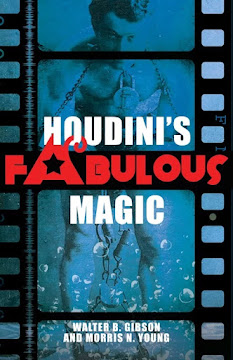
Houdini's Fabulous Magic is BACK

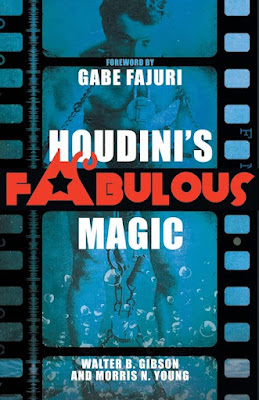
After being out of print for more than 40 years, today sees the re-release of Houdini's Fabulous Magic by Walter B. Gibson and Morris N. Young. This new edition includes a Forward by Gabe Fajuri of Potter & Potter auctions and is published by Vine Leaves Press.

Incredible escapes, fantastic sleight-of-hand-Houdini's most challenging performances are dramatically portrayed in Houdini's Fabulous Magic. Walter Gibson, co-author, was in close touch with Harry Houdini for a number of years before his death and worked with the master magician in preparing material for the book. It is with the aid of Houdini's own scrapbooks and notes that this book was written.

The spectacular highlights of Houdini's career are described-and explained-here. Included are the famous escapes: escapes from a padlocked milk can filled with water; from locked jail cells; from a water-filled Chinese torture cell while suspended upside down; from packing cases weighted under water. Again, in this book, Houdini walks through a brick wall, vanishes a 10,000-pound elephant and is buried alive. Once more, Houdini and his wife Bessie mysteriously exchange places in a locked trunk-in three seconds!

And Houdini the man is not ignored. His impact on the world in the early years of the twentieth century was enormous. He was a public hero who, in his own way, helped sweep out the cobwebs of nineteenth-century thinking. While doing so, he distinguished himself as a patriot, writer, collector of magic, aviator, movie idol, philanthropist, and crusader against fraudulent spiritualistic practices.

This is a technical manual for magicians, complete with illustrations and diagrams, but it is also an astute analysis of the best of Houdini's magic and a readable biography of a man who turned himself into a legend. It is a book for would-be conjurers, for professional necromancers, for those curious about the methods and means of one of the most enchanting men of our century.


I've always loved Houdini's Fabulous Magic and I'm excited to see it return to print. You can check out my overview of the book and its publishing history HERE. I haven't seen this new edition in the flesh yet, but I'm excited to get it. I've shared some of the publishers promotional material on Patreon.

Thursday, December 15, 2022

A fabulous start to 2023

Before I take my traditional year end break, I wanted to give a shout-out to the first big Houdini happening of 2023. In January the excellent 1961 book Houdini's Fabulous Magic by Walter B. Gibson and Morris N. Young will be reprinted in a new edition with a forward by Gabe Fajuri. Here's a teaser from publisher Vine Leaves Press.


You can pre-order the 2023 edition of Houdini's Fabulous Magic at Amazon.com and Amazon.co.uk. Release date is January 17.

Monday, March 14, 2022

'Houdini's Fabulous Magic' returns in 2023

Here's some great news. The excellent 1961 book Houdini's Fabulous Magic by Walter B. Gibson and Morris N. Young will be reprinted in 2023. This new edition will include a Forward by Gabe Fajuri and be published by Vine Leaves Press.

I came across this news via the website of Charles and Cheryl Young. They are the children of Morris N. Young. They are also co-authoring a work of fiction, Houdini's Last Handcuffs, for release in 2024.

I've always loved Houdini's Fabulous Magic and I'm excited to see it return to print. You can check out my overview of the book and its publishing history via the top link below.

Sunday, July 12, 2020

Mystifier, Winter 2002

Continuing my issue by issue look back at the Mystifier, the newsletter of the Houdini Historical Center that ran from 1991-2003.


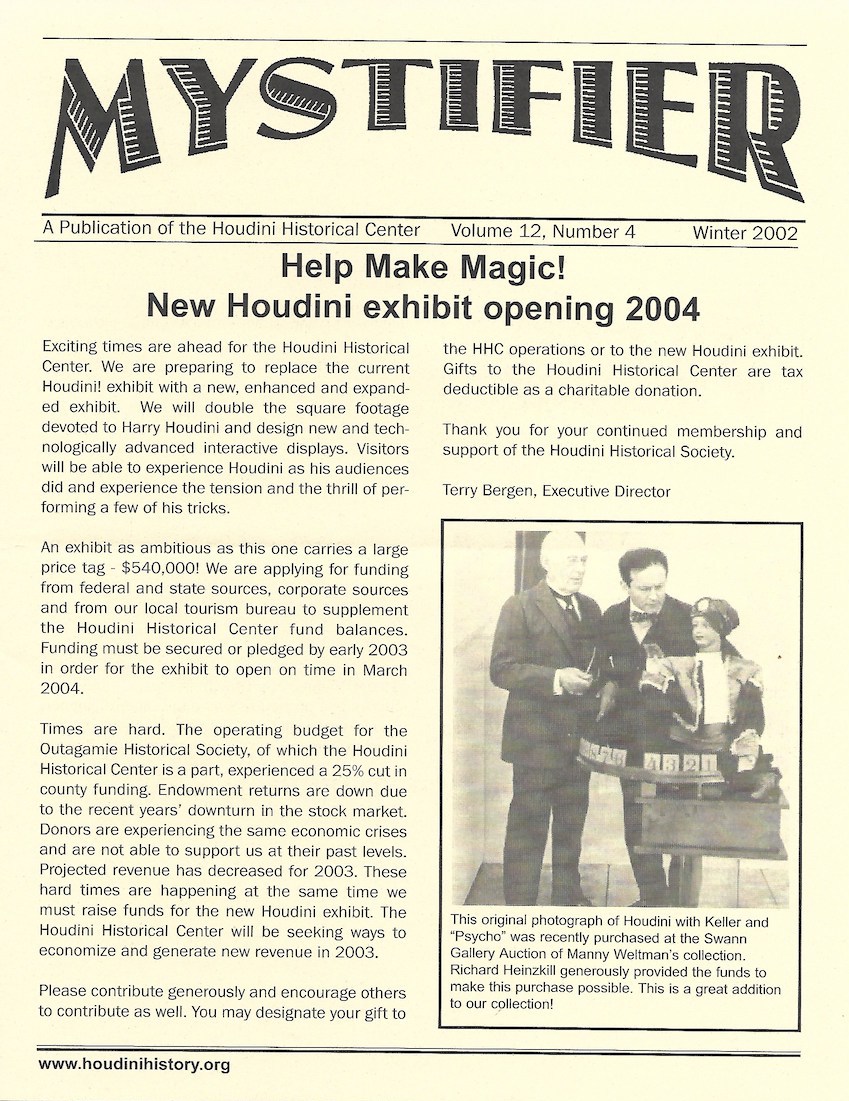
The now single color Mystifier for Winter 2002 begins with what would appear to be great news; a major expansion of the Houdini exhibit and new displays coming in 2004. In reality this was the beginning of the end for the "Houdini Historical Center" and the Mystifier under the new leadership of Executive Director Terry Bergen. (I've found it's never a good sign when a museum announces its displays will become "interactive.")

In addition to Bergen's opening article, which is largely a plea for donations for her vision, the cover of the newsletter features a nice photo of Houdini and Harry Kellar with the "Psycho" automaton. The caption says the HHC acquired the original photo at the recent Manny Weltman Swann Auction with funds provided by Richard Heinzkill.

Inside the newsletter is an obituary of Dr. Morris N. Young, who passed away on November 20, 2002 on his way to a magic convention in which he was the honoree. As a child Young saw Houdini perform and even shook his hand! He later co-authored the book Houdini Fabulous Magic with Walter B. Gibson. Young was also on the HHC board and regular contributor to the Mystifier.

The newsletter also contains an insert questionnaire asking members what aspects of Houdini's life should be highlighted in the new exhibits. The insert is meant to be mailed back to the HHC (which technically makes this a 4-page newsletter). Ominously, one question asks: "Would you like information on how Houdini performed his tricks?" This is followed by a full page ad for the HHC's new Houdini envelopes.

Sid Radner devotes his entire "Backstage" column to the 2002 Official Houdini Seance held in the Brooklyn Room of the New York, New York Hotel and Casino in Las Vegas. The seance was conducted by the "famous" Reverend Ray Fraser and his daughter Wendy Fraser-Baily from Detroit. The famous Houdini stayed away.

Sid then asks readers for suggestions about where future seances should be held, saying they are seeking "some special location at which he previously entertained." He then lists his Holyoke and Palm Beach addresses. He also announces (again) that he will soon acquire a computer to make communication easier.

Mystifier
Volume 12, Number 4
Winter 2002
6 pages

Contents:
New Houdini Exhibit Opening in 2004
R.I.P. Dr. Morris N. Young
Survey on a New Houdini Exhibit
Houdini Envelopes Available To Members
Backstage with Sid Radner


Related:

Thursday, May 28, 2020

Listen to The New School's 1977 Houdini Seance

In 1977 The New School in New York City offered a 10-week course called "The Incredible Houdini: The Man...The Myth...The Magic". It was taught by Gabriel Grayson and included a mouthwatering lineup of guest speakers. Last weekend Joe Notaro shared a flyer from the course showing that lineup of a-listers (click to view).

While doing a little more research I discovered something pretty wild. The New School Archives has a 2+ hour recording of a Houdini Seance held in their auditorium at 66 West 12th Street on Halloween 1977. While not part of the official curriculum, it was related to the course and open to the public. At the table was Milbourne Christopher, Bernard C. Meyer, Billie Dunninger, Morris N. Young, Louis Rachow, Henry Muller, and Sidney Radner. (Walter Gibson was ill and unable to attend.) The moderator was Gabriel Grayson.

It's not your typical Houdini seance in that the medium, Ethel Meyers (who played a role in the Amityville Horror hoax), quickly makes contact and "Houdini" speaks to the gathering in the first person. This means the experts at the table can ask questions of Houdini directly.

Did she/he pass scrutiny? If you want to hear for yourself, you can access both parts via the link below.


If you don't want to go to the trouble of listening, I can tell you that Meyers, after getting off to a good spooky start, bombs spectacularly when the questions begin. She...I mean, Houdini...cannot or will not answer even the most basic question. The knockout blow occurs when Sidney Radner asks, "What do the letters USD mean to you?" Her answer: "United States Detention Home."

One thing that has me intrigued is when Christopher asks details of a seance Houdini attended in January 1926. It's clear Christopher has Houdini's notes on this seance, but it's one I've never heard of. If anyone is aware of these notes or has the details, please give me a shout.

I'm also wondering if The New School recorded the course and guest speakers. To hear the remembrances of Houdini by Walter B. Gibson would be phenomenal. Also, Louis Rachow played the Houdini voice recording during his class on November 15. This marked the first time the recording was played publicly. How much of it did he play?

If anyone attended this course, please share your memories in the Comments below.

Related:

Friday, December 6, 2019

Mystifier, Second Quarter 2000

Continuing my issue by issue look back at the Mystifier, the newsletter of the Houdini Historical Center that ran from 1991-2003.


The second quarter 2000 Mystifier kicks off with an article by curator Kimberly Louagie about Dai Vernon. Louagie states that "by far the most popular question asked in the last few years is––who fooled Houdini?" (Really?) That man was, of course, Dai Vernon, "The Professor", who never had a good thing to say about Houdini himself. So we'll leave it at that!

The second major article of the newsletter is about the history of 278 by Dr. Morris Young. Young recalls his own visits to Houdini's brownstone, including being the participant in a Houdini radio seance broadcast from 278 by Long John Nebel. (Young dates this as 1944, but from what I find, the Nebel seance happened in 1971.)

In his time, Dr. Young was also a recognized expert in the use of mnemonics and codes, and he closes his article with this curious application of mnemonics to Houdini's address:

So motivated by Houdini's often expressed interest in mentalism, codes, cypher and coincidence, I became impelled to submit "278" to its phonetic numeral mnemonic implications. Suddenly, "278" resounded in my ears as "han(d)cuff" or alternatively, uncuff. In the system, numerals are given the sound of consonants. 2 equals N; 7 equals hard C or K; 8 equals F or PH, Trying out the system on "113" (the street number), I equals T or D or TH; 3 equals M. In making up words, vowels have no mnemonic value and may be used liberally. W, H and Y are "neuters". Accordingly, "278 W. 113" becomes "Uncuff We Tie Them", the address of the house.

In "Backstage with Sid Radner", Sid reports that S.A.M. president Harry Monti and past presidents George Schindler and Frank Daily visited the HHC following that year's S.A.M. national convention in Milwaukee. He then plugs the HHC website and museum shop. Sid also announces that the new Houdini Museum at the Venetian Casino in Las Vegas will be open by the time this newsletter arrives.

Sid closes with the story of how he fooled Dai Vernon twice in 1942 with a left-handed peek and one-handed bottom deal. Sid says, "Perhaps I should have billed myself as the 'gambling expert who fooled Vernon', but much of the general public didn't know who Vernon was." Mic drop.

Mystifier
Volume 10, Number 2
Second Quarter, 2000
6 pages

Contents:
Who Fooled Houdini?
New Members
History, Numbering Coincidence Surrounds Houdini's "278"
Special Thanks
Backstage with Sid Radner


Related:

Monday, September 9, 2019

Mystifier, Second Quarter 1999

Continuing my issue by issue look back at the Mystifier, the newsletter of the Houdini Historical Center that ran from 1991-2003.


A tonal change came with the Second Quarter 1999 Mystifier, evidenced in the main article, "Houdini Accepts the Challenge," by new curator Kimberly Louagie. For those accustomed to their quarterly Mystifier delivering a deep dive into Houdini history or illuminating some new bit of Houdini minutia, it was a bit startling to read:

Harry Houdini challenged the world to produce a pair of handcuffs that could hold him prisoner. He later extended that challenge to all types of restraints.

The article continues in this very general vein for four of the newsletter's six pages. While it's well-written and researched, it's clear Louagie is writing for a reader without pre-knowledge of Houdini. Maybe this was because Louagie herself was new to the subject. Or maybe it was a deliberate attempt to reach out beyond the base to a more general audience. But I can remember being a bit perplexed by this piece.

Louagie's article is followed by a list of thanks to those who donated in a recent HHC fund raising campaign (talk about the base). There's a photo of the famous 1911 head and shoulders lithograph, part of the Boldt collection, being newly hung in the HHC stairwell. Among the New Members is Dr. Bruce Averbook.

In "Backstage with Sid Radner", Sid again talks about seeing the Houdini musical at the Marriott Theater in Lincolnshire, Illinois. He compliments actor Bernie Yvon who played Houdini in the production. Sid then gives a shout out to Dr. Morris Young's new book, Radio Music Live, 1920-1950. While having nothing to do with Houdini, Young was a well known Houdini aficionado and a member of the HHC board.

Sid then announces that the Official Houdini Seance that year will be held in London, traveling outside of the U.S. for the first time. He also reports that Butterfield and Butterfield in Los Angeles will be holding a major auction "featuring a large number of Houdini items." These turned out to be items from the Houdini Magical Hall of Fame that had survived the fire in 1995.

Mystifier
Volume 9, Number 2
Second Quarter, 1999
6 pages

Contents:
Houdini Accepts the Challenge
New Members
New Poster Hung at HHC
Summer Magic Series
Backstage with Sid Radner


Related:

Saturday, May 25, 2019

Mystifier, Fourth Quarter 1997

Continuing my issue by issue look back at the Mystifier, the newsletter of the Houdini Historical Center that ran from 1991-2003.


The Fourth Quarter 1997 Mystifier begins with the first article by new curator Margaret A. Ehr. In it, she addresses the controversial Fox television special Breaking the Magician's Code: Magic's Biggest Secrets Finally Revealed, which was running at this time. Ehr condemns it--along with the rest of the magic community--but she notes Houdini himself exposed his own secrets from time to time. She then explores two articles Houdini wrote for The Ladies Home Journal in 1918: "How I Get Out of a Strait-Jacket" and "How I Get Out of My Rope Ties". Near the end she states:

Perhaps Houdini had no fear that others, even knowing his exact techniques, could ever hope to truly challenge him. Houdini himself realized that he was physically exceptional. He understood that his short stature worked to his advantage, as did his impressive strength and flexibility. Few could match Houdini's claims of a double-dislocation at will, or six-inch chest expansion, either. Even knowing precisely what Houdini did to achieve his escapes, few if any magicians would ever be capable of Houdini's success. 

An article by Houdini scholar and regular Mystifier contributor Morris N. Young called "Defending Rabbi Weiss" follows. Young begins:

Too many attempts have been made to malign the reputation of Houdini's father, Mayer Samuel Weiss, especially regarding whether or not he was ordained as a rabbi. It is my purpose to show how unjust those accusations are.

Young goes on to explain how one went about becoming a rabbi in the days of Houdini's father, and how no official paperwork did not mean he was not a rabbi. Young doesn't name names, but this doubt was first cast by Manny Weltman in his 1993 book, Houdini: Escape into Legend, The Early Years: 1862–1900. (Rabbi Weiss's Certificate of Ordination was discovered by David Saltman in 2016.)

The museum shop announces pre-orders for four upcoming videos: Mystic Circle Murder, Houdini The Life of the Worlds Greatest Escapolgist, The Truth About Houdini, and a 2-set VHS of The Master Mystery. The announcement of The Master Mystery was a bombshell as it marked the first release of this movie. A familiar name listed in the "New Members" column is David Byron.

In his "Backstage" column, Sid Radner again sings the praises of the Goodspeed Opera House's Houdini musical. He also gives a detailed report on the Official Houdini Seance, which that year was held on the stage of the Goodspeed. A very special attendee was Anna Crankshaw (Thurlow), great-granddaughter of Margery. Also around the table were: Patrick Culliton, Tom Boldt, Gene Gamache, Larry Weeks, Geno Munari, and Susan Postal, the actress who played Margery in Goodspeed play. The medium was Elaine Kuzmeskus assisted by Barbara Dryden-Masse. Harry, as always, was a no show.

Sid concludes with a mention of a new series by Canada's Discovery TV on the history of magic set to premiere in Fall 1998. Sid says the crew spent 5 1/2 at his home shooting material for the Houdini episode.

[It's surprising this newsletter fails to mention the movie FairyTale: A True Story which was released in October '97.]

Mystifier
Volume 7, Number 4
Fourth Quarter, 1997
6 pages

Contents:
Revealing Houdini's Secrets–Again
Society of Young Magicians Program Update
Defending Rabbi Weiss
New Videos in Museum Shop
Member News
Backstage with Sid Radner


Related:

Thursday, January 10, 2019

Mystifier, First Quarter 1996

Continuing my issue by issue look back at the Mystifier, the newsletter of the Houdini Historical Center that ran from 1991-2003.


The First Quarter 1996 Mystifier kicks off with the announcement of a special exhibit called Mind Over Magic set to open in Fall.

Mind Over Magic represents a fresh approach to Houdini in both its interpretive content and its exhibition techniques. Interpretively the exhibit will place Houdini's career in the broader context of the master magicians who preceded him. Whereas the Houdini! exhibit surveys Houdini life and career, Mind Over Magic will examine how Houdini came out of and transformed the classical magic tradition.

[Mind Over Magic would ultimately be shelved in favor of an exhibition devoted to The Master Mystery.]

The newsletter continues with an article by Dr. Morris N. Young about Houdini's "haunted" bust in the collection of the HHC. The museum's bust is a clay copy of the original acquired by Sidney Radner from Hardeen. Young notes the mysterious destruction of other Houdini busts and asks: "Will it share the same fate as others? Or is there a supernatural element that is now content with its current location?"

This newsletter also contains an article by myself chronicling the many attempts by producer Ray Stark to mount a Houdini biopic. At the time this on-again off-again project was on-again. I was excited to have something published in Mystifier, which I now see as a forerunner and inspiration for my blog. The article was later published in MAGIC Magazine. I posted an updated version HERE.

The museum shop reports that a new book, The Importance of Harry Houdini by Adam Woog, is now in stock. So too are a set of 12 new Houdini postcards. Among the New Members are the familiar names of Ian McColl and Joseph M. Notaro.

In his "Backstage" column, Sid Radner talks about his recent trip to Las Vegas where he saw both David Copperfield and Lance Burton. He was also able to visit the early Copperfield collection. Sid writes:

A real highlight of our trip was being guests of David Copperfield at his "wearhouse," which houses his magic collection, offices, living quarters, exercise rooms, rehearsal rooms, etc. David has what must be the most complete collection of magic memorabilia in the world. He has an especially fine Houdini collection which includes some great posters.

Sid then reveals a scoop ("only in the Mystifier do you get information like this!") that the Houdini Picture Corporation is back in business and collectors will be able to acquire stock certificates in their names. While Sid doesn't detail it here, the company was reincorporated by Geno Munari who was establishing his "Houdini Magic Shop" chain in Las Vegas at this time.

Sid concludes with the news that Ken Silverman's still untitled Houdini biography is due for an October release from Harper Collins.

Mystifier
Volume 6, Number 1
First Quarter, 1996
6 pages

Contents:
New Exhibit Opens Oct. 25
'Haunted' Statue Taunts Skeptics
New Book at Museum Shop
Hollywood Still Looking for Houdini
Backstage with Sid Radner


Related:

Wednesday, October 17, 2018

Mystifier, Second Quarter 1995

Continuing my issue by issue look back at the Mystifier, the newsletter of the Houdini Historical Center that ran from 1991-2003.


The Second Quarter 1995 Mystifier opens with the news that a collection of photographs, clippings, and letters related to Houdini's first performing partner Jacob Hyman was donated to the HHC by Joy U. Reynolds, Hyman's great-niece. (As this was not part of the Radner collection, presumably the material is still held in Appleton.) That's the good news.

The bad news is a report on the catastrophic fire at the Houdini Magical Hall of Fame in Niagara Falls on May 1, 1995. The newsletter gives a good accounting (better than press reports at the time) of what was destroyed:

According to fire inspectors' reports, the blaze began when rubbish containing cigarette butts smoldered and eventually caught fire. As of this printing, the damages have not been fully assessed. According to Hall of Fame owner and HHC Board Member Henry Muller, "It's hard to estimate the total losses. About two-thirds of the museum is still standing, but it's a question of relative value, since the Chinese Water Torture Cell and the secret message burned." [...] Another irreplaceable item lost was a one-of-kind leather straitjacket, which was made especially for Houdini and used in Scotland. Fortunately, many items such as picks, keys, handcuffs, packing cases, and several Blackstone and Thurston illusions survived the fire unscathed.

Dr. Morris N. Young then writes about meeting Dorothy Young, and how, on his suggestion, she painted a portrait of Houdini "as she has seen him in 1926." Dr. Young says the painting was donated to the HHC for display. I don't believe I've ever seen this, but would love to!

The newsletter also includes a report on rising attendance, and that David Copperfield has joined the HHC Board. Among the "New Members" listed is one John Cox. (What took me so long?)

Sid Radner devotes the first part of his "Backstage" column to the Hall of Fame fire. He says that a planned auction of several of the illusions housed at the museum will no longer go forward. He also writes that "the loss of the Water Torture Cell could present a fresh opportunity to lobby for  Houdini postage stamp featuring the cell."

Sid then notes that James Bond author John Gardner is a member of the HHC. He reports that the HHC was recently mentioned on Jeopardy!, and that Houdini's connection to Appleton was included in the April 4, 1995 New York Times crossword. He also announces the upcoming publication of "a very important limited edition book explaining how Houdini came to America", and that there will be a new restaurant chain similar to the Hard Rock Cafe with a Houdini/magic theme.

The book, Houdini Comes To America by Ronald J. Hilgert, appeared the following year. The restaurant never materialized.

Mystifier
Volume 5, Number 2
Second Quarter, 1995
6 pages

Contents:
Recent HHC Donations
Fire: Loss of Magic History
Center Attendance Up
Museum Shop
Copperfield on HHC Board
Backstage with Sid Radner


Related:

Monday, July 2, 2018

Mystifier, Fourth Quarter 1993

Continuing my look back at the Mystifier, the newsletter of the Houdini Historical Center that ran from 1991-2003.


The Fourth Quarter 1993 Mystifier starts with an article  by Morris N. Young about "Houdini's Journeys into Code-Breaking." Who knew? Says Young:

Early in his career as a magician, Houdini discovered that the secret arts of magic extended into unsuspected fringe realms. When presented with a challenge to decipher a group of scrambled letters, he succeeded in doing so.

By relating his knowledge of cryptography to the performing arts, Houdini was able to fathom methods used in training animals to respond to questions, as well as the mysteries of second sight, mentalism, and alleged communication with the spirit world.

The issue continues with Houdini's own unedited draft of article he wrote for the March 1926 Aeronautic Review called "Flight and Magic." This was provided by collector Manny Weltman. One interesting tidbit is that Houdini says he regrets not leaving his plane in a museum in Australia "for it was the first successful plane to fly there." He also claims to have held the first insurance on an airplane.

An article by Library of Congress curator Joan F. Higbee Ph.D. describes the two major collections housed at the Washington institution; one willed by Houdini himself and the McManus-Young collections donated in 1956.

An update on the museum shop ("Business has been booming!") notes the arrival of a "Special limited edition" of the graphic novel Batman-Houdini: The Devil's Workshop. I'm not sure what made this edition special, but the article states it's a "a one-time printing."

Finally, Sid Radner in his "Backstage" column discusses the 1993 Official Houdini Seance, held that year in Cincinnati at the Union Central Insurance Company--the company that held Houdini's life insurance at the time of his death. The inner circle attendees were: Henry Muller, Moira Thomas, Tom Boldt, Dr. Morris Young, Dr. Bernard Dolenz, Dorothy Young, Ken Klosterman, Marie Blood, and Tom Rozoff. Sid notes that the seance this year received world-wide news coverage via CNN.

The newsletter concludes with Christmas poem reprinted from the Dec. 15, 1923 The Sphinx.

Mystifier
Volume 3, Number 4
Fourth Quarter, 1993
6 pages

Contents:
Houdini's Journey into Code-Breaking
Flight and Magic
Magic at the Library of Congress
New Books at the Museum Shop
Backstage with Sid Radner


Related:

Saturday, April 21, 2018

Mystifier, Fourth Quarter 1992

Continuing my look back at Mystifier, the quarterly newsletter of the Houdini Historical Center that ran from 1991-2003.


The Fourth Quarter 1992 Mystifier is a standout issue in that it reprints a full account of a challenge packing crate escape at the Zoo-Hippodrome in Glasgow in 1904. This challenge had an interesting added element, as you can read below:

During the day representatives of the firm had visited the Zoo and complained that there was a trap door on the stage. They proposed to erect a platform on which the packing case should be placed. To that Houdini had no objections, so he called upon the carpenters present to proceed to business, and the band played. Four tradesmen immediately threw off their coats. Long stout beams were dragged on to the stage, and they set to work with hammer and nails to baffle, if possible, the daring performer. The music of the orchestra was almost drowned in the noise of the active woodworkers. By and by the platform was completed. It was about a couple of feet high, supported by struts, so that a clear view of the stage floor could be obtained underneath.

The newsletter continues with an article by Tom Boldt about the newly opened La Maison de Robert-Houdin-Centre National des Arts de la Magie et de I'illusion in Blois, France. A Christmas greeting from Houdini's December 1907 issue of the Conjurer's Magazine is reprinted along with "Helpful Hints for Young Magicians Under Eighty" from the August 12, 1908 issue.

Regular contributor Dr. Morris N. Young then provides an interesting article about the books Houdini traveled with on tour in 1911. Among the some 19 mentioned books that Houdini felt were important enough to keep with him at all times are curiosities such as The International Scientific Series Animal Locomotion and Grimms Fairy Tales.

In "Backstage with Sidney Radner", Sid reports on the recent discovery of a large cache of uncatalogued Houdini material in the Library of Congress. Incredibly, this material had remained unboxed since its arrival in 1927! Sid talks about meeting Dorothy Young for the first time at the 1992 Official Houdini Seance at the Houdini Magical Hall of Fame. He says that the BBC and National Geographic are both working on Houdini documentaries. Sid also notes that the first volume of Frank Koval's Illustrated Houdini Research Diary -- "an absolute must for Houdini researchers" -- is available from the museum shop for $20. So too is Pat Culliton's Houdini's Strange Tales.

Sid finishes by reporting that David Copperfield visited Appleton and the Houdini Historical Center on November 19, 1992, and "gave us a very generous plug during his performance in nearby Neenah, for which we give great thanks."

Mystifier
Volume 2, Number 4
Fourth Quarter, 1992
6 pages

Contents:
Looking Through Scrapbooks
Center to Honor Robert-Houdin
Queries
Houdini's Bookshelf on Tour
Helpful Hints for Magicians
Backstage with Sid Radner

Thanks to Gary Hunt of Handcuff Queens for providing me with this issue.


Related:

Sunday, April 8, 2018

Mystifier, Third Quarter 1992

Continuing my look back at the Mystifier, the quarterly newsletter of the Houdini Historical Center that ran from 1991-2003.


The first issue to carry the new Mystifier name was released in the Third Quarter of 1992. The newsletter kicks off with a terrific article by William M. Doerflinger who, as a boy, saw Houdini do his vanishing elephant at the New York Hippodrome. What a memory! Here's an excerpt:

To a round of applause, Houdini and the ponderous elephant appeared from the wings, walked to center stage, and saluted the audience. A very large, slightly rectangular cabinet, curtained along one of its long sides, had been pushed on stage by assistants. It was shown to be empty. The docile elephant lumbered up a short ramp and into the cabinet. The curtains were drawn. The cabinet was then slowly rotated, and left with its curtained side toward the audience. Houdini walked to the cabinet and whisked apart the curtains. We looked into an empty cabinet and through a circular opening, much too small for the elephant to pass through, in its rear wall. The elephant was gone.

The newsletter continues with "A Tale of Two Trunks" by Morris N. Young in which he examines a second trunk Houdini used to carry his escape tools. The HHC Endowment Fund is then discussed. We then get a lengthy first draft article by Houdini on "Historical Lock Pickers", edited and annotated by collector and manuscript owner Manny Weltman.

In his "Backstage" column, Sid Radner reports on the success of the recent Magic Collectors' convention in Appleton, saying, "we had the greatest every gathering of Houdini experts ever assembled one area!" He also notes that "six or more books by convention attendees are in the works, the first of which, by Pat Culliton, had a September publication date." That book was Houdini's Strange Tales.

The newsletter concludes with news of new postcards in the museum shop.

Mystifier
Volume 2, Number 3
Third Quarter, 1992
6 pages

Contents:
Seeing the Elephant Vanish
A Tale of Two Trunks
HHC Endowment
Queries
Historical Lock Pickers
Backstage with Sid Radner


Related:

Tuesday, March 27, 2018

????? (Mystifier), Second Quarter, 1992

Continuing my look back at the Mystifier, the quarterly newsletter of the Houdini Historical Center that ran from 1991-2003.


The Houdini Historical Center newsletter was looking for a new name when this third issue was released in 1992. The newsletter asked members to choose from the choices: The Mystifier, Escape, Metamorphosis, Off the Cuff, Houdiniana, On Stage, Stage, Cuff and Key, Houdini Unlocked, or The Challenge. Which did they choose? You'll have to wait until the next issue or find out!

But the real focus of this issue was "Houdini's Trunk No. 8." This was the trunk that traveled with Houdini and contained all his tools and "wherewithal for any sort of escape." The contents of the trunk were donated to the museum by Dr. Morris N. Young, and the newsletter contains a lengthy  article by Young penned for the December 1951 MUM describing in detail how he acquired the trunk from Hardeen's widow and its contents.

A search through the drawers revealed in orderly placement what proved to be mainly hardware supplies. No doubt the assemblage of materials represented years of trial and experience in being prepared for any contingency anywhere, anytime. There had to be no dependency on local shops or fancies, and secrets could not be revealed indirectly through purchase of specific supplies.

A second article by Ken Silverman called "More Houdini Trunks" discusses a written inventory of what Houdini's other traveling trunks contained, including a breakdown of Milk Cans he was using in  England in February 1911:

He had with him in England no fewer than four cans, described in the inventory as one "1910 New York Can," one "Dunston Challenge Can," one "Gamage Can," and one "Can 1910 unprepaired [sic]."

New items added to the HHC gift shop are discussed, including a glass etched Houdini portrait set on a walnut base with back lighting. Houdini's 1925 Christmas card is also reproduced.

In his "Backstage with Sid Radner" column, Sid discusses the upcoming first board meeting of the HHC and the new temporary exhibit, Houdini on Tour: The Traveling Magic Show, which featured the contents of Trunk No. 8. He again mentions a proposed Houdini stage musical, and that production of a new Houdini movie is "delayed for the couple of months." (This was the Ray Stark film which would never go before cameras.)

The newsletter concludes with a pitch for donations.

?????
Volume 2, Number 2
Second Quarter, 1992
6 pages

Contents:
Houdini's Tools on Display
Trunk No. 8
More on Trunks
Magic Items for Sale
Queries
Backstage with Sid Radner
Window Open for Donations


Related:

    Friday, March 9, 2018

    Center Stage (Mystifier), First Issue, April 1991

    Today we kick off our look back at the Mystifier, the newsletter of the Houdini Historical Center that ran from 1991-2003. In many ways, this was the forerunner of blogs like WILD ABOUT HARRY.


    The Houdini Historical Center's Mystifier newsletter began life as "Center Stage." Volume 1, Number 1 was published in April 1991. On it's front page was an introduction, "Welcome to Center Stage", which laid out its mission statement:

    What is Center Stage all about? It is a forum. It's one of the ways the HHC hopes to facilitate the fair and open exchange of information between people from a variety of backgrounds who are interested in Houdini. Academic historians and magic collectors, magicians and magic buffs, escape artists and locksmiths, antique dealers, and folks who just plain find Houdini interesting will all find something for them in Center Stage.

    True to their word, the first feature article by Dr. Morris N. Young is a rare treat. Young gives "An Eye Witness Account" of seeing Houdini in Boston when he was a youth. Young notes that while he went in expecting to be dazzled by Houdini's escape feats, he came away most impressed with his magic, notably what Young called his "card acrobatics." This eyewitness assessment of Houdini's magic led to a special editor's note:

    His unique account and testimonial challenges the common assumption that Houdini was a great escape artist and publicity manager but only a mediocre magician. Dr. Young's account, along with other evidence that had been brought forward in recent years, force us to reconsider this assumption.

    The second feature, "From The Sidney H. Radner Collection", showcases a newspaper clipping from 1899 about Houdini's escape from handcuffs in a San Fransisco police station. The article contains a terrific illustration of Houdini standing on a table surrounded by officers.

    In "Sid's Notes", Radner explains how his collection came to find its new home in Appleton in 1988.

    When then-Outagamie Museum Curator Christopher Miller arrived at my home to examine my collection, I knew immediately that I had made a sensible decision. Chris arrived with white cotton gloves–-explaining to me why these artifacts should not be touched by human hands. I was thoroughly impressed. Only gloved hands have touched the collection since.

    Finally, in "Queries", Thomas J. Bolt writes that he's looking for "stories, anecdotes, legends, etc., about Houdini's life in Appleton", and Christopher Miller of the Minnesota Historical Society seeks information on Houdini's Milk Can Escape.

    Center Stage
    Volume 1, Number 1
    April 1991
    4 pages

    Contents:
    An Eye Witness Account
    San Francisco, 1899
    Sid's Notes
    Houdini Historical Center Membership Form
    Queries


    Related:

    Thursday, September 24, 2015

    The best forgotten Houdini book

    Continuing my examination of books about Houdini using images and insights from my own collection.

    Houdini's Fabulous Magic by Walter B. Gibson and Morris N. Young is the best forgotten Houdini book. I say that because when one thinks of books on Houdini's methods, one tends to turn to Houdini The Key by Patrick Culliton, The Secrets of Houdini by J.C. Cannel, or even Gibson's earlier work, Houdini's Escapes and Magic. Maybe because Fabulous Magic contains some reprinted material from the earlier Gibson book it tends to be thought of as a somewhat recycled work. But it's actually one of the very best books on Houdini's major feats and methods and maybe the best book for the layperson. It also contains historical tidbits that aren't found elsewhere. So let's remember it today!

    Walter B. Gibson and Dr. Morris Young make an excellent team. Gibson knew Houdini and Young had one of the best Houdini and magic collections in the world (it's now in the Library of Congress). So Houdini's Fabulous Magic is packed with rare images on almost every page. It was certainly the best illustrated Houdini book up to that time. Also, for me, it feels like Gibson is finally willing to part with secrets that he had kept to himself – or at least out of print – for years.

    The chapters on Houdini's challenge handcuff act and jail escapes are among the best, offering a whole host of clever methods that Houdini employed beyond the "key in a kiss." A clue to why these chapters are especially strong might be found in the acknowledgements:

    Reminiscences of early Houdini days were personally provided by Lewis Goldstein, only living member of the Houdini show during the Handcuff Era of the early 1900s. Goldstein also worked with the Hardeen company during that same period, and the authors appreciate his first-hand recollections.

    Goldstein is likely the source of the following story of a jail escape. It's not something I've read elsewhere, and I love how it shows that Houdini and Hardeen could work together spontaneously:

    On one occasion, Houdini went to look over a jail cell accompanied by his brother Hardeen. The lock was formidable, but of the spring latch type. While the police chief was asking Houdini why he didn't try to make the escape then and there, Houdini suddenly decided that he would.
    Houdini whispered a quick word to Hardeen and while Houdini was being searched, Hardeen pulled a sheet of paper from a notebook, wadded it tightly, and edged close enough to the door to jam the wad into the latch socket. Houdini was put into the cell naked, keyless, and presumably defeated; but the police chief and the jailer had scarcely turned away before they heard the door clang again behind them and there was Houdini free!

    Houdini's Fabulous Magic also includes a final chapter "About Houdini" which features autobiographical excerpts by the great magician himself. And while the book has a very good chapter on the Water Torture Cell, it doesn't reveal the method. Some secrets should be kept.

    Publication history:

    Houdini's Fabulous Magic was first published in hardcover in 1961 by Chilton Book Company. The cover art has Houdini's name running vertically down a dark green background, somewhat recalling a spirit slate. As far as I know, it was only published in the United States. The book went through at least five hardcover printings with the same dust jacket artwork (I have a 5th dated August 1968).

    The one and only paperback edition (that I know of) was published by Barns & Noble Books in 1977.

    First hardcover (1961) and first paperback (1977).

    Houdini's Fabulous Magic would benefit from the great Houdini renaissance of the mid 1970s. The book was reprinted in a new hardcover by Bell Publishing. This time the jacket featured the famous image of Houdini in handcuffs (dated 1903 in the book itself) against an orange background. The copyright page only references the 1961 edition, but it appears this hardcover might have been released in October 1976.

    Bell hardcovers from the 1970s.

    Bell later released another hardcover edition with new dust jacket art that added the descriptive: "His own scrapbooks reveal the secrets of 38 major illusions." Once again, the year of publication is unclear because the copyright only references the 1961 edition. But from my own recollection, this grey jacketed edition replaced the orange edition in my local magic shop around 1978.

    Houdini's Fabulous Magic long ago vanished from print. But if one is interested in learning Houdini's methods, hunting down one of these old copies would be a fabulous way to do so.

    UPDATE: In 2023 Vine Leaves Press reprinted Houdini's Fabulous Magic in paperback with a new Forward by Gabe Fajuri.


    Enjoy these other selections from the WILD ABOUT HARRY bookshelf:

    Friday, December 28, 2012

    Houdini on Magic gets a cover revamp (update)

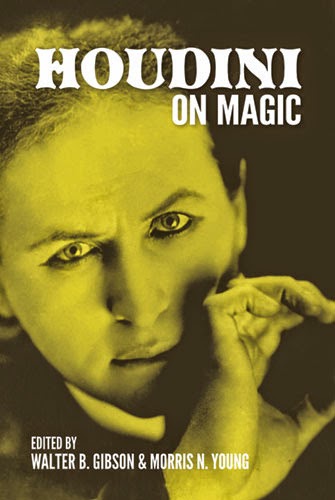
    Dover's perennial trade paperback edition of Houdini on Magic by Walter B. Gibson and Morris N. Young has received a minor cover art makeover. The new cover pictured on Amazon and the Dover website shows a new title font treatment, and the resolution on the photo of Houdini looks improved as well. (Yes, this is the kind of thing I get excited about.)

    Houdini on Magic was first published by Dover in 1953 and has never gone out of print. Click here for a retrospective on the book and the changes in cover art over the years.

    Dover's The Secrets of Houdini has also received a new title treatment on the book's spine. Watch for a retrospective on that title coming in the new year.

    UPDATE: According to the publisher, "the cover is new, but the new covers will not be shipping for a few months because of our inventory of the old covers."

    Thursday, February 16, 2012

    The perennial Houdini on Magic

    My recent post about Scholastic's The Great Houdini got me wondering which Houdini book has had the longest continuous life in print. Didn't take me long to figure out that it must be Houdini on Magic by Walter B. Gibson and Morris N. Young. The book was first published in 1953 by Dover and has apparently never gone out of print. Check out the Dover website or Amazon where you can still buy a brand new copy today. This is also the book that you'll most likely find looking back at you from any magic shop book rack.

    The original 1953 hardcover and paperback edition.

    The book itself is a confection of previously published material, including Gibson's Houdini's Escape and Magic and Houdini's own books and pitchbooks. This means it contains some Houdini mythology. On the upside, it's very nicely illustrated and Gibson's introduction -- in which he talks about knowing and working with Houdini -- is worth the price of the book alone.

    Paperback editions from the 1960s.

    Here I've gathered a selection of Houdini on Magic covers from my own collection (along with the Gresham bio, Houdini on Magic was the first Houdini book I ever purchased). The Dover copyright pages only ever say 1953, so it's hard to determine exactly when these books were first published. I can't claim these are all the variations, but it's a good cross section of the major changes in cover art that the book has experienced over its amazing 59 years in print!

    Houdini on Magic cover art from the 1970s to today.

    UPDATE: In 2013, Dover gave the perennial Houdini on Magic a bit of cover revamp. Still going strong!


    Also enjoy:

    Translate