Showing posts with label Religion. Show all posts

Saturday, November 30, 2024

Deconstructing Houdini '53: Resurrection

Continuing my scene-by-scene dissection of Houdini (1953). Last time, an overboard box escape went horribly wrong and Houdini finally met his end. Or has he?

Chapter 19: Resurrection

This scene is the conclusion of the famed trapped under the ice sequence, but it's worth examining on its own as it contains a significant moment in Houdini's life. Maybe even THE most significant moment.

We dissolve from Otto standing alone by the side of the hole in the ice to Bess back in the hotel room, still dressed in black with the lights low. She hears newsboys calling on the street: "Houdini lost in Detroit River!" This atmospheric addition to the story was the creation of Bess Houdini herself. It first appears in the Harold Kellock book:

    Back in the hotel Mrs. Houdini was lying uneasily in bed when she heard newsboys crying in the street.
    "Quick, open the window wide," she said to her attendant, and suddenly the cries became clear: "Extree! Extree! Houdini dead!" "Extree! Houdini drowned in river."

Bess closes the door and breaks down in tears. But then the hotel door silently opens behind her. Bess turns to see a darkened silhouette of Houdini standing there. Is it a ghost? No, it's Houdini in the flesh, accompanied by Otto. He is risen! (At this point, the ten-year-old me decided I needed to devote my life to Houdini.)


Harry and Bess embrace. He explains that the current swept him downstream. He feared he'd "never find the opening," but then heard his mother's voice calling to him. He swam toward the sound of her voice and found the opening in the ice. (Presumably, with Otto still standing vigil.) Bess cries as Harry assures her, "I'll never leave you. I'll never leave you."


The addition of Houdini's mother's death and guiding voice is a deviation from the established mythology. Here, divine intervention saves Houdini from his Halloween fate (this time). But Houdini's own "true" version of the story has none of this. In fact, he goes out of his way to say that he searched and found no "greater" or "guiding light" to rescue him. In his own version of events, Houdini saves himself.

I do think it's inspired to not show Houdini's escape from his icy confinement. Letting the scene end on a down note makes his mysterious reappearance feel like an actual resurrection. It makes him an even more mythic and powerful figure. But his ascendancy comes with a cost.


The phone rings. Harry takes the call, and darkness descends over his features. "What time did she die?" he asks. When he hangs up, he tells Bess that his mother died at the same time he heard her calling to him. Houdini collapses into Bess's arms and we fade to black.

It's interesting to note that because the filmmakers chose to stage this on Halloween, it means his mother also died on Halloween. A bad day indeed! Houdini's mother actually died on July 17, 1913, and Houdini learned of her death during a press conference in Copenhagen. But the movie is correct in showing that Houdini was not present for his mother's death, and the news came as a great shock to him. Such a shock that it will change the course of his life and career.

But we'll save that for next time.

Friday, August 2, 2024

Houdini's admiration for Ben-Hur


Here's an interesting nugget to finish off the work week. This comes from an interview with Houdini by Fred Lockley in The Oregon Daily Journal on June 4, 1920.


I can understand how the character of Judah Ben-Hur would appeal to Houdini. Not only could he identify with him as a fellow Jew, but I think Houdini saw himself as someone who developed his mind and body despite his circumstances. For some reason, I'm reminded of this quote:

"When I was playing Dime Museums and being classed a 'freak,' I generally kept very quiet and tried to make a living, not knowing that I was developing my dexterity by working ten to fifteen times daily."

Today, we tend to think of Ben-Hur as a classic movie. But when Houdini gave this interview, Ben-Hur was best known as a novel by Lew Wallace and an enormously popular stage play. This is also from The Oregon Daily Journal (Feb. 22, 1920).


Curiously, Houdini says in this interview that his father was born in Italy instead of Hungary. But Houdini plays fast and loose with the truth throughout this piece. He also claims to have "flown a mile" in Australia.

This interview appears to have been conducted while Houdini was working on Terror Island at the Lasky Studio in Hollywood. Here's another nice detail.


Remember, "row well and live."

Want more? You can read all three installments of the Fred Lockley-Houdini interview as a "Scholar" member of my Patreon below.


Related:

Monday, November 13, 2023

Dua Lipa has to explain Houdini was a real person


In an interview with Italian radio station RDS, pop star Dua Lipa explained how she uses Houdini in her new song:

"Houdini is an escape artist and I love the idea of using him as a metaphor for knowing your own worth, knowing when to stay in a situation, knowing what you deserve, and also when something doesn't go your way or something doesn't feel right, knowing when to leave or knowing when to go Houdini. And in this sense, I use Houdini as a verb as well."

Nice answer. But then the interview took a slightly embarrassing turn, which you can watch for yourself below:

To be fair to the interviewer, English is not her first language, and I suspect she meant "epic." But thank you, Dua, for doing the Lord's work!


You can watch the full interview on UPROXX. Purchase "Houdini" on Amazon Music U.S. or Amazon Music UK. Watch the video on YouTube.

Monday, October 25, 2021

The Houdini Conspiracy by Christopher G. Owen

It's been a while since we've had some Houdini fiction to sink our teeth into, and this one sounds like quite the meal! Below is the official plot summery for The Houdini Conspiracy: The Crusade Against Spiritualism by Christopher G. Owen.

It is the 1920s and Catholic leaders do not want another wave of spiritualism in America, especially after barely containing the last one. Now as a new organization emerges armed with their own bible, they fear they are about to witness a highly organized attack on the religious hegemony in the New World. One of the leaders of this organization is Cora Richmond, a deep trance medium who has just authored a troubling book.

Erik Weisz, otherwise known as the Great Houdini, is a world-class showman and flamboyant self-promoter who is in the waning days of his career when he receives the commission of a lifetime from his handlers: to lead a worldwide crusade to destroy the spiritualist movement in America so it will never recover to its former level. As established religions of the world, based on a flimsy patchwork of myth and stolen history, find their champion in Houdini, now only time will tell if he can singlehandedly sabotage humanity's age-old quest for spirituality and create a heroic legacy that will endure for generations to come.

In this fascinating tale, the Great Houdini is commissioned to lead a global crusade to destroy a modern spiritualist movement in America.

Monday, October 11, 2021

LINK: Houdini's Weird Tales Q&A 2

Joe Notaro at HHCE has more Houdini Q&A from the April 1924 issue of Weird Tales magazine. I'm especially intrigued by Houdini's answer regarding Black Mass:

I have never seen a complete description of the “Black Mass” and the rituals. Some of it, if my memory serves me right, was photographed in Sweden, and was of such a nature that the picture, which cost a fortune, had never been seen by the public. It was called, I believe, “Superstition of the Age.” I saw this film run, but up to the present it has never been seen outside of a private projection room. It took more that two years to make it. 

I'd love to know the circumstances of when and where Houdini was able to screen this forbidden film.

Click the headline above to check out the full Q&A at Harry Houdini Circumstantial Evidence.

Tuesday, October 5, 2021

Which synagogue did Houdini visit in Providence?

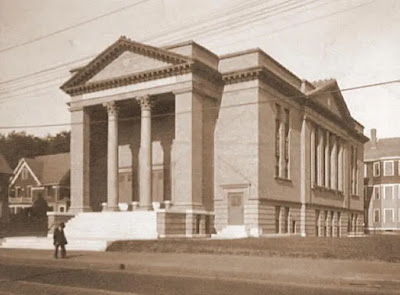
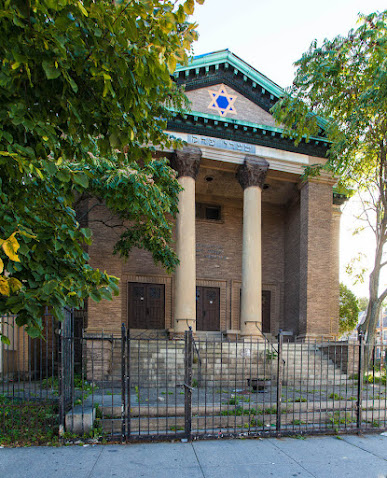
My mind is still with Houdini in Providence 95 years ago this week. Today was his second day in the city, and it held special significance. October 5, 1926, was the 34th anniversary of his father's death. Houdini said he always made a point to find a synagogue to say Kaddish on October 5, even if it meant traveling outside of a city to do so. Houdini didn't need to travel on this day. In doing a very cursory search online, I see that Providence has two notable synagogues in 1926, both of which still stand.

The Broad Street Synagogue (later known as Temple Beth-El) is located at 688 Broad Street in Providence. According to Wikipedia, the Jews of Providence who founded Temple Beth-El were predominantly Ashkenazi Jews from German-speaking areas. The majority of the early congregants were immigrants from Germany, the Netherlands, Hungary, and Poland. If I had to guess, I would say this is the synagogue where Houdini said his final Kaddish.


The building survives but is currently vacant. In 2020 it was named as one of named one of Providence's "Most Endangered Buildings" by the Providence Preservation Society.


Another candidate is The Sons of Jacob Synagogue located at 24 Douglas Avenue in the Smith Hill neighborhood of Providence. Wikipedia states that the congregation which built it was formed in 1896 by Orthodox Jews who immigrated from Russia. The Rhode Island Jewish Museum is currently running a campaign to restore the building and "into a center that curates the immigrant experience."


Like I said, I didn't do a thorough search for synagogues in Providence in 1926, so it's possible Houdini visited another one entirely. It's also possible he skipped the ritual this year, but I don't think that's very likely. He was devoted to both his parents and he loved a good ritual!

From the review of his opening night show, we know he had instructed an audience member to meet him at the theater at 10AM to be "disillusioned" about the medium Keeler. So I suspect Houdini started his day with his synagogue visit and remembrance of his father.

Monday, May 17, 2021

Bess helps clear a "witch"

In 1656 Eunice "Goody" Cole was convicted of being a witch in Boston. After serving a jail sentence she was again accused of witchcraft in Hampton, New Hampshire, where she died in prison in 1680. It only took the citizens of Hampton 258 years to realize they might have made a mistake. So on August 25, 1938 they organized a ceremony to clear Eunice's name. And guess who was there?

I'll let the report from the AP take it from here.

Click to enlarge.

It's nice to know Bess kept up her husband's battle against "the cancer of superstition."

Below are more adventures of Bess in her later years.

Related:

Friday, August 7, 2020

Houdini and the Omro possession


In March 1926 newspapers reported that an 11-year-old girl name Marie Maybourne from Omro, Wisconsin, appeared to be possessed. In what sounds weirdly similar to the events of The Exorcist (which itself was inspired by a 1949 case), furniture was said to move on its own and voices were heard emanating from the walls. Omro's marshal, James Stead, was unable to explain the strange happenings. A local priest, Rev. William Grace, claimed he heard more than one voice when Marie spoke and sang. On March 29 The Brainerd Daily Dispatch reported:

Houdini, renowned as a ghost chaser, has been asked to come here to look expertly into the mystery and detect, if possible, any hoax.

Houdini was performing his "3 Shows in One" at the Princess Theater in Chicago at this time and had his own spirits to deal with on stage. But he did offer his assessment of the case to reporters. The following appeared in the Kenosha Evening News on April 2, 1926:


Houdini never came to Omro, and a general skepticism seemed to settle over the affair, with Marshall Stead telling the United Press, "These people are carrying this thing too far." After a while the case vanished from the papers and no more was heard about the Omro possession.

Related:

Sunday, April 21, 2019

Happy Easter from Bess Houdini

This needle point was made by Bess Houdini and today hangs in the home of her great-nephew, John C. Hinson. It depicts...well, you know who that is! (No, not him.)


Bess was raised in a strict Roman Catholic family. Her going into show business and marrying a Jewish magician estranged her from her mother who was convinced Houdini was the devil. But fame and wealth seemed to soothe Mrs. Rahner's religious objections, and she even came to live with the Houdinis in 278.

Bess maintained her religious beliefs and, like her mother, was highly superstitious (it's said she never wore yellow because it was bad luck and refused to enter a room if someone had whistled in it). Based on her letters, she appears to have re-embraced her Catholic faith later in life when this needle point was made. Although she was not so devout that she didn't find fun in naming her pet marmoset "Satan."

Happy Easter Sunday.

Related:

Monday, April 15, 2019

Mystifier, Second Quarter 1997

Continuing my issue by issue look back at the Mystifier, the newsletter of the Houdini Historical Center that ran from 1991-2003.


The Second Quarter 1997 Mystifier continues coverage of the Rabbi Weiss documents recently acquired by the HHC. This time curator Benjamin Filene examines a prayer Rabbi Weiss delivered at the opening of the first Appleton Temple on the corner of College Avenue and Oneida Street on October 28, 1878.

A synagogue, Rabbi Weiss emphasizes further, is built not for God, but for the Jewish community itself. The first temple, then, was an essential step in forging strong bonds among the Jewish residents.
Rabbi Weiss's emphasis on community only underscores the extent to which his dismissal by the Appleton congregation in 1882 must have been a personal tragedy. Only months before his dismissal, the congregation moved into a beautiful new building of its own -- a place that offered even greater opportunities for forging community -- Rabbi Weiss was cut off form the community he had hoped to build and thrive within.

The remainder of the issue is largely taken up with HHC business, including the announcement that curator Filene will be leaving the center for a new job at the Minnesota State Historical Society. It also notes that Ken Silverman has been awarded the Milbourne Christopher prize, and that he will speak at the HHC on September 20 as the keynote speaker for the Wisconsin Council for Local History Regional Convention.

The museum store announces the arrival of Houdini pre-paid phones cards. The cards come in sets of three (12 total) and feature images of Houdini from the HHC collection. Phone cards were popular in the 1990s. Each card allows for 30 minutes of long distance calls inside the U.S. (I have a set of these and will share in a future post.)

In his "Backstage" column, Sid Radner reports that Gene Gamache's documentary Houdini: People Came to See Him Die has won a TELLY award. He says he recently visited Geno Munari's new Houdini's Magic Shop in the New York New York Hotel in Las Vegas. Sid writes, apparently without irony, that, "Foreign visitors or those from the west coast need not go east to see New York City anymore--the flavor and landmarks of the Big Apple are recreated vividly and thoroughly at the hotel." Good to know!

Sid continues by saying that he and Houdini Magical Hall of Fame owner Henry Muller attended a performance of the new musical Ragtime in Toronto. "The show has a prominent Houdini presence," reports Sid. He notes the Silverman book will be published in Japan at the end of the year. He also once again gives a shout-out to the Goodspeed Opera House's Houdini musical, and again says he wishes the U.S. postal service would honor Houdini with a stamp.

Mystifier
Volume 7, Number 2
Second Quarter, 1997
6 pages

Contents:
Filene's Farewell
Rabbi Weiss Dedicates Temple
Membership News
Houdini Phone Cards Now Available
Backstage with Sid Radner


Related:

Thursday, November 22, 2018

Houdini's ten favorite books

The below is from the The Courier Journal, May 9, 1923. Would have been nice to have seen The Memories of Robert-Houdin on this list, or any magic book for that matter. But I do love that he includes "Sherlock Holmes".


Wednesday, July 11, 2018

Janet Langer remembers working for Houdini

Recently I came across a remarkable article from the March 31, 1975 Journal News about 81-year-old Janet Langer who worked as a Houdini's secretary and stenographer. Any first hand recollection of Houdini is gold, especially now that so many (all?) of the known eyewitnesses have passed on.

Interviewed at the Maple Leaf Nursing Home in Monsey, New York by Journal News reporter Bob McEwen, Mrs. Langer recalled:

"I was about 23 when I first started working with him in 1917. He was a very temperamental man, and hard to work for, but I was a young girl then and very much impressed with him.
I used to attend all his performances, but Houdini was a very secretive man. He never revealed any of his tricks to me. The only ones who ever knew how he made his escapes where his wife and his assistant, a man named John [sic] Collins."

The article goes on to say that when Houdini wasn't touring he was "dictating the story of his life to Janet in the attic of his three-story brownstone at 278 West 135th [sic] Street." It then continues:

"I used to take 150 words per minute shorthand in those days," she said. "He paid a good salary too. About $70 a week. In those days that was a lot of money. Of course his fees were phenomenal. When he was appearing at the Loew's State Theater in New York he was making $2000 a week, an amazing figure even by today's standards."
"He was a man who got what he wanted," she said. "His one regret was not having a son he could leave his secrets to."
Mrs. Langer said it wasn't always fun working for Houdini because he was so demanding, but seeing him perform made it al worthwhile. Occasionally he would take time out from his dictation to talk more intimately with her.
"He'd orate for hours and hours, then stop and say, 'Oh, c'mon, let's talk.' I'm a Orthodox Jew and he was very interested in Judaism. Houdini was a Jew (but not very religious).

"He was always asking me about my religion, and I was going to invite him to my family's seder one year, but just before Passover I quit. I got tired of it and decided to move on.

"I never regretted working for Houdini," she said. "I was young and he came along and gave me the opportunity to travel. I never would have gotten the chance otherwise. The traveling kept me from getting married too early, and I had several offers in those years."

I'm wondering if this "life story" Houdini was dictating could have been the autobiography that he is said to have later lost?

Mrs. Langer also recounts how Houdini escaped from a nailed "coffin" under the ice of the Detroit river, saying, "It was the most unbelievable thing I've ever seen. The crowds went wild." This is a little disconcerting as we know this didn't happen. But maybe she witnessed some other Houdini underwater escape and over time it melded with the Tony Curtis movie? Even reporter McEwen concedes that her "memory has been dimmed by age and the pain of arthritis."

But other than this, her recollections do have a ring of authenticity, and what a gem this is from 1975.

Related:

Saturday, June 30, 2018

LINK: Rabbi Weiss’s Farewell Sermon

Tom Interval has update his blog Houdini Museum with a brilliantly researched and superbly written examination of Houdini father, Mayer Samuel Weiss. There's a lot of new information here, including an account of Mayer Samuel delivering sermons in Louisville, Kentucky in 1883 on "The human soul can never die" and "The characteristics of women as shown in Solomon's song entitled 'The Worth of the Woman'."

Tom also helps debunk the idea that Mayer Samuel was fired from his position in Appleton because he could not speak English, finding evidence that his replacement also couldn't speak English.

But you don't need to hear all this from me. Click the headline and have a read at Tom's own Houdini Museum.

Related:

Sunday, June 24, 2018

LINK: How Harry Houdini stayed chained to his roots as a rabbi’s son

Here's an interesting article from The Times of Israel about Houdini's Judaism and the new exhibition, Inescapable: The Life and Legacy of Harry Houdini, which opens today at The Jewish Museum of Maryland. Of particular note is this significant piece of new information uncovered by curator David London.

London cited a letter from Houdini to “a lifetime friend” in Appleton, Wisconsin, in which the magician told of his “relief one year after his mother’s death, when he no longer had to recite the Mourner’s Kaddish prayer nightly.” While it is not known whether he did this on his own accord or out of reverence for his parents, “we discovered he did that 365 days,” London said.

Click the headline to read the full article at The Times of Israel.

Thanks to Ken Trombly.

Related:

Friday, April 6, 2018

Houdini on the Bible, Freud, spirits, and spells


In September 1925 The Pittsburgh Press ran a series of articles in which Houdini answered readers questions. As you can see from the photo above (which I've never seen before), Houdini came into the newspaper office to do so. The questions were primarily related to spiritualism as Houdini was engaged in exposing fraudulent mediums at this time. But some veered into other areas and prove quite revealing, yet I've never seen them quoted in any book.

So to celebrate Houdini's other birthday today, I've excerpted some choice exchanges below. Enjoy.

Wilhelmina Braun–Why do you keep hounding the spiritualists when you known they are consoling the bereaved? Why don't you leave them their faith?
Houdini–You might as well give the dope fiend dope, as a cure. It is far better to tell the bereaved immediately what is what, than let them chase a rainbow.
Anna Jackson–Mediums explain to me that the reason you do not get any evidence from the spirit world is that you are too antagonistic and that you are not acceptable to the spirits. You stop the progress when you are in a seance room.
Houdini–You might just as well say that a man not feeling in the proper frame of mind goes to the photographer. The photographer would say, "You are antagonistic and the emulsion on the negative will not work." Ten thousand magicians investigating the process of the radio could not stop it.
James Atkinson–Do you know there are a great many allusions in the Bible regarding spirit return; Do you wish us to believe that these statements in the Bible are wrong? Have you ever read the Bible?
Houdini–Yes, I not only read the Bible but I study it frequently. I try to keep away from Biblical arguments, as there are so many interpretations of the same thing. But I do know it states in Leviticus: "Thou shalt not suffer a witch to live." And you will find frequent statements against having "familiar wizards," but I have no desire to enter into controversies regarding Biblical statements in THE PRESS, if you consult your Bible you will find facts, but please bear in mind I am willing to meet anyone in person and talk over any paragraph in same.
John Stone–You claim you do not believe in spiritualism, but you evidently are superstitious. As I was walking past THE PRESS office the other day, you were with a short gentleman, he walked under the ladder and you did not. Why are you superstitious?
Houdini–We are all superstitious more or less, and I was afraid that the man on top who had a pot of paint, might let it accidentally fall, so to make assurance doubly sure, I walked around the ladder. If you wish to test me, meet me with a flock of ladders and I will walk under them for you. I will admit I have been superstitious, but that was before I looked into the thing and I cannot believe that just because I am seated at a table with 13 that is going to cause someone to die–the only thing that bothers me is that there are people at the table who worry about it.
M. O. Mack, Blairsville–Can you tell me how to locate hidden things? I know about where there is a pot of gold and silver money, but not the exact spot. If you can tell me, you will be well paid.
Houdini–Your letter caused me the first good laugh I have had in a long time. Finding hidden treasure, pots of gold, etc., is something beyond the ken of men. These things are found by accident or clues. I remember the story of a man who had a dream that in his farm there was a pot of gold hidden and he had to plow it up in order to find it. He plowed it up and then thought he might seed it and he had a rich crop. He then saw the dream he had of the pot of gold came true, as the result of his hard work.
Dora Baron–I lost my first born three years ago and since then have been blessed with another child. As often as I embrace my baby I imagine it is still the first born, to whom I was attached. A medium told me that the soul of the first baby is in the body of the one I now possess. Can this be true?
Houdini–The theory of one soul occupying the body of another leans more toward the reincarnation belief, and the white soul that you lost certainly would not usurp the body of another little soul. So your first born is with the other babies who die in babyhood and the little stranger you are now loving was given to you as an entirely different human and will grow up as such. Mothers who lose their first born rarely get over it; there is something so sweet and divine in the first born of a real honest mother that, no matter how much times passes, they still yearn for the little soul whose baby hands entwined themselves around the mother's heart. I am certain that no medium would be in a position to tell you one way or the other.
Henry Frey–Enclosed is a clipping from THE PRESS, which you have read before this, telling about a man driving a car blindfolded through the streets. Explain it. Can you do it without help?
Houdini–Regarding the clipping mailed, that party does not claim that the spirits help him in his work. I never expose an entertainer, or one who admits that he resorts to the natural science and laws. [Note: The Blindfold Drive was a specialty of Houdini's friend and fellow debunker Dunninger.]
Thoman Wilsens–At a friend's home some months ago we all laid hands on a heavy table. We were all friends, and the answered questions by wrapping and eventually moved clear across the room and out the door. There was no chance for trickery. How can you explain that?
Houdini–The theory that tables can be made to move with spirit agency was exploded by Prof. Tyndell long ago, also by Prof. Carpenter. Anyone can make a table move by laying on of the hands. It is simply synchronization of movement, and that is why soldiers break formation when they get to a bridge. If you wish to test a table, do not place your hands on same and see if it will move.
Edgar Johnson–How can a medium read a message that I have written on a visiting card and, though I marked the envelope, nevertheless she read my message.
Houdini–This is accomplished by the medium having a sponge saturated with alcohol and by smearing the envelope with the alcohol causes the paper to become transparent, enabling her to read the message. Try this yourself and you will see that in a few moments the alcohol dries. When I was a boy I paid a medium $100 for this secret.
James Willis–Is there any truth in the statement, of which you are accused, and which came up at your lecture demonstration in Boston, that the Catholic Church is paying you to attack religion, and what is your birth and religion?
Houdini–No. I am the son of one of the prominent rabbi's of America, taught in the junior classes of his college in Milwaukee. I was born in Appleton, Wis., 50 years ago, and if I were to be born again, and the Almighty in his infinite wisdom would grant me the privilege of selecting parents. I would ask for no greater boon than to once again have the same Godfearing mother and studious father.
William Chester Jones, Lancaster–Is there anything true in the ouija board, as I have a had a number of wonderful things told to me by that board? I was alone and no one in the room still it wrote me a message and included a secret of the family of which the purport is known only to the "Clare" who guided my hand in writing or spelling the message
Houdini–The ouija board is the first step towards insanity. A great many people believe that there is something in this writer of supposed-to-be supernormal actions. Even Epes Sargent, the well known author and one time editor of the Boston Transcript believed implicitly in the tracing of the ouija board, but if you will securely tie the operator's eyes and change the letters on the board no one can write messages.
Penley Smith–Do you believe in the Freud theory?
Houdini–I haven't gone into it 100 per cent, as yet, but from what I have discovered it appears to be a license to openly speak about sex matters in mixed circles. Freud's statement that the sex problem is so strong in infants is open to discussion. I do not agree with the doctrine of psycho-analysis, but know that some people have to be analyzed as they cannot do their own thinking. They are like sheep; when one makes a move, the rest follow.
Fred Voalked–I know that you are in league with the devil. If not, please explain to me how you made the elephant vanish six years ago at the New York Hippodrome. I saw what I saw, and you can't kid me. Manager Dillingham also complained that he could not keep you supplied with elephants.
Houdini–I am sorry to note your version of my act, but you are all wrong. Everything I do can be explained by natural means and as to my being in league with the devil, no, that belongs to the dark ages before people were enlightened as they are in the present day.
Mrs. Anna Weber–Will my daughter return and when?
Houdini–I thank you. You will note at the top of the column I am not a fortune teller but I am publishing this in case your daughter reads it and she will know you are worried.
Louis Gensen–Many people believe in the life after death and incarnation. Kindly explain your opinion.
Houdini–I do believe in the hereafter and many believe in reincarnation. I do not.
Mrs. Mary A. Yuran–I am 24 years old and married three years and weigh only 93 pounds. Do you think I have a spell put on me, as I am getting awful poor. And I've been going to different doctors and they can't cure me. I can't sleep right. Sometimes I go to sleep and something seems to get hold of me so that I can't move myself. I call for help and try to move myself, but I can't. What could that be?
Houdini–No one can put a spell upon you. Even in Pittsburgh there are men and women pretending that there are spells on humans and for a certain sum they will cause the spell to leave. Under no circumstances believe that you have a spell. The fact that thought is in your mind is enough to make you worry, and worry will kill a cat. Forget all about it. Take plenty of exercise and plain food, consult a doctor and you will regain your health and cheerful frame of mind. If there was such a thing as casting spells and killing anyone the mediums would have killed me long ago. But the Almighty in His infinite wisdom does not allow such a thing.

That last question is alarming, no? One wonders what ever happened to poor Mrs. Mary A. Yuran. And considering Houdini's low opinion of psychoanalysis, I can't help but wonder what he would have thought of Bernard C. Meyer's Houdini: A Mind in Chains, A Psychoanalytic Portrait. His rejection of reincarnation is also interesting in light of his earlier stated belief.

Accepting open questions was one of the features of Houdini's 3 Shows in One. In fact, a question box was placed outside the theater for this. It's said that a transcription was taken at each of these performances for legal reasons. One wonders what ever became of those transcriptions? I'm sure they contained more gems like: "If there was such a thing as casting spells and killing anyone the mediums would have killed me long ago."

UPDATE: Our great friend Janet Davis has found out what happened to Mrs. Mary A. Yuran. The good news is she lived to the ripe old age of 86. Her husband served in WWII, and they had several children. [More here.] So maybe Houdini's advice helped!

Thank you, Janet.

Related:

Saturday, July 29, 2017

When I thought Charles Nelson Reilly was Houdini

I typically track my interest in Houdini back to my first viewing of the classic Tony Curtis Houdini biopic on November 16, 1975. But the truth is my first encounter with Houdini came much earlier. So this is my strange confession.

I have no idea what age I was, but when I was very young, we had a turtle that we kept in a shallow fishbowl on a kitchen counter top. Somehow the turtle was able to escape his bowl, get down from the counter, and get inside a closet. The turtle did this three times, at which point my parents named it "Houdini."

It was then my father explained to me who "Houdini" was. I can vividly remember this moment. He told to me Houdini was a man who lived long ago and who could escape from anything and never failed. This information blew my mind, especially as I was raised with no religion whatsoever. This was really the moment that I learned of the miraculous; that a seemingly supernatural man once walked the earth and proved his powers to all who challenged him. Damn!

Flash forward to 1971 when, like so many of my generation, I watched some pretty trippy children's television. One of those shows was Lidsville, produced by Sid & Marty Krofft. What I really liked about the show was the opening song which told the story of Mark (Butch Patrick of Munsters fame) who dared to sneak into a magician's dressing room to discover the secret of his magic hat. This sends Mark into a psychedelic land of "hat people" ruled over by an evil magician named The Great Horatio J. Hoo-Doo, played by Charles Nelson Reilly. You can check out the opening below.


Now, in my 7-year-old mind, I thought Hoo-Doo was Houdini. Not that it was an actor playing the part, I really thought he WAS Houdini. He fit the bill as the all-powerful wizard of lore, the very source of magic, who was somehow both menace and friend to young Mark. And he had the name. In fact, in Episode 15, Houdini gets a name check in one of Hoo-Doo's songs:

Who makes women's hearts go twitter?
Hoo-Doo!
Who makes husbands all turn bitter?
Hoo-Doo!
Who makes magic like Houdini
Only wish he could?
Cuz he does it twice as good
Hoo-Doo! Hoo-Doo!
Hoo-Doo, that's who!

I don't know how long this idea remained in my head, because beyond the credits, I lost interest in Lidsville, which only lasted 17 episodes. But the idea of Houdini was planted deep within me, and I was starting to pick up on pop cultural references, such as the name Hoo-Doo. So, yes, my earliest conception of Houdini was some kind of a cross between Jesus Christ and Charles Nelson Reilly. And when Tony Curtis arrived on the scene, complete with his martyr's death and a promise of resurrection, I finally decided, "Okay, its time to find out the truth about this guy."

I'm still trying to do that.

For the full story of Lidsville, check out this terrific post at Cult Oddities. Below are links to some more, less psychedelic appearances of Houdini on children's TV.

Related:

Saturday, November 26, 2016

"A Houdini for the Millennium"

Having scored success using Houdini as a character in its popular Spawn series [see Houdini's SPAWN], in 1998 Image Comics launched a 4-issue mini-series featuring Houdini himself. In Daring Escapes, Houdini is a trans-dimensional time-traveller battling the forces of evil. Escape artist Jim Steranko, who penned an essay for issue #1, called it "a Houdini for the Millennium."

Daring Escapes was written by Andy Grossberg and Tom Orzechowski with art by Alan Weiss, Arthur Nichols and Jim Fern. Each issue containing a unique magic dedication. Below is are the covers and a description of each installment.


ISSUE ONE: Heart of the Matter
"Dedicated forever to Harry Houdini, the man who could not be held!"
Houdini, residing in an afterlife called the "Overlap," is assigned the task of retrieving a statuette made of dangerous Hellite (conjured in Spawn 19-20). The action plays out in 1492 Rome and sees Houdini escaping from the Vatican dungeon. This issue also contains the essay "Houdini Reincarnated!" by Jim Steranko. Released in September 1998 in two variant covers (above).

ISSUE TWO: Matters of the Heart
"Dedicated to James Randi, Esq. for his amazing book on conjuring."
Houdini travels with "Balsamo's Circus of Delights" through Central Italy in 1503 in pursuit of an artifact stolen by a dimension hopping Pope who may be immortal. Meanwhile, evil grows more powerful in modern day New York. With issue #2, Jim Fern replaced artist Arthur Nichols. The issue includes an essay by writer Andy Grossberg. Houdini's aviation career and Bess get brief mentions. There's even a nod to Star Wars. Released in October 1998.

ISSUE THREE: Mind Over Matter
"Dedicated to Kenneth Silverman. 'Houdini!!! The Career of 
Ehrich Weiss' is a must read!"
Houdini teams up with a young angel named Kimiel in pursuit of the Hellite statue in a modern day Manhattan awash in evil. This issue includes a flashback to a 1913 performance of Houdini's Water Torture Cell. It also includes letters to the editors. Released in November 1998. 

ISSUE FOUR: Heart and Soul
"Dedicated to all magicians everywhere, stage or otherwise!"
Houdini and Kimiel battle Pope Borgia and his cultists in a Manhattan church and uncover the true mastermind behind the plot, Judas Iscariot! A grand finale packed with a campy mix of religion and action. Writer Tom Orzechowski provides a final essay about the creation of the Houdini character in both Spawn and Daring Escapes. Released in March 1999.

Despite hopes, Daring Escapes was never collected and released in a combined edition (as far as I know).

Below are links to more adventures of Houdini in the comic realm.

Related:

Tuesday, August 16, 2016

The doctor, the nurse, and the Bible of Ehrich Weiss

Strap yourselves in, because what I have to share today is exciting on many levels. Not since the Houdini spiritualism scrapbook have I felt like I've stumbled on a bigger Houdini "scoop" in regards to an hitherto unknown artifact and some juicy Houdini family history. So here we go.

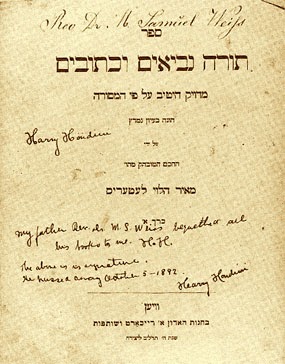
Let's start with the artifact. The photos below were sent to me by musician Tara O'Grady. This Bible, published in 1883 by The American Bible Society, has been in Tara's family since the late 1970s. As you can see by the inscription, it once belonged to Houdini's father, Mayer Samuel Weiss. In 1893, it appears to have became the personal Bible of 19-year-old Ehrich Weiss. He had already adopted the stage name "Houdini", but still used his real name on meaningful things such as this.

This is an incredible find and an important piece of Houdini history, and the story of how it came to be in Tara's family is just as incredible. But first, enjoy these photos of the Ehrich Weiss Bible.


Okay, now the history.

Houdini's brother, Dr. Leopold Weiss, was a successful New York radiologist. For a time he even ran his practice out of Houdini's home in Harlem. Around 1916, Houdini and Leopold had a falling out when Leo married Sadie, the divorced wife of another Weiss brother, Nathan. Speculation is that Houdini conflated the strain of the family scandal with his mother's death (even though his mother had died three years before). Houdini turned against Leo, banishing him from the family cemetery plot and even cutting his head out of family portraits. The brothers never reconciled.

Leopold continued his medical practice in New York City. His nurse was named Marguerite Elliott. And that's where Tara picks up the story:

Mrs. Marguerite Elliott lived across the street from me growing up in New York. She was a nurse and began working for Dr. Leopold Weiss from the moment she graduated nursing school until his retirement in 1949 due to blindness. Leo always showered her with gifts and her husband Robert did not appreciate it. He was quite jealous and he knew the doctor was also a married man. It was obvious Leo was in love with my neighbor. He gave her six plates that he purchased at auction, Myott Staffordshire China, made in England with gold trim. He also gave her his family bible, signed by his father Rev. Dr. M. S. Weisz, and his brother, Ehrich Weiss.

Houdini and Leopold Weiss.
According to Tara, one of the things that Marguerite remembered was that Dr. Weiss did not speak well of his famous brother. Leopold said Houdini "was an embarrassment to the family because he was a magician." Possibly Leo felt entertainment was a lowly profession compared to his own. Or maybe the hard feelings between the brothers went both ways. But it's fascinating to hear what Leo had to say because, until now, we've only heard Houdini's side of the feud.

In 1962, Leopold, elderly and now blind, killed himself by leaping off the roof of his apartment. He left all his belongings to Marguerite Elliott. But Marguerite's husband forbid her to accept, and what might have been left behind by the final Weiss sibling is now long gone. Marguerite's husband died in 1969. Marguerite, who never had children, lived alone.

Tara continues the story...

My parents moved across the street from [Marguerite] in 1970. My mother was a caring Irish immigrant who befriended the old nurse and took care of her when she needed help.
One day, around 1978, my mother was in the basement of Marguerite's house and asked her what the large book on the floor was. It had been sitting on her basement floor for 30 years. It was Houdini's bible, and she gave it to my mother because she had no value for it, and she said perhaps mom could get a "couple of bucks" out of it. She also gave mom the six English plates.

Marguerite Elliott died in 1982. The Weiss family Bible lived on in the home of the O'Grady family, as Tara recalls:

Throughout my childhood, I would occasionally point out the signed bible on my parents' bookshelf to my friends and claimed it was Harry Houdini's. But no one really showed any interest. My parents didn't even show much interest and didn't bother getting it appraised because they didn't know how to go about it. They also didn't know why a Jewish family would own a bible, and since it didn't say Houdini, they thought it wasn’t worth much.
So it sat on their bookshelf for another 30 odd years.
I finally looked into it the other day because I was walking in a Queens cemetery and posted a photo of a tombstone on Facebook. A friend commented asking if Houdini was buried there, and I replied no, but I had his signed bible. The friend asked if I would sell it to him. I said I'd have to research. That's when I realized it was worth a bit more than "a couple of bucks."
Thanks, Mrs. Elliott.

And that brings the story to all of us today. Having explored their options, Tara and her family have decided to sell the Bible privately. So if you are interested in adding this to your collection, EMAIL ME and I will put you in touch with Tara.

My thanks to Tara O'Grady for allowing me to "break the news" of this remarkable Houdini artifact here on my blog. Here's hoping the Houdini Bible will find a good new home.

UPDATE: The Ehrich Weiss Bible is going to Budapest.

Related:

Wednesday, June 22, 2016

Did the Houdinis secretly marry in 1901?

Today is the 122nd wedding anniversary of Harry and Bess Houdini. The couple married on June 22, 1894. Or did they? In recent years, historians have pointed out that there's something fishy about the official story of the Houdinis marriage. While there is no doubt Harry and Bess lived and traveled together from that June day, some have questioned whether they were ever actually legally married at all.

As the story goes, Harry and Bess met in Coney Island where they were both performers, and after knowing each other for only a week, they married. The famous Coney Island boss John Y. McKane performed the civil ceremony. They later repeated their vows in two more ceremonies, one with a Rabbi (for Harry's family) and again with a Roman Catholic Priest (for Bess's family). This led to Bess saying, "I’m the most married person I know, three times and to the same man."

But the late great Houdini historian Manny Weltman found problems with this story. In his book, Houdini: Escape into Legend: The Early Years (1993), Weltman revealed that John Y. McKane could not have married Harry and Bess as he was in Sing Sing prison at the time. There were also plenty of rackets on the Bowery in those days, and it's possible whatever marriage license the young couple purchased (for $2.00 -- Bess paid) might not have been legit. In Houdini His Life Story, Bess admits: "How people went about getting married was a mystery to both of us."

As to the later ceremonies, Weltman (and later William Rauscher) argued that no Rabbi or Catholic priest would have performed a mixed faith marriage in 1894 as it was prohibited by both faiths at that time. Houdini said they were married by Rabbi Tintner of Mt. Zion Temple -- "The man who married me to the woman I have never ceased to love." Trouble is, Rabbi Tintner would have only been 14-years-old in 1894. The Priest who did the Catholic ceremony was said to be Rev. G.S. Loui of Brooklyn. But Weltman could find no priest by the name of Loui (or Louis) in the records of the New York Roman Catholic Archdiocese, nor in the 1894 phone book. To top it all off, no record of the Houdinis marriage certificate has ever been found.

So this is what leads some to question whether Harry and Bess Houdini were ever legally married. Another possibility is that they got legally married later in life in secret ceremony. That's the theory that comes to my mind when I look at the photo below from Houdini His Legend and His Magic by Doug Henning. Is this the smoking gun evidence that has been hiding in plain sight all these years?


This photo comes from Bess Houdini's own scrapbook, and was among several other "anniversary" pictures. (The Houdini's took an anniversary photo every year, in Coney Island if they were in town.) On the photo is written: "Houdini and wife, married 7 years." So at first sight, this appears to be their 7th anniversary photo. But look at what's written at an earlier time in ink that is fading: "1901 Wedding day." That could be just another way of referring to an anniversary. Or it could literally mean their Wedding DAY. It also happens to be the first such photo in the album.

Is it possible this photo was actually taken on their legal Wedding Day in 1901? They are certainly dressed for it. Rabbi Tintner would have been old enough to conduct the ceremony, and the secret of the missing wedding certificate might be a simple as no one has looked for it in the year 1901. It's also possible the marriage took place in Europe, which is where the Houdinis spent much of that year.

Later, when this annotated "wedding day" photo was added to the album, it was re-annotated as an anniversary photo along with the other pictures, as by that time Houdini was establishing his official biography and mythology. Recall that the Houdinis also created a romantic fiction about how they first met.

Anyway, this photo and the "Wedding Day" annotation has always given me pause, so I thought today was a good day to throw it into the stew of speculation about the Houdinis mysterious marriage.

Related:

Tuesday, June 7, 2016

REVIEW: Houdini & Doyle (ep. 6): The Monsters of Nethermoor

Houdini & Doyle episode 6, The Monsters of Nethermoor, provides an unexpected journey for our heroes in what is now the second half of the 10 episode series. Instead of London, the setting is the countryside, and this time the rolls are reversed; Houdini is the believer and Doyle is the skeptic. The crux of the mystery; aliens!


Our first look at Houdini and Doyle in this episode is a clever re-creation the classic Sidney Paget illustration with our heroes in the roles of Holmes and Watson. This is great fun, and I love that it pretty much confirms what has been simmering since episode one -- that Houdini is Doyle's new Sherlock, right down to being an irritant.

Houdini, Doyle and Adelaide arrive in the small town of Nethermoor (shot in Darbyshire) to investigate what's believed to be an alien abduction. But because the couple who experienced the attack are interracial, racism becomes a theme in this episode. Houdini comes to the defense of the black survivor, feeling that Doyle is judging him too quickly because of his race (forget that we've already had several black characters in the series). During the course of the episode, Houdini's own strong feelings about bigotry boil to the surface, and at one point Houdini beats up a man in a bar for his disparaging remarks. (More on this below.)


Eventually, Houdini and Doyle find themselves tied up in a cave. Following the role reversal idea, Doyle is able to free himself while Houdini cannot. This sounds better than it plays out as the ropes don't really appear to be holding him in any way that would defeat The Great Houdini. But it's good for a laugh.

The mystery of Adelaide Stratton continues to deepen, and I have to admit, I'm not loving this. Adelaide is my second favorite character, and I feel she's slipping away from me just as she's slipping away from Houdini and Doyle. I loved her forthrightness and clarity. Now she's a woman with a past and many secrets and that just isn't working as well for me. But I guess we'll see how this develops.

Spoilers
The solution to the mystery is pretty unusual. The abducting creatures are neither monsters nor aliens, but human cave dwellers who have lost all contact with the outside world for generations. I'm not sure this entirely explains their extreme appearance, but it was a nice twist, and Houdini leading them into the light gives Harry a chance to be messianic in a whole new way.

Just the facts

During their meeting with "Mad Martha" (played by veteran actress Janine Duvitski), Houdini reveals his background after she presses him on the matter. At first he says he's from the U.S., but then admits to being born in Budapest and that his family immigrated when he was four. All true. It's also true that Houdini would always claim to be an American (born in Appleton, Wisconsin). "I'm sure you're not a stranger to prejudice," says Martha.

Houdini's heritage comes into play later when he tells Adelaide a story of experiencing anti-Semitism as a boy. It's suggested this is what motivated him to become an escape artist. It's a good story, but it doesn't come from the life of the real Houdini. In fact, if Houdini experienced direct prejudice, this is one aspect of his life that he kept private.

Still, there are indications that Houdini understood full well the world in which he was living. When he ran away from home as a young boy, he concealed his Jewish last name and instead went by White. When in Russian in 1903, Houdini visited the site of a recent Jewish massacre and commented on how Jewish entertainers were "licensed like a dog" when entering the country. Houdini also experienced no shortage of indirect anti-Semitic attacks from Spiritualists. One was Dr. Le Roi Crandon, the husband of Margery, who once stated in a letter to none other than Sir Arthur Conan Doyle, "My deep regret is that this low-minded Jew has any claim on the word American."

The scene in which Houdini gets into a bar fight includes the nice detail of Houdini first inviting the man to hit him in the stomach. (Instead, the man hits him in the face.) Of course, Houdini inviting people to punch him in the stomach is an infamous part of Houdini lore as it was a contributing factor to his death.


Depicting Houdini as a brawler is also accurate. Houdini grew up in hard times and on rough streets, and the world of circus sideshows and early vaudeville were rough and tumble. Houdini apparently had such a bad fight with "Bill the Dog Boy" that he started carrying a gun. There are also scattered stories of scuffles with various rival Handcuff Kings and cab drivers, and the infamous Houdina Co. brawl that landed Harry in legal trouble. He also gave fight scenes in his movies his all, throwing himself headlong into action, even breaking his wrist in The Master Mystery.


Finally, Houdini is shown employing hypnosis in this episode. Houdini was not known to possess any legitimate hypnotic abilities, but in his struggling days, he learned the rudiments of the act from a man named Billy Diamond and performed for a time as a hypnotist under the name "Professor Murat."

Next Monday: Houdini & Doyle find themselves in "Bedlam."

Houdini Star of David image from The Devil's Workshop.

Related:

Translate