Showing posts with label Diving suit. Show all posts

Wednesday, August 3, 2022

The Norfolk kerfuffle

Here's a terrific illustration of Houdini and his fellow performers at the Colonial Theater in Norfolk, Virginia, during the week of March 4, 1912. This engagement is notable in that it featured a standout challenge and a bizarrely ignominious end.


Houdini's upcoming appearance at the 1,100 seat Colonial Theater was heavily promoted. This was his first appearance in Norfolk and a rare appearance for him in Virginia (his last being Richmond in 1900). The Virginian Pilot and the Norfolk Landmark ran a full-page illustrated profile headlined, "Houdini: The Man with the Charmed Life." The manager of the Colonial, H.B. Hearns, even refused an offer of $500 from the Orpheum in Harrisburg to retain Houdini for another week.

Houdini would receive $1,200 plus a percentage of the box office. This was the second highest salary ever paid to a performer at the Colonial (the first being Gus Edwards and his The Song Revue). But Wilmer & Vincent, the company behind the theater, felt the Handcuff King was worth it:

In view of Mr. Houdini's drawing powers, and the excellent support theater-goers of Norfork and vicinity have given the Colonial this season, they are taking a chance and confidently expect this really marvelous man to break every record the house has ever had. And at regular scale of prices.

Houdini did not disappoint when he opened on March 4, playing two shows to standing room only. He featured his Double Fold Death Defying Mystery and also accepted a string of challenge escapes for the week. The Schlitz Brewing Co. challenged him to escape his Milk Can filled with beer. The Norfolk Automobile Trade Association proposed a challenge in which Houdini would be chained within two Goodyear tires and nailed to the stage. He was also challenged to escape from the Norfolk County jail. While the newspapers ran the challenge, I couldn't find any account of the escape itself. In fact, it doesn't appear he did any outdoor stunts to promote his appearance, possibly because a snow storm had arrived that week.

The most notable challenge was saved for last. It was announced from the Colonial stage following Houdini's successful escape from the Goodyear tires. The newspapers described the scene:

Perhaps the most interesting feature of his appearance here was the reading of a challenge received from the committee of the submarine station of the Navy Yard, challenging him to allow himself to be fastened in a regulation navy deep-sea diving suit, and he to escape without injuring the suit. The specifications were so severe as to cause the audience to laugh, and when Houdini excepted the challenge, setting Friday night for the test, there was prolonged cheering.

The day before the challenge Houdini travelled to the Navy station to examine the diving suit. He stated that if he could figure out a way to escape, he would give the secret to the Navy as a way to help seamen who might find themselves trapped. For this Houdini said he would ask nothing in return, "except the credit for the invention."

There was nothing inherently dangerous about the diving suit challenge. But this didn't stop Houdini from playing up the drama. A terrific account of the escape was carried in the next day's paper.

Virginian Pilot and the Norfolk Landmark, March 9, 1912

However, the diving suit escape wasn't the only drama audiences witnessed that night. The seeds of what happened next are hinted at in the above which alludes to some "trouble between Houdini and the manager" that delayed the start of the escape. That trouble only escalated after his performance, as was reported by the Virginian Pilot and the Norfolk Landmark the following day:

As the last act of the bill went on the audience became conscious of a disturbance behind the scenes. Houdini was crying out that he was being cheated and wanted the balance of his salary. Just as the closing act went off and the sheet was dropped for the moving pictures, Houdini rushed out before the footlights clad in a bathrobe.

"I am Houdini–Harry Houdini!" He exclaimed. "I want my money. These people won't give me my salary." With other expressions of a like nature, he rushed about the stage, blocking the pictures. Fearing that a panic would result and that the audience would become excited, the stage manager dragged him behind the scenes by force, Houdini resisting and clinging to every possible foothold and handhold.

The police were called and Houdini was arrested. A large crowd gathered in front of the theater to see the magician taken away in a police car, but he was "quietly taken through a rear entrance and spirited away to the station house." There Houdini was charged with creating a disturbance. Edwards Stevens, a fellow performer at the Colonial (who can also be seen in the top illustration), posted his $50 bail.

On his release Houdini told reporters, "This action was taken merely because the manager of the theater and myself had a misunderstanding. I will admit that I became excited, but who wouldn't cry for $400–even make a bigger fuss than I did?"

This wasn't the first time Houdini had hijacked a stage to protest the actions of a theater manager. In 1910 Houdini took to the stage of the Holburn Empire in London when a manager asked him to not appear at a matinee. Despite the police being called, Houdini won the audience over by insisting they remain in their seats until he was allowed to perform for them as advertised.

Houdini considered staying in Norfolk to fight the case. But he decided to move on to his next engagement in Trenton, vowing in time to "get my desserts." Variety later offered some insight into what led up to the fracas:

Variety, March 16, 1912

In April Houdini filed suit to recover his $400. It's unclear if he ever got his money. But he did make good on his promise to give the secret of his diving suit escape to the U.S. Navy, and received a patent for his invention in 1921. He never returned to Norfolk.

According to the always helpful Cinema Treasures, the Colonial Theater stood at 116 W. Tazewell Street. With the decline of vaudeville in the 1930s it became a full time movie theater. By the 1960s it had fallen into disrepair and was being used to show adult films. It ceased operation sometime in the 1970s and the building was later demolished.

Below is the only image of the Colonial I could find in it's later days. Today a modern development, Harbor Heights, stands on the site of Houdini's first diving suit challenge and his Norfolk kerfuffle.


Want more? You can see and download 19 newspaper clippings that I used as research for this post as a "Scholar" member of my new Patreon. Just click the image below to go:


Thursday, January 27, 2022

Houdini's Frozen in Ice escape of 1911


Our friend Joe Fox, Assistant Librarian at the Magic Castle, recently made an intriguing discovery in the January 25, 1911 issue of The Magical World, a British weekly publication. In a column by editor Max Sterling is following item:

Harry Houdini, of handcuff and other fame, who has been appearing at the Nottingham Empire with huge success, has been confiding with a correspondent of the "Encore" that he "has another big surprise to spring up on the public." He avers that his tank act will be a "pup" to his new show, and I believe him. Clad in a diving suit––the helmet will contain an air enough to last him 10 minutes––he proposes with the aid of a glass box, to allow himself to be frozen solid. The freezing plant will be on the stage in full view of the audience. The squares of glass, brass fitted and jointed, constitute the box, and when the wily one is thoroughly frozen, the entire outfit is placed in his cabinet, and he does the rest by releasing himself, yet leaving the ice intact. How it is going to be done Houdini himself only knows, but he has tried it and accomplished the seeming impossible, I presume there will be no "frost" as far as he is concerned. The above show he proposes springing upon London in five or six weeks' time.

I always believed Frozen in Ice was a concept Houdini was working on near the end of his career. But here it is in 1911! While Houdini never did "spring" this upon London (as far as I know), this is still an exciting find as it offers the first and most detailed description of any frozen in ice escape that I'm aware of.

The use of a diving suit is entirely new. I also can't help but wonder if the glass box, "brass fitted and jointed", is the Water Torture Cell. The debut of the USD was still a year away (the "tank act" referred to here is the Milk Can), but the cell was likely in construction at this time. Could Houdini have been considering a very different use for the cell? Or could this all be a ruse to conceal the actual escape Houdini had in mind?

Houdini's Escapes by Walter Gibson contains a chapter on a "Frozen in a Block if Ice" escape. But that is a very different concept and Gibson offers no history behind it. The version that finally did make it to the stage was performed by Bess in 1927 but, again, a very different concept.

Gibson illustration (left) and Bess version (right).

Thank you Joe!

UPDATE: Joe Notaro of Harry Houdini Circumstantial Evidence has found another description in the January 15, 1911 "The Umpire" that provides a few more performance details:

The performer, having dressed for the part, will take his place in the water in a glass tank, the sides of which fit into brass sides, and the freezing process will be effected in sight of the audience by means of a special plant installed on the stage. When the refrigerator has got in its fine work, the glass slides will be removed, and the block of ice, with Houdini inside, will be placed under the canopy. A few seconds later the performer will reveal himself in kind friends in front, and the iceberg will be shown intact.

Fred Pittella of Houdini and Escapes Museum sends over a detailed look at how Bess's 1927 freezing effect operated. This sounds very similar to the "plant" as described in the 1911 clippings. I'm wondering if it was the same apparatuses?

Science and Invention, September, 1928.

Friday, August 31, 2018

A Master Mystery revelation at UCLA


Two weeks ago, Joe Notaro and I met at the beautiful Powell Library on the UCLA campus. We were there for, what else, Houdini! Now, I've long known that the UCLA Film & Television Archive has a copy of The Master Mystery that is (almost) complete. But for whatever insane reason, I've not made the time to go watch it. Joe has made the time and has done some great work identifying the differences in the various available versions. So if you want to get into the details, check out Joe's blog. What I'm going to do here is share what I saw in general, and explain what a revelation it was!

For starters, August 17, 2018, was the first time I ever saw The Master Mystery. Yes, I have the Bill McIlhany VHS and the Kino DVD (both made from a print in the Raymond Rohauer Archive licensed by the Douris Corporation), and I've watched those many, MANY times. But I now realize what I was watching was not The Master Mystery at all. That is a severely truncated version of the serial that dramatically alters the structure, story, and even the spirit of what was shown to audiences in 1918 and 1919. At least that's true of the first 6 episodes, which is what I'm going to focus on here.

To set the scene, Joe arranged for us a private room with a desk and table inside the UCLA Media Lab, which is a great way to watch and study the movie. Research copies are made available on VHS, which the student staff load into a bank of players that feed the individual stations and rooms. Here you have the ability to fast forward, pause, etc., and we did a lot of that!

I already blogged about the incredible newsreel footage from Houdini's 1913 Success challenge, which is what we watched first. But then it was Master Mystery time.

The movie

Episode One is largely the same as what one sees on Kino, apart from a few additional title cards (which Joe has meticulously documented). Episode One is a pleasure to watch with a nice handcuff escape at the midpoint and rousing action that culminates with an unconscious Houdini (as Quentin Locke) being strapped into a straitjacket. That's where the cliffhanger ending occurs.

Episode 2 picks up with the conclusion of the straitjacket escape, and here's where the UCLA version begins to diverge from the commercially available versions. On Kino, Episode 2 ends with Houdini tied to the coat rack. It's an abrupt cliffhanger and a bit of a letdown as it's the first escape in that episode. But maybe that was the nature of these old serials, right? Get you where you want to be and then..."To Be Continued Next Week." This is what I've always thought, and it turns out I've been dead wrong!

In the UCLA version (the real film), the coat rack escape plays out in full in the middle of the episode. It was never a cliffhanger. In fact, this establishes the structure of what is to follow. There are three major escapes or action sequences per episode, which makes for a very different viewing experience and a heck of a lot of fun! Episode 2 continues all the way to the Bakers Dock sequence and cliffhangs (is that a term? -- it is now!) with a bound Houdini and a thug falling into the water. It was at this point I turned to Joe and said, "This is a completely different movie!" Joe's answer, "Just wait."

The next four episodes--and that's more than an hour worth of movie--are entirely new. (Only a few fragments of the Bakers Dock sequence show up in Kino.) And it's not just new escapes. There are whole plot-lines that makes The Master Mystery work story-wise in a way that it just doesn't on Kino. Again, if you want the scene by scene breakdown, check out Joe's blog. But among the things we see right away are both underwater escapes at Bakers Dock play out in full. Seeing Houdini escaping ropes and chains underwater is a beautiful thing to behold.

The Acid Vat escape, a fragment of which is only available as a extra on Kino, plays out at the end of Episode 3 and is wonderfully suspenseful as it intercuts Marguerite Marsh's Eva approaching the cabin and reaching for the doorknob, which we know will dunk Harry into the acid. So much fun. So too is the sequence in which Houdini is tied inside a rooftop water tank with the spigots turned on full. This is the escape I was most looking forward to seeing on this day, and I was not disappointed. It's spectacular! But, surprisingly, it was not the escape that left the deepest impression.

That happens at the midpoint of Episode 3 when Houdini is locked inside a jail cell. There is a magnificent closeup of Houdini at the bars as he turns his intense gaze to the lock. In another closeup, the faceplate on the lock disappears and we are suddenly able to see inside the mechanism as the gears begin to unlock by some invisible force. It's a wonderfully creative way to show the escape, and there isn't anything like it in any other Houdini movie. It knocked me out.

I should stop here to say that the great Patrick Culliton saw the complete Master Mystery projected many years ago at The Silent Movie Theater in Los Angeles. Not only does he remember the three escapes per episode, but he also always mentions this jail escape. It has remained vivid in his mind for decades. Now I understand why!

Episode 4 is also a stunner, and it has an important connection to Houdini history. At the midpoint of the episode, Locke and Eva travel out on a lake to test a special diving suit. The Automaton and his collection of thugs pursue them in their own boat. (The idea of the Automaton as the leader of the gang is made much clearer in the complete version.) This is all filmed on an actual body of water, and seeing the Automaton on a skiff is wild stuff. But what's most exciting is we get to see Houdini escape from his diving suit underwater, separating it at the waist using the "quick release" mechanism of his real-world patent. Fantastic.

Characters are also introduced and developed in these episodes in important ways. Ruth Stonehouse is far better developed and is clearly featured. So to is Edna Dixon as Deluxe Dora. A great sequence is when Houdini visits Dora's luxury boudoir apartment. Here he rummages through her roll-top desk until a booby trapped box explodes in his face, blowing him back over a chair. It's a stunt Houdini clearly does himself. (It's depicted on the Episode 5 poster.) And speaking of explosions, Episode 5 into 6 features a fantastic ticking bomb sequence. When the bomb goes off, it flattens Houdini under a doorway and blows the Automaton out into the street. Yes, the Automaton is "killed" as part of the story. But when Locke and Eva later sneak into a dark lab to examine his remains, laying Frankenstein-like on a table... "It's alive!"

Episode 7 is where the UCLA version and Kino join back up. The UCLA print is missing Episodes 8 and 10 (which are available on Kino). Episode 11 is missing from Kino, but available in full at UCLA. Episodes 12-15 are the same in both. I should also note there is very little film damage visible in the original UCLA source.

What aren't so pristine are the Media Lab's current viewing copies. Time is taking its toll on these. In fact, while we were watching, the machine started eating the first tape! As you might imagine, Joe and I freaked out. Were we watching Houdini history being devoured before our eyes? The second tape--the one that contains the new Episode 11--would not play at all (so I didn't get to see that episode). Joe had watched this tape in the past, so it appears it has only recently died.

Fortunately, the original 16mm film is safely stored in the UCLA vaults, and the very helpful staff said they would look into having fresh tapes made from the source. Unfortunately, they are not set up to make digital copies, which is what really needs to be done.

So why haven't we seen this version of The Master Mystery on DVD? Why can't we stitch this and the Rohauer/Douris print together and make the complete serial available for all?

I only spoke briefly with the helpful head of the department, Maya Smukler, so I don't have all the facts, but it's clear that UCLA is not able to license this as they can their other material. Why that is will have to be investigated. But let's hope there is some way to get this out there. Because everyone should see and enjoy The Master Mystery the way Houdini made it. The way I saw it on this memorable day at UCLA.

Thanks again to Joe Notaro for finally getting me to UCLA. Also thanks to Maya Smukler, Susan Tenenbaum, and the student volunteers who helped us out.

UPDATEA Master Mystery UCLA update.

Related:

Friday, August 25, 2017

'Waiting for Houdini' at the 2000 Official Seance

The 74th annual Official Houdini Seance was held at the Humphrey Scottish Rite Masonic Center in Milwaukee, Wisconsin on Halloween 2000. The event was recorded and released as part of a documentary, Waiting For Houdini. I recently found it on YouTube (misidentified as the 2001 seance), and it's definitely worth watching.

The seance is fascinating as the medium, Rev. Pamla Ashlay, communicates directly with Houdini for some time (you can be the judge of whether she really made contact). Intercut with the seance are interviews with Sidney Radner and Dr. Morris Young. These are a must watch. Sid shows handcuffs and talks at length about his times with Hardeen, even admitting that he passed on acquiring Houdini's diving suit. Dr. Young tells of meeting Houdini himself in September 1926 when he was only 17. I'm sorry to have never met Dr. Young, who passed away in 2002 at age 93. He seems like a very kind man with genuine love for Houdini, and how I would have loved to have heard more about that meeting!

Below is the full documentary. Production values are a little homespun, but there is gold here. Enjoy.


No word yet on the location for this year's Official Houdini Seance, but I've heard a rumor that it may be in the South.

Related:

Monday, January 9, 2017

LINK: Harry Houdini Was an Ingenious Inventor, He Just Didn't Want Anybody to Know

Check out this excellent article by Jackson Landers about Houdini the inventor. The piece includes some good observations by Teller and a few scatterbrained quotes from yours truly (I need to get better with phone interviews). It also includes some very nice photos from National Air and Space Museum Archives, including the infamous "photo Houdini didn't want you to see."

Click the headline to read at Smithsonian.com.

Thursday, November 10, 2016

Houdini's underwater battle surfaces

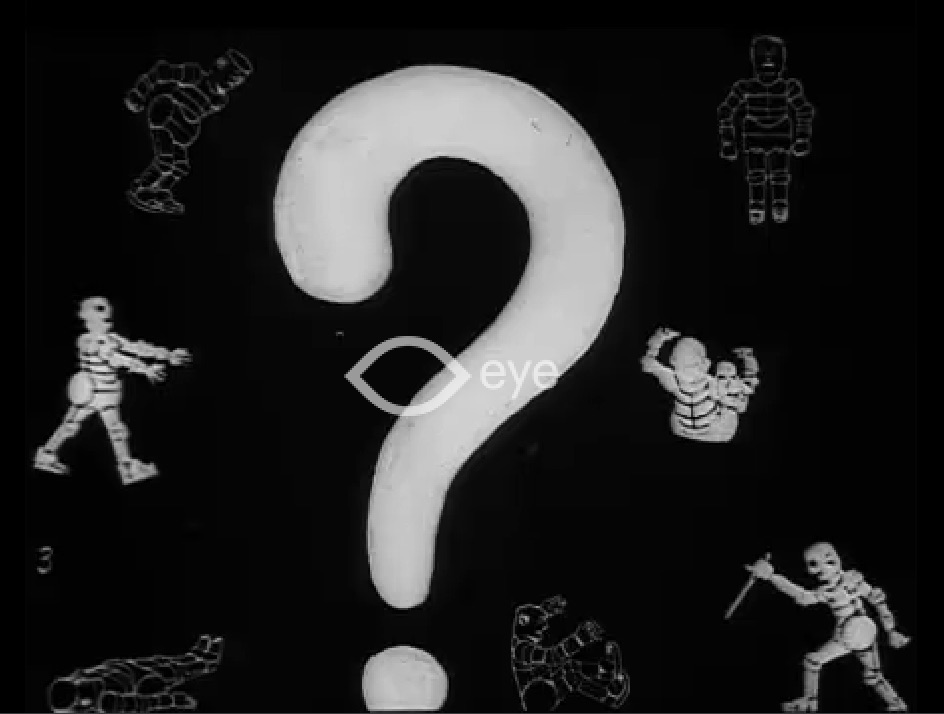
Houdini collector Arthur Moses recently made a terrific discovery via Elif Rongen, Curator of The EYE Filmmuseum in Amsterdam. The screen caps below come from a 9 minute compilation of footage from a Dutch print of The Master Mystery. Among the clips is Houdini underwater in a diving suit fighting with another diver. This footage is missing from the current Kino DVD release of the film, so this is unseen Houdini here!


According to Joe Notaro, who recently made a thorough study of the missing Master Mystery footage, this scene was originally part of Episode Four: "The Test." (Not Episode Five, as claimed in the Kino explanatory cards.)

In the episode, Locke is testing a "self-liberating diving suit" with Eva's assistance. But beneath the waters Locke is ambushed by another diver. "There, under the sea, commenced a battle royal!" The villainous diver draws a knife and severs Locke’s oxygen tube (which is what we see in the Dutch clip). But Locke manages to escape the suit...Houdini style!

Unfortunately, the Dutch clip does not include the escape itself. However, Joe points out that an archival print in the collection of the UCLA Film Archives does include the full sequence. But UCLA does not allow copying or screen captures, so this is best look we'll get until someone embarks on a proper restoration.

There is another layer of interest here. Houdini invented a diving suit with a quick release mechanism for emergencies. It's said he did so "after word came to him that one of his best friends, a diver in Australia, was lost when his air lines were destroyed." Houdini shared his patent with the U.S. Navy, believing it could save lives. Newspapers at the time noted that the scene in The Master Mystery shows "a practical working demonstration" of Houdini's great invention.


Below are some of the unique title cards that appeared in this Dutch print, along with a newspaper advert from the time. Cinema Context records 23 screenings of "Houdini, de boeienkoning" in The Netherlands from August through October 1920.


Recently I learned that The Master Mystery may contain another Houdini icon that could exist in the cut scenes. I'll dig a little deeper and see what I can discover about that one. Stay tuned.

Thanks to Arthur Moses, Elif Rongen and Joe Notaro.

Related:

Monday, December 15, 2014

Houdini books a return to Pawn Stars


An inscribed copy of Houdini's 1908 book The Unmasking of Robert-Houdin made an appearance on Pawn Stars tonight. The book was brought into the store by owner "Kevin" who wanted $5000. After Steve Grad, Principle Authenticator for PSA/DNA, authenticated the signature and estimated the value at $2400, Rick offered the owner $1500. The two men could not make a deal.

The episode was a nice showcase for Houdini. It even featured a Houdini quiz at one of the commercial breaks.


This marks Houdini's third appearance on Pawn Stars. Previous items that found their way into the Las Vegas based store were a pair of Houdini handcuffs and a straitjacket.

Related:

Thursday, July 31, 2014

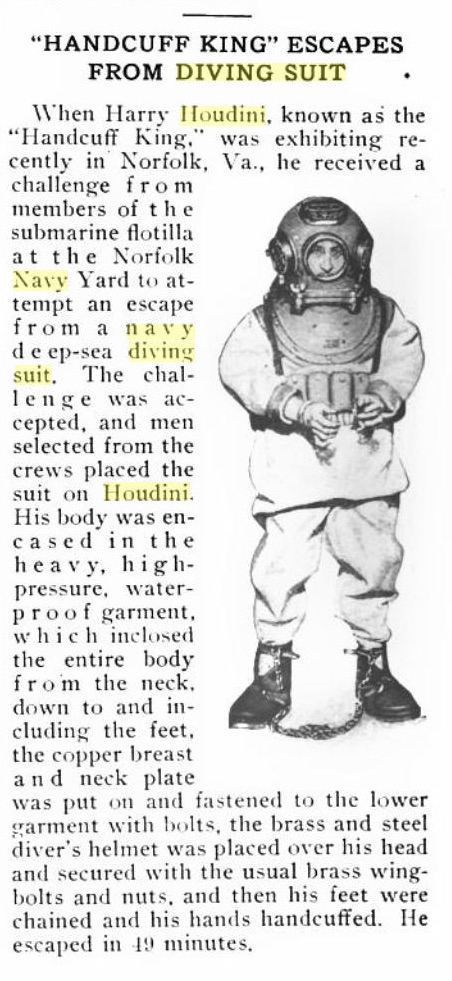
Houdini and the diving suit challenge

In the 1971 BBC documentary The Truth About Houdini, there is a quick shot of Houdini in handcuffs and leg-irons wearing a deep-sea diving suit. It's driven me crazy that I've never seen this photo elsewhere and complete.


But now the great Kevin Connolly has uncovered the full photo in a clipping detailing this challenge escape. So click on over to Houdini Himself and learn the story of Houdini's daring dive (on land)!

UPDATE: Kevin's site is now offline, but he has graciously allowed me to share his clipping here. This is the only account of this challenge that I know of. Enjoy.


It's worth noting that Houdini patented a deep-sea diving suit with an emergency quick release mechanism. No escape from the bends, however.

Thanks Kevin.

UPDATE 2: I can now identify this as being the week of March 4-10, 1912, while Houdini was at the Colonial Theater in Norfolk, VA. However, the exact day of the challenge currently eludes me.

UPDATE 3: The date eludes me no longer! This happened on Friday, March 8, 1912. Newspapers reported that Houdini was "nearly exhausted and his shirt was splotched with blood in several places."

Virginian Pilot and Norfolk Landmark, March 7, 1912

Translate