Showing posts with label Cecil B. DeMille. Show all posts

Monday, June 17, 2024

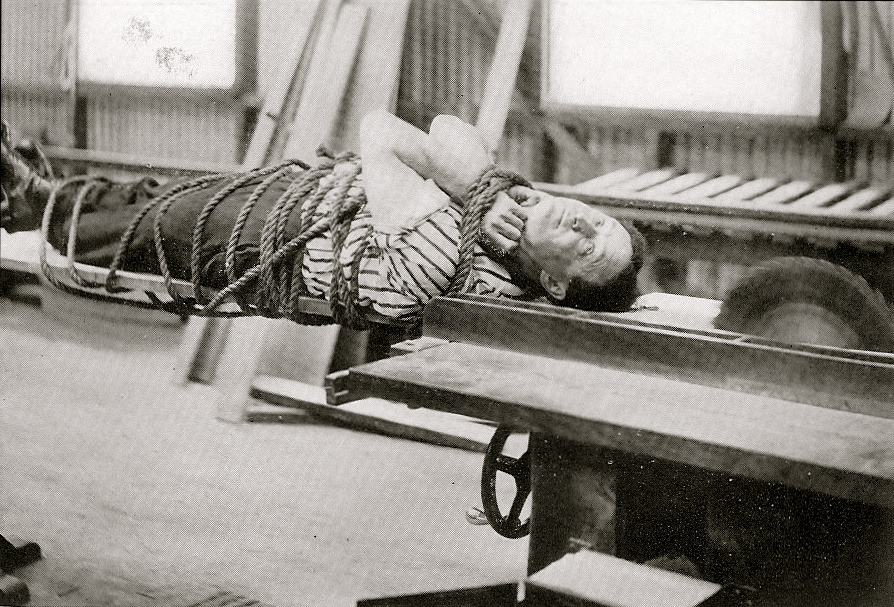
LINK: Houdini monkeys with a buzz saw

The photo below has long been somewhat of a mystery. But now our friend Joe Notaro has discovered an issue of Motion-Play Magazine for May 25, 1919, which describes Houdini's encounter with the buzz saw. Click to read at Harry Houdini Circumstantial Evidence.


This article also answers the question of what "trick" Houdini is showing DeMille in this photo.

Thanks Joe!

Related:

Tuesday, January 30, 2024

Hobnobbing in Hollywood

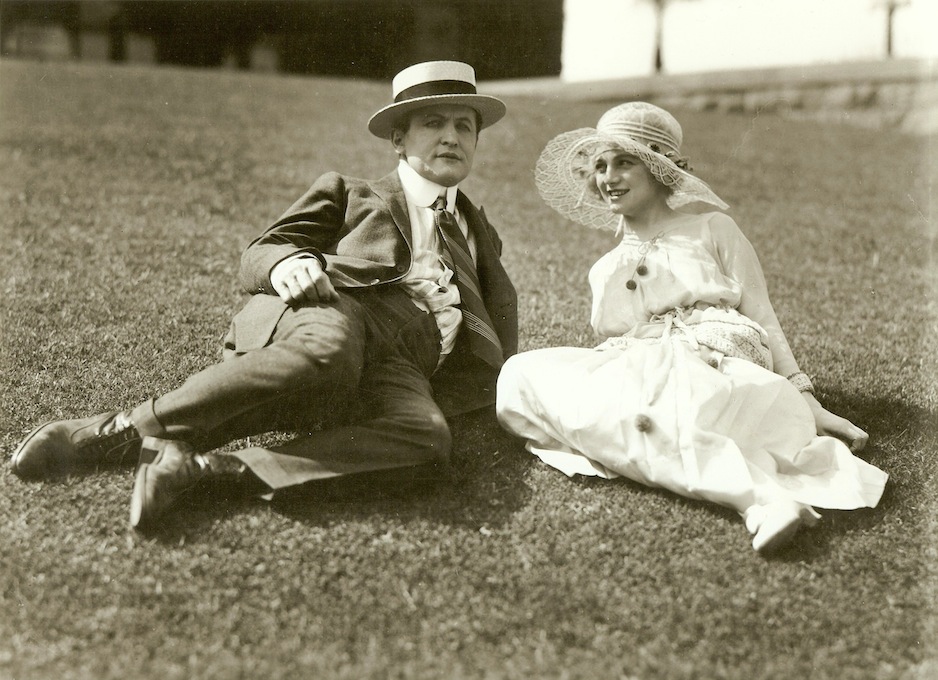
I love finding new shots of Houdini hobnobbing with Hollywood royalty. Here's a photo of him with director Cecil B. DeMille and star Wallace Reid. This would have been taken at the time of his arrival in Hollywood to start work on The Grim Game in 1919.

Picturegoer, Sept. 25, 1920

Here's another DeMille morsel. The photo below is from the documentary The Lost City of Cecil B. Demille and shows the director with the submarine model that appears in Houdini's Terror Island. This raises the question of which came first. The model or the movie?


Below are some more Houdini-DeMille-Reid connections.
 
Related:

Thursday, November 10, 2022

Movie night


I've always wondered what movies Houdini might have seen during his lifetime. He certainly lived during an exciting time in cinema history. Did he ever see The Kid or Phantom of the Opera I wonder? I do know he and Bess were regular movie goers, but apart from his own movies, I've never come across any specific mention of any movie he might have seen. Until now!

Not surprisingly, I found this at the mighty Harry Ransom Center during my visit last summer. The below letter--which can be found in the Houdini-Bess correspondence file--tells the tale and is a delightful letter to boot.

Click to enlarge.

I'm assuming Bess and her mother accepted Harry's playfully formal invitation. The theater they would have traveled to that night was the Geo. M. Cohan Theatre located at 1482 Broadway in Times Square. The photo at the top of this post shows the theater when it was playing The Ten Commandments during its record breaking run in 1924. Houdini had met the movie's famed director, Cecil B. DeMille, in Hollywood in 1919.

New York Daily News, July 6, 1924.

The Geo. M. Cohan Theatre was demolished in 1938 along with the Fitzgerald Building in which it was housed. The New York Theatre opened on the site in 1940. Today the site is occupied by the 4 Times Square skyscraper.

Related:

Wednesday, May 13, 2020

Houdini gets tricky with DeMille

Here's an item that ran in the Los Angeles Times 101 years ago today. It shows Houdini and famed director Cecil B. DeMille at the Famous Players-Lasky studio, where Houdini would soon begin production on The Grim Game. I don't know exactly what trick Houdini is showing DeMille here. But this is a great example of how the studio publicity department made it known that the Handcuff King had arrived in Tinseltown!

Los Angeles Times, May 13, 1919.

Another photo of Houdini and DeMille taken at this same time appears in Houdini His Legend and His Magic by Doug Henning (page 118). Years later, Bess Houdini posed for a photo with the director and his daughter on the Paramount lot. You can see that pic via the top related link below.

Related:

Saturday, March 9, 2019

A gathering at Famous Players-Lasky

Here's a photo of a gathering at the Famous Players-Lasky studio commissary in Hollywood. This comes from the July 5, 1919 Motion Picture News. Can you spot our boy? Extra points if you can spot his Terror Island co-star and director (even though this was taken while Houdini was shooting The Grim Game).

Click to enlarge.

The Famous Players-Lasky studio stood on Vine Street between Selma and Sunset Blvd. Today it's the site of modern development and a 1968 bank building which once housed "The Society of American Magicians Hall of Fame and Magic Museum."

Below are a few more posts that show Houdini at work at the Lasky studio.

Related:

Tuesday, April 7, 2015

What caused The Grim Game plane crash?


Our friend Bill Mullins alerts me to an article in the September 1939 issue of Flying Magazine about Cecil B. DeMille and his aviation interests. It was DeMille's company, Mercury Aviation, that rented the two "Jenny" biplanes used in Houdini's The Grim Game from "DeMille Field No. 1" in Santa Monica.

The article includes an account of the famous accident while filming. What's interesting is it blames Houdini's stunt double, Robert E. Kennedy, for causing the collision. This is the first I've ever heard of blame being placed on anyone for the accident. Here's the excerpt:

Money came in rapidly from airplane rentals to film companies. Harry Houdini made a picture at the DeMille fields, called "The Grim Game." A wing-walker, doubling for Houdini, got down on his ladder and "froze." The pilots jockeyed and jockeyed – and finally locked wings. They started a double flat spin, broke apart. One pilot landed with the wing-walker still clinging to the ladder, with a shattered upper right wing. The other came in with more serious damage, rolled over on its back.
"No one was injured," DeMille recalled. "The pilots jumped from their ships, took out after the frightened wing-walker to vent their wrath, for he was the cause of the accident. They didn't catch him. So far as I know, he's never been back to Hollywood since."

One clarification to the above is that Kennedy was hanging from a rope, not a ladder. Ladders were more typically used by wingwalkers for this kind of stunt. The accident footage is especially clear in the new TCM restoration of the film, but its still hard to tell exactly what happened. A few times the planes come in close, but Kennedy never seems close enough to safely transfer, and at one point he comes dangerously close to the propellers. Perhaps DeMille just wanted to shield his pilots from any blame.

Of course, publicity for The Grim Game claimed it was Houdini himself dangling from the end of the rope and who survived the crash. Houdini never denied it.


Thanks Bill.

UPDATE: You can read more about the happless stuntman Robert E. Kennedy at Joe Notaro's HHCE: How did Kennedy get the plane-changing job? and What happened to Kennedy after the plane incident?

Related:

Monday, October 13, 2014

When Houdini returned to Hollywood


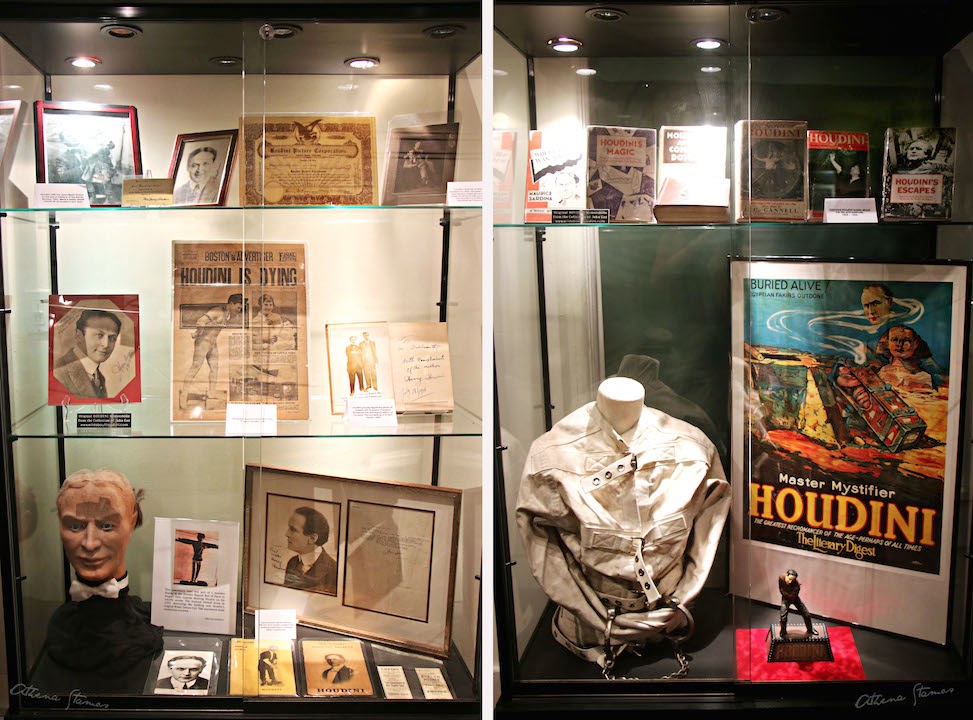
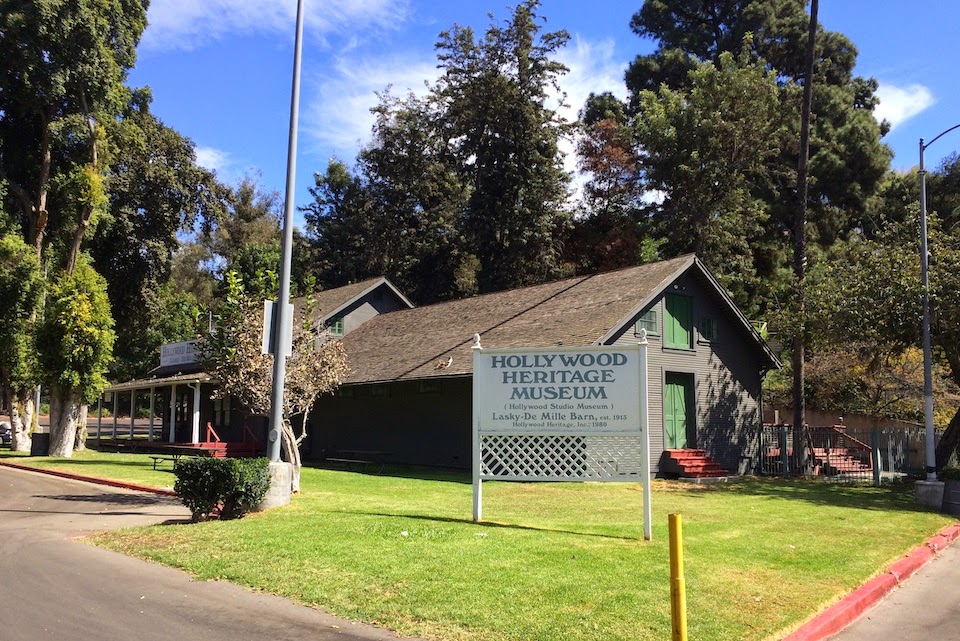
Last Wednesday, October 8, I had the great pleasure of speaking at a special "Houdini in Hollywood" event at the Hollywood Heritage Museum. I'm happy to report that the evening was a resounding success, and I think all who attended had a great time. It was a true celebration of Houdini and his film career, and the museum was a perfect venue for this.

The Hollywood Heritage Museum is housed in the historic Lasky-DeMille Barn, which sits across from the Hollywood Bowl. This was the very first movie studio in Hollywood. It was here in 1913 that Jesse Lasky and Cecil B. DeMille filmed The Squaw Man. For many years the Barn made up the cornerstone of the Famous Players-Lasky studio on Selma and Vine. This was where Houdini made two of his films, The Grim Game and Terror Island, so, yes, Houdini was here!

The museum threw open the entire front room for our use, and we turned it into a Houdini museum. Three display cases were filled with Houdini memorabilia from my own collection along with memorabilia and handcuffs from the collection of Joe Fox. (The items will remain on the display until October 18.) On the night of the big event, Mark Willoughby provided what I called "the star of the show": an original lobby painting for The Man From Beyond owned by Houdini himself. This is one of only four paintings made for the Houdini film and it has never been displayed before. A stunner!

Original The Man From Beyond lobby painting.

The event sold out at the door and we had standing room only when I took to the podium at 7:30pm. I was excited to see some major magic luminaries in attendance, such as Mike Caveney, Rob Zabrecky, Mark Cannon, Patrick Culliton, and Flim Flam playwright Gene Franklin Smith. I was also happy to see so many friends and family in attendance. (I tried not to think that if I bombed, I would be doing so in front of many people who are very important to me.)

Rob Zabrecky, Mike Caveney, and Patrick Culliton.

I am happy to say my talk went extremely well. The Keynote presentation I had been building for the past month played to perfection (the movie clips had frozen up in my last practice run, so I was biting my nails). My talk, which lasted an hour, followed Houdini's life and career with an emphasis on his involvement in cinema. Despite the fact that the air-conditioning wasn't working, I felt I had the audience with me the entire time. They applauded each film clip as if it where a Houdini performance, and they even applauded some moments in the talk itself. There were also some nice laughs, including a tremendous laugh when I shared Jesse Lasky's assessment of Houdini's acting: "He did his best acting handcuffed and locked in a trunk at the bottom of a river." I have to thank James Hamilton for providing me with this great quotation.

I made a few mistakes that I can remedy here. I said "Lilly" Lee when it should have been Lila Lee. How Green Was My Valley was made in 1941, not '59 (see, I should never go off the topic of Houdini). Also, I think I gave the impression that Nita Naldi was absent from the surviving prints of The Man From Beyond. Not so. I was making the point that any scenes she might have had with Houdini are no longer present.


I had time for a few questions before introducing Jim Steinmeyer. Jim is a living legend who has designed and built magic apparatus for every great modern magician starting with Doug Henning and David Copperfield. Jim is also a best-selling author of several excellent books on magic, including Hiding The Elephant, which I consider one of the very best books ever written on the art. Jim took the podium and spoke briefly about how Houdini tied into his books, The Glorious Deception, The Last Greatest Magician in the World and Hiding the Elephant. Jim had copies to sign and sell during intermission. I have to say, it was a real honor to be sharing the stage with a giant like Jim Steinmeyer.

With Hollywood Heritage President Bryan Cooper and Jim Steinmeyer.

We then held our raffle, which was chaotic and fun. We gave away passes to The Autry National Center; a signed copy of The Glorious Deception (the rare hardcover); a DVD of the Houdini miniseries which Lionsgate had donated for the evening (a friend won this); and a pass for 4 to the The Magic Castle with dinner included. This last prize came from Jim Steinmeyer who sits on the AMA board, and was a real treat for the happy winner.

We then had intermission in which people gathered and enjoyed our Houdini museum. Food and refreshments where provided by Grub on a table nicely themed to Halloween. Interestingly, one of the displays case lights had failed to work during our preparations, and we had given up on it. I was surprised to see that the lights were now all mysteriously blazing away. Are you here, Harry?


We then settled back in the main room for a screening of Terror Island. Hollywood Heritage had selected this particular film because of the connection to Jesse Lasky and the Barn, but I think it was the best choice regardless. Most venues screen The Man From Beyond because it is the most complete Houdini film. But I think Terror Island plays much better for a modern audience. The movie played especially well to this audience of silent movie enthusiasts, who laughed and applauded several sequences. Of course, I really wish we could have shown The Grim Game. Maybe in the future.

This was the debut of my "Houdini in Hollywood" talk and I'm really happy that it went so well. I had to cut it down to fit the full Hollywood Heritage program, but I think an audience would enjoy a slightly longer talk with more clips. I'm now looking to present an extend version of this talk, and I'm currently eyeballing locations. Stay tuned.

I want to thank all the amazing staff at Hollywood Heritage, especially Richard Adkins, Bryan Cooper, and George Kiel. This organization is devoted to the preservation of Hollywood history, from film and photos archives to historic buildings and landmarks. It's a non-profit and a true labor of love for all who work very hard.

Also thanks to Ben Roman at the Magic Castle for arranging a discount to the event for AMA members. Thanks again to Mark Willoughby and Joe Fox for making our display extra special. And a big thanks to the multi-talented Athena Stamos for being my official photographer and taking all these awesome photos you see here.

It was a glorious return to Hollywood for Harry.

Houdini was here.

Related:

Friday, March 28, 2014

Haunting Houdini in Los Angeles

The Haunted Houdini Tour poster and booklet.

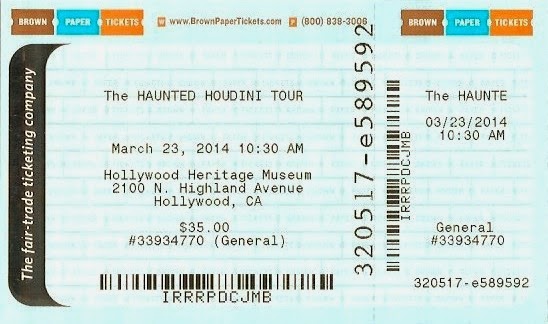
On Sunday, March 23, I had the great pleasure of taking "The Haunted Houdini Tour" of Los Angeles. This was a co-production of GOULA and LA Hauntings and was conducted by renowned ghost hunter, Richard Carradine. I was expecting to have a good time with my fellow Houdini buffs, but I frankly didn't expect to learn anything that I didn't already know about Houdini and L.A. Well, I'm happy to report that Richard knew his topic and this tour did provide me with a few revelatory moments. So let's hit the road!

I elected to take the 10:30am tour, which was the first of three tours planned for the day. Joining me were fellow Houdini nuts: Joe Fox, Joe Notaro (HHCE), Mark Willoughby, and my father, Ronald Cox (not a "nut", but integral in the formation of my Houdini mania). We gathered and met tour guide Richard Carradine in front of the historic Hollywood Heritage Museum across from the Hollywood Bowl in, you guessed it, Hollywood! This was actually our first Houdini location. The 101-year-old barn that houses Hollywood Heritage was once part of the Famous Players-Lasky Studio where Houdini made The Grim Game and Terror Island. Yes, Houdini walked through these doors.

Richard Carradine, Joe Notaro, Mark Willoughby, John Cox, and Joe Fox.

Twelve of us loaded into a black van, and the first surprise was that Richard handed out a special 30-page tour booklet he had prepared with photos and news-clippings related to Houdini and Los Angeles (collector alert!). Some of the clippings were new to me, including one with a photo of Houdini and director Cecil B. DeMille that I've never seen before. There was also a clipping that made my jaw drop as it solved a recent mystery discussed here on WILD ABOUT HARRY...but let's save that for when we get there.

We left the museum and plunged into Hollywood for our first location at the corner of Selma and Vine. This is where the Famous Players-Lasky Studio once stood. As I said, this is where Houdini made his two Hollywood features, The Grim Game and Terror Island, and where the Hollywood Heritage barn originally stood. For years it was a parking lot. On this day it was being cleared for construction. At the far corner of the studio on Sunset and Vine stands a bank which also has a Houdini connection. It was here in the basement that the S.A.M. Houdini collection was housed (trapped actually) for many years. Richard pointed out that the ghost of Fatty Arbuckle is also said to haunt this stretch of Sunset Blvd.

Famous Players-Lasky Studio in Houdini's time (Hollywood Heritage).

After pulling a Houdini escape from traffic on Sunset Blvd, we continued up into Laurel Canyon and stopped in front of the fabled Houdini Estate. Richard nicely laid out the history and mystery of the property (and its related ghost stories -- this was a "haunted" tour after all). He also offered up his own theory on why the property is confused with Houdini and suggested an alternate location for where the great magician might have stayed. I admit, I found his ideas on this pretty intriguing, and it could shake up my own thinking on this. It's a little too much to go into now, but maybe I can talk Richard into writing a guest blog for us at some point.

After the house, we set out on a long trek downtown, passing the cemetery that holds Harry Kellar on the way. Richard kept the journey lively and always interesting with a steady commentary that took us from Houdini's movie career into the realm of the spirits!

Arriving in downtown, I was very excited when we rolled up to the "First Spiritualist Church of Los Angeles." This is a famous L.A. Houdini location that I've somehow never found time to visit myself. It was in this church that Houdini, under his own test conditions, took a photo that produced a strange streak of light that he couldn't explain. It's come down as the only spirit-related phenomena that stumped Houdini.

Amazingly, the church, which was founded in 1911 and expanded in 1921, is largely unchanged, at least on the outside. Here we disembarked from our van and took some photos, and I was able to take a quick peek inside. The interior has seen renovation and there was a service being held on this Sunday morning (no, not a seance, it's now a Christian church), so there was no way to recreate the photo of Houdini at the alter (reproduced in the tour booklet). The church is not in the best of condition, so how long this important Houdini location will remain unchanged is questionable. But what a treat to see!


From the Church it was a short hop to the next location, and here's where Richard solved a Houdini mystery for us. We rolled up to the historic Los Angeles Examiner Building, where Houdini once performed a suspended straitjacket escape. I blogged about this back in November, but could not identify exactly when this escape took place. Well, the clipping in the booklet that made my jaw drop before we left Hollywood was an article from the Examiner which dates the escape as April 5, 1923. This was at the same time as the First Spiritualist Church photo and Houdini's Spiritualist lecture. A busy time for Houdini in Los Angeles!

The clipping also included a photo of Houdini being strapped into the jacket, and I was surprised to see that it was the photo used on a recent episode of Pawn Stars to authenticate a Houdini straitjacket (which sold in auction in 2011). So not only do we now know the date of this escape, but we know which straitjacket he used that day. It's wild that in just a few months we've gone from never even knowing that this escape happened, to now knowing more about this than probably any other single suspended straitjacket escape.


Another interesting detail in the clipping (which, unfortunately, does not include the full text) is that the cameraman who took the photos of the escape that day from the 3rd floor of the Los Angeles Railway Building across the street, dropped his camera to the street and almost fell himself. The camera was destroyed, but the pictures of Houdini mysteriously survived. Is that a ghost story? Maybe.

From the Examiner Building we proceeded down Broadway and turned up Hill. Here Richard pointed out the location of the long-gone Hillstreet Theater. This is where Houdini gave his first ever lecture on Spiritualism. This was a point of pride for me as this is not something covered in most books, and I suspect Richard learned about this from WILD ABOUT HARRY.

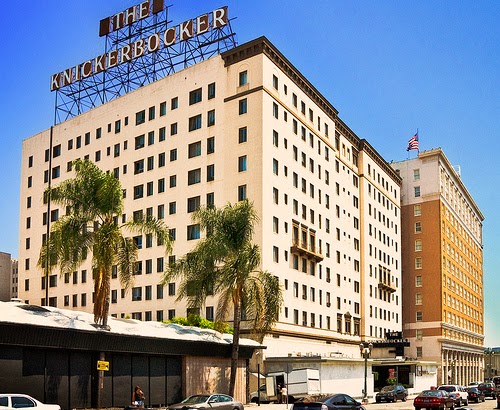
We then jumped on the freeway and headed back into Hollywood -- completing a nice circular route -- and drove past the Knickerbocker Hotel. It was here on the rooftop that Bess and Edward Saint held the Final Houdini Seance in 1936. This is probably one of then most famous Houdini Hollywood locations and, as with these other sites, is still largely unchanged (although it's now private senior housing).


We continued down Hollywood Blvd. and made a right turn at Houdini's star on the Walk of Fame. The final location Richard pointed out was, appropriately enough, The Magic Castle.

Arriving back at Hollywood Heritage, we were able to buy copies of "The Haunted Houdini Tour" poster signed by artist Jose Cabrera. Our ticket also gave us admission to the museum, which contains the original office of Cecil B. DeMille and some wonderful silent movie memorabilia and equipment. It was a little late to catch the last brunch seating at the Magic Castle, so we instead headed to Du-par's in Studio City where my father treated us all to a lunch that included even more Houdini talk. Thanks again, dad!

At the start of the tour, Richard said he and the organizers worried whether anyone would be interested in a Houdini-themed tour. Well, the three sold out tours that day certainly put that fear to rest. Here's hoping GOULA, LA Hauntings, and Richard Carradine might treat us to another ghostly Houdini event in the future.


Related:
Sunday, February 5, 2012

Houdini's leading ladies: Lila Lee

Continuing our look back the leading ladies who shared the bill with Houdini in his silent movies, today we meet the lovely Lila Lee, who was born Augusta Wilhelmena Fredericka Appel in Union Hill, New Jersey, on July 25, 1901.

At age 18 Lee landed the part of Beverly West in Houdini's second feature for Famous Players-Lasky, Terror Island (1920). Lee is the most physical of all of Houdini's leading ladies, finding herself in the middle of much of the action. Her leap through a barn door on her horse is as impressive as Houdini's own spectacular stunts in the film (and it appears it's really Lee who did the stunt). She even appears alongside Houdini in a rare three sheet poster (below).

Here is Lila Lee's biography on Fandango:

A pretty, apple-cheeked WAMPAS Baby Star of 1922, Lila Lee had been a performer since childhood and was widely known as "Cuddles," one of the stars of Gus Edwards' kiddie troupe. She was brought to Hollywood by Paramount's Jesse Lasky and headlined in her very first film, The Cruise of the Make Believe (1918). In typical silent screen style, she played a poor girl secretly supported by a rich admirer and the New York Times thought she had a "limitless future before her."

After appearing as the servant wench in Cecil B. DeMille's Male and Female (1919), Paramount began to see the newcomer as a potential successor to that popular film's star, the elegant Gloria Swanson, and embarked on a hefty publicity campaign. Lee's detractors, however, were quick to point out that her work never really lived up to the ballyhoo. "She seemed permanently neutral," as one critic pointed out. Her co-starring turn opposite Rudolph Valentino in the immensely popular bull-fight melodrama Blood and Sand (1922) was still far from persuasive but her jet-black hair, severely braided in coils over each ear, created a trend and the fan mail kept pouring in. Her tumultuous marriage to matinee-idol James Kirkwood, very much an "A Star Is Born" affair, created additional headlines that lasted until their divorce in 1931.

Lila Lee's up-and-down screen career was bedeviled by severe bouts with what was euphemistically referred to as tuberculosis but whispered to be the results of acute alcoholism. As Lon Chaney's leading lady in The Unholy Three (1930), she was positioned to become one of the new sound era's first major stars but a series of bad judgments and, again, highly publicized bouts with illness, led to supporting roles in Grade-B films. In 1936, she was a witness to the suicide of playboy Reid Russell and the resulting headlines reportedly made her camera shy. There were several aborted stage comebacks in the 1940s, a short-lived marriage or two, and appearances on early television soap operas in the 1950s. Her son with Kirkwood, James Kirkwood Jr., became a noted author and playwright but Lee did not live to see his crowning glory, the legendary Broadway musical A Chorus Line. Retiring from performing after playing country singer Margie Bowes' hayseed mother in the Florida-lensed Cottonpickin' Chickenpickers (1967), the veteran star died of a stroke at Saranac Lake, NY, in November of 1973. ~ Hans J. Wollstein, Rovi

Lila Lee is one of only two Houdini leading ladies to have a star on the Hollywood Walk of Fame at 1716 Vine Street, very near the original location of the Famous Players-Lasky Studio where she worked with the Great Houdini.


More Houdini leading ladies:

Saturday, February 4, 2012

Houdini's leading ladies: Ann Forrest

Today I'm launching a series of blog posts featuring a look back at the leading ladies who shared the bill with Houdini in his silents movies. I thought I'd start off with Ann Forrest, who was born Anna Kromann on April 14, 1895 in Sønderho, Denmark. At age 24 Ann landed the plum role of aspiring reporter Mary Cameron in The Grim Game, Houdini's first feature film for Famous Players-Lasky.

Here is Ann Forrest's biography on Fandango (a terrific resource for bios of silent stars):

Danish-born silent screen actress Ann Forrest began her film career in 1915 performing diving stunts for the American "Flying-A" company under her real name, Ann Kroman. She became a star three years later opposite William Farnum in the first screen version of Zane Grey's The Rainbow Trail (1918), a major success for Fox, who would film the story twice more. It was Farnum who on the film's Grand Canyon location grandly rechristened the Danish actress as Ann Forrest; Kroman, according to Farnum, was too foreign for an American star. The brawny actor picked Forrest because, he explained, the name "signified something big, yet short and snappy." 
The newly christened Ann Forrest was Harry Houdini's beleaguered leading lady in the action melodrama The Grim Game (1919) and earned rave reviews for playing a pathetic kitchen maid in The Prince Chap (1920). Blonde and "cute" rather than beautiful, Forrest made a strong impression on director Cecil B. DeMille who signed her to a five-year personal contract. Not exactly the type to loll about on a tiger skin like DeMille's usual coterie of leading ladies, Forrest never actually appeared in a DeMille film but was instead shipped overseas for Love's Boomerang (1922) in which she earned above-title star billing. Filmed in both England and France, the melodrama was a major success but her return to Hollywood proved anticlimactic and she left films in 1926 in favor of the legitimate stage. 
In 1930, along with her director and leading man, Forrest was arrested and charged with "indecent exposure" during rehearsals for the then-controversial play Frankie and Johnny. That incident, along with a severe car accident, curtailed Ann Forrest's stage career and she retired completely from show business in 1931. ~ Hans J. Wollstein, Rovi

According to her Wikipedia entry, Ann Forrest died on October 25, 1985 in San Diego, CA. That would have put her at age 90. Of all of Houdini's leading ladies, Ann enjoyed the longest life. It's a shame she was never interviewed (as far as I know) about her recollections of working with the Great Houdini.

Houdini and Ann in a publicity pic for The Grim Game.

More Houdini leading ladies:

Saturday, January 21, 2012

Finding the grave of Edward Saint

Embolden by our success at finding the grave of Jacob Hyman, my fellow Houdini buffs and I recently went in search of the final resting place of Charles David Myers aka Professor Sesrad aka Sir Edward St. Ra-Diem aka Dr. Edward Saint. Saint was the business manager, companion, and some claim secret husband of Bess Houdini in her later years. Saint tirelessly promoted Houdini's name and legacy and was the driving force behind the Final Houdini Seance. He died in 1942.

The location of Saint's grave has long been somewhat of a mystery. But then Joe Fox discovered that he was buried under his real name, Charles David Myers, in Hollywood Forever, a famous old cemetery in the heart of Hollywood which holds Valentino, Cecile B. DeMille, Douglas Fairbanks Sr. & Jr, and many other stars from the early days of Hollywood.

So on Sunday, January 15, 2012, we set out to find the long forgotten grave of Edward Saint. Instead of telling the whole story in words, I'll let this 7 minute video (from the new WILD ABOUT HARRY YouTube Channel) tell the tale instead. As you'll see, Saint turned out to be as tricky in death as he was in life.


Thanks to Lisa Cousins, Joe Fox, Patrick Culliton and Mark Willoughby for letting me film and share our adventure. This video-blog post was somewhat of an experiment, so let me know what you thought of it in the comments below.

Sunday, December 12, 2010

Bessie visits Paramount (and so do I)

This wonderful photo, recently sold by Stephen Sparks (GranHoudini.net), shows Bess Houdini with director Cecile B. DeMille and his daughter Katherine in the 1930s. The photo is captioned: "OLD FRIENDS---Mrs. Harry Houdini calls at Paramount studios to invite her old friend, C.B. DeMille, and his daughter, Katherine, to the annual convention of the Pacific Coast Society of Magicians, which opens on July 25th at the Hollywood Knickerbocker hotel."

I was at Paramount on Friday and decided to go in search of the spot where this photo was taken. My working theory was that it was taken in an area behind the original administration building called Production Park. I've seen many photos of visiting celebrities and dignitaries in Production Park, and it's one of the few areas where you'll find grass on the Paramount lot.

However, as I stood there, I couldn't really find a set of windows that matched the spacing of those in the background of the photo. Orbiting the area, I discovered it's far more likely this photo was taken in front of the administration building, probably near the south/west corner where the spacing of the windows looked most correct (adjacent to what is now the DeMille Building, which may or may not be coincidence).

In the 1930s this was technically outside the studio. Until 1990, a public street (Marathon) ran along the front of the administration building and up to the Bronsan Gate. It can been seen clearly in this vintage postcard. 


When Paramount sold Western Costume and demolished the building for its new theater, it enclosed the area. The street is now a pedestrian walkway and a parking lot now extends the studio to Melrose Ave.

It makes sense that this photo op would be done here instead of on the actual lot. The front of the studio was probably the most photogenic area in the 1930s when Paramount was a bustling, busy factory behind those famous gates (and still is).

Here's a modern map of the studio with a red asterisk where I believe the photo was taken.

Click to enlarge.

Was a Houdini here?

For those who wonder whether Bessie might have been feeling the ghosts from Houdini's own film work on this day, know that when Houdini made his two Paramount features, the studio was located at the corner of Vine and Selma. They wouldn't move here until 1926.

Translate