Last week I had the pleasure of interviewing Rick Schmidlin who produced the TCM restoration of Houdini's The Grim Game. I posted my Q&A with Rick in two installments: Finding The Grim Game and Saving The Grim Game.
Today I have a BONUS excerpt in which Rick and I discuss the mystery of the original 35mm nitrate print. This was said to be the last surviving print of The Grim Game, and it was disposed of in 1959 when Larry had the film transferred to 16mm safety film. But where did he get it?
WAH: Did Larry tell you how he got the original nitrate print?
RICK: He said he got it from Bess. I don't... Where would Bess have been in 1943?
WAH: Dead. Well, she died in early 1943, she was in Hollywood before that.
RICK: Exactly. So I don't think he got anything from Bess. He kept on saying that he got it from Bess. But Larry was just a kid, he wasn't even in the army in 1943. He definitely wasn't in Hollywood and he definitely didn't go to Hollywood to get this stuff.
WAH: Right.
RICK: Now, my guess is this. And this is just educated. Houdini had the
lab in New Jersey. And when
The Grim Game and his other film projects came they went to the lab. Basically it was like, "I've done the projects, and, by the way, guys, can you give me a print, I want to keep it for myself." Because he was an archivist, he saved his books, he saved his scrapbooks, he's gonna save his films. He was interested in films and he had the facility to keep it. Now when the lab closed...what year was that?
WAH: It's unclear when he closed to lab, but it was by mid '20s.
RICK: 1922, wasn't it?
WAH: Well, Haldane of the Secret Service was released in 1923, so I've always thought the lab closed down around that time. It took a while for Houdini to unravel his movie businesses.
RICK: Right, so the lab closes down, and the film elements of his negatives go to...probably Hardeen's Estate?
WAH: Hardeen ran the film lab, so, yes, he might have taken possession of a lot of that stuff.
RICK: That's what I'm thinking. So he took the films. Now if you look at what was said on the Kino, and you look at the history of the film, which makes perfect sense, around 1947 all this nitrate film is sitting in New York, and they have their house inspected. And they have a young Larry Weeks who's been in
This Is The Army trying to buy everything he can. He may have bought a bookshelf [Larry had a Houdini bookshelf in his apartment], he may have gotten a scrapbook, he had a little money. Remember, he had been in an Irvin Berlin play on Broadway.
WAH: Now when you say this, you mean he's at Hardeen's home, correct?
RICK: Yes, that's what happened.
WAH: And Hardeen died in 1945, so Elsie Hardeen was unloading stuff.
RICK: Right. Again, this is where the detective works comes in, and where we think logical.
 |
| Film reels showing nitrate decomposition. |
So the film is sitting in New York, and the insurance man comes in to inspect the house, knowing nitrate in this day...people are watching it. I know many people who in the 1940s had to throw away many great nitrate films because, you know, they could explode an entire city block. So they have to get rid of them. And they were probably told they had to bring them somewhere that would have cost them money. So they call this kid who been pestering them for anything he can get on Houdini, and ask if he wants them. And he was up there like a flash. So Larry in 1947 obtains the films. That's my hypothesis. But if you think about it -- lab, Hardeen, the location...that's why I say "Houdini heirs" in the beginning. Does that make sense to you?
WAH: It makes sense to me. When Bessie sold 278, much of her stuff went with her to her sister's house -- the Hinsons. A lot of it remained with them when she went to Hollywood. The Hinsons did have a great many Houdini movies, and they were visited by the insurance man. That's where that story comes from. Marie Blood tells it. So when Larry said he got his stuff from "Bess", I always felt what he was saying was that he got it from the Hinsons. But the Hinsons say they threw out all their films after the visit from the insurance man and that Larry did not get The Grim Game from them. They are clear on that to this day. So, like you, I think Larry could only have gotten it from Elsie Hardeen, especially at that time. I heard that's what happened. And then he later acquired some things from the Hinsons because I do know that he visited them in 1956. And eventually it just all sort of melded together. That's why there's a confusion of when and where he got what. It all just became one collection of artifacts from the "Houdini family."
RICK: Right.
***
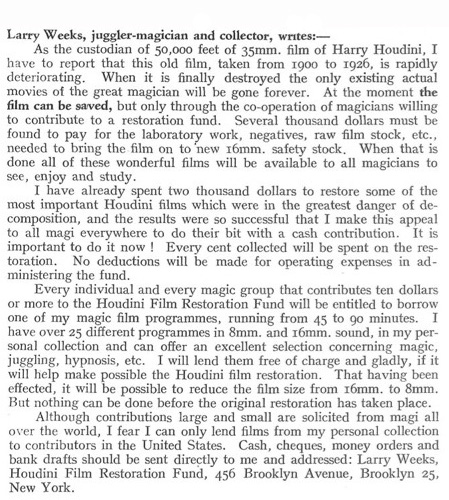
As a postscript, in 1958 Larry Weeks formed the "Houdini Film Restoration Fund." Larry knew that his nitrate prints were in danger of decay (recall that Rick said
The Grim Game probably only had six months left). Check out this item written by Larry himself in a 1960 issue of
Abacradabra:
Reading this 55 years later, one thing becomes clear. A lot of people were involved in this effort to find and restore
The Grim Game, and a lot of people deserve credit. But the person who truly saved
The Grim Game, the person who is most responsible for us now being able to see and enjoy Houdini's best film, is the late Larry Weeks, "Houdini's Biggest Fan."
Related: