Showing posts with label Ehrich Weiss. Show all posts

Wednesday, June 12, 2019

"Your loving son Ehrichovitz" (updated)

Ruth Brandon's 1993 biography, The Life and Many Deaths of Harry Houdini, is not a book I reference often. Silverman and Christopher are my usual go-to sources. But maybe this is a mistake. Because recently while thumbing through the Brandon book, I spotted something I don't believe has appeared in any other biography. And it's quite a significant piece of early Houdini history!

On page 20-21 (of the U.S. hardcover), Brandon quotes an undated letter written by Ehrich Weiss to his mother when he was "ten or eleven." This is not the well-known "dear Ma" postcard. This is something else entirely, and would be only the second known letter between Houdini and his mother (Houdini was buried with all their correspondence).

I was excited to see Brandon sourced the letter to the Harry Ransom Center at the University of Texas at Austin. So I reached out to our good friend Eric Colleary, who was kind enough to provide an image of the letter for me to share here on WILD ABOUT HARRY. Drink it in!

darling mother at last time time has arrived when I am allowed to write you a few lines how slowly the time passess but still my term will soon be over and we shall be united in happiness again. your loving son Ehrichovitz.

Okay, let's unpack this one!

As this letter is undated, I first wanted to satisfy myself that it was actually written by the young Houdini and not as an adult. The fact that he signs it "Ehrich" doesn't really tell us much as it's likely he signed all letters to his mother with his real name. The handwriting is the key, and it does nicely match the familiar "Dear Ma" postcard (see below). He's writing more slowly and carefully on this one, but it still shows the uncertain and cautious penmanship of a young person. (Brandon calls it "scrawled", which it certainly is not.) Houdini's handwriting because worse with age, so this does appear to be written by the young Ehrich Weiss.


But the real intriguing thing here is his use of the word "term." On the face of it, "term" would imply a school of some kind. This is why Brandon quotes the letter, concluding, "at some point there seems to have been an interval of enforced study."

But there's precious little known about Ehrich Weiss's eduction. There's a photo (in the collection of Dr. Bruce Averbook) of Ehrich and classmates in front of an Appleton schoolhouse. Manny Weltman in Houdini: Escape into Legend says he and his brothers where enrolled at the Humbolt Avenue School in Milwaukee ("but they were always playing hooky, preferring to roam the streets, get acquainted with the kids, and join the gang"). It's also said he would study at various pop-up schools run by his father. But this letter suggests a boarding school of some kind, distant and removed from his family and mother. So none of his known schooling seems to fit this.

It's maybe worth reconsidering the word "term." Should we automatically assume a school? His reference to being "allowed to write" suggests strictness in whatever institution he is writing from. Would a school discourage letter writing?

Is it possible the young Ehrich Weiss did a stint in a reformatory? The adult Houdini did reminisce about stealing eggs from stores in Milwaukee, and he was a lifelong brawler. So maybe at some point he got himself into enough trouble to receive some institutional punishment? Of course, this would never make it into his official biography, whereas you'd think a boarding school education would as Houdini was always eager to showcase his intellect.

The last thing is the signature, Ehrichovitz. The addition of "ovitz" is curious, but it's likely just an affectionate or playful sign off. He'd sometimes sign love letters to Bess, "Houdinisky."

But this letter reveals one thing I think we can all agree on. This boy loved his mama!

Thanks to Eric Colleary for sharing this remarkable artifact. The Houdini Collections are open to the public and available to search via finding aids at the Ransom Center website.

UPDATE: Our friend and crack librarian at the Magic Castle, Joe Fox, has solved the mystery. And it looks like I have serious egg on my face. This letter is a fabrication created by Houdini to illustrate an article about code breaking in the April 1908 issue of his Conjures Monthly Magazine. See below:


Guess this is why it was among Houdini's personal papers and not in his casket.

Thank you Joe!

Related:

Tuesday, April 24, 2018

Ehrich Weiss makes a name for himself

Houdini has always been used in advertising, both during his life and after his death. Here's an interesting ad from 1939 for "vikingized" coal. The illustration doesn't look much like Harry, but I am happy to see they got the spelling of his real name right.


Below are a few more adventures in Houdini advertising.

Related:

Wednesday, January 11, 2017

Kevin Mitnick's secret identity

Some of you will remember Kevin Mitnick, the infamous hacker who evaded the FBI for years before finally being arrested in 1995. While watching the 2016 documentary Lo and Behold, Reveries of the Connected World, I discovered something about Mitnick that I never knew. Check out the clip below.


Mitnick appears to still be a Houdini fan. When Google celebrated Houdini's birthday with a Doodle in 2011, he tweeted out the following:


Lo and Behold, Reveries of the Connected World can be streamed on Netflix and Amazon Video or purchased on DVD.

Sunday, December 4, 2016

The Ehrich Weiss Bible is in The House

The recently unearthed "Ehrich Weiss Bible" is now part of The House of Houdini museum in Budapest, Hungary. The Bible was delivered yesterday by musician Tara O'Grady whose family owned the Bible for some 38 years. The arrival was heralded by a major press event with dignitaries. Later that evening, Tara performed in concert with Hungarian jazz musicians including Attila Korb.

Below is a terrific shot by Richard Velasco of museum founder David Merlini and Tara with the museum's newest addition.


The Bible, which is signed by Houdini's father Rabbi Weiss and by Houdini as "Ehrich Weiss" in 1893, came to Tara's family via the nurse of Houdini's brother Dr. Leopold Weiss. It's a wild story that Tara first shared HERE.

For more information on Tara visit her website and Twitter. You can find out more about The House of Houdini via their website and Facebook.

Related:

Friday, November 11, 2016

The Ehrich Weiss Bible is going to Budapest


The recently unearthed "Ehrich Weiss Bible," which has been in the family of musician Tara O'Grady for some 38 years, will find a new home at David Merlini's House of Houdini museum in Budapest, Hungary. The Bible's arrival will be heralded with a major press event and concert on December 3. The following is from Tara's website:

On December 3rd Tara O'Grady returns to the city where she studied during her university days to present a rare signed bible from 1893 belonging to one of Hungary's most famous sons - Ehrich Weiss aka Harry Houdini. A press conference will take place at 11am at The House of Houdini. Irish Ambassador Pat Kelly will join Tara along with Museum Founder and Hungarian escape artist David Merlini, as well as the Hungarian Prime Minister’s cultural advisor Géza Szőcs.
Later that evening a reception and concert will be held at 8pm at Becketts hosted by the Irish Hungarian Business Circle. Tara will be joined by Hungarian jazz musicians including Attila Korb. It will be a magical day indeed!

Tara first shared images and the amazing story of how the Bible came to be in her family with WILD ABOUT HARRY in August. While there was interest from private collectors and auction houses, it's nice to know the Bible had landed somewhere where it can be enjoyed by the public and help tell the story of Houdini. David Merlini opened The House of Houdini, which is the first and only museum devoted to Houdini in Europe, in June.

Tara O'Grady and David Merlini (and Harry).

For more information visit Tara's website and Twitter or the official House of Houdini website and Facebook.

Related:

Tuesday, August 16, 2016

The doctor, the nurse, and the Bible of Ehrich Weiss

Strap yourselves in, because what I have to share today is exciting on many levels. Not since the Houdini spiritualism scrapbook have I felt like I've stumbled on a bigger Houdini "scoop" in regards to an hitherto unknown artifact and some juicy Houdini family history. So here we go.

Let's start with the artifact. The photos below were sent to me by musician Tara O'Grady. This Bible, published in 1883 by The American Bible Society, has been in Tara's family since the late 1970s. As you can see by the inscription, it once belonged to Houdini's father, Mayer Samuel Weiss. In 1893, it appears to have became the personal Bible of 19-year-old Ehrich Weiss. He had already adopted the stage name "Houdini", but still used his real name on meaningful things such as this.

This is an incredible find and an important piece of Houdini history, and the story of how it came to be in Tara's family is just as incredible. But first, enjoy these photos of the Ehrich Weiss Bible.


Okay, now the history.

Houdini's brother, Dr. Leopold Weiss, was a successful New York radiologist. For a time he even ran his practice out of Houdini's home in Harlem. Around 1916, Houdini and Leopold had a falling out when Leo married Sadie, the divorced wife of another Weiss brother, Nathan. Speculation is that Houdini conflated the strain of the family scandal with his mother's death (even though his mother had died three years before). Houdini turned against Leo, banishing him from the family cemetery plot and even cutting his head out of family portraits. The brothers never reconciled.

Leopold continued his medical practice in New York City. His nurse was named Marguerite Elliott. And that's where Tara picks up the story:

Mrs. Marguerite Elliott lived across the street from me growing up in New York. She was a nurse and began working for Dr. Leopold Weiss from the moment she graduated nursing school until his retirement in 1949 due to blindness. Leo always showered her with gifts and her husband Robert did not appreciate it. He was quite jealous and he knew the doctor was also a married man. It was obvious Leo was in love with my neighbor. He gave her six plates that he purchased at auction, Myott Staffordshire China, made in England with gold trim. He also gave her his family bible, signed by his father Rev. Dr. M. S. Weisz, and his brother, Ehrich Weiss.

Houdini and Leopold Weiss.
According to Tara, one of the things that Marguerite remembered was that Dr. Weiss did not speak well of his famous brother. Leopold said Houdini "was an embarrassment to the family because he was a magician." Possibly Leo felt entertainment was a lowly profession compared to his own. Or maybe the hard feelings between the brothers went both ways. But it's fascinating to hear what Leo had to say because, until now, we've only heard Houdini's side of the feud.

In 1962, Leopold, elderly and now blind, killed himself by leaping off the roof of his apartment. He left all his belongings to Marguerite Elliott. But Marguerite's husband forbid her to accept, and what might have been left behind by the final Weiss sibling is now long gone. Marguerite's husband died in 1969. Marguerite, who never had children, lived alone.

Tara continues the story...

My parents moved across the street from [Marguerite] in 1970. My mother was a caring Irish immigrant who befriended the old nurse and took care of her when she needed help.
One day, around 1978, my mother was in the basement of Marguerite's house and asked her what the large book on the floor was. It had been sitting on her basement floor for 30 years. It was Houdini's bible, and she gave it to my mother because she had no value for it, and she said perhaps mom could get a "couple of bucks" out of it. She also gave mom the six English plates.

Marguerite Elliott died in 1982. The Weiss family Bible lived on in the home of the O'Grady family, as Tara recalls:

Throughout my childhood, I would occasionally point out the signed bible on my parents' bookshelf to my friends and claimed it was Harry Houdini's. But no one really showed any interest. My parents didn't even show much interest and didn't bother getting it appraised because they didn't know how to go about it. They also didn't know why a Jewish family would own a bible, and since it didn't say Houdini, they thought it wasn’t worth much.
So it sat on their bookshelf for another 30 odd years.
I finally looked into it the other day because I was walking in a Queens cemetery and posted a photo of a tombstone on Facebook. A friend commented asking if Houdini was buried there, and I replied no, but I had his signed bible. The friend asked if I would sell it to him. I said I'd have to research. That's when I realized it was worth a bit more than "a couple of bucks."
Thanks, Mrs. Elliott.

And that brings the story to all of us today. Having explored their options, Tara and her family have decided to sell the Bible privately. So if you are interested in adding this to your collection, EMAIL ME and I will put you in touch with Tara.

My thanks to Tara O'Grady for allowing me to "break the news" of this remarkable Houdini artifact here on my blog. Here's hoping the Houdini Bible will find a good new home.

UPDATEThe Ehrich Weiss Bible is going to Budapest.

Related:

Tuesday, May 31, 2016

REVIEW: Houdini & Doyle (ep. 5): The Curse of Korhza

Houdini & Doyle episode 5, The Curse of Korhza, will be of special interest to Houdini buffs as it brings Harry into battle with his traditional nemesis; the medium! In this case, it's the attractive Madam Korhza (Emily Hampshire), a psychic medium who specializes in solving crimes, especially lost children. Is Korhza for real, or is she "solving" her own crimes?

Needless to say, Houdini is the skeptic and Doyle the believer in a debate that in real-life brought about the end of their friendship. However, the idea of spiritualism as a movement and religion isn't part of the debate here. The focus is on the question of Korhza herself.

This is another solid, well-written episode with snappy dialogue and nice twists. In her séance parlor, Korhza pulls off manifestations that (temporarily) stump Houdini. She even does her own version of Metamorphosis. There is a nice secondary storyline with Houdini being suspicious (jealous?) of a man his mother is dating. We also get to see Houdini in underwater action as he saves the final child victim. "I work with water a lot," says Harry.

Surprisingly, mid-way through the episode, Houdini sleeps with Korhza. It seems a touch gratuitous, but I do like that it echoes the ultimate Houdini and Margery fantasy. In fact, there is a lot of Mina Crandon present in the characterization of Korhza. But we will talk more about that below.


Speaking of trysts, it appears the potential Houdini-Adelaide relationship is being sidelined as we delve deeper into the question of Adelaide's past and former husband, who we now learn is deceased. During the episode, Korzha predicts that "Adelaide Stratton" will not survive, and indeed she doesn't! That's because the episode ends with the revelation that Adelaide is living under an assumed name. This not only adds another layer of mystery to Adelaide, but also gives Korzha a layer of legitimacy.

In fact, Korhza comes off looking pretty good in the end. She's a trickster as skilled as Houdini, a detective as skilled as Sherlock Holmes, but also someone who might be able to plug into the other side. If there is a Season 2, I expect Madame Korzha will be back.

Just the facts

Houdini & Doyle is slowly revealing Houdini's biography, which is something I'm obviously enjoying about this series. In this episode, we take an important step in that we finally hear Houdini's real name, Ehrich (clip below).


As I mentioned above, Korhza appears to echo the real-life Mina Crandon a.k.a. Margery, a vivacious medium who had Boston society and scientists stumped until Houdini landed in her séance chamber. While Houdini never slept with Margery, there was one attempt at seduction. But Houdini famously said, "Her applesauce means nothing to me." How I would have loved it if Weston's Houdini would have mentioned Korhza's own "applesauce."

The most dramatic bit of Houdini history is Harry's admission that he worked a fraudulent medium in his early days. This, of course, is true. However, the story he tells about how one of his sitters killed herself to be with her dead husband is far more tragic than anything that ever happened to the real Harry. The strangest event is when Houdini predicted a boy would fall from his bicycle and break his arm. When it happened the next day, the hysterical mother returned to the theater and accused Houdini of black magic.

Of his time as a medium, Houdini later wrote:

“No matter what I pulled, someone in the audience was pretty sure to claim it as a direct message. When I noted the deep earnestness with which my utterances were being received, and that I was being considered a medium of far more than ordinary psychic powers, I felt that the game had gone far enough.”

This episode was penned by Magic Castle member Josh Brandon, so we get some nice nods to real magic effects. The Kellar Rope Tie gets a mention. And according to Josh, Michael Weston performed a one-handed card cut for the episode, but it was cut for time.

While I doubt Cecelia Weiss ever "dated" after Rabbi Weiss's death, the close and loving relationship between Houdini and his mother is all very accurate. In fact, this episode ends with a touching scene between them that beautifully illustrates the real-life closeness of mother and son. Houdini would have approved.


Next Monday: Houdini & Doyle travel to the country to face "The Monsters of Nethermoor."

Monday, May 30, 2016

Houdini & Doyle tonight

Houdini & Doyle take on a medium in episode five, The Curse of Korzha, tonight at 9/8c on FOX. Here's a short clip I think Houdini buffs will enjoy.


An attractive traveling medium uses her psychic gifts to solve crimes, frustrating Houdini when he can’t figure out her tricks. Doyle feels she may be the real thing, so he is mortified by her next prediction: the end of Adelaide Stratton.

"The Curse of Korzha" is written by Magic Castle memeber Josh Brandon. Josh will be live tweeting both the east and west coast airings tonight @THEJoshBrandon. Watch for my review tomorrow.

Houdini & Doyle airs every Monday at 9/8c. You can watch earlier episodes at FOX NOW.

Related:

Sunday, March 1, 2015

The Ehrich Weisz Chronicles book 2 released today

The second book in Marty Chan's The Ehrich Weisz Chronicles, Infinity Coil, is released today. Here's a description:

Ehrich Weisz, Demon Hunter was introduced to steampunk fans in Demon Gate. Now, he is continuing his increasingly desperate quest to rescue his brother in an alternate universe in the sequel, Infinity Coil.

Now a fugitive from Demon Watch, young Ehrich Weisz hides in the underbelly of an alternate New York where immigrants from other dimensions mingle among Americans. Amid growing racial tensions, Ehrich searches for Kifo, the man who stole his brother's mind and locked it inside an ancient medallion. With the help of his friends, including Nikola Tesla, Ehrich poses as a stage magician named Harry Houdini to draw out Kifo's next target—the commissioner of Demon Watch, Thomas Edison. Ehrich is willing to risk the outbreak of war to save his brother, but he must decide whether or not he can betray his friends...

According to a teaser on the last page, the next and final book in the series, Metamorphosis, will be released in 2016.

Chan's series is not to be confused with Simon Nicholson's "Young Houdini" series. The second book in that series is due for release later this year.

Purchase The Ehrich Weisz Chronicles: Infinity Coil at Amazon.com.

Related:

Saturday, November 15, 2014

Ehrich Weiss book pulls a Houdini

An 1856 edition of The Confessions by J.J. Rousseau inscribed by its owner "Ehrich Weiss" magically blew past its estimate of $1,000-1,200 and sold for a healthy $13,800 (including the 15% buyers premium) in today's Haversat & Ewing Galleries magic auction. The buyer's ID name was "Copperfield", which is either someone being cute, or it really was the magic man (he did win most of the high-end lots).


It's pretty rare to see an Ehrich Weiss signature of any kind come up for auction. What's especially interesting here is the date of 1893. This is two years into his professional career as "Harry Houdini", yet he still thinks of himself as Ehrich Weiss. Perhaps the act of getting married the following year was what finally made him shed his boyhood name.

Overall, the Houdini items did extremely well, with most selling for well above their estimates. The Houdini Bible fetched $6,238. A Houdini lock pick unlocked $3,018. A letter that mentions H.P. Lovecraft went for $2,817. A rare Dutch advertising card sold for $2,213. A pair of leg-irons grabbed $2,415. (All prices include the 15% buyers premium.)

The lot that I was after (but didn't win) was a Souvenir Program from Houdini's 3 Shows In One. While these aren't particularly rare (and there was a nice reproduction done by Lee Jacobs in 1979) what drew me to this program were the words: "Coast to Coast Tour - Season 1926-27" on the cover. I don't recall ever seeing this on one of these programs before. The fact that Houdini's second season was to be a "coast to coast tour" (his first season didn't travel beyond Illinois) is also a new piece of information to me. Presumably, this would have meant a stop in Los Angeles, which would have been his first appearance in LA since 1923. I wonder what theater he would have played?

Congrats to all the winners, and to Haversat & Ewing for another successful magic auction.

Related:

Wednesday, October 22, 2014

H. Richter's Sons

Here's a photo of what was once H. Richter's Sons Neckwear factory at 502-504 Broadway. This is where young Ehrich Weiss was employed for two and a half years from 1889 to 1891 as an assistant lining cutter. Today it is the site of Bloomingdale's SoHo.


In a story that sounds a little too cute to be true, it's said that Ehrich got the job at Richter's by spotting a long line of applicants waiting behind a Help Wanted sign. He went to the head of the line, removed the sign, and said in an officious voice that the position had been filled and thanked everyone for coming. When the crowd dispersed, he went inside and landed the job for himself.

Far from being a sweatshop as it was characterized in the 1998 Houdini biopic, Richter's was a good job for a young man at the time. Ehrich was even a member of the Neckwear Makers union (he would continue to keep up his dues into adulthood). The Annual Report on Factory Inspection (Volume 14) for 1900 shows Richter's employed 25 men and 75 women (none under the age of 18); hours of labor were less than other clothing firms; and it had logged only one complaint.

Click to enlarge.

Of course, Ehrich was underage when he worked here, so conditions might have been a little rougher in the early 1890s. It's also said that his elderly father worked a bench for a time. It's interesting to note how many young women Ehrich worked in close proximity with for over 2 years, yet there is not a single recorded date or romantic exploit in his life until Bess in 1894.

But might Richter's play an even more important role in the Houdini story? Recall that it was Ehrich's friend and fellow Richter's employee Jacob Hyman who suggested that he add an "i" to the name of Robert-Houdin to become "Houdini." I've often wondered exactly where this momentous moment happened. Might it have been while working across the bench from each other in this very building?

Was "Houdini" born in Bloomingdale's?

View on Google Maps.

Related:

Wednesday, April 9, 2014

Houdini the young runner

This is an excerpt from Houdini's 1925-26 full evening show program highlighting his early days as a runner. Athletics were a true passion of young Ehrich Weiss. What I like about this is it shows an uncommon shot of the young Houdini in the uniform of the Allerton Club, which pre-dates the more well-known shot of him from the Pastime Athletic Club. I also find it interesting that it states Houdini "is not a believer in Prohibition," which was the law of the land at the time.


You can read more about Houdini's pre-magic days as a young athlete HERE.

Saturday, March 1, 2014

LINK: Dr. Lynn fools Houdini

Our friend David Saltman has posted another must read on his blog The Houdini File. This time David shares the results of his investigation into whether it was really possible that young Ehrich Weiss saw the famous English conjurer Dr. Lynn and his famous "Bloodless Vivisection" in Wisconsin in the 1880s.

Some great information here, so click on the headline and have a read at The Houdini File...and do try to keep your head!

Related:

Wednesday, February 19, 2014

How to spell Houdini's real name

Photo signed "Ehrich"
This is WILD ABOUT HARRY's 2000th post, and for the occasion I thought I'd tackle what might be the #1 most common mistake people make when writing about Houdini -- his real name.

Or to be more precise, the spelling of his real name.

Houdini's real name was Ehrich Weiss. Note the spelling: E-H-R-I-C-H. There's an "H" in there. That is how he spelled his real name throughout his life. We know this because with have numerous examples of his Ehrich Weiss signature. It appears on the postcard he sent his mother when he ran away from home. It appears on love letters to Bess. It appears in signed books and photos. It appears on some contracts and legal papers. Ehrich Weiss. Show me an example of his name spelled any other way in his own hand and I will eat my straitjacket.

His name was never Eric or Erich. These are the most frequent misspellings that find their way into print. "Eric" might come from accounts of him billing himself as "Eric The Great" as a boy. (Although I think this might have been a misspelling by early journalists who only heard the name and assumed the most obvious spelling.) But even if this spelling is rooted in a stage name, it's just as wrong as saying Bess's maiden name was Raymond (which also happens).

There's no excuse for ever using Erich. It's just wrong, wrong, wrong. However, it certainly looks more correct than Ehrich, so it's understandable how this misspelling can stick in the head and flow off the hand. Even the 1960 biography Houdini: Master of Magic misuses Erich throughout. But there is no justifiable reason for ever using it. So… Erich.

The only exception is the spelling Erik Weisz. Now, I don't like seeing this anymore than Eric or Erich, but this is the spelling that appears on his actual birth certificate. However, Houdini himself never spelled his name this way. When the Weiss family came to the U.S. when Houdini was 4, the spelling became Ehrich Weiss and remained so for the rest of his life. This Erik spelling shouldn't be used at all, in my opinion. It just muddies the waters. But the main source of lazy journalists, Wikipedia, lists Erik Weisz as his "real" name, so it is frequently written as such (and I'm afraid I'm responsible for introducing the birth certificate to Wikipedia -- wish I hadn't now).

Using a combination spelling his new world first name with old world last name -- Ehrich Weisz -- is a new phenomena that only belongs in fiction. And while it's said his first name evolved from Ehrich to "Erie" to "Harry" (and some boyhood friends remember him as "Harry"), I've never seen Harry Weiss on any documentation, so one has to be careful with that one.

So with this 2000th post, let's all get firmly behind Ehrich Weiss. It's the spelling Houdini used. It's the spelling Bess used. It's the spelling everyone used. It was Houdini's real name.

What's that name again?…


That's right.

Photo from the collection of John C. Hinson. Signature image from a 1901 legal paper reproduced in The Original Houdini Scrapbook by Walter B. Gibson.

Friday, February 7, 2014

Ehrich Weiss in Milwaukee

Our good friend David Saltman is tackling on his blog The Houdini File a part of Houdini's history that is vastly under-researched. I'm talking about the years young Ehrich and his family lived in Milwaukee, Wisconsin. While Houdini himself said of these years "the less said the better," this was a transformative time for Ehrich Weiss, and David had uncovered some information that has never see print before.

Begin the journey by visiting the links below:

Friday, December 13, 2013

Photo reveals young Houdini and poster mock-up

A photo posted to the news section of the David Lawson Lean Performing Arts Services for Children shows Adrien Brody posing with a young actor (identified only as "Louis M") who plays Ehrich Weiss in the new Houdini miniseries. It also reveals a mock-up of the famous "Can the the Dead Speak to the Living?" poster featuring Brody's own likeness.

I don't have permission to share the photo here, but I can point you to the post itself. So CLICK HERE and enjoy this Houdini miniseries triple treat (before it maybe disappears).


Houdini stars Adrien Brody as Houdini and Kristen Connolly as Bess. The 4-hour miniseries is being directed by Uli Edel from a script by Nicholas Meyer. Houdini is an A&E Studios Lionsgate co-production. It will air over the course of two nights on HISTORY in 2014.

UPDATE: Looks like the pic has now been taken down.

Monday, October 28, 2013

Discover 'The Ehrich Weisz Chronicles'


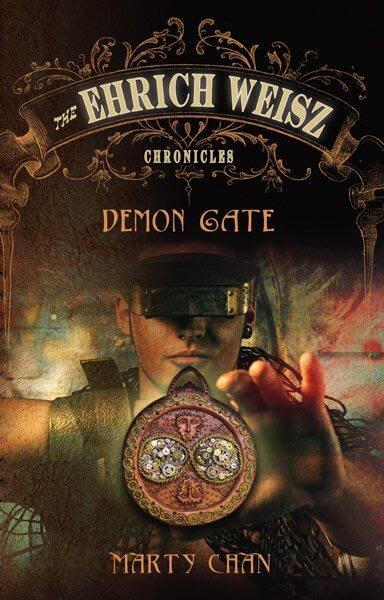
Here's a Halloween treat. The first book in a new teen fantasy series about the adventures of a young Harry Houdini has just been released. The Ehrich Weisz Chronicles: Demon Gate is written by Marty Chan and published in paperback by Fitzhenry & Whiteside. Here's the description:

When young Ehrich Weisz — the future illusionist, Harry Houdini — follows his brother, Dash, through a strange portal, he is thrust into an alternate New York where the immigrants aren't just different ethnicities but different species. He finds work in this strange steampunk world as a Demon Hunter, tracking down dangerous otherworldly visitors that threaten the city's safety, while hiding his own foreign origins. A curious medallion, his only clue to finding his brother, leads Ehrich to a mysterious woman caught up in inter-dimensional intrigue, and he must learn who to trust as he unravels the truth if he ever wants to find his way home. 
First of a new series, The Ehrich Weisz Chronicles, by the award-winning Marty Chan.

Marty Chan is a playwright, radio writer, television story editor, and the author of several young adult novels and picture books, including The Mystery of the Frozen Brains. Marty was the first playwright in residence at the Citadel Theatre. He also served as Chair of the Edmonton Arts Council and taught playwriting at the University of Alberta. He received an Arts Achievement Award and a Performance Award from the City of Edmonton. Demon Gate is his first teen fantasy novel.

You can buy The Ehrich Weisz Chronicles: Demon Gate from Amazon.com. The next book, The Ehrich Weisz Chronicles: Infinity Coil, will be released in Fall 2014.

Monday, September 16, 2013

Greatest signed Houdini photo EVER

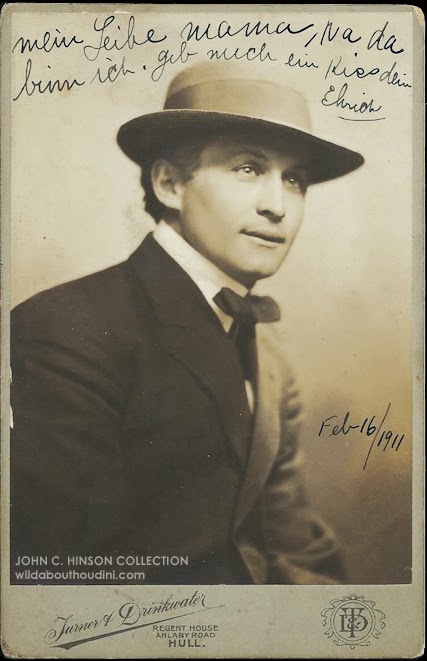
Let's kick off our new Hinson Endowment today with what I'm deeming to be the greatest signed Houdini photo EVER. Why do I say that? Well, for starters, Houdini has inscribed this beautiful cabinet photo (which is a rare image in itself) in German. That makes this one of the very few examples of his use of the family language. He's also signed it with his real name, Ehrich. Again, only a handful of Ehrich (Weiss) signatures exist.

But what really makes this special and a major piece of Houdiniana is the fact that Houdini has inscribed this photo to his mother. Apart from the famous "Dear Ma" postcard of his youth, this is the only piece of writing from Houdini to his mother that I've ever seen. Boom.


So what does this greatest EVER inscription say exactly? That's not entirely clear, even to our benefactor, John Hinson. So I turned to a German friend, Helmut Schierer from Nuremberg, who gave me his take. Says Helmut:

It's a bit strange, sounds like somebody not having used his German for some time and not being overly concerned about orthography. It's a mix of German and English and makes a - slight - mistake, mixing dative and accusative as Berliners are prone to. It says:

'My Daer Mama, well here I am. Give me (here he used the wrong grammatical case) a kiss your Ehrich.'

Thanks to Helmut for the translation and, of course, to John C. Hinson for allowing me to share this rare family treasure. We're off to great start!

Wednesday, August 7, 2013

Houdini Begins

When did Harry Houdini become a magician? The answer is not always clear. While there are many tales of young Ehrich Weiss performing acrobatics and magic in five cent circuses in Wisconsin, most serious Houdini biographies attribute the start of his magic career with his reading The Memories of Robert-Houdin in 1891.

But according to the remarkable book, Sixty Years of Psychical Research, written by Houdini's boyhood friend Joseph F. Rinn in 1950, Houdini was giving semi-professional magic performances two years before he ever read the Robert-Houdin book. Rinn's recollections begin on page 65:

[In 1886] I joined the Pastime Athletic Club, which had grounds at Sixty-seventh Street and the East River, where I quickly developed as a runner. I became captain of the club and was its champion sprint runner in 1889, when a new member joined by the name of Ehrich Weiss, who later became famous as Harry Houdini, the magician and escape artist.

As Weiss was ambitious to win a running prize, he turned to me as captain for advice, and under my instruction he trained and won his first prize.

At the time, Weiss (or Houdini, as I shall henceforth call him) was making and lining ties at a low wage for H. Richter's Sons. His ambition to be a boy magician was curtailed by lack of funds for the purchase of paraphernalia, for performances he gave after working hours at small social affairs and in public schools.

When Houdini learned that I was a magic fan and a friend of the Herrmanns, we became good pals.

In the spring of 1889 Houdini has another friends in his shop, named Jacob Hayman, who was a magic fan, and they frequently worked together, giving amateur magic performances.

On April 30, 1889, Houdini informed me that he and Jack Hayman were booked to give a magic performance at some social affair. "I guess we'll make a flop of it," said Houdini ruefully, "because we haven't enough paraphernalia."

"Oh, I can remedy that," I said, "Come over to Martinka's with me and I'll make you a present of some magic apparatus. Consider it my Christmas present," I added, as Houdini was quite proud and touchy about money matters."

As this is before Houdini's exposure to Robert-Houdin, I wonder what named he and Jack used at what sounds like their first professional engagement?

Later in the book, Rinn recalls when his friend read that seminal work of magic and truly set off to become a professional magician:

It was early 1891 that Ehrich Weiss read The Memories of Robert Houdin, the French magician, and determined to become a professional magician under the name of Harry Houdini, which name he legally made his own at a later date.

A short time after he made his decision, he said to me, "I've made up my mind, Joe, to quite my job and become a professional magician under the name of Harry Houdini."

"But Ehrich, you are only seventeen," I protested. "Isn't that rather young to give up a good job for an uncertain theatrical career?

Houdini replied, "It may seem daffy to a solid businessman like you, Joe, but I've the urge in my blood to be a professional magician and nothing can stop me."

"Well, it's your funeral, Ehrich," I said resignedly; "but get a recommendation for your present employer in case you can't make a success of being a magician."

A few days later Houdini saw me and reported: "Well, I've quit my job, Joe. I followed your advice and got a recommendation. Here it is." I read the letter, which I now possess.


H. RICHTER'S SONS
502 & 504 Broadway

New York, April 3, 1891.
To Whom It May Concern:

We hereby certify that Mr. Ehrich Weiss has been in our employ for two years and six months as assistant lining cutter and we cheerfully recommend him as an honest, industrious young man.
H. Richter's Sons

It's interesting that this oft quoted recommendation letter found its way into Rinn's collection. He doesn't say how he got it, but I can imagine Houdini giving to it to his friend once he had achieved fame as The Handcuff King. Maybe he even gave it to him as "a Christmas present."

Joseph F. Rinn (Library of Congress Collection)

Sunday, April 28, 2013

Houdini's Russian contract sells for $10,000

The Washington Symposium on Magic History concluded yesterday with an auction that saw the sale of a major Houdini artifact.

According to a report on the conference from attendee Dean Carnegie at The Magic Detective, Mike Caveney offered for sale the original contract, written in Russian, for Houdini's one and only tour of that country in 1903. What makes this contact especially attractive is that it's signed both "Harry Houdini" and "Ehrich Weiss." According to Dean:

"It sold for $10,000 to Bill Kalush, but word is he purchased it for someone else who has a big ass warehouse in Las Vegas, at least that's the gossip going around."

Head on over to The Magic Detective to read Dean's full report. Congrats to Ken Trombly for hosting what sounded like a very successful and memorable magic event.

UPDATE: David Saltman has posted photos of the contract and explains how it helps solve a Houdini mystery on his blog The Houdini File.

Translate