Showing posts with label Houdini Magical Hall of Fame. Show all posts

Tuesday, December 2, 2025

Arrival of the Mirror Cuffs


Here's a nice find from the October 18, 1976 Welland Evening Tribune. This photo was taken at the Houdini Magical Hall of Fame in Niagara Falls, Canada, which was preparing to host the 50th anniversary Houdini seance that year. 

On public view for the first time, as part of the seance paraphernalia, will be Houdini's famous "Mirror Handcuffs." Prized by Houdini while he lived, since his death, they have been a part of a private collection held by a niece of Houdini's in New Jersey. The sterling silver handcuffs are engraved: 
"Presented to Harry Houdini, The Handcuff King, by the Daily Illustrated Mirror, London, as a memento of his success in escaping from the celebrated Mirror Handcuffs, March 17, 1904."

The article says these are the engraved silver replicas. I don't know whether the working cuffs came at the same time, but I know the museum had both when I saw them on display in 1990. Today, both are in David Copperfield's International Museum and Library of the Conjuring Arts in Las Vegas.

I'm actually more intrigued by the pouch holding the handcuffs and a photo from the challenge with what may be Houdini's handwriting. Does this pouch date back to Houdini? Is it still around today?

Want more? This month's Patreon reward is a searchable PDF of the 32-page souvenir booklet published by the Houdini Magical Hall of Fame during its 27 years in business. Just click below to claim.


Related:

Thursday, May 1, 2025

The Houdini Magical Hall of Fame fire 30 years ago today

Our friend Tom Interval at Interval Magic reminds me that today marks a grim anniversary. It was 30 years ago tonight that the Houdini Magical Hall of Fame in Niagara Falls, Canada, burned in a late fire. Among the Houdini rarities destroyed was the original Water Torture Cell. Below is the news as it appeared in The Toronto Star the following day.

The Toronto Star, May 2, 1995.

Do you remember when and where you learned the news that the Houdini Magical Hall of Fame was no more?

Related:

Wednesday, April 24, 2024

1971: Year of the Torture Cell(s)

Houdini's Water Torture Cell made its last public appearance on the night of October 11, 1926, in Albany, New York. This was the night Houdini broke his ankle. Despite plans to resume the cell in Detroit, Houdini died before that happened. After that, the famed prop remained out of sight for the next 45 years. Then, in 1971, two Water Torture Cells, both claiming to be the original, returned to public view.

In May 1971, the Water Torture Cell that Sidney Radner acquired from Hardeen in 1942 was put on permanent display at the Houdini Magical Hall of Fame in Niagara Falls, Canada. Some assume the cell was in the museum from the start (the museum opened in 1968), but it was actually a later addition, as we can see below.

The Holyoke Daily Transcript and Telegram, May 29, 1971.

Later that same year, magician Abb Dickson announced that he had acquired Houdini's original Water Torture Cell and was making plans to display it. Abb claimed he found the cell in England and had even solved its secrets by having it x-rayed.

The Atlanta Journal, Sept. 6, 1971.

In October, Abb's cell was revealed alongside a collection of other alleged Houdini ratites at the Dutch Square Mall in Columbia, South Carolina.

The Columbia Record, Oct. 25, 1971.


Of course, Abb's cell was pure hokum—it was made of sheet metal with a shower drain at the bottom. One wonders if the arrival of the real cell in Canada had inspired Abb in this endeavor? Abb would tour his Houdini exhibit and cell for several years. The cell was also used in the 1976 television biopic, The Great Houdinis.

The real Water Torture Cell remained on display at the Houdini Magical Hall of Fame until a fire destroyed much of the cell in 1995. Today, the restored cell is back on display at David Copperfield's International Museum and Library of the Conjuring Arts in Las Vegas.

Abb Dickson's cell also survives today in the collection of Troy Milligan. On occasion, it has been offered for sale on eBay, but I'm not sure of its current status.

Want more? I've uploaded to my Patreon a collection of photos of the original Water Torture Cell on display at the Houdini Magical Hall of Fame throughout the years and what remained of it after the fire.


Related:

Friday, February 10, 2023

USD dummy

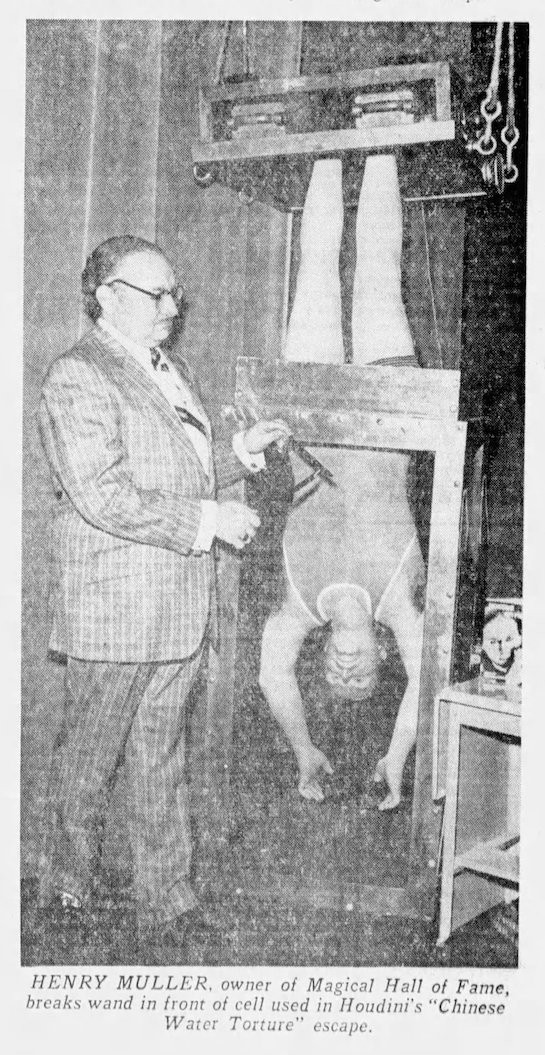
Here's a photo from the July 27, 1974 Buffalo Evening News showing how the Water Torture Cell was displayed at the Houdini Magical Hall of Fame in its early days. 


Can't say I love the idea of a Houdini mannequin hanging inside this precious prop. But it's certainly preferable to the later water effect that leaked and damaged the cell. This display can also be seen a museum postcard for the 1970s below. 


You can see some other images of the Water Torture Cell on display at the Houdini Magical Hall of Fame throughout the years via the links below.

Wednesday, December 14, 2022

Hear Dunninger inventory his Houdini collection

David Muller, author of Growing Up With Houdini, recently sent me an extraordinary recording of Joseph Dunninger verbally cataloging his entire collection of magic and Houdini artifacts. Dunninger sold his collection to David's father, Henry Muller, in 1967. These rarities were displayed for many years at the Houdini Magical Hall of Fame in Niagara Falls, Canada. 

I shared Dunninger's 29-minute primary inventory for members of my Patreon on Monday. Today I'm posting his 8-minute "supplemental" list unlocked so anyone can listen for FREE. Just click below to go.

Wednesday, November 30, 2022

Houdini's curious cross escape

One of the more unusual pieces of surviving Houdini apparatus is his "Cross Escape." There are actually two crosses. One is gaffed for quick release and was acquired by Sidney Radner from Hardeen. Today it is owned by Teller. The other was acquired by Henry Muller from Dunninger and was displayed for many years at the Houdini Magical Hall of Fame. The photo in the right shows this latter cross as it appeared in the museum. (Fun fact: I now own that mannequin head.)

I admit this particular escape has always perplexed me. The Houdini Magical Hall of Fame described it as "a famous Houdini challenge escape," yet I've never been able to find any account of Houdini ever performing it. The quick release gaff seems more like a spiritualism or magic effect than a Houdini escape, and the overt religiousness doesn't seem to be Houdini's style. Recall how he took offense to Carl Mysto's use of a coffin onstage.

But David Muller recently sent me extraordinary audio of Joseph Dunninger going through the collection he sold to David's father in 1967, describing each piece of apparatus and its history. Here's what he says about the cross:

Dunninger: "The Houdini cross escape, used in Houdini's earlier performances. Made in his museum days. He would be tied to the cross, a screen would be placed in front of it and in a few moments he would liberate himself. It needs some repair as is obvious, but it's of very great historical value as it belonged to Houdini and was one of his first sensational escapes."

Hearing Dunninger call this an effect from Houdini's "museum days" is informative. Maybe this explains why I've not been able to find an account of it? And its similarity to a spiritualism or magic effect fits with the evolution of the escape act.

Teller also describes it as a "carnival item." In an interview Two Magicians One Mic Podcast, in which we get a glimpse of his cross in his "Houdini alcove", Teller says:

Teller: "It's a carnival item. It would be erected on stage and the person who's doing the spiel on the bally would take, usually, a runaway 13 or 14-year-old drug addicted girl, who happens to be with the carnival, and tie her neck and wrists to this cross. And then at the moment when they were trying to turn the tip and bring the whole group into the tent, all of a sudden she would just walk away from it. The ties would be gone."


The cross escape coming from dime museums or carnivals does makes sense. It's even possible Houdini didn't build the effect himself, but acquired it as he did his electric chair. But I'll keep on searching for some account of Houdini doing the escape himself.

In the 1970 BBC documentary The Truth About Houdini, Sidney Radner demonstrated his gaffed cross. This scene was cut scene from the documentary––possibly because The Magic Circle objected to the exposure––and it does not appear in any version of the doc today. But you can watch the full clip as a member of my Patreon below.


Thanks to David Muller for the Dunninger audio and Dan Bowen for the Teller interview alert.

Related:

Tuesday, November 30, 2021

Purchase David Muller's 'Growing Up With Houdini'

The book Growing Up With Houdini, David Muller's wonderful remembrance of his family and the creation of the Houdini Magical Hall of Fame, can now be purchased directly from the official website growingupwithhoudini.com. There you can also see some incredible pics, such as the below photo of Sidney Radner and Walter B. Gibson with a familiar Houdini prop.


Growing Up With Houdini tells the story of how the Muller family fled the Nazis and their native Slovakia to settle in Niagara Falls, Canada. There Henry Muller created the Houdini Magical Hall of Fame in 1968. The book contains many rare photographs and documents that have never been shared before. David also reveals a wild early connection between the museum and Doug Henning.


Purchase Growing Up With Houdini at growingupwithhoudini.com.

Thursday, September 16, 2021

Poster for Houdini's Grand Magical Revue

Over the weekend a poster for Houdini's 1908 appearance at the Circus Brusch in Germany sold on eBay. I mentioned that I had seen that poster along with another for Houdini's "Grand Magical Revue" at Wilshire Coin in Santa Monica in 2016. Here's a photo I took that day of that other poster.


The Grand Magical Revue with a short-lived attempt by Houdini to mount a straight magic show in England in 1914. He only presented it a dozen times. This poster is for the last known performance at the Empire Theatre in Nottingham on June 12, 1914.

Both this and the Circus Brush poster came from the Houdini Magical Hall of Fame in Canada. Both are heavily lacquered. There are a few surviving Grand Magical Revue posters, but what's nice about this one is it lists "De Kolta's Marvellous Cube" among the illusions to be performed. This poster appears on page 101 of Houdini His Life and Art by James Randi and Burt Randolph Sugar.

I've not seen this poster since that day back in 2016, but it was for sale along with the Circus Brush poster. Perhaps that means we will see it appear on eBay as well?

UPDATE: Looks like this poster has inspired some reproductions over the years, as seen below. The one on the left was part of a "Houdini Portfolio" from the 1970s. On the right is a reproduction created by the Houdini Historical Center in 1995 (thanks to Chunk Romano for the image). Looks like the HHC felt the need to add a photo of Houdini in chains, which is incongruous on a poster advertising him as a straight Magician.


Related:

Sunday, September 12, 2021

1908 Circus Busch playbill sells on eBay

A rare playbill for Houdini at the Circus Busch in Berlin in 1908 sold in a one day Buy It Now auction on eBay yesterday. It was initially listed for $5000, but then reduced to $2500. The seller was The Record Parlour, a vintage record and memorabilia store in Hollywood.

The listing didn't provide any provenance, but I can. This was part of a four poster display at the Houdini Magical Hall of Fame in Canada. It was auctioned in 1999 and wound up at Wilshire Coin in Santa Monica, where I got a look at it in 2016. At the time the owner was looking to sell this along with another poster for Houdini's Grand Magical Revue. (You can see that poster HERE.)

As far as the playbill itself, it certainly checks out historically. Houdini opened at the Circus Busch the week of August 31, 1908. This advertises his appearance on Saturday, October 3, which was midway through his eight week run. Houdini was featuring his Milk Can at this time. The photo of Houdini in cuffs is from 1904.

Related:

Wednesday, May 19, 2021

The Steel Straitjacket

Near the end of Houdini (1953) we see Tony Curtis' Houdini challenged to escape from what the movie calls "a steel straitjacket." It's a terrific escape performed by Curtis without a cut. The "steel straitjacket" was provided by Houdini's technical advisor Joseph Dunninger, who claimed it was used by Houdini himself. Below is a photo of Dunninger with the jacket from the July 26, 1967 Middletown Journal.


The steel straitjacket was purchased along with the rest of the Dunninger collection by Henry Muller in 1967 to supply his Houdini Magical Hall of Fame in Niagara Falls, Canada. The jacket was displayed as the "Armoured Breast Plate" (it was no longer on display when I went to the museum in 1990). After the catastrophic fire of 1995 the steel straitjacket was housed in a warehouse along with the rest of the surviving collection.

One person who remembered seeing the straitjacket in the museum was magician and collector Rob Allen from Niagara Falls, New York. "I always remember seeing it on display there," says Rob. "I would always stop and look at it as I thought it was the most intriguing piece among the Houdini escaped pieces." Following the fire, Rob purchased some items from Henry's warehouse. But there was one item he always coveted. In a November 2007 issue of Magicol, Rob remembered:

After my first purchase from Henry, I met him numerous times, often taking things he owned to sell at Yankee Gatherings and Magic Collectors' Weekends. It was fun for me and I finally told Henry during one of our meetings that I wanted to buy the Steel Straitjacket although I couldn't afford to pay for it at that time.

"Rob, it's yours," he said. "It won't leave the warehouse. When you have the money you can come pick it up."

That day finally came. If I had not arranged to buy it, the Houdini Steel Straitjacket would have been shipped with the rest of the warehouse contents to Hollywood, where the items were auctioned by Butterfield & Butterfield in November 1999.

Happily, Rob still owns the steel straitjacket today. Here's a photo he shared. Still looks fantastic!


But the question remains. Did Houdini really use this? Like the iron overboard box from the movie--also supplied by Dunninger who also claimed it was Houdini's--I've never seen any photo or read any reference to Houdini doing this particular escape. But how great would it be if one day we did find a photo of Houdini in this now iconic restraint?

Until then, we'll have to be satisfied with the scene from the movie (this is copyrighted so may have ads). Enjoy.


Thanks to Joe Fox for his help with the post, and a big thanks to Rob Allen for showing us the steel straitjacket today.

Saturday, February 6, 2021

Guest Blog: Chronicles of the Mystery WTC (Part 2)

It was one year ago that Richard Sherry & Dayle Krall made the remarkable discovery of a working Water Torture Cell in Canada. The cell resembled Houdini's original Water Torture Cell, which was destroyed in a fire in 1995, almost exactly. The appearance of this "Mystery WTC" sparked curiosity and controversy as to its origins and purpose. 

Over the past year Richard and Dayle have been examining, restoring, and researching their discovery. Today I'm excited to share the second part of their two part Guest Blog that explains all they have uncovered. Enjoy!

Chronicles of the Mystery WTC
by Richard Sherry & Dayle Krall

Part 2: Discoveries and Theories

During the process of reassembling (see Part 1), we have had many new discoveries which we would like to share. 

When we removed the large hasp that locks the stocks, we discovered another set of screw holes behind it. We found this curious. 


Another discovery that we found earlier and wanted to share again for those who had not seen it. As Richard took the brass plate off of one of the locks and was looking at the lock, he noticed that there was something wedged between the lock case and the cut out in the wood of the stocks. After removing it he found that it was a 1909 British coin. It looks like this coin was being used as a shim and would have been installed when the stocks were built. We wonder who put that coin there and why? The interesting part is that the WTC was built in Britain around 1910-1911.


It is also extremely peculiar that there are four Collins locks on the stocks. They add no additional functionality. Does anyone have any ideas why there would be four?

Lifting Ring Puzzle 
The lifting ring is made from 5/16” thick, 1 ½” x 1 ¼” angle iron. It appears to be cast and weighs a ton. Richard has always found it curious why the lifting ring had cut outs in it to accommodate the large hasps that fasten the stocks to the Cell. The hasps are bent in a way that they will pass over the lifting ring so why the cut outs? It is Richard’s belief, that there was an error made during the construction and the thickness of the lifting ring was not considered. Richard believes this because the cut outs in the lifting ring are just a little bit deeper than the thickness of the metal of the ring. The slots were cut down 3/8” deep. Does anyone else have any other ideas why this would be the way it is?

Ring Hooks
One of the large ring hooks came off. It would not fit back into the hole in the lifting ring. It appears that the ring hooks were heat fitted – where the hole in the lifting ring frame was heated and the ring shaft was put into the hole and when it cooled down it was a perfectly tight fit.

Two exceptional discoveries
This picture shows how the panels are joined together using lap joints. It appears that there was some kind glue or sealant of some sort that was put in between the lap joints to help prevent water leakage.


When we were assembling the 5 panels on the right side of the Cell, Dayle noticed that the centre panel was different. Upon further inspection we noticed a couple of things. One, the lap joints were clean. There wasn’t any residue on the joint. Two, the corners of the joint were perfectly straight whereas the corners of the rest of the panels were ever so slightly rounded. This leads us to believe that this panel may have been replaced at some point in time.


Here we have a real bombshell. One day when Richard was polishing the glass inside the Cell he dropped the Windex bottle and noticed that the bottom back panel moved. After examining the bottom panel, it was discovered that between the lap joints was a metal tube. This tube could be lifted vertically and may be some kind of breathing tube. Of course, we do not know if this had ever been used.

The board was spring loaded so it would pop open if hit at the back. We won’t go into the complete description of it right now, but it is almost something out of James Bond.

In the picture, Richard replaced the steel spring that had decayed into two pieces just to see how this worked. He thinks this is how it would have worked.


This Cell has a working gaff and John Cox has the pictures to verify it but we will not be including those pictures for public release.

We tried to remove the wood rings that surround the drain valves but couldn’t. We had to remove the drain valves first because there was a membrane attached to the wooden rings. This, of course, made total sense to prevent leakage.

We also noticed on a couple of screws that there was steel wool wrapped around them. This was often used when a screw thread was starting to wear to tighten it.

The frames of the Cell were constructed with mortise and tenon joints. This was noticed because one of the joints had come loose.

It was also very curious that on the back panel of the Water Cell, the panel themselves were opposite. The lap joints were opposite compared to the other two sides because the screws of each panel were installed above the seam whereas they were installed below the seam on the other two sides.

There are also two diagonal gouges in the back panel. Both near the third bolt from the top on each side. These gouges are possibly from a chain that was wrapped around a Cell when moving it. We are not certain of this, but this explanation matches the gouges perfectly.

Missing Items
When we received this Cell we noticed that there were a few thing missing:
  • 2 drain plugs
  • 2 brass handles on the back of the stocks
  • Upper section of right brass hasp near the front
  • 8 bolts
  • A few screws 

After reassembling the Cell and having developed a much better sense of how it was built and works we are wondering, now more than ever, where this Mystery WTC came from.

Years ago, Richard built what he thought was an exact working replica (right) of Houdini’s WTC from pictures and other information he had gathered over the years. This Mystery WTC is constructed slightly different than his previous understanding. Richard had contacted Dave Dorsett to verify the measurements of the Cell that sat in the Niagara Falls museum that was going to be sent out for restoration. From Richard’s understanding Dave Dorsett had bid on the contract to restore the WTC in 1991 and was therefore able to get all the measurements of the Cell that was in the museum at that time. The measurements that Dave Dorsett provided were essentially the same measurements as the working replica WTC Richard built years ago. These measurements do not match the Mystery WTC.

With the discrepancy between the measurements Dave Dorsett provided of the WTC in the Niagara Falls museum and the measurements we had of the Mystery WTC we had no idea what the Mystery WTC was and where is came from. It wasn’t until Richard had discussed the Mystery WTC with Dean Gunnarson that new information came to light. Dean provided the precise measurements and dimensions of the WTC that James Randi had drawn up of the Cell that was first delivered to the Niagara Falls museum in 1971. These measurements and dimensions match the Mystery WTC exactly and they are not the same measurements that the Cell in the museum had after the museum moved locations.

Just to name a few discrepancies between the two Cells:
  • The steel frame is a little over 3” in the WTC in the museum that everyone is familiar with, however the frame in the Mystery WTC is 3 ¼” which is the same as what Randi documented in 1971. 
  • The Mystery Cell is also 2” deeper which is the same as what Randi documented in 1971.

Here is our theory, as crazy as it sounds. When the museum was being moved to the second location, a local farmer stored the WTC and other items from the museum as a favor. The items that had been stored were moved into the new museum location; everything except the WTC. Parts from this Cell had been removed (the two back handles, two plugs, one piece of the side hasp, etc). The Cell that was stored remained stored for decades – minus the parts mentioned. Over the years other magicians and collectors had been contacted regarding a sale but there were no buyers. A fellow performer from Nova Scotia had been approached but he was not in the position to purchase it at that time. We purchased the Cell when Dayle had been contacted by the seller and this was because they had found her as "The Houdini Girl" and thought she might be interested.

We are not certain, but we think that the Cell that went into the museum that Randi had measured had been left in storage when the museum moved, and a duplicate Cell was made using the parts removed from the original WTC. This duplicate was then put in place in the new museum location.

Maybe this is why no one really cared about the condition of the WTC that was in the museum and it was so neglected over the years? After the fire and the insurance claim was processed the Cell that was stored had to remain hidden.

After all the time and money invested, we still do not have any definitive proof of what this Mystery WTC is, BUT WE LOVE IT! These are some very wild ideas but what better place than Wild About Harry to discuss them?

If anyone has any information or questions, they would like to discuss that cannot be posted publicly on Wild About Harry, please feel free to contact us at richard@sherryandkrallmagic.com. 


Thank you Richard & Dayle!

Saturday, November 7, 2020

Growing Up With Houdini by David J. Muller

David Muller, son of the late Henry Muller, has written a new book called Growing Up With Houdini. It's a wonderful work that tells the story of the Muller family and, of course, his father's Houdini Magical Hall of Fame. 


The first part of the book relates the incredible story of how the Muller family fled the Nazis and their native Slovakia to settle in Niagara Falls, Canada, where they established a successful meat selling business. The book then covers in detail the founding and formation of the Houdini Magical Hall of Fame in 1968, along with many photographs and documents. A true highlight is a reproduction of the original inventory of artifacts in the Dunninger collection that made up the bulk of the museum. David also shares a wild early connection between the museum and Doug Henning.

David is taking a unique and generous approach in offering this book. It is not for sale. David gives them away and in exchange asks people to give a donation to their favorite charity in his father's memory.

You can contact David Muller via the website: www.growingupwithhoudini.com.

Wednesday, July 1, 2020

The Muller Mirror mystery key

On last Sunday's Magic Collectors' Corner ZOOM conference, Roger Dreyer gave a tour of his amazing Houdini Museum of New York at Fantasma Magic (which is now reopened for business). Among the many Houdini treasures Roger showed was a replica of the famous Mirror Handcuff made by Ian McColl. The cuff hangs in a display case with a key, and I was very surprised when Roger said he bought the key from the late Henry Muller who told him it was "the duplicate key."


I immediately remembered this post from 2013 in which I shared a photo of Mirror handcuffs on display at Henry Muller's Houdini Magical Hall of Fame with two keys. This is significant as the Mirror cuffs are supposed to have only one key. Both keys eventually vanished from the display case.

Roger has been good enough to send over a nice photo of the mystery key, which he purchased from Henry in 2016.


Now, before we get too excited and begin to speculate that this second key might have been used by Houdini to open the cuff during his famous 1904 challenge, Roger reports that David Copperfield tried this key on the original Mirror Handcuff and it did NOT work. So despite being a "reproduction not made by anyone modern", this doesn't appear to be the secret of the Mirror Handcuff escape.

But what is this key and why does it exist? I guess it's yet another Henry Muller Houdini mystery.

If you missed this latest Houdini-themed conference (#11) you can watch it on the Magic Collectors Corner Facebook Group.

Thanks Roger.

Related:

Wednesday, June 3, 2020

Richard Sherry promises "astounding news" about the Canadian Mystery Cell

Richard Sherry, who in February revealed himself as the owner of what we've come to call the "Canadian Mystery Cell", shared the following on his Facebook page last week.

Click to enlarge.

Everything I know about this cell I shared in my original post about its discovery, so I'm as much in dark as anyone at this point. But I'm thrilled the son is talking, and I look forward to some facts about this unusual magic artifact.

UPDATE: Richard and Dayle have written a two-part guest blog showing the cell in detail (Part 1) and sharing their discoveries and theories (Part 2).

Related:

Thursday, April 23, 2020

The refurbished Water Torture Cell in 1994

Today our friend Tom Frueh shares with us photos he took of the original Houdini Water Torture Cell in the Houdini Magical Hall of Fame in 1994. While we've seen pics of the cell in the museum in the '70s, '80s, and early '90s (all of which showed the cell in a sorry state of neglect), these photos show it after its first restoration by John Gaughan. Looks darn good! (And notice they finally have the lifting frame on correctly.) You can also see on display some travel cases that carried sections of the cell when disassembled.


Unfortunately, the cell only stood in this state for a short period of time. On May 1, 1995 fire swept the museum and destroyed the cell. The cell that exists today in the David Copperfield Collection is a restoration from what survived.

Thanks Tom.

Related:

Sunday, February 16, 2020

Houdini Milk Can and Iron Box at auction March 6


The famous Iron Box seen in Houdini (1953) and a Milk Can that just might be the can Houdini used for his Double Fold Death Defying Mystery will be auctioned by Bonhams in New York on March 6, 2020. Both these props come with a fair amount of mystery attached, but the folks at Bonhams have done their homework, as you can see by the detailed auction descriptions below.

LOT 60: A HARRY HOUDINI TRICK STEEL CRATE USED IN THE 1953 PARAMOUNT FILM, HOUDINI
 
Magician's steel crate with hinged lid, 28 x 28 x 36 inches, sides perforated with half-inch round holes, trap bottom, exterior painted green. 
Constructed of steel with a solid lid designed to be padlocked to the body, small holes on each side, and a sliding "trap door" on the bottom through which the illusionist can make his escape, this crate boasts an amazing pedigree and history. While on exhibit at the Houdini Magical Hall of Fame, the piece was identified as having been used by Houdini in his underwater escape trick, though the museum claimed it was only used twice, as the weight of the steel made it far too dangerous. We have not been able to confirm its use in performance by Houdini, unfortunately. All of the other references to Houdini's underwater trick, both in actual waterways and onstage in the Hippodrome tank, refer to the illusionist being nailed into wooden crates or packing crates (though some are reported to have been reinforced with steel or lead).

We can say with confidence that it was part of Houdini's estate (it appears on an inventory listing of property sold by Bess Houdini to Joseph Dunninger shortly after Houdini's death). 
Joseph "The Amazing" Dunninger was a popular "mentalist" who specialized in illusions and debunking mediums, also a passion of Houdini's. He was reportedly close to Houdini and his wife Bess, and purchased a quantity of property from the widow after Houdini's sudden death in 1926. As early as 1930, Dunninger published an advertisement to sell props and other material in The Linking Ring, the official publication of the International Brotherhood of Magicians, offering the steel crate for sale: 
"IRON BOX ESCAPE. Will stand lobby inspection. Used by Houdini. Worth $400. Tremendous bargain ......... $175." 
In 1938, the iron box again appears in a Dunninger ad in the same publication offering items for sale: 
"IRON BOX ESCAPE. Sensational for overboard or stage presentation. Belonged to Houdini." 
The 1938 ad also mentions the Houdini Trunk of all Nations illusion and the Houdini Lattice Cabinet (with Houdini's name mentioned in all caps) both of which made their way to the Houdini Museum in Niagara Falls along with the steel trunk in the 1960s. 
The steel crate does appear in the 1953 film Houdini starring Tony Curtis. The Amazing Dunninger was hired as creative consultant on the film, and many items from his Houdini collection made their way into the final cut, including the collection of handcuffs sold in these rooms on December 5, 2018 (lot 244). The crate is clearly visible in the overboard escape sequence in the film, the perforations on the steel crate making for a dramatic scene as the water pours out in torrents while the crate is pulled up from the bottom of the river. 

An unusual theory has been floated about the origin of this steel crate, inspired by a blind item in a 1939 issue of the magic periodical The Jinx, edited and published by Theodore Annemann from October 1934 to December 1941 (thanks to mymagicuncle.blogspot.com for the clue). For some backstory, Houdini and fellow illusionist Harry Blackstone, Sr. nursed a bitter feud in the early part of the 20th century which apparently dates from the introduction of the overboard box escape. Houdini always accused Blackstone of copying him, but the truth may be the opposite. From issue #68, November 25, 1939, page 468, Annemann writes: 
"Years ago there were two rival conjurors, one specializing in escape work, the other making a feature of it but not in entirety. Around 1907 there was published in Popular Mechanics an escape from a barrel after being submersed in water. By an amateur magician it was first known (as far as can be found) escape to be made under water. The barrel, its halves held together with bayonet catches, was meant to be practically kicked apart under water and let sing. H.B. then built a metal box with a sliding panel unlocked with a forked pick. He refused to sell this to H.H. so the latter did the 'overboard' box with a packing case instead. Later , H.B., seeing the psychological effect of a locally built case over a special iron box, stored the thing away in N.Y. with other illusions. Time marches on. H.B. now stands accused of under water escape larceny by H.H. We can allow that in regards to the packing case but not in priority to the general effect itself. H.B. needs the iron box to prove his point. It has disappeared! Time marches on some more. H.H. winds up a spectacular life. Into the picture comes J.D. who acquires some of the H.H. stage properties. In the cellar he finds a large iron box which no one knows anything about. Suspecting a trap, J.D. toils and finally locates a sliding panel. H.B. still has the pick for the box he found gone from the storehouse. J.D. has an iron box he found in the H.H. cellar ... on the sidelines, we suggest that H.B. and J.D. patch up their feud or declare a three hour truce while they check the finis to a truly rugged individualistic story of magicians at work and play." 
To summarize, Annemann suggests that the present steel box was actually made by Blackstone, not Houdini. Houdini wanted to buy it from Harry Blackstone, and when the latter refused, Houdini created his own underwater escape using wooden crate boxes built on site (which Blackstone then copied). An intriguing theory: is this the actual first "overboard box," designed by Blackstone and suppressed by Houdini? 
Provenance: Estate of Harry Houdini. Sold by Bess Houdini to the Amazing Dunninger [Joseph Dunninger, 1892-1975], c.1927. Loaned by Dunninger to Paramount for the production of the 1953 film Houdini, in which it appears as the "underwater crate." Sold by the Amazing Dunninger to Henry Muller in 1967. On exhibition at the Houdini Magical Hall of Fame in Niagara Falls, Canada 1968-1997. Sold to Tom Thayer, 1997. Sold to the present owners, 1999. 
Estimate:
US$ 50,000 - 70,000
£ 38,000 - 54,000

LOT 61: HOUDINI'S (DOUBLE FOLD?) MILK CAN 
White metal vessel, 35 inches high by 26 inches in diameter at widest, bottom 22 inches in diameter, welded "milk jug" with tapered neck, 3 (of 4) wing nut screws at bottom at north, south and east, and two faux hasps at either side of the neck. WITH: trick lid featuring domed top and four padlock hasps connecting to vessel (lid supplied later).
For nearly two decades, this vessel remained on display at the Houdini Magical Hall of Fame in Niagara Falls, Canada as an example of the illusionist's famous "milk can" escape, in which he was locked inside a metal can which was then filled with water, giving him only a short time in which to escape before drowning. The blogspot Wild About Houdini theorizes that this can is actually the mate to the "Double Fold Death Defying Mystery" box sold at auction in July of 2014 at Potter & Potter in Chicago, which is plausible given the unique characteristics of this can.

The Double Fold Death Defying Water Mystery, introduced c.1911, took the milk can escape and ratcheted up the drama. In the earlier escape, Houdini was padlocked into a large milk can which was then filled with water, from which he would escape while hidden behind a screen (the milk cans had "trick lids" or necks that could only be opened from inside, allowing him to escape). In the double fold mystery, the milk can was hidden inside a larger wooden crate, making the escape that much more difficult.

The strongest argument that this milk can is the Double Fold can is the hasp on the neck. Measuring 3 1/2 by 5 inches, the hasps, which appear on either side, appear to be decorative only. In an image located in the Harry Ransom Center's Harry Houdini Papers titled "Milk Can and Box used in the Double Fold Death Defying Water Mystery" (container 13.17), the hasp is clearly visible on the neck of the can sitting inside the box. Additionally, no other Houdini milk can appears to have this decorative hasp. The hasp can also be matched to images of the can as it sits on display at the Houdini Magical Hall of Fame.

Another piece of evidence: the diameter of the can's bottom is 22 inches, which will just fit inside the circular inset at the interior bottom of the Double Fold box sold in 2014. And finally, the height of the current can sans supplied lid is 35 inches, which, if the original short lid were added, would just fit inside the 38 1/2 inch ceiling of the Double Fold box. 
Though Hardeen likely acquired the Double Fold Box and its can at the same time, at some point the two were separated. The box was sold by Hardeen to Jack Lawain of Monmouth, Illinois, who used it in performance himself, before offering it at auction in 2014. The can was sold by Hardeen to Sidney Radner, who then placed it on exhibition at the Houdini Hall of Fame.  
Provenance: Estate of Harry Houdini to his brother, the Magician Hardeen; sold by Hardeen (along with other items of Houdini material) to Sidney Radner; on exhibit at the Houdini Hall of Fame, 1968-1997; sold by Radner to Tom Thayer, 1997. Sold by Thayer to the present owner. 
Estimate:
US$ 25,000 - 35,000
£ 19,000 - 27,000

In case it isn't clear, the lid on the can is not the original lid, nor does it resemble the original (which was said to have been "lost" at the Houdini Magical Hall of Fame). The owner had this lid made. And while the neck hasp referred to in the Ransom Center's Double Fold photo is indeed the same type of hasp as seen on this can, the can itself is not an exact match.

You might recall this post from 2016 in which I reported that these were displayed in a coin shop in Santa Monica where they were treated with a fair amount of indignity (customers sat on the iron box while waiting to be served). I'm very happy to see these treasures liberated at last. Here's hoping they will land in a good home.

Related:

Monday, October 28, 2019

The Ghost of Harry Houdini

Here's a well done video by Caitlin Jane to kick off my special Halloween week of "Ghost Posts." She might not have all her facts straight, I'm all for bloggers and YouTubers who take on Houdini as a topic, and who doesn't love a ghost story!


Stay tuned for more Houdini "Ghost Posts" from the past resurrected every day at 1:26 PM (the exact time of Houdini's death) just to spook you.

Related:

Tuesday, June 11, 2019

Oversized Houdini family photo sells on eBay

This remarkable oversized photo of Houdini, Bess, and Cecelia Weiss recently sold on eBay for $2,399.50. While a familiar image, this photo, said to be original, is annotated with a date: "May 1901, Essen Rhur, Germany." This was when Cecelia first came to Europe after Harry's breakout fame. It was during the trip that Harry and Mama traveled to Budapest.

This photo comes from the collection of Henry Muller and the Houdini Magical Hall of Fame. Items from Henry's collection are being sold on eBay by a seller named printreaders64. There have been some interesting items at unconventional prices.

Related:

Monday, May 13, 2019

Houdini secrecy oath sells on eBay

A handwritten Houdini oath of secrecy signed by locksmith Gilbert Dawes and witnessed by Franz Kukol sold on eBay over the weekend for $988. The oath is dated February 10, 1911 when Houdini was performing at the Empire Theater in Leeds. Below is a photo and the auction description.

Click to enlarge.

This rare and famous letter was a oath of secrecy from Harry Houdini's Locksmith; in the letter Mr. Gilbert Dawes agrees to not to disclose the secrets of Houdini. The second individual in the letter is Houdini's apprentice. We contacted the current living relatives of Gilbert to learn that the famous living magician Edwin Dawes is a relative of the late Gilbert Dawes and found records of his existence. Dated 1911. 
Henry Muller (1930 –2017), was the founder, owner and curator of the Houdini Magical Hall of Fame in Niagara Falls, Canada. Mr. Muller purchased this letter in 1967 along with other Houdini original locks, keys, illusions and paraphernalia from Joseph Dunninger. Dunninger had acquired them from Houdini’s wife Beatrice and his brother Hardeen, to whom Houdini had bequeathed the collection. The Houdini Magical Hall of Fame existed from 1967 to 1991. In 1991, a fire consumed much of the museum. This item was on display in a part of the museum that was not consumed by the flames. The keys are now is custody of the late Mr. Muller’s son David. David is offering a COA and will field any questions about the keys' chain of custody for authentication purposes. I also encourage you to do your research on the Houdini Magical Hall of Fame to validate my information. These are museum pieces of history and would be a exciting item to own! (see attached photos)

Does anyone recall seeing this letter on display at the Houdini Magical Hall of Fame (because I don't)? It will be interesting to see if more Henry Muller rarities surface on eBay. Muller died in 2017

Thanks to Kevin Connolly for the alert.

Related:

Saturday, January 12, 2019

A gift between Circumnavigators

One of my last (and most popular) posts of 2018 was about Houdini's little discussed membership in the Circumnavigators Club. Now club president David Mink has sent over another terrific Houdini related find from the November 5, 1922 issue of the club journal, The Log.


This is pretty fantastic. Not only does it provide an exact date for this famous gift (this is when Houdini was in Los Angeles filming The Grim Game), but I didn't know Harry Kellar was also a member of the Circumnavigators Club. And I've not seen that particular photo before.

After Houdini's death, "Circumpsycho" traveled to Joseph Dunninger. Henry Muller then acquired him for his Houdini Magical Hall of Fame in Niagara Falls. There the automaton suffered neglect, vandalism, and fell into disrepair. In 1986 John Gaughan rescued him from the museum. Today the fully restored and operational Psycho resides in John's collection.


You can see film of Psycho in action HERE on The Paul Daniels Magic Show in 1988. Is it just coincide that his "random" number selection begins with 278?

Thanks to David Mink. For details on the still very active Circumnavigators Club visit their official website.

Related:

Translate