Showing posts with label Lawsuits. Show all posts

Wednesday, August 3, 2022

The Norfolk kerfuffle

Here's a terrific illustration of Houdini and his fellow performers at the Colonial Theater in Norfolk, Virginia, during the week of March 4, 1912. This engagement is notable in that it featured a standout challenge and a bizarrely ignominious end.


Houdini's upcoming appearance at the 1,100 seat Colonial Theater was heavily promoted. This was his first appearance in Norfolk and a rare appearance for him in Virginia (his last being Richmond in 1900). The Virginian Pilot and the Norfolk Landmark ran a full-page illustrated profile headlined, "Houdini: The Man with the Charmed Life." The manager of the Colonial, H.B. Hearns, even refused an offer of $500 from the Orpheum in Harrisburg to retain Houdini for another week.

Houdini would receive $1,200 plus a percentage of the box office. This was the second highest salary ever paid to a performer at the Colonial (the first being Gus Edwards and his The Song Revue). But Wilmer & Vincent, the company behind the theater, felt the Handcuff King was worth it:

In view of Mr. Houdini's drawing powers, and the excellent support theater-goers of Norfork and vicinity have given the Colonial this season, they are taking a chance and confidently expect this really marvelous man to break every record the house has ever had. And at regular scale of prices.

Houdini did not disappoint when he opened on March 4, playing two shows to standing room only. He featured his Double Fold Death Defying Mystery and also accepted a string of challenge escapes for the week. The Schlitz Brewing Co. challenged him to escape his Milk Can filled with beer. The Norfolk Automobile Trade Association proposed a challenge in which Houdini would be chained within two Goodyear tires and nailed to the stage. He was also challenged to escape from the Norfolk County jail. While the newspapers ran the challenge, I couldn't find any account of the escape itself. In fact, it doesn't appear he did any outdoor stunts to promote his appearance, possibly because a snow storm had arrived that week.

The most notable challenge was saved for last. It was announced from the Colonial stage following Houdini's successful escape from the Goodyear tires. The newspapers described the scene:

Perhaps the most interesting feature of his appearance here was the reading of a challenge received from the committee of the submarine station of the Navy Yard, challenging him to allow himself to be fastened in a regulation navy deep-sea diving suit, and he to escape without injuring the suit. The specifications were so severe as to cause the audience to laugh, and when Houdini excepted the challenge, setting Friday night for the test, there was prolonged cheering.

The day before the challenge Houdini travelled to the Navy station to examine the diving suit. He stated that if he could figure out a way to escape, he would give the secret to the Navy as a way to help seamen who might find themselves trapped. For this Houdini said he would ask nothing in return, "except the credit for the invention."

There was nothing inherently dangerous about the diving suit challenge. But this didn't stop Houdini from playing up the drama. A terrific account of the escape was carried in the next day's paper.

Virginian Pilot and the Norfolk Landmark, March 9, 1912

However, the diving suit escape wasn't the only drama audiences witnessed that night. The seeds of what happened next are hinted at in the above which alludes to some "trouble between Houdini and the manager" that delayed the start of the escape. That trouble only escalated after his performance, as was reported by the Virginian Pilot and the Norfolk Landmark the following day:

As the last act of the bill went on the audience became conscious of a disturbance behind the scenes. Houdini was crying out that he was being cheated and wanted the balance of his salary. Just as the closing act went off and the sheet was dropped for the moving pictures, Houdini rushed out before the footlights clad in a bathrobe.

"I am Houdini–Harry Houdini!" He exclaimed. "I want my money. These people won't give me my salary." With other expressions of a like nature, he rushed about the stage, blocking the pictures. Fearing that a panic would result and that the audience would become excited, the stage manager dragged him behind the scenes by force, Houdini resisting and clinging to every possible foothold and handhold.

The police were called and Houdini was arrested. A large crowd gathered in front of the theater to see the magician taken away in a police car, but he was "quietly taken through a rear entrance and spirited away to the station house." There Houdini was charged with creating a disturbance. Edwards Stevens, a fellow performer at the Colonial (who can also be seen in the top illustration), posted his $50 bail.

On his release Houdini told reporters, "This action was taken merely because the manager of the theater and myself had a misunderstanding. I will admit that I became excited, but who wouldn't cry for $400–even make a bigger fuss than I did?"

This wasn't the first time Houdini had hijacked a stage to protest the actions of a theater manager. In 1910 Houdini took to the stage of the Holburn Empire in London when a manager asked him to not appear at a matinee. Despite the police being called, Houdini won the audience over by insisting they remain in their seats until he was allowed to perform for them as advertised.

Houdini considered staying in Norfolk to fight the case. But he decided to move on to his next engagement in Trenton, vowing in time to "get my desserts." Variety later offered some insight into what led up to the fracas:

Variety, March 16, 1912

In April Houdini filed suit to recover his $400. It's unclear if he ever got his money. But he did make good on his promise to give the secret of his diving suit escape to the U.S. Navy, and received a patent for his invention in 1921. He never returned to Norfolk.

According to the always helpful Cinema Treasures, the Colonial Theater stood at 116 W. Tazewell Street. With the decline of vaudeville in the 1930s it became a full time movie theater. By the 1960s it had fallen into disrepair and was being used to show adult films. It ceased operation sometime in the 1970s and the building was later demolished.

Below is the only image of the Colonial I could find in it's later days. Today a modern development, Harbor Heights, stands on the site of Houdini's first diving suit challenge and his Norfolk kerfuffle.


Want more? You can see and download 19 newspaper clippings that I used as research for this post as a "Scholar" member of my new Patreon. Just click the image below to go:


Monday, December 7, 2020

Franz and Frank


For many years the great Patrick Culliton, a.k.a. Houdini's Ghost, has expressed his belief that Houdini's first chief assistant Franz Kukol did not leave Houdini's employment in 1914 to go fight for his native Austria during World War I, as was reported by newspapers at that time (some saying Houdini dismissed him because of his nationality). Patrick believes Houdini helped Franz "disappear" by fabricating the story and changing his name to Frank Williamson. As Williamson, Franz continued to assist Houdini for the remainder of his career.

As evidence, Patrick cites a letter written by Houdini in September 1924 to the Roosevelt Memorial Association. This is ten years after Kukol's supposed dismissal, yet in the letter Houdini states:

Mr. Frank Kukol will call you personally and give you further details about the group photographs in question.

This is pretty solid proof that Kukol is still around and going by the name of Frank in 1924. So he either never went to war or had returned. So this part of Pat's theory is, to my mind, confirmed.

But what evidence do we have that he became Frank Williamson? There are plenty of people named Frank in the world, and the 1924 letter still calls him Kukol. This part of Pat's theory had remained unconfirmed for me. But now a document has surfaced that that I believe provides the proof!


The above legal statement witnessed and signed by a collection of Houdini associates sold yesterday at Heritage Auctions for a healthy $718 (including buyers premium). It relates to Houdini's lawsuit with medium Arthur McNally in March 1926. The document is interesting in itself, but what caught my eye is that one of the 11 signatures is Frank Williamson (who gives his address as 38 Marcy Place, NYC).

I checked Williamson's signature against some known signatures of Franz Kukol. It you put them together, the similarities are striking! Especially the "F" and "r" in both names.


This is petty good evidence that Franz and Frank are indeed the same man. So I'm now happy to accept this second part of Patrick's theory. Franz Kukol became Frank Williamson.

The third part of Pat's theory is his identification of the man below as Frank/Franz. This man shows up in many photos assisting Houdini and is even in Haldane of the Secret Service. He's most clearly seen in the famous monk rope tie footage shot on the Haldane set in 1921. Thanks to the recently uncovered Sherman Grinberg footage, we can now see his features in detail.


I admit I'm still struggling to see Franz in this man, so I'm not yet 100% convinced of this last part of Patrick's theory. But the way things are going, I will not be surprised when we find evidence that proves Patrick correct once again. Because he's not just "Houdini's Ghost." He's also Franz!


Friday, November 6, 2020

Breedlove vs. Houdini trial photo fetches $400

An original glass slide from the 1926 Breedlove vs. Houdini trial in Chicago sold on eBay last week for $400.75. Several other slides from noted press photographer Henryk Schafer sold back in July, but this image may be my favorite. It shows medium Herbert O.  Breedlove pleading his case before the judge with Houdini glaring at him with arms folded. So good.

Click to enlarge.
This is an original, one-of-a-kind glass plate photographic negative which depicts an intense courtroom scene, whereby Houdini denounces Herbert O. Breedlove, a Chicago medium and mindreader, as being a fake. Judge Francis Borelli is hearing argument from Breedlove, with Houdini standing just to the left. Breedlove was suing Houdini for criminal libel, claiming that Houdini's criticisms made it impossible for Breedlove to conduct his mindreading business. Witnessed accounts say the atmosphere was so intense that one man fainted and Breedlove himself collapsed in his chair. When Houdini asked Breedlove to tell him the nickname which his father had given him, Breedlove could not come up with the answer, and the charges were dropped. Houdini had long waged a vigorous campaign to expose unscrupulous mediums and spiritualists.

According to Milbourne Christopher (Houdini The Untold Story), Houdini escaped the libel charge.

Saturday, August 1, 2020

Five original Houdini glass negatives sell on eBay

A remarkable set of original Houdini glass negatives sold on eBay yesterday. They show Houdini being bound to a chair by young girls ($781.00); Houdini and trumpet medium Annie Benninghofen ($1,150.00); and two photos of Houdini at the South Clark Street courthouse in Chicago ($402.00 and $159.50). The look on Houdini's face in the last photo is priceless! All the images are from 1926 and taken by noted photojournalist Henry Schaefer of Acme Newspictures for the Chicago Herald-Examiner.


But there was actually a fifth negative that the seller had mistakenly identified as being Annie Benninghofen. Nope, that's Houdini! The auction was at only $2 with ten seconds to go and I was hoping to get a bargin. But in the last seconds it shot up to $187.50, so it appears not everyone was fooled.


Don't believe this is Houdini? Check out the below from The Tao of Houdini by Patrick Culliton. This appeared in the Chicago Herald-Examiner.


Related:

Monday, June 15, 2020

Houdini's forgotten agent: Jenie Jacobs

We all know about Martin Beck's involvement in managing Houdini's early career. We also know about Harry Day who booked Houdini on his UK tours. But I recently discovered there was another agent in Houdini's life: Jenie Jacobs.

Jacobs has an interesting story herself. She grew up in a Syracuse orphanage and was "cast adrift" at age 13. She came to New York and worked her way through law school at New York University while learning stenography at night. She then entered the agency business and in time distinguished herself as one of only two female booking agents in the business (the other was in Russia). She lived with her life-long partner Pauline Cook of the vaudeville sharp-shooting team "Cook and Clinton." The two later formed their own agency.

It not clear exactly when Jacobs first entered Houdini's orbit, but to hear her tell it, it was early in his career. In a syndicated 1922 profile ("A Creator of Footlight Careers") she claimed to be responsible for Houdini's high salary. Her story doesn't quite comport with known facts, but you gotta love her last line, as I'm sure Houdini did.


It's more likely Jacobs represented Houdini after his return to the U.S. in 1905. She definitely represented Hardeen when he returned in 1907. Her name is featured prominently on Hardeen's trade advertisements, referring to her as "Miss Jenie Jacobs, The Hustling Agent." She also represented Houdini's boyhood friend and one-time Houdini Brother Joe Hayman. Joe played Vaudeville with Mildred Franklin as "Hayman and Franklin." Another familiar client was Dr. Walford Bodie, "The Famous Bloodless Surgeon and Electric Wizard."


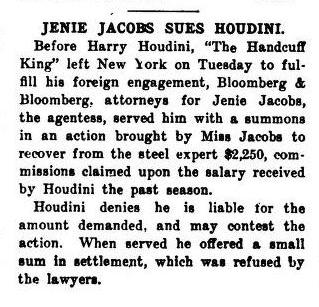
Jacobs relationship with Houdini appears to have soured, and in 1908 she sued the magician for $2,250 in commissions owed.

Variety, Aug. 22, 1908

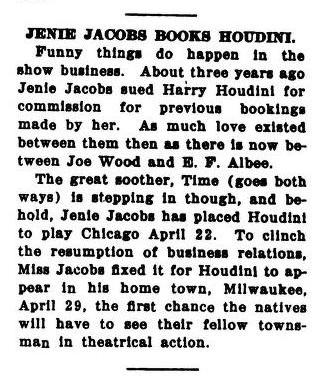
It may be a testament to her skills of persuasion that she was able to reconcile with Houdini a few years later and once again act as his agent.*

Variety, April 13, 1912

It speaks well of Houdini and Hardeen that in this male dominated age they entrusted their careers to a woman (and an apparent gay woman at that). But it's clear Jacobs had no problems asserting herself in a "mans world." She offered this advice to women:

"[This] is the particular warning I would like to hold up to women: not to let their own timidity and men's boldness bluff them into feeling that they are unable to carry on business on their own account. We must bluff a little too and keep awake."

In 1921 Jacobs launched a successful career as a theatrical producer, clocking several hits on Broadway. She also sued the all-powerful United Booking Office (UBO) for "oppression and discrimination." She continued to represent top talent, including Jack Benny, and soon branched into radio. In the 1930s she became closely affiliated with the RKO circuit. It's possible she may have again booked Hardeen at this time.

Jenie Jacobs died of cancer on February 21, 1933 at age 55. She is buried in Cypress Hills Cemetery in Brooklyn.


* UPDATE: I've since learned that Houdini and Jacobs settled their lawsuit for $1.

Related:

Saturday, March 16, 2019

The saga of Houdini's Film Developing Corporation


It doesn't get much attention in biographies, but the Film Developing Corporation, a.k.a. FDC, was a major part of Houdini's (and Hardeen's) life from 1916 to 1925. It also marked Houdini's entrance into the movie business, albeit behind the scenes. While the FDC is today forgotten, the building that housed it remains. But we'll get to that.

Houdini formed the Film Developing Corporation on September 25, 1916. Opening a film lab was, in theory, a good investment. Movies were exploding in popularity and even threatened to supplant vaudeville. And here at last was a way for Houdini to earn a steady income without having to tour. There was a fair amount of competition. But the FDC promised a faster, cheaper process for developing motion picture film using machinery and chemicals worked out by an aniline dye expert named Gustav Dietz. This was at a time when most film developing was still done by hand.

The executive offices for the FDC were located at 22 West 42nd St. in New York, while the film plant itself was located across the river at 216-222 Weehawken Street in Hoboken, New Jersey. Houdini was President, Hardeen Vice President, and Alfred Davidson Secretary and Treasurer. Houdini took his new role seriously enough that on his 1918 draft registration card, he listed his profession as: "Actor / Manager, Film Factory."

The December 20, 1919 issue of Motion Picture News gave a nice description of the FDCs laboratory operations:

On the west shore of the Hudson not far from the center of Hoboken the laboratory of the Film Developing Corporation is running full blast. The laboratory under the direction of Messrs. Houdini, Hardeen and Davidson has forged ahead by its production of work of high quality until it occupies a position as one of the leaders in the fine film development.
Although the interior of all laboratories are much the same as far as equipment and procedia are concerned, the Film Development laboratory offers some refinements in these respects. Particularly impressive is the roominess of the separate departments. Instead of having many machines in a close space with little room for expansion, there is plenty of space in every direction.
In the printing room, for instance, there is room for 15 to 20 printing machines, and a like amount of spaciousness is found in the performing department. Three projectors, two Simplexes and a Baird, are used to prove each foot of film before being sent out.
But probably the most interesting parts of the Film Developing plant are the automatic developing machines. There are three of these automatics, a small negative machine and two mammoth positive machines. Through the use of these machines, it is possible to pass films from printing machines through the various developing and drying processes without being touched by the human hands. The drying drums are totally inclosed and fed with perfect conditioned air.
In personnel the laboratory is especially fortunate tin having workers long experienced in handling of film. Superintendent Flosse has been identified with laboratory practice for many years. Mr. Joseph Leighton is an expert negative developer. Miss Madelaine Keough is floor lady, and Miss Sohns is in charge of the printing department.
The Film Developing plant has been laid out for an ultimate capacity of 1,500,000 feet weekly.

Personnel and titles would change during the first few years of the company. Nathan Saland, who had experience running film labs, was brought in as Vice President and Hardeen became Secretary and Treasurer.

Houdini had convinced his brother to leave the stage to help run the business. Hardeen's true feelings about surrendering his successful stage career for a desk job are not known. But a profile of Hardeen in the "Equipment Services" column of Motion Picture News chirpily noted:

Mr. Hardeen's executive ability has had much to do with the success of the firm in which he is interested. His long experience in the stage has given him a personality which aids him in handling employees. And strange as it may seem to view of the fact that his present work is much less exhilarating that the one which made him famous he has become thoroughly absorbed in his laboratory and only on rare occasions such as benefits does he drop his robe of business and take up the secrets of tricks of the magician.

The FDC had some notable clients, including Famous Players-Lasky, who would later produce Houdini's The Grim Game and Terror Island. The FDC also developed First National's innovative newsreels called "Kinograms". When Houdini formed his own production company, the FDC did all the processing for his two feature films, The Man From Beyond and Haldane of the Secret Service. According to "Houdini's Ghost" Patrick Culliton, the lab also pioneered the concept of "Film Dailies", turning around shot footage within 24 hours for the film company to review.

With Houdini at the helm, it should comes as no surprise that the FDC aggressively advertised themselves, primarily in trade publications. Below are two such ads from 1919 and 1923.


Unfortunately, the FDC was problematic almost from the start. Dietz's special chemicals proved highly corrosive to the machinery. The war also affected the supply of chemicals needed for the automatic developers, and "rather than chance it with results not quite up to the standard," they shut the machines down. Profits proved elusive. To cover mounting expenses, in 1921 Houdini created a real estate holding company called The Weehawken Street Corporation, naming Bess Vice President. Through it he purchased the building for $35,000 and then rented it back to the FDC for $541 a month. This accomplished little. As Ken Silverman noted in Houdini!!! The Career of Ehrich Weiss, "Houdini was out of his depth in this financial wheeling-dealing."

Then there were the lawsuits. A former manager, Arnold de Biere, sued the company for $2600 in unpaid salary. The case was settled out of court for $2000. The FDC was also hit with an ugly lawsuit by rival Powers Film Products, which claimed, falsely, that the FDC was a foreign-owned company. The charge made news, causing deals to collapse and some customers to withhold payments, one for $8000. Houdini filed a $25,000 countersuit for damage to the company's reputation.

Among the FDC stockholders was magician Harry Kellar, who had cautioned Houdini early on "not to go too deep into it as you have worked too hard for your money to throw it away." Now Kellar grew concerned that if the FDC went bankrupt, he'd be held libel for its debts. Houdini persuaded him to not sell his 125 shares and granted him the power of attorney. "I'm not worried about losing my money in the FDC," he wrote to Kellar, "but would certainly worry about losing your friendship."


The FDC and Houdini soldiered on, expanding and installing new equipment in 1922. But business didn't improve, and the following year, two shareholders filed a lawsuit against Houdini and Hardeen for mismanaging the company.

The stress of the business took its toll on Hardeen, who had to have surgery for ulcers. But even with the weight of the FDCs problems, Houdini still found time to tour, make movies, lecture, write books, and launch his campaign against fraudulent spirit mediums. But with Houdini's waning interest in even his own motion picture productions, in 1925, he at last threw in the towel.

In November 1925 Nathan Salad resigned as Vice President and set up his own Saland Film Laboratories. The Weehawken Street Corp. folded that same year, and the FDC appears to have remained in existence in name only. Houdini now used part of the building as his workshop. Two famous photos show Houdini and his assistants at work inside the building, which are the only images of Houdini at the Weehawken site (as far as I'm aware).

In January 1926, G. Bert Ward leased the lab and it became the Ward Cine Laboratory. After Houdini's death, the FDCs equipment was sold to Seiden Camera Exchange. This appears to have been the official end of the Film Developing Corporation.

Film Daily, August 15, 1927.

But it was not the end for the Weehawken Street building. Happily, the building still exists today. The address is now 216 19th Street in Union City, NJ. (I visited it last year.) While modernized, it still retains its familiar structure inside and out, and would be recognizable to Houdini today. It's now a rental space frequently used for film and television work. Aware of the Houdini connection, the owners have dubbed the building "Houdini Studio."


A postscript to all this. One of Houdini's fellow Scientific American spiritualist investigation committee members was Daniel F. Comstock, who had founded the Technicolor Film Laboratories also in 1916. One wonders if, during their downtime, the conversation veered from ectoplasm to the shared frustrations of being a "Manager, Film Factory."

Related:

Sunday, January 7, 2018

100 years ago Houdini vanished an elephant


It was 100 years ago today, January 7, 1918, that Houdini first vanished a live elephant at the enormous Hippodrome Theater in New York. To this day, no one knows exactly how Houdini did it. But that hasn't stopped magicians from speculating.

In the effect, an elephant named "Jennie" was ushered into the rear of a large cabinet decorated as a circus wagon. The cabinet was closed and turned toward the audience, a task requiring a block and tackle and 30 men. On Houdini's command, both the front and back of the cabinet were opened so the audience could see through to the back of the stage. The elephant was gone. "No special background, in full glare of the lights, and it is a weird trick," Houdini proudly proclaimed.

The vanishing elephant was an instant hit and became the new highlight of the Hippodrome's "Cheer Up" revue. It also led to the longest engagement of Houdini's career (19 weeks). But some magicians thought the presentation was lacking. They complained that because of the semi-circular seating inside the huge Hippodrome auditorium, only people directly in front of the cabinet could see that the elephant had actually vanished. Others had to take Houdini's word for it. But while magicians might have criticized the effect, they could still not explain how Houdini did it.


Houdini's elephant was part of the "Powers Performing Elephants" troop, a regular feature of the Hippodrome show. Houdini claimed she was the daughter of Barnum's famous Jumbo and that she was "gentle as a kitten." He also pointed out, "I never allowed a hook to be used, relying on block sugar to make her go through her stunt, and she certainly is very fond of me." Some descriptions say Jennie wore a large blue ribbon around her neck and a giant wristwatch on her leg (so the audience could see her until the last second). Interestingly, Jennie would outlive Houdini by many years. An article from May 25, 1950 shows her alive and well at age 86.

Of course, with a trick the garnered as much attention as the vanishing elephant, competitors rushed to create their own versions. Always one to aggressively protect his effects, Houdini took out ads in the trades warning competitors of his copyright. This appears to have worked as no other vanishing elephants appeared during Houdini's lifetime (that I'm aware).


Houdini revived the elephant vanish in 1922 at the Times Square Theater in New York to perform after screenings of his film The Man From Beyond. Some say the trick was more effective in the smaller venue, in which Houdini alternated between two smaller elephants borrowed from the Ringling Circus. As little as we know of the Hippodrome vanish, we know even less about the Times Square version, which may or may not have employed the same method.

How did he do it?

No one knows exactly how Houdini vanished his elephant. But that hasn't stopped the publication of explanations. J.C. Cannell (The Secrets of Houdini) wrote that the elephant passed into a second hidden cabinet. Walter B. Gibson and Morris N. Young (Houdini's Fabulous Magic) described a method that employed the use of black art. Modern Mechanic claimed the elephant was hidden behind a false backdrop. Even the infamous "Masked Magician" revealed a method involving mirrors, but his presentation bore no resemblance to how Houdini presented his effect. Interestingly, Houdini must have revealed the secret one night when he invited a committee of engineers, in town for a convention, to enter the cabinet. He then vanished them to the delight of their fellow employees.

The theory that holds the most water was first put forth by Guy Jarrett, who had pitched his own vanishing elephant idea to the Hippodrome management and was turned down. Jarrett's explanation was based on the Disappearing Donkey, an effect Houdini had purchased from Charles Morritt in 1914. While Jarrett's theory was dismissed by many as unworkable at this scale, it was championed by Jim Steinmeyer, who demonstrated the feasibility of it at the 1983 Magic Collectors Convention in Chicago using a toy elephant and a scale replica of the cabinet. Steinmeyer later published his theory in his book Hiding The Elephant (2003). As for its flawed presentation, Steinmeyer wrote, "It might have been a great illusion disguised as a bad illusion."

The great Patrick Culliton, who published his own Notes on the Vanishing Elephant, believes that the Jarrett/Steinmeyer theory is most likely the correct one. In fact, Patrick thinks Jarett, who never actually saw the illusion himself, might have been tipped to the method by Clyde Powers, the stage manager of Cheer Up!, who owned a magic shop where Jarrett worked.

However, the Jarrett/Steinmeyer theory relies on eyewitness accounts of how the trick was presented, specifically that the audience looked through a round opening in the front of the cabinet. But in a 1992 issue of the Mystifier, William M. Doerflinger, who saw the trick as a youth, specifically refutes this, saying:

"Some later commentators suspected that the audience had looked through a circular opening at the front of the cabinet as well as through the back, somewhat as though the cabinet was a huge Phantom Tube. My own visual image agrees with those who say there was no circular opening at the front; it was completely curtained until Houdini drew the curtains aside."

Frustratingly, there are no surviving photos of the cabinet or any of the apparatus Houdini used during his vanishing elephant to help settle the matter of exactly how it appeared to the audience. There's not even a known poster. So in more ways than one, the vanishing elephant remains one of Houdini's great mysteries. As Houdini himself said, "Even the elephant doesn't know how it's done."


The above illustration is from Escape King: The Story of Houdini (1975) by John Ernst.

UPDATE: David Haversat of David Haversat Magic has shared with me the unpublished notes of Milbourne Christopher explaining how he vanished his own elephant. Christopher writes that he believes his method is the same that Houdini used. As a rule, I don't expose secrets on this blog, so even though David has given me permission to share the notes, I'm reluctant to do so. But I will say I think Christopher's method makes sense, and it allows for the front of the cabinet to be fully opened as some eyewitness say that it was. I'm now thinking Milbourne Christopher may be the one who finally got it right.


Related:

Tuesday, December 12, 2017

The last battlefield

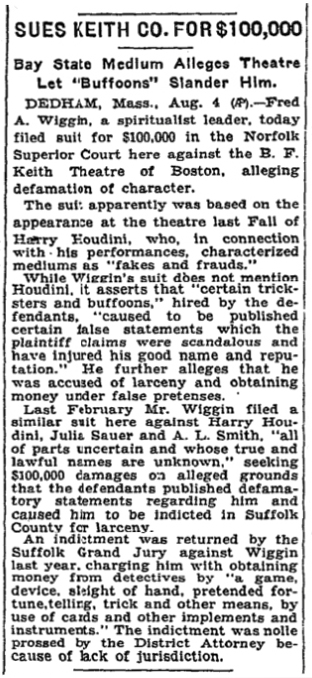
It isn't surprising that Houdini's campaign against fraudulent mediums brought on lawsuits. It's said Houdini was facing over $2 million in lawsuits at the time of his death. And while we could expect mediums to file suit against Houdini himself, here's one who took the extra step of suing the theater, in this case B.F. Keith's in Boston. This is from the August 5, 1926 New York Times (page 34).


Houdini didn't seem to be troubled by lawsuits. He had the means to defend himself and made the most of the publicity. But suing individual theaters (or circuits) could make them reluctant to book Houdini, and that could impact his career. So this might have been a shrewd tactic late in the battle.

In fact, this is shrewd enough that I can't help but wonder if Boston's own Dr. Le Roi Crandon (husband of Margery) might have been guiding the medium here?

Thanks to long-time reader Harry Houdini (real name) for this one.

Related:

NOTE: If you enjoy historical posts such as this one, please see that I now offer a custom Viewing Option in which you can view only Houdini history related posts.

Saturday, November 19, 2016

The master mystery behind Houdini's pirated films

Our friend Joe Notaro over at HHCE has come up with a nice new nugget of info about Houdini's movie career. Joe examined four mysterious Houdini "movies" that appear in newspapers around 1920-21: The Marked Woman, The Lure of Power, The Law Pirates and The Doctor’s Vengeance. It's clear from the ads that these features were made using footage from Houdini's 15 episode serial, The Master Mystery. But were they legitimate releases?


We now know that answer is "no." Joe has discovered a notice from Octagon Films warning distributors that the titles are pirated work by Amber Productions of Philadelphia. It certainly took some cheek for Amber to call one of their movies "Law Pirates."


By 1920, Houdini was on the outs with Octagon and producer B.A. Rolfe. He had to sue for money owned him for the serial. So here's a thought. Could Houdini be behind Amber Productions? He might have felt entitled after being stiffed by Rolfe, and he did own a film lab that could have whipped up these prints. Just throwing it out there.

Related:

Wednesday, May 11, 2016

When Houdini threatened to sue Doyle

The new series Houdini & Doyle (Mondays at 9/8c on FOX) will not dramatize the famous falling out between the two friends. The show creators say they might tackle it should the show continue for more seasons. But for these initial 10 episodes, Houdini and Doyle will remain friendly competitors.

But the real Houdini and Doyle did have a nasty split over the issue of spiritualism. How bad did it get? In 1925, Variety reported that Houdini was considering suing Doyle, whom he called "a menace to mankind."


Houdini appears to have never followed through with his threat.

Thanks to Bill Mullins.

Related:

Monday, July 27, 2015

LINK: Widow of magician & Houdini biographer scammed out of $1M

DNAinfo has a detailed article by James Fanelli today about how the late Maurine Christopher, widow of legendary magician, collector, and Houdini biographer Milbourne Christopher, was allegedly "looted" of her savings in the last years of her life by two scam artists. Click the headline above to read the whole, distressing tale.


Before her death in 2013 at age 92, Maurine worked with David Haversat on two beautiful collector editions of her husband's Houdini works: Houdini The Untold Story and Houdini A Pictorial Life.

Related:

Friday, August 15, 2014

Houdini's "Cologne Papers" at auction

Here's another incredible Houdini artifact from Potter & Potter's auction of Houdiniana set for August 23. I think this has the potential of being a recorded setter because of its importance to Houdini history. I'll let the auction description speak for itself.

Lot 60: Houdini’s German Slander Trial Archive, known as “The Cologne Papers.” Being a file of documents from the famous 1902 German court case in which Houdini successfully sued Cologne Patrolman Werner Graff and newspaper editor Johann Merfeld for slander. Graff alleged Houdini was not the “genius of escape” he claimed to be. Merfeld published the allegations. Houdini was vindicated in a court of law, and the judgement was upheld on appeal. The most significant item in the archive is a folio containing a nearly 50-page-long handwritten transcript of the court proceedings, in German. This is bound in cloth with marbled endsheets, elaborately gilt stamped on the front board with old German text which roughly translates to “Public Apology! In the Name of the King against the policeman Werner Graf of the Cologne Police. Harry Houdini.”

No Houdini biographer to date has had access to this folio. Many passages have been boldly underlined or marked in pencil, presumably by Houdini, who habitually made notations of this sort, and who would use scenes from the trial in his own publications in following years. Also bound in is a handwritten notice in which the plaintiff is identified as “Weiss” as opposed to “Houdini”; and a short summation of the judgement, typed and signed on three legal-size sheets and signed by a German official. Tipped on to various blank leaves are scattered newspaper clippings in both German and English, and other official documents. Two typescripts contemporary to the trial, one in German, the other its English translation are also included. These reproduce the handwritten account and detail the proceedings, which included escapes by Houdini from locks and chains, as well as a demonstration of how to escape handcuffs. Three telegrams are part of the archive. The first, dated February 26, 1902, was sent to Hardeen by Houdini. The message is one word: “Victory.” Below this is Houdini’s typed note, “I cabled this to Dash from Cologne Germany, when I won my lawsuit. H.H. [Signed] Houdini.” The telegram has been laminated.

The second is a telegram of congratulations sent to Houdini by his friend James Bard. Houdini’s typed note on the telegram states, “Wire from Jim Bard and Schelessinge[r] when I won my law suite in Cologne. H.H.” The third, in German, bears Houdini’s typed note: “Wire received from Herr Dr. Althoff when I won my lawsuit... . HH. And this is written in 1914.” As biographers Kalush and Sloman explain, “Houdini’s sweetest revenge came when the court ordered a public apology from the Kaiser be issued to Houdini….” This, then, is the most personal and lasting relic of that sweet revenge, and an important historic artifact of one of Houdini’s first great publicity stunts; a unique and personal document from his early years and successes in Europe, as he rose to greater fame.
Estimate: $20,000 – $30,000
Starting Bid: $10,000
SOLD FOR $26,000

We had a ringside seat in the discovery of this important archive in 2012. Our good friend Kevin Connolly, who had been "trying to chase this down for 30 years," broke the news of its discovery in a series of posts at his blog Houdini Himself (now offline).

It's incredible to think that "no Houdini biographer to date has had access to this folio." (Although Ken Silverman in Houdini!!! The Career of Ehrich Weiss had some unique information of the trail.) What new information could we discover here? And am I crazy to think that this might bring the second highest price of any item in the auction (I expect the Double Fold box will be #1)? We'll see.

Poster Houdini had made announcing his victory in Cologne.

You can view and bid on all the items in the Potter & Potter auction now at Live Auctioneers. You can also purchase the auction catalog or download a free PDF from the Potter & Potter website.

Related:

Monday, June 30, 2014

Houdini coming to the silver screen

A July 20, 1918 issue of Motion Picture News recently sold on eBay for $115.46. It includes a full page ad announcing the signing of Houdini by B. A. Rolfe to star in a motion picture serial. That serial was, of course, The Master Mystery, and this ad heralds the start of Houdini's career as a screen actor. You gotta love the quote in Houdini's own hand: "It is authentic Houdini."

"There will be ten episodes and work will begin about July 15. I cannot announce the complete cast yet, but it will be a notable one. It is the intention to make it a serial that will live long and be remembered."

- B. A. Rolfe

Of course, a year later, this is how Houdini's relationship with B. A. Rolfe ended:

The Evening World, Oct. 9, 1919.

Sunday, May 5, 2013

A new twist in Houdini vs. Houdina


The story of Houdini's altercation at the Houdina Company in New York is well-known. It's a Rashomon-like tale in which, according to the owners, Houdini burst into their office wild-eyed, accused them of using his name, and started to break the place apart.

Houdini's version of the story is that he and his secretary, Oscar Teale, went down to the Houdina office to object to the use of the name because he was receiving their bills. He was threatened by four "Gorillas" and a scuffle broke out.

Said Houdini, "Two of the men started towards me and two were behind. Teale was thrown up against the wall, staggering. Had no idea I was smashing up chandeliers. All I thought was to save myself. I picked up a chair and acted in real life the scenes that I have portrayed before the camera."

The incident made the New York Times on July 22, 1925:


But now our friend Dean Carnegie at The Magic Detective has uncovered a remarkable third version of the story. Dean has been in contact with the son of Francis P. Houdina (a fictitious name) who says the entire thing was staged!

You'll have to visit Dean's site to read the details of this latest twist in our Rashomon tale, but this is a major discovery. My only reservation is that, as you can read above, the incident resulted in legal action. Sure, Houdini frequently staged events...but to involve the legal system in a publicity stunt? Seems even Houdini wouldn't have crossed that line.

Nevertheless, Dean's evidence is compelling and this is a true scoop, so click on over and read Clearing the name of HOUDINA at The Magic Detective.

Translate