Showing posts with label Psychology. Show all posts

Friday, May 30, 2025

The fatalist in Seattle

Here's a nice clipping of Houdini doing a suspended straitjacket escape from the Seattle Times building on October 19, 1915. This was during Houdini's week-long run at Seattle's Orpheum Theater located on 3rd & Madison. It was his first appearance in the city.

Seattle Daily Times, Oct. 20, 1915

While finding a new photo of Houdini is always great, I get just as excited when I discover a nugget such as the below. This is an early mention of Houdini's belief in reincarnation and fatalism, and how he came to hold these beliefs.

Seattle Daily Times, Oct 22, 1915

A fatalist is a person who believes that all events are predetermined and therefore inevitable. A fatalist believes in destiny. Houdini would often describe himself as a fatalist. The earliest mention I've found was in 1909, and the latest was in 1924. You could say that it was a core philosophy. 


Hey, let's see what Google's A.I. has to say about this:

WRONG

This week, Houdini sat for a new series of publicity photos at the studio of F. C. LaPine at 1109 Third Avenue in Seattle. One of those famous portraits is below.

The Fatalist

What's left of Houdini's Seattle? Not much. The Orpheum was demolished in 1949. The Seattle Times building stood on the northeast corner of 2nd Ave. and Union St. Like so many Houdini locations, a parking lot stands on the site today.


You can read more about Houdini in Seattle at HistoryLink.org. You can also continue on to his next stop, Portland.

Want more? I've uploaded a file of newspaper clippings related to Houdini's 1915 Seattle engagement, along with a few more articles in which he describes himself as a fatalist, to my Patreon.


Related:

Friday, July 29, 2022

The secret origins of Houdini the debunker


One of the more engrained Houdini myths is that his interest in spiritualism and crusade against fakes began with his mother's death in 1913. It didn't. But I've already tackled that in a post HERE. The question I want to tackle today is what did motivate him to begin exposing spiritualistic fraud?

Turns out Houdini answered that himself in an interview with the Dayton Daily News on September 26, 1925. It's a story that opens a door to a wider speculation, which I will get into in a moment. But first, here's that interview with the key paragraph excerpted:

    Houdini, born in Appleton, Wis., has been actively experimenting with spiritualism since he was 17, soon after his father died.

    "My father left his insurance papers in an usual state," said Houdini. "Innocent then, my mother and I went to a spiritualist.

    "Three of the four mediums enabled us to talk with my father. He said he was perfectly happy. It seems strange to me that my father, knowing our pinch circumstances, would say any such thing.

    "That's what started my suspicions and caused me to expose this cruel deception to the world."

So there we go. Houdini smelled a rat as early as the 1892. But for me this explanation has embedded within it something even deeper.

What I find most interesting here is his mother's participation. It begs the question: Did Cecelia Weiss believe in spiritualism? Could she even have been an ardent believer? 

If so, this would explain the conflicting nature of Houdini's obsession with the subject. On one hand, he was committed to protect his mother by sussing out the frauds that he saw prying on grieving windows like herself. But was he also driven to redeem his mothers belief by finding the real thing. Hence, Houdini's search for a real thing was every bit as strong as his hunt for fakes.

I really think this could be a key to Houdini's psyche and I have thought this for some time. But evidence is scant. Because just as we have a Germany problem, we also have a "Mama problem." 

Houdini was buried with all his mother's letters forming a pillow under his head, so no conversation between them survives. Therefore, we really don't know all that much about the most important person and most influential relationship in Houdini's life. How many of those letters discuss spiritualism, I wonder?

Food for thought!

Friday, May 7, 2021

No hard feelings

One of the things Hollywood gets wrong about Houdini is showing him bellowing onstage how no one ("Not even God!!!") can hold him a prisoner. But had Houdini done this in reality, audiences would have surely turned on him and rooted for such a braggart to fail. While Houdini was a boaster off-stage, on-stage he actually presented a more humble persona. He would famously say to his audience, "I don't know if I'm going to get out of this, but I assure you I am going to give it my best." He presented himself as the underdog and audiences rooted for him.

Of course, Houdini always did escape. But he also went out of his way not to humiliate his challengers. No escape was ever presented as easy, even when it was. Houdini would frequently say he had never faced such a well-made packing case or a more expert rope tie. He left good will in his wake.

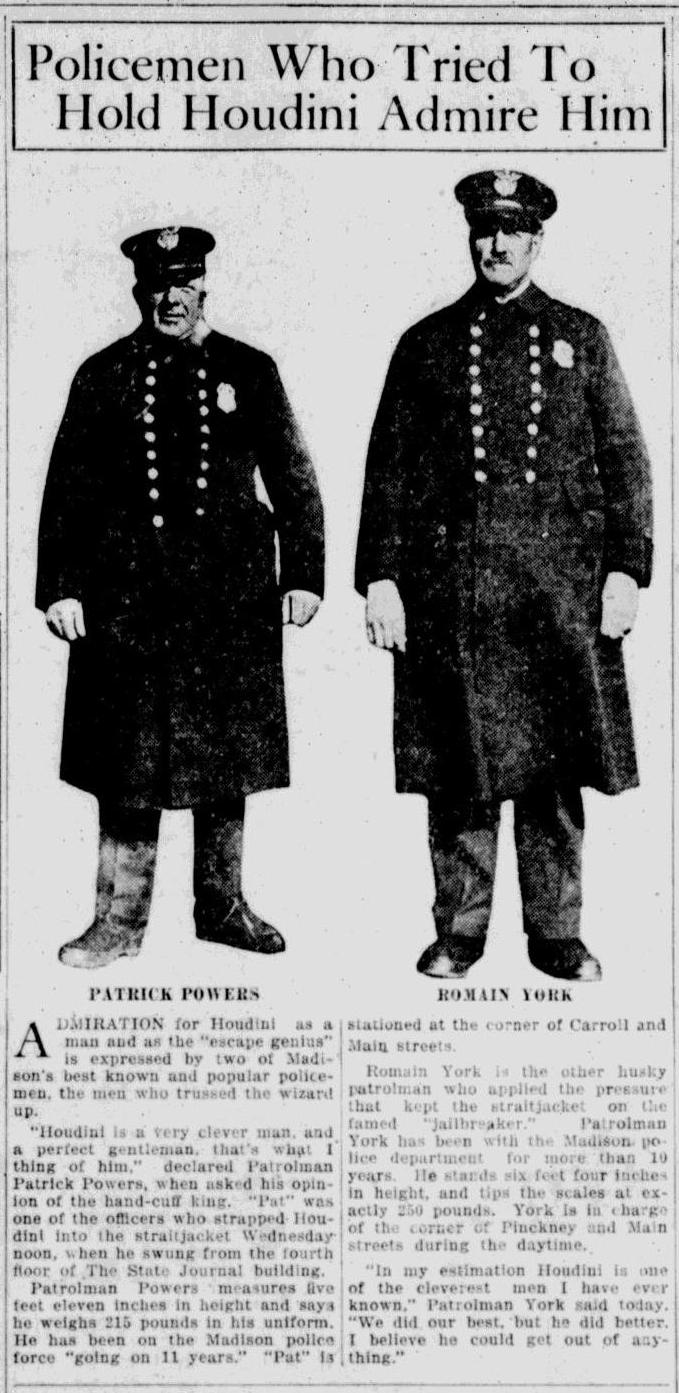
The below is a nice example of this. This ran in the The Wisconsin State Journal following Houdini's suspended straitjacket escape from the State Journal building in Madison on January 23, 1924.

Click to enlarge.

Of course, there were exceptions, such as William Hope Hodgson in Blackburn. And later in his career Houdini did do some on-stage boasting. A 1922 review in the Baltimore Evening News complained, "Houdini spends about 10 minutes telling of his greatness, then performs two tricks that he has been showing for years." But in this case he was boasting of past triumphs.

Okay, so maybe Hollywood got it half right.

Friday, April 10, 2020

Mystifier, Third Quarter 2001

Continuing my issue by issue look back at the Mystifier, the newsletter of the Houdini Historical Center that ran from 1991-2003.


The third quarter 2001 Mystifier kicks off with a review by HHC curator Kimberly Louagie of the new book Houdini's Box: The Art of Escape by Adam Phillips. While somewhat critical of the author's undeveloped ideas, in the end she still recommends the book as "a first step in delving into a very difficult discussion about Houdini's psyche." A highlight of the review is a terrific photo of Houdini in his plate glass box in Pittsburgh in 1907.

A list of new members and a gift shop update follows. We then get a terrific piece by George Hardeen introducing himself and talking about how he has only recently come to know the Houdini world. George writes:

I'm surrounded by new friendly people willing to guide me, and faces from the past who seem oddly familiar. They should. The faces are my family, and the new people are those who knew them, love them and love them still.

Sid starts his "Backstage" column with a rundown of several new books: Final Seance: The Strange Friendship between Houdini and Cohen Doyle by Massimo Polidoro; Spellbinder: The Life of Harry Houdini by Tom Lalicki; Houdini, Tarzan, and the Perfect Man: The White Male Body in the Challenge of Modernity in America by John F. Kason; and the aforementioned Houdini's Box: The Art of Escape by Adam Phillips. Sid also notes that the bestseller The Adventures of Kavalier and Clay by Michael Chabon "features repeated references to Houdini."

Sid continues with a shoutout to a Houdini article in the November 2001 Games magazine. He officially announces that the Houdini Stamp will be issued on July 3, 2002. He speaks about meeting George Hardeen, and that plans are underway to hold The Official Houdini Seance in Detroit that year.

Sid closes by announcing that a Houdini straitjacket was stolen from the Houdini Museum at the Venetian Hotel in Las Vegas. He asks for any information that could help in the recovery of the jacket and arrest of the guilty party. (I'm not sure if it was ever recovered.)

Mystifier
Volume 11, Number 3
Third Quarter, 2001
6 pages

Contents:
Houdini's Box Reviewed
New Members
Magic Items for Young Children
Seeking Hardeen
Backstage with Sid Radner


Related:

Wednesday, March 4, 2020

Yar, The Primeval Man by Harry Houdini (Part II)

Yar, The Primeval Man is treatment for an unmade film that Houdini wrote in 1921. You can read Part I HERE. Below we conclude the saga of Yar, Aie, and War, and also explore how Houdini's psychology is on show in this strangest of all his strange tales.

The roar of the Great Animals draws nearer, awakening Yar to a new peril. Huge rocks are dislodged by Yar and the people and rolled down the hill on the approaching animals, some of which retire. Suddenly there is a shriek is a huge tusked monster attacks Aie’s father. Yar runs to his assistance with a sharp pointed stone and kills the monster.

Realizing the value of the animal’s weapons, Yar, with a sharp pointed stone, cuts out the animal’s tusks. He roars with joy for he now has a formidable weapon to battle with the monsters. Yar also notices that none of the animals approach the fire. He swiftly heaps leaves and twigs on it and surrounds the people in a ring of fire. From this barricade they drive the animals back.

Dawn approaching, the people go to refresh themselves at the big water (drinking hole) and to look for food. The males tear the skin and tusks from the animals they have killed during the night. There is feasting. Aie turns with loathing from the blood-dripping flesh. She remembers the roasted meat and wants some of that. Yar also prefers the cooked meat and burrows for more cooked animals. He then remembers the fire. He drags the carcasses over, places them on the fire, and watches the burning meats.

The females, who have gorged themselves with the raw and dripping meat, now look upon the discarded skins. After speculating upon the matter they arrive at the conclusion that Aie and War look very attractive in their furs. In a short time every male and female is gowned in the latest fashion and has a tusk for a weapon.

But Aie and Huf have not forgotten their old feud during all these wonderful experiences. Huf attempts to take Aie from Yar with the result that there ensues a long battle for supremacy. The two roll down a precipice from the top of the hill, and drop into a tree, the branches of which break, sending the two into the rushing waters. There are the fight continues until Yar, holding Huf’s head under the water, vanquishes his opponent.

Aie watches it as her mother did befor her and gurgles with glee to see Huf vanquished by her mate. Yar returns to Sun Girl. He looks about as if he defies anything to harm her and then crushes her in his arms.

Even as they embrace there comes the Great Cold, the forerunner of the Great Doom. How long and how far the huge icebergs had traveled no tongue can tell, but slowly and surely they come on. Yar, his arms protectingly around Aie, watches open-mouthed the oncoming white meance. He clutches his tusk but even as he does he realizes that his weapon is useless against such a monster.
The Little People, oblivious to the approaching of the Great Doom, snuggle into their furs with the increasing severity of the Great Cold. On and on comes the huge white monster, towering above the cliff on which a Little People make their homes.

Aie, terrified by the sight of the monster, shrieks and runs, leaving Yar standing as of hypnotized by the glare of the oncoming demon. Aie runs on—anywhere to escape the monster. Yar catches a glimpse of Aie as she disappears. He pursues her. Down the cliffside he rushes and as he is swifter than Aie he overtakes her and draws her, trembling, in his arms.

In the shallow basin which they have reached, Aie again feel safe, for she cannot see the white monster.

Suddenly a terrific roar reaches them—a roar mightier than Thor’s. The next instant the white monster topples toward them. They back against the wall of the basin, their eyes closed to the terrible thing. When they open them again they are choking in water, brought to great heights by the fall of the iceberg into the basin.

Quickly recovering himself, Yar seizes the sinking Aie and after a harrowing struggle brings her safely back to the ledge. Before the fire which Yar has built outside a cave, Aie regains her composure.

Yar sees that the Little People are unhurt, the White Monster having missed them, though they have suffered from the cold and large pieces of ice that fell on their ledge.

Yar vainly attempts to coax Aie into the cave. He tries to force her but still she refuses. Yar is perplexed. Somehow he cannot drag her in by the hair, as has been the custom. He hears the voice of his mother whimpering and enters the cave leaving Aie seated at the fire.

Attracted by the fire, a tail man (ape) wanders towards Aie, seizes her and attempts to carry her away. Her shrieks attract Yar who battles with the tail-man, kills it and frees Aie.

Yar takes Aie back to the cave but still she refuses to enter. He cannot understand for Aie is his mate. After making his whimpering mother comfortable, Yar ponders over his problem.

An inspiration comes. With a smile of assurance for Aie, Yar gathers up some of the larger branches and twigs. Aie watches him curiously and sees him stand the larger branches and twigs upright, then other across the top until Yar has built a tent like lean to. He then gathers leaves and soft moss which he piles inside the shelter until he has formed a soft downy couch. He motions to Aie to enter.

Aie starts toward the shelter, surveys the inside and then turning an illuminating smile upon Yar, she takes him by both hands, purses up her lips and with her lips on his she draws him into their home.
THE END

In Yar, The Primeval Man Houdini seems to be digging deeper into is own psyche than ever before. Of course, the idea that he's the smartest and strongest of all the cavemen is not far below the surface. But the most compelling and most discussed aspect is the three-way relationship between Yar (Houdini), War his mother (Cecelia Weiss), and the outsider "Sun Girl" Aie (the Catholic Bess). One of the things I most like about Yar is it's really the first time Houdini has written the authentic Bess into one of his stories. How like Bess are Aies' "rages" which, interestingly, Yar finds attractive. It's his most unsentimental relationship, and, ironically considering the setting, his most realistic.

As for the de rigueur mother worship, in Yar we actually get an evolution. In the end, Yar is able to set his mother aside and join Aie in private (sexual) domesticity. How different from Bahl Yahn the Strong Man, written in 1907, which concludes with Bahl working the fields with his mother strapped to his back for the rest of his life. And speaking of mothers, I find it intriguing that both stories feature spouses who have been unintentionally handicapped by their husbands. Perhaps a deep seeded feeling that Rabbi Weiss unintentionally threw his spouse and family into a world of desperate struggle?

Interestingly, in June 1922 Sir Arthur Conan Doyle would show footage at an SAM banquet of dinosaurs created using stop motion animation for a proposed film of his book The Lost World (ultimately released in 1925). While Houdini only refers to them as "animals", it's clear Yar is battling an assortment of prehistoric beasts, and Doyle's footage would have shown him how these special effects could be achieved. Had it been made, Yar might have broken new ground. Wouldn't it have been wild if, along with the first movie robot, a Houdini film would have been credited with the first stop motion dinosaur?

Finally, it's fun to note the many similarities between Yar, The Primeval Man and the classic 1966 film One Million Years B.C. starring John Richardson and Raquel Welch. Not just the battles with dinosaurs and rival cavemen as you'd expect, but the core story of a caveman meeting a mate outside his tribe. But I guess there are only so many cave stories one can tell!

Descendants of Yar and Aie.

Related:

    Monday, March 2, 2020

    Yar, The Primeval Man by Harry Houdini (Part I)

    In 1921 Houdini wrote a treatment for a proposed movie called Yar, The Primeval Man. It was never made, which might have been for the best. Of all Houdini's writings, Yar may be the most revealing of his relationships and his inner world (his inner caveman). And like his short story "Bahl Yahn, the Strong Man", of which it bears many similarities, Yar was clearly written by Houdini himself.

    Houdini copyrighted Yar by printing it as a 12-page pamphlet that he appears to have only given out to friends. I own the copy he gave to Joseph Dunninger and I've used it to transcribe the story in full below. Because of the length, I'm sharing this in two parts. I've also spiced it up with photos from The Man From Beyond.

    Enjoy this strangest of Houdini's strange tales.

    The Strange People are happy. They dance with glee for they have the better position. They squirm in and out the great boulders, and with mighty pushes send huge rocks tumbling down on their enemies, the Little People.
    They soon tire, however, of watching the writhing wretches below, and turn to rest in their caves. Yar, chief of the Strange People, looks for War, his mother (she cannot keep up with the younger people, so Yar always swings her over his back and carries her to her cave) but she is nowhere to be found.

    Yar is perplexed. Where is she? Is it possible she has fallen in the tsish tsish (great waters)? He runs back and anxiously surveys the cliffs. There he sees her hanging helplessly on the ragged edge. His primitive mind, unable to reason his own danger, he run swiftly down the incline, reaches her, and with a guttural cry swings her over his back just as Gurre, the chief of the Little People and deadly enemy of the Strange People, pounces on him and drags him down to his cave.

    Yar holds one hand on his mother to prevent her from tumbling off his back and with the other hand fights gallantly with his assailant. He is overpowered, however, when Huf, son of Gurre, comes to his father's aid and Yar is obliged to watch his mother being dragged away by her hair. The Little People tie Yar with the fibrous ferns and foliage to two long branches of the huge trees, arrow fashion, in the same manner that they dispose of the sick and wounded people, so that he can be catapulted into the great waters.

    After their labor of securing him, the Little People all gaze on Yar with savage joy; all but Aie, the sun woman, whose hair is like the sun. She is the daughter of Ahi the Loon, (Ahi never leaves his cave, not since he lost Ooo, the mother of Aie).

    Many moons before, all the Little People were hunting in the black forest for the small animals for food, Ahi wandered further than any other people ever had dared. He soon returned, however, but with him was a strange woman, a woman with Sun Hair. She was a strange creature, evidently of higher intellect than the Little People, but they accepted Ooo without showing any emotion except the first one of surprise. Ooo liked to wander on the higher cliffs, but Ahi soon showed her, in his primitive way, that he did not care for her wanderings. Ooo was an obedient and affectionate mate. Soon Aie was born. It was then that Gurre, the young chief, coveted Ooo.

    There were some stirring battles between Ahi and Gurre, at which Ooo looked on quietly with her cryptic smile. One day Ooo, who was running swiftly away from Gurre, missed her footing, and fell headlong into the Great Waters, just as Ahi emerged from his cave. He thought Gurre had thrown or pushed Ooo. Again they had a battle. Ahi was badly wounded and ever since he has been a loon.

    Aie, his daughter, brings him food. Seeing Yar, Aie gazes fascinated at this strange being, who is different from her people. She is pleased with him. She touches him, she looks into his eyes. Yar seems as pleased as she. He is really too surprised to release himself, until he sees her shudder. It is the shudder of fear for she hears Thor, the God of Thunder, rumbling with displeasure.

    Yar quickly breaks the bonds while the people run to their caves to get away from the angry waters of Thor. 
    Yar finds his mother in places her in a hole to protect her from the Angry Waters. He, however, does not fear Thor. He rather likes the torrents of water, and the angry lights of Thor’s eyes (lightning).

    He walks toward the black forest, catches some of the scurrying animals and returns to feed his mother. Thor bellows louder and louder and the people huddled together, whimpering with fear. Thor sends another angry flash of his eyes right into the Black Forest and presently the Black Forest burst into flames.

    The angry flames come nearer and nearer to the caves and the people, excited and shaking with fear, run in all directions. Yar, with his mother on his back, climbs to the high hills. Aie follows him with her eyes. Surely the strange being can conquer Thor, she feels. She runs after him and her father, who is now forced to leave his hermit cave as the flashes approach, follows. Then the people who cannot reason, forgetful that Yar is their enemy, also follow.

    At the top is safety. Yar stands at the brink, defying Thor to send his flames up on the hill. Aie is close by looking at him in admiration. Her fear leaves at Yar’s bravery, but there in the background is Huf.

    Huf sees the look on Aie’s face. With a quick stride he reaches her side, for he has chosen her to be his mate. He seizes her by the hair. She struggles and squeals. Yar turns to see that it is the Sun Girl.

    He seizes Huf by the nape of the neck and flings him aside. Aie glides shyly to Yar’s side. They chatter in their nameless language, well pleased with each other. As they look each other over, not yet able to understand the call of love, the storm subsides. The people are hungry. Yar is the first to go for food. He enters the black forest. The people follow at a distance, ready to run at the first sign of Danger. But there is no food. The animals have vanished. Yar burrows in the ruins. He soon discovers a creature. Strange, it does not struggle. He had always been obliged to fight the creatures. In a rage, he tears it to pieces. Hunger calls and he tastes. It is not disagreeable, though of course, there is no rich dripping blood. But in all the vast forest there is no fast scurrying creature, so this must suffice until his hunger is appeased.

    Aie soon follows the example of Yar and burrows into the ground.She also imitates Yar by eating the roasted animals. The people, desperately hungry, follow suit and soon all are feasting. After the feast, they look around for caves, and find them on the side of a cliff.

    Yar finds an attractive large one. He enters, but quickly emerges, grasping by the throat an animal which had escaped the flames. He quickly kills it, and dexterously skins it. He now has food for a long time.

    He enters the cave again, but this time more cautiously, and finds no more fighting creatures. He then looks for and finds his mother and gently shoves her into the cave. The people are soon asleep. From the outer edges of the black forest come the Great Animals, who now can find no food, since the fire has destroyed their prey. 
     
    Yar hears their roars and sends a challenging cry. Aie comes shivering from her cave. The night is cold. He shoves her in the same cave with his mother, but it is cold there too. He has an inspiration. He tosses the skin of the animal he has killed over the two women. (The people wore no covering of any kind, save leaves.) Yar also remembers that he felt no cold when he walked on the ashes of the great forest.

    Again his mental faculties work. He rushes over to the forest, grabs a smoldering ember and places it in front of the cave. The flames lick up the twigs and leaves lying about. He gathers more wood and presently has a roaring fire.

    Aie hears the crackling of the flames and thinking the animals have approached, runs to the entrance of the cave with the bearskin about her. Yar’s mother whimpers when she finds her covering gone. Yar hears her whimper, realizes that both women want the fur, and is perplexed.

    He tries to take it from Aie but she won't give it up. Yar’s mother is shivering. He tries to push the fire near the cave, but finds it hurts. He looks about for another animal. There are only the Great Ones beyond the forest whose growls he hears.
    A solution to his problem offers itself, and acting upon it, Yar takes the fur from Air (who kicks and bites to keep it) and with his teeth tears it in twos he does his food) and gives each woman half of it. They are then all pleased, but Aie soon finds she must keep both hands on the fur to keep it on; she cannot wrap it about her as before.

    She makes a spring to take the other part of the skin from the older woman, but even then it won't stay put. Whenever Aie is perplexed she flies into a rage. To Yar she looks adorable in her rage, but he must find a way to appease her.

    Yar remembers how he was bound on the catapult, so he hunts for the long ferns, wraps Aie in the fur, and winds the ferns about her body. The touch of her flesh thrills him. He touches her again, each time more tenderly, and puts both arms around her. Slowly he crushes her to him. Some impulse drives him to place his lips on her, and then he kisses her. It is the first kiss.

    Aie dances with joy. Yar is astonished at her pleasure and kisses her again and again. The people who had slowly gathered around the blaze look on in awe. Huf, who has looked on all this with displeasure, glides up to Aie. He would like to try this new amusement.

    He touches Aie, roughly seizes her to reach her lips. Aie quickly stoops, picks up a stone and promptly crashes it upon Huf’s head.

    Yar’s mother, hearing all the exciting chatter, emerges from her cave holding the fur about her. Yar remembers what he did to Aie’s robe and arranges his mother’s the same way. Remembering in the kiss, Yar kisses his mother. Both are astonished. It is not like the kiss of Aie, but it is as if God kissed them both. It is sacred. A look of joy overspreads the old woman's face and she places her arms about her son, swaying backward and forward with cries of joy.

    She places her lips on Yar’s brow. It is a sacred rite. The other females look to their children (as a rule they dragged them by their hair), but now they lift them in their arms in imitate Yar’s mother. The children are rocked to sleep for the first time, to the worldless crooning of the mothers.

    TO BE CONTINUED...

    Related:

      Sunday, January 19, 2020

      Bahl Yahn the Strong Man. A Good Night Story by Harry Houdini

      One of the more curious and unknown aspects of Houdini's career is that he published several works of short fiction. The first of these stories, "Bahl Yahn the Strong Man," appeared in the May 26, 1907 edition of the New York Sunday World. It was then syndicated in newspapers across the country. Below is the story transcribed in full from the June 2, 1907 St. Louis Post Dispatch along with the original illustrations. Enjoy.


      This is the story of Bahl Yahn who was a giant such as you see each year at the circus. More than that, he was a strong man, which many giants are not. And, last of all, he was swarthy, deep-eyed and mysterious looking — just the sort of fellow that all boys and girls like to see at the circus. 
      Many, many years before Bahl Yahn came to America, a band of Hindoo musicians was giving shows upon the streets of a seaport town in the East Indies where there were many soldiers of good Queen Victoria. With the musicians was a young girl who smilingly held out her hand for coins. She was so light and slim that one of the officers in gay uniform, a strapping fellow, whose strength was the envy of all the other soldiers, picked her up, tossed her high in the air and caught her as she came down. The girl thought this was great fun to go flying through the air, and it is hard to say who was more pleased with the applesauce of the crowd, the girl or the big officer, whose strength all admired.
      But perhaps they played too long at this dangerous game, for the last time he failed to reach far enough out to catch the flying figure, and when the girl woke up from what seemed to her like a long and troubled sleep she learned that never again would she walk. But she was as brave as she was pretty, and by and by the young officer, who I promised her people that she should never want for good care, found that he loved her for her bravery and patience, and so they were married. 
      To their home came little Yahn – little only for a short time. He soon outgrew his pretty mother’s arms and promised to be as big and strong as his father. And his father would say to him, when the two bathed and road and exercised together: “You must grow strong and tall and always take care of your mother if anything happens to me.” And then Bahl Yahn would stand very straight and salute his father. When the latter was killed in a battle the boy was willing and able to care for his tiny, crippled mother. 
      They had no money, so he went away from the city to where he could till a farm. This lay on a bay in which ships often anchored, and Bahl Yahn’s mother loved to go with him into the field and watch the ships come and go. So Bahl Yahn made for her a cunning little seat of rushes which hooked over his shoulders, and there she sat like a queen on his back while he worked, for he was strong enough to carry her and work, too. 
      Thus it was that some red-faced men found him one day. They had come ashore for fresh water and, seeing how strong he was, they offered Bahl Yahn much money to carry the barrels of water on board the vessel. He could not carry both his mother in the barrels on his back, so he sat her carefully under a tree when he made trips to and from the vessel. It was hard work, and the captain of the boat, who could speak a bit of Hindoo language, kept telling Bahl Yahn what a wonderful man he was, which pleased the young Hindoo mightily. Also after each trip the captain would give Bahl Yahn a sweetish, spicy drink that tasted very good, but which finally made the young man feel rather strange. Never before had his knees felt so shaky, his hands so uncertain, and on the last trip he had to sit down to rest on the ship’s deck. And that was the last Bahl Yahn knew until he woke up far out to sea, with the stars shining over his head and ropes tied around his wrist and ankles. 
      My! How Bahl Yahn did try to fight! And after the wicked sailors were tired of watching his struggles they gave him more of the spicy drink and again he fell asleep. When he woke they put him to work doing the heaviest labor about the ship, and Bahl Yahn worked, for he found that when he did not work he was lashed and when he did work he received the sweetish drink that made him stop worrying about his poor mother sitting alone under the tree. 
      Thus was Bahl Yahn brought to America and delivered to the manager of a circus. He received new, fine clothes, plenty to eat, and, above all, as much of the liquor, for which he had formed a habit, as he asked for. Gradually he forgot the little mother under the tree and his promise to his father to care for her always. There is no telling whether the little mother would ever see him again if Ned Green and his grandmother had not gone to the circus. Ned was big for his age and straight and his grandmother was little in bent and white-haired, and Ned was as careful of her as if she had been a piece of thin, fine china. They stopped a long time before the platform in the side show where Bahl Yahn, the Hindoo giant, sat, and Ned told his grandmother what wonderful things he would buy and do for her if only he were as big and strong as Bahl Yahn. 
      Bahl Yahn listen to the boy’s chatter, and something stirred in his heart and there came to his dull eyes a light that had not been there since he had begun to drink so much of the spicy liquor. Neither that night nor the next day did he sleep and on the third day there came to the circus an old Hindoo who lived in the city’s foreign quarter, and Bahl Yahn leaned forward and grasped the old man's hand and they became friends. After that Bahl Yahn drank no more liquor, but every day he practiced the exercises his father had taught him, and the circus people were very much pleased and had his picture taken doing the exercises, and more and more boys and girls came to see him. No longer he sulked in his chair. He smiled and was always busy. 
      Then came a night when Bahl Yahn could not be found, and the next day the papers told of the wonderful contest of strength in which the Hindoo giant had wrestled with a strong man at a dime museum for a purse of $500, and how when the victory was won he had slipped away with an aged Hindoo and the $500, to be seen no more. But what the papers did not know was that Bahl Yahn was far out on the Atlantic Ocean while yet the circus people did not know that he had run away. 
      It was many weeks before Bahl Yahn reached a little farm overlooking the bay. There was his mother in the care of neighbors, desolate, older and white of hair, but still praying for him to come back. The next day he returned to work in the fields, with his mother on his back. When they sat down to eat their frugal lunch she cried a little and said: "Oh my son, it is good to feel your strong back beneath me, your strong arms around me.” 
      And Bahl Yahn held her tiny hand in his big, powerful fingers, and, looking far across the blue water, murmured: 
      "Yes, little mother, it is good to have a strong back and a strong arm, but there are other kinds of strength that a man or a woman needs more – it is to refuse that which tastes good to the tongue but eats out the heart and makes one forget duty and promises.” 
      But the little mother, who had never heard of the spicy drink which had stolen her son from her, just smiled and stroked his hand happily.

      Unlike his later ghostwritten stories (one by H.P. Lovecraft no less), I believe Houdini really did write "Bahl Yahn the Strong Man". His psychology, values, fears, and predilections are just all over this tale. It's really a snapshot of his interior world -- his sense of duty to his father, his guilt over leaving his mother for extended periods, his love of physical fitness and hard work, and his disapproval of alcohol for men and women (a veiled message for Bess who may have developed her taste for the "sweetish drink" by now?). And the mysterious "old Hindoo who lived in the city’s foreign quarter" appears to be a substitute father figure, the likes of which Houdini would seek approval from his whole life.

      One puzzle remains the identity of "Ned Green" who is mentioned by name when no-one else in the story is given a name besides Yahn. It's almost as though this "good-night story" is intended for young Ned.

      Once when asked what his greatest ambition was, Houdini answered: "To live a life and die being worthy of the mother who bore me." Words that could have come from mighty Bahl Yahn himself.


      According to Patrick Culliton, who collected Houdini's fiction in his book Houdini's Strange Tales (1992), "Bahl Yahn the Strong Man" was first uncovered by Manny Weltman.

      Related:

      Thursday, April 11, 2019

      Houdini and Margery rarities at the Wellcome Collection

      Today sees the opening of Smoke and Mirrors: The Psychology of Magic at the Wellcome Collection in London. The exhibition includes some spectacular Houdini and Margery rarities, such as the famous bell box, Margery's seance chairs, and a loving cup given to Margery by Sir Arthur Conan Doyle (seen right).

      What can magic and conjuring tell us about the human mind? Our new exhibition brings together the worlds of psychology and entertainment in search of the truth about deception. 
      Explore how our biases affect our perception and whether our senses can be hacked. Discover spirit photography, magic props and psychology experiments to see how magic works on – and in – the mind of the spectator.
      Artefacts on display from the world of magic include the head of the gorilla costume worn by Derren Brown, Harry Houdini’s ‘Bell Box’, Tommy Cooper’s fez, and Paul Daniels’s sawing-in-half box. 
      An accompanying live performance programme explores what magic reveals about the nature of perception and how psychologists have used conjuring to understand the appeal of the ‘supernatural’.

      The Margery items come from the private Libbet Crandon de Malamud Collection and Margery's great granddaughter Anna Thurlow, who's in London for the opening. She tells us:

      "The Wellcome Trust show was fantastic. Really beautifully curated - it celebrated the artistry of magic, the joy of allowing oneself to be willingly deceived but also encouraged critical thinking. Somehow they avoided all the pastiche and common conventions in achieving that goal, so very fresh and engaging."

      Smoke and Mirrors: The Psychology of Magic runs through September 15, 2019. Galleries are open Tuesday–Sunday. Admission is free. Visit the Wellcome Collection website for more details.


      Related:

      Sunday, March 24, 2019

      The Houdini birth year conundrum

      Houdini buffs have long discussed the question of Houdini's two birthdays. While Houdini celebrated it on April 6, his birth certificate shows he was actually born March 24 (today!). In a letter to Hardeen, Houdini admitted that he celebrated his birthday on April 6 because that's when their mother would write to him. "As SHE always wrote me on April 6th, that will be my adopted birthdate."

      But there's another mystery around Houdini's birth that never seems to get discussed. It's the question of why Houdini for the first half of his life claimed he was born in 1873 instead of 1874. When I first started encountering this 1873 date, I would chalk it up to a misprint or isolated error on Houdini's part. But I now see there is consistency in Houdini both using this date and calculating his age during these years. So it appears Houdini really believed he was born in 1873.

      This has some interesting implications. Houdini thought he was a full year older during his formative years. So when he made the decision to leave his tie cutter job and begin a career as a magician, he thought he was 18. But he was 17. When he married Bess in 1894, he believed he was 21. He was 20.

      So when did Houdini learn the truth?

      On his May 26, 1900 passport application, Houdini records his birth year as 1873. But on his application for renewal filed April 15, 1903, he writes 1874 for what appears to be the first time. So what happened between these dates? One pretty significant thing; he went to Budapest.

      I think it's possible Houdini discovered his true birth year from records or from relatives during his weekend visit to Budapest with his mother in 1901. However, in his pitchbook, The Life, History and Handcuff Secrets of Houdini, and in his first book, The Right Way To Do Wrong, both published in 1906, he once again gives his birth year as 1873.

      The Right Way To Do Wrong (1906)

      But the bigger mystery in all this is why Houdini believed his birth year was 1873 in the first place.

      Before I get too deep into the weeds, I need to acknowledge that it could be just an honest mistake. I know it's hard for us to conceive this kind of mistake today, but the Weiss family grew up in a very different world, one without easily accessible records, and dates would be what one recorded yourself or could remember. And when having a child a year, birthdays and even birth years could be confused. Or it could be Houdini, who we know was famously bad at recording dates, was even worse than we think!

      But if it was an honest mistake discovered in 1901, why does Houdini continue to use the wrong date in his publicity material? This suggests there might be something more to this.

      Now, I do have a theory that gets us into some pretty provocative territory. These are thoughts I've had for a while, but have not shared. This is pure wild speculation on my part, but hear me out.

      Houdini's sister Gladys once stated that Houdini/Ehrich was named after an earlier baby who had died. This remarkable claim appears in a letter she wrote to Bess in 1936, reproduced in full in The Houdini Birth Research Committee's Report (1972). She writes:

      There was an infant son Ehrich of our household, at that time. This babe through a fall, died and broke the hearts of both our parents. Both of them said, if ever another son were to be their blessing, his name would be Ehrich.

      No other evidence of this earlier Ehrich has surfaced, and in the next sentence Gladys says Houdini was born in Appleton. So she might be doing some myth making here. But it seems odd for her to be doing so with Bess, and she also writes, "I'm sure you have heard mother tell you all this before." So this seems like information that was well known among family members.

      So if we take Gladys' word for it, could this earlier Ehrich have been born in 1873? Could he have been born on April 6, 1873!? Could Houdini's mother have confused the birth years of the two Ehrichs? Or, and this is where it starts to get strange, could the heartbroken Cecelia have been such a believer in reincarnation (as Houdini later said he was) that she decided her new Ehrich was the old Ehrich and that he was spiritually "born" in 1873 and wanted to honor that.

      In the same letter that Houdini admits to April 6 being his "adopted birthday", he writes: "It hurts me to think I can't talk it over with Darling Mother." Could his mother's clinging to the trauma of the earlier Ehrich and her strange transference onto Houdini be what they needed to "talk over"?

      This also helps explain the pitchbook and The Right Way To Do Wrong. Having discovered the truth in 1901, Houdini recorded his real birth year in official records. But for the public record, one that his mother might read, it remained 1873 for HER. Tellingly, the 1914 edition of his pitchbook, published after her death, his birth year is updated to 1874.

      Is your head swimming yet? Here's one final bit of Freud for you.

      If there was an earlier Ehrich who died in an accident, might it explain the extreme attachment Cecelia had for her second Ehrich. Might it also explain Houdini's drive to become a "death defier" -- compulsively acting out his own death and resurrection to delight his mother and heal the grief caused by "his" original failure to escape death. Recall his famous diary entry after his Rochester bridge jump in 1907: "Ma saw me jump!" Might this be the key to Houdini's psyche?

      Anyway, on his 145th birthday today (or is it 146?), I just thought I'd share my thoughts on yet another delightfully mysterious aspect in the delightfully mysterious life of the great Harry Houdini.

      Happy birthday Harry!

      Related:

      Thursday, May 14, 2015

      Bessie and the Colonel


      Remember that scene in the Houdini miniseries in which Bess (Kristen Connolly) sits on the lap of a soldier at a party and Houdini (Adrien Brody) goes to pieces? Believe it or not, this is based on a real event. The curious story was first told in Harold Kelock's 1927 biography Houdini His Life Story as follows:

      Once and once only did Mrs. Houdini venture in a small way to put Houdini's personal jealousy to the test. They were at a party at which the pace was a bit swifter than at those they commonly attended. A certain colonel invited Mrs. Houdini to sit on his knee and drink a glass of champagne with him. The colonel and his knee had no attraction for Mrs. Houdini, but she was seized with a whimsical desire to see how Houdini would react to such a performance. A few minutes later, when Houdini entered the room, the scene was set. Mrs. Houdini was sipping her champagne and gazing roguishly up at the colonel, and his arm was about her waist. 
      Houdini stopped sharply in the doorway with an expression of incredulous horror on his face that his wife never forgot. His knees sagged as if he had received a knockout blow. Mrs. Houdini rushed to him and helped him to a chair. He could hardly speak. She helped him into a taxi and into their lodgings. None of her explanations could lift him from his utter prostration of spirit. He wept bitterly far into the night. For days he dragged himself about, brooding and dejected. 
      Weeks afterward they were dining with friends at a hotel. In the party was a young lieutenant in dress uniform. A passing waiter slipped and spilled the contents of nineteen cocktail glasses over this resplendent young man. As he stood up mopping himself off, he remarked, with mock concern: "I wonder what the colonel would say?" 
      At the words "the colonel," Houdini pushed aside his knife and fork and an expression of deep gloom over-spread his face. His evening was ruined. Mrs. Houdini had to take him home before he spoiled the occasion for every one else.

      The story of Bess and the colonel also appears in Houdini: A Mind in Chains by Bernard C. Meyer, the book on which the Houdini miniseries was based (the author is screenwriter Nicholas Meyer's father). This incident is ripe for a psychological read, and Dr. Meyer observes: "It was as though the nightmare of abandonment had come true."

      Bess had an adventurous spirit, and while I don't believe she was ever unfaithful to her husband, she did enjoy her flirtations and escapades. In a taped interview, her sister Marie recalled how when she and Bess would go out dancing, Bess would tell men they were single girls. After they had gotten their fill of attention and a box of candy "for their mother," they would excuse themselves to the ladies room and then "beat it."

      "Houdini never knew she did that," says Marie. "She was a devil."


      TOMORROW we'll continue our look at the Houdinis marriage with an affectionate letter from Harry to Bess that I don't believe has ever been published before.

      Related:

      Saturday, September 27, 2014

      Houdini the unhappy commuter

      On Wednesday I had the great pleasure of seeing Teller's Tempest at the South Coast Repertory in Costa Mesa, thanks to the generosity of magician and Magic Castle librarian Lisa Cousins and Tim Quinlan of Inside Magic. The play was as amazing as the rave reviews promised, and it was great to see it with a group of magicians from the Castle. ("What do the magicians think?" someone eagerly asked me at intermission.)

      But what I want to share today was a discovery we made after the play. Our group returned to the Magic Castle to ring in the birthday of "Princess Irene" Larsen at midnight. But before the clock struck 12, Lisa and I stole down to the closed library where she wanted to show me a recent discovery in their special "locked case" collection.

      It was a copy of the book The Missing Link in Modern Spiritualism by A. Leah Underhill of the Fox Family, which had belonged to Houdini. Tipped inside were two remarkable letters. The first was from Houdini to his friend and research assistant Oscar Teale. What I love about this letter is it's a great slice of life, and it reveals a different side of Houdini. And have we ever heard about this Long Island rental before?

      Click to enlarge.

      Now, not to get all Bernard Meyer on us, but it seems to me that this letter comes from a Houdini who is a little depressed. There's also a strong sense of abandonment here, both by Bess and Teale. Houdini was almost certainly a workaholic, and I do think he was prone to slipping into funks when he wasn't working. It's not the first time this depressed Houdini shows himself while on vacation. It's also worth noting that this letter was written the day before the 12th anniversary of his mother's death. That could be the real explanation for his mood here, even if Houdini wasn't aware of it himself.

      The second letter is Teale's response, and it's just as personal and revealing. Teale seems to be going out of his way to cheer up Houdini and reassure him that he isn't alone (I unfortunately didn't photograph page 1 in which Teale explains why he wasn't able to make it to the S.A.M. meeting). Teale was an older man, and as a past National President of the S.A.M. (1908-09), he might have been somewhat of a father figure to Houdini. This unique exchange hints at that kind of a relationship.

      Click to enlarge.

      Teale tipped these letters into the book and it remained part of his collection until his death. Today many of Teale's books, several of which had come direct from Houdini, are housed at the William Larsen Sr. Memorial Library at the Magic Castle.

      Thanks again to Lisa and Tim for the invite to the play, and permission to share this treasure here on WILD ABOUT HARRY.

      Related:

      Wednesday, July 16, 2014

      Houdini miniseries adapted from controversial 1976 biography

      In the interview posted on Screen World News last week, producer Gerald W. Abrams revealed that screenwriter Nicholas Meyer "adapted" his screenplay for the 4-hour Houdini miniseries from the 1976 book, Houdini: A Mind in Chains. That book was written by Meyer's father, Bernard C. Meyer, M.D.

      Houdini: A Mind in Chains is a "Psychoanalytic Portrait" of Houdini. It's a controversial book as it puts forth some highly Freudian interpretations of Houdini's Milk Can escape (a womb), hints of bondage in his act, and even suggests that Houdini might have suffered from claustrophobia. It was also the first book to reveal the family conflict between Houdini, his brother Leo, and Sadie Weiss (who divorced Houdini's brother Nathan to marry Leo). Some Houdini scholars dismiss the book as too much psychobabble, but I find it interesting reading, and in 1976 it broke new ground as far as revealing new information. Unfortunately, the book was never published in paperback or any edition after the 1976 hardcover.

      If Meyer really did use this book as the main source for his Houdini miniseries script, might we expect see some of these psychological issues explored? The most recent trailer, in which Houdini speaks about "fears", suggests the movie might indeed spend at least some time inside that mind of chains. I'm also wondering if this means we might finally see a reprint of the Meyer book.

      "What's your biggest fear?"

      Related:

      Wednesday, November 14, 2012

      Houdini was clearly not a car guy

      Joe Fox found this tidbit in the November 1941 issue of Genii. It appeared in "Odd Magical Facts" by Frank Fewins. It's a great slice of life anecdote and yet another example of Houdini's discomfort with automobiles.

      This was told to me by Hy Meyer who was there:  One evening during a severe rain storm a group of vaudeville celebrities of the good old days were fining at Reisenwewer's in New York City. [...] All were invited by Al Jolson to attend his opening at the Winter Garden that evening. 
      A quarter of an hour before show time, with the rain still coming down in torrents, the show folks in the restaurant decided to make the trip to the Winter Garden by taxi, a distance of about eight blocks. As they began pilling [sic] into the cabs, Houdini, who had managed to borrow an umbrella, started to make the trip afoot.  One of the group yelled, "Hey, Harry, aren't you going to ride with us?" 
      Houdini, with a gesture of his hand replied "I should say not, I'm not going to risk my life in one of those things, not in this weather," and started off with his raised umbrella, arriving at the Winter Garden fairly drenched. 
      Hy says this incident caused much comment from the group.  It amazed them to think that Houdini, the Ace Dare Devil of them all, feared riding in a taxi on a rainy night.


      Perhaps this story is yet another example that helps support the provocative theory that Houdini suffered from latent claustrophobia? Or maybe he just understood danger better than most.

      Thanks to Joe Fox.

      Translate