Showing posts with label Herrmann. Show all posts

Tuesday, September 5, 2023

Houdini sees Adelaide

Houdini sees Adelaide Herrmann perform for the first time in 25 years in this Patreon exclusive.


Please note that I will be sharing more of my history-related posts exclusively on Patreon. So if this is the kind of thing you like best about WILD ABOUT HARRY, you might consider joining!


Sunday, January 24, 2021

Meet Madame Blanche Corelli

Those interested in Houdini's extended family will be interested in the new book, Madame Blanche Corelli: Correspondence with Hall Lippincott January 1931–September 1939 by Cindy Lippincott.

Blanche Corelli (real name Maria Dorothea Herrmann) was the only child of Compars Herrmann of the famous Herrmann magic family. She was also related to Houdini via his father's first marriage (Mayer Samuel's first wife was a first cousin to Blanche's mother, Rosa Csillag.) Like her mother, Blanche had a successful career as an opera singer. She later became a music teacher in Germany.

The book contains correspondence between Blanche and the author's father, Hall Lippincott. While the focuses here is on Blanche's later years in Berlin, the introduction does mention her Houdini connection with a nod to Dean Carnegie's groundbreaking 2011 post at The Magic Detective. Unfortunately, Blanche only makes a few passing mentions of her famous cousin in the letters themselves.

I own a copy of A Magician Among the Spirits that Houdini inscribed to Blanche in 1924. She in turn gave it to Dante in 1939. So I'm excited to add this book to my shelf.

You can add Madame Blanche Corelli to your shelf via Amazon.com and Amazon.co.uk.

Related:

Saturday, April 11, 2020

10th Anniversary: Golden Age in bronze

In 2010 Mike Elizalde's special effects house Spectral Motion launched their amazing "Magicians Series" of bronze busts. I discovered these by surprise at Monsterpalooza and blogged about them 10 years ago today.


TEN YEAR UPDATE: Spectral Motion has thus far created busts of Houdini, Robert-Houdin, Kellar, Thurston, Chung Ling Soo, Alexander Herrmann, Adelaide Herrmann, Blackstone, Dante, and Cardini. All are on display at the Magic Castle. I've heard talk of mini busts and a new series of contemporary magicians. Mike Elizalde recently teased Ricky Jay on his Twitter. As for Houdini, I've never pulled the trigger on one of these (they are $2650), but I remain tempted and they still have a few in stock. My dream is they'll one day do a second Houdini bust at his older "Master Mystifier" age.


Related:

Monday, February 3, 2020

The Houdinis are Rogers' Orpheum Stars of 1897


During their early years, Harry and Bess Houdini joined an assortment of traveling performance troupes. Their stints with the Welsh Bros. Circus, the California Concert Co, the Marco Co. and the American Gaiety Girls are well documented. But what never gets mentioned is the "Rogers' Orpheum Stars Co." which Harry and Bess toured with in Wisconsin in March and April of 1897.

The Rogers' Orpheum Stars Co. was a self-contained traveling vaudeville show with 14 acts that ran 2 1/2 hours. The "Orpheum" in the name is not the same thing as the big time Orpheum Vaudeville circuit controlled by Martin Beck, but I'm sure the Rogers' Stars were happy for any confusion!

Below is an advertisement for the troupe at Rhode’s Opera House in Kenosha, Wisconsin. You'll note Harry and Bess appear three times on the bill. Once together as "The Houdinis" doing Metamorphosis ("Hindoo box mystery"). "La Petite Bessie" then does her "character vocalist" singing act. Finally we see "Mysterious Harry" doing magic as "the only rival to Hermann the great."


Below is a review of the show at the Belle City Opera House in Racine, Wisconsin. Notice that Houdini seems committed to "Mysterious Harry" being his solo stage name at this time. Yikes.


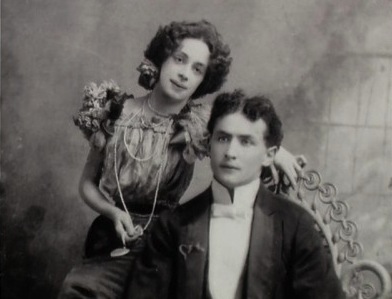
Here's one last thought. I have seen evidence in Ken Trombly's collection that the famous photo below, frequently misidentified as being Houdini first theatrical photo (far from it), was taken around the time of the Houdinis tour with the Rogers' Orpheum Stars in 1897. In fact, this photo might have been taken expressly for this tour. So should we stop thinking of this image as being "Houdini" and instead consider it a rare pic of "Mysterious Harry"?


Below are more links related to The Houdinis early career.

Related:

Sunday, July 29, 2018

'Women in the Golden Age of Magic' at New-York Historical Society, Aug. 2

Author Margaret Steel will give a talk on "Women in the Golden Age of Magic" at the New-York Historical Society on August 2. This is part of the museum's special "Summer of Magic" programing.

Women in the Golden Age of Magic
FEATURING:
Margaret Steel
Thu, August 2nd, 2018 | 7-8 pm

EVENT DETAILS
In the 1880s, women exploded into the world of magic when Madame Adelaide Herrmann replaced the traditional boy assistant as the first glamorous female illusion partner. Many followed in her footsteps, including her famous contemporaries Bess Houdini and the spectacular illusionist Dot Robinson. In 1899, following the sudden death of her magician husband, Madame Herrmann shocked the world by stepping into the magician’s role herself as vaudeville’s Queen of Magic. That same year, Talma, the Queen of Coins, debuted her own magic act in England. Join us as historian and magician Margaret Steele explores the lives of these pioneering women and their influence on the work of contemporary women in magic. Book signing after the program
Margaret Steele is the editor of Adelaide Herrmann Queen of Magic.
TICKETS
Click here to buy tickets at the event page or contact New-York Historical's call center at (212) 485-9268. Advance tickets may be purchased on site at New-York Historical’s Admissions desk during museum hours.

The New-York Historical Society's Summer of Magic: Treasures from the David Copperfield Collection exhibition features rare treasures from the Golden Age of Magic, including Houdini's original Milk Can, Metamorphosis trunk, straitjacket, Bess's stage coat, and the Mirror Handcuffs (the first time the cuffs have been shown publicly in some 20 years). The exhibition runs through Sept. 16, 2018.


Related:

Saturday, June 3, 2017

Remembering James Hamilton

Last month I was shocked and saddened to learn that James Hamilton had passed away. James was a wonderful man who was Wild About Herrmanns. He even looked like Herrmann! I always enjoyed seeing James at the Magic Castle and at magic conventions. I felt we were kindred spirits in our devotion to a single magician, and I always asked him what was new and happening in the Herrmann world. To be standing with him when he got his first good look at the magnificent Matthew Brady portrait of Alexander Herrmann at the last L.A. Magic History Conference was a real treat.

It was also James who provided me with the Jesse L. Lasky quote: "[Houdini] did his best acting handcuffed and locked in a trunk at the bottom of a river." I would frequently tell him that his line was still getting the biggest laugh of my lectures. He always liked that. It also seemed like every time I saw him he was in the midst of sharing. Whether it be his knowledge, items from his collection, or just his own great joy and enthusiasm. In fact, I believe I first met him while he was helping a young historian with information about Adelaide Herrmann for her college dissertation on Women in Magic. That was James.

Yesterday at the Magic Castle, I heard someone say, "James is now with Alexander." I do like the idea that Herrmann is now sharing with him.

Items from James's Herrmann collection will be auctioned by our friends Haversat & Ewing Galleries on June 23-24.

Related:

Thursday, April 14, 2016

LINK: Houdini, Martin Beck, and Herrmann in Cincinnati

The new blog on the block, Houdini & Hardeen, has uncovered some terrific information about Houdini, Martin Beck, and magician Leon Hermann in Cincinnati in December 1899. Quite the confluence at a key time in Houdini's life and career.

I'll let you click the headline and discover the story for yourself. Know there's info here that I don't we've heard before, and that our favorite kind!

At last weekend's big Potter & Potter auction a collection of early letters from Martin Beck to Houdini sold for $26,000.

UPDATE: Unfortunately, it looks like the Houdini & Hardeen blog is no longer online.

Related posts:

Wednesday, February 10, 2016

Houdini and Brindamour: Showdown in San Francisco


Magic historian Gary Hunt, who blogs at Magic Footnotes and has made a specialty of researching escape artists of Houdini's era, has uncovered a story about Houdini and a rival "Handcuff King" that I don't think has ever appeared in print before. I'm excited to share that story today.

In September of 1907, Houdini was appearing in San Francisco at the Orpheum Theatre on Ellis Street near what's known as the Fillmore District. The Orpheum had relocated to the area while downtown was being rebuilt after the devastating earthquake and fire of 1906. Right next door to the Orpheum was another vaudeville house, The Princess.

During the final week of Houdini's engagement, a rival escape artist, Brindamour, was booked into the Princess Theater. Below is a photo from Brindamour's own scrapbook showing the side by side theaters at this time. In fact, you can see a Brindamour poster in front of the Princess.

Click to enlarge.

George W. Brindamour was born to French Canadian parents in Cannon Mills, Minnesota on April 5, 1870. A one time photographer, Brindamour began performing handcuff escapes at the turn of the century. He claimed to have been the originator of the handcuff act. With his mustache and goatee, it was said he also sometimes doubled on stage for Herrmann the Great (presumably Leon).

In 1900, when Houdini was first finding success in the U.S. under the management of Martin Beck, Brindamour twice appeared in opposition theaters in Providence and Philadelphia offering an exposé of Houdini's act. Soon Houdini was off to Europe and super stardom; but his absence allowed Brindamour to gain a foothold in America vaudeville with his own version of the handcuff act.

Gary reports that a confrontation between Houdini and Brindamour had been building during the summer of 1907. The men sniped at each other in the pages of Variety, which ran an ad touting Brindamour's $1,000 per week salary as the highest ever paid by the Western States Vaudeville Association. Rumor had it that the William Morris Agency had signed Brindamour to play against Houdini who had recently signed with a rival agency. As if to tweak Houdini even more, the Princess advertised Brindamour as "King of All Handcuff Kings." Variety predicted that "fur should fly" when the two rivals finally met in San Francisco.


So did Houdini march over to the Princess with his Bean Giant, Mirror Cuff, or one of his other "handcuff king beaters"? Did he send confederates to gum up Brindamour's act or knock down his advertising? (Recall Houdini once allegedly threatened to shoot down a balloon advertising Blackstone that flew within sight of his own theater.)

The September 21, 1907 issue of Variety reported what happened:

Jail Breakers at Peace
Despite the predictions of open warfare when the rival jail breakers (Houdini and Brindamour) came into as close a competition as they were last week in this city, the dove of peace reigned supreme over Ellis street. Both lock defiers pursuing the even tenor of their ways as though oblivious of the other’s existence.

Anticlimactic, I know, but that's also what makes this interesting. Why didn't Houdini go after Brindamour (or vice versa)?

Well, in 1907, Houdini was already looking beyond handcuffs and jail-breaking as his bread and butter. His feature that week was a challenge to escape from a box made by employees of the Emporium department store. The week prior he had escaped from a paper bag without tearing the paper. In fact, while Brindamour's was billed as King of all Handcuff Kings, Houdini's billing at the Orpheum was: "Houdini in New Sensations." So Brindamour might have seemed less of a threat to Houdini at this time, and to have engaged him would have just given him publicity. The best way to hurt Brindamour (and William Morris) was to do nothing.

But it's also possible Houdini and Brindamour might have made a truce. It's possible both men could sense that a spat over who was the superior "handcuff king" might seem trivial and petty to citizens of a city that was still digging out from one of the worst catastrophes of the 20th century.

After San Fransisco, Brindamour and Houdini never again crossed paths, and Brindamour would meet what The Santa Cruz Sentinel called his "waterloo" just a few weeks later in Sacramento.


Brindamour keep doing the handcuff escape act long after it went out of fashion. When bookings got slim, he would sometimes put on a full evening show or just do magic. He performed on all the major vaudeville circuits through the 1920s. He retired to Los Angeles in 1930 and was said to have played character roles in movies. George Brindamour passed away on July 31, 1941 at the age of 71.

Today the Orpheum and Princess are long gone, and Ellis Street has been subdivided with a shopping center and condos. (I visited the area last Halloween while I was in San Francisco for the Official Houdini Seance.) But it's fun to know that, for one week in 1907, Houdini and Brindamour shared the street as co-handcuff kings.


Thank you Gary Hunt for this story, photos, and additional background information on Brindamour.

Related posts:

Tuesday, January 12, 2016

Spectral Motion reveals Dante bust

Spectral Motion will add Dante (Harry Jansen) to their series of bronze busts of great magicians. Dante joins Houdini, Harry Kellar, Alexander Herrmann, Chung Ling Soo, Howard Thurston, and Robert-Houdin.

It's become sport to recommend magicians to Spectral Motion owner and Magic Castle member, Mike Elizalde. I've been pushing for Blackstone and Doug Henning myself.

You can see all the famous magicians busts and pre-order the Dante bust at the Spectral Motion website.

Related:

Friday, November 13, 2015

REPORT: Inside the L.A. Conference on Magic History

Last week I had the great pleasure of attending the 14th Los Angeles Conference on Magic History (my first). So much went on during the 3-day conference that I'll leave it to traditional magic journals such as Genii to properly detail all that hosts Jim Steinmeyer, Mike Caveney and John Gaughan brought attendees this year. Instead, I'll focus on the Houdini highlights.

Thursday, November 5th

The conference had two major Houdini events this year. The first came on Thursday when Houdini himself made an appearance in the form of Casey Wong's amazingly life-like Houdini figure (which you might remember from this post).

Casey gave a talk Thursday afternoon and spoke at length about the creation of his Houdini figure. It was a excellent lecture with photos of every step in the process. The time and effort that went into creating Harry was tremendous -- every hair on his head was individually inserted, for example. Casey explained that he made his Houdini taller than life-size (he's 6-foot) because he wanted to depict Houdini "as he saw himself." Much has been made of Houdini's pale appearance. Casey explained that the idea here was to depict Houdini onstage, so his pale visage is pancake stage makeup.

The Houdini figure was set up in the conference museum. It was certainly a popular display, with attendees taking photos and selfies with the Master Mystifier all weekend.


Other Thursday lectures included Bill Becker on spirit photography; Trevor Dawson on Signor Arvi; Richard Hatch on Dr. Kurt Volkmann; and a thought-provoking talk by Peter Lamont on the history of magic and witchcraft, and why we may have been getting that history all wrong.

I should say that nearly every talk throughout the conference had a reference to Houdini. One of my favorites came during the Thursday lecture by Dean Arnold and Ken Trombly, who spoke about how they recently uncovered a large cache of Chung Ling Soo posters in England. Dean, a pilot, told an amusing story of how he inadvertently invaded an airport's airspace when he flew himself to the site of the find. When Ken asked if he had a photo of his plane, Dean brought up a photo of Houdini's Voisin.

Speaking of aviation, Joe Hanosek gave me a nice photo of Houdini flying his Voisin. It's not an original, but it's a nice clear shot of the plane in flight that I will use on future posts. Joe also gave me a copy of his new booklet, Houdini!!! in Columbus, Ohio.

Friday, November 6th

On Friday, before the afternoon lectures, a group of us snuck out to The Magic Castle for lunch in the Houdini Seance Room (of course!). This gathering of "Houdini Nuts" has become a tradition whenever the mighty Arthur Moses comes to town. It's also a tradition for Arthur to bring a creative gift for the Nuts. This time it was a bag of nuts! Another thrill was that the great Patrick Culliton joined us and held court as only "Houdini's Ghost" can do.

One of the perks of being invited to the L.A. History Conference is having access to the dealers' room. These are magic's top sellers, and the room is a museum in itself. But it's also where one can buy some rare pieces typically only encountered at auction. I hadn't planned on buying anything, but then I remembered my "Moses Buy" philosophy... Buy one quality Houdini item a year.

I found that item at the table of a legend himself, Ken Trombly, collector and proprietor of MagicPosters.com (flip through the Kalush book, and if there's a photo of Houdini you've never seen, chances are it came from Ken's collection). Ken shared with me a binder filled with original Houdini challenges. I could not resist what I considered the best in the book. You can see my new treasure below.


The Friday lectures were largely Houdini-free, but still fascinating. One of the reasons I go to magic conventions is to learn about other magicians. Bill Spooner discussed the long career of African-American magician Eugene Hellman. Dale Lorzo covered Edwin H. Brush. Bill Liles spoke on Raymond Phillips, Magician of the Radio Waves. Steve Valentine discussed the Cards to Pocket routine (he's wild about C2P!). Bill Becker talked Matthew Brady & Herrmann (more on this below), and our friend Bill Mullins gave a great lecture on gambler Kid Canfield.

The grand finale was Jim Steinmeyer's recreation of Kellar's Blue Room and Self-Decapitation Illusion, with Nicholas Night playing the part of Harry Kellar. Getting the opportunity to see lost illusions from the golden and pre-golden age of magic, recreated for one night only, is what the L.A. Magic History Conference is all about. Unforgettable.

Another highlight on Friday was the announcement of an amazing new find, and even though this isn't Houdini-related, it's too incredible not to detail. Speaker Bill Becker revealed he had discovered in a private collection the negative of a never-before-seen portrait of Alexander Herrmann, taken by the famous Civil War photographer Matthew Brady. What's even more incredible is that the photo is of such high resolution that one can make out Brady and his studio in the reflection of Herrmann's eye.

A large print was made for the conference and displayed in the museum after the Friday night talks. I don't know what the future holds for this image, but it was a beautiful thing to see. Even Herrmann expert James Hamilton said it was the best portrait of Alexander he had ever seen.


Saturday, November 7th

On Saturday we took a field trip to Spectral Motion in Burbank, owned and operated by Mike Elizalde. Spectral Motion is a practical special effects house that creates real movie magic, especially creature costumes and animatronics, for major films such as Hellboy and Hansel and Gretel. But magic fans might recognize Spectral Motion as the makers of a series of beautiful bronze busts of master magicians. During the tour of the workshop, I spied a familiar face looking down from a shelf of original clay molds.


The big Saturday night show saw lectures and performances by John Gaughan (Automata in the Movies), Gene Anderson and Jack Goldfinger (The Torn and Restored Newspaper), John Carney (as L'Homme Masqué), and Mike Caveney who performed John Daniel's "Sawing A Lady in Half" and Maurice Rooklyn's "Birth of a Pearl" using the original apparatus. Saturday also saw the second big Houdini feature of the conference. This was the surprise appearance of Q the Automaton from The Master Mystery.

I've already shared details and a film clip of Q's invasion HERE. Below is one more photo of the Automaton mingling in the courtyard of the Garland hotel after Friday's lectures. Q was played by Jeff Chang whose eyes you can see through the mouth. During his talk, John Gaughan showed how you could see this in the original film. I never realized that the actor was looking through the mouth, but this was a clever way to add a foot or more of height to the robot. Needless to say, the Automaton was a monster hit!


The conference itself was filled with magic luminaries. I was thrilled to meet Lance Burton, and I almost fell over when he said knew my blog and even specifically recalled my post on the Buried Alive. Other recognizable faces were: Ricky Jay, Mac King, Max Maven (who gave me a rivet that popped off the Automaton), Bill Kalush, David Ben, Julie Eng, Adele Friel Rhindress, Rob Zabrecky, Jonathan Pendragon, Erika Larsen, Lisa Cousins, Joe Fox, and many more names and faces familiar and famous. What a magical weekend it was.


Related:

Monday, July 20, 2015

"I don't drink, smoke or chew"

Last month I saw the Houdini miniseries receive an IIG Award at the Los Angeles Center For Inquiry. During the reception, I was excited to discover that the CFI has several framed letters on display from Houdini's early career. These are copies of originals from a rare document collection in Santa Barbara, and are letters that I've never seen before.

The letter below I found especially interesting. It appears to be the second page of letter in which the young Houdini pitches himself for work.

Click to enlarge.

There's a lot to love here. It's a really interesting mix of bravado and humility. First off, notice that the stationary says "6th Annual Tour - 1890 to 1896." The Houdinis act began with their marriage in 1894, only two years earlier. Possibly Houdini is including his own first appearances on stage, which were around 1890. But this shows just how important it was at the time to be perceived as a "seasoned" act.

I'm also intrigued by the claim that "Herrmann the Great stole the idea for our act from us and he featured it." Alexander Herrmann was by far the most famous magician of the day (and was also indirectly related to Houdini). It's hard to know exactly what "act" Houdini is referring to here. The obvious candidate would be Metamorphosis. But while Herrmann did substitution illusions such as Indian Mail, Asiatic Boxes, and Lost Strobeika, they don't seem similar enough to be considered a lift. It's possible Houdini is referring to the mind reading act he did with Bess, a version of which Herrmann did perform. But claiming this as an original creation is a stretch. So this accusation is a bit of mystery. (Herrmann would die the year this letter was written.)

Finally, you gotta love Houdini's line: "I don't drink smoke or chew and we are good useful people, dress fair and willing workers." This really gives a feel for the frontier world Houdini lived and worked in at this time.

Today we tend to think of everything before 1900 as a prelude to Houdini's real career -- the struggle. We also tend to ascribe this thinking to Houdini himself, that all was in service of some future point of success and fame. But the sense I get from reading this letter is that Houdini already considered himself a success. The kind of worldwide fame Houdini would later achieve was born of 20th century mass media and might have been inconceivable in 1896. Houdini couldn't see the future (as far as we know!), so his life on the road with Bess at this time was his career -- his 6th Annual Tour, in fact. So successful even Herrmann The Great steals from him!

A fascinating letter and a nice surprise discovery at the CFI.

Thanks to Herrmann expert James Hamilton for help with the Herrmann info.

UPDATE: In the chapter about Metamorphosis in Houdini's Fabulous Magic, Walter Gibson refers to Herrmann's "Asiatic Trunk Mystery" which he was "presenting at the time of his death in 1896." Hermann billed it as his "Original Oriental Mystery" -- words that seem very similar to what we see on this stationary. I'm now convinced the Asiatic Trunk Mystery was the act that Houdini felt Herrmann stole from him.

Thursday, June 26, 2014

S.A.M. exhibition disappearing in July

If you haven't seen the Society of American Magician's Hall of Fame collection at the Whittier Historical Society & Museum in Whittier, CA, know that the clock is ticking. The exhibition will be closing after a "Grand Finale Magic Show" event on July 19.

The exhibition, which opened in 2012, features an impressive display of rare Houdini artifacts, including a dress worn by Bess, Houdini's die box, a brick from 278, and three handcuff displays created by Edward Saint in 1936. On one of these boards is the original Russian Manacle and key. This was a handcuff custom made by Houdini at the height of his Handcuff King career, and along with the Mirror and the French Letter Cuff, is probably the most famous and recognizable Houdini handcuff.


There are some amazing non-Houdini magic artifacts in the exhibition as well, including; T. Nelson Downs' top hat, Cooke's own linking rings with carrying case, and Alexander Herrmann's original cups and balls. There are also some beautiful original Thurston posters.

It's unclear if the collection will move to a new location or go back into storage.

The Whittier Museum is located at 6755 Newlin Avenue, Whittier, CA 90601. Admission is free, but you might to call ahead and make sure the exhibition is open that day. I've heard tales of people traveling there only to discover the exhibition doors locked. Also, the light had been burned out in the Houdini case, making it impossible to see the items inside. Hopefully that has been corrected.

Related:

Wednesday, August 7, 2013

Houdini Begins

When did Harry Houdini become a magician? The answer is not always clear. While there are many tales of young Ehrich Weiss performing acrobatics and magic in five cent circuses in Wisconsin, most serious Houdini biographies attribute the start of his magic career with his reading The Memories of Robert-Houdin in 1891.

But according to the remarkable book, Sixty Years of Psychical Research, written by Houdini's boyhood friend Joseph F. Rinn in 1950, Houdini was giving semi-professional magic performances two years before he ever read the Robert-Houdin book. Rinn's recollections begin on page 65:

[In 1886] I joined the Pastime Athletic Club, which had grounds at Sixty-seventh Street and the East River, where I quickly developed as a runner. I became captain of the club and was its champion sprint runner in 1889, when a new member joined by the name of Ehrich Weiss, who later became famous as Harry Houdini, the magician and escape artist.

As Weiss was ambitious to win a running prize, he turned to me as captain for advice, and under my instruction he trained and won his first prize.

At the time, Weiss (or Houdini, as I shall henceforth call him) was making and lining ties at a low wage for H. Richter's Sons. His ambition to be a boy magician was curtailed by lack of funds for the purchase of paraphernalia, for performances he gave after working hours at small social affairs and in public schools.

When Houdini learned that I was a magic fan and a friend of the Herrmanns, we became good pals.

In the spring of 1889 Houdini has another friends in his shop, named Jacob Hayman, who was a magic fan, and they frequently worked together, giving amateur magic performances.

On April 30, 1889, Houdini informed me that he and Jack Hayman were booked to give a magic performance at some social affair. "I guess we'll make a flop of it," said Houdini ruefully, "because we haven't enough paraphernalia."

"Oh, I can remedy that," I said, "Come over to Martinka's with me and I'll make you a present of some magic apparatus. Consider it my Christmas present," I added, as Houdini was quite proud and touchy about money matters."

As this is before Houdini's exposure to Robert-Houdin, I wonder what named he and Jack used at what sounds like their first professional engagement?

Later in the book, Rinn recalls when his friend read that seminal work of magic and truly set off to become a professional magician:

It was early 1891 that Ehrich Weiss read The Memories of Robert Houdin, the French magician, and determined to become a professional magician under the name of Harry Houdini, which name he legally made his own at a later date.

A short time after he made his decision, he said to me, "I've made up my mind, Joe, to quite my job and become a professional magician under the name of Harry Houdini."

"But Ehrich, you are only seventeen," I protested. "Isn't that rather young to give up a good job for an uncertain theatrical career?

Houdini replied, "It may seem daffy to a solid businessman like you, Joe, but I've the urge in my blood to be a professional magician and nothing can stop me."

"Well, it's your funeral, Ehrich," I said resignedly; "but get a recommendation for your present employer in case you can't make a success of being a magician."

A few days later Houdini saw me and reported: "Well, I've quit my job, Joe. I followed your advice and got a recommendation. Here it is." I read the letter, which I now possess.


H. RICHTER'S SONS
502 & 504 Broadway

New York, April 3, 1891.
To Whom It May Concern:

We hereby certify that Mr. Ehrich Weiss has been in our employ for two years and six months as assistant lining cutter and we cheerfully recommend him as an honest, industrious young man.
H. Richter's Sons

It's interesting that this oft quoted recommendation letter found its way into Rinn's collection. He doesn't say how he got it, but I can imagine Houdini giving to it to his friend once he had achieved fame as The Handcuff King. Maybe he even gave it to him as "a Christmas present."

Joseph F. Rinn (Library of Congress Collection)

Saturday, July 27, 2013

Houdini Challenge poster and other rarities sell at Potter & Potter

A nice oversized Houdini Challenge poster sold today at Potter & Potter's "Summer Shelf Sale" of magic books and memorabilia for $2,640 (including 20% buyers premium). The auction estimate was $2,000 - $2,500. According to an auction watcher at the Thayer forum, the poster "had at least two aggressive phone bidders."

The 1916 14 x 22 poster advertised a challenge to Houdini from U.S. Navy Chief Petty Officers to escape from handcuffs and manacles brought to the New York Hippodrome. As this was during the first World War, this could be considered as a Houdini-World War I item. The auction correctly pointed out that most printed matter relating to Houdini's challenges are small handbills, so the size of this adds to its appeal. I also really love the disclaimer at the bottom: "The Challengers have been absolved from all blame in case of accident."


The auction also saw the sale of a portrait photo of Houdini posing with his book, The Unmasking of Robert-Houdin for $420. A 1924 letter from Houdini on S.A.M. stationary calling for a meeting at his home to discuss the issue of "exposures for publicity" sold for $840. (This was an issue Houdini found himself in hot water over more than once.)


The small candid photo of Harry and Bess Houdini, which I speculated here could be the only photo of them at their Laurel Canyon bungalow in Hollywood, sold for $960. It blew away the auction estimate of $200-250 (and my own humble bid -- sigh).


The auction also had an interesting Howard Thurston letter dated November 15, 1926, in which the magician writes:

"Papers are full of Houdini taking his secrets to his grave. You know that is not true and it belittles the remaining magicians."

That letter sold for $1,140.

Among the non-Houdini highlights were an inscribed portrait of Leon Herrmann ($3,360), an Alexander Herrmann Throw-out card ($1,320), and a Harry Kellar "Centipede" poster which brought in the highest price of the auction, $7,800.

Congrats to all the buyers.

Thursday, July 25, 2013

Is this Houdini and Bess in Laurel Canyon?


This intriguing candid photo of Harry and Bess Houdini will be auctioned by Potter & Potter this Saturday, July 27, as part of their Summer Shelf Sale. The auction includes almost 1000 collectible and contemporary magic books, as well as Herrmann, Kellar, and Houdini memorabilia, including a nice Challenge poster.

This photo excites me for several reasons. First, I've never seen it. Also, you gotta love the parrot on Bessie's shoulder. (Possibly "Laura" or "Pat Houdini". See: Houdini's pets.) But it's the location of this shot that has me most intrigued.

The catalog listing says circa 1924, but the auction house tells me that's just a guesstimate. To my eye that looks like Houdini with his black-dyed silent movie hair. He also appears dressed as he was in his Jesse L. Lasky "Extreme Houdini" publicity photos. That means this could be Houdini and Bess in Hollywood in 1919 while he was making The Grim Game (the auction house has now changed the date on the online listing to 1919).

So if this is Hollywood at that time, is it possible that this is the first and only shot of Houdini and Bess at their rented bungalow in Laurel Canyon? Could this be the "smoking gun evidence" that I spoke about in my lengthy post about the famous "Houdini Estate" last year? Those trees do look a lot like Laurel Canyon to me (I used to live there), and the house on the right does look to be in the style of a canyon home of the time.

Unfortunately, the consignor of this pic wishes to remain anonymous, so no clues where this photo came from. If only that parrot could talk.

Potter & Potter's Summer Shelf Sale auction takes place on July 27, 2013. The auction catalog can be downloaded as a PDF from the Potter & Potter website.

Thanks to Adam Steinfeld for the find and Gabe Fajuri for the auction info.

UPDATE: The photo sold for $960. See: Houdini Challenge poster and other rarities sell at Potter & Potter.

Sunday, December 16, 2012

Doug Henning and Houdini's glasses

I'm all about Doug Henning this weekend. Not only was yesterday the anniversary of his 3rd NBC special, but I've also I've just finished reading John Harrison's excellent biography, Spellbinder: The Wonder-Filled Life of Doug Henning.

I really think this book is essential reading for anyone interested in magic history. In fact, I'd even go as far to say that it's as important as The Memories of Robert-Houdin in understanding how a single magician advanced the art of magic from one golden age to another. I also applaud Harrison for his amazing research and for telling the story of Henning, who I don't think always gets the credit he deserves. I put Henning right up there with Houdin, Herrmann, and Houdini as one of the seminal figures in magic history. I think that will become more apparent with time.

Anyway, Houdini is mentioned several times in the book, including this intriguing paragraph on page 147 which provides a kernel of info that I don't think has ever been published before. Houdini wore glasses?

Doug wanted to make sure [chief assistant Dale] Soules knew how much he cared for her. While appearing in The Magic Show, Doug met Houdini's niece by marriage, Ruth Kavanaugh, while doing research for a book about Houdini on which he was collaborating with Charlie Reynolds. Kavanaugh took a liking to Doug and, as a gift, presented him with an exquisite pair of Houdini's reading glasses. The sterling silver frame was attached to a little handle with a secret catch. When you pressed the catch, the glasses opened up into a full sized lorgnette. Before leaving The Magic Show, he wrapped the precious spectacles in a small box with a silk bow and gave them to Soules as a gift. She treasured the glasses, but sadly, they were stolen after a performance of her one-woman show, which featured a scene about Doug, The Magic Show, and Houdini's glasses.

The mention of a full sized lorgnette gives me pause. A lorgnette (a long vertical handle for holding the glasses to your eyes) is typically associated with women's glasses of the period. Is it possible these were actually Bess's reading glasses? Or maybe they had come from Houdini's magic collection and had belonged to someone like Adelaide Herrmann?

Nevertheless, it's interesting to think Houdini might have worn reading glasses. I'd love to see a photo of Houdini in his glasses. I'd also love to know where these long lost glasses are today.


Purchase Spellbinder: The Wonder-Filled Life of Doug Henning by John Harrison on Amazon.

Friday, November 23, 2012

Houdini's lost levitation


There's a moment in Paramount's 1953 Houdini biopic when we see Harry (Tony Curtis) doing a classic levitation with Bess (Janet Leigh). The levitation is one of the most iconic tricks in all of magic, so of course the filmmakers wanted to include a shot of Houdini performing the effect. The image even made the poster. Trouble is, there is no record (that I can find) of Houdini ever doing a levitation, so I've always chocked this up to just another fictional embellishment of the film.

But now it looks like the Curtis movie had it right (without knowing it). Turns out Houdini did indeed perform a traditional levitation with Bess early in his career. This fresh revelation comes from the new book, The Metamorphosis: The Apprenticeship of Harry Houdini by Bruce MacNab (see, I told you this book rewrites Houdini history).

Here's the story...

When Harry and Bess set out as part of the Marco Magic Company's tour of the Canadian Maritimes in 1896 (the subject of Bruce's book), one of the headline effects of the show was a levitation. At the time, it was fashionable to tie-in the levitation with the popular novel Trilby by George du Maurier (as Alexander Herrmann had done). Onstage "Marco", aka Edward James Dooley, played the part of Svengali with Bess as his hypnotic subject, Trilby. Bess/Trilby would be laid on a plank across two chairs. On Marco/Svengali's command, the chairs would be removed and Bess with remain suspended in mid air. It's possible Houdini, who doubled as an assistant in the troop, might have operated the complex levitation apparatus behind the scenes.

But when the Marco show failed and folded and Dooley went home to the U.S., Harry and Bess continued the tour with their own act. Many of Marco's props had been confiscated for non-payment of bills, but somehow Houdini was able to salvage a few pieces of equipment, including his own Metamorphosis trunk and the Trilby levitation.

So when The Houdinis performed their act in several Maritime cities, along with handcuff escapes and Metamorphosis, audiences saw "Mysterious Harry" and "Le Petite Bessie" doing a classic Trilby levitation as part of their show. In fact, a review of The Houdinis act at the Moncton Opera House singled out the effect for praise:

"Trilby, or the mystery of Mahomet, in which a human being actually floats in space without any visible means of support, was one of the startling features of last night's evening's performance."

But it looks like the levitation would be unique to Harry and Bessie's Canadian adventure. When they booked passage home abroad the steamship S.S. Yarmouth, they couldn't even afford the price of a ticket for themselves, let alone heavy cargo. The Metamorphosis trunk made the trip, but it appears the Trilby levitation remained behind in Nova Scotia.

(Interestingly, Howard Thurston patented a "Trilby" levitation in 1927, although I expect Thurston was using a completely new and much more complex method.)

So there we have it. Harry Houdini did indeed perform a traditional levitation with Bess, if only for a short time. So now the question remains -- what ever happened to Houdini's levitation apparatus? Also, how awesome would it be if we could find a photo of the young Harry and Bess performing the effect...just like Tony and Janet 57 years later.

Bruce MacNab's The Metamorphosis: The Apprenticeship of Harry Houdini can be purchased on Amazon.com or direct from Goose Lane Editions. For more about the history of the levitation illusion, enjoy this episode of the BBC documentary, History of Magic.


UPDATE: Houdini's Trilby levitation is mentioned on page 1 of Houdini The Key by Patrick Culliton. So it's Patrick -- who also wrote the forward to Bruce's book -- who deserves the credit for first bringing this information to light.

UPDATE 2: Eric Fry reminds me that Houdini put the secret of the Trilby levitation up for sale in his 1898 magic catalog, Magic Made Easy. Price: $1.00

The Original Houdini Scrapbook

UPDATE 3: Want to see a photo of Houdini doing a levitation? Here you go.

Tuesday, September 18, 2012

Russian Manacle and other Houdini rarities in Whittier

Houdini in the Russian Manacle
Houdini's famous "Russian Manacle" are among the items from the Society of American Magicians Hall of Fame and Museum currently on display at the Whittier Historical Society & Museum in Whittier, CA. The exhibition is called Behind Smoke and Mirrors: The History of Magic and Illusion and features an impressive display of rare Houdini artifacts.

The Houdini display -- which sits in a booth behind glass -- includes a dress worn by Bess, Houdini's die box, a brick from 278, signed photos, two original playbills and, most excitingly, three handcuff display boards created by Edward Saint in June 1936 (we know this because newspaper padding used in the boards bears this date). Two of the boards display authentic Houdini handcuffs and another is made up entirely of keys.

But what will be of most interest to Houdini fans is that affixed to one of the boards is the original Russian Manacle and key! This was a handcuff custom made by Houdini at the height of his Handcuff King career. Along with the Mirror and the French Letter Cuff, the Russian Manacle is probably the most famous and recognizable Houdini handcuff. There are several photos of Houdini in this cuff, and it's also featured on this famous poster. While handcuff collectors have crafted reproductions of the Russian Manacle over the years, this is the original. (Unfortunately, the museum does not allow photography, so I can't show it to you on display.)

The Whittier Museum hosted a very well-attended opening reception on Sunday with a magic show by SAM members and refreshments. I was there along with fellow Houdini aficionados Mark Lyons, Joe Fox, Jay Leslie, Jeffery Abraham, Mike Castle, and Mark and Sheila Cannon. Mark was able to examine the boards closely and provided me the information about the newspaper padding. He also pointed out that the keyhole slide on the Russian Manacle is now missing, and that all the cuffs on the board had been painted silver at some point, probably by Edward Saint so they'd look better on display.

While the Houdini items are certainly a major draw, not to be ignored are some of the other amazing magic artifacts on display. These include T. Nelson Downs top hat, Cooke's own linking rings with carrying case, and Alexander Herrmann's original cups and balls. There are also some beautiful original Thurston posters and a faithful reproduction of his colorful Sawing a Woman in Half illusion.

The SAM collection was originally housed in the basement of a Hollywood bank and viewable only by invitation. But in December 2004, an underground electrical blast contaminated the building with toxic PCBs and all access to the collection was sealed as the SAM settled with the LADWP over the cost of decontamination. This is the first time the collection has been displayed since the accident and the first time it has even been opened to the general public.

Behind Smoke and Mirrors: The History of Magic and Illusion runs through July 13, 2013. The Whittier Museum is located at 6755 Newlin Avenue, Whittier, CA 90601. Admission is FREE.

For more information on the collection and upcoming special events, check out the SAM Hall of Fame Facebook page and the official website.

Okay, maybe I did sneak just one pic...

Monday, August 27, 2012

Magicol, No. 183

The new issue of Magicol (No. 183) has arrived, and as always there's something in it for us Houdini nuts.

This issue is all about the joy of magic posters, and as you can see from the image on the back of the magazine (right), The Houdinis Metamorphosis poster is covered. Dr. Bruce Averbook selects this as his "dessert island" poster. "It gives me chills," he writes.

The "Houdini For President" poster is also featured in David Ben's terrific article on poster values. Something Gabe Fajuri writes about a Herrmann poster also applies here: "You know you're famous when your posters advertise who you are, not what you do."

The 43rd Magic Collectors Weekend in Chicago is also covered. It includes a nice mention of my own Houdini talk along with coverage of the big Friday night Houdini presentations by Arthur Moses and William Pack.

You can subscribe to Magicol at www.magicana.com.

Friday, May 18, 2012

REPORT: Houdini haunts The 43rd Magic Collectors Weekend

Click here to see cover #2
Last week I had the extreme pleasure of attending Magicana's 43rd Magic Collectors Weekend in Chicago, which this year offered an embarrassment of riches for the Houdini buff.

I knew this was going to be my kind of event when I saw that the official program featured Houdini on the cover. Actually, there were two programs printed with two variant Houdini covers. As you only got one in your convention pack, a weekend challenge was tracking down that second variant! Inside the program is the recently discovered Water Torture Cell photo from Scotland. This program marks the first in-print publication of this incredible photo.

I flew in late on Thursday afternoon, so I unfortunately missed the dealer show hosted by Tom Ewing. This is too bad, because from the photos I've seen, the show appeared to be filled with fun and magic. But I was there for the lively interview with the weekend's Guests of Honor, Richard Kaufman (editor of Genii and publisher of many books) and James Hagy.

A nice cocktail reception followed where I was able to meet and greet my fellow collectors. Some, like the legendary Mario Carrandi Jr., I was meeting in person for the first time after having corresponded with them for years. Speaking of Mario, at his dealer table he had Houdini's walking stick. The stick is inscribed to Houdini as a gift from Will Goldston. Price: a cool $25,000. Well, at least I got to touch it!

DAY 2

Arthur Moses with Houdini's
walking stick
Friday morning kicked off with James Hamilton giving a talk on the Herrmann dynasty. James is THE man when it comes to all things Herrmann. He even sports Herrmannesque facial hair. James spoke about Houdini's connection to the Herrmann family (via Blanche Corelli), and said that he thought it odd that Houdini never played up his relation to this famous magic family in his own publicity. (I agree. It is odd.) After the talk, James gave me his booklet about Herrmann and Jesse L. Lasky. Lasky produced Houdini's two Hollywood features, so it's interesting to learn about a Lasky-Herrmann connection. Following James was Will Houstoun, editor of The Magic Circular, who gave a very well researched and informative talk on the influence of magic playlets, including Prof. Hoffmann's King Koko.

After a short break, it was my turn! Now I can finally reveal the nature of my talk. A few months ago I was contacted by MCW organizer David Ben and the tireless Julie Eng who asked if I would like to give the attendees a look at a remarkable Houdini artifact they had unique access to. This was the actual guestbook which sat inside Houdini's home at 278 W. 113th St, and later Bessie's residence at 67 Payson Avenue, from 1919 to 1975. Inside are an amazing collection of some of magic’s most famous names; Thurston, Dunninger, Powell, Horace Goldin and many, many more. There are also some intriguing historical gems, like Houdini's sister Gladys signing her name as "Gladys Houdini" and the revelation of a hitherto unknown séance! (I'm going to blog more about this mysterious séance at some point).


Armed with a copy of this amazing guestbook, I worked up a presentation called "Guests & Ghosts of 278." To introduce the book, I first showed photos of Houdini's New York home, including photos of the inside of 278 today (the story of how I got these and why I can't post them here on my blog got a nice laugh). I then paged through the book via a big screen Keynote presentation, showing some of the famous names and offering some background and speculations, etc.

I've gotta say, I've never done anything like this before. Two months ago I had no idea how to use Keynote. I didn't know if it would work, if I would freeze and forget everything, or even how much time I was allotted or I would take. But I think it went wonderfully well, and I was moved that so many of my fellow attendees went out of their way to tell me how much they enjoyed it afterwards. Whew! I really appreciate David and Julie giving me the chance to do this talk. This is something I'd love to do again, as I tweeted immediately after the presentation:


After lunch we returned for a terrific lecture by David Charvet on "Emil Jarrow: The Humorist Trickster". One of the reasons I love attending events like the MCW is that I get to learn about magicians other than Houdini. I admit I had never heard of Jarrow until this weekend. Again, terrific stuff!

David Ben than gave a fascinating talk on Max Malini, "Uncited Sources - The Rise & Fall of Max Malini". Now, I had heard of Malini, but I really didn't know much about his life and work, which turned out to be very interesting indeed. This was followed by a special screening of a filmed panel discussion about Charlie Miller "by those who knew him best". Unfortunately, this was the only event that I missed as I was crashing after all the pent up energy I had for my own talk, and I had to sneak back to my room for a quick nap before dinner. Besides, I wanted to be fresh for the BIG night.

That BIG Friday night kicked off after a dinner break with the great William Pack giving a taste of his acclaimed Houdini lecture, complete with props. Bill puts on these talks in libraries and schools across the country. His presentation is very entertaining and dramatic, and I was grateful for all the advice Bill gave me on doing Houdini lectures (as I now have the bug). Bill has also published a 130-page book that he sells at his talks, The Essential Houdini, which of course I had to snap up!

Following Bill's talk was a screening of a remarkable archival copy of Houdini! - Witness to Yesterday. Witness to Yesterday was a half-hour Canadian series featuring Patrick Watson interviewing famous people from history. In this episode he interviews "Houdini" portrayed by Teller of Penn & Teller. It was really very well written (by Thomas Baxter) and performed, and I've yet to talk to one person -- including "Handsome Jack" Lovick who is THE Penn & Teller expert -- who even knows about the existence of this program. I respected the convention rules and did not snap any photos of the screen -- but I'll tell you that Teller looked pretty good in his Houdini wig. I really hope this sees the light of day at some point as it was a real treat.

Then came the highlight of the evening (and maybe the weekend itself). Arthur Moses took the stage and offered up his "game changer." In a talk called "Have You Heard It All?", Arthur played the complete Houdini voice tapes. I've already blogged about this here, but I'll just say again that hearing the full voice recordings was incredible! In essence, what we heard was over five minutes of Houdini's voice that is not available to the public and has only ever been heard by a handful of people.

A private listen
Afterwards I got a more intimate listen as I helped Arthur and his crew double check the transcriptions. I was struck by how Houdini's voice was even more heavily accented and his English even more broken than what we hear in the familiar 1:20 version (which is an edited combination of both recordings, as Arthur was able to demonstrate). The major difference between the two versions seemed to be that in one Houdini issues his $1000 challenge "to anyone who can prove it is possible to obtain air inside of the Torture Cell" and in the other he didn't; although there were changes in phrasing throughout. In the non-challenge version (I think) he signs off by saying, "This record spoken by Harry Houdini."

Unfortunately, I don't think Arthur will be able to release these recordings in any major public way. The same goes for the 278 guestbook and the Teller film. But that's why there are events like the MCW. Some things can only be shared in this way.

DAY 3

Saturday kicked off early with an open forum discussion moderated by David Ben. Here the future of the MCW was discussed, including the possibility of it becoming a bi-annual event and moving to different cities. After this, Loren Pankratz gave a very interesting talk on Reginald Scot's Discoverie of Witchcraft, which is the first English language book to describe the methods of magic.

"Magicienne" Dell O'Dell
Next up was magician (or "Magicienne") Julie Sobanski with her well-crafted talk on "Women in Magic". Julie is currently writing a book on her topic, and I really enjoyed her presentation, especially as I had just been to the Magic Castle's own celebration of Women in Magic Week. Why aren't there more female magicians? Julie got the biggest laugh of the convention when she proposed one theory: "Early maturity steers most girls away from magic."

Julie, by the way, is president of the Houdini Club of Wisconsin and an escape artist in her own right. She even performs a straitjacket escape in rollar skates!

After Julie came my friend and fellow Angelino, Diego Domingo, who gave a wholly unique talk called, "The Prophet, the Assassination, the Cult of Doom, and Top Hat Magic" (featuring Arthur Moses doing his best "hick" voice). It was a terrific talk that had the room laughing and gasping at the artifacts Diego has collected during his on-going quest to expose religious hucksters -- some of whom use store bought magic tricks to prove their divinity. Fantastic stuff!

After a short break, the mighty Max Maven presented his talk on "Magical Jews - By One of Them." This was the same talk Max gave at the Skirball Cultural Center last year during the Houdini Art and Magic and Masters of Magic: Jewish Magicians of the Golden Age exhibitions. As I missed that, I was thrilled to catch it here. Needless to say, it was excellent, even though Max warned us up front that he wouldn't be talking much about Houdini as "he has his own press."

After a lunch break came Trevor Dawson from the UK who gave a very well researched and informative lecture on "Charles Dickens: Conjurer, Mesmerist, and Showman". This was followed by Bill Spooner's "Remembering Rex Slocombe" which included his own personal recollections at just how talented and funny Slocombe was. And speaking of voice tapes, Bill played the only known recording of Slocombe doing his famous comedy magic act.

Next came a special drawing for five copies of "The Shroud of Vernon." These are numbered pieces of cloth "Cut from the Shroud of Vernon" containing the phantom image of Dai Vernon's favorite card, the Ace of Clubs. I never win things like this, so it was a great surprise when I won! I think Houdini was looking after me this weekend.

The Shroud of Vernon

Then came a screening of a documentary about Mark Wilson's groundbreaking The Magic Land of Alakazam, followed by a Q&A with Mark and Darnell Wilson themselves. It was a real thrill to see and hear one of the great magicians of my childhood, and a true pioneer of magic on television.

After a dinner break, it was back to "The McVicker's Theater, circa 1912" for "An Evening of Mystery: Magical Varieties". Here David Charvet MC'd the evening as Jarrow, and also performed an amazing spirit painting effect; David Ben did a terrific magic performance with cards; Mark Wilson surprised the attendees with a performance; and Max Maven closed the show doing card and mind reading that absolutely blew my mind!

A final dessert reception was held after the big show. And with that the 43rd Magic Collectors Weekend came to a close. What a magical time it was!


*MCW photos by Wayne Wissner. Magicana © 2012 All rights reserved.

Translate