Showing posts with label California Concert Co.. Show all posts

Tuesday, January 11, 2022

Houdini's nights in a bar room

In the book Houdini His Life Story by Harold Kellock, there is a tale of The Houdinis early career that I've always loved. It tells of how, in 1898, Harry and Bess joined a theatrical company and performed as actors in the popular temperance play, Ten Nights in a Barroom. But did this really happen? 

Let's start with the story as told in Kellock:

After Dr. Hill's outfit gave up the ghost, early in 1898, they joined a traveling repertoire show which specialized in blood-curdling melodramas. [...] Ever jealous of his professional prestige as a magician, he appeared in the melodramas under an assumed name, and in order that the audiences should not recognize the actor as the Great Houdini, he would play his part with a wad of paper stuffed in each cheek.

In the fine old repertoire standby, "Ten Nights in a Barroom," Houdini played Jim Morgan [likely a typo as the character in the book and play is named Joe Morgan], the paternal bar-fly, and Mrs. Houdini his little daughter Mary who pleaded, "Father, dear father, come home with me now." A rivalry had arisen between Mrs. Houdini and the titular leading lady of the company which did not add to the harmony of life. Mrs. Houdini knew that she was a better actress than the leading lady. The leading lady knew that she outclassed Mrs. Houdini. Their respective husbands had a difficult time.

In the course of devising bits of stage business to steal the leading lady's thunder, Mrs. Houdini secretly decided to adapt a realistic trick to the barroom scene. According to the traditional action, little Mary pleads with her father to go home; in a drunken rage he flings a bottle at her, and she falls comfortably on a fat rug and dies.

Mrs. Houdini filled a small rubber balloon with red ink and hid it under her curls. When Houdini as her father hurled the bottle, she slapped her hand to her brow and broke the rubber, and the red ink spurted over her face. "My God, Bess!" groaned Houdini, springing forward with a cry of terror that was not in the lines, and in his excitement swallowing both wads of paper. His wife had to come to life and explain the trick to him before the show could go on.

I know Kellock is filled with mythology and generally considered an unreliable source, but I've always believed this story. It tracks with their early career, and Bess's rivalry with the leading lady strikes me as a believable detail. Unfortunately, Kellock does not provide any verifiable details, such as the name of the company nor the time and place. But he does provide the clue that it came after The Houdinis stint with Dr. Hill's California Concert Company and before their second tour with the Welsh Bros Circus. That is a fairly narrow window of time. So over the Christmas break, I went in search of Houdini in the bar room!

The California Concert Co. disbanded in Cherryvale, Kansas, on February 5, 1898. Harry and Bess then travelled to St. Joseph, Missouri, where they played Bert Martin's Eden Musee, a dime museum located at 5th and Edmond, through February 20. You can see them in the ad below misspelled as The Houdins.
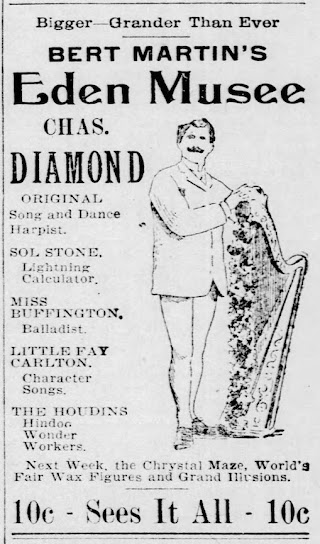
The St Joseph Herald, Feb. 10, 1898.

The Houdinis (or "Houdins") vanish from the Eden's bill the following week. But look what shows up in their place!
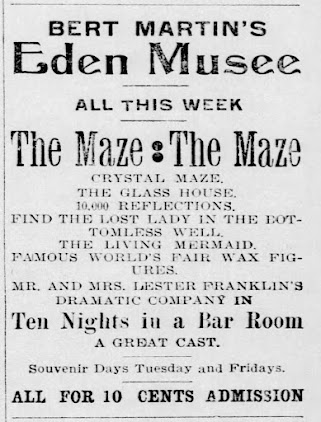
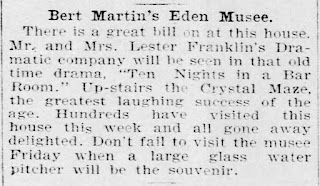
The St. Joseph Herald, Feb. 24, 1898.

This is almost certainly the production that Harry and Bess performed in. This is further supported by the fact that The Houdinis gave a one-night magic and spiritualism performance at the A.O.U.W. Lodge in St. Joseph on February 27, thus proving they are still in the city. I'm also assuming it was Mrs. Lester who was Bess's rival, confirming Kellock's account that the company's leading lady was married. Unfortunately, I've not been able to discover what alias Houdini used.

The below clipping from the St. Joseph Daily News indicates that the play used "attractive advertising". What a great Houdini collectible one of these adverts would be today. You would think Houdini, the great collector of theatrical memorabilia, might have kept one for himself. Might one be tucked away in the Harry Ransom Center?
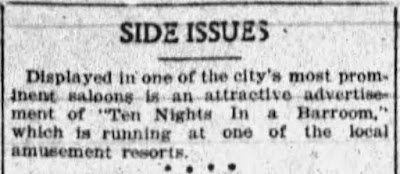
St. Joseph Daily News, Feb. 21, 1898.

Mr. and Mrs. Lester Franklin's Dramatic Company remained at the Eden for a second week with the play At Temple Valley. Did Harry and Bess remain as well? It's likely they did as I've found no evidence of them performing elsewhere. [*See UPDATE.]
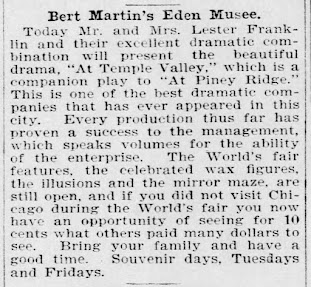
The St. Joseph Herald, Feb. 27, 1898

The theatrical company leaves the Eden the following week and I can find no evidence of it ever again. In fact, I could find no evidence of it before the Eden. So could this troupe have only existed for these two weeks in St. Joseph? The Houdinis would resurface at Middleton's dime museum in Chicago on March 14.

Unfortunately, these proved to be the final weeks for the Eden Musee itself. Despite offering giveaways and free tickets in the local paper, the Eden closed its doors on March 21, 1898. The manager of the nearby Wonderland museum briefly exhibited acts there. But in May it became a furnishing goods store.

Below is the intersection of 5th and Edmond today. I'm not sure exactly where the Eden sat, but could one of these surviving older structures be the building?


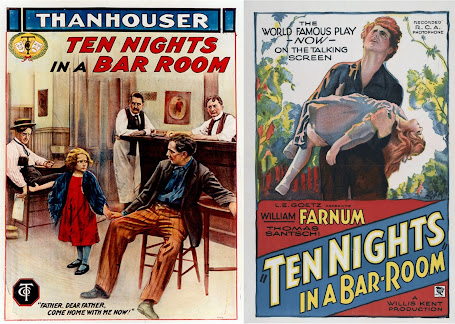
While Ten Nights in a Barroom was just a blip in Houdini's career, the play itself had a long life. It was even adapted as a film several times. Below are a two film posters showing Joe Morgan and the unfortunate Mary...once played by Harry and Bess Houdini!

UPDATE 1: Looks like the Houdinis did not spend that second week with the Franklin company. Houdini records in his diary that they took the week off and spent "nearly every night" enjoying plays at The Crawford Theater in St. Joesph. Thanks to Dr. Bruce Averbook for this info.

UPDATE 2: I've just discovered that Houdini also played Joe Morgan ("who has seen better days") in a "One-Act Comedy" called FOILED. This was part of the California Concert Company's program and was likely a comedic take on Ten Nights in a Barroom. Mary Morgan was played by "Little Aelienne".

Tuesday, May 4, 2021

Exclusive Houdini in Kansas poster offering

Our friend Don Creekmore is hard at work on his upcoming book about Houdini's early tours of Kansas, Escaping The Sunflower State. Now Don is offering an exclusive "Escaping The Sunflower State 1897-1898 Tour Poster" to help fund his ongoing research. Below are details.

During the cold winter of 1897 & 1898, Harry & Bess Houdini toured South Eastern Kansas with a medicine show called The California Concert Company. While no posters exist from this time, one inspired by Don Creekmore's research into his future book, Escaping The Sunflower State, has been designed. ​ 

An iconic image of Houdini is flanked by each Kansas town Houdini performed in. Until now, some of these performance locations were unknown to most! The Celebrated Psychometric Clairvoyant is a novel quote from a newspaper reporter's description of Houdini in 1897. The title of the upcoming book is highlighted at the bottom. ​ 

Only 50 posters measuring 27" by 19" were printed. Each poster will also be hand-numbered and signed by Don Creekmore. Proceeds will go towards further research and publication of the book, planned for 2023. ​Signed & Numbered Posters Priced At $44.99 each, shipping included. 

You can purchase the poster and read up on Don's latest research HERE.

Saturday, January 23, 2021

Smitten with Bess


Today is Bess Houdini's birthday. She was born Wilhelmina Beatrice Rahner in Brooklyn on January 23, 1876. For the occasion, I thought I'd share this review from the January 7, 1898 Galena Daily Republican. Clearly this reviewer was smitten with Bess! This is when the Houdinis were touring with the California Concert Company medicine show in Kansas. In these early years, Bess did a solo singing act in addition to her role in The Houdinis. Enjoy.


A bonus here is we learn Olivette was one of the songs she would sing.


Happy 145th birthday Bess!

Thursday, June 25, 2020

Locking down Houdini in Kansas

Don Creekmore, a lifelong resident of Kansas with a particular interest in the history of the Wichita area, is writing a book about Houdini in the Sunflower State. Don has launched a very well done website showcasing his research and asking for help in locating Houdini in Kansas. I love specialized work like this, and Don's site has me dazzled, especially all the new info he's uncovered on the California Concert Company. Have a look:

"Like many youngsters, Harry Houdini was almost a mythical figure in magic and history to me. How could someone bigger than life have any notable connection to Kansas? As my interest in his life, feats and mythology grew I stumbled upon a piece of faded fragile paper that would set in motion my desire to learn about Houdini's connection to the state & people of Kansas. As fate would have it, I would get married to my high school sweetheart in the Wichita Orpheum theater where Houdini performed in 1923.

So what was the faded piece of paper that started everything? As they say, you will have to wait for the book....."  -Don Creekmore

Related:

Friday, March 20, 2020

Mystifier, Second Quarter 2001

Continuing my issue by issue look back at the Mystifier, the newsletter of the Houdini Historical Center that ran from 1991-2003.


The second quarter 2001 Mystifier is largely made up of an excellent article by HHC curator Kimberly Louagie about "Houdini in 1897." Along with the California Concert Co. she also includes the Houdinis time with Rogers' Orpheum Stars. This is not one of the better documented years in Houdini's life so this article is a treat.

The newsletter continues with the announcement that the HHC website will replace their mailed museum shop catalog (sign of the times). It then covers a recent documentary shoot by the Travel Channel at the center. New members include Bill Martin and Max Maven. Recent Fund Drive Donors are also listed.

Sid Radner begins his "Backstage" column with news that Tom Carrier's Mysteriarch Enterprises has taken over Norman Bigelow's Escape Masters and will relaunch the publication starting October 1, 2001. (Did this ever happen?) Sid then gives a shout out to the new Radisson Paper Valley Hotel in Appleton, and says his sources tell him the Houdini stamp "is closer to becoming a reality." He then alerts readers to a Houdini-related story in the December 2000 issue of Popular Science.

Sid closes by saying he's working with members of New York University's Center for Advanced Technology on a virtual museum devoted to Jewish culture. "One of these days I will get a computer and join the 21st century," says Sid.

Mystifier
Volume 11, Number 2
Second Quarter, 2001
6 pages

Contents:
Houdini in 1897
Fund Drive Donors
Museum Shop News
Travel Channel Documentary Crew Films at HHC
Backstage with Sid Radner


Related:

Monday, November 28, 2016

When did Houdini become "King of Handcuffs"?


My recent post about How "The Houdinis" became "Houdini" has raised the question of exactly when Houdini adopted his famous "King of Handcuffs" moniker. Some say it was Martin Beck who came up with the name when he signed Houdini to his Oprheum circut in 1899. Bill Kalush in The Secret Life of Houdini Laid Bare states that Houdini first used the billing in Joplin, Missouri in May 1898 (actually, the book contains a typo, 1889, which is impossible as Houdini was still Ehrich Weiss in 1889).

But now Joe Notaro has found an even earlier mention in The Columbus Daily Advocate for Tuesday, December 28, 1897. This was when Harry and Bess were traveling with the California Concert Co., a medicine show headed by "Dr." Thomas Hill that played the midwest.

Columbus Daily Advocate, December 28, 1897.

So is this the earliest use of "King of Handcuffs"? It certainly is a strong candidate. Bruce MacNab, an authority on Houdini's early career and the author of The Metamorphosis: The Apprenticeship of Harry Houdini, says that he has not come across anything earlier.

The "King of Handcuffs" billing shows up again in May 1898 when the Houdinis are performing with the Welsh Bros. Circus. After Houdini signs with Martin Beck in March 1899, it becomes almost standard.

In October 1899, The Marion County Herald shortened it to "The Handcuff King" in a headline. As far as I can find, this is the first appearance of that famous variation. One wonders if this is where Houdini got the idea? (There was also a racehorse called "Handcuff King" active at this time.)

Interestingly, the same article says Houdini is also known as "the Needle King," in reference to his East Indian Needle trick. That one didn't stick.

So for the moment, it appears December 28, 1897 is indeed the earliest mention of Houdini as the "King of Handcuffs." It also proves that it was Houdini who came up with the name before Martin Beck came along and helped make it world famous.

Thanks to Joe Notaro and Bruce MacNab.

UPDATE: You can now read a day-by-day account of the Houdinis' tour with the California Concert Co. and the Welsh Bros. Circus in Escaping Obscurity: The Travel Diary of Harry Houdini 1897-1899, available exclusively from Mike Caveney's Magic Words.


Related:

Wednesday, November 9, 2016

Houdini got Drunk again

Houdini once again made an appearance on Derek Waters Drunk History, this time in a segment about the life of Buster Keaton. An inebriated Patrick Walsh told how Houdini named the young Keaton "Buster" after seeing him fall down a flight of stairs. Houdini appears again later when Buster needs to escape from a straitjacket.


Houdini first appeared on the show in 2013 in a segment about his friendship with Sir Arthur Conan Doyle. Houdini was played by Ken Marino. I don't who portrayed Houdini in this latest appearance.

So how accurate is the history here? The story of Houdini naming Buster appears in many Houdini and Keaton biographies, although Keaton experts point out that Buster's father would sometimes tell this story with other famous figures in Houdini's place. The show suggests that Houdini was already an "internationally famous magician" at the time. But this would have happened in the 1890s when the Houdinis and the Keatons where still struggling. (It's said they worked together in the California Concert Co., a medicine show that Harry and Bess traveled with in late 1897.) The notion that Houdini taught Buster to escape from a straitjacket is something I've not heard before.


Drunk History airs on Comedy Central. You can also get it Amazon. The Keaton segment is in season 4, episode 2: "Legends." It first aired October 4, 2016. Season 4 also features a segment about the Fox sisters and spiritualism (episode 6: "Siblings.")

Thanks to Michael Curran for the alert.

Related:

Translate