Last night I had the pleasure of joining Mike Caveney and Jonathan Levit "Behind the Bookcase" at the Academy of Magical Arts, where I shared some things I haven't yet posted to the blog. First and foremost was "the secret of Houdini's suit." So today I wanted to share with all and lay out my theory in full. Enjoy!
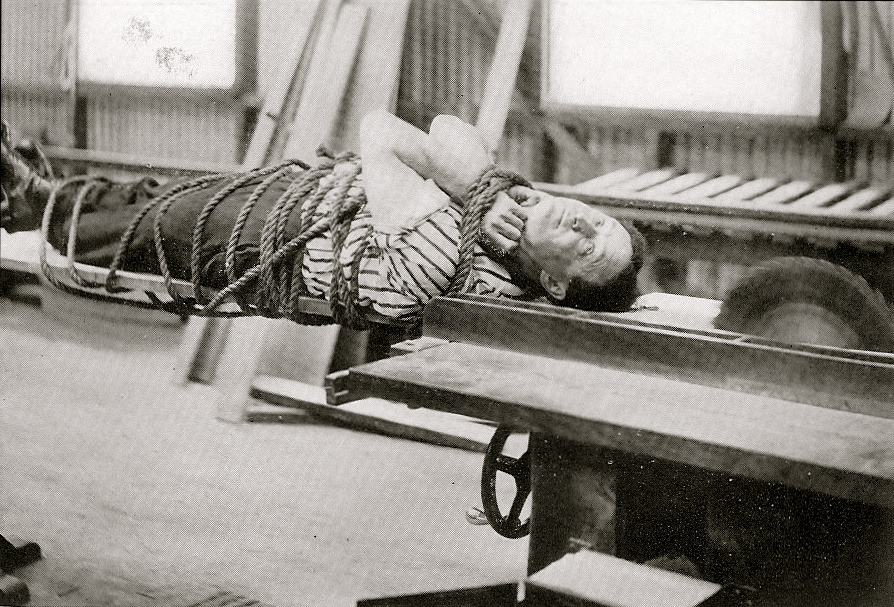
This is a famous photo of Houdini likely taken in early 1918. Here we see him in a black suit of clothes that appears in many other photos. And I mean
many. In fact, I have not seen a photo or film clip of Houdini in everyday life taken between 1914 and 1918 in which he
isn't wearing this same black suit. There's even a photo of him wearing it on a golf course!
So what's the story? Was this just a favorite suit? Or is there something else going on? I believe there's something else going on, and I have a theory of what that something might be.
Whenever Houdini does something inexplicable in his personal life, I always consider the possibility that it has something to do with his mother. Because it always does! At first I thought this was maybe a suit she bought for him. Or maybe it was one she simply thought he looked good in. That would probably be enough for Houdini to wear it everyday for four years. But as far as I can find, this suit first appears a few months
after his mother's death. And that's the key.
This was a time when Houdini was displaying his grief in any number of ways. He even had new stationary and greeting cards made rimmed in a black boarder. I believe this suit was another part of his formalized grieving. I believe what we've been looking at all these years is Houdini in a
mourning suit.
Mourning clothes are typically associated with women, but it was not unheard of for men at this time. Women's fashion dictated veils, etc., but the only real requirement for men was that it should be black. Also, in Jewish tradition, someone in mourning is not allowed to wear new clothes for a year. And that's another aspect of this suit that has always struck me as peculiar even before I landed on this idea. Houdini was fairly modern, even dashing, in his dress leading up this time. (
Just look at him here.) But this is a very Victorian suit.
Houdini also had a specific hat that went with this suit with a thick hatband that can be seen in several photos. Turns out hatbands, typically made of crepe, were a feature of Victorian male mourning clothes. And according to
The Vintage News, "widows were expected to wear special clothes to indicate that they were in mourning for up to four years after the death." Houdini appears to have worn this suit for, yes, a little over four years.
But I think the most convincing evidence is that he wore this suit to the 1916 dedication ceremony for the exedra he created for his parents at Machpelah cemetery. In a photo from the event we see others dressed formally in tail coats and top hats. But not Houdini. Obviously Houdini would have thought very carefully about how he dressed for such a sacred occasion, and it's
unthinkable that he'd wear his old "everyday suit" if it didn't broadcast special meaning. Wearing this suit was making a statement which now seems abundantly clear. He was a man in mourning.
Below are a few choice images of Houdini in the black suit.
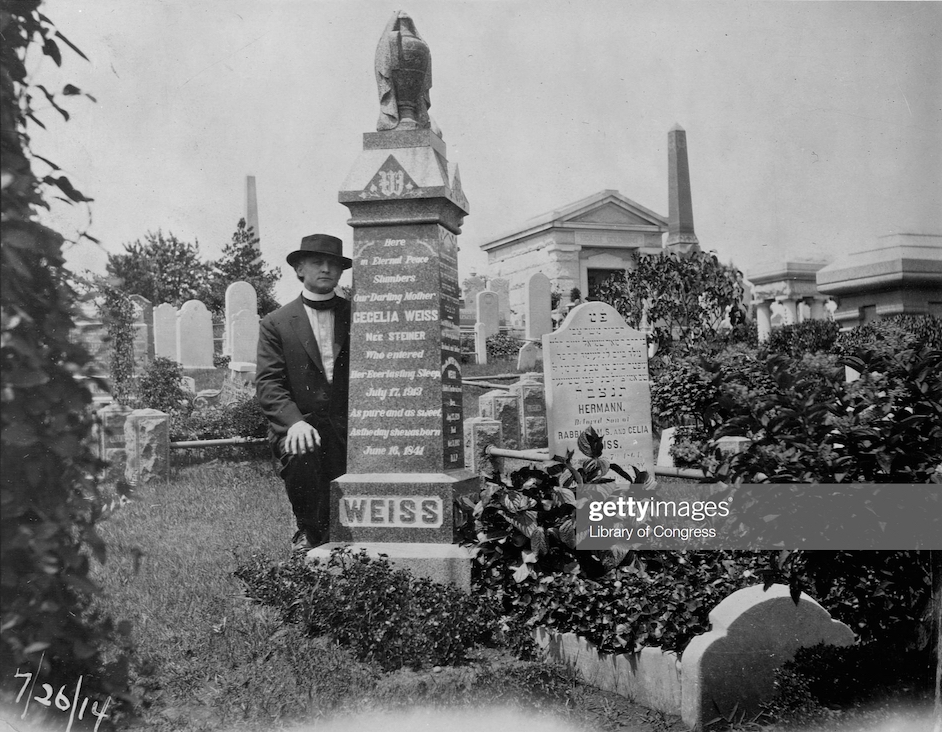
 |
| In the graveyard (1914). |
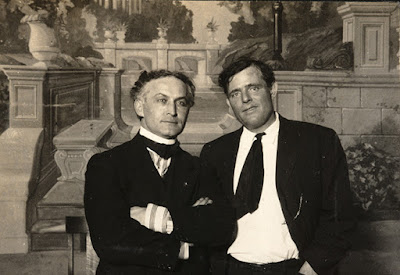 |
| In California with Jack London (1915). |
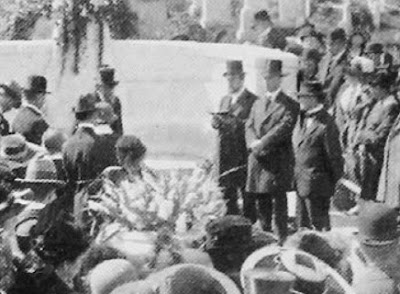 |
| At the exedra dedication (1916). |
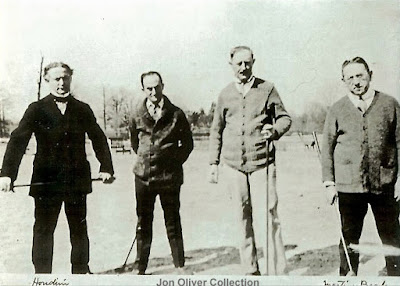 |
| On the golf course (undated). |
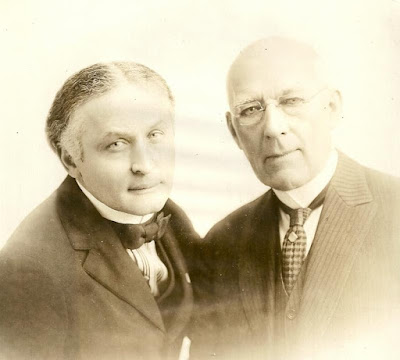 |
| With Harry Kellar (1917). |
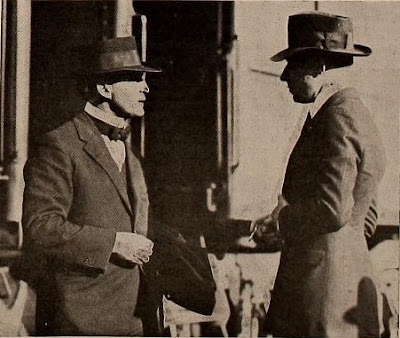 |
| Traveling to Hollywood (1919). |
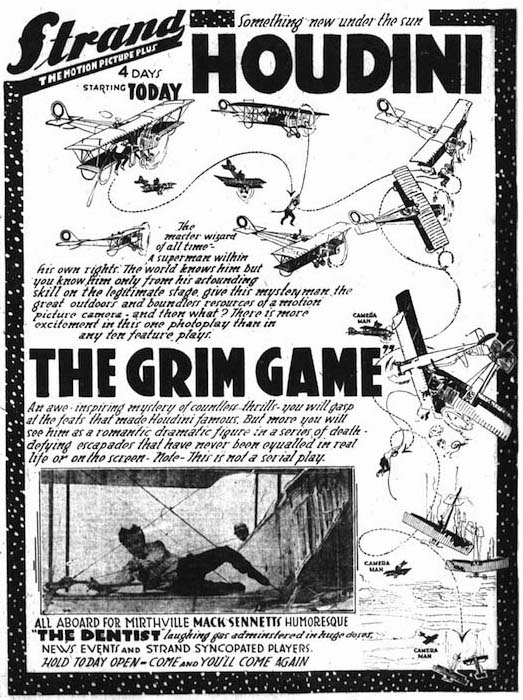
The last images I've found of Houdini in the suit are from his early days in Los Angeles in April 1919 when he came to work on The Grim Game. It may be telling that a young starlet commented in a fan magazine on the strange suit Houdini was seen wearing around Hollywood. So maybe he decided to it was time to give up the ghost. By May 1919 he is sporting a new suit and a youthful straw hat. This old suit appears to vanish.
But Houdini wore this suit for so long and in so many photos that it has become part of his iconography. It inspired Harvey Keitel's wardrobe in 1998's FairyTale: A True Story. It also appears in the 1976 biopic The Great Houdinis in the scenes following his mother's death. It's telling that the costume designer instinctively associated this look with mourning. The suit is not described in the screenplay, but in the novelization it says: "That coat he's wearing, she thought, that had to be thrown out. And that terrible hat. He looks like an immigrant. One more week without shaving, he'll look just like his father, the Rabbi."
So what do we think? Was this Houdini's mourning suit? Sound off in the comments below.
Related:


.png)