
Showing posts with label Bridge jumps. Show all posts
Showing posts with label Bridge jumps. Show all posts
Monday, August 31, 2026
LINK: Harry Houdini: Keeping the Legend Alive

Saturday, February 28, 2026
Houdini and Eva Tanguay in Rochester
Here's a terrific ad for the Cook Opera House in Rochester, New York, showing Houdini and Eva Tanguay on the same bill. (If you don't know who Tanguay was, check out this post.) This is the week Houdini did his famous jump from the Weighlock Bridge. It's wild to know that Eva was on the same bill. Did she see the jump?


Related:

Want more? I recently shared a collection of Houdini-related Rochester clippings with my Scholar-level patrons below.
Related:
Friday, December 5, 2025
Exploring Houdini's Boston

While on a recent research trip for my next book, I passed through Boston, which is a fantastic city for Houdini locations. Among these is the site of Keith's Theatre, where Houdini appeared many times and did so many famous feats, including his escape from a sea monster. However, identifying the theater's location can be tricky. Most photos and vintage postcards (such as the above) show an impressive entrance on Tremont Street. This is what stands on that site today.

However, this was not the theater. This was just a facade built along the well-trafficked street that led patrons into an arcade and through a tunnel under Mason Street, bringing them up into the actual theater on Washington Street.
Below is the original building on Washington Street that once housed Houdini's Keith's Theatre. You can see a billboard above it listing the many venues that once occupied the building, including Keith's (I didn't even notice this billboard when I was taking this pic).

The pic below shows a different perspective. On one side of the building is the Paramount Theater. This is where the Adams House Hotel once stood. Houdini stayed at Adams House whenever he was in Boston. It was there that he took the first of his famous ice baths. On the other side is the current Opera House, which was once called the B.F. Keith's Theater. But this was a newer Keith's, opened in 1928, so don't be fooled by this one, especially as it resembles the Tremont Street facade.

This wasn't my only stop. I've shared a series of videos on my Patreon exploring the other locations, including the real location of Houdini's famed "Boston Tombs" jailbreak, which I think might come as a surprise to most folks. I know it was a surprise to me!
If you're a patron, you can continue the tour below.


Still need more Houdini in Boston? Below are a few links you might enjoy.
Thursday, August 14, 2025
News 10 on Houdini's Rochester bridge jump
Here's a terrific report from WHEC News 10 in Rochester about Houdini's jump from the Weighlock Bridge and the film footage that captured that leap. It's well-researched, and we get to see our friends Jeff and Debbie Blood. I love that they pinpointed the location and identified one of the still-standing buildings glimpsed in the footage. Enjoy.
I think this footage is an excellent candidate for the National Film Registry, which every year selects 25 films that showcase American film heritage and increase awareness for film preservation.
Thanks to Jeff and Debbie Blood for the alert.
Friday, May 2, 2025
Where Houdini wasn't

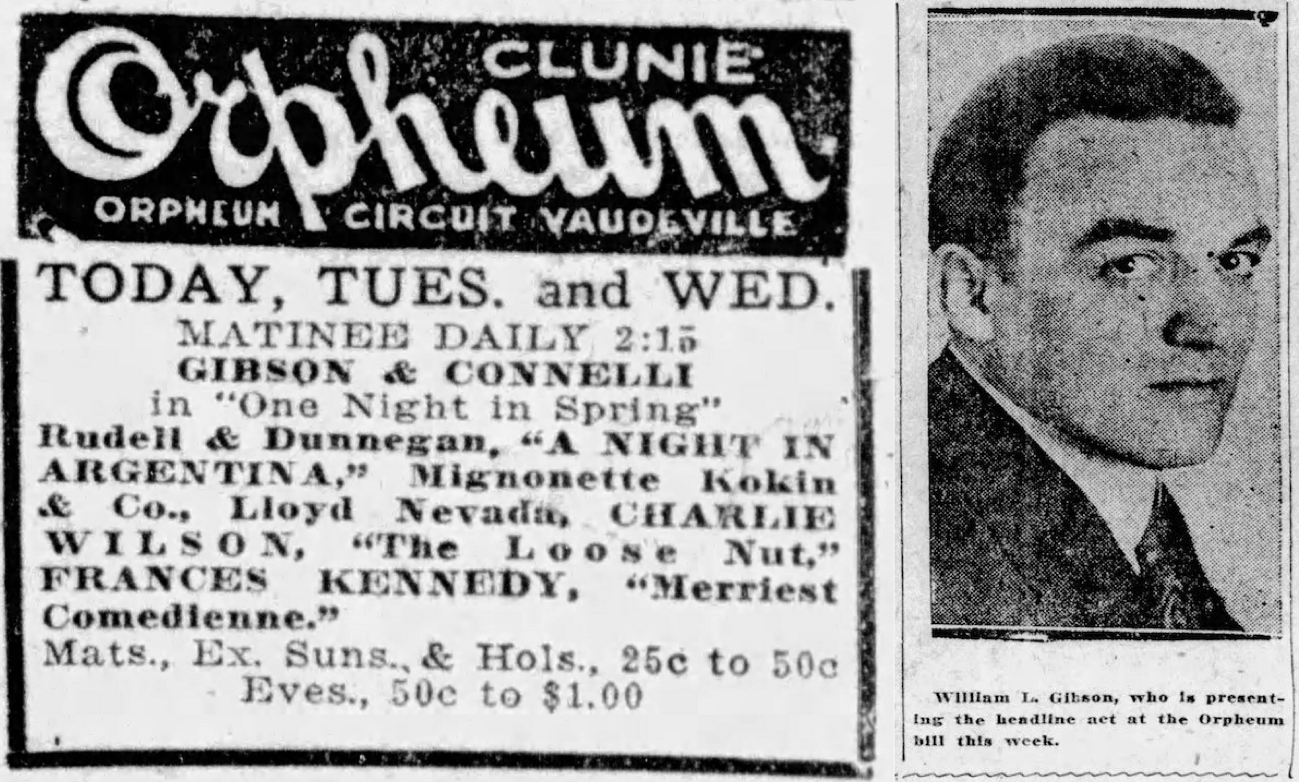
Recently, four unusually nice Houdini letters sold at RR auctions online. Among them was a letter to Faber Birren in Chicago in which Houdini included the route for his current vaudeville tour. What stood out to me was that the list showed Houdini playing a split week in Sacramento and Fresno starting March 25, 1923.
That never happened. Houdini pulled a vanishing act and played Oakland this week instead. I don't know why his route changed, but it's likely Houdini was happy about it as it involved less travel. Oakland was a short hop over the bay from his previous booking in San Francisco, and a full week is better than a split.
However, this meant Houdini would never play Sacramento. He would have likely done a suspended straitjacket escape in the city as well. You were so close, Sacramento! But at least Sacramentans got to see Hardeen at the Pantages in 1908 and 1910. He even jumped off the Yolo bridge.
 |
| The Sacramento Bee, Nov. 9, 1908. |
Of course, I wanted to know precisely where Houdini would have appeared had he played these dates. This was a little tricky to find as the Orpheum circuit never built its own theater in either city. They used existing theaters that changed over the years. But with some digging, I discovered that the Clunie Theater on 811 K Street was the home of Orpheum vaudeville in Sacramento at the time of Houdini's planned appearance. (They would move to the State Theater later that year.) Below is the only photo I could find of the Clunie.
 |
| www.performingartsarchive.com |
Instead of Houdini, the Clunie featured William Gibson and Regina Connelli in the comedic skit "One Night in Spring" as the headliners. Gibson & Connelli also filled Houdini's spot in Fresno starting on March 29th. I'm sure they were the cat's pajamas!
In Fresno, Orpheum vaudeville was featured at the White Theater at 1317 Broadway. Houdini would give his spiritualism lecture at the White Theater on Oct. 26, 1924, so Houdini did eventually make it to Fresno, if only for one day.
 |
| The Fresno Morning Republican, Oct. 26, 1924. |
Both theaters are now long gone.
Thursday, November 28, 2024
Houdini's greatest outdoor stunt determined!


Can't say I'm surprised to see this one reach #1, as it would be my choice as well. Houdini first started doing the suspended straitjacket in 1915 and continued it until the end of his career. Not only could the escape be viewed by a maximum number of spectators, but it always drew headlines along with photos of the incredible crowds. It was also an escape that looked much more dangerous than it actually was. It was a winner in Houdini's day and still a winner today!
#2 Bridge jumps (24%)
%20copy.jpg)
#3 Jailbreaking (15%)

#5 Seance busting (9%)

#4 Overboard Box (6%)

#5 Feats of strength and endurance (3%)

#6 Other (0%)
No patrons opted for this, so it looks like we pretty much covered it!
These are the results as of today. However, the poll is still active, so if you want to have your say and maybe move your favorite up a notch, you can still vote as a member of my Patreon. I'm currently offering a special Black Friday sale of 10% off all new memberships by using the promo code BESS.

Tuesday, November 12, 2024
Breaking the ice in 1959

 |
| Detroit Free Press, Aug. 2, 1959. |
Ironically, this article ends with a new myth about how Houdini may have escaped from the Mirror Handcuffs. It's Houdini myth whack-a-mole!
Of course, the best depiction of the under-the-ice myth is in the 1953 Houdini biopic starring Tony Curtis and Janet Leigh. Coincidently, that sequence is the topic of the next "Deconstructing Houdini '53," which I will be posting this Saturday.
Related:
Monday, September 16, 2024
LINK: A Window on the Past: Harry Houdini’s trip to Portland in 1908

Related:
Monday, August 5, 2024
Guest blog: Houdini in Pittsburgh by Zabrecky
Recently, magician Rob Zabrecky spent six weeks performing in Pittsburgh. As the lead Houdini Seance medium at the Magic Castle, Rob knows his Houdini history, and Pittsburgh has a lot of Houdini history! Rob takes us on a tour in this special guest blog. Enjoy!

HARRY HOUDINI
IN PITTSBURG
A deepish dive into the master magician’s
life and times in the Steel CityBy Rob Zabrecky
Pittsburgh is a wonderful city. Many of its original buildings, homes, and small businesses are still intact and operating. There are more neighborhoods than you’ll be able to visit, and many of its downtown areas could easily be stunt doubles for lower Manhattan’s streets and alleys. And let’s not forget that Steel City was a regular stop for Harry Houdini, who headlined its theaters, jumped off one of its bridges, and wiggled upside down out of a strait jacket before legions of curious onlookers long before you were born.
The master magician performed in Pittsburgh many times, primarily at the Grand Opera Theater (1906 – 1915) at 332 Fifth Avenue in downtown (now operating as The Warner Centre). Pittsburgh was a regular stop during his touring years. He performed here nearly annually for two decades until his death in 1926. Next time you’re there don’t miss:
The Houdini Triangle…at least that’s what I call it. The following three locations are within a few short walkable blocks of each other. Each location represents a different aspect of Houdini’s performing and touring career:
*Houdini Upside-down Straightjacket Escape: At lunchtime on November 6, 1916, Houdini hung like a bat outside the office windows of the Pittsburgh Sun newspaper performing his world famous upside-down straightjacket escape. He dangled and escaped from the straightjacket high above legions of Steel City spectators prior to his show later that evening at the New Davis Theater. This performance also served as a publicity stunt, making local headlines and ensuring every ticket for his full evening show was sold.
100 years later to the day, Pittsburgh magician and escapologist, Lee Terbosic, recreated Houdini’s escape before a large and enthusiastic crowd to commemorate Houdini’s original feat.
Liberty Avenue & Wood Street, one block from Liberty Magic, 811 Liberty Avenue, Downtown Pittsburgh*Houdini Bridge Jumps/Plunges: Houdini jumped off the old Seventh Street Bridge into the Allegheny River twice, both times while handcuffed in Pittsburgh Steel. The daredevil’s first jump was on May 22, 1907 and was repeated the following year on March 13, 1908.
The second jump proved much more difficult than the first; the nearly freezing temperatures of the early spring water was much colder than during his previous jump. Houdini biographer Bill Kalush wrote: “On March 13, 1908 Houdini told a reporter from The Pittsburgh Leader that the day before the leap he sent a cable to Hardeen, who was doing similar act then in Europe, and the charges came to exactly $13. That same day Houdini’s mail consisted of 13 letters. He switched rooms at his hotel and the new room, was no. 26, divisible by 13. The letters contained 13 new challenges, the license plate of the auto that drove him to the bridge totaled up to 13, and the cinematographer who was filming the jump had exactly 1,300 feet of film in his camera.”
“I feel nervous today,” Houdini said. “There is a goneness in my innards that isn’t pleasant.” He ate an apple to settle himself down, then dove. It was exactly 1:13.“In a minute and half from the time, I struck the water I had freed myself and was ready to rise to the surface,” Houdini told the press. “Small boats were cruising about looking for me, and, as luck would have it, I came rushing up at great speed just underneath one of these crafts. So rapid was my ascent that in rising I hit my head a fearful blow…and sank back into the water again stunned and bleeding. When I struck that boat I thought of the thirteens of the day and concluded that it was up to me to battle for my life. Just when it seemed that all was over with me, I rose to the surface and willing hands dragged me to safety. It isn’t any fun taking your life in your hands. Really, I’m in earnest. If a fellow wasn’t married it would be a different thing, though even a single man oughtn’t to be hankering for chances to risk his life”
The Seventh Street Bridge/Andy Warhol Bridge
Seventh Street & The Allegheny River*Location of former Alvin Theater: Nearly a year before his death, on September 18, 1925, Houdini was winding down a run at Pittsburgh’s Shubert Alvin Theater. During the run he offered $10,000 to anyone who could use supernatural powers to correctly answer three questions that were placed by him into sealed envelopes. Then then pastor of the Pittsburgh Church of Divine Healing, Reverend Dr. Alice Dooley, attempted — and failed — to answer Houdini’s secret questions.
119 Sixth Street, near Sixth Street Bridge. Currently a closed Bailey’s Gym.


*
Many of Houdini’s Pittsburgh performances were presented at the now defunct Grand & Davis Theaters:
September 24-29, 1906: Grand Theatre, Pittsburgh, PA
May 20-25, 1907: Grand Theatre, Pittsburgh, PA
May 27 – Jun 1, 1907: Grand Theatre, Pittsburgh, PA
March 13, 1908: Houdini jumps from 7th Street Bridge, known today as the Andy Warhol Bridge, Pittsburgh, PA
March 16-21, 1908: Grand Theatre, Pittsburgh, PA
November 13-18, 1911: Grand Theatre, Pittsburgh, PA
March 8-13, 1915: Grand Theatre, Pittsburgh, PA
November 6-11, 1916: Davis Theatre, Pittsburgh, PA
March 6-11, 1922: Davis Theatre, Pittsburgh, PA
February 1, 1924: Carnegie Music Hall, Pittsburgh, PA
February 23-28, 1925: Davis Theatre, Pittsburgh, PA
September 14-19, 1925: Alvin Theatre, Pittsburgh, PA
*
From an article titled, “Harry Houdini and Pittsburgh – the ties that bind,” Clay Morgan wrote:
Industrial dominance drove the growth and identity that brought Pittsburgh to prominence and made it a major destination for famous vaudevillian performers. Houdini arrived in 1905, fresh off a five-year European tour that created his reputation as escape artist and "King of Handcuffs."
Around 40,000 Pittsburghers were treated to the nail-biting exhibition one century ago on March 13, 1908. Houdini stripped to his swimsuit, surrendered to tight manacles fashioned from Pittsburgh steel and leapt 40 feet from the original Seventh Street Bridge into the stinging Allegheny River waters. In a short while, his head bobbed up and vanished before he emerged for good, free and holding the conquered cuffs.
Houdini’s first Pittsburgh plunge came almost a year earlier, on May 22, 1907. A rare photo from the time peers over the backs of spectators staring at the bridge in direction of the North Shore. In the background, filthy factories pour billows of smoke into the lunchtime sky over the crowed waterfront. To the right, onlookers crowd the rails of the bridge. Over a dozen boats linger in the water. In the center of it all is Houdini in mid-jump – dressed in a white bathing suit and falling, knees still up. In less than two minutes he rose from the murky stage.
However, his first trip to Pittsburgh was in November 1905, The Jewish Criterion wrote: “He defies anyone to come on the stage of the Grand next week and bind him successfully.”
The Grand Opera House hosted Houdini during his first visits to Pittsburgh from 1905-08. Intense buzz in 1906 created so many sell-outs that Houdini stayed a third week so everyone around town could have a chance to experience the mind-jarring show.
He returned to the Pittsburgh Grand in 1913 [most likely 1915] and brought influences from afar, the East Indian Needle Trick and the legendary Chinese Water Torture Chamber. On Nov 6, 1916, Houdini escaped from a Straitjacket while hanging from the Pittsburgh Sun Building 50 feet in the air. On Nov 7, 1916, Pittsburghers packed in the New Davis Theatre to see Houdini headline.
In October 1919 (as Congress outlawed alcohol), “The Grim Game” opened in theatres such as the Grand, Strand and Belmar. Houdini played Harvey Hanford, wrongfully accused of murder and desperate to escape.
Pittsburgh’s strict “blue laws” also outlawed movies and performances on Sundays, so Houdini won by grabbing the headline show on Saturday evenings. In Pittsburgh, he topped his buddies Charlie Chaplin, Buster Keaton and Tom Mix.
Over the final years of his life, Houdini dueled with Sherlock Holmes creator Sir Arthur Conan Doyle, an avid supporter of spiritualism. The men took turns lecturing in Pittsburgh. Houdini spoke at the Carnegie Hall on Feb. 21, 1924. The following year he brought a full medium exposing show to the Davis Theater. Once again, Pittsburgh demand kept him in town an extra week. Houdini’s final Pittsburgh show was at the Alvin Theatre in September of 1925.
In 1916, Houdini — now 42 years old — returned to Pittsburgh to appear at the former Davis Theatre. He drew thousands of people into the street by hanging upside-down in a straightjacket on a rope in front of the offices of the Pittsburgh Sun newspaper at the corner of Wood Street and Liberty Avenue downtown. He wowed the huge crowd (and promoted his show) by successfully and safely wriggling out of the jacket.


Thank you Rob!
Rob's own nicely formated PDF of this article can be downloaded at my Patreon below.

Related:
Wednesday, March 13, 2024
"That's an awful river."
I've shared on my Patreon a vivid account of Houdini's handcuffed leap into the Mississippi River on November 17, 1907. There are details here that I've not read before. Dive in by clicking below.

I recently updated my Bridge jumps page to list all of Houdini's known jumps. Thanks to my patrons for supporting this work.
Thursday, February 29, 2024
Leap Day Dash
While we know Hardeen was born on March 4, 1876, in Budapest, like his famous brother, he later claimed Appleton as his birthplace and changed his birthdate. The date Dash chose was February 29 (Leap Day), showing he had a sense of humor about all this. As it only happens once every four years, let's celebrate Hardeen's "birthday" today with some dashing posters.
Below is one of my all-time favorite posters for either brother. If Houdini ever created a poster depicting a bridge jump, I've not seen it. But it would be tough to do better than this one. This appeared on the back of the July 1945 Conjurers Magazine "Hardeen Memorial Issue." How I would love to see this in color.


Here's another Hardeen poster that features a bridge jump as a key image. This is a blow-up from a photo of an Oakland billboard when the brothers were both performing there in 1915. Again, how I'd love to see this in color.

Here's another beauty. This appears on the back of Hardeen's pitchbook.

While the above posters will be familiar to some, I'm sharing a Hardeen poster on my Patreon today that I bet you've never seen because I sure hadn't! And, yes, this one is in color. This comes from Eric Colleary and our friends at the Harry Ransom Center. Enjoy.
Happy Leap Day Birthday, Dash!
Monday, December 4, 2023
Houdini's Denver dives

%20copy.png) |
| The Denver Post, Oct. 14, 1907 |
The photos taken that day by Daily News staff photographer Ralph Baird were enlarged and displayed in the lobby of the Denver Orpheum. (Including the image at the top of this post, which I'm excited to confirm is Denver.) But The News felt the public would like to see Houdini perform the feat for themselves, so they arranged for him to repeat the stunt on Sunday, Oct. 20. It was unusual for Houdini to repeat an outdoor stunt during the same engagement, but he agreed to do so.
 |
| The Daily News, Oct. 17, 1907 |
It's interesting to see that Houdini wanted a ladder placed atop the pavilion this time so he could make a higher jump. During the first jump, he had hit the bottom of the lake. However, at the last moment, Denver Mayor Robert W. Speer objected to the stunt.
 |
| The Daily News, Oct. 20, 1907 |
Houdini stayed out of the controversy, but The News took the mayor to task for what it saw as his hypocrisy. In an Oct. 31st editorial called "Awake at Last," the paper sarcastically congratulated the mayor for suddenly waking up to the city's blue laws and how he would now, no doubt, close down the saloons and gambling halls that line his pockets. They conclude:
And there are any number of other things for the mayor to do, now that he has taken this high moral resolve. And it thrills us with joy to know that we were the unwilling instruments bringing this great good to the city. [...] Why, oh, why didn't we think of the Houdini jump sooner, and get the mayor's conscience waked up two years ago, in time to keep him from helping steal the franchises? But it's awake now; that's one comfort. There should be notable doings in the city pretty quick.

 |
| Mayor Spreer |
Mayor Spreer survived the scandal and became the only Denver mayor elected to three terms. However, he didn't survive the 1918 flu pandemic and passed away during his third term.
The site of Houdini's Denver leap still exists today. While the pavilion has been rebuilt, it is, presumably, still in the same spot. A terrific Denver Houdini location. Maybe the current mayor, Mike Johnson, can put a historical plaque in the pavilion commemorating Houdini's October 13, 1907 leap and make up for his predecessor denying the citizens of Denver that second jump? Just an idea!


Want more? You can view or download an assortment of newspaper clippings from Houdini's 1907 Denver appearance as a "Scholar" member of my Patreon below. Thanks to my patrons for supporting content like this.

Photo at the top of this post from the McCord-Stewart Museum.
Subscribe to:
Posts (Atom)