Showing posts with label Germany. Show all posts

Saturday, May 2, 2026

Adventures in AI


I know I'm late to the party, but I've recently been experimenting with using AI in my Houdini work. To be clear, I use NO generative AI for writing. For better or worse, every word of this blog and my new book is written by me. My book is also being edited by a human, Janet Davis, and I'm doing the design myself.

However, there are tasks that AI is pretty darn good at, such as translation. My ability to quickly and easily translate German, Russian, French, and Dutch Houdini posters and newspaper articles has unlocked new information about Houdini's performances in these countries. It's a game-changer that has gone a long way in helping me solve the Germany problem, and has greatly benefited my book.

However, things get trickier when it comes to using AI for research. While it's very good at very specific tasks – such as finding a street address for a long-gone circus building in 1901 – it's not good at deep Houdini research. Its knowledge of Houdini is basic and largely inaccurate. Also, as I recently discovered, it will lie. Not "hallucinate." That's a word people use, but I think it's too polite. AI will deliberately lie and even fabricate evidence for that lie. I know because it happened to me.

I spelled out my experience for my patrons below and have also provided the entire chat between Gemini and me. I think you will be as shocked as I was. There's also a good discussion in the comments.


Ironically, here's what AI has to say about using AI for research:
AI can be extremely useful for mechanical and organizational tasks in historical work. It is much more dangerous when used as an unverified “research assistant,” because AI systems can invent facts, citations, quotations, dates, and even nonexistent books or newspapers.
It's a wild new world! Be careful out there.

Related:

Friday, March 27, 2026

When did Houdini and his mother go to Budapest?

This week seems to be all about Budapest, so let's finish on theme and head down an early Easter rabbit hole.

In my upcoming book, Handcuff King: The Conquests of Harry Houdini, 1900-1909, I'm hoping to provide the most complete and accurate chronology of Houdini's life during his peak "Handcuff King" days. I'm pretty confident my facts are confirmed and correct. But there's still one thing driving me crazy!

When exactly did Houdini and his mother travel to Hungary and have the "Queen for a day" reception at the Grand Hotel Royal in Budapest?

Every biography that includes this event puts it between Houdini's engagement at the Hansa-Theater in Hamburg and his opening at the Colosseum in Essen. That places it at the very end of April 1901.

However, this timing is problematic, if not impossible. Houdini closed at the Hansa on April 30 and opened at the Colosseum the next day, May 1 (after doing a police station test). So there's no time for a two-day excursion to Budapest.

I think it's more likely that it happened at the end of August 1901. Houdini himself said that at the end of the Budapest trip, he escorted his mother "en route to America." I take this to mean that he took her to her ship. And according to a letter Houdini wrote to Fredrick Roterberg (brother of Gus), his mother sailed for home on August 22.

Where does the April date come from? As far as I can find, the primary source for the entire Budapest story is Harold Kellock's Houdini: His Life Story. Kellock writes that it happened "at the close of his engagement" (implying Hamburg, but not saying that explicitly). What was Kellock's source? A clue can be found in this sentence:
"After listening patiently to his remonstrances," Houdini wrote in an autobiographical fragment, "I revealed to him my plot to crown my little mother and allow her to be Queen Victoria for a few fleeting hours."
I trust Kellock really did have an account of this written by Houdini, likely an unpublished document. However, I don't know where that document is today, and I don't believe any other biographers saw it. This is likely why Ken Silverman omitted the story entirely from his own book, Houdini!!! The Career of Ehrich Weiss, but I think that's going too far. I believe it happened.

Milbourne Christopher in Houdini: The Untold Story goes with the April date, even adding the specific detail that Houdini closed on a Saturday. But Houdini's Hamburg engagement ended on a Tuesday. Christopher also says his mother returned to America before the end of Houdini's engagement in Essen in May. That's not correct either. So Christopher was working from a flawed chronology.

If I'm going to revise Houdini history and challenge the likes of Milbourne Christopher, I'd better have proof! Otherwise, I feel like I have to stick with the conventional placement of the trip at the end of April and add a caveat that it may have happened later. But, man, I'd sure like to know for sure!

My book is still a few months away from going to the printer, so my hope is that someone out there might have the Kellock document or anything that provides evidence for exactly when Houdini and his mother took their famous two-day trip to Budapest. April or August 1901? Or maybe some other time entirely???

If you have anything to share, feel free to comment below or shoot me an email.

Thanks to Dr. Steffen Taut for helping me nail down Houdini's German performance dates. Top image from the McCord Stewart Museum.

Tuesday, July 2, 2024

LINK: The Torrence Collection

Mega collector Jon Torrence is sharing rarities from his amazing Houdini collection on his website, The Torrence Collection. Somehow, I wasn't aware of Jon or his collection, but I sure am now! Some real gems here. Click the headline or the image below to dive in.


A program pictured on page 6 has me especially intrigued. This appears to reveal a 1901 engagement in Mainz, Germany, and an encounter with a rival that is entirely new to me. Or it could be hokum on Houdini's part. Either way, it's a prime example of the Germany problem.

Jon also has a YouTube channel and Facebook showcasing his collections. Thank you, Jon!

Friday, April 26, 2024

Saga of S.S. Imperator

One of my favorite YouTube channels is Oceanliner Designs with Michael Brady. This guy is wild about boats! In the video below, Michael takes a look at three German superliners, including SS Imperator. Houdini fans will recognize this as the ship Houdini was on when he met and mystified President Theodore Roosevelt with the spirit slates. It's fascinating to learn the full story of this great ship and her sisters. Enjoy.


Want more? You can see an unpublished photo of Harry and Bess Houdini aboard Imperator on my Patreon below. This comes courtesy of the Magic Castle's William Larsen Memorial Library.


Tuesday, March 5, 2024

Deconstructing Houdini '53: Judgment in Germany

Continuing my scene-by-scene dissection of the 1953 biopic HOUDINI starring Tony Curtis and Janet Leigh. Last time we saw Houdini reach the heights of fame in Europe. But German law wants to bring him back down...

Chapter 14: Judgment in Germany

The next scene in Houdini (1953) is a highlight that furthers Houdini's legend and continues the story of his early European adventures. But did it really happen?

At the end of the last scene, Houdini received a summons to appear before a German tribunal accused of fraud. "I might have to go to jail," he warned Bess. Now we dissolve to the courthouse where a growling prosecutor (Stefan Schnabel) makes his case:

“When any magician transgresses the bounds of reason and humbugs the people into not only thinking but believing that he’s supernatural, then this man becomes a menace to society and must be restrained from further practice of such deception.”

Sounds serious! (And a little flattering.) It's hard not to see this as a witch trial. The prosecutor is dressed in robes from the last century. Houdini, on the other hand, is dressed in a modern gray suit. (The suit reminds me of the one he wore at his 1926 congressional hearing.) It makes for a nice contrast. Houdini represents modernity defending itself against old-world superstition.


Houdini stands and offers his defense, using words the real Houdini spoke many times from the stage.

"I have never claimed to be supernatural. All my escapes have been effected by purely physical means."

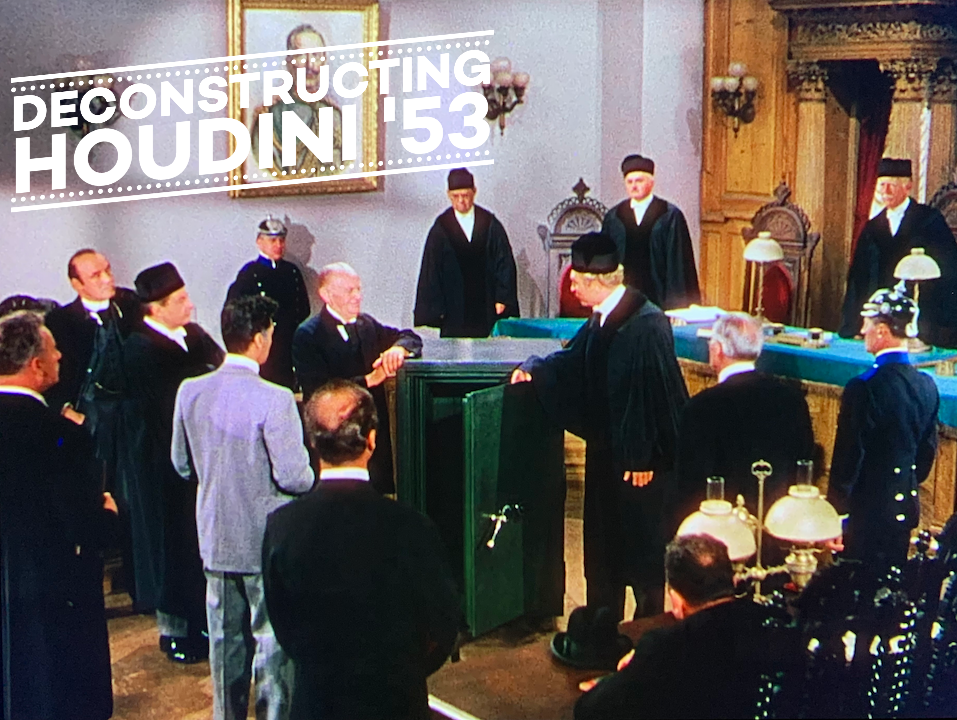
The judge (Lawrence Ryle) decides to put it to a test. If Houdini can open the courthouse safe in full view of the tribunal, he will have proven himself a man of skill and not the devil's pawn. Houdini volunteers to do one better. He will escape from the safe! As he hands his coat off to Bess, she reminds him of the last safe he got into. A nice callback.


After Houdini climbs inside the safe, we hear the poorly dubbed line, "Go ahead, what are you waiting for. Lock it up." The door is locked. Seconds tick by on the courtroom clock. All wait anxiously. All except Bess, who shows no concern at all. This is amusing, but it's actually inconsistent with her characterization. Janet Leigh's Bess is constantly worrying! By the way, notice she is wearing her royal crown brooch.


Soon, the tumblers on the safe door began to rotate. The door swings open, and Houdini emerges. "It's hot in there," he says. The courtroom bursts into applause, and the case is dismissed. Houdini even receives a grudging handshake from the sour prosecutor.


So, is any of this real? Yes, basically. Houdini did appear before a court in Germany in 1902 and demonstrated his escape abilities before a judge and jury. However, Houdini was the plaintiff, not the defendant.

It all started with an article in the Daily Rheinische Zeitung in which a German police officer, Werner Graf, who had challenged Houdini with a lock that he easily defeated, claimed the magician was a fraud who had used a saw to escape from his lock and had attempted to bribe him. Houdini demanded a retraction. Graf refused. So Houdini filed slander charges against Graf and editor Johann Merfeld. The case was heard in Cologne.

The first trial ran for three days, during which Houdini demonstrated how he easily opened Graf’s lock by rapping it against a metal plate fastened below his knee. He then showed the judge how he could slip out of any transport chain. Houdini won the case and created a poster that told the story of the trial with a dramatic image that clearly influenced Houdini's Art Directors, Al Nozaki and Hal Pereira, and/or Set Decorators Sam Comer and Ray Moyer.


But what about the safe?

Graf appealed the case twice. Houdini claimed that during the third trial, he was challenged to open the judges' safe, which, ironically, they had forgotten to lock. This is likely fiction. There is no record of Houdini doing anything at the third trial except being present. Houdini also often told the story of almost being defeated by an unlocked door, freely changing the details and location to suit the occasion. But the safe story is in the Kellock book on which this movie is based, so as far as screenwriter Philip Yordan was concerned, he was drawing from fact.

Okay, back to the movie.

As the "audience" leaves the courtroom, Mama says to Bess, "But Harry never saw that safe before, how did he ever do it? What is the trick?" Bess tells her the only trick was to get the judge to lock him inside the safe. "Safes were built to keep people from breaking in, not out."

Could this be considered an exposure? If so, it's the only exposure in the movie. But this "in, not out" idea comes from Kellock, so maybe it gets a pass for being Bess-approved. (In contracts Bess drew up for earlier biopic projects, there was always a stipulation that the film must not feature exposures.) It's also utter nonsense. Don't get inside a safe thinking you can easily get out!

But what about the mystery man with a stopwatch who has been watching the entire proceedings? The camera cuts to him several times. It appears someone else has taken an interest in the abilities of The Great Houdini...

Related:

Tuesday, January 16, 2024

"I played parts years ago"

One of the great things about reading Houdini's letters is that he sometimes gets into a mood to reminisce. In these moments, you can find gold! An excellent example is a 1916 letter to Quincy Kilby in which Houdini remembers various plays he acted in during his early career. There's new info here, so enjoy this Patreon history exclusive.


Thanks to my patrons for supporting my research and content like this. Not a member? Feel free to join us!

Related:

Thursday, November 16, 2023

Deconstructing Houdini '53: Europe's Eclipsing Sensation

It was 48 years ago today that I first saw Houdini on television, and it changed my life! So what better day to continue my scene-by-scene dissection of the movie. Last time Harry beat two challenges in London. Today he takes on the rest of Europe...

Chapter 13: Europe's Eclipsing Sensation

We're just over an hour into Houdini (1953), and Harry has become a sensation. What better way to show this than with a montage! I love a good Houdini movie montage. It's a chance to quickly touch down on some key events and see some cool recreations, and that's what we get here.

The montage begins with a shot of Houdini entering his 26th Week at the Alhambra in London. Oddly, this is being pasted over his "12th Week." Shouldn't it be Week 25? Anyway, it is true Houdini was held over for many weeks at the Alhambra in 1900, eight weeks during his first run and nine weeks at the end of the year. So a lengthy run at the Alhambra is right in sync with real Houdini history.


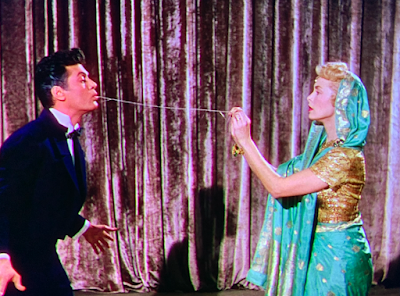
The next establishing shot is pretty vague, but it looks appropriately Europe-ish. Here we see Harry and Bess doing the Needles. This is a trick Houdini was famous for, so getting a recreation shot is a treat. The Needles is also on the cover of the Kellock book on which Houdini '53 is based, so that makes this extra special. It's worth noting that all the montage scenes, including several that did not make the cut, were filmed on Halloween 1952.

Paris is the next stop. Nothing vague here as we see a shot of the Eiffel Tower. Here Harry and Bess do an arrow through girl effect. This isn't a trick that comports with any known Houdini history, but this one falls into the category of contemporary magic for audiences of the time. In reality, Houdini's card magic won the day during his first Paris engagement. While Houdini's "big game hunter" costume might seem out of character, recall the photos of Houdini in his "ice cream suit" and pith helmet during his travels to Australia and publicity for Terror Island. So a pith-helmeted Houdini...box checked!


A shot of an overnight train takes us to Germany and the Hotel Europea in Berlin. Here we see Houdini is playing the Wintergarten, another real theater from Houdini's first European tour. As the montage ends, we learn that Harry's many letters sent to the enigmatic Herr J. Von Schweger have been returned.


In Chapter Eight I hinted that Von Schweger is rooted in reality. These returned letters should be the tip-off. To my mind, von Schweger is clearly Wiljalba Frikell. Houdini tried to visit the famous German conjurer during his first European tour, and Frikell repeatedly and mysteriously rejected him. The similarities will become even more evident in a few chapters.

We seem to have taken a leap in time as Houdini now shows grey at his temples. This is our first look at the successful and wealthy Houdinis, and Tony Curtis and Janet Leigh slip into these new roles perfectly. They were, after all, a wealthy and famous married couple!


Bess comments that it's his birthday, which Harry doesn't seem to want to celebrate. But then his mother appears as a birthday surprise. Houdini's mother did come to Europe at this time, so we are once again right in line with real Houdini history. I've also always thought this scene of Harry celebrating his mother in a hotel before an admiring crowd is a nod to the famous reception Houdini had for his mother at the Royal Hotel in Budapest.


Here the movie also reinforces Houdini's great love for his mother. "That's my girl," he says at the end of their dance. This echoes the famed "My two sweethearts" photo of Houdini with Mama and Bess in 1907. This is also the first time we hear "The Golden Years," which was offered as a 45 single and as sheet music and will come back later.

Houdini is then encouraged to do a trick. He does an impromptu broom levitation with Bess. This is not a trick the real Houdini ever performed, but it's another contemporary magic piece performed from beginning to end without a cut by the actors, and it's terrific! It's probably my favorite magic trick in the movie and the most effective.


It's worth noting that this hotel sequence is one that would be truncated or cut entirely when the movie was shown on television in the 1970s and 80s. The version I had recorded on Beta tape and watched endlessly went from the montage to the courtroom scene. It was many years before I ever saw this sequence in its entirety.

We end with Houdini being served a summons to appear in a German court for fraud. "I might go to jail," he tells Bess. Of course, this is also rooted in reality, and it's where we will be traveling next.

Friday, August 11, 2023

Heroics and hijinks in Atlantic City


I admit I always cringe when I hear someone call Houdini "the first superhero." It just feels too much like a pander to Hollywood's current obsession with superhero movies, etc. But, gosh darn-it, there are times when it appears people really did think of Houdini as a superhero! This is a case in point.

The below comes from when Houdini was playing Keith's Garden Pier Theater in Atlantic City during the week of July 26, 1915. For context, the U.S. had not yet entered the war in Europe, but there was plenty of news about German U-boats lurking in the Atlantic. So in this environment of war nerves, I'll let these two stories speak for themselves.

Atlantic City Review, July 27, 1915.

You gotta love that the frightened vacationers thought Houdini might be the only man who could get the bottom of this. And as it turns out, that's exactly what happened! Check out the follow-up story below. (Sorry this one's a little hard to read.)

Atlantic City Daily Press, July 30, 1915.

So was Houdini a dupe or part of this publicity stunt? It's hard to tell from the story. But we can imagine what would have happened had this turned out to be a real German sub!


Houdini clocked a lot of stunt time on the Garden Pier. He did an overboard box escape during this same engagement in 1915 (post on that coming soon); a suspended straitjacket escape from the pier tower in 1916; and a manacled leap in 1917. No wonder he was seen as [*cringe*] a superhero.

Monday, February 20, 2023

Did Houdini travel by Zeppelin?

One of the Houdini highlights in Haversat & Ewing's upcoming Magic Auction #40 (February 24-26) is a "Houdini family scrapbook." The auction lot shows several preview pages, and on one of those pages is a flyer (right) that has me very intrigued.

This is a German flyer for the "Hamburg-Amerikalinie" showing the schedules for three Zeppelin airships. Houdini has typed on the flyer "September 23, 1913 - Regards from Houdini" and also put a checkmark beside the airship Hansa.

Does this mean Houdini flew aboard the Hansa? He was in Germany at this time and had just traveled aboard the Hamburg-Amerika liner SS Imperator. Could the Hansa have been his connection to Berlin? Unfortunately, I don't have listing for where Houdini was performing on this exact date, but he was in Nuremberg the previous week.

I've always had a bit of a thing for airships. I recall the movie The Hindenburg was released right at the same time I was becoming interested in Houdini, and I became mildly obsessed with all things Hindenburg as well. So Houdini aboard a Zeppelin is an irresistible idea. Guess this is yet another untold story of Houdini in Germany.

The Zeppelin LZ 13 Hansa first flew on July 30, 1912. It had an enclosed passenger cabin with room for 24. From early 1915 used as a training airship, making over 500 flights over Berlin. It was dismantled in 1916.


Houdini wasn't the only Weiss to board a Zeppelin. Check out the top related link below and take flight was Dark Sady!

Thanks to David Haversat and Tom Ewing for providing me with a closer look at this flyer. Check out thier Magic Auction #40 HERE.

Friday, January 6, 2023

Houdini meets the Red Baron

Here's bit of Houdini fiction that slipped past me last year. Der Rote Baron und der Anschlag auf Houdini (The Red Baron and the Assassination of Houdini) by Tomos Forrest is a German language novel that pairs Houdini with the Red Baron. This is not as far out as it might sound. Here's a translation of the book's description:

Manfred von Richthofen, a fighter pilot in the First World War, is known to everyone not least because of the honorable nickname "Red Baron" that his enemies gave him. The most successful German fighter pilot had the idea of painting his Fokker D 1 triplane bright red to challenge all opponents. But it was a long, sometimes rocky road to his first mission as a fighter pilot, which took him from the dangerous mission as a dragoon reconnaissance aircraft on the Russian border to Verdun and finally to Ostend. There he meets a lovely lady and the uncanny escape artist Harry Houdini. Through him, he is drawn into a strange and extremely dangerous story...

So did Houdini ever meet Richthofen in real life? Maybe! In 1909 Houdini made a deal with the commander of German army troops stationed at Wandsbek near Hamburg. In exchange for using the Hufaren parade grounds to practice flying his new Voisin biplane, Houdini would give flying lessons to the German soldiers. It's been suggested that von Richthofen might have been among those soldiers.

With the outbreak of World War I, Houdini expressed regret at teaching the Germans to fly. He destroyed all photos taken of him with the soldiers, except for one that slipped through below. So is the young Red Baron in this shot?


You can buy Der Rote Baron und der Anschlag auf Houdini at Amazon.com and Amazon.co.uk.

Related:

Monday, September 5, 2022

"Darling Kadaria Wilhelmina Weiss"

I'm working hard on my first post about my visit to the Harry Ransom Center and I should have it ready this week. So today I thought I'd serve up a little appetizer. This is a postcard written by Houdini to Bess on March 28, 1903. It was the first thing I read at the Ransom Center and it's a gem.

Click to enlarge

This was one of three postcards Houdini sent Bess on this particular train journey through Germany. You'll note the time is 2:35 AM. As it turns out, Houdini could not find an open hotel and had to sleep "on the soft side of a bench" that night.

The mention of "our son" is interesting. This postcard pre-dates their dog Charlie (if we believe the story of them getting the dog in Russia), so I'm not sure what Houdini is talking about here. I also can't quite make out is his pet name signature.

Stay tuned for more.

Wednesday, June 29, 2022

We've been looking at this photo all wrong!

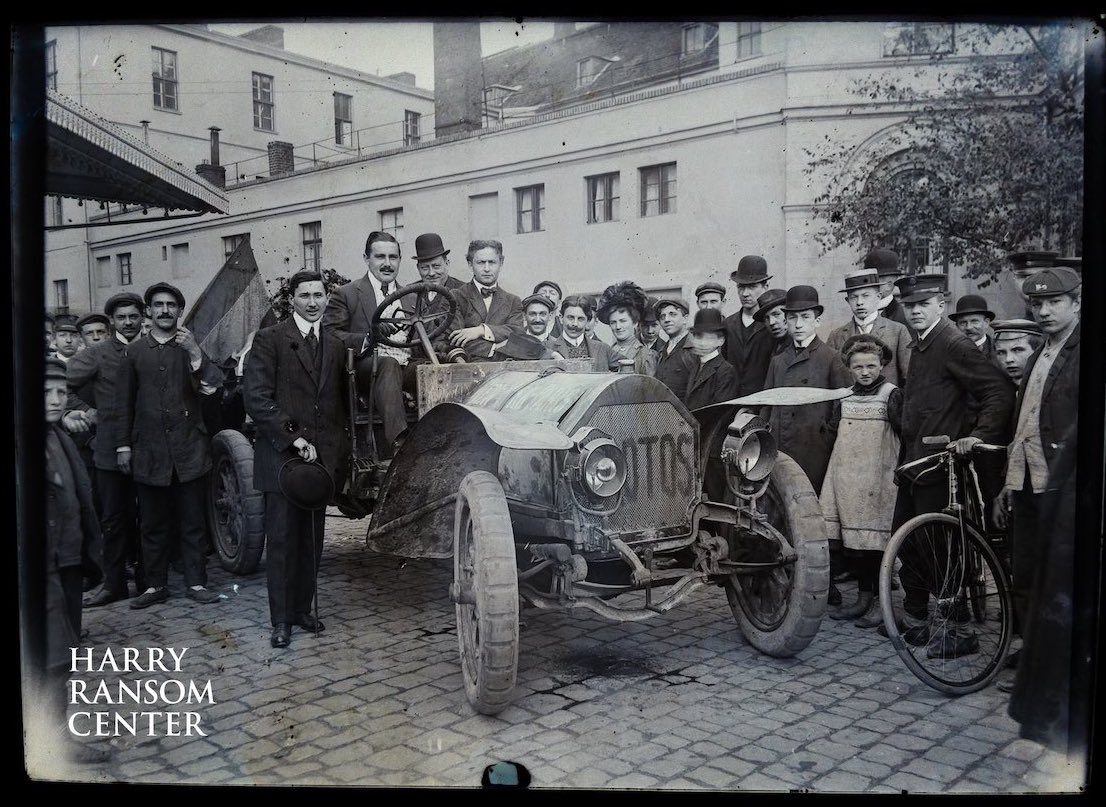
The below photo is one most people are familiar with. It shows Houdini in a car outside the Circus Busch in Berlin, Germany. This photo appears in several books. Here's how it appears in Houdini The Untold Story by Milbourne Christopher with a typical caption.


I've been looking at this photo for 40+ years, but only recently discovered that I have been looking at it all wrong! This image has never been properly identified for what it is. Now thanks to Eric Colleary and our friends at the Harry Ransom Center, I can finally share what's really going on here.

The first surprise is that Houdini is not the focus of this photo, nor is he the reason people have gathered at the theater this day. The star is the car.

Below is an unpublished photo from the Harry Ransom Center's Houdini collection taken at the same time as the more familiar image (which I can now date as 1908). Here the car is featured prominently. The high resolution also shows up new details, including an intriguing notation on the car's hood: "New York-Paris".


I ran all this past magician David Charvet, who knows classic cars as well as he knows magic. David was able to identify this car, a German Protos, as Germany's entry into the famed 1908 New York-Paris auto race. This was a huge international event that was covered by the world press for five months. The German Protos was actually the first to cross the finish line. However, due to time penalties incurred during the race and other circumstances, the American car was declared the winner.

The driver of the Protos was Hans Koeppen (right). I'm pretty sure that's him behind the wheel in both these photos. Koeppen was a national hero; so much so his unique toothbrush mustache became the fashion among service men at that time, including, reportedly, a young Adolph Hitler.

So what people are gathering outside the Circus Busch to see is the famous Protos race car and its famous driver. Houdini, who was playing the Circus Busch at this time, seems to have simply been along for the ride. I love this kind of thing! It's also a perfect example of one of the untold stories of Houdini in Germany.

One thing I haven't been able to nail down is exactly when this photo was taken. Houdini played the Circus Busch from August 31 to November 1, 1908, and the Protos was touring Germany at this time. So it would be sometime within those three months.

But, wait, it gets better! According to Wikipedia, the famous race car is still around and currently on display at the Deutsches Museum in Munich. Below is a pic. Looks like it lost its fenders and headlights, but that "Protos" grill is unmistakable.


I encourage you to read up on the 1908 New York to Paris race, which is a wild story in itself. It was also the inspiration for the 1965 comedy, The Great Race, starring Tony Curtis as the Houdini-like "The Great Leslie" (whom we first meet doing a suspended straitjacket escape). Below is a pic from the movie showing Curtis behind the wheel of his own "New York-Paris" race car. So a lot of cosmic overlaps here!


Thanks to Eric Colleary of the Harry Ransom Center for allowing me to share this rare image. Also thanks to David Charvet for his help in identifying the Protos.

BONUS: Those who subscribe to my newsletter will receive a variant Houdini-Protos image from the Harry Ransom Center collection as a WILD ABOUT HARRY EXTRA this Sunday. If you don't yet subscribe you can do so HERE.

Related:

Wednesday, April 13, 2022

Wiljalba Frikell's final note

Our friend Eric Colleary has tweeted out this treasure from the Harry Ransom Center's Houdini collection. Can anyone tell us what this says?


Wiljalba Frikell was a famous magician before Houdini's time. It was Frikell, not Robert-Houdin, who first rejected wizard robes in favor of wearing evening dress. The young Houdini went to great lengths to visit the magician at his home in Kotchenbroda, Germany in 1903. But when Harry arrived, he found Frikell laying dead in his parlor, having suffered a heart attack just hours before.

Houdini at the Frikell home. (The Unmasking of Robert-Houdin)

I've always heard about this note, but have never actually seen it. Thank you Eric!

Sunday, September 12, 2021

1908 Circus Busch playbill sells on eBay

A rare playbill for Houdini at the Circus Busch in Berlin in 1908 sold in a one day Buy It Now auction on eBay yesterday. It was initially listed for $5000, but then reduced to $2500. The seller was The Record Parlour, a vintage record and memorabilia store in Hollywood.

The listing didn't provide any provenance, but I can. This was part of a four poster display at the Houdini Magical Hall of Fame in Canada. It was auctioned in 1999 and wound up at Wilshire Coin in Santa Monica, where I got a look at it in 2016. At the time the owner was looking to sell this along with another poster for Houdini's Grand Magical Revue. (You can see that poster HERE.)

As far as the playbill itself, it certainly checks out historically. Houdini opened at the Circus Busch the week of August 31, 1908. This advertises his appearance on Saturday, October 3, which was midway through his eight week run. Houdini was featuring his Milk Can at this time. The photo of Houdini in cuffs is from 1904.

Related:

Thursday, February 18, 2021

Another German gem

Here's a new find from the April 1, 1901 Altonaer-Nachrichten when Houdini was appearing at the Hansa Theater in Hamburg. A couple photos I've not seen before. Das ist gut!

Monday, February 15, 2021

Houdini's neueste Sensation!

Here's a terrific German newspaper advert from when Houdini was playing the Hansa Theater in Hamburg in December 1909. What I really like about this is it's as close to a poster for Houdini's Challenge Packing Case escape as we're ever likely to see. Doesn't take much to imagine how this could be turned into a full color lithograph. Even the headline, "Houdini's neueste Sensation!", later appeared on a German poster for the Water Torture Cell.

Altonaer Nachrichten, December 1, 1909

This is also an unusual ad in that the Challenge Packing Case escape was hardly "neueste" in 1909. Houdini had first performed it in Essen, Germany, in 1902, and it became a regular part of his act from that point on. Along with the straitjacket, it was the challenge escape that enjoyed the most longevity, even making it to Houdini's 1925-26 full evening roadshow.

Thursday, February 11, 2021

The Germany problem


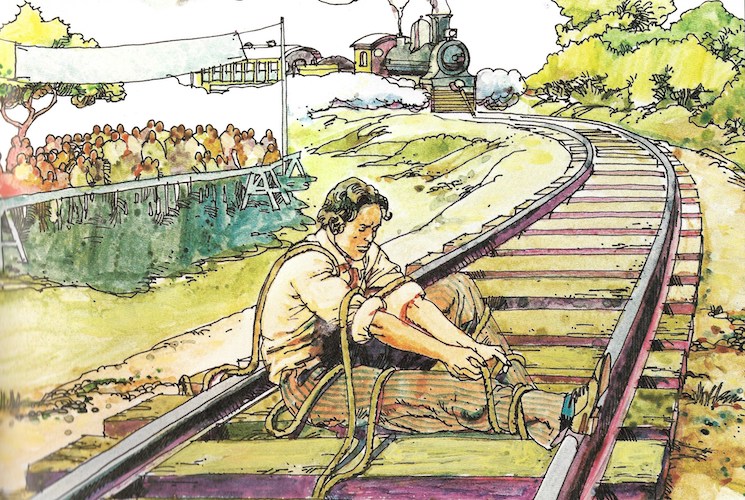
Last weekend our friend Joe Notaro at Harry Houdini Circumstantial Evidence shared a post about Houdini's Train Track Escape - Believe it Or Not. This is an event I've never been able to confirm. The sole source appears to be Walter B. Gibson, who did at times inadvertently spread mythology (including the trapped under the ice story). But Joe has found an account written by Gibson in 1954 that now gives us a location: Dresden, Germany. That's good! And it's bad.

I will let you go read about the escape at Joe's site. Instead, I want to talk about how this illustrates what I've come to think of as "the Germany problem."

From 1900 to 1913, Houdini performed in Germany as much as any other country. He spoke the language and was generally very comfortable with all things German. He even preferred traveling on German steamships. His engagements in Germany were lengthy and he seems to favor the country as a place to try things out for the first time. We know he did his first challenge packing crate escape in Essen, learned to fly in Hamburg, and debuted The Water Torture Cell in Berlin. It's even said he tried out a version of Buried Alive for the first time in Germany.  So Germany is a big part of Houdini's early career. Yet we know almost nothing about these engagements!

The reason for this seems due to the fact that Houdini history has largely been written by English speakers, and the stories of his German exploits would found be in German newspapers. Sure, we have a passable amount of information that can be found in his English pitchbooks (the Cologne trials, Kleppini, etc.). But I'll bet my knackwurst there is so much more!

It now appears the train track escape may be one of those "lost" German stories. But at least we now know where to look. Houdini performed at the Central Theater in Dresden during the entire months of September 1900 and October 1903. So if there is any newspaper account of this escape, it would be during those times. Also, the Harold Kellock biography claims Houdini did his first bridge jump in Dresden. That's another one I’ve never been able to confirm because...the Germany problem.

So here's a shout out to any German Houdini nuts who care to take up the challenge and uncover Houdini's adventures in Dresden. Not only might you find this train track escape, but you also may find his first bridge jump, and who knows what other untold stories!

Oh, we also have a Netherlands problem. But I guess we can tackle that another time.

Train track illustration from The Great Book of Magic by Wendy Rydell.

Friday, June 19, 2020

Climb aboard the Frisia

Here's a cutaway model of the German steamship SS Frisia that resides in the Smithsonian. What's this have to do with Houdini? Well, it was the Frisia that the Weiss family boarded in Hamburg 142 years ago today bound for America. It was the first ocean voyage for the 4-year-old Ehrich Weiss.


Built in 1872 by Caird & Co. in Scotland, the Frisia (originally launched as the Alsatia) was part of the Hamburg-American Line. It had room for 820 passengers and could make the Atlantic crossing in about 12 days. Frisia was one of the last iron steamships of its era. Following its run as an immigrant ship, Frisia was sold to Italian owners who converted it into a coal carrier. In 1902, the ship, then known as the Arno, was scrapped in Italy.


You can see many more photos of the SS Frisia model at the Smithsonian's American History website.

For more information about the Weiss family immigration check out Houdini Comes To America by Ronald J. Hilgert and Houdini: Escape into Legend, The Early Years: 1862–1900 by Manny Weltman.

Related:

Sunday, May 31, 2020

Arthur Moses reprints the first Houdini & Holmes adventure

Here's something exciting. Arthur Moses has released a new book that examines the 1908 story "Auf den Spuren Houdinis" (On The Trail Of Houdini). This marked the first fictional pairing of Houdini and Sherlock Holmes. The book includes the original German text as well as a never before published English translation. Below are details.

After a performance in Berlin, Germany, Houdini is kidnapped by his lesser rivals. Sherlock Holmes is urgently summoned to Berlin to investigate. Through his masterful deductive reasoning he tracks down the dangerous perpetrators in the nick of time. 
A recreation in its entirety of the German language pulp magazine series Aus den Geheimakten des Welt-Detektivs, featuring the 1908 issue number 101 "Auf den Spuren Houdini's" (On The Trail Of Houdini). Uniting Harry Houdini and Sherlock Holmes, formidable protagonists together, one being a fictional character and the other a living legend of history, is a masterful stroke synchronizing their uniquely charismatic identities. This text focuses on a single 1908 German language publication which brought them together, along with its never before published English translation in addition to later translated foreign language editions based upon the German work. Their two personas are as popular today as ever, with many modern pastiches, comic books and films successfully pairing Houdini and Holmes. 
Other reprints of this title in other foreign languages are represented by reproducing their covers; France, Belgium, Denmark, Mexico, Netherlands, Portugal, Romania, and Spain. Sherlock Holmes was the creation of Sir Arthur Conan Doyle.

But it gets even better! Arthur has also released two other separate volumes containing the rare Portuguese versions of this story from 1911 and circa 1920.


Says Arthur, "All 3 will have a great interest for both Houdini and Sherlock Holmes collectors." He has launched a website devoted to the books. All can be purchased from Amazon:

Harry Houdini & Sherlock Holmes Together Again In 1908: Auf Den Spuren Houdinis (On The Trail Of Houdini) 

Harry Houdini & Sherlock Holmes "Extraordinary Adventures of a Secret Police - The Missing Athlete" (Portuguese Edition 1911) 

Harry Houdini & Sherlock Holmes "Extraordinary Adventures of Sherlock Holmes - The Missing Athlete (Portuguese Edition 1920) 
The books can also be found on Amazon.de, Amazon.fr, Amazon.es, Amazon.it, Amazon.jp, and Amazon.ca.

Related:

    Saturday, October 26, 2019

    Houdini portrait signed in German fetches $7,200

    A beautiful 1900 portrait photo of Houdini signed in German to his friend and Chicago-based magic dealer August Roterberg sold today in Potter and Potter's "Magic Collection of Rudiger Deutsch: Part 1" auction for $7,200.00 (including buyers premium).

    What might be most surprising about this is how unsurprising that price is. Even though it blew away the auction estimate of $2,500 - $3,500, we seem to be moving into a time when even unsigned photos are touching $3000.

    What makes this one extra special is the inscription in German. You don't see this too often. I also love that it's dated April 6, 1901, his 27th birthday, which was not mentioned in the auction description. Houdini signed this while he was playing the Hansa Theater in Hamburg, Germany.

    Related:

    Translate