Showing posts with label The Master Mystery (1918). Show all posts

Tuesday, March 10, 2026

The Houdini Centennial Collection at The Miracle Factory

Our friend Todd Karr at The Miracle Factory is once again offering DVDs of rare Houdini film footage. His announcement below.

In honor of the 2026 100th anniversary of the death of Harry Houdini, we’ve decided to reissue four of our long-out-of-print anthologies of historic Houdini films in a four-disk set that we’re calling The Houdini Centennial Collection.

We’re only producing 100 of these signed and numbered sets, so order now. This fascinating collection contains some of the most important archival footage of Houdini ever filmed. If you’re interested in Houdini, these must-have movies and rare clips are essential parts of his legacy.

The Houdini Centennial Collection: A four-disk set of historic Houdini media

1. Houdini Captured on Film DVD: Houdini in Newsreels 1901-1926
2. The Houdini Picture Show DVD: Houdini’s Feature Films 1920-1923
3. Houdini: The Master Mystery DVD: The 1919 Serial
4. Houdini Sounds of Mystery CD: Featuring Houdini’s Voice and the Final Houdini Séance

And please don't forget to visit The Magic Bibliography Site, our incredibly handy new website for serious magicians, historians, and collectors, and take advantage of our introductory-rate subscription before it expires April 1, 2026.

You can get more details and purchase The Houdini Centennial Collection at The Miracle Factory.

Friday, September 26, 2025

Houdini and the Rio's (attempted) silent movie revival


In 1954, the Rio Theatre in San Francisco converted to an all-silent cinema, banking on nostalgia for the old classics in an era of Cinemascope and 3D. The article below, which appeared in the San Francisco Chronicle on New Year's Day, laid out the plan.

San Francisco Chronicle, Jan. 1, 1954.

While not mentioned in the above article, Houdini was an integral part of the Rio's slate. A new episode of The Master Mystery would play before each new feature. Interestingly, Paramount's biopic Houdini (1953) was still playing in theaters, and could be seen at the Roxie on 16th and Valencia at this same time.

The Rio's first offering was the 1923 Lon Chaney classic The Hunchback of Notre Dame, along with episode 1 of The Master Mystery. A Universal Monster and Houdini? I would have been there in a second!


This wasn't the only time Houdini and The Hunchback of Notre Dame played in proximity. The below is from Waco, Texas, when Houdini was on his spiritualism lecture tour in 1924. Did Houdini ever see the movie, I wonder?

The Waco Times Herald, Oct. 8, 1924.

Week 2 featured Orchids & Ermine (1927) with the great Colleen Moore, the 1912 short The New York Hat with Mary Pickford and Lionel Barrymore, and The Mystery Mystery episode 2.


Week 3 featured the Wallace Beery comedy Behind the Front (1926), the Harry Langdon short Soldier Man, and episode 3 of The Master Mystery.


The 4th week features "Anatole France's Classic" Crainquebille (1922) and D.W. Griffith's Judith of Bethulia (1914). Despite an earlier newspaper report that The Master Mystery episode 4 would be part of the program, it is not included in the opening-day advertisement. Possibly it was dropped due to the length of the features.


The Rio's next feature would have been the Clara Bow comedy drama Dancing Mothers (1926), along with Laurel and Hardy's Criminals at Large (1929) and The Master Mystery. A newspaper reported it would be episode 4, offering further evidence that it had been dropped the previous week.

However, a slate of "Disney's True-Life Adventure" films opened at the Rio instead. The San Francisco Call reported the change.

The San Francisco Call Bulletin, Jan. 23, 1954

The mention of TV may be telling. In mid-January, local San Francisco television station KRON purchased a package of silents and began running its own series of silents as part of its late-night programming. Among their films were The Headless Horseman (1922) with Will Rogers, The Primrose Path (1925) with Clara Bow, and, yes, The Man From Beyond (1922) with you-know-who!

I wonder what print of The Master Mystery the Rio was showing? It could have been the complete 16mm print owned by John Hampton of the Silent Movie Theater in Los Angeles, which was going strong at this time. Perhaps the two theaters worked out an agreement to share films. Finally, how disappointing must it have been to Houdini fans to have the Rio pull the plug after only three (or four) episodes?

In the 1960s, the Rio became the Toho Rio and screened Japanese films. It was then acquired by United Artists and was known as the Metro II in the 1970s. In 1982, it briefly became the Rio again, before being sold and renamed the Mercury Theatre. It screened foreign films until its closure in 1986. It was demolished in 1990.

Below are more appearances of Houdini's movies in revival houses.

UPDATE: Here's a fun update. Our good friend Diego Domingo performed a special Halloween magic show at the Rio when it was the Metro II in 1970. In fact, Diego had pitched the idea of showing his 16mm print of The Man From Beyond to them, but the theater opted for a horror film instead.

Tuesday, March 11, 2025

Mastery Mystery Episode 10 poster sells for 31K

A one-sheet lithograph for The Master Mystery Episode 10 sold on Friday for $31,000 at Poster Store Auction. This does not include the steep 31% buyers premium. It's unclear if this was the same poster that was sold by Haversat & Ewing in 2020.


The auction listing touted this as "only copy of this fabulous poster known to have survived," but this is not the case. There are at least two others in private hands. But it's a beauty and I think this might be a new record for a Master Mystery poster at auction.

Related:

Wednesday, July 31, 2024

Wild while away

I've returned from my summer break, which was not a break from Houdini. In fact, there was an unusual amount of Houdini activity! I kept my patrons in the loop.

First up, the great Patrick Culliton, "Houdini's Ghost," married his sweetheart Calista Carradine at Brookledge, the historic home of the Larsen magic family and a spot Bess Houdini knew well. I've shared some photos below.


An unexpected trip to San Jose, California, brought me into contact with some well-known ghost hunters and some terrific Houdini history. I'll be sharing more in October, but patrons got the inside scoop.


I also unearthed a new assistant and a second Houdini-Boudini photo. I shared the first installment of The Master Mystery audiobook, a Houdini vs. Margery timeline, and Rob Zabracky provided us with a tour of Houdini's Pittsburg (which I will be posting as a guest blog next month).

Not a member of my Patreon? If you like Houdini and enjoy a peek behind the curtain, I think you will enjoy it. You will also be supporting my work and all that I do here on WILD ABOUT HARRY. You can try it out for as little as $5 a month. Just click below for details, and come hang with us!


Tuesday, April 30, 2024

The Houdini movie book we've been waiting for

There have been many specialized Houdini books over the years. We've had books devoted to his tours of Australia, Canada, and Britain, his fiction, his friendship with Sir Arthur Conan Doyle, and his battle with Margery. There's even an entire book about a single trick that he only did once. Yet, there has never been a book about his movies.

Earlier this month, I reported on the publication of Joe Notaro's new book, Houdini Adaptations, containing the rare magazine adaptations of two Houdini films, The Grim Game and Terror Island. But now that I have the book in hand, I can see that it is so much more.

Joe takes a deep dive into Houdini's first three films, including summaries of every episode of The Master Mystery, and offers a wealth of information and many rare photos. Joe also covers all the known treatments for unmade Houdini films, such as the bonkers "Yar The Primeval Man" and the never-before-published "Out of the Shadows." So, yes, this is the Houdini movie book we've all been waiting for!

I therefore thought I would give this important work a second shoutout. If you are into Houdini's movies or if you just like seeing Houdini photos and promotional material that you've never seen before, this book is a must-buy. Congratulations to Joe for finally filling in this gap on our Houdini bookshelves.

Houdini Adaptations is available at Amazon.com and Amazon.co.uk. U.S. customers can order signed copies directly from Joe via PayPal to Joe.M.Notaro@gmail.com. The price is $40 and includes a signed book with a premium-color interior and USPS book-rate shipping.

Friday, January 19, 2024

Blackstone can't escape virtual Houdini

I recently discovered this intriguing advertisement in The Sandusky Register for March 27, 1919. An unknown suspended straitjacket escape, perhaps?

The Sandusky Register, March 27, 1919.

Turns out this was not the real Houdini but what appears to have been a free screening of The Master Mystery. The serial opened at Sandusky's Plaza Theater that week.

The Sandusky Register, April 3, 1919.

Below is the Hotel Rieger as it would have appeared at this time. The building survives today as a home for the elderly. Now, exactly how they pulled off an outdoor screening with the projection equipment that existed in 1919 is something I don't know!


But that's not the end of the story. On the same page that ran the free screening ad, you can see another magician opening in Sandusky on that very same day.

The Sandusky Register, March 27, 1919.

One wonders how Harry Blackstone felt about having to compete with a free screening of the Houdini serial on his opening night. But he went on to do well and was even held over for three extra days. The Houdini movie may have whetted the citizens' appetite for escapes, as Blackstone offered up a straitjacket and packing case escape on these extra days.

The Sandusky Register, March 30, 1919.

Blackstone then moved on to Emerson, Ohio, where he once again found himself competing with a virtual Houdini at the American Theater.

Evening Review, April 16, 1919.

This time, Blackstone did an overboard box escape from the Emerson Showboat, as you can see below.

Evening Review, April 16, 1919.

This is actually the earliest Harry Blackstone overboard box escape that I've been able to find. Some claim Blackstone did this escape first. But I've found no evidence to support that, and 1919 is a long time after Houdini's first overboard box escape in 1912. Keep trying, Blackie!


Photo from Houdini: A Pictorial Life by Milbourne Christopher.

Tuesday, July 25, 2023

The Master Mystery at The Silent Movie Theater

Here's an early photo of what became known as The Silent Movie Theater in Los Angeles, CA. As you can see, this photo was taken when the theater was playing Houdini's The Master Mystery.


Film buff John Hampton built The Silent Movie Theater in 1942. Hampton owned a near complete 16mm print of The Master Mystery containing far more material than what has ever been made commercially available. Patrick Culliton recalls seeing the complete serial at The Silent Movie Theater in the late 1950s and early '60s. The theater would also occasionally show The Man From Beyond and Haldane of the Secret Service.

The Silent Movie Theater closed in 1997 and John Hampton's print of The Master Mystery is today housed in the Packard Humanities Institute. It can be viewed at the UCLA Film & Television Archive, as I did in 2018.

You can read a history of The Silent Movie Theater, including details of its dark ending, at the excellent blog I Am Not A Stalker.

Hollywood Citizen News, May 3, 1947.

Friday, November 18, 2022

You cannot keep him out!

On November 18, 1918, Houdini's The Master Mystery premiered at the St. James Theater in Boston. Houdini attended the premiere with co-star Marguerite Marsh. It's been a few years since I've celebrated The Master Mystery's debut, so let's do so today with this terrific ad from the Exhibitors Herald.


I think it's interesting that this ad doesn't feature Houdini's image. Instead, this showcases his co-star, Q The Automaton, said to be the very first movie robot. You can't keep HIM out of your theater either, as this footage from the 2015 Los Angeles Magic History Conference proves.


I'll be marking this anniversary by watching the first few episodes tonight. Q lives!

Related: 

Saturday, November 12, 2022

LINK: Douglas Fairbanks Jr. remembers Houdini

This week I shared to my Pateron a clip of actor Douglas Fairbanks Jr. talking about Houdini. While Fairbanks remembers seeing Houdini at the New York Hippodrome, his very first memory of Houdini was seeing The Master Mystery as a boy. The clip is from the 1976 series The Amazing World of Cinema.

Thursday, September 22, 2022

More treasures of the Harry Ransom Center

Last month I spent an incredible six days at the Harry Ransom Center at the University of Texas in Austin, which holds the largest public collection of Houdini research material in the world. I shared some of the incredible treasures I saw on my first day in this post. Today I'm back with more.

It's worth repeating that the Harry Ransom Center is open to the public, so "anyone with a photo ID and a sense of curiosity" can see the treasures I'm about to show. Their website has excellent finding aids for the Harry Houdini Papers, the Harry Houdini Collection, and the Magic Collection. And if you are considering selling or donating a Houdini collection or item where it will be well protected and forever available, the Harry Ransom Center should be at the top of your list. So let's get back there!

One of the best things about my visit was the remarkable VIP treatment I received from Eric Colleary, Cline Curator of Theatre & Performing Arts Collections, and my good friend. Eric allowed me to do my research in the stacks where I could pull down boxes of Houdiniana at will. He also had a nice surprise waiting for me there. He had unboxed and placed their famous Houdini Estate bank box on the table right in front of me where it remained the entire time. So this was my view in paradise.


Each morning I also walked past a remarkable piece of furniture. This breakfront belonged to Houdini and stood in the parlor of 278. This actually played a key role in Messmore Kendall acquiring Houdini's collections from Bess in 1927 (as you can read here). The breakfront came to the HRC in 1958 along with the Kendall Collection. But it went on an odyssey adventure and even resided for a time in the Governor's Reception Room of the Texas State Capitol. In 2019 Eric discovered it in storage and brought it back to the Harry Ransom Center where it lives today. Good morning Houdini's breakfront!


My primary goal was to read all the correspondence in the collection and mine dates and data for my upcoming chronology book. Yes, I was there to "work." But there was a lot of correspondence to read! Some files bewitched me more than others. First and foremost was a large file of letters written by Houdini to Bess. As I shared in part one, this was the file I started with and the letters are remarkable. It's also the file that contains the most letters written by Houdini himself. (As these are Houdini's own files, most of the Ransom Center correspondence are written to him.)

Here's another delightful letter from that precious file. A marvelous slice of 278 life:


Another file of interest was a large collection of letters written by Montraville M. Wood, a Chicago inventor and associate of Thomas Edison who worked with Houdini on his Milk Can. The file is packed with letters related to improvements to the apparatus and the construction of new cans. Wood includes many illustrations. But there was one illustration at the end of a letter that tickled me as it must have tickled Houdini.


Another standout file contained correspondence from Birchet "Kit" Clarke, a famous press agent and Harry Kellar's former manager. I loved these letters! I don't know why Clarke isn't mentioned more in Houdini biographies as his letters are loaded with gold (including the mention of a Vanishing Elephant poster). They are also very, very funny. He uses a variety of nicknames for Houdini, his favorite being "Googley." There's even one letter that Clarke taped together as one giant scroll (below). Their friendship was a revelation to me.


Occasionally Eric and I would fall down a side rabbit hole. While chatting about newspapers, Eric pointed out that the Ransom Center has the photo morgue archive of the New York Journal-American. He did a quick search and found there was a Houdini file in that collection. Had anyone ever looked at it? Eric asked if I wanted to take a break and head down to those stacks and see what might be there. Yes please! Once there, Eric pulled a thick file of press photos from a container. The photos were fantastic, but largely familiar. And then this happened!


If you're like me, you just went weak in the knees. Yes, this is a third variation of the famous "my two sweethearts" photograph taken at the F. Gutekunst photo studio in Philadelphia in 1907. This is actually a photograph of a photograph, not an original, but still a great find. The Ransom Center has the originals of the other photos from this famous session, because of course they do!

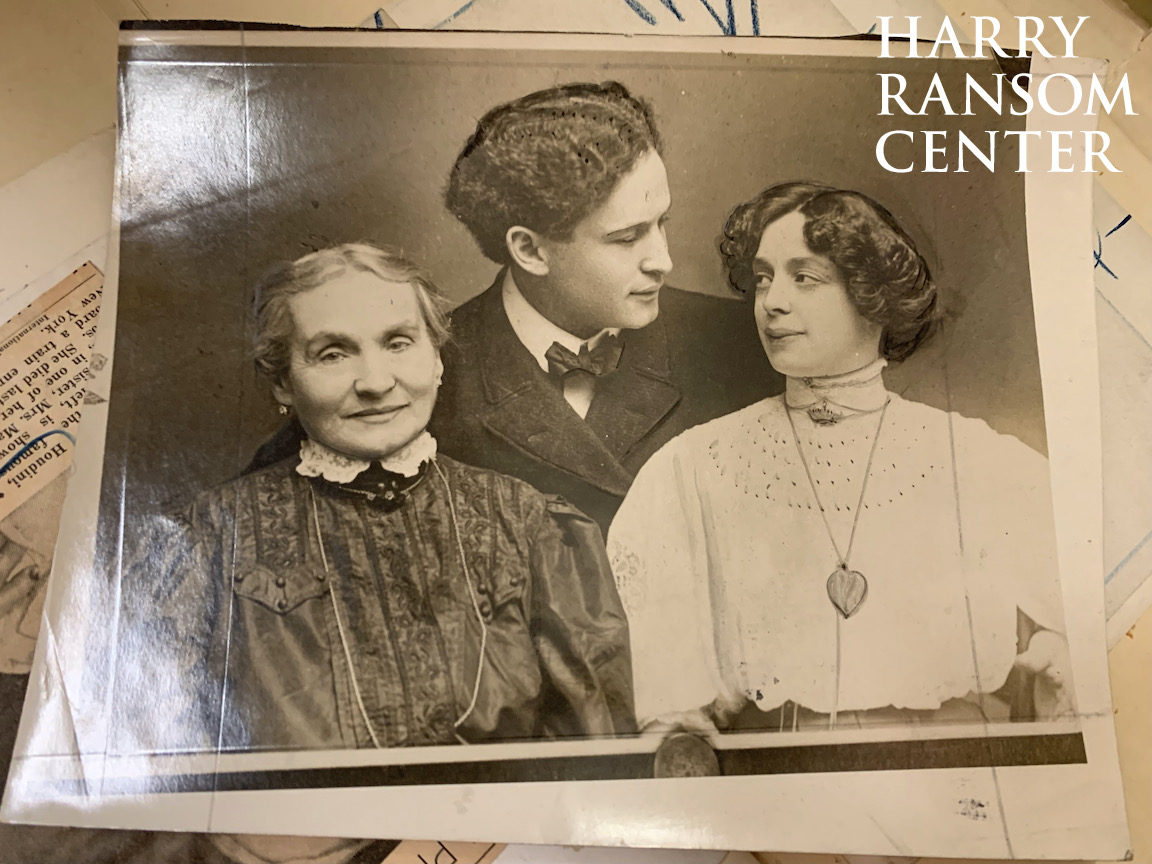
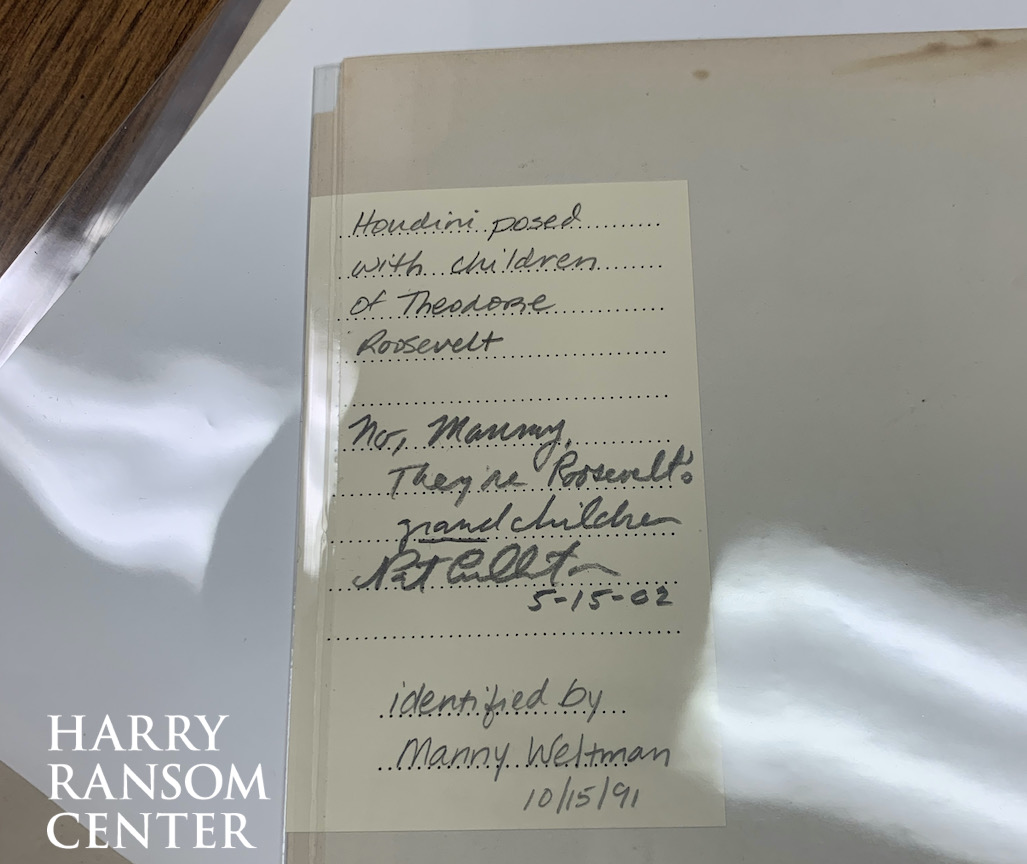
Occasionally I'd come across something unexpected, such as the below. The Ransom Center allows researchers to insert notes into a file if they have some clarifying information. Slipped into the sleeve of the famous photo of Houdini and the Roosevelt grandchildren (as seen here) I found this exchange between my friends and mentors Manny Weltman and Patrick Culliton. Pretty funny.


I actually added my own note identifying the photo's location and date (Feb. 20, 1925. Home of Mrs. H.A. Alexander, 167 East 74th St., NYC). So I love that Manny, Patrick and I all now share a sleeve in the Harry Ransom Center.

As the days ticked away, I found myself growing apprehensive. It was becoming clear I was not going to be able to read all the correspondence in the collection, and I knew there were other treasures that I would kick myself for not seeing. I began to formulate a new plan how to split my days between correspondence and big ticket items. But many times I just surrendered myself to anything that might be "cool." Eric, as always, was delighted to lay these treasures before me.

I mean, how could I not see this famous Ransom Center rarity? This is the only known copy of Houdini's very first pitchbook. Even Houdini considered this to be rare. It's actually much smaller than I imagined (7 inches), but what a piece of history.


Anything from Houdini's 1903 Russian tour is a mega rarity. Here are two fantastic broadsides advertising his appearance at the Gordon "Aquarium" Garden in Moscow in July 1903. Can you believe the condition?


Here are two large format photos of Houdini and Samri Baldwin. I wonder why Houdini had these made? The Ransom Center also holds a fair amount of correspondence from the famed "White Mahatma." In one letter from 1919 Baldwin writes:
"I was much gratified at receiving your courteous letter; particularly because so many professionals who become rich and famous forget all their old friends. Your letter showed me that I was never wrong in my estimate of you in thinking that money and fame would never make you a bit different from the whole souled boy I knew in Halifax and Kansas years ago."

This is a large and meticulous scrapbook Houdini kept devoted to his movies. Half is filled with fan mail from all over the world, still in their original envelopes. (One love struck young fan from South Africa starts her letter: "Houdini, I hope you like long letters because I've lots to tell you.") The second half contains newspaper clippings devoted to The Man From Beyond. I was expecting it to continue with Haldane of the Secret Service, but it did not. In fact, Houdini seems to have abandoned this scrapbook along with his movie career.


At the moment, the scrapbook is unavailable to view as it is much too brittle. The Ransom Center is working on a way to best preserve the contents. So this was a rare and exciting thing to see. Thank you Eric!

Speaking of movies, I nearly lost it when Eric brought these out. The Ransom Center has several original title cards from The Master Mystery (and one from The Grim Game). They are hand painted and works of art in their own right. These are the only surviving production artifacts from The Master Mystery, so pretty special!


The Ransom Center has some mysteries as well. Below is a custom picture frame with the name "Harry Houdini" across the top. What special image did this frame once hold? I also got to see the famous Ransom Center seed (found among Houdini's papers). What kind of freak seed is this?


My final day was Saturday, August 13. I only had a half day to research as I had to catch a flight in the afternoon. As Eric was off, I spent that morning in the Ransom Center Reading Room, which I'm happy I got to experience as its very well appointed and the staff is very helpful. I spent these last hours photographing everything I still wanted to read, including files of letters written by Hardeen to his "Dear brother Ehrich", and the Chung Ling Soo file, which Eric emphasized as being a must. I even stumbled on a signed photo of Charmian London. The minx.


Believe it or not, as noon rolled around I sat back and realized I had nothing left to see. I had done it! I had, at the very least, laid eyes on everything I knew I wanted to see. In addition, Eric and I had taken an amazing tour of the Paramount Theater and I was able to enjoy Esther's Follies on the invitation of Ray Anderson, which is a must see when in Austin. So in six days I had accomplished my research goals and also achieved a life-long dream...

I had seen the treasures of the Harry Ransom Center!

When I landed back in Burbank that night, I entered the airport to be greeted by this. An omen? I don't know, but I felt like he might be saying, "You ain't seen nothing yet."


Thanks to Eric Colleary and all the wonderful staff of the Harry Ransom Center for giving me this incredible experience and allowing me to share these treasures here on WILD ABOUT HARRY.

Related:

Friday, October 15, 2021

Watch Posterfix restore Houdini posters

This fascinating video from Posterfix in New York shows their full restoration of a Houdini Master Mystery 1-sheet poster. I might have argued to leave the poster fragment as-is until I saw the final product. Pretty amazing. The video also shows the restoration of a Master Mystery lobby card and three Houdini handbills from 1902.


Posterfix also took on the task of restoring five Houdini window cards from the recent find in Warwick, Rhode Island. One of those restored cards sold last month in a Potter & Potter auction. That video below.


Thanks to Michael Mitnick for the alert.

Wednesday, September 29, 2021

The silent cinema of Harry Houdini

It's my pleasure to offer up my contribution to the Silent Movie Day Blogathon which is being co-hosted by Silent-ology and In the Good Old Days of Classic Hollywood. My topic? Take a guess...

It's probably the least known part of Houdini's storied career that he made several silent movies and even ran his own movie studio for a time. This may be because his foray into the movies is considered one of his few failures. But during the waning days of vaudeville his movies kept his name and exploits before the public and only increased his fame. And the fact that his movies are still screened and enjoyed 100 years later is certainly some form of cinematic success.

So for National Silent Movie Day today, I thought I'd offer a rundown of Houdini's movies; the good, the bad, and how they can be seen today.

The Master Mystery (1918)
While Houdini had made a short film in Paris in 1909 (Les merveilleux exploits de Houdini à Paris), his first real entry into narrative cinema was a 15-part serial called The Master Mystery. Independently produced through Octagon Films, The Master Mystery was shot in and around New York and New Jersey. The first episode debuted in November 1918. The serial was aggressively advertised with Houdini making personal appearances at movie houses. It proved to be a surprising success, although Houdini would later have to sue Octagon for his share of the profits.

The plot of The Master Mystery finds Houdini as Department of Justice agent Quentin Locke infiltrating International Patents who are buying up breakthrough inventions for the sole purpose of repressing them. One of these inventions is a hulking robot called The Automaton, who leads a gang against Locke at every turn. It's wonderful stuff with Houdini/Locke escaping two death traps per episode. The movie co-stars Marguerite Marsh and Ruth Stonehouse and was directed by Burton King. The Automaton is said to be cinema's very first robot. I'll leave that for others to debate.

The Master Mystery was released on VHS in 1998 and then as part of Kino's Houdini The Movie Star DVD set in 2008. That DVD is now out of print and the serial has yet to make it to streamers, but it can be found on YouTube. However, this commercial version is severely truncated, missing many escapes and some episodes entirely. The complete serial does survive in the collection of the Packard Humanities Institute and can be viewed at the UCLA Archives. Here's hoping the full version will be released some day because it is a delight.

The Grim Game (1919)
The success of The Master Mystery got the attention of Hollywood, and in 1919 Houdini headed to the coast to make The Grim Game for Famous Players-Lasky. The movie was shot in and around Los Angeles and Hollywood and became newsworthy when two planes collided in mid-air while filming a stunt. The footage of the plane crash would remain in the movie and featured heavily in advertising, although the fact that it was a stuntman and not Houdini involved in he accident was kept secret. The movie was directed by Irvin Willat and co-stars Ann Forrest and Mae Busch.

The Grim Game is well-tailored to Houdini and easily his best movie. The Hitchcockian plot still holds up today. Houdini plays reporter Harvey Hanford who sets out to prove the folly of circumstantial evidence by framing himself for the "murder" of his fiancée's uncle whom he knows is simply away on business. But when the man turns up dead, Hanford suddenly finds himself accused of the crime and in a master frame of his own creation that takes would take a Houdini to escape.

The Grim Game was considered a lost film until TCM acquired the last known print from collector Larry Weeks and debuted a restored version at the TCM Classic Film Festival in Hollywood in 2015. The movie aired on TCM that same year. But it has never repeated and a planned DVD release never materialized. It is currently streaming on the TV Time app. Here's hoping someone will license the home video rights, which are available via Park Circus, and do a proper DVD release of this Houdini's best film.

Terror Island (1920)
Impressed by The Grim Game, Famous Players-Lasky decided to rush a second Houdini movie into production before the end of 1919. Houdini postponed a European tour and returned to Hollywood to begin work on Terror Island. The film was shot at the Lasky Hollywood studio and on location in Riverside and Catalina Island. This time the director was James Cruze and co-starred Lila Lee.

Terror Island finds inventor Harry Harper (Houdini) seeking sunken treasure and the missing father of the heroine on a South Seas island populated by cannibals and criminals out to secure the treasure for themselves. The movie showcases innovative underwater photography, but even at the time the plot was considered old fashioned and more suited to a serial. The movie did not achieve the creative or commercial success of Houdini's previous work, and despite promises of more films to come, Terror Island marked his last Hollywood production.

Terror Island is available on DVD, streaming and YouTube. However, this only surviving print, sourced from the Library of Congress, is missing two reels containing two of the movie's three escapes. So modern viewers must contend with this and the stereotypical portrayal of the natives typical of adventure movies of this era. But it's still Houdini and it does contain some classic early Hollywood thrills.

The Man From Beyond (1922)
Hollywood may have cooled on Houdini as a movie star, but Houdini was still willing to bet on himself. In 1921 he formed the Houdini Picture Corporation and produced two films back to back. The first was The Man From Beyond, shot at the Tilford Cinema Studios in Manhattan and on location in Lake Placid, New Jersey, and Niagara Falls. The Master Mystery director Burton King returned and Houdini's co-star was fellow vaudevillian Jane Connolly in her only movie role. The script was written by Houdini himself and it shows.

The Man From Beyond tells the story of a man frozen in Arctic ice for 100 years. He's discovered by two explores and thawed out in 1920 where he meets the reincarnation of his long lost love. The film is a strange amalgamation of action and melodrama that reflects Houdini's growing interest in spiritualism at this time. While the entire enterprise seems amateurish, especially when compared to Houdini's Hollywood productions, it's still a compelling document of Houdini's psyche and the thrilling climax at Niagara Falls still holds up.

The Man From Beyond has always been the Houdini film most accessible to the public. Prints were sold in 16mm and 8mm as early as the 1960s. It was also released on VHS by Video Yesteryear in the 1980s. Today several versions are available on DVD and there's even a Blu-Ray restoration. It's also available for streaming and on YouTube.

Haldane of the Secret Service (1923)
The second and last movie made by the Houdini Picture Corporation was Haldane of the Secret Service. The movie was shot in and around New York in 1921. Additional footage taken during Houdini's European tour the previous year was incorporated into the film to give it a globetrotting flavor. Burton King returned to direct, although his name does not appear on the surviving credits. Houdini is now generally credited as director, writer and star. Gladys Leslie co-stars. While Houdini distributed The Man From Beyond via state rights, Haldane was released by FBO in 1923.

Haldane of the Secret Service returns to formula action with Houdini playing Department of Justice agent Heath Haldane on the trail of counterfeiters and a mysterious gang boss known as Mr. Yu. The movie isn't as bad as its reputation, and Haldane/Houdini's escape from a giant water wheel is one of his best. However, the movie was poorly received  and even Houdini didn't do much promotion for it. But by 1923 he was on his way to a new career exposing fraudulent mediums and happy to leave movies behind.

Haldane of the Secret Service was unavailable for many years until a complete print was screened at the Silent Movie Theater in Los Angeles in 2007. This led to a DVD release. Today it can be found on streaming and on YouTube.

I hope you enjoyed this brief retrospective of Harry Houdini's silent film work. Happy National Silent Movie Day!


The Man From Beyond poster image courtesy the Harry Ransom Center at the University of Texas, Austin. 

Translate