Showing posts with label Pitchbooks. Show all posts

Tuesday, April 9, 2024

Houdini's Russian pitchbook has a new home

Our friend David Haversat has revealed via his newsletter that he is now the proud owner of Houdini's ultra-rare Russian pitchbook. These were created for Houdini's tour of Russia in 1903 and pre-date his America's Sensational Preplexer! pitchbook by several months. That makes this the very first (biographical) Houdini pitchbook.

To my knowledge, there are only two Russian pitchbooks in existence. The other is in David Copperfield's International Museum and Library of the Conjuring Arts in Las Vegas.

Sunday, February 19, 2023

Don Creekmore talks Houdini in Kansas on PBS

Our good friend Don Creekmore talks about Houdini in Kansas in this 2021 PBS interview. Don is currently working on a book about Houdini in the Sunflower State. In this interview he shares his very rare early Houdini pitchbook. Enjoy.


Thursday, September 22, 2022

More treasures of the Harry Ransom Center

Last month I spent an incredible six days at the Harry Ransom Center at the University of Texas in Austin, which holds the largest public collection of Houdini research material in the world. I shared some of the incredible treasures I saw on my first day in this post. Today I'm back with more.

It's worth repeating that the Harry Ransom Center is open to the public, so "anyone with a photo ID and a sense of curiosity" can see the treasures I'm about to show. Their website has excellent finding aids for the Harry Houdini Papers, the Harry Houdini Collection, and the Magic Collection. And if you are considering selling or donating a Houdini collection or item where it will be well protected and forever available, the Harry Ransom Center should be at the top of your list. So let's get back there!

One of the best things about my visit was the remarkable VIP treatment I received from Eric Colleary, Cline Curator of Theatre & Performing Arts Collections, and my good friend. Eric allowed me to do my research in the stacks where I could pull down boxes of Houdiniana at will. He also had a nice surprise waiting for me there. He had unboxed and placed their famous Houdini Estate bank box on the table right in front of me where it remained the entire time. So this was my view in paradise.


Each morning I also walked past a remarkable piece of furniture. This breakfront belonged to Houdini and stood in the parlor of 278. This actually played a key role in Messmore Kendall acquiring Houdini's collections from Bess in 1927 (as you can read here). The breakfront came to the HRC in 1958 along with the Kendall Collection. But it went on an odyssey adventure and even resided for a time in the Governor's Reception Room of the Texas State Capitol. In 2019 Eric discovered it in storage and brought it back to the Harry Ransom Center where it lives today. Good morning Houdini's breakfront!


My primary goal was to read all the correspondence in the collection and mine dates and data for my upcoming chronology book. Yes, I was there to "work." But there was a lot of correspondence to read! Some files bewitched me more than others. First and foremost was a large file of letters written by Houdini to Bess. As I shared in part one, this was the file I started with and the letters are remarkable. It's also the file that contains the most letters written by Houdini himself. (As these are Houdini's own files, most of the Ransom Center correspondence are written to him.)

Here's another delightful letter from that precious file. A marvelous slice of 278 life:


Another file of interest was a large collection of letters written by Montraville M. Wood, a Chicago inventor and associate of Thomas Edison who worked with Houdini on his Milk Can. The file is packed with letters related to improvements to the apparatus and the construction of new cans. Wood includes many illustrations. But there was one illustration at the end of a letter that tickled me as it must have tickled Houdini.


Another standout file contained correspondence from Birchet "Kit" Clarke, a famous press agent and Harry Kellar's former manager. I loved these letters! I don't know why Clarke isn't mentioned more in Houdini biographies as his letters are loaded with gold (including the mention of a Vanishing Elephant poster). They are also very, very funny. He uses a variety of nicknames for Houdini, his favorite being "Googley." There's even one letter that Clarke taped together as one giant scroll (below). Their friendship was a revelation to me.


Occasionally Eric and I would fall down a side rabbit hole. While chatting about newspapers, Eric pointed out that the Ransom Center has the photo morgue archive of the New York Journal-American. He did a quick search and found there was a Houdini file in that collection. Had anyone ever looked at it? Eric asked if I wanted to take a break and head down to those stacks and see what might be there. Yes please! Once there, Eric pulled a thick file of press photos from a container. The photos were fantastic, but largely familiar. And then this happened!


If you're like me, you just went weak in the knees. Yes, this is a third variation of the famous "my two sweethearts" photograph taken at the F. Gutekunst photo studio in Philadelphia in 1907. This is actually a photograph of a photograph, not an original, but still a great find. The Ransom Center has the originals of the other photos from this famous session, because of course they do!

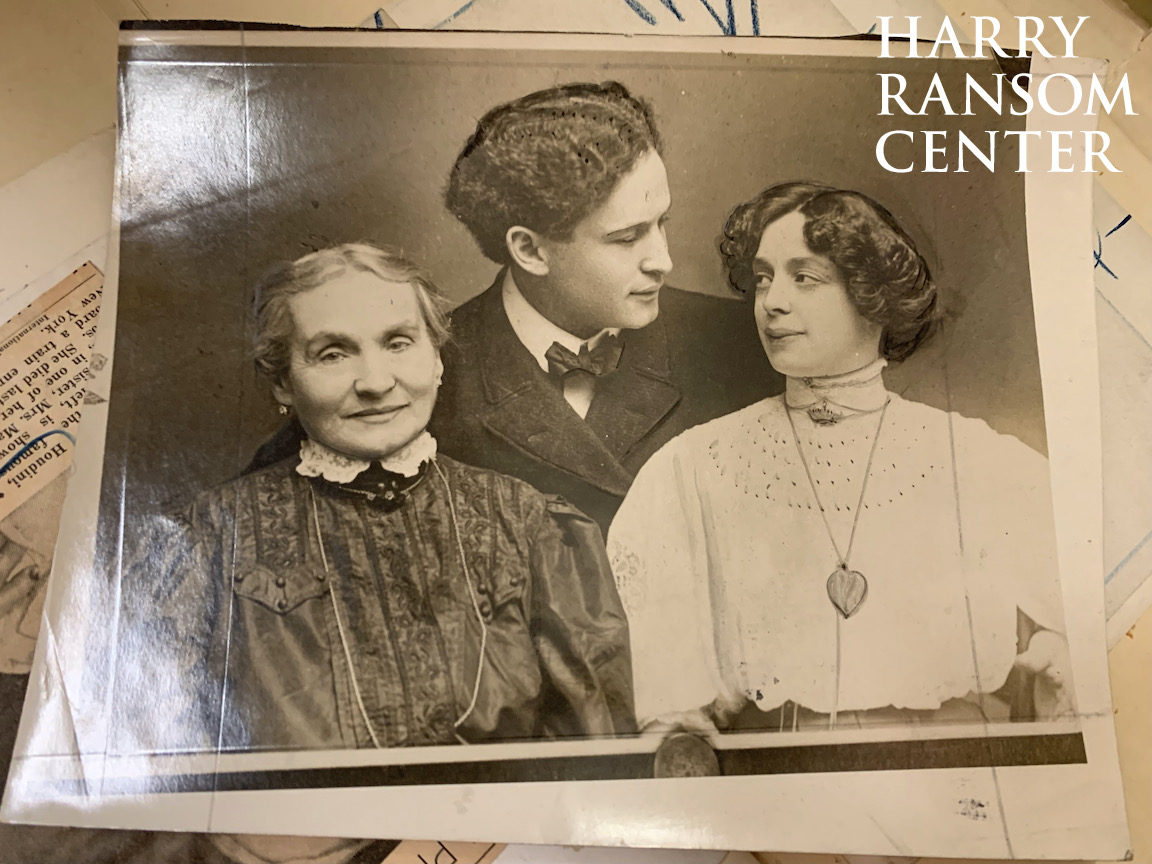
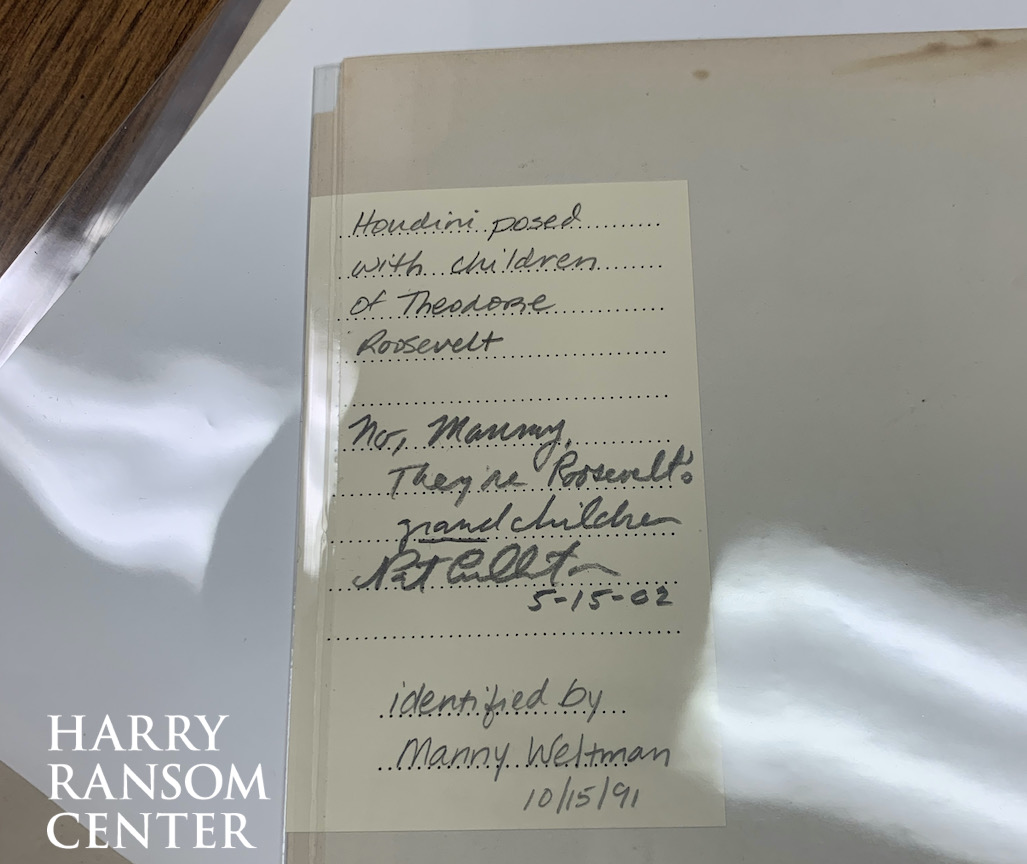
Occasionally I'd come across something unexpected, such as the below. The Ransom Center allows researchers to insert notes into a file if they have some clarifying information. Slipped into the sleeve of the famous photo of Houdini and the Roosevelt grandchildren (as seen here) I found this exchange between my friends and mentors Manny Weltman and Patrick Culliton. Pretty funny.


I actually added my own note identifying the photo's location and date (Feb. 20, 1925. Home of Mrs. H.A. Alexander, 167 East 74th St., NYC). So I love that Manny, Patrick and I all now share a sleeve in the Harry Ransom Center.

As the days ticked away, I found myself growing apprehensive. It was becoming clear I was not going to be able to read all the correspondence in the collection, and I knew there were other treasures that I would kick myself for not seeing. I began to formulate a new plan how to split my days between correspondence and big ticket items. But many times I just surrendered myself to anything that might be "cool." Eric, as always, was delighted to lay these treasures before me.

I mean, how could I not see this famous Ransom Center rarity? This is the only known copy of Houdini's very first pitchbook. Even Houdini considered this to be rare. It's actually much smaller than I imagined (7 inches), but what a piece of history.


Anything from Houdini's 1903 Russian tour is a mega rarity. Here are two fantastic broadsides advertising his appearance at the Gordon "Aquarium" Garden in Moscow in July 1903. Can you believe the condition?


Here are two large format photos of Houdini and Samri Baldwin. I wonder why Houdini had these made? The Ransom Center also holds a fair amount of correspondence from the famed "White Mahatma." In one letter from 1919 Baldwin writes:
"I was much gratified at receiving your courteous letter; particularly because so many professionals who become rich and famous forget all their old friends. Your letter showed me that I was never wrong in my estimate of you in thinking that money and fame would never make you a bit different from the whole souled boy I knew in Halifax and Kansas years ago."

This is a large and meticulous scrapbook Houdini kept devoted to his movies. Half is filled with fan mail from all over the world, still in their original envelopes. (One love struck young fan from South Africa starts her letter: "Houdini, I hope you like long letters because I've lots to tell you.") The second half contains newspaper clippings devoted to The Man From Beyond. I was expecting it to continue with Haldane of the Secret Service, but it did not. In fact, Houdini seems to have abandoned this scrapbook along with his movie career.


At the moment, the scrapbook is unavailable to view as it is much too brittle. The Ransom Center is working on a way to best preserve the contents. So this was a rare and exciting thing to see. Thank you Eric!

Speaking of movies, I nearly lost it when Eric brought these out. The Ransom Center has several original title cards from The Master Mystery (and one from The Grim Game). They are hand painted and works of art in their own right. These are the only surviving production artifacts from The Master Mystery, so pretty special!


The Ransom Center has some mysteries as well. Below is a custom picture frame with the name "Harry Houdini" across the top. What special image did this frame once hold? I also got to see the famous Ransom Center seed (found among Houdini's papers). What kind of freak seed is this?


My final day was Saturday, August 13. I only had a half day to research as I had to catch a flight in the afternoon. As Eric was off, I spent that morning in the Ransom Center Reading Room, which I'm happy I got to experience as its very well appointed and the staff is very helpful. I spent these last hours photographing everything I still wanted to read, including files of letters written by Hardeen to his "Dear brother Ehrich", and the Chung Ling Soo file, which Eric emphasized as being a must. I even stumbled on a signed photo of Charmian London. The minx.


Believe it or not, as noon rolled around I sat back and realized I had nothing left to see. I had done it! I had, at the very least, laid eyes on everything I knew I wanted to see. In addition, Eric and I had taken an amazing tour of the Paramount Theater and I was able to enjoy Esther's Follies on the invitation of Ray Anderson, which is a must see when in Austin. So in six days I had accomplished my research goals and also achieved a life-long dream...

I had seen the treasures of the Harry Ransom Center!

When I landed back in Burbank that night, I entered the airport to be greeted by this. An omen? I don't know, but I felt like he might be saying, "You ain't seen nothing yet."


Thanks to Eric Colleary and all the wonderful staff of the Harry Ransom Center for giving me this incredible experience and allowing me to share these treasures here on WILD ABOUT HARRY.

Related:

Friday, September 9, 2022

Treasures of the Harry Ransom Center

Last month I spent an incredible six days at the Harry Ransom Center at the University of Texas in Austin, which holds the largest public collection of Houdini research material in the world. Today I'm excited to share what I saw on my first day.

You might be wondering how such a large Houdini collection wound up in Texas? As I chronicled in a recent post (Exploring Houdini's Austin), in 1927 Messmore Kendall purchased the bulk of Houdini's private papers and his theatrical collection to add to his own massive collection. After Kendall's death, his entire collection was purchased by Karl Hoblitzelle for the Harry Ransom Center in 1958.

The Ransom Center also holds Houdini material from the Albert Davis and the Morris N. Young collections, and they are still making acquisitions. (Such as their famous ball and chain in 2016.) In fact, if you are looking to sell or donate a Houdini item or collection to an institution where it will be well protected and forever accessible, the Harry Ransom Center should be at the top of your list.

It's also good to say up front that anyone "with a photo ID and a sense or curiosity" can see the treasures I'm about to show. I wasn't special. The Harry Ransom Center is open to the public and their website has excellent finding aids for the Harry Houdini Papers, Harry Houdini Collection, and Magic Collection. However, the collection is massive! So massive I could not see it all in six days. But with the help of the amazing Eric Colleary, Cline Curator of Theatre & Performing Arts Collections, I saw a lot. So let's get into it!


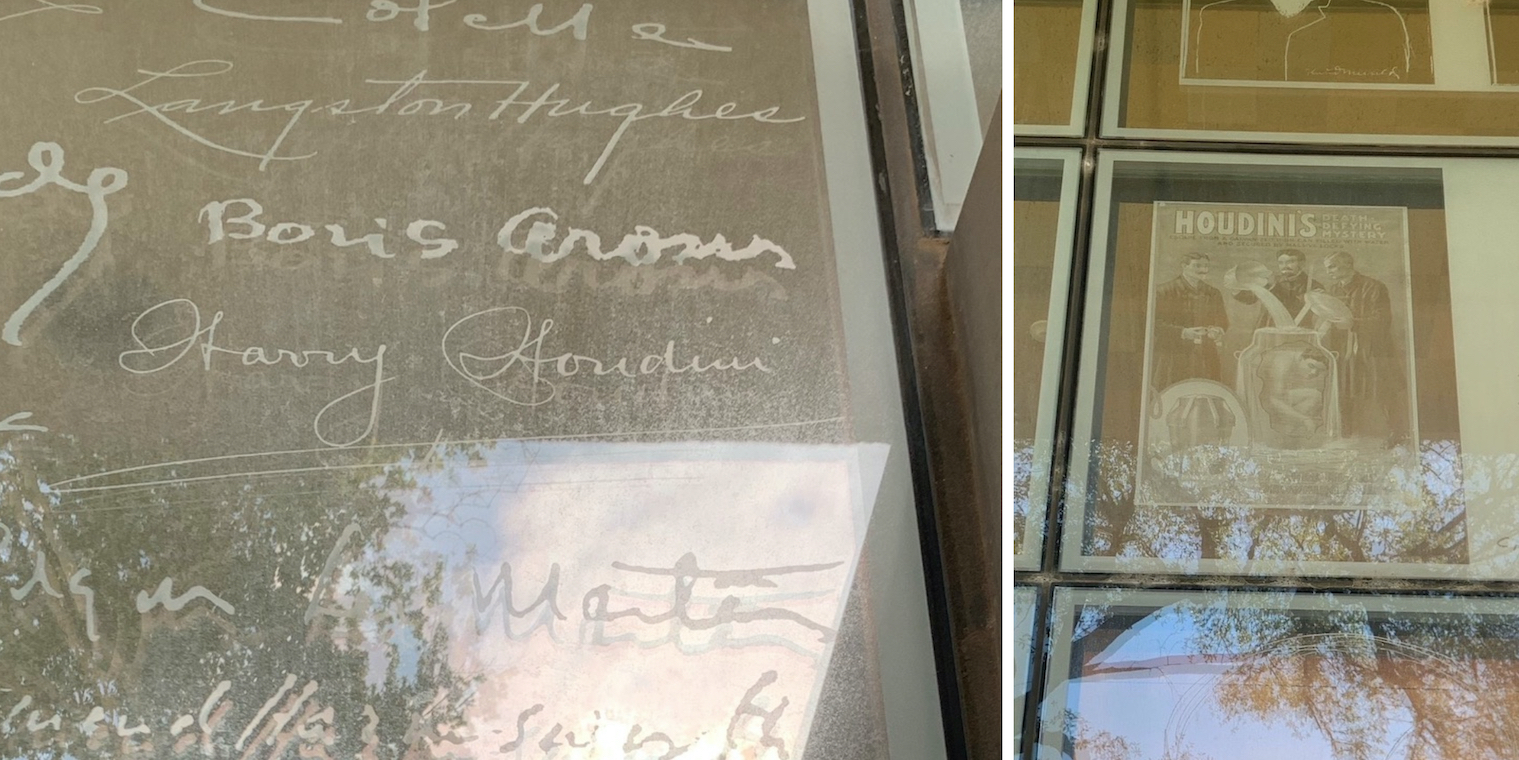
My Houdini discoveries happened before I even entered the building on that first morning (which, for the record, was August 8, 2022). Famous signatures and key holdings are etched into the building's decorative glass. Of course, I had to seek out Houdini, and I'm happy to report he is well represented. I was off to a good start.


Inside I met up with the aforementioned Eric Colleary who gave me a private tour of the Center and the stacks. You know, I've always only thought of the Ransom Center just in terms of Houdini. But the Houdini collection, as big as it is, is only a very small part of their massive holdings. The Ransom Center is filled with other treasures! There's even a Gutenberg Bible on display in the lobby. I got a peek at a few unique treasures, such as Charlie Chaplin's bow-tie and Sir Arthur Conan Doyle's handwritten manuscript for A Scandal in Bohemia.


The first Houdini treasure I saw was his 1910 Aviation trophy. Eric and I had bonded over this back in 2019, so this was a perfect way to start. The plaque is larger than I thought, which was a common theme of everything I saw this day. I was also able to look very closely at the date and can report that it has not been modified as was long claimed by my pal and mentor Manny Weltman. Sorry Manny!


Books were not going to be a focus of my research, but the Ransom Center's got 'em! Below is Eric with Houdini's own copy of The Discoverie of Witchcraft. They also have the original receipt from Maggs Bros. in London, showing Houdini purchased the book on August 4, 1917 for £23 (marked down from £25).


We then passed through the Preservation & Conservation Department. There I met Andrea Knowlton, Senior Book Conservator at the Harry Ransom Center. Among her current projects is Houdini's 1897 Magic Made Easy catalog. This was a treat to see, and it's great to know the Ransom Center is taking steps to ensure this mega rarity will be around forever.


Eric and I spent a good amount of time in their oversized flat items stacks, because it's here one finds their incredible collection of Houdini posters. We started with two posters from his 1920 UK tour that I've never seen. The condition is so flawless it felt like I was time traveling. And there was more...


Much more! How about three 1913 playbills from Cardiff, marking the first appearance of the Water Torture Cell in England. And in case you're wondering, the Ransom Center does not sell or trade their duplicates. The collections they acquire remain intact.


Here's one for you Mirror Handcuff fans. This newsstand poster announces the headlines for March 18, 1904, the day after the famous challenge. This is one Houdini kept himself.


The earliest poster in the Ransom Center (as far as I recall) is this mega rarity advertising Harry and Bess in a "Spiritualistic Entertainment." This was printed in St. Joseph, Missouri, possibly in 1898, and is a treasure indeed.


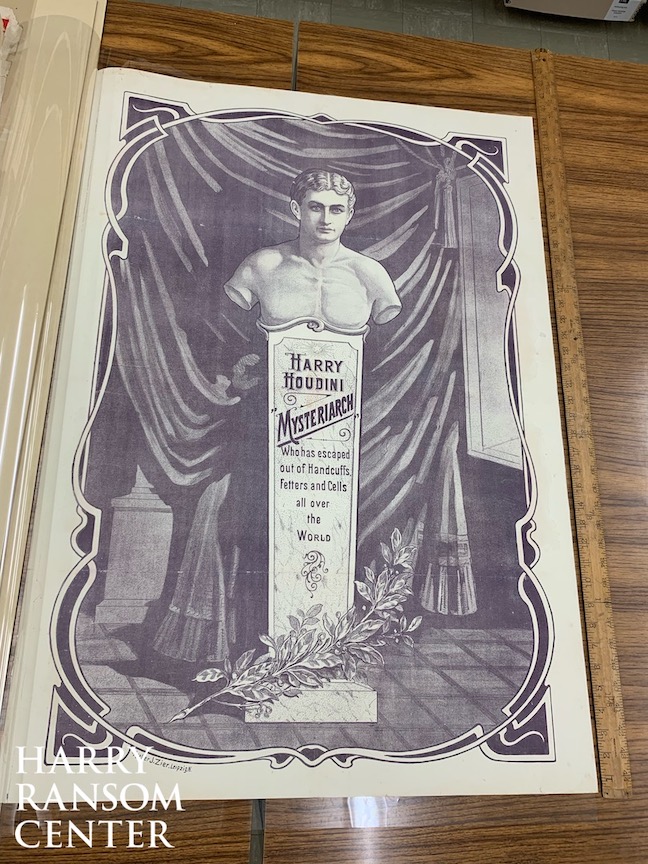
While the Ransom Center holds some familiar and famous posters, such as Houdini's Milk Can and Circus Busch Water Torture Cell, here's a poster you never see. I never even knew this was a full size (40 inch) poster until Eric laid it before me. This was made by Atelier J. Zier in Leipzig, likely in 1901 (the only time Houdini played that city). This one really grabbed me and I'm considering it for the frontispiece of my book.


The Ransom Center also has a complete collection of posters from Houdini's The Man From Beyond. I've shared some of these elsewhere, but here's one that's too big to share or even see in full. This massive six-sheet would ship in sections and be pieced together on a billboard. Below is just a single panel. But what a panel! The colors and stone lithography are breathtaking.


Below is a poster not found in The Man From Beyond pressbook. This was made by Hegeman Printing Co. of New York and may have been for the film's general release. (The white area is presumably where theater information would be printed or written.) It's more of a bread and butter one-sheet, but that's what makes it so special and rare.


It was now time to get down to "work," and Eric made me an incredible offer. I could do my research in the Ransom Center's comfortable and well appointed Reading Room. Here you put in your requests for materials via the online Finding Aids and their crack staff retrieves them from the stacks for you. This is what it looks like.


Or, if I didn't mind a less glamorous setting, I could work with him up in the stacks themselves. There I could pull down boxes of Houdiniana at will. Eric and I could also chase down leads on the spot and gab. No choice there. Stacks for me! You know, some people go to Hawaii for their vacation. This is me in paradise.


Now, I came to the Harry Ransom Center with the primary goal of building on my chronology and mining as many dates from the collection as I could find. Letters are gold in this regard, so my plan was to read through all their Houdini correspondence, even if that meant sacrificing things like photographs. But instead of starting at Container 1, I decided to plunge into Container 8, which I knew held a file of letters written by Houdini to Bess.


I couldn't have chosen a better way to start. This file could be the greatest treasure in the entire Harry Ransom Center. These letters are filled with warmth and wit, showing Houdini to be playful, loving and very human. The first two postcards so knocked me out that I must have spent 45 mins reading, re-reading, consulting my chronology, reading again, laughing, and then reading to Eric. And then came a 12-page handwritten stream of consciousness love letter from 1924. Incredible!

When I looked up from that one it was 5 PM. Closing time. Hours had passed and I had gotten through only three pieces of correspondence. Suddenly, six days (now five!) felt like a very short amount of time. And did I really have the discipline to limit myself to correspondence with so many other Houdini treasures all around me?

It was only the beginning.

Can't wait for more? Members of my Patreon can view 17 preview images from my next post: More Treasures of the Harry Ransom Center. Click the image below to go.

Sunday, July 17, 2022

New book! The Houdini Pitchbooks by Arthur Moses

A new book by mega collector Arthur Moses has just appeared on Amazon. This is an exciting and essential new Houdini resource from the man who has it all! Here's a description of The Houdini Pitchbooks.

Harry Houdini (1874-1926) was the quintessential immigrant success story. Brought to America as a small boy, his family had little means of financial support. Yet young Erik Weisz (birth name) rose above his family’s poverty and became the world’s most renowned escape artist, magician, and debunker of spiritualists. He was fearless when taking on a challenge and incapable of accepting defeat.

Pitchbooks, as they were known, were commonly used by performers and businesses in the latter 19th and early 20th centuries as an expansion of early playbills or advertising. Instead of a single sheet flyer, these multi-page pamphlets enabled the advertiser or performer to further extol their talents or products while generating additional financial revenues.

Includes all the known Houdini pitchbooks and their variants. This body of work includes over 40 different rare pitchbooks, including their cover images, along with the history of each. Variants include such differences as cover colors, page counts, minor text changes, revised editions, publication dates, printers, etc. An unmatched and valuable resource guide.


Arthur dedicates the book to our late friend John Bushey, who always wanted to publish a work such as this.

You can purchase The Houdini Pitchbooks in hardcover or paperback at Amazon.com and Amazon.co.uk.

Tuesday, June 1, 2021

Margery pamphlet original vs. reproduction

We are all aware of that pesky Parson's Theater reproduction program from the 1970s that will sometimes appear at auction as an original. Now it looks like that has a successor. 

Yesterday a reproduction of Houdini's Margery pamphlet, which were sold by the Houdini Historical Center in 1996 for $4.50, sold in an online Invaluable auction for $649 (including premium). Unless the buyer has a thing for reproductions, I've gotta think they believed it was an original. Wittingly or unwittingly, the auction did not clarify this.

Like the Parson's program, this booklet does not identify itself as a reproduction. But it's pretty obvious when you put it side by side with an original. The yellow cover and the lack of "Price, One Dollar" are instant tells, as is the smaller dimension. So bidders beware!

Original (left) and reproduction (right).

Speaking of sketchy auction items, check out this Houdini photo on eBay "signed" two weeks after he died. So Houdini did come back! It currently has eight bids.

Saturday, January 30, 2021

Set of Houdini printing blocks sell (quickly!) on eBay

On Monday there was some excitement on eBay when six original Houdini wood printing blocks appeared from a seller in Florida with relatively low Buy It Now prices (which quickly shot up as they started selling fast!). When the dust settled, I was thrilled to come away with the below.


Wood blocks like these were used in the printing of newspapers and other print media and can be one of a kind. The seller says she found the entire set at an estate sale of a 90+ year-old man. Three of the blocks are etched plates like the above and three are photos on copper. The largest of these is the well-known "Houdini at Different Ages of His Career" page from his pitchbook. Below are the auction images.


While I recognize all these blocks from their newspaper appearances, my own block is a bit of a mystery. While I suspect it was also used in newspapers, the only image I've found so far is the below print in the McCord Museum. Is this the original drawing from which this block was made? You'll notice it has the artist signature. Unfortunately, I can't make it out. [See UPDATES.]

McCord Museum

I would love to more more about printing blocks in general. Were they all one of a kind? How did newspapers acquire them? Would Houdini have provided them himself? If you have any answers, please let me know in the Comments.

Thanks to Todd Karr of The Miracle Factory for giving me the heads up on these!

UPDATE: Chuck Romano of My Magic Uncle tells me the artist here appears to be Howard K. Elcock, an English pen and ink illustrator who did a lot of artwork for Will Goldston's publications. The following is from The Magazine of Magic, February 1915:


UPDATE: Another development. I've just discovered this illustration appears in the "Revised 1920" edition of Houdini's The Adventurous Life of a Versatile Artist pitchbook (below). Curiously, the illustration is not in the later "Revised 1922" edition. Instead, the original photograph appears in its place. Maybe he lost the block!


UPDATE: I've now learned these plates came out of the famous 1980 278 estate sale. Also, what the seller told me about these coming from the estate of a 90+ year old man may not be accurate.

Friday, September 11, 2020

Did Hardeen really discover the full view straitjacket escape?


It's an established part of Houdini lore that he originally performed his straitjacket escape inside a cabinet until Hardeen discovered the power of doing the escape in full view when challenged to do so one night by an audience that didn't believe his cabinet escape. After that, Houdini quickly adopted the full view presentation and the straitjacket became one of his most iconic and popular escapes.

I've always found this perplexing. How could Houdini, who knew full well the power of rope escapes done in full view of the audience, fail to see this himself? Nevertheless, here's proof positive that as late as November 12, 1904, Houdini is still doing the straitjacket escape inside his "red velvet tent." This is from the Birmingham Daily Gazette:

Click to enlarge.

From this it appears the escape is still effective ("the applause was tremendous"), so maybe that's why Houdini never felt the need to experiment. I should add that I've found another cabinet straitjacket escape on December 2, 1904, at the Pavilion Theatre in Newcastle (with a carpet laid on the floor to ensure no traps), but the above clipping makes better reading.

So if Hardeen really did make this seminal discovery, exactly when and where did this happen? Turns out that is NOT an easy question to answer. There are conflicting claims and not one of them commits to a date. But we know Houdini is still in his cabinet in November-December 1904, and it's said he did his first full view escape in Paris in March 1905. So we can assume Hardeen made his discovery sometime between those dates.

Thanks to my recent deep dive into the British Newspaper Archive (which I've re-upped for another month), I have Hardeen's schedule at this time. So with this in hand, let's examine the major candidates:

Christopher:
In Houdini The Untold Story, Milbourne Christopher says Hardeen made his discovery at the Swansea Empire in Wales. He does not provide a date, but Hardeen played Swansea the week of December 26, 1904, which is within the timeline. Christopher says Dash sent Houdini a newspaper clipping. That makes me suspect his source is a letter. I wish I knew for sure, because Christopher is also the sole source for Houdini doing his first full view escape in Paris in March 1905. (The first account I can find is April 14, 1905 in Cardiff.) This is two months after Swansea, so either Hardeen took his time telling him or Houdini took his time in adopting it. Or maybe there's a better candidate...

The pitchbook:
I believe everyone, including Christopher, uses Hardeen's pitchbook, The Life and History of Hardeen, as the primary source for the dramatics of this event. And why shouldn't they? The pitchbook contains what appears to be a detailed newspaper account (which, unfortunately, is undated and unattributed). It even has a photo of the theater announcing the re-challenge on a huge outside banner.


The pitchbook identifies the events as having played out at the "London Empire." Now, when I hear "London Empire", I think of the Empire Theater in Leicester Square. But Hardeen never performed there. So this could be a reference to greater London, and Hardeen did play Empires in Hackney, Holloway, and New Cross in late November 1904, which are (just) within the timeline. [UPDATE: The photo is the Holloway Empire.]

But here's the problem. Elsewhere this pitchbook photo is credited as being 1906. This is well after Houdini is doing the straitjacket in full view. In fact, I have found numerous accounts of Hardeen being called out of his cabinet to repeat his straitjacket escape all throughout 1906. It appears to have been a standard (staged) re-challenge, similar to how Houdini would be "re-challenged" to do his packing crate escape. In fact, Hardeen becomes so associated with this, the English press dubbed him "the straitjacket man." Here is one such account from the Empress Theater in Hartlepool on April 7, 1906:

Hartlepool Northern Daily Mail.

I now believe everything in the pitchbook is referencing one of these later staged escapes. It's also possible the story in the pitchbook is not even an actual newspaper clipping, which is why it is unattributed and suspiciously vague. So the pitchbook is pure misdirection.

Does this mean the entire story of Hardeen discovering the full view straitjacket escape is manufactured mythology? Did the brothers discover it in some other way, maybe even seeing an imitator do it? When going down one of these Houdini rabbit holes the "it never happened" option always has to be considered. But before we jump to that conclusion, there's one more candidate to hear from...

Hardeen (Himself):
In the March 1941 issue of The Sphinx, Hardeen provided a lengthy article called "Houdini-Hardeen Strait-Jacket Escape". In it he states he made his full view discovery at the "Bedford Music Hall, Camdentown, London." He also says the escape took a full "grueling hour." He doesn't give a date (why make it easy on us?), but I've discovered Hardeen at the New Bedford Palace of Varieties in Camden Town on March 24, 1905. Presumably Dash played the full week which began on March 20.

Music Hall and Theatre Review, March 24, 1905.

This engagement fits like a glove! It is within the timeline and, better yet, it is while Houdini is in Paris. So Christopher's claim that Hardeen told Houdini about the escape via letter and that Houdini first tried it in Paris works beautifully. We also know Dash joined Houdini in Cardiff for his battles with Frank Hilbert during the week of April 12, and it's on April 14th that Houdini does the first documented full view escape that I can find.

(By the way, Hardeen states in this same article that he and Houdini saw their first straitjacket in Berlin in 1900, which cannot be right. But that's a can of worms for another time.)

While I'm still not sure we have this is 100% locked down, I do feel pretty good about the March 1905 New Bedford engagement as being the time and place Hardeen discovered the full view straitjacket escape. I also still believe the core claim; that it was Dash who made this discovery and not Houdini. The primary reason are the 1906 staged re-challenges. Only Dash did these, and that suggests he had some ownership over this particular twist on the act. Not to mention he was able to put the story in his pitchbook.

So, yes, I think we are safe leaving this one in Hardeen's column. Feel free to let me know what you think in the comments.


Thanks to Joe Fox for providing me with a copy of the original Hardeen Sphinx article. It is also reprinted in Pat Culliton's Houdini The Key and Hardeen: Monarch of Manacles by William V. Rauscher.

Translate