Showing posts with label 1930s. Show all posts

Thursday, January 8, 2026

Houdini's Escapes escapes copyright

Over the past few years, Public Domain Day has become increasingly popular. On January 1st of each year, a new tranche of books, movies, and music falls out of copyright. This became big news when Micky Mouse (the Steamboat Willy version) became Public Domain. Admittedly, copyright is tricky and varies by country, but in general, this year sees anything from 1930 joining the Public Domain.

So are any Houdini books entering the public domain this year? Yes! Houdini's Escapes by Water B. Gibson was first published in 1930 and, presumably, is now out of copyright. The combo edition, Houdini's Escapes and Magic, also shows a 1930 copyright. However, later editions list a 1932 copyright for Houdini's Magic (released as a separate edition), which may complicate matters. But the solo Escapes has escaped!

I have a fond memory of this book. When I first became interested in Houdini, I would peruse bibliographies in the backs of my books to see what other Houdini books had been released in past years. I fixated on the title, Houdini's Escapes. There was a book just about Houdini's escapes!? That sounded like a dream book. But at the time, I had no idea how to find an out-of-print book.

Then, like magic, one day I walked into my local Waldenbooks, and there on the shelf was a gleaming new mass-market paperback called Houdini's Escapes. It took me a while to process that this was the same book from 1930. It was like it had been reprinted just for me! (By the way, the mass-market format is also essentially going away this year.)

Now, truth be told, I was a bit disappointed in the book back then. I had expected a highlight book about Houdini's most famous escapes and the stories behind them. Instead, this is largely a collection of escape concepts from Houdini's notebooks. And no pictures! That all came in the book Houdini's Fabulous Magic (1961), which had its own magical reprint around this same time.

But I still have my Houdini Escapes Bantam paperback (right), and when I eventually found a first edition hardcover from 1930, I flipped for that cover! And today I value the book as a glimpse inside Houdini's mind and a record of unusual escapes that could have been.

Monday, February 17, 2025

Houdini's secret marks?

Here's a curiosity from the January 1938 issue of Genii magazine. This is a new one to me.


Another Houdini mystery? Or a bit of Ed Saint malarkly? Let us know if you've spotted any mysterious markings in any Houdini-owned books you might be fortunate enough to have.

Below is Houdini's copy of Hocus Pocus Junior: The Anatomie of Legerdemain (1635) in the Library of Congress. Certainly one of his rarest books. If you click the image you can see every page. I've paged through it and found no obvious marks.


Thanks to Eric Colleary for providing the LOC link. Eric is currently organizing an exhibition and writing a book on Houdini's Library for the Harry Ransom Center.

Tuesday, October 29, 2024

The Houdini way to San Jose


It was 100 years ago today on October 29, 1924, that Houdini gave his spiritualism lecture at the Victory Theatre in San Jose, California. This was Houdini's only visit to the city. A review of the lecture in the San Jose Mercury News began:

    A missionary with a message of sanity and common sense, Houdini, a powerfully built little man in a dress suit, left no doubt in the minds of an audience at the Victory theatre last night that so-called mediums are despicable frauds. It was a wonderful evening's entertainment, the best San Jose has offered in a long time.

During the lecture, SAM member Fred P. Faltersack came onstage to assist Houdini in demonstrations. Faltersack worked at the nearby Winchester Mystery House, the world's most vivid example of how belief in spiritualism can overtake a person's life. After the lecture, Faltersack gave Harry and Bess a midnight tour of the sprawling property. Houdini was reportedly impressed with Mrs. Winchester's seance chamber. The next day, Houdini and company left for San Fransisco.


I recently took a quick trip to San Jose and had a chance to visit the various Houdini locations in the city. There's more than you might think!

First up was the site of The Victory Theatre at 45 N 1st Street (the address later changed to 57 N 1st). The Victory later became a movie theater and was renamed The Crest. In October 1953, it played the Tony Curtis Houdini biopic. So I guess Houdini returned after all! It's fun to think that someone who saw Houdini at The Crest may have also seen the real Houdini there in 1924.


The Crest remained a popular San Jose cinema until 1965, when it burned to the ground. The fire was attributed to two teenage boys. The theater was never rebuilt. 


Today, the site of the Victory/Crest is a parking lot. Ironically, an escape room currently sits at the end of the block.


Just one block over from the Victory is the site of the Empire Theater at 23 N 2nd Street. Hardeen appeared here twice in July and November 1908. The theater closed in 1926. Today, an attractive building stands on the spot, but it's unclear if this is the original theater building. (I don't think it is.)

San Jose Mercury, Nov 17, 1908

Not far from the sites of the Victory and Empire is the still-active Jose Theater at 62 S. Second Street. The Jose's vertical sign once hung outside the Victory/Crest. It was moved and re-lettered after the Victory's destruction in 1965. Theater lore holds that Houdini performed here, but I think it's being confused with the Victory. However, Terror Island played here in 1920, so it still qualifies as a Houdini location to me!

Evening News, June 11, 1920.

San Jose once again became the center of Houdini activity when the PCAM (Pacific Coast Association of Magicians) held its annual convention at the Civic Auditorium in July 1938. Bess was an honored guest and featured in their big show inside the Mongomery Theater. Here, on July 21, 1938, it was proclaimed that Halloween would henceforth be known as National Magic Day in honor of Houdini.

Evening News, July 19, 1938.

The San Jose Civic Auditorium and Mongomery Theater still stand today. So does the Hotel Sainte Claire (today the Westin), where Bess and Ed Saint stayed during the convention. The hotel sits just across the street from the Auditorium at 302 South Market Street.


Finally, the Winchester Mystery House still stands and is a very popular San Jose landmark and tourist attraction. They are proud of their Houdini connection. In their archives, they have a 1924 newspaper clipping that Houdini signed and sent to the house after his visit. A large Houdini poster also hangs in one of their dining rooms.

George Hardeen at the Winchester Mystery House in 2024.

There was a plan to hold a Houdini Seance at the Winchester Mystery House during the 1938 PCAM convention to be attended by Bess and conducted by Ed Saint. The seance was announced in newspapers and magic magazines. But it never happened. In 1976, a local SAM chapter held a 50th Anniversary Houdini seance in the house. 

Genii, July 1938. The seance never happened.

This week, Houdini seances will be held in Appleton, Scranton, Las Vegas, Chicago, and more. But if you ask me, I think this year Houdini's spirit can be found in San Jose!


Related:

Monday, November 6, 2023

Joe Notaro is hot on the trail of the "Tatler Cuffs"

Our friend Joe Notaro at Harry Houdini Circumstantial Evidence is continuing to investigate the mystery of the "Tatler handcuffs" and has found yet another link in the chain.

As a refresher, in 2014, a page from a 1904 issue of Tatler magazine appeared on eBay that featured a photo of Houdini's Mirror Handcuffs (right). However, the cuffs and key depicted in that photo are noticeably different from the Mirror Handcuffs that survive today in the Copperfield collection. This mystery manacle has come to be known as the "Tatler Cuffs."

Joe had a major breakthrough in 2020 when he found a second photo of the Tatler Cuffs in 1933, along with evidence that Bess gave the cuffs to W.W. Durbin, owner of the American Egyptian Hall Theater and Museum in Ohio.

Now Joe has found compelling evidence that the Tatler cuffs were displayed as part of Ted Heuber's traveling IBM Museum in the 1930s and may have remained in Heuber's possession for a permanent museum that never happened. Joe even found a mention of them in a 1955 Linking Ring.

For this latest development, click over to HHCE and read: The missing IBM Museum is “the key” to the Tatler Handcuffs. This is wild stuff!

Tuesday, October 17, 2023

Foster Lardner: the man on the platform


Last week I shared the exciting news that David Haversat had acquired photo albums that once belonged to Foster Lardner. For 26 years Lardner worked with the Keith's organization in Providence, Rhode Island. He can even be seen standing on the platform with Houdini during a suspended straitjacket escape in 1924.

I've done a little more research into Lardner. Turns out he had much more of a connection to the world of magic than I realized. He was a student of Al Baker and a member of the SAM. He even made the cover of The Sphinx in October 1928. In that issue, Dr. A.M. Wilson writes:

     It is with no little pleasure and pride that I present the portrait of Mr. Foster Lardner, manager of the E. F. Albee Theatre, Providence, R.I. Mr. Lardner is a graduate of the University of Wisconsin, a scholar as well as a theatrical manager and magician. He has been practically interested in magic from his boyhood days. During the late World War he gave frequent magical entertainments for the soldiers in hospitals and gives frequent shows in the children's hospital of Providence. Magic has no better friend than Mr. Lardner. He knows the game from back stage to footlights. Every reputable magician, amateur or professional, has a friend and him. Mr. Lardner is too modest to write his own biography or to give me sufficient data to write it for him. [...] I consider my life richer for the friendship of Foster Lardner.

Lardner left Keith's in 1930 after it had become part of RKO. From this point on, he appears to indulge his passion for magic. In 1931, he stage-managed the SAM's "Carnival of Magic" featuring Hardeen, Cardini, and Jarrow. He also worked up a lecture, "Behind the Scenes with the Master Magicians," which you can see advertised below. You can bet Houdini was part of this talk!

Evening Bulletin, March 30, 1932.

As Wilson noted, Lardner frequently performed magic for children. Below is a nice set of photos showing Lardner entertaining tykes at the Rhode Island Hospital in 1931. He even used a rabbit named "Houdini."

Evening Bulletin, Dec. 20, 1931.

While Lardner might have been considered an amateur magician, in 1934 he joined the rarified ranks of only a handful of magicians to die onstage (literally). Below is an account of the evening and also offers a nice obituary of Lardner's life overall.

Evening Bulletin, May 18, 1934.

So there's a little primer on Foster Lardner, no longer just the man on the platform. I'm sure there's more to uncover, and maybe someone like Dean Carnegie, The Magic Detective, will do so one day. But I certainly consider Foster Lardner now part of the Houdini story.


Thanks to Joe Fox of the William Larsen Sr. Memorial Library at the Magic Castle for The Sphinx images and info.

Saturday, February 11, 2023

The living Bessie

Today marks the 80th anniversary of the death of Bess Houdini on February 11, 1943, aboard a train outside Needles, California. I thought a nice way to mark the day would be to bring her back to life in the best way possible. Below is Bess in the 1938 film Religious Racketeers aka Mystic Circle Murder. If you've not seen this footage, you are in for a treat. This is currently the only sync sound footage of any member of the Houdini family. Enjoy.


Here's to Bessie!

Friday, December 2, 2022

The bouncing beds of 278

In 1938 a ghostly phenomena was reported in Jonesville, Virginia, when the Sybert family claimed that the bed of their 9-year-old daughter, Bertha, would bounce uncontrollably whenever she was in it. Bertha also showed signs of possession. The press would dub her "Bouncing Bertha" and a bouncing bed would later appear in The Exorcist. You can read more about "The Legend of Bouncing Bertha" HERE.


In December a reporter asked Bess Houdini about the Virginia phenomena and, as you'll read below, she dismissed it as "bunk" (others would eventually come to the same conclusion). But what I really like about this article is Bess's description of bouncing beds and other trickery inside her former home of 278.

The Skyland Post, Dec. 29, 1938.

Houdini's bed survives today in the collection of Jon Oliver. No reports of bouncing.

Thursday, May 19, 2022

The Pecoraro Files

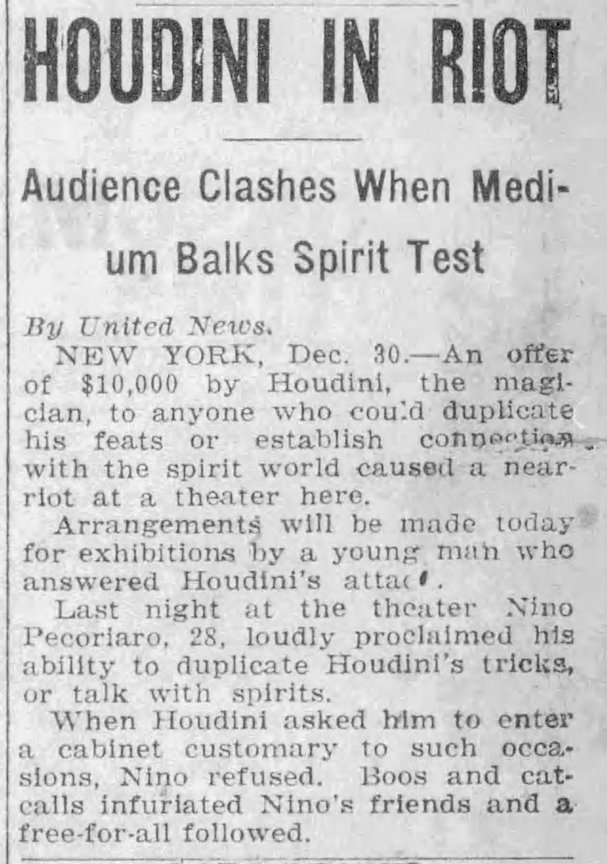
Here's a news item that was widely syndicated in late December 1925. This occurred during Houdini's 3 Shows in One at the National Theater on 41st Street in New York City. An evening with Houdini was never dull!

The Cincinnati Post, Dec. 30, 1925.

Nino Pecoraro (misspelled Pecoriaro in the above) was an Italian spiritualist who claimed his spirit guide was the deceased medium Eusapia Palladino. Pecoraro's reputation was greatly bolstered when he impressed Sir Arthur Conan Doyle during a seance at the offices of the American Psychical Institute in New York City in 1922. However, Doyle was dismayed when full details of the seance appeared in newspapers the next day "with the copyright mark below it, to show that it had been duly paid for."

The incident at the National wasn't Houdini's first encounter with Pecoraro. In 1923 the famed "boy medium" was tested by the Scientific American committee on which Houdini served. Houdini was on tour and did not attend the first two tests, during which Pecoraro impressed the committee with his ability to manifest ghostly phenomena while securely bound. The head of committee, J. Malcolm Bird, who would later collude with Margery, even wondered if the smell of garlic on the Italian's breath could be "celestial garlic." No joke.

Things looked good for Pecoraro. That is until Houdini arrived for the third test on December 18. He was mortified to see the committeemen securing Pecoraro with a single piece of long rope. Houdini cut the rope into pieces and tied the medium himself. That put an end to Pecoraro's ghost show and his shot at the Scientific American prize. (For an excellent account of all this check out The Witch of Lime Street by David Jaher.)

While Houdini biographies all contain the story of the Scientific American tests, none of them mention this follow-up incident at the National. Was it really a "riot"? One thing I find intriguing is the photo below. This shows Houdini and Pecoraro around the time of this confrontation. In fact, Houdini and the young medium took a series of portraits together at a New York photo studio. Why would they do this? Were they planning a public test, as alluded to in the article, that never came to pass? Could the theater incident have been a publicity stunt that got out of hand? There may be an untold story here.


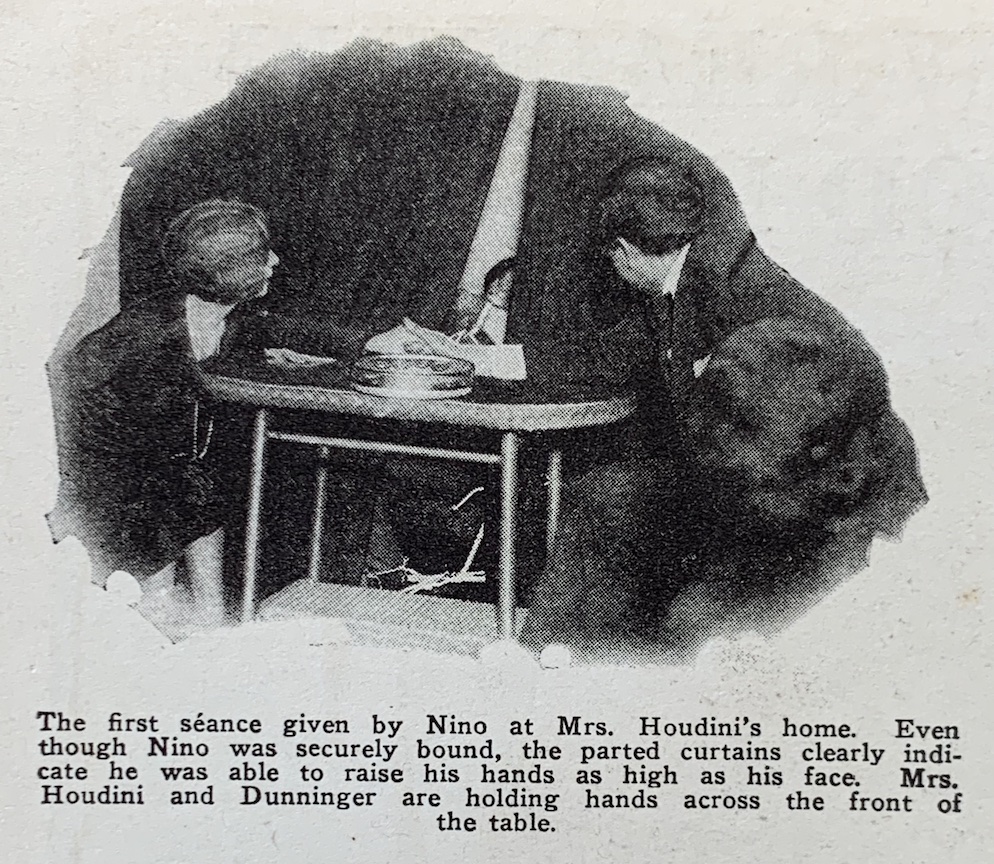
After Houdini's death, Pecoraro gave Bess a private seance at her home on Payson Ave. Joseph Dunninger was also in attendance. Nino went through his regular routine but failed to deliver the all important Houdini Code to Bessie.


In 1928 Pecoraro was at it again. This time the medium offered to produce Houdini's physical spirit at the offices of Science & Invention magazine which offered a $21,000 prize for genuine spirit phenomena. Bess attended the seance and cameramen surrounded Pecoraro's cabinet, ready to snap a photo of the master magician. Nothing happened. "Not Even for $21,000 Would Houdini Show Himself at Seance" read a newspaper headline the next day.

A few days later Joseph Dunninger recreated Pecoraro's seance using trickery for better results. The photo below shows "Houdini" making his reappearance with Bess looking on. Pecoraro's manager, Charles E. Davenport, asserted that Dunninger had mediumistic powers even if he didn't know it.


In 1931 Pecoraro finally confessed to being a fraud. He demonstrated his methods, which included producing a message from Houdini, at a New York press conference. The resulting United Press story is pretty amusing.

The Ogden Standard Examiner, April 9, 1931.

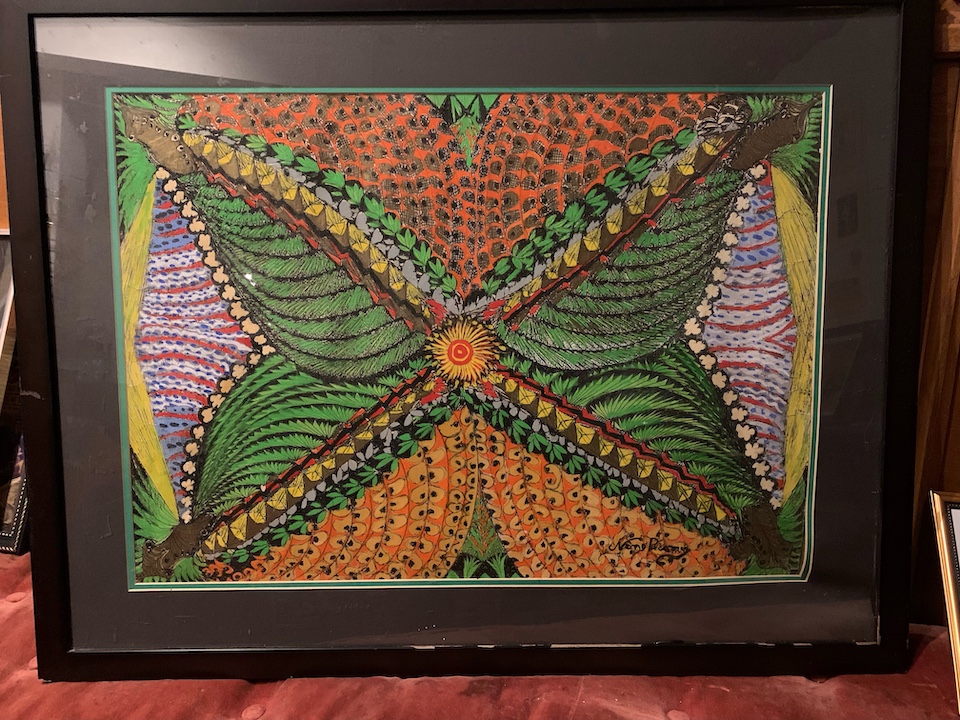
It's unclear if Pecoraro ever did become a cement salesman, but he did continue to paint. In fact, two of his paintings are on exhibit at the Houdini Museum in Scranton, PA.

On April 27, 1973, Pecoraro collapsed while walking with a friend in Naples and died on his way to the hospital. He was 74.

Painting by Nino Pecoraro at the Houdini Museum in Scranton.

Thanks to the Houdini Museum in Scranton for the photo of their Nino painting. Other images come from Houdini: A Pictorial Life by Milbourne Christopher, Houdini's Sprit Exposes by Joseph Dunninger, and Newspapers.com.

Tuesday, May 3, 2022

Houdini helps a fellow Hungarian from beyond

Recently magician Richard Hatch sent me a collection of original Houdini press clippings from the 1930s and '40s. Some real gems in the batch, including the below. The movie being referenced here, "Vampires of Prague", would ultimately be released as Mark of the Vampire by MGM in 1935.


I don't know what this "net trick" of Houdini's would have been, but I don't think we need to go looking for it. I suspect this entire news item is the invention of the MGM publicity department. I just enjoy the intersection of Houdini and classic horror films, which have always been a side passion.

Mark of the Vampire was directed by Tod Browning, who also directed the Hungarian Lugosi in Dracula. Coincidently, I've just worked up another post with a Houdini-Tod Browning connection. Click here for that.

For more vampiric Houdini adventures, check out the links below.

Thanks Richard.

Related:

Wednesday, February 23, 2022

Handiwork

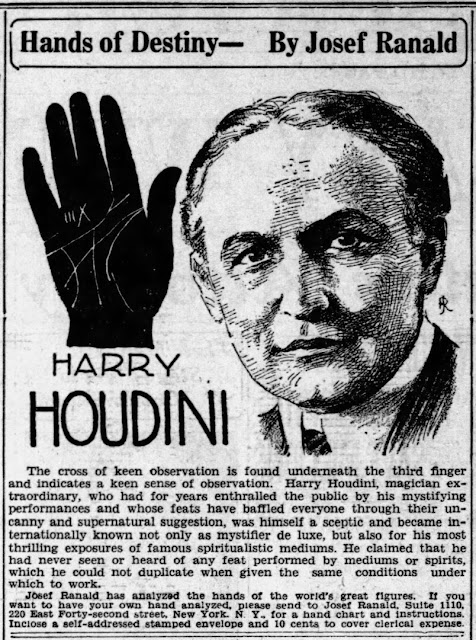
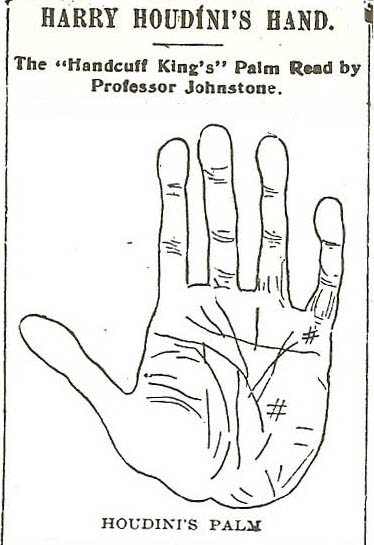
Returning to our Weird Week theme, here's one for all you aspiring palm readers. This article ran in the Moline Daily Dispatch on April 13, 1932, and offers a look at Houdini's right palm (allegedly). Note the "cross of keen observation"!


This is not the first time Houdini's palm appeared in newsprint. In 1900 a Kansas City paper reported that Houdini had his "hand examined" by a local palm-reader, Professor Paul Alexander Johnston, and ran the illustration below. This shows his left hand, so that gives us both of Houdini's palms to examine.


Does this mean Houdini believed in palmistry? Before we jump to that conclusion, let's hear from the man himself. The topic came up during Houdini's 1926 testimony before Congress, and here's what he had to say:

Mr. McLeod: Is it a fact that palmistry is a science?
Mr. Houdini: No; it is not.
Mr. McLeod: What do you call it?
Mr. Houdini: It is a fraud. How can you tell anything the lines of the hand? You can tell whether a man is a bricklayer or a bank clerk.
Mr. McLeod: And that is as far as you can go?
Mr. Houdini: That is a far as anybody can go unless they deduce from reading you.

Sounds like he's using his cross of keen observation.

Images: Newspapers.com and 'Houdini His Legend and His Magic' by Doug Henning.

Related:

Thursday, September 23, 2021

Hardeen at the Prospect

Here's a nice shot of Hardeen with a challenge packing case from the March 24, 1933 Brooklyn Daily Eagle. This is when Hardeen was appearing at the RKO Prospect Theater in Brooklyn not too far from where he lived. I'm always surprised how tall these boxes were, and this image shows that clearly. Note the mention of a Houdini display in the theater lobby.


Houdini himself played the Prospect in November 1914 and April 1916 (accepting a beer challenge from the Interboro Brewing Co. on April 13). The theater was converted to retail space in 1967, but the building still stands today. In fact, remains of the theater can still be found inside.


Below are posts with some more images of challenge packing crates.

Related:

Tuesday, September 7, 2021

LINK: Larger than Life: Harry Houdini & Mickey Cohen

Paranormal investigator Scott Markus has a nice post on his blog What's YOUR Ghost Story? about Houdini and gangster Mickey Cohen. Scott explains:

I love the concept of taking two seemingly opposite figures in history, putting them up next to one another and then seeing what types of comparisons we can draw and what ironies might present themselves. I’m not fully trying to do that here, but I can’t keep myself from doing it entirely.

Scott touches on a lot of Houdini Los Angeles history in this delightful and original read. So click the headline to check it out What's YOUR Ghost Story?

Monday, May 17, 2021

Bess helps clear a "witch"

In 1656 Eunice "Goody" Cole was convicted of being a witch in Boston. After serving a jail sentence she was again accused of witchcraft in Hampton, New Hampshire, where she died in prison in 1680. It only took the citizens of Hampton 258 years to realize they might have made a mistake. So on August 25, 1938 they organized a ceremony to clear Eunice's name. And guess who was there?

I'll let the report from the AP take it from here.

Click to enlarge.

It's nice to know Bess kept up her husband's battle against "the cancer of superstition."

Below are more adventures of Bess in her later years.

Related:

Sunday, January 24, 2021

Meet Madame Blanche Corelli

Those interested in Houdini's extended family will be interested in the new book, Madame Blanche Corelli: Correspondence with Hall Lippincott January 1931–September 1939 by Cindy Lippincott.

Blanche Corelli (real name Maria Dorothea Herrmann) was the only child of Compars Herrmann of the famous Herrmann magic family. She was also related to Houdini via his father's first marriage (Mayer Samuel's first wife was a first cousin to Blanche's mother, Rosa Csillag.) Like her mother, Blanche had a successful career as an opera singer. She later became a music teacher in Germany.

The book contains correspondence between Blanche and the author's father, Hall Lippincott. While the focuses here is on Blanche's later years in Berlin, the introduction does mention her Houdini connection with a nod to Dean Carnegie's groundbreaking 2011 post at The Magic Detective. Unfortunately, Blanche only makes a few passing mentions of her famous cousin in the letters themselves.

I own a copy of A Magician Among the Spirits that Houdini inscribed to Blanche in 1924. She in turn gave it to Dante in 1939. So I'm excited to add this book to my shelf.

You can add Madame Blanche Corelli to your shelf via Amazon.com and Amazon.co.uk.

Related:

Monday, December 14, 2020

Bess Houdini P.C.A.M. show poster

A terrific poster for "Mrs. Harry Houdini and America's Most Famous Magicians in The Greatest Magic Show Ever Presented" sold on eBay today for $261.99. If this poster looks familiar, that's because it appears in Walter B. Gibson's The Original Houdini Scrapbook (page 197). But there it's in black and white. Here we see it in glorious color!


This show was part of the 5th annual P.C.A.M. (Pacific Coast Associations of Magicians) Convention in Reno, Nevada in 1937. Bessie was a regular attendee at P.C.A.M. gatherings and typically the guest of honor. On this occasion she was presented with the keys to the city by Mayor John A. Copper and crowned "Queen of Magic" by P.C.A.M. president Caryl Fleming. Below is an excerpt from the July 19, 1937 Reno Gazette that covered her arrival in "The Biggest Little City in the World".


The Reno Gazette also covered the show, running the below photo of magician Bob Stull doing the "Shooting a Ribbon Thru Girl" illusion that would later be seen in Houdini (1953). 


According to a report in Genii, Bess didn't actually performed in the show. Instead she was introduced and gave a short speech, noting: "I did the substitution trick for your grandfathers."

10th Anniversary: Bessie on the backlot

It was 10 years ago that I embarked on a little Hollywood archeology in search of the exact spot seen in a photo of Bess Houdini at Paramount studios in the 1930s. Did I find it? Click the link below and find out.


UPDATE: The photo above surfaced in recent years and is the second taken during Bessie's visit that I've seen. I also now know the year was 1935. Of course, Paramount is still there and so is this spot. My theory of its location still holds as far as I can tell. This was among my first Houdini archeological jaunts and has become a favorite thing to do!

With this I'm closing out my year long look back at the 10th Anniversary of WILD ABOUT HARRY. I hope you've enjoyed revisiting some of these past posts.

Monday, October 19, 2020

This is Houdini's seance busting flashlight!

Today I have something very exciting to share. This is the flashlight Houdini is said to have used to expose fake mediums during seances. This comes from the collection of our good friend Diego Domingo who has owned it for 50 years.


The flashlight is surprising in a few ways. It is certainly much smaller than expected. And while there is no maker's name on it, this is a commercially sold "vest flashlight" of the time. (I just bought an identical one on eBay.) The one modification Houdini appears to have made was to paint the bulb red. But this makes sense and helps further verify that this was for seance use. Red light was considered the only "safe" light for a seance. It's said white light would cause ectoplasm to vanish and harm the medium. And being small would make it easy for Houdini to conceal. So a palm sized flashlight with a red bulb is exactly what we should expect, and it's what we have!


But would this flashlight be bright enough to expose a medium across a room, as we see Houdini doing in various dramatic illustrations? That seems unlikely. But if one reads the newspaper accounts of Houdini's exposures--notably the famous Cecil Cook exposure--it states that Houdini "crept close" to the medium. In that case this flashlight would indeed reveal a medium in all their fraudulent glory. It's also likely Houdini used this just to catch a quick glance at any suspicious seance room activity without drawing attention.

The flashlight no longer has its battery, and exactly what kind of battery it took and how it worked is a bit of a mystery.


Okay, so how did Diego come to have this treasure?

As discussed in a recent post, the flashlight found its way into the collection of George Hippisley a.k.a. Karlin the Magician in 1946 (but we'll come back to this date). George eventually put the flashlight up for sale along with a large collection of Blackstone material in June 1970. Most of that material was purchased by Bob Lund and Dan Waldron. But Diego got the jump on the Houdini items.

I'll let Diego take it from here:

"In 1970(!), going thru the latest copy of The Linking Ring, I saw an ad by an George W. Hippisley, selling magic items, mostly Blackstone memorabilia and props. What caught my eye was that it included Houdini items as well. Back then, I was very fascinated with Houdini and escapes and sent my 50 cents for his list."  

Click to enlarge.
"The list was an amazing array of items, most/all previously owned by Harry Blackstone, Sr. I quickly scanned the Houdini items and eventually ordered: A spirit trumpet that was from Houdini. A small flashlight HH used to expose mediums in their dark seance rooms. A piece of paper with HH correct birthplace/birthday written by Blackstone on it. A small clipping from The Billboard Magazine regarding Houdini and Blackstone each claiming to have first performed the overboard packing case escape. AND, a typed and signed letter by Houdini, bad-mouthing Blackstone. (so what else is new?) I cannot recall if I didn’t order other items because they were already sold or because of my limited funds. I probably talked to Hippisley regarding what was available so I could be sure to get it."

Along with Diego's purchases came a letter from George Hippisley himself explaining exactly how he came to own these items:

July 14, 1970

Dear Mr. Domingo:

In 1936 I approached Mrs. Beatrice Houdini for some token from her late husband's effects. A letter came back requesting information about my connection with magic and magicians. This letter has since been lost.

However, I answered the letter and some time later a package and an envelope came from Edward Saint, Mrs. Houdini's manager. In the package were the trumpet, the flashlight, and the cuts as listed in my listings for sale.

In the envelope with the Houdini challenges and the movie stills and lobby photos. These were folded which wasn't a fortunate thing. I believe this envelope I enclosed with the items you purchased from me. 

That is how I came to have these items. There was no further word explanation about them. I wrote in return of the receipt and thanked both Mrs. Houdini and Mr. Saint for them. There was no reply. 

Sincerely yours,

George W. Hippisley

This is a different origin story from what appeared in that 1946 newspaper item, which implied George received the flashlight in a package from Bill Larsen Sr. that same year. I don't have an explanation for this, but it's possible George did receive a package from Bill Sr., but the reporter found his Houdini items more newsworthy and decided to work them into the story, even if it meant fudging the dates. I am more apt to believe Hippisley's own version of events.

So there we have it. Houdini's seance flashlight shines again! An old flashlight might not be too exciting to some. But I think this represents Houdini's spirit busting crusade better than just about any other artifact, so I consider this a major find. 

Congrats Diego for making one heck of a good buy 50 years ago. And thank you for allowing me to share it here today on WILD ABOUT HARRY.


Also thanks to Magic Castle librarian Joe Fox for helping us shine a light on this exciting magic history, and to Jim Klodzen for providing a copy of the original George Hippisley list.

Translate