Here's a new one. Did Houdini do an escape from a lion's cage at a Belgian circus? The following is from The Football Post on January 4, 1913.
Football Post, Jan. 4, 1913.
Before we dismiss this as the product of an overly imaginative reporter, know that there is supporting evidence for this from Houdini himself. During his run at the Circus Hagenbeck in Brussels in late 1912, Houdini sent one of his circus playbills to his friend Quincy Kilby in Boston. On it he wrote:
I performed my act in the Lions cage. H. H.
The entire menage was ironed off like a hugh [sic] cage.
I'm still not entirely sure what Houdini did here, but he appears to have done something involving lions, and that's pretty wild!
Interestingly, one of "The Amazing Exploits of Houdini" stories features Houdini escaping from a lion's cage. "The Cage" ran in the February 18, 1922, issue of the Kinema Comic and is one of the stories collected in the new book from Joe Notaro and Arthur Moses, Kinema Comic 1922 (Jan-Jun) The Amazing Exploits of HOUDINI.
Want more? You can see the original playbill Houdini sent Kilby as a "Scholar" member of my Patreon.
We are all familiar with the famous photos of Houdini doing his Water Torture Cell. When and where these photos were taken has, to my knowledge, never been identified. But I think I may have finally found the answer.
I'm sharing this one on my Patreon as a History Exclusive. Click the image below to view it and 43 other similar discoveries. Lucky patrons!
Here's an ad from 1980 for all old-time style Bell telephone that evokes nostalgia for 1913. They had me at "Ragtime," and sold me with "The Great Houdini."
The Houston Chronicle, Sept. 29, 1980.
My guess is this wasn't a great seller as it seems ill-timed. Nostalgia was big in the 1970s. I actually had an old-time phone. But a wave of modernity was about to hit the go-go '80s. Ah, those were the days.
Here's an interesting illustration from the Sporting Life, February 28, 1913, when Houdini was performing the Water Torture Cell at the Finsbury Park Empire in London.
The artist is very likely drawing from what he saw firsthand. Check out the unusual configuration of the "band of steel" (as Houdini called them) on the cell. It appears that care is being taken to allow the audience to see Houdini's head when inside the cell; hence, the lower section is left open. First time I've seen this.
I also can't help but see a mustache on Houdini in this illustration, but I'm sure that's just a shadow. I've always thought it surprising that Houdini never even experimented with a mustache and remained clean-shaven his entire life. Mustaches were very fashionable at this time, as the historical footage below can attest.
Want more? You can see Houdini's original illustration and notes for the Water Torture cell from the collection of David Haversat as a member of my Patreon below.
We are all familiar with the letters Houdini wrote to his brother Hardeen after his mother's death in 1913. But I had never seen a letter from Hardeen back to Harry. That's why I was so excited to find a handful of such letters at the Harry Ransom Center.
The first thing that struck me was Hardeen starts off his letters with, "My dear brother Ehrich." Dash using Houdini's real name was eye-opening in itself. Then in a letter dated December 28, 1913, I found this intriguing nugget:
A fellow by the name of Bedwin came to me a week a go and wanted to sell me the U.S.D. trick for $250. I went to see it and this fellow must have gone to see you at every performance as he has the thing built just like yours, BUT he cannot do it upside down, he only has his hands stuck out of the top, but the trick looks great. He has worked around New York a week or so, but is a bad show man and can not get any work. I offered him a hundred dollars for the trick, but he refused to take it.
Now what do you think about it, I was going to buy it just to take it off his hands, but will wait until I hear from you.
There was no follow-up in the file and I'm not able to find any mention of a magician named Bedwin performing in New York at this time. Maybe someone else wants to run with this? I do wonder what happened to his Torture Cell?
Want more? You can read Dash's full 2-page letter, which includes some interesting personal details, as a "Scholar" member of my Patreon by clicking below.
I've always felt like Houdini's escape from the famed prison ship Success on June 4, 1913 doesn't get enough attention as one of his greatest escapes. But it really was! It's also, I believe, his last official "jailbreak."
So on this 110th anniversary, why not click back to my deep dive from 2018 and give it some love:
One of the Houdini highlights in Haversat & Ewing's upcoming Magic Auction #40 (February 24-26) is a "Houdini family scrapbook." The auction lot shows several preview pages, and on one of those pages is a flyer (right) that has me very intrigued.
This is a German flyer for the "Hamburg-Amerikalinie" showing the schedules for three Zeppelin airships. Houdini has typed on the flyer "September 23, 1913 - Regards from Houdini" and also put a checkmark beside the airship Hansa.
Does this mean Houdini flew aboard the Hansa? He was in Germany at this time and had just traveled aboard the Hamburg-Amerika liner SS Imperator. Could the Hansa have been his connection to Berlin? Unfortunately, I don't have listing for where Houdini was performing on this exact date, but he was in Nuremberg the previous week.
I've always had a bit of a thing for airships. I recall the movie The Hindenburg was released right at the same time I was becoming interested in Houdini, and I became mildly obsessed with all things Hindenburg as well. So Houdini aboard a Zeppelin is an irresistible idea. Guess this is yet another untold story of Houdini in Germany.
The Zeppelin LZ 13 Hansa first flew on July 30, 1912. It had an enclosed passenger cabin with room for 24. From early 1915 used as a training airship, making over 500 flights over Berlin. It was dismantled in 1916.
Houdini wasn't the only Weiss to board a Zeppelin. Check out the top related link below and take flight was Dark Sady!
Thanks to David Haversat and Tom Ewing for providing me with a closer look at this flyer. Check out thier Magic Auction #40 HERE.
Where did Houdini get his ideas? Where, for instance, did he get the idea to be locked in a giant Milk Can? Could he have seen a milk truck rolling down on the street one day and was suddenly struck by the idea--a moment of inspiration now forever lost in time?
Unfortunately, we really don't know when and where Houdini got the ideas for many of his most famous feats. That's why what I have today is so exciting.
Houdini debuted his famous Water Torture Cell in Germany in September 1912. At the start of 1913, he brought the effect to England. On January 6 he opened at the Cardiff Empire and gave an interview to the Western Mail. In it he reveals exactly when, where, and how he landed on the idea for his new escape. This has never appeared in any book as far as I know.
I'll let Houdini tell you it himself:
Acknowledged to be one of the world's greatest mystery men, Houdini, the self-liberator and the original "Handcuff King," who is performing at the Cardiff Empire this week, made the interesting fact known to a Western Mail reporter on Thursday that he will always retain happy memories of Cardiff.
"I like Cardiff, and I like Cardiff audiences, and I think they like me," said Houdini; "but what will ever keep Cardiff dear to me is the fact that your city is really the birthplace of my latest and greatest trick––the Chinese water torture cell.
At the time the inspiration came to me through reading an article in your excellent paper illustrating types of Chinese torture which I purchased in Cardiff. I had rented premises for the purpose of perfecting an entirely different trick. When the idea came I at once stopped working the trick which I was engaged on and set about the 'torture cell,' with the result you may see any evening this week. It is a great trick––my greatest. But, though I had perfected the idea, it was nearly a year before I nerved myself to perform it."
The "entirely different trick" Houdini was working on was, I believe, his frozen in ice escape. As I covered here, this would have involved a glass tank described a being "brass fitted and jointed." News of Houdini working on the effect was reported in January 1911. Houdini played Cardiff in March of 1911. Interestingly, Frank Koval says Houdini visited someone named Charles O. Williams about the construction of the cell this same week. So the timeline of Houdini's story does check out.
One thing that really surprises me here is Houdini calling it the "Chinese" Water Torture Cell. Before I read this, I would have told you Houdini only used "Chinese" in the United States. In Europe, it was always billed as just The Water Torture Cell. Check out the playbill for this very week in Cardiff as an example.
I also always though the use of the word "Chinese" was a commercial flourish, like calling the Needles the "Hindoo Needle Trick" or saying the "Chinese Linking Rings." Evoking the mystery of far off lands has long been fashionable in magic. But here's Houdini saying the inspiration for the escape actually came from images of Chinese torture. This is news to me!
Try as I might, I could not locate the original article in the Western Mail that inspired Houdini in 1911. What kind of torture instruments could it have depicted? Sometime involving foot stocks? Water? Inversion? I would love to know.
I guess it's also possible that Houdini is making all this up just for the reporter. We know he sometimes did that. But I sense we have something real here and a unique glimpse into Houdini's creative process.
Want more? You can read and download the original Western Mail article along with other research material gathered for this post as a Scholar on my Patreon.
Here's an interesting item from the New York Clipper that provides new insight into Houdini's ill-fated Scandinavian tour of 1913. It also challenges conventional wisdom about exactly where Houdini was when his tour came to its sudden end. But we'll get to that.
New York Clipper, July 12, 1913
Of course, most of what was announced did not happen. That's because on July 17 Houdini's mother died and he immediately returned to New York (breaking his contract which had consequences as you'll read below). The three month Scandinavian tour was canceled and so too much of the tour of France. Houdini did honor his commitment to the Moss circuit in the UK the following year. Notice the mention of an "entire two hour show." I can only assume this is his Grand Magical Revue. It's interesting to see it was planned this early.
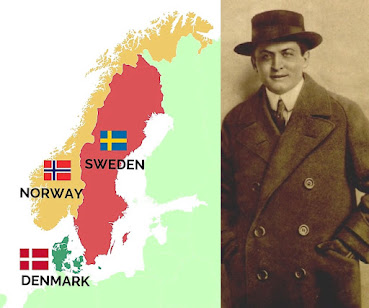
What's strange is the mention of Houdini playing Stockholm, Sweden, on July 16-18. Biographers have all put Houdini in Copenhagen when he received the news of his mother's death on July 17. That ain't Sweden!
It's possible plans changed or the paper got it wrong. But the below article from the New York Evening World announcing Houdini return to New York also says he was "called from Sweden." By the way, the "double" who was arrested was Jim Collins.
New York Evening World, July 29, 1913
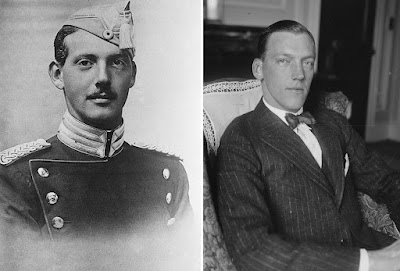
Despite this, the evidence for Copenhagen is strong. Milbourne Christopher in HoudiniThe Untold Story has many details that confirms the location, including the fact that Princes Aage and Axel of the Danish Royal Family attended Houdini's show.
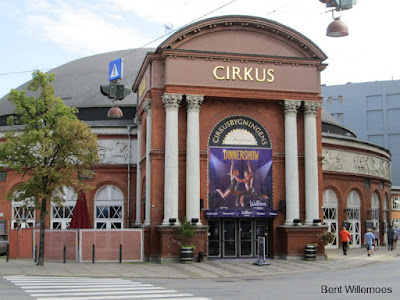
In 1990 Danish magician and collector Johan Ahlberg visited the Royal Library archives and uncovered newspaper accounts that confirmed Houdini's 1913 appearance in Denmark. Houdini opened on July 16 at the Cirkus Building in central Copenhagen. He was scheduled to give a special matinee the following day, July 17, but moments before the show he received the news of his mother's death and collapsed.
The Cirkus Building still stands today. So it was in the building that Houdini began and ended his 1913 Scandinavian tour, and received the worst news of his life.
UPDATE: Our friend David Merlini of The House of Houdini has provided information on another hitherto unknown stop on this tour. On August 16 Houdini was scheduled to appear with the Beketow Circus in Budapest! This would have marked his first and likely only professional appearance in his home town.
During my summer slowdown I thought I'd offer up some relevant "flashback" posts to scratch that Houdini history itch. Today we mark a dark anniversary.
On July 17, 1913, Houdini's mother died in Asbury Park, New Jersey. CLICK HERE for a post from 2016 that deep dives into these tragic few days 108 year ago.
When Houdini returned to the UK at the start of 1913 his new feature was The Water Torture Cell (which he had debuted in Germany the year before). He was proud and protective of his new sensation, as this notice in the February 15, 1913 issue of The Era illustrates.
Click to enlarge.
The "Special Licence" Houdini is referring to is the license he received in 1911 when he first presented the Water Torture Cell as part of a play called Challenged. The mention of the two "Copyists" being fined in Germany is interesting. One is certainly Miss Undina. But who was the other?
An interesting piece of Houdini history is set to be sold in Haversat & Ewing Galleries latest magic auction November 8-9. I'll let the auction description speak for itself.
This fabulous framed portrait was given to Will Goldston by Harry Houdini for the London Magician's Club. The Magicians' Club of London was formed in 1911 by Harry Houdini, Will Goldston, Servais Le Roy along with other notable names in magic.
On March 19, 1913 the gathering place for the organization was officially recognized with a large crowd and much pomp and circumstance. With the press at hand, the organization's president Harry Houdini formally declared the club as being officially open! The Clubroom is where the Houdini portrait was hung in 1913 and where it would remain for decades. The early photo of the room (below) clearly identifies the Houdini framed image on the right hand side of the wall.
The Davenport Family acquired the famous portrait when they purchased Will Goldston's estate in 1949 and it has since been hanging at Davenport's Magic Shop. In original frame, does not contain glass. Portrait itself measures 26" x 19.5" - with frame 28.5" x22". This is a genuine and important piece of magic history, not to be missed. Est. $10,000-12,000
The auction includes several other nice Houdini lots from the Davenport Family/Will Goldston estate that can be viewed HERE.
UPDATE: Bidding topped out at $6,125.00, but the Reserve Price was not met.
Today marks the anniversary of Houdini's hiring of Franz Kukol on March 2, 1903. So what better day for a Franz-themed post! But this story has a story behind it.
When I was a young "Houdini Enthusiast" [a moniker I should really start using again], I corresponded with various magicians, and even wrote a column for a small magic magazine called The Magician Again. Recently I discovered some letters from that time, and one from Magician/Mentalist Ron Oliver from New Lowell, Ontario, contained a curious story about Houdini and Franz Kukol that I had completely forgotten about.
The story concerns a gold watch that Houdini presented to Franz on the stage of the Finsbury Park Empire in London on March 2, 1913, as a gift for 10 years of service. But Ron's story suggests there might have been more to this gift.
Below is an excerpt from the letter Ron wrote me on December 16, 1980.
The story of the Kukol watch was told to me by a man whose father worked at the Finsbury theater in London from 1910 to 1915. He was a stage manager for the various acts that came in and, several times, saw Houdini. The full story is like this:
"One afternoon, after the matinee performance, Kukol received a telegram from his Mother, saying that she was very ill and wanted to see him. He conferred with Harry, who allowed him to go. Kukol left the theater, headed for the train. No one saw him again for about eight days.
When he finally returned, Harry was somewhat incensed at the fact that Franz had been gone so long. They retired to Harry's dressing room and a rather loud quarrel ensued. Apparently, Kukol wouldn't reveal where he had been, but did say that his mother was well. That was a week before the anniversary. The next day, Harry received a telegram from the Austrian army, from some high ranking official, asking for military help. The Austrians had heard that war was in the air, but in the future. They wanted Harry to give some of his secrets so they could be prepared....ie: handcuff slipping, cell escapes, etc.
As to whether or not Harry divulged the secrets, no body knows. But Franz and Harry had a long talk behind closed doors and emerged very good friends again. Everyone assumed the argument was over, but the guy I spoke to said that his father always felt that Franz had been asked to reveal the secrets of his boss to his old employers, the Austrian army, and refused. The would explain his being missing for almost a week. It would also explain the inscription, in Austrian, on the back of Kukol's gift watch...roughly translated, it supposedly says "To Franz Kukol...for keeping faith....Houdini."
How much of this is true, I really don't know. The guy says that his father used to tell the story whenever someone would bring up the name Houdini. He delivered all the telegrams and kept tabs on who came and went in the theater, so it seems logical that he would know.
Franz Kukol was, as you know, an ex-army officer. And the Austrian army was correct in its assumption that a war was coming soon. About 17 months after the little thing with Kukol, Franz was called back into active duty with the army. War had begun.
Of course, we now believe Kukol never returned to Austria and instead continued to work with Houdini under the name of Frank Williamson, but that is another story.
Thank you Ron Oliver for this story and memory from the past.
Houdini's escape from the convict ship Success on June 4, 1913 is not one of his more widely known challenge escapes. This could be because no photos from the stunt have survived. Nevertheless, this is one of his great escapes, and it's a story worth telling in detail. And while no photos exist, film footage does! But I'll get to that.
The Success was a former Australian convict ship commanded by Captain David H. Smith. In 1911, it came to the United States to tour as a floating museum and tourist attraction. For fifty cents, visitors could view shackles and torture devices on deck, and go below to see cells containing wax figures of prisoners in restraints. There was also the infamous "Black Hole" in the stern of the ship; two solitary confinement cells two-feet square in which a prisoner "could neither sit down nor stand upright." Captain Smith offered $100 to any woman who could remain confined in the Black Hole for a specified period of time. A student nurse from Somerville won the contest and gained local fame by remaining a remarkable 30 hours.
In the summer of 1913, the Success arrived in New York City and docked at 79th St. and Riverside Drive. It was opened daily 10 A.M. to 10 P.M., and proved to be a popular attraction.
Meanwhile, an ocean away, Houdini was boarding his own ship, the North German-Lloyd liner Kronprinz Wilhelm. He was headed home to New York where he was set to open at Hammerstein's Victoria on June 2. Here he would present the American debut of his latest invention, The Chinese Water Torture Cell.
Always keen for publicity, Captain Smith sent a cable to Hammerstein's proposing a challenge. The cable was relayed to Houdini at sea. This resulted in the following spirited exchange:
ON BOARD CONVICT SHIP "SUCCESS"
79th St. and Riverside Drive.
New York City, Wednesday, May 21, 1913.
Dear Sir:--Hearing you are bringing Houdini back from Europe for a special two weeks' engagement, I hereby challenge your star to escape from one of the cells on board the historical Convict Ship "Success."
If you will allow me to manacle him, lock him into one of the cells, I am ready to wager that he will not escape.
(Signed) D.H. SMITH, Captain.
Radio Mid-Ocean
ON BOARD N.D.L. KRONPRINZ WILHELM
Friday, May 23, 1913
Accept challenge any time mutually agreed upon to undergo test. Want no favors, but demand fair play.
(Signed) HOUDINI.
HOUDINI, N.D.L. KRONPRINZ WILHELM (Via Wireless)
New York City, Saturday, May 24, 1913
Will give you fair play. Come to Convict Ship "Success," 79th St. and Riverside Drive, Wednesday, June 4, one-thirty P.M., prepared to undergo test, which I feel certain will be the most difficulty one you have ever undertaken.
(Signed) CAPTAIN SMITH.
The merging of these two New York summer attractions was inspired, and the challenge was well advertised. On Wednesday, June 4, Houdini arrived at the appointed time, as had a large crowd to witness the contest. The wager between Captain Smith and Houdini was set at $1000. A much later account in the Lewiston Journal claimed Houdini first escaped from shackles and a straitjacket while hanging from the ship's yard arm, but I've found no evidence to support this.
Captain Smith first brought Houdini to the Black Hole. But Houdini refused. "I wouldn't go in your Black Hole for $1000," he said. Instead, Houdini was locked in one of the "refractory" cells on the lower deck. Here the heavy cell doors were made of ancient teakwood and six inches thick. He was also manacled and secured to a ringbolt attached to the hull.
The New York Evening Telegram reported that it took Houdini one hour and forty-five minutes to escape, then:
In some mysterious way he gained his freedom through one of the portholes of the old ship, and the first news of his escape came from the hundreds aboard and ashore when, with a cry of triumph, Houdini, broken chains and fetters still clinging to legs and arms, dived into the waters of the Hudson and swam about until picked up by a boatman.
Captain D.H. Smith, who commands the Success, was as discomfited over the escape of Houdini as the latter was elated.
As I said, there are no photos from this day (that I'm aware), but there is film! Newsreels were on hand to record the event, and this footage, which has never been shown in any documentary or made available on any DVD, is housed at the UCLA Film & Television Archive. I recently had a chance to watch it along with Joe Notaro, who first revealed the existence of this footage on his blog, Harry Houdini Circumstantial Evidence. Unfortunately, UCLA does not allow photos, so (like Joe), I'll just have to describe what I saw.
The footage runs approximately two and a half minutes and starts off with various shots of the Success itself. We see a reenactment of prisoners being marched up the gangway. We also see a variety of restraints and torture implements on deck, including a Spanish Maiden (check out Houdini Escapes and Magic page 313 for a similar case).
Following a static card explaining the $1000 challenge, we see Houdini and Captain Smith posing with a group of men. Houdini is wearing a dashing hat (which can be seen here), and is grinning broadly--so much so his upper lip seems to fold over his teeth--a true Cheshire Cat grin. He looks sensational and you can really feel his charisma coming off the screen.
Wax figure in a Success cell.
We then see Houdini, having escaped, swimming in the water fully clothed. What's interesting is he's dragging along one of the wax convict figures, as if he broke out his "cell mate" as a joke. I've not found any mention of this wax figure in any newspaper accounts of the stunt. Again, he's smiling broadly the entire time.
Houdini then pulls himself up on a dock, barefoot in sopping wet clothes. Jim Collins stands off to one side with some other unidentified men. Houdini looks powerful and fit as he hitches up his pants and tucks in his shirt. (I'm struck by how he looks very much the same as he does in the 1909 Rochester footage.) Hardeen then briefly steps into frame, waving Houdini forward with a quick jerk of his arm as if saying, "Let's go!"
The final shot shows Houdini posing in an open top car with a large group of men, including Hardeen. Houdini is still wet and grinning broadly. But what's most striking in this shot (and it took Joe and I a few viewings to catch this) is that Houdini's brother Dr. Leopold Weiss is at the wheel of the car! This is the only film footage I've ever seen of Leopold. There the film ends.
This footage offers a remarkable document of this fantastic escape, and of the Success itself. It's also likely the last film footage of Houdini before his mother's death just several weeks later, which was said to have changed him noticeably. So I feel like this escape, and this film, captures Houdini at the zenith of his powers and personal happiness. He feels youthful and exuberant, even standing still he beams. But maybe that's because he just won $1000.
The Success would continue to tour the U.S. for many years. In 1915 it arrived in San Francisco for the Panama–Pacific International Exposition (where Houdini did an overboard box escape). Below is film of Roscoe "Fatty" Arbuckle and Mable Normand visiting at the ship during the exhibition and being shown around by, presumably, Captain Smith himself.
Years later the Success was branded a hoax -- that it was never truly a convict ship. The ship finally met its end by fire near Port Clinton, Ohio, on July 4, 1946.
Today the site of the Success challenge is the 79th Street Boat Basin, operated by the New York City Department of Parks and Recreation. It's still home to boats and even the occasional floating museum ship, just like Success.
Hope you enjoyed this look back at the Success challenge and the description of the rare UCLA film footage, which I hope can be made available for all to see one day. (If you're interested, the exact catalog listing is HERE.)
Fifteen years ago Bill Bremer, a postcard collector in Texas, unearthed a cache of 36 postcards sent to Houdini's sister, Carrie Gladys Weiss. All this week I am sharing select cards from this remarkable collection. [Read the full story of Bill's find here.]
Today we have two postcards sent to Carrie Gladys from brother Theo Hardeen while he was on tour in 1913. The first is from Salem, Massachusetts, postmarked Nov. 28, 1913. The other is from Lowell, Massachusetts, postmarked Jan. 31, 1913. The cards are signed Dash and (untypically) Theodore. Both are addressed to Gladys at 278. As you can see, Dash is a man of few words!
Tomorrow I'll share a postcard to Gladys from an unlikely sender. This one will wow you!
In July of 1913, Houdini departed New York for a Scandinavian tour that would see him perform for the first time before the King of Sweden in Stockholm. After bidding an extended goodbye to his mother at the dock -- and promising to bring her back a pair of woolen slippers, size six -- he set sail on the German ocean liner Kronprinzessin Cecilie.
His brother Hardeen stayed closer to home, accepting an engagement in Asbury Park, New Jersey. Thinking his mother would enjoy a vacation by the sea, Hardeen brought along Cecelia Weiss.
Asbury Park is a seaside community located on New Jersey's central coast. Developed in 1871 as a resort, the city features a mile-and-a-quarter stretch of oceanfront. In its heyday, as many as 600,000 people a year vacationed in Asbury Park. In 1912, The New York Times estimated that the summer population could alone reach 200,000.
Opening day ad for Hardeen at the Lyric, July 14, 1913.
Hardeen opened at the year-old Lyric Theater on July 14, 1913. The Lyric was located at 214 Cookman Avenue. It featured vaudeville and even early movies -- "The Lyroscope Animated Photo Plays." Here Hardeen did his usual act; escaping a straitjacket, accepting challenges, and closing with the Milk Can. On July 15, he leapt manacled from the Asbury Park Fishing Pier.
The following day Hardeen escaped from a packing crate made by The Tusting Piano Co. But unbeknownst to the audience, the real drama was playing off-stage. The next day, July 17, the Lyric ran a special Announcement in the Asbury Park Press that said it all:
Special announcement on July 17, 1913.
Upon their arrival in Asbury Park, Cecelia Weiss had suffered a stroke that left part of her body paralyzed. She was tended to in Room 18 at the Imperial Hotel by Dr. James Ackerman, who put her on the critical list. Hardeen phoned his brother Leopold and sister Gladys who quickly arrived from New York. After escaping from the Tusting packing crate at the Lyric, Hardeen rushed back to Cecelia's bedside. She struggled to communicate a message for Houdini, but was unable to speak. She died at 12:15 AM on July 17.
Hardeen sent a cable to Houdini notifying him of their mother's death. Thinking it was simply a welcoming message from "the folks", he delayed opening it. After performing his Water Torture Cell at the Circus Beketow in Copenhagen before an audience that included the royal princes (Houdini did his act in Danish), he finally read Hardeen's cable at a press reception and fell unconscious to the floor.
Houdini and Bess quickly reboarded the Kronprinzessin Cecilie for its return voyage to New York, leaving Jim Collins behind to deal with the show. In Denmark, breaking a contract was a serious offense, and Collins was jailed until the situation was explained to the theater manager.
Following her death, it was reported that Mrs. Weiss has been taken by "Undertaker Burtis" on the 1:10 train to Brooklyn. The funeral had been planned for the following Sunday, but was delayed until Houdini returned. Houdini arrived several days later to find his mother laid out in the parlor of 278. He had brought along the woolen slippers she asked for and placed them in her casket.
Cecelia's death devastated Houdini. On the one year anniversary, Leopold drove Houdini and Hardeen back to Asbury Park to photograph Room 18 at the Imperial Hotel (what happened to those photos, I wonder?). That night Houdini wrote in his diary: "Things have never been the same, since, and I know that they can never be the same again."
The Imperial Hotel is, presumably, long gone (at least I couldn't find any information about it, past or present, online). But the Lyric Theater remained a fixture on Cookman Avenue until the 1960s. Renamed Park Cinema, it became a pornographic movie theater in the 1970s and '80s. It also appeared in the Robert DeNiro film City by the Sea (2002) and in The Sopranos.
The building was finally demolished along with the rest of the block in 2005. Today the site of Hardeen's Lyric Theater is an empty lot.
A remarkable photo postcard showing a dapper Houdini posing with members of the Associated Wizards of the South (AWS) sold on eBay today for $470.93. Below is the photo and a description from the seller.
This is an exceptionally rare RPPC (real photo postcard) of Harry and Bessie Houdini with the AWS (Associated Wizards of the South) taken on Southampton Docks prior to Harry Houdini's departure to New York on 21st May 1913.
The AWS are the 4th oldest magical society in the world and Harry Houdini became a member during a 5 night string of shows at the Southampton Hippodrome in 1911. Famously the day after this first meeting with the AWS Harry Houdini performed his Water Torture Cell trick for the very first time to a rumoured audience of 1 in Southampton. Houdini wrote articles and attended further meetings with the group.
During one meeting the AWS chairman, Professor Woodley challenged the star to a display of contact mind-reading. Houdini, boastful of his own expertise in this area, insisted on being the person to hide the object for Woodley to find, which he did, over and over leaving Houdini unable to discover the secret to the trick - I know, as I'm his great grandson but its a family secret. Professor Woodley can be seen behind Houdini's left shoulder (the tall chap in a cap). The famed early magician Spitari is also in the postcard, second on the left.
These postcards were available for AWS members only and no more then 10 were ever produced. I believe this may be the only existing copy. It has been lent out by the family on a few occasions over the years. Channel 4 productions, The Magic Circle and Magical World have all borrowed the postcard from the family in the past.
A truly rare piece from an early magical society, original and direct from the family.
The only correction I'd make is I don't believe that's Bess standing beside Houdini. Still, a fantastic never-before-seen image of Houdini with a wonderful story to go with it. Congrats to the winner.
It's been said that Houdini got the idea for his famous suspended straitjacket escape from a super fan, Randolph Douglas (a.k.a. Randini), during a visit to the Douglas home in England in June 1914. The most recent biography, The Secret Life of Houdini (2006), even goes as far to state that Randini "changed the course of magic history" that day. Houdini would first perform the suspend straitjacket in Kansas City on September 8, 1915. It would become his signature outdoor escape.
But now reader Bill Mullins sends in a clipping that throws us a curve in regards to where Houdini might have gotten the idea for the escape and how original it was to the escape king.
Here we have a magician named "Mysterio" performing a suspended straitjacket escape in 1913, a full year before the Douglas demonstration and two years before Houdini first did the escape himself. Furthermore, it appears that Mysterio did this escape a number of times. Digging a little deeper (via Ask Alexander) reveals that Mysterio is actually "The Great Alvin." Alvin would come into conflict with a magician named L.L. Gaffney who performed magic and handcuff escapes as "Mysterio" in Europe and the U.S. and objected to the use of his name.
Here's the full clipping from the Buffalo Evening News which ran 100 years ago today on November 21, 1913.
So did Houdini know about Mysterio and his suspended straitjacket escape? It seems unlikely that he wouldn't. Mysterio's escapes were well reported in the pages of The Sphinx. It appears he last did the escape in 1914, so perhaps by 1915 Houdini felt enough time had passed that he could do the escape himself. Funny to think that Houdini would imitate an imitator who was himself impersonating an imitator. (Did you get all that?)
To be fair, I don't believe Houdini ever claimed the suspended straitjacket escape to be an "original invention" the way he advertised the Milk Can and Water Torture Cell as such. Of course, he also never said it wasn't. But Houdini had the foresight and courage to be raised over 100 feet, which truly made this a spectacular escape. When it comes to suspended straitjackets, height does matter.
The loser here may be Randolph Douglas and the notion that he introduced Houdini to the idea of the suspended straitjacket escape. Magic history was not changed that day. But it could be that Houdini let the young man believe that he had indeed showed him something new. Heck, it took us 100 years to discover otherwise.
Thanks to Bill Mullins for this revelatory discovery. UPDATE: Only after I finished this post did I learn that Joe Notaro revealed this news on his blog Harry Houdini Circumstantial Evidence in October. Joe also discovered that Mysterio/Alivn's real name was Al Pitroff. Good work, Joe!
UPDATE 2: It appears Pitroff is still doing the suspended straitjacket escape in 1915, as can been seen in the below ad from the Perth Amboy Evening News, February 12, 1915.
Author and Houdini aficionado David Saltman has a very interesting post on his blog The Houdini File about the possibility that Houdini could have returned to Russia in 1913, and may have even been involved in an effort to "undermine Rasputin." David has uncovered a Russian theater ticket from 1913 with Houdini's name on it, as well as a letter from Houdini to the U.S. Ambassador to Russia suggesting that they meet up in "Petersburg."
This is pretty wild stuff. Is it possible Houdini went back to Russia in the middle of his career without it ever being chronicled? I hate to say it, but it makes me wonder if there's something to the whole "Houdini was a spy" thing after all. I'm not ready to completely climb aboard that theory just yet, but I would recommend reading what David has uncovered below:
I'm pushing our regular Monday installment of "Unpublished Houdini" to tomorrow so I can bring you another treasure from the Hinson family collection which marks its 100th anniversary today. This silver punch bowl was given to Houdini by his assistants on October 28, 1913 in Stuttgart to commemorate his 30 years as a performer (1883-1913). The punch bowl is inscribed with the names: J. Collins - J. Vickery - F. Kukol - J. Zwettler. While the first three names are familiar ones, this is the first I've heard of an assistant named Zwettler.
This magnificent punch bowl can be spotted among Houdini's trophies in several photos (like this one). In the 1930s Bess passed it on to her sister, Marie Hinson. According to John C. Hinson, the family used it to store nuts and bolts until his father received it in 1950. The bowl passed to John in 1992 and was actually used at the New England Magic Collectors Association convention that year. It is now on display at Ray Goulet's Mini Museum of Magic in Watertown, Massachusetts, where it can be seen and enjoyed by all.
So I guess that means today is the 130th anniversary of Houdini as a performer. Let's fill up the punch bowl and celebrate!


.png)


.jpg)