Showing posts with label McGill University. Show all posts

Saturday, April 20, 2019

LINK: The Hopewell professor and Houdini’s mysterious death

Below are links to a well-researched two-part article by John Ashton about the days leading up to Houdini's death and the role played by the head of the psychology department at McGill University, Professor William Dunlop Tait.


Professor William Dunlop Tait.

The photo seen in part 2 is credited as being Houdini at the Princess Theater in Montreal. But it's actually a still frame from his card manipulation movie Velvet Fingers. To discover why the photo is mistakenly captioned, check out THIS POST at Joe Notaro's HHCE.

Thanks to Dorothy Dietrich and Dick Brookz at the Houdini Museum in Scranton.

Related:

Sunday, May 28, 2017

Magic comes to the McCord Museum in Montreal


This weekend magic came to the city of Montreal with the opening of the McCord Museum's "ILLUSIONS: The Art of Magic" exhibition and "The 44th Magic Collectors Weekend." There was plenty of Houdini to be found during the 3 days of events. Houdini biographer and weekend honoree William Kalush gave a talk in support of the idea that Houdini was as great a magician as he was a showman and escape artist (now that's a Bill Kalush theory I can get behind). There were also several original Houdini posters on display at the McCord exhibition.


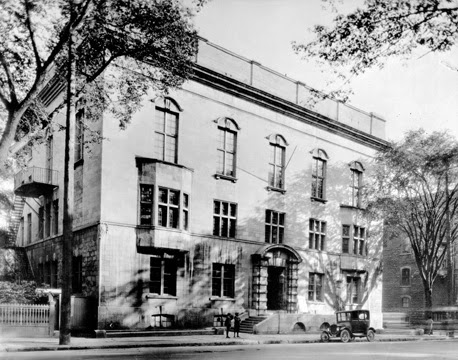
The McCord museum is housed in a building that was once the McGill University student union. This is where Houdini spoke in 1926, the day before the fateful dressing room encounter with McGill student J. Gordon Whitehead (and where he is also said to have successfully demonstrated his ability to take a punch). 

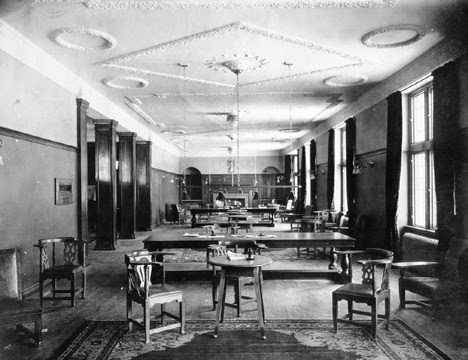
Magic Collector's Weekend attendees were treated to a private display of original Houdini artifacts in the very room where Houdini spoke (which has since been subdivide). In 2015, the McCord received a large bequest of magic memorabilia, including over 1000 individual items related to Houdini. 


Other weekend speakers included: Andrew Pinard ("Jonathan Harrington"), Dr. Joe Culpepper ("Doctoring Magic"), David Ben ("Downs' Masterpiece"), Max Maven ("Torn Roots"), Michael Grandinetti ("A Young Person's Guide to Doug Henning"), Lesley Fitzpatrick-Walker  ("Metamorphosis: The Last Unicorn"), Brian Lumley ("According to Plan") and Mike Caveney ("Egyptian Hall").

The 44th Magic Collectors Weekend was hosted by David Ben and Julie Eng of Magicana. I'm story I wasn't able to attend this year. Looks like it was a great event in a location steeped in Houdini history.


"ILLUSIONS: The Art of Magic" runs through January 7, 2018. For more information visit the McCord Museum. A book devoted to the exhibition is available at Amazon.com (U.S.) and Amazon.co.uk (UK).

Thanks to magician and Houdini lecturer William Pack for the photos. Lecture information thanks to Phil Schwartz of the great Thayer Magic.

Related:

Thursday, January 28, 2016

Houdini lives at LILA


On Tuesday I had the great pleasure of giving a talk about Houdini to the 7th Grade class at the International School of Los Angeles a.k.a. LILA. This was a tag-team talk with the great Joe Fox who demonstrated some of Houdini's magic and escapes. Joe did the Kellar Rope Tie, Spirit Slates, escaped from handcuffs and showed the students a real straitjacket. But Joe really brought the house down when he extracted a 4-inch lock-pick from his nose!

The students were attentive and enthusiastic, and I was very impressed with how much knowledge of Houdini they already had. True, their teacher, Anna Scottie, had assigned them a Houdini biography to read (Harry Houdini: Death Defying Showman by Rita Thievon Mullin), but during the Q&A, I could see they had already dug beyond the text. One bright young man asked about "conspiracy theories" surrounding his death. The Miracle Factory's Todd Karr, who arranged this event, informed me that his daughter, Sierra, had developed a particular interest in Bean Giant handcuffs. Looks like there's a new generation of Houdini Nuts in the making!

The students also taught me a lesson about magic history. They seemed especially taken with the story of the Mirror Handcuff Challenge, but when I mentioned that the handcuffs are today owned by David Copperfield, I could hear, "Who?" These bright young students, who knew the name J. Gordon Whitehead, had never heard of David Copperfield?

Afterwards, Todd told me that shouldn't have come as a surprise. They would know the name Criss Angel, but Copperfield has been off television for decades. That's when I realized I've been holding a false assumption. I believed Copperfield had broken through into popular culture and had taken a place beside Houdini as the very definition of a magician. After all, in the recent Marvel movie Ant-Man, a character reacts to the Ant-Man's metamorphosis as "some David Copperfield s***."

However, I'm now thinking that Copperfield, like so many other great magicians in history, might not transcend his era. Not that he will ever be forgotten within the world of magic. But a horse who escapes from its stable will never be called a "Copperfield Horse." (I use this example because I opened the talk with a clip of "Houdini Horse.")

This helps me understand how a magician as popular as Howard Thurston could today be largely forgotten outside magic circles. It also makes me marvel even more at how strong Houdini's hold is on popular culture. I guess a biopic every decade and 150+ books help. Not to mention that Houdini still tends to fascinate school kids.

As I was leaving the school, I noticed the car parked beside mine had a surprising window sticker. If you're as knowledgeable about Houdini as the 7th graders at LILA, you'll understand why I thought this was a little spooky...


Thanks to Todd Karr, Sierra Karr, Anna Scotti, Milan Mendis, Anneli Harvey, and all the 7th Grade students at LILA for a wonderful visit.

Related:

Monday, June 2, 2014

The Prince of Wales assault


We all know J. Gordon Whitehead punched Houdini in the stomach at the Princess Theater in Montreal on October 22, 1926. That punch started a chain of events that would lead to the magician's death on Halloween. But in his seminal work, The Man Who Killed Houdini, author Don Bell uncovered evidence of two other punches delivered by McGill University students during Houdini's stay in the city.

Recently we looked at the first of these, "the Pickleman punch," which took place at the McGill University Union Hall on October 19. Today we have what might be better described as an "assault" on Houdini in the lobby of the Prince of Wales Hotel on McGill College St., just a few blocks west of the Princess Theater.

In 1990, Gilles Larin, the grandson of the Prince of Wales owner, Francis Larin, related to Bell the remarkable story, which he said was part of family lore. He heard it from his father and grandfather, although the only eyewitness was the night clerk, Honore Larin (Francis' brother). Here's the story as told in Bell's book:

After giving a performance Houdini usually had a meal and relaxed in the Prince of Wales lobby, reading newspapers. In the back of the  hotel was a tavern [Pig & Whistle] frequented by McGill students. It had a door leading to the lobby, but when the hotel closed at 11 p.m., the students usually went out through the rear exit leading to the lane in back.

But that particular night when Houdini was there waiting to board the overnight train that would take him and his company to Toronto, Buffalo, etc. and then to Detroit, three or four students who were rather drunk spilled out of the tavern into the lobby. One of them, mimicking the act that Houdini presented in his show where he dared anyone to hit him in the stomach walked up to Houdini, who was sitting in a lounge chair reading a newspaper, and, without any warning, hit him through the newspaper in the stomach, a crunching blow. Houdini, doubled over in pain, said, "You shouldn't have done that," then got up, very slowly, and walked out of the lobby.

Larin goes on to say that while this incident was "much discussed" the next day, there was no police report filed and Houdini was already gone. The timing of this is interesting. If Houdini was waiting for the train to Detroit, then this happened after the Whitehead blows, which would have made this especially painful (and damaging?). It's generally accepted that Houdini's appendix ruptured while on the overnight train to Detroit.

It's also interesting to speculate whether Houdini's unidentified assailant that night suffered the same confusion and guilt that Gerald Pickleman experienced. After Houdini's death, it was only reported that he had died as result of being punched by a "McGill University student." The name J. Gordon Whitehead and the details of the dressing room punch did not become public until 1953. Any student who struck Houdini that week would assume they were the student in the news reports. Houdini's words, "You shouldn't have done that," would have certainly haunted this student. (Unless he was too drunk to recall the incident at all.)

This one is a bit harder to accept than the Pickleman punch, which still had living eyewitnesses into the 1980s. While I find no reason to not believe this happened, second hand accounts are by their nature unreliable, especially when they are over 80-years-old. Still, it's a curious piece of the puzzle that is the last week of Houdini's life.

Related:

Thursday, May 15, 2014

Sam Smilovitz at McGill

Here's another selection from the archive of McGill University yearbooks recently uncovered by our friends at the Houdini Museum in Scranton and Joe Notaro of Harry Houdini Circumstantial Evidence.

Below are images of Samuel J. Smilovitz a.k.a "Smiley." Sam was the art student who sketched Houdini during his lecture at McGill's Union Hall on October 19, 1926. Houdini was so impressed with the sketch that he invited Smiley to come see him backstage at the Princess Theater and do another for him. Smiley invited a friend, Jacques Price, and together they visited Houdini on October 22. It was during this visit that a third student, J. Gordon Whitehead, who was unknown to both Smiley and Price, joined the gathering. The rest is Houdini history.


Above is Sam Smiley's graduation photo from the 1927 yearbook. Below is a shot of Smiley with fellow members of the Maccabaean Circle, a student group devoted to Jewish culture and ideas.

Click to enlarge.

Unfortunately, I could find no photos of Jacques Price in the yearbooks. But you can see his photo in my recent interview with his daughter, Karen Mann. That post also includes a photo of Smiley in 1994.

Thanks again to Dorothy Dietrich, Dick Brookz, and Joe Notaro. You can check out all the McGill Yearbooks HERE.

Related:

    Friday, May 9, 2014

    Is this J. Gordon Whitehead at McGill in 1926?

    Recently our friends at the Houdini Museum in Scranton and Joe Notaro of HHCE turned up an amazing archive of yearbooks from McGill University. Of course, it was a student from McGill, Jocelyn Gordon Whitehead, who punched Houdini in his dressing room at the Princess Theater on October 22, 1926. Could these books give us our first look at Whitehead as a student?

    There is only one known photo of Whitehead, taken almost 25 years after the Houdini incident when he was in his 50s. Because he never graduated, there is no individual yearbook photo of him as a student. However, this group shot of the "Arts '28 Class" in the 1926 yearbook is said to include a "Whitehead, J.G." (as well as Gerald Pickleman, who also "tested" Houdini that week). Unfortunately, it doesn't specify which student is Whitehead.

    Click to enlarge.

    Sam Smilovitz (aka "Smiley"), who was also present in the dressing room, gave a good description of Whitehead. Smiley described him as: "At least six foot two – wearing a blue gabardine coat that seemed much too small for him. An oldish looking young man about 27 or 28 years of age [he was actually almost 31]. He impressed one as being the very genteel type of student. His face was ruddy, his hair very thin on top; his frame was powerful though loosely-knit, and his neck was inordinately long."

    My candidate for Whitehead is the individual below. He seems to match Smiley's description quite well -- right down to what might be his blue coat -- and I just feel like he might be our man.


    What do you think? If this is indeed J. Gordon Whitehead, it is only the second known photo, and the only one taken at the time of the Houdini punch. Wild indeed.

    Thanks to Dorothy Dietrich, Dick Brookz, and Joe Notaro. You can check out all the McGill Yearbooks HERE.

    Related:

    Monday, May 5, 2014

    The Pickleman punch

    McGill University's Union Hall.

    We all know J. Gordon Whithead punched Houdini in the stomach in his dressing room at the Princess Theater in Montreal on October 22, 1926. It's debated whether or not the punch caused or just masked his fatal appendicitis, but all agree that Whitehead's punch was the start of a chain of events that would lead to the magician's death on Halloween. But in his seminal work, The Man Who Killed Houdini, author Don Bell uncovered evidence of two other punches delivered by McGill University students during Houdini's stay in the city that might extend that chain a little further back.

    One of those punches is said to have occurred in the lobby of the Prince of Wales Hotel. However, that incident is questionable as it only comes via second-hand sources, so I'm going to save it for another time. The punch I want to discuss today is the first of the three for which there is strong evidence. This punch or "test" occurred on October 19, 1926, when Houdini was giving his lecture at McGill University. Bell calls it "the Pickleman punch."

    Bell first learned of the Pickleman punch from a former McGill University student named Dr. William Cohen. Dr. Cohen said that a student named Gerald Pickleman had tested Houdini with a blow at the McGill Union Hall (today the McCord Museum). Unfortunately, Dr. Cohen could not remember specific details, although he did recall Houdini putting a needle through his cheek during this same meeting with students.

    Eventually, Bell tracked down a key eyewitness to the Pickleman punch, another former McGill student named Jack Hausner. Bell interviewed the 84-year-old Hausner in Palm Beach, Florida in 1991. As you'll see, Hausner confused it with the Whitehead blow, as would others. Hausner recalled:

    "It was in a public room where students went to socialize -- to shoot a game of pool or snooker. Houdini was passing through and we engaged him in conversation. He was very warm when we met him.

    I remember clearly his challenge to anyone within the group to punch him -- with all his might! -- in his stomach so that he could demonstrate his powers of concentration to withstand physical pain and survive unharmed.

    I must differ with you concerning the identity of the person who delivered the blow which apparently resulted in his death a week or two later. That person was not Gordon Whitehead, as you believe. If my memory serves me correctly, it was an undergraduate known to many of us at the time, name Gerald Pickleman (or Pickelman). ... He came from a family who lived in upper New York State.

    Pickleman was a pretty burly fellow, but as far as I knew he wasn't a boxer and didn't work for the McGill Daily, although anyone could have contributed an article from time to time. Houdini had time to prepare himself. The blow wasn't unexpected. Pickleman was 170 pounds or so, five feet seven or nine. It was just one blow."
    Site of the Pickleman punch?

    Gerald Pickleman died in 1981, but Bell was able to find his widow, Annette Pickleman, who independently confirmed the events at Union Hall:

    "Gerry told the story many times," she said, "whenever Houdini's name came up, but in later years people hadn't discussed it with him as much. It wasn't a thing he boasted about, but nor was it a secret or anything he ever tried to hide. He had the normal guilt a person would have. He was a sensitive man, not the kind of person who would go around punching people. He wasn't aware [that the punch had caused Houdini's death] until after the autopsy. That's when he began to talk about it."

    What's tragic here is it appears Pickleman blamed himself for delivering the blow that "killed Houdini." But one can see how this happened. After Houdini's death, the newspapers only reported that he was struck by a "student of McGill University." In fact, the name of J. Gordon Whitehead did not appear in print until 1953. So it's understandable that Pickleman believed that he was the "McGill student" who fatally injured Houdini. Poor guy.

    Now, I'd be remiss in not mentioning that Dr. William Tait, head of the McGill psychology department, who had invited Houdini to give his lecture at the University that day, denied that Houdini was struck by a student at the meeting. He said Houdini left in a taxi immediately after the lecture. But he may have been unaware of the informal meeting with the students (which could have happened before the lecture), or was trying to protect the University. He also said Houdini appeared ill at the meeting.

    I do believe the Pickleman punch happened as independently described by William Cohen, Jack Hausner and Annette Pickleman (by way of her husband). I also believe it's likely that this "punch me as hard as you can" challenge and successful first demonstration at Union Hall is what motivated the drunken students at the Prince of Wales to test Houdini and, of course, J. Gordon Whitehead in the dressing room at the Princess Theater on the fateful day. You might even say Houdini's death began here.

    Union Hall is today the McCord Museum in Montreal.

    Related:

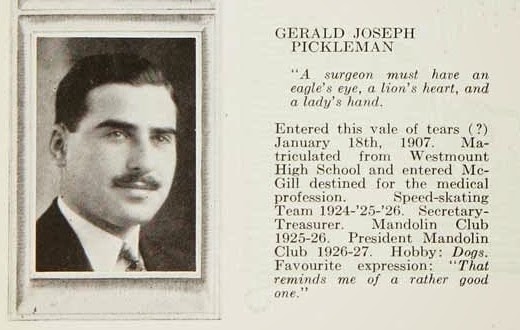
    UPDATE: Thanks to our friends at the Houdini Museum in Scranton and Joe Notaro, here is a photo of Gerald Pickleman from the 1929 McGill yearbook.

    Sunday, February 23, 2014

    Interview with Karen Mann, daughter of Jacques Price

    Karen Mann and her father Jacques Price.
    A highlight of last year's Official Houdini Seance in Nova Scotia was the attendance of Dr. Karen Mann, the daughter of Jacques "Jack" Price. Price was one of the three students in Houdini's dressing room in Montreal on October 22, 1926 and witnessed the punches by J. Gordon Whitehead. Those punches lead to Houdini's death nine days later on Halloween.

    Now I'm honored to share a Q&A interview I was able to conduct with Dr. Mann via email. While she isn't able to answer all our deepest questions or help confirm or dispel the many conspiracy theories that have grown up around this incident, it's still incredible to hear from someone personally associated with the most infamous moment in Houdini history. So without further ado, here's Karen!

    WAH: First, can you please tell us a little about yourself?

    KM: I am the only child, and only daughter of Jacques Price and his wife Margo. I live in Halifax Nova Scotia. I am a university professor in medical education, and although I have 'officially' retired, I still work at things I love, like teaching, and am probably employed about 75%of time. My husband and I live in Halifax, and he too is partially retired from the University. I have three grown children, and we have 8 almost 9 grandchildren.

    WAH: Can you tell us a little about your father, Jack Price, and what happened to him after McGill University?

    KM: After McGill, my dad found his way to University of Toronto, where he studied civil engineering, graduating in the late 30s. I think he worked for some time before he went to university. It was in Toronto that he met my mother, who was from Niagara Falls. They married in 1940, and moved to Nova Scotia, via Prince Edward island. My dad served in the Royal Air Force in the War, as a squadron Leader, who taught calculus to pilots. He spent his work life as a self-employed civil engineer, a profession which he loved.

    Jack Price sat center on Oct. 22.
    WAH: Do you remember when you first learned that your father was one of the students in the dressing room on Oct. 22, 1926, when Houdini was punched?

    KM: I learned about it from Donald Bell, who was researching and writing a book called The Man Who Killed Houdini. He contacted me as he had been trying to find my dad without success. He had gone to the UK, and found my dad's sisters who were still living in Blackpool and Preston, in the North of England. He found them through the local Synagogue, which was also how I learned that my dad was Jewish. Someone told him there, that my dad had a daughter in Halifax, and as Halifax is a small place, he found me without too much difficulty. I think it was sometime in 1992.

    WAH: Do you remember exactly what your father told you about that day?

    KM: I asked my dad about the incident, and the first thing he said was 'I didn't do anything wrong'. I think back on that now, and realize that there may have been a lot of questions around exactly what happened, and he was very cautious. He did tell me a little about it, just as the incident has been reported.

    WAH: Did your father ever hint that he thought J. Gordon Whitehead deliberately tried to injure Houdini that day?

    KM: WE didn't discuss it. At the time, I didn't know enough about the story to ask those questions.

    WAH: Some think that Houdini's lawyer, Bernard Ernst, manipulated the details of the dressing room incident to aid his insurance claim for an accidental death. Did your father ever say anything about being manipulated or that his affidavit wasn't the full truth of what happened?

    KM: No, he didn't. We didn't get to chat about it again. My mom died shortly thereafter and my dad within a few months. He was also a very private man all his life.

    WAH: Did you know if your father went to see Houdini's lecture at McGill, or if he had ever seen Houdini perform on stage?

    KM: I think he had. I think he was interested in meeting him, and so was happy to go backstage with his friend, Sam Smilovich.

    Sam Smilovich in 1994.
    WAH: Did your father stay in contact with Sam Smilovich after college? Did you know Sam?

    KM: I don't know for sure; however when I spoke with him, I remember his being aware of what had happened with Sam following their time together, so they must have done in some way, perhaps not directly.

    WAH: Did your father ever tell you what happened to the sketch Sam did of Houdini that day in the dressing room?

    KM: No- wouldn't it be wonderful to see!

    WAH: Did your father talk about the dressing room incident in public? Was it general knowledge among his friends that he was one of the eyewitnesses to the punch that may have killed Houdini?

    KM: Absolutely not! He was reluctant to talk about it even with me. And when Don Bell called him following my conversation with him, my dad told him he didn't want to discuss it. No one knew. My mother was unaware even, until I told her.

    WAH: Finally, how was the seance in Nova Scotia? Any strange phenomena occur?

    Karen Mann
    KM: The séance in Nova Scotia was a wonderful experience from start to finish. I felt very pleased to be there and really enjoyed meeting all the people who are so interested in and knowledgeable about Houdini. I'm not sure whether we actually heard anything, as our medium was unable to play back the tape very clearly. He (the medium) said that he could hear chains clanging- whether Houdini's or those of a ghost purported to live in the Citadel where the séance was held. My most enduring thought about the séance is that I really felt it connected me with my dad, who died in 1993. I especially appreciated the opportunity to say a few words about him.

    Please join me in thanking Dr. Karen Mann for sharing her recollections of her father with all of us here at WILD ABOUT HARRY.

    Photos from The Man Who Killed Houdini by Don Bell. Also thanks to Bruce MacNab for making this possible.

    Related posts:

    Tuesday, October 22, 2013

    Time to rethink the rethinking on the Houdini punch


    It was 87 years ago today that Houdini was punched in the stomach by J. Gordon Whitehead in the dressing room of the Princess Theater in Montreal. Those punches marked the start of a chain of events that would culminate in Houdini's death on Halloween eight days later. But did those punches kill him?

    After Houdini's death, it was widely reported that the punches (frequently misreported as a single punch) were the cause of his fatal illness -- "traumatic appendicitis." But in the past few decades, historians have questioned this on medical grounds, saying that it's more likely Houdini was suffering from appendicitis before the attack and the punch only worked to cover-up the serious infection developing in his abdomen. This opinion has been stated in many Houdini documentaries (even by yours truly), and even appears on the official McGill University website. In fact, the most recent Houdini biography, The Secret Life of Houdini, goes as far as to say that traumatic appendicitis as a medical condition "has never existed" (page 518).

    Eyewitness sketch
    But Houdini author and expert Patrick Culliton has pushed back hard against this thinking in recent years. He believes Houdini's appendicitis was caused by Whitehead's blows. Furthermore, he thinks Houdini was not struck unexpectedly. He believes Houdini was prepared for the blows, but because of his broken ankle, he elected to remain lying on his dressing room couch. But with his back against a hard surface, there was no "give" when the punches were struck, which is key to performing a feat of physical prowess such as absorbing blows to the stomach.

    Patrick cites the famous footage of Frank "Cannonball" Richards getting hit in the stomach with a cannonball. Having give in the body is essential. Had Richard's been standing with his back against a hard surface, well... Hence the blows from Whitehead were especially damaging to Houdini's internal organs.

    But what about the claim that traumatic appendicitis doesn't exist? Why are we asking magicians? Why not ask a real doctor?

    Marc Gellman, M.D., a Houdini buff and reader of this blog, has taken up this question for us and sent over a May 28, 2010 report by the RCS Advance Surgical Standard on Trauma Surgery on the "Systematic review of blunt abdominal trauma as a cause of acute appendicitis." Their conclusion; while rare, traumatic appendicitis absolutely exists. In fact, this report seems to confirm many of the conditions of Houdini's fast acting illness.


    Click to enlarge.
    Although rare, the diagnosis of acute appendicitis must be considered following direct abdominal trauma especially if the patient complained of abdominal right lower quadrant (RLQ) pain, nausea and anorexia. Appendicitis can be reasonably attributed to trauma if the presentation was early after the traumatic event and the patient has not suffered from suggestive symptoms prior to trauma.

    It's important to know that Houdini's doctors all signed off on the traumatic appendicitis diagnosis. The push back against the idea came from Houdini's insurance company. If they could establish that Houdini was suffering from the illness before the dressing room incident, they would not have to pay double indemnity for an accidental death. Some newspapers aided in this, reporting that Houdini was ill on his arrival in Montreal and was traveling with a nurse.

    But sworn affidavits from all of Houdini's crew refuted the idea that the magician was ill before Montreal. It's true that a nurse was traveling with the show, but she was looking after Bess who was still recovering from a serious bout of food poisoning. The insurance company failed to establish pre-illness and eventually paid out. That should have been the end of the story.

    So why have we all now taken up the cause of the insurance company? Why shouldn't we accept the word of Houdini's own assistants and the diagnosis of his own doctors? I believe it's because, at some point, someone suggested the medical improbability (and then impossibility) of traumatic appendicitis and we all took the bait. For some it appeals to a sense of logic; to others a predilection for conspiracy theories.

    But thanks to Marc, we now know traumatic appendicitis does exist. So the possibility that Houdini died from Whitehead's blows has to be seriously entertained, especially considering how the punches were delivered (Patrick's theory). In fact, I'd say the burden of proof is all on the opposite side.

    Now, whether Whitehead intended to injure Houdini or if the incident was truly accidental is something else that is argued by Houdini buffs, but I'm not opening that can of worms here. One controversy at a time! What I'm offering up here is proof that it is medically possible Houdini's fatal appendicitis could have been caused by the punches he received 87 years ago today.


    Thanks to Marc Gellman, M.D. for his help clarifying the medical side of this for us. If you'd like to read the full RCS report, shoot me an email and I will send you the PDF.

    UPDATE: Check out this post for a revelation that might shed some new light on Houdini's reluctance to seek medical attention. Read: Did a contract clause kill Houdini?

    Friday, August 3, 2012

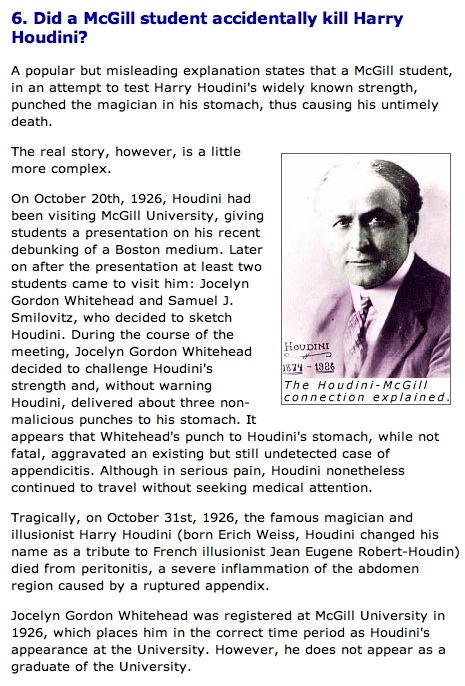
    The McGill explanation

    The official website for McGill University in Montreal has an FAQ section and one of those FAQs is, as you might expect, what role a University student played in Houdini's death. Here is their answer:


    Pretty good answer (despite misspelling Ehrich). However, the University is certainly taking a path that resolves Whitehead -- and by extension the school -- of any responsibility. While many now believe Houdini had a developing case of appendicitis when he was struck, there are some, like Houdini expert Patrick Culliton (Houdini's Ghost), who believes the punches did cause Houdini's illness. And there are others, most notably the gang at the Houdini Museum in Scranton, who would not categorize Whitehead's blows as "non-malicious". They believe Whitehead had every intention of doing serious harm to Houdini that day.

    It is interesting that the answer confirms Whitehead's enrollment in 1926. I believe Don Bell in his seminal work, The Man Who Killed Houdini, said he was never able to confirm that Whitehead was ever actually a student. News that Whitehead never graduated is also new, although I think this was always assumed.

    Something tells me the question of Whitehead's intent and the timing of Houdini's illness might never be entirely resolved.


    Wednesday, July 11, 2012

    Guest Blog: Discovery in Montréal

    Today I offer up a very special Guest Blog by a very special contributor. Michael Cartellone is not only the drummer for the legendary rock back, Lynyrd Skynyrd, but he is also a major Houdini buff! That's right, he's "one of us." Michael recently shared with me photos of a remarkable discovery he made while touring. I'll let Michael take it from here...

    Montréal, Canada: July 6, 2012

    One of the great things about my job is getting to travel and see the world. The reality though, is with all that travel, sometimes you lose track of where you are! As an example, the other day was typical of life on tour: travel at night, wake up at a hotel, work out, have lunch and then decide to go for a walk in the afternoon. I went out the front door- looked left- looked right- decided left looked more interesting, so I turned and started walking that direction.

    Two blocks later, I came upon this...


    It took a moment... McGill... hmm... McGill University?... that's right! I'm in Montréal... Montréal!

    So, into the University Library I ran- and using one of their computer's, looked up the location of the Princess Theatré. It turned out, I was only a 10 minute walk from where it was originally located. As I was walking, I was a bit in shock, thinking how lucky I was to stumble onto McGill and now be heading toward the Princess- at the same time shaking my head in disbelief, realizing how easily it could have slipped by!

    Anyway, I recognized the Princess right away- as it looked much like the photos I had seen online (after it had been gutted/remodeled into Le Parisien Cinema). It's a shame the original, beautiful marquee is gone, replaced with grey cement blocks, but it's a miracle that anything is left of the Princess, at all.


    If you take another look at the above photo, you'll see what I saw as I was about to leave. Could it be? Is that old brick, from the original building above and at the back? As I work often in a Theatré, I recognized that as the tall/top of a stage (where the catwalk and lighting trusses would be). So, much like our friend John Cox would do with his camera, I walked around the back of the building.

    Lo and Behold... there it was... the original backstage door and loading dock of the Princess Theatré!


    Apparently, when they gutted the Princess, they left the outer backstage walls intact! I couldn't believe what I was seeing.

    Then, it really struck me... this is the backstage door Houdini would have used to leave the building... after the punch.

    Best Wishes,
    Michael Cartellone

    Saturday, October 22, 2011

    85 years ago: Houdini in Montreal

    It was 85 years ago today that Harry Houdini was playing at the Princess Theater in Montreal, Canada. He had lectured a few days before at McGill University, where he reportedly boasted about his ability to withstand blows to his stomach.

    Houdini invited two students, Sam Smilovitz (aka Smiley), and Jacques Price, to visit him backstage at the Princess. Houdini was still nursing a broken ankle, caused by an accident in the Water Torture Cell earlier in the month. He reclined on his dressing room couch and read his mail while Smiley, an art student, sketched him. (Smiley would later do a sketch of the dressing room scene itself.)

    Soon a third student joined the party, J. Gordon Whitehead. He returned some books to Houdini and started to pepper the magician with questions. He then asked if it was true that Houdini could withstand blows to his abdomen without injury. Houdini said that it was.

    Whitehead rose up and started hitting Houdini in the stomach. He delivered several blows before Houdini waved him off saying, "That will do."

    After the bizarre incident, Smiley finished his sketch, which Houdini signed and dated for him. Looking at the image, Houdini is reported to have said, "You made me look a little tired in this picture. The truth is, I don't feel so well."

    It was 85 years ago, and Houdini's next stop was Detroit...

    Friday, June 15, 2007

    Last photo...no! True location revealed


    Thanks to reader Mike Castle, we can now firmly establish that the above picture is not the last photo ever taken of Houdini at McGill University in 1926, as was claimed in a recent eBay auction. This is actually a photo of Houdini posing outside the White House in Washington D.C.

    Check out the postcard below. There can be no doubt that Houdini is standing in the pathway of the West Wing at approximately the area of the red dot (determined by counting off 12 windows along the wing).

    Red dot marks where Houdini is standing

    This suggests the photo was taken in either February or May of 1926 when Houdini traveled to the capitol to testify before Congress on a bill to outlaw fortune telling in the District of Columbia.

    But this hardly takes the shine off this image. Sure, it isn’t Houdini’s “last photo.” But it is the only image I know of showing the master magician at the White House.

    Thank you Mike!

    UPDATE: It's likey this was taken on Wednesday, May 19, 1926, when Houdini visited the White House to deliver an affidavit related to his congressional testimony to Everett Sanders, secretary to President Coolidge.

    Thursday, June 14, 2007

    Last photo of Houdini?

    A recent eBay auction offered up what it claims is the last photo taken of Harry Houdini. The auction describes the photo as taken in a “University area in Canada” shortly before Houdini gave a lecture there. The description goes on to explain that Houdini was then “beaten by a group of students in his dressing room” and died shortly after.

    Considering Houdini was not “beaten by a group of students” (the perpetrator was a single student from McGill University and generally considered a freak accident), I’m not sure I’m willing to buy all the auction’s claims about this pic.

    Also, having been to McGill, I don’t recall any buildings in that style. To my eye, that looks a lot like the White House in the background, suggesting this was possibly taken during Houdini’s trip to D.C. to testify on a bill outlawing fortune telling (but now I’m the one who’s just guessing).

    Still, it’s a nice pic, and one I can’t recalling seeing elsewhere.

    The starting price was $1,250.00 and ended with no bids.

    UPDATE: Last photo...no! True location revealed.

    Translate