Showing posts with label Film Developing Corporation (FDC). Show all posts

Sunday, January 4, 2026

LINK: Escape To A Magical New Cafe In Houdini’s Old Haunt

Here's some great news that I received over the Christmas break. The building that once housed Houdini's Film Developing Corporation and later his magic workshop is now a cafe called Beni Coffee. The building had been private, but now anyone can visit the famous space and have a coffee at the same time! I'm super excited about this. 

Click the headline or any of the images below to read a nice report by Susie Felber at the Weehawken Gazette.


At the moment, Beni Coffee is only open on weekends. It's located at 216 19th St Union City, NJ 07087. Tell them Houdini sent you!

Thank you Susie Felber for the news.

Related:

Monday, February 21, 2022

Video reveals "weird" Houdini collectible

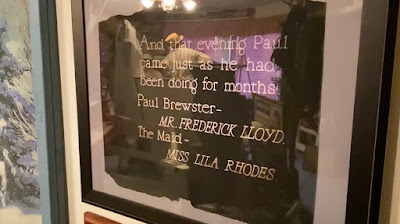
This video from the YouTube channel Weird And The Wonderful includes a unique and surprising Houdini collectible. It comes up right at the start of the tour around the one minute mark.


I am familiar with Houdini's practice of using movie memorabilia, such as lobby cards, as backing boards and dividers for items in his theatrical collection. Our friend Eric Colleary of the Harry Ransom Center told me they've come across many examples of these, and in some cases they are more valuable than the items they were used to protect!

These cards (which I would call "title cards" rather than "lobby cards") were almost certainly used by Houdini's Film Developing Corporation on one of their non-Houdini projects. One of the cards appears to be from the 1919 film, Winning His Wife. Once photographed, these were no longer of any use, hence Houdini gave them a renewed purpose.


The idea that Houdini did this is somewhat insider information and I've never seen these outside the Harry Ransom Center. So I'm interested in how someone came to have these and also understand exactly what they were. Who was the mysterious autograph show seller, I wonder?

Enjoy some of the other videos on this channel. Cynthia's wax figure collection is amazing. It's quite the weird and wonderful home museum!

Wednesday, April 7, 2021

"Houdini's Not-So-Magical Film Factory" in The Linking Ring

The April 2021 issue of The Linking Ring comntains an article by yours truly about Houdini's Film Developing Corporation, his "not-so-magical film factory." This is an updated version of the deep dive I first posted here.

I'm honored that The Linking Ring's executive editor Sammy Smith has invited me to submit occasional Houdini-related articles from WAH to his magazine. So if you have a favorite post that you'd like to see in print, please let me know!

The Linking Ring is the official magazine of the International Brotherhood of Magicians (IBM). You can join the IBM and receive the magazine via their official website.

Saturday, March 16, 2019

The saga of Houdini's Film Developing Corporation


It doesn't get much attention in biographies, but the Film Developing Corporation, a.k.a. FDC, was a major part of Houdini's (and Hardeen's) life from 1916 to 1925. It also marked Houdini's entrance into the movie business, albeit behind the scenes. While the FDC is today forgotten, the building that housed it remains. But we'll get to that.

Houdini formed the Film Developing Corporation on September 25, 1916. Opening a film lab was, in theory, a good investment. Movies were exploding in popularity and even threatened to supplant vaudeville. And here at last was a way for Houdini to earn a steady income without having to tour. There was a fair amount of competition. But the FDC promised a faster, cheaper process for developing motion picture film using machinery and chemicals worked out by an aniline dye expert named Gustav Dietz. This was at a time when most film developing was still done by hand.

The executive offices for the FDC were located at 22 West 42nd St. in New York, while the film plant itself was located across the river at 216-222 Weehawken Street in Hoboken, New Jersey. Houdini was President, Hardeen Vice President, and Alfred Davidson Secretary and Treasurer. Houdini took his new role seriously enough that on his 1918 draft registration card, he listed his profession as: "Actor / Manager, Film Factory."

The December 20, 1919 issue of Motion Picture News gave a nice description of the FDCs laboratory operations:

On the west shore of the Hudson not far from the center of Hoboken the laboratory of the Film Developing Corporation is running full blast. The laboratory under the direction of Messrs. Houdini, Hardeen and Davidson has forged ahead by its production of work of high quality until it occupies a position as one of the leaders in the fine film development.
Although the interior of all laboratories are much the same as far as equipment and procedia are concerned, the Film Development laboratory offers some refinements in these respects. Particularly impressive is the roominess of the separate departments. Instead of having many machines in a close space with little room for expansion, there is plenty of space in every direction.
In the printing room, for instance, there is room for 15 to 20 printing machines, and a like amount of spaciousness is found in the performing department. Three projectors, two Simplexes and a Baird, are used to prove each foot of film before being sent out.
But probably the most interesting parts of the Film Developing plant are the automatic developing machines. There are three of these automatics, a small negative machine and two mammoth positive machines. Through the use of these machines, it is possible to pass films from printing machines through the various developing and drying processes without being touched by the human hands. The drying drums are totally inclosed and fed with perfect conditioned air.
In personnel the laboratory is especially fortunate tin having workers long experienced in handling of film. Superintendent Flosse has been identified with laboratory practice for many years. Mr. Joseph Leighton is an expert negative developer. Miss Madelaine Keough is floor lady, and Miss Sohns is in charge of the printing department.
The Film Developing plant has been laid out for an ultimate capacity of 1,500,000 feet weekly.

Personnel and titles would change during the first few years of the company. Nathan Saland, who had experience running film labs, was brought in as Vice President and Hardeen became Secretary and Treasurer.

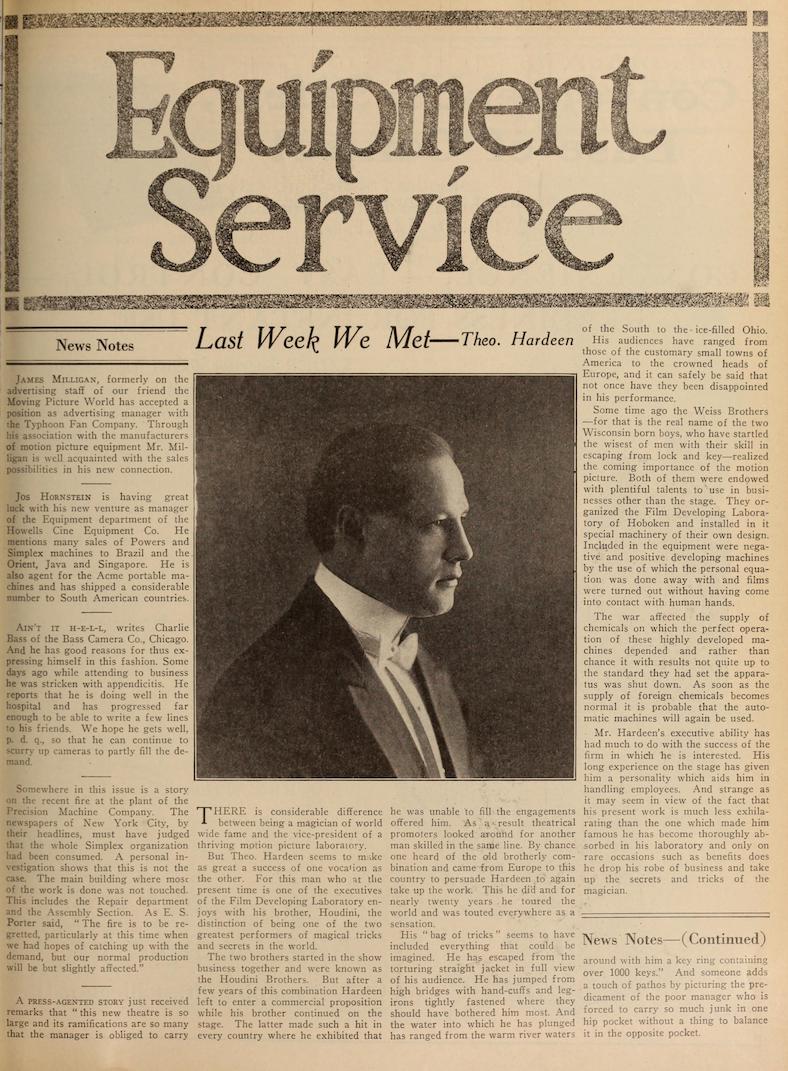
Houdini had convinced his brother to leave the stage to help run the business. Hardeen's true feelings about surrendering his successful stage career for a desk job are not known. But a profile of Hardeen in the "Equipment Services" column of Motion Picture News chirpily noted:

Mr. Hardeen's executive ability has had much to do with the success of the firm in which he is interested. His long experience in the stage has given him a personality which aids him in handling employees. And strange as it may seem to view of the fact that his present work is much less exhilarating that the one which made him famous he has become thoroughly absorbed in his laboratory and only on rare occasions such as benefits does he drop his robe of business and take up the secrets of tricks of the magician.

The FDC had some notable clients, including Famous Players-Lasky, who would later produce Houdini's The Grim Game and Terror Island. The FDC also developed First National's innovative newsreels called "Kinograms". When Houdini formed his own production company, the FDC did all the processing for his two feature films, The Man From Beyond and Haldane of the Secret Service. According to "Houdini's Ghost" Patrick Culliton, the lab also pioneered the concept of "Film Dailies", turning around shot footage within 24 hours for the film company to review.

With Houdini at the helm, it should comes as no surprise that the FDC aggressively advertised themselves, primarily in trade publications. Below are two such ads from 1919 and 1923.


Unfortunately, the FDC was problematic almost from the start. Dietz's special chemicals proved highly corrosive to the machinery. The war also affected the supply of chemicals needed for the automatic developers, and "rather than chance it with results not quite up to the standard," they shut the machines down. Profits proved elusive. To cover mounting expenses, in 1921 Houdini created a real estate holding company called The Weehawken Street Corporation, naming Bess Vice President. Through it he purchased the building for $35,000 and then rented it back to the FDC for $541 a month. This accomplished little. As Ken Silverman noted in Houdini!!! The Career of Ehrich Weiss, "Houdini was out of his depth in this financial wheeling-dealing."

Then there were the lawsuits. A former manager, Arnold de Biere, sued the company for $2600 in unpaid salary. The case was settled out of court for $2000. The FDC was also hit with an ugly lawsuit by rival Powers Film Products, which claimed, falsely, that the FDC was a foreign-owned company. The charge made news, causing deals to collapse and some customers to withhold payments, one for $8000. Houdini filed a $25,000 countersuit for damage to the company's reputation.

Among the FDC stockholders was magician Harry Kellar, who had cautioned Houdini early on "not to go too deep into it as you have worked too hard for your money to throw it away." Now Kellar grew concerned that if the FDC went bankrupt, he'd be held libel for its debts. Houdini persuaded him to not sell his 125 shares and granted him the power of attorney. "I'm not worried about losing my money in the FDC," he wrote to Kellar, "but would certainly worry about losing your friendship."


The FDC and Houdini soldiered on, expanding and installing new equipment in 1922. But business didn't improve, and the following year, two shareholders filed a lawsuit against Houdini and Hardeen for mismanaging the company.

The stress of the business took its toll on Hardeen, who had to have surgery for ulcers. But even with the weight of the FDCs problems, Houdini still found time to tour, make movies, lecture, write books, and launch his campaign against fraudulent spirit mediums. But with Houdini's waning interest in even his own motion picture productions, in 1925, he at last threw in the towel.

In November 1925 Nathan Salad resigned as Vice President and set up his own Saland Film Laboratories. The Weehawken Street Corp. folded that same year, and the FDC appears to have remained in existence in name only. Houdini now used part of the building as his workshop. Two famous photos show Houdini and his assistants at work inside the building, which are the only images of Houdini at the Weehawken site (as far as I'm aware).

In January 1926, G. Bert Ward leased the lab and it became the Ward Cine Laboratory. After Houdini's death, the FDCs equipment was sold to Seiden Camera Exchange. This appears to have been the official end of the Film Developing Corporation.

Film Daily, August 15, 1927.

But it was not the end for the Weehawken Street building. Happily, the building still exists today. The address is now 216 19th Street in Union City, NJ. (I visited it last year.) While modernized, it still retains its familiar structure inside and out, and would be recognizable to Houdini today. It's now a rental space frequently used for film and television work. Aware of the Houdini connection, the owners have dubbed the building "Houdini Studio."


A postscript to all this. One of Houdini's fellow Scientific American spiritualist investigation committee members was Daniel F. Comstock, who had founded the Technicolor Film Laboratories also in 1916. One wonders if, during their downtime, the conversation veered from ectoplasm to the shared frustrations of being a "Manager, Film Factory."

Related:

Monday, March 4, 2019

Hardeen's new job

Today is the birthday of Houdini's brother Theo. Hardeen, born on March 4, 1876 in Budapest, Hungary. For the occasion, I thought I'd share this untypical profile of Hardeen from the February 14, 1920 issue of Motion Picture News. It is not about him as an escape artist, but as Vice President of Houdini's Film Developing Corporation, a role he played from 1917 to 1925. The photo is also one I've not seen before.

Click to enlarge.

Stay tuned for a deep dive into the FDC, including some unique trade advertisements and a description of the working plant itself. In the meantime...

Happy birthday Dash!

Related:

Thursday, January 31, 2019

The Landrah Corporation?

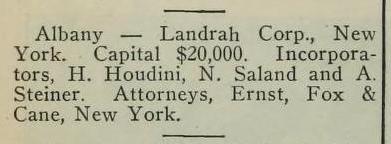
Here's a mystery for the end of the month. This appeared in the November 12, 1924 issue of The Film Daily and shows Houdini formed something called the "Landrah Corporation" that year. I have no idea what this was!


The only other reference I can find is a similar incorporation notice in the October 29, 1924 issue of Variety. This one is harder to read, but it does give a touch more information, including that the business is related to "pictures."


By 1924 Houdini was putting movies behind him, so it seems odd for him to be starting any new "picture" enterprise. Or maybe this has something to do with the dissolution of his various movie companies?

This is as deep as I've gone, so I figured I'd throw it out to the research wolves. Another Houdini mystery to chew on!

Related:

Friday, July 20, 2018

Wild in Houdini's New York (2018)

Last weekend I traveled to New York City to speak at the New-York Historical Society. It was a fantastic trip filled with Houdini sights and discoveries. I'm sensitive about not making this blog "all about me" (people come here for Harry), and I considered not writing up this trip up as I did my visit to NYC last year. But there was just too much cool Houdini stuff to not share! So here we go. All about me. And if you're wondering where the photo to the left was taken, just you wait!

I arrived on Thursday night and met up with my father and sister, Taylor, who would be sharing some of my adventures. (My sister, whom I'm very proud, lives in Manhattan and works for Macy's Fashion Design.) We had dinner at Keens Steakhouse in Herald Square. The restaurant dates back to 1885 and is deeply rooted in the theatrical history of the area. Actress Lillie Langtry famously challenged Keens Men Only policy in 1905. While there were no references to Houdini inside, there's no question that he ate here, so I considered this a Houdini sight in itself.

Friday, July 13th

I had most of the day free before my talk, so I decided to hit a few Houdini locations. The first was the Houdini Museum of New York at Fantasma Magic. This was my first visit to their new location with an expanded space for owner Roger Dreyer's spectacular Houdini collection. Roger wasn't able to be there, but he told his staff to let me see anything I wanted, even offering to open any display case and let me handle any object.

I've written about the museum's artifacts in previous posts [be sure and read: Did Hardeen reveal Houdini's most secret secret?], but what stood out to me this time was the grave bust of Houdini that now sits in the entryway. This is the 1976 replacement bust, which was stolen in 1983 and recovered in 2002. It's on loan from the Society of American Magicians. What I love is it still has the police evidence tag on it -- now part of its history! I was also excited to see a very detailed photo of Bess in her stage coat; the very coat I would be seeing on display at the NYHS that night. John Gaughan's full size reproduction of the Automaton from The Master Mystery is a new and popular addition. I also got to see some of the treasures back in Roger's private office. It was a perfect way to begin my day. Thanks to everyone at the museum for making me feel so welcome.


I then crossed town to "Mrs. Loeffler's Boarding House" at 244 East 79th Street. This was the first New York home of the Weiss family, and it would still be recognizable to them today (at least the outside). I stopped in at Sojourn restaurant excited to see the historic plaque that was given to them by the S.A.M. in 2016. I presumed it would be hanging up in the restaurant or somewhere on the building facade. Unfortunately, it was nowhere to be found.

My great friend Colleen Bak, formerly "our girl in Queens" who so lovingly watched over Houdini's grave, joined me for lunch. We had a delightful meal and conversation. Did young Ehrich and Dash play where we were seated? It's possible!

Time was getting tight, but with Colleen's subway assistance, I could squeeze in one more stop. So we shot down to 14th Street where, again, I had been told I would find a historic plaque. This time I was in luck! Near 14th and 3rd is a plaque marking the spot where Tony Pastor's famous vaudeville theater once stood. Interestingly, it was just across the street from where Huber's Dime Museum was located at 106 East 14th Street. So I got two Houdini locations in one. Thanks Colleen!

I then zipped back to Taylor's apartment; napped, showered, put on my suit, and I was off to the New-York Historical Society, housed in a beautiful building off Central Park West. There I met curator Cristian Petru Panaite who showed me around the amazing Summer of Magic: Treasures from the David Copperfield Collection exhibition. It's every bit as impressive as I imagined, and the Houdini area (a round glass enclosure surrounded by large screens showing Houdini doing escapes) was breathtaking. And the Mirror Cuffs!


The exhibition also had a clever "levitation" photo op. Here's Taylor getting a lift from DC.


After a quick sound check inside the museum's impressive Robert H. Smith Auditorium, I was able to meet magicians Adam RealMan and The Great Dubini, who were performing for the assembling crowd and would be featured for the entire "Houdini Weekend." But now it was showtime!

I'm happy to report that my talk on "Houdini in New York" seemed to go over extremely well. I had built this talk just for this event, and I really wanted to deliver for the museum and David Copperfield who had put so much (blind?) faith in me. I shared several uncommon stories, and the ~370 attendees seemed to really enjoy them. I was also able to play up the fact that the day marked the 104th anniversary of Houdini's first performance of his Walking Through A Brick Wall at Hammerstein's Victoria in NYC, a happy coincidence.


We then screened the excellent PBS documentary Houdini (2000). After the screening, I met many friends and blog readers, and even the family of Kenneth Silvermam. I was also thrilled to meet in person the new owners of Houdini's house (278), who were sitting front and center. They told me they were stunned when I showed a photo of Mrs. Loeffler's boarding house and Sojourn restaurant, because that is where they had met! So they met at Houdini's first New York home and then ended up buying his house. Now that is wild!

Saturday, July 14th

This was to be an exciting day, as I had been invited to see 278, which is currently in the process of being restored. Having met my father and sister at my talk, the new owners also invited them along, so this proved to be a nice family adventure for us. At noon we made our way to Harlem and walked up the steps and through those magical doors. Last year when I left the open house, I felt a wave of sadness as I realized I may never be back. But here I was back inside 278!

This time I knew much more about the house. But that doesn't mean there still weren't discoveries to be made. The first was just how much Fred Thomas, the previous owner, had saved it. I'm afraid I've never given him enough credit for this. But now I saw the photos Fred took when he first bought the house in 1991. I'm not sure what the heck was going on inside the house during the '80s, but it looked on the edge of being condemned! I also saw Fred's blueprints for his own renovations and restorations. So while he may not have loved Houdini fans, he clearly loved 278. Thank you Fred!

I was also able to go down into the basement, which I could not do in 2017. At long last I saw the mysterious wheel that has, so far, failed to excite Houdini collectors, maybe because some have suggested it might just be part of the dumbwaiter or some other mechanical part of the house. I wanted to get to the bottom of this, so I rolled it out into the light to get a closer look. I even took a wet paper towel to clean it off.

The first thing I discovered was that it was painted dark green with signs of bright orange paint as well. It reminded me of circus colors, and my mind flashed on this image. Could this have been from a circus wagon? Or, better yet, could it have come from Houdini's vanishing elephant cabinet, which was said to have been painted to look like...a circus wagon!!!


This possibility had me bouncing off the basement walls. However, when I later read up on wagon wheels, it turns out they were commonly painted this shade of dark green to hide dirt. Orange was also a color commonly found on wagons. (Who knew wagons were so colorful?) So the paint was not unusual or especially theatrical. However, it does confirm this is a wagon wheel, not a gear, and Houdini did an escape called "the big wheel release." So I'm pretty convinced this is the last original Houdini prop stored in the basement of 278. (A wine press that dates back to Houdini is also still present.)

The owners then took me on a very thorough tour, showing me where they had uncovered some of the original flooring and features, and even a few mysterious areas that had been sealed off, such as a large space in the basement and a fireplace on the top floor. What could be inside? They intend to find out! I also saw the original doorway to Houdini's library that Fred had stored in the basement. It will be put back in place. The new flooring in Houdini's bathroom will also be taken out. According to the owners, Fred did not remove the original floor, just covered it over. So will they find the much mentioned "H" in the tile underneath? (One concern is Fred might have poured concrete over it.)

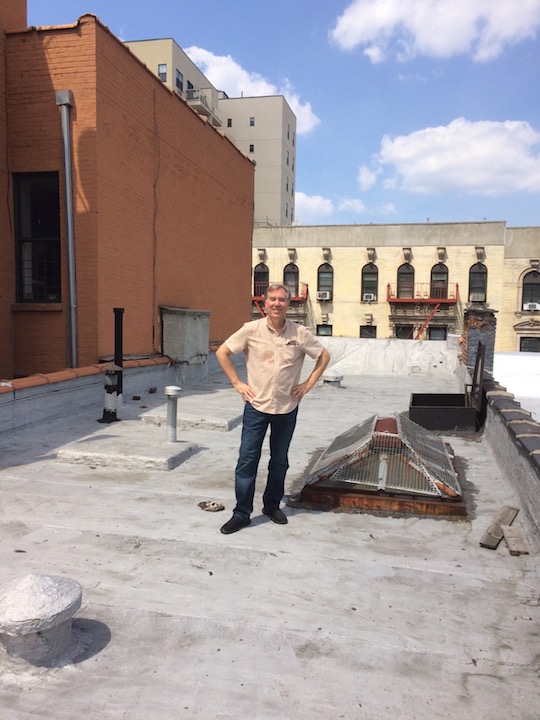
We explored and talked for hours (outlasting my dad and Taylor). Then, for the grand finale, we went up on the roof. Yes, I was on the freakin' roof of 278! Here I could see the top of the famous stairway skylight, and also where two other skylights had originally been (or maybe the stairway skylight had been moved?). I was also able to take a flashlight and look into a crawl space just below the roof -- gazing into the very guts of 278. The owners joked (or not?) that it would be fun to project film of Houdini escaping from a straitjacket on the side of the adjacent building so it could be seen from the street below. Um...yes please!

After our explorations, we had a lovely outdoor lunch at Bier International just down the street (I could see 278 from my seat). We enjoyed sausages and beer, and I was struck by how the area still has a German influence, just as it did in Houdini's day. It was a sensational time and I'm so grateful to the new homeowners for the visit. I really got a good idea of what they are planning, and I know the finished house is going to be magnificent. They also invited me back, so I'm excited that I'll be able to continue to share details of the house's revival.

By now it was late afternoon and I was pretty tired, but I decided to go for broke and make the trek out to Queens and visit Houdini himself. After an hour subway and bus ride, I found myself at Machpelah Cemetery. It was closed on Saturday, but I know Houdini's trick of how to walk through walls. The weather was perfect and the light beautiful, and I spent a good two hours there as the sun set. I've never been to the grave alone, and it was nice to spend this time, as Houdini himself once put it, "in silent contemplation." (Okay, I did briefly FaceTime with my cat.)


Sunday, July 16th

My flight home wasn't until the afternoon, so I could still hit a few Houdini spots. For this I was aided by the great Fred Pittella, whose amazing Houdini collection I saw during my 2017 trip. Fred picked me up from Taylor's apartment and we travelled to Union City, New Jersey. There we found the building that once housed Houdini's workshop and his ill-fated Film Developing Corporation. Today it is part of Hudson River Studios, a collective of buildings available as rental space. This building is known as, what else?, "Houdini"! There's even a pic of Harry inside the front door. (And that's where I took the top image.)


The building was closed on Sunday, but I was happy just to see the outside, which still looks almost exactly as it did in Houdini's time. But then a film crew arrived to load some equipment into the building. After a little persuading, the very nice woman in charge allowed us to have a quick look inside. It was immediately clear that the film lab must have been housed in a large open area on the first floor. But what about the workshop?

Until now, my best guess was that it was on the second floor. This is because in the few photos of that space the windows appear to be level with the neighboring rooftops. Unfortunately, we could not get to the second floor as that is where the film shoot was taking place. However, Fred and I could see those same level rooftops from the first floor -- so it's a bit of an optical illusion. That means it's possible the workshop was here somewhere.

That's when I moved toward the back and found another room off to the side. Boom! The brick walls and the windows are a very good match to the famous photos. It also makes logical sense that Houdini's workshop, with its heavy machinery, would be on the first floor. So Fred and I firmly believe we've found the location of Houdini's magic workshop. What an unexpected treat!


By the way, the fact that there hasn't been an Official Houdini Seance in this place is crazy! This needs to happen.

Leaving the lab, Fred and I traveled deeper into New Jersey for what would be the last stop of my trip, and it was a big finish! We arrived at the home of the King himself, Kevin Connolly, who owns one of the world's great Houdini collections.

To describe all I saw just isn't possible. Kevin's study is filled with Houdini posters, pitchbooks, tobacco cards (the largest collection of Houdini cards in existence), and bookcases overflowing. At long last I got to see the fabled Russian pitchbook. Kevin even kindly paged through it for me, allowing me to confirm some important research. He also showed me his Haldane of the Secret Service pressbook, which came from the Christopher Collection and is, as far as I know, the only one in existence. Oh some of the Haldane posters it shows!

If that wasn't enough, we then took a seat at the dining room table and Kevin served up an unending banquet of file folders jam packed with programs, letters, and photos. Truly spectacular Houdiniana at my fingertips. In one folder Kevin had programs from almost every stop of Houdini's 1922 Vaudeville tour (allowing me to confirm and fill in a few spots on my Chronology). I also got to read through the unusual letters Houdini wrote about monkey gland transplants, an operation he might have been considering having himself.

It was also just a delight to talk, joke, and gossip with Kevin and Fred. These guys know where all the bodies are buried! They also remember the "old timers" like Sid Radner, Jay Marshall, and Milbourne Christopher. Hmmm...does that make us the new "old timers"?


We bid our goodbyes to Kevin and his lovely wife Susan, and Fred drove me to the airport. Thus my 2018 Houdini adventure came to an end. Thanks to everyone who made it so special.

Thanks to my dad, Ron Cox, Colleen Bak, and Ray McNally for the event and exhibition pics.

Related:

Saturday, June 16, 2018

Early Houdini playbill produces $2880 at auction

An 1896 playbill clipping for the Marco Magic Company in Halifax, Nova Scotia, sold today at Potter & Potter's The Magic Collection of David Baldwin II auction for $2880 (including 20% buyers premium).

The young Houdini and Bess were members of this ill-fated magic troupe. The program shows "Twenty Minutes with Mysterious Harry Houdini" and also lists Houdini as the Stage Director. "Mlle Marco, Psychometric Artist, Clairvoyant and Exponent of Mental Occultism", who gets second billing below Marco himself, is actually Bess.

[The full story of the Houdinis Maritime misadventure appears in the excellent 2012 book, The Metamorphosis: The Apprenticeship of Harry Houdini, by Bruce MacNab.]

It's pretty uncommon to see original items from so early in Houdini's career at auction, and even rarer to see something from the Marco show, so this was a nice get for someone. At one point this had belonged to Bess's sister, Marie Hinson.

The auction also featured several original stills from The Man From Beyond, some stamped "H.P.C." on the back (for Houdini Picture Corporation). Each sold for between $400-$750.

A surprise in the auction was a pair of original press photos from Houdini's Shelton Pool Test which fetched $1,800 on a $250-$350 estimate. They are not unknown images, so I'm not sure why they went so high.


I had my eye on two letters; one from Hardeen to Houdini written on Film Developing Corp. stationary, and the other written by Edward Saint on "Madame Houdini Speaks" stationary (this was the working title for Religious Racketeers). Both had magnificent content and fetched $570 and $360 respectively.

Related:

Saturday, September 10, 2016

It's now the "Houdini Studio" in New Jersey

I'll be darned. Our friend Perry in New Jersey has discovered a new website for the building at 216 19th St. in Union City, which was once owned by Houdini and housed his Film Developing Corporation and possibly his magic workshop. It appears the building has been renamed "Houdini Studio." The website sources THIS POST from 2014 pointing out the connection. Our work is done here!


The new "Houdini Studio" website also offers photos of the inside, which we can maybe use to help prove and/or pinpoint the exact location of Houdini's workshop, as seen in THIS PHOTO from the Kevin Connolly collection that I shared last week.

Below is what the the building looked like in Houdini's day. Back then the address was 216-222 Weehawken Street.


I feel kinda proud that this building is now known as Houdini Studio. But to give proper credit, this location was first uncovered by the great Patrick Culliton and first revealed on Kevin Connolly's blog "Houdini Himself" in 2010 (Kevin took down his blog and all its content earlier this year).

Thank you Perry.

Related:

Monday, September 5, 2016

Houdini in his workshop

For Labor Day, I couldn't resist sharing this amazing image of Houdini in his New Jersey workshop preparing magic apparatus for his 1925-26 3 Shows in One. This photo comes from the formidable collection of the great Kevin Connolly. Kevin recently shared this at his Facebook group, CONJURING HISTORY - BUY, SELL AND TALK.

Click to enlarge.

The folks over at Kevin's group have been doing a great job dissecting what we can see here. Houdini is holding what appears to be a Vanishing Birdcage. This was actually a Harry Blackstone specialty at this time. Behind him we can see a pair of Conradi Vanishing and Appearing Lamps. These once went wrong during a show and Houdini denounced the manufacturer from the stage. Another thing spotted by the eagle-eyed David Charvet are what appear to be two 35mm film canisters on the work bench.

It's been suggested that Houdini's New Jersey workshop may have been located in the same building that once housed his Film Developing Corporation (FDC). That building still stands today.

Thanks to Kevin Connolly for generously allowing to share this shot. Hope you are all having a relaxing Labor Day weekend and are ready for the Fall "seance season."

UPDATE: To help our discussion in the comments below, here's the other more well-known image of Houdini in his workshop. This comes from Gresham's Houdini The Man Who Walked Through Walls and is credited there to "Brown Brothers."

Click to enlarge.

UPDATE: Having now been in the building, I can say with almost complete certainty that the workshop was on the ground floor. I was in the room where all the windows, wall features, and even the views match. Here's a pic.


Related:

Friday, January 1, 2016

Houdini in 1916

Welcome to another year of WILD ABOUT HARRY! Let's kick off 2016 with a look back at what Houdini himself was up to 100 years ago.


This post is now retired. 

But you will still be able to enjoy the story of Houdini in 1916 with the publication of my upcoming book.

Friday, April 24, 2015

Rick Schmidlin (Bonus): Where did Larry Weeks get The Grim Game?

Last week I had the pleasure of interviewing Rick Schmidlin who produced the TCM restoration of Houdini's The Grim Game. I posted my Q&A with Rick in two installments: Finding The Grim Game and Saving The Grim Game.

Today I have a BONUS excerpt in which Rick and I discuss the mystery of the original 35mm nitrate print. This was said to be the last surviving print of The Grim Game, and it was disposed of in 1959 when Larry had the film transferred to 16mm safety film. But where did he get it?

WAH: Did Larry tell you how he got the original nitrate print?

RICK: He said he got it from Bess. I don't... Where would Bess have been in 1943?

WAH: Dead. Well, she died in early 1943, she was in Hollywood before that.

RICK: Exactly. So I don't think he got anything from Bess. He kept on saying that he got it from Bess. But Larry was just a kid, he wasn't even in the army in 1943. He definitely wasn't in Hollywood and he definitely didn't go to Hollywood to get this stuff.

WAH: Right.

RICK: Now, my guess is this. And this is just educated. Houdini had the lab in New Jersey. And when The Grim Game and his other film projects came they went to the lab. Basically it was like, "I've done the projects, and, by the way, guys, can you give me a print, I want to keep it for myself." Because he was an archivist, he saved his books, he saved his scrapbooks, he's gonna save his films. He was interested in films and he had the facility to keep it. Now when the lab closed...what year was that?

WAH: It's unclear when he closed to lab, but it was by mid '20s.

RICK: 1922, wasn't it?

WAH: Well, Haldane of the Secret Service was released in 1923, so I've always thought the lab closed down around that time. It took a while for Houdini to unravel his movie businesses.

RICK: Right, so the lab closes down, and the film elements of his negatives go to...probably Hardeen's Estate?

WAH: Hardeen ran the film lab, so, yes, he might have taken possession of a lot of that stuff.

RICK: That's what I'm thinking. So he took the films. Now if you look at what was said on the Kino, and you look at the history of the film, which makes perfect sense, around 1947 all this nitrate film is sitting in New York, and they have their house inspected. And they have a young Larry Weeks who's been in This Is The Army trying to buy everything he can. He may have bought a bookshelf [Larry had a Houdini bookshelf in his apartment], he may have gotten a scrapbook, he had a little money. Remember, he had been in an Irvin Berlin play on Broadway.

WAH: Now when you say this, you mean he's at Hardeen's home, correct?

RICK: Yes, that's what happened.

WAH: And Hardeen died in 1945, so Elsie Hardeen was unloading stuff.

RICK: Right. Again, this is where the detective works comes in, and where we think logical.

Film reels showing nitrate decomposition.

So the film is sitting in New York, and the insurance man comes in to inspect the house, knowing nitrate in this day...people are watching it. I know many people who in the 1940s had to throw away many great nitrate films because, you know, they could explode an entire city block. So they have to get rid of them. And they were probably told they had to bring them somewhere that would have cost them money. So they call this kid who been pestering them for anything he can get on Houdini, and ask if he wants them. And he was up there like a flash. So Larry in 1947 obtains the films. That's my hypothesis. But if you think about it -- lab, Hardeen, the location...that's why I say "Houdini heirs" in the beginning. Does that make sense to you?

WAH: It makes sense to me. When Bessie sold 278, much of her stuff went with her to her sister's house -- the Hinsons. A lot of it remained with them when she went to Hollywood. The Hinsons did have a great many Houdini movies, and they were visited by the insurance man. That's where that story comes from. Marie Blood tells it. So when Larry said he got his stuff from "Bess", I always felt what he was saying was that he got it from the Hinsons. But the Hinsons say they threw out all their films after the visit from the insurance man and that Larry did not get The Grim Game from them. They are clear on that to this day. So, like you, I think Larry could only have gotten it from Elsie Hardeen, especially at that time. I heard that's what happened. And then he later acquired some things from the Hinsons because I do know that he visited them in 1956. And eventually it just all sort of melded together. That's why there's a confusion of when and where he got what. It all just became one collection of artifacts from the "Houdini family."

RICK: Right.

***

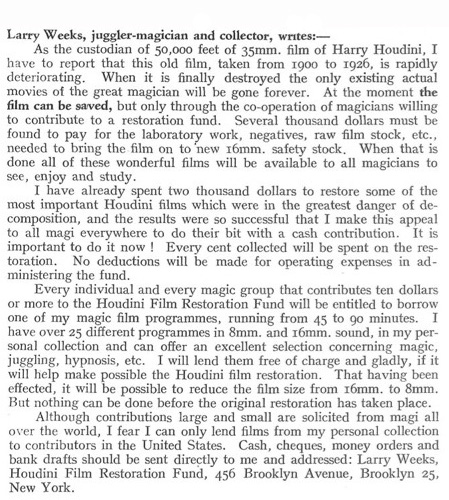
As a postscript, in 1958 Larry Weeks formed the "Houdini Film Restoration Fund." Larry knew that his nitrate prints were in danger of decay (recall that Rick said The Grim Game probably only had six months left). Check out this item written by Larry himself in a 1960 issue of Abacradabra:


Reading this 55 years later, one thing becomes clear. A lot of people were involved in this effort to find and restore The Grim Game, and a lot of people deserve credit. But the person who truly saved The Grim Game, the person who is most responsible for us now being able to see and enjoy Houdini's best film, is the late Larry Weeks, "Houdini's Biggest Fan."


Related:

Thursday, March 12, 2015

Hardeen hangs up his handcuffs

Here's a remarkable article from the January 21, 1917 Oakland Tribune announcing the retirement of Theo. Hardeen from show business. The article features a nice photo of Elsie Hardeen and their two sons, Harry Houdini Hardeen and Theodore Hardeen, Jr. Amusingly, it states that Hardeen will dump all his equipment into the San Fransisco Bay! Anyone up for an underwater expedition?

Click to enlarge.

Hardeen would continue to fill periodic engagements throughout 1917 and 1918, so I guess not everything went into the Bay. But by 1919, he really was free of the escape business.

While there certainly may be truth to Hardeen's wish to be with his family, the real reason Hardeen left his career was so he could run Houdini's Film Developing Corporation. Houdini was responsible for Dash's career -- he came up with the Hardeen name and set him up with his full act in early 1900s. I can't help but wonder if retiring and running the FDC was something Dash wanted to do, or whether it was the new edict of his older brother. Nevertheless, Dash did it, and came away with ulcers.

After Houdini's death, Hardeen retuned to performing, although this might have happened even if Houdini had lived. A letter in the Arthur Moses collection shows that Dash was on Houdini's payroll until August 1926. He would have needed to seek work at this point.

This clipping from The San Bernardino County Sun for November 23, 1926 is the earliest mention of Hardeen's return to show business that I can find. It's just a mere 24 days after Houdini's death. But maybe the most curious thing about this new item -- is that mustache on Dash?

Click to enlarge.

Hardeen continued to perform as "Houdini's Successor" for many years before turning the show over to Douglas Geoffrey a.k.a. Hardeen Jr. (not his son) in May 1945. He died a short time later.

Clipping source: Newspapers.com.

Related posts:

Tuesday, May 13, 2014

Houdini's film lab - then and now

Perry from New Jersey, a self-described "Houdini freak the past 40 years", recently took a photo safari on our behalf and returned with these terrific shots of 216 19th Street in Union City, NJ. In Houdini's day, this was 216-222 Weehawken Street and was the location of Houdini's Film Developing Corporation (FDC).

The FDC was not a movie production company, as is sometimes confused, but an actual lab that processed motion picture film. Houdini started the business in September 1916 and convinced Hardeen to leave his own career as an escape artist to run the company. Along with serving outside clients, Houdini used the FDC to process his own movies, The Man From Beyond and Haldane of the Secret Service.

The building is remarkably unchanged. Heck, even the telephone pole is still in place! And Perry actually got a photo of the building from the exact same angle as the only existing photo of the FDC, which appeared in a trade magazine as part of a Christmas greeting/advert.


Unfortunately, the FDC would prove to be a difficult business to run, and it cost Houdini and his investors dearly (including magician Harry Kellar). An ugly legal battle with rival Powers Film Products hurt the reputation of the company when Powers charged that it was foreign owned and some customers withheld payment. To cover expenses, Houdini mortgaged the building through a new company he called The Weehawken Street Corporation, and rented it back to the FDC. Hardeen developed ulcers and Houdini would later confess, "It will be a Godsend for all of us if we get away from it in a legitimate manner."

Eventually, Houdini did escape the FDC. As for the building, Patrick Culliton believes it became Houdini's workshop where he prepared the large scale illusions for his full evening show. It was later used by Hardeen and Jim Vickery. Below is a less common shot of Houdini in his New Jersey workshop from Pat's own Houdini The Key. Clearly a brick building, and the window seems right...


Here are a few more shots of the building that Houdini and Hardeen knew very well. Today it is a rental space managed by Union City Studios. Good place for a Houdini seance?


Thank you Perry!

Related:

Translate