Showing posts with label 1912. Show all posts

Friday, September 5, 2025

Did Houdini escape from a lion's den?


Here's a new one. Did Houdini do an escape from a lion's cage at a Belgian circus? The following is from The Football Post on January 4, 1913.

Football Post, Jan. 4, 1913.

Before we dismiss this as the product of an overly imaginative reporter, know that there is supporting evidence for this from Houdini himself. During his run at the Circus Hagenbeck in Brussels in late 1912, Houdini sent one of his circus playbills to his friend Quincy Kilby in Boston. On it he wrote:

I performed my act in the Lions cage. H. H.
The entire menage was ironed off like a hugh [sic] cage.

I'm still not entirely sure what Houdini did here, but he appears to have done something involving lions, and that's pretty wild!

Interestingly, one of "The Amazing Exploits of Houdini" stories features Houdini escaping from a lion's cage. "The Cage" ran in the February 18, 1922, issue of the Kinema Comic and is one of the stories collected in the new book from Joe Notaro and Arthur Moses, Kinema Comic 1922 (Jan-Jun) The Amazing Exploits of HOUDINI.

Want more? You can see the original playbill Houdini sent Kilby as a "Scholar" member of my Patreon.


Top image generated by A.I.

Wednesday, August 3, 2022

The Norfolk kerfuffle

Here's a terrific illustration of Houdini and his fellow performers at the Colonial Theater in Norfolk, Virginia, during the week of March 4, 1912. This engagement is notable in that it featured a standout challenge and a bizarrely ignominious end.


Houdini's upcoming appearance at the 1,100 seat Colonial Theater was heavily promoted. This was his first appearance in Norfolk and a rare appearance for him in Virginia (his last being Richmond in 1900). The Virginian Pilot and the Norfolk Landmark ran a full-page illustrated profile headlined, "Houdini: The Man with the Charmed Life." The manager of the Colonial, H.B. Hearns, even refused an offer of $500 from the Orpheum in Harrisburg to retain Houdini for another week.

Houdini would receive $1,200 plus a percentage of the box office. This was the second highest salary ever paid to a performer at the Colonial (the first being Gus Edwards and his The Song Revue). But Wilmer & Vincent, the company behind the theater, felt the Handcuff King was worth it:

In view of Mr. Houdini's drawing powers, and the excellent support theater-goers of Norfork and vicinity have given the Colonial this season, they are taking a chance and confidently expect this really marvelous man to break every record the house has ever had. And at regular scale of prices.

Houdini did not disappoint when he opened on March 4, playing two shows to standing room only. He featured his Double Fold Death Defying Mystery and also accepted a string of challenge escapes for the week. The Schlitz Brewing Co. challenged him to escape his Milk Can filled with beer. The Norfolk Automobile Trade Association proposed a challenge in which Houdini would be chained within two Goodyear tires and nailed to the stage. He was also challenged to escape from the Norfolk County jail. While the newspapers ran the challenge, I couldn't find any account of the escape itself. In fact, it doesn't appear he did any outdoor stunts to promote his appearance, possibly because a snow storm had arrived that week.

The most notable challenge was saved for last. It was announced from the Colonial stage following Houdini's successful escape from the Goodyear tires. The newspapers described the scene:

Perhaps the most interesting feature of his appearance here was the reading of a challenge received from the committee of the submarine station of the Navy Yard, challenging him to allow himself to be fastened in a regulation navy deep-sea diving suit, and he to escape without injuring the suit. The specifications were so severe as to cause the audience to laugh, and when Houdini excepted the challenge, setting Friday night for the test, there was prolonged cheering.

The day before the challenge Houdini travelled to the Navy station to examine the diving suit. He stated that if he could figure out a way to escape, he would give the secret to the Navy as a way to help seamen who might find themselves trapped. For this Houdini said he would ask nothing in return, "except the credit for the invention."

There was nothing inherently dangerous about the diving suit challenge. But this didn't stop Houdini from playing up the drama. A terrific account of the escape was carried in the next day's paper.

Virginian Pilot and the Norfolk Landmark, March 9, 1912

However, the diving suit escape wasn't the only drama audiences witnessed that night. The seeds of what happened next are hinted at in the above which alludes to some "trouble between Houdini and the manager" that delayed the start of the escape. That trouble only escalated after his performance, as was reported by the Virginian Pilot and the Norfolk Landmark the following day:

As the last act of the bill went on the audience became conscious of a disturbance behind the scenes. Houdini was crying out that he was being cheated and wanted the balance of his salary. Just as the closing act went off and the sheet was dropped for the moving pictures, Houdini rushed out before the footlights clad in a bathrobe.

"I am Houdini–Harry Houdini!" He exclaimed. "I want my money. These people won't give me my salary." With other expressions of a like nature, he rushed about the stage, blocking the pictures. Fearing that a panic would result and that the audience would become excited, the stage manager dragged him behind the scenes by force, Houdini resisting and clinging to every possible foothold and handhold.

The police were called and Houdini was arrested. A large crowd gathered in front of the theater to see the magician taken away in a police car, but he was "quietly taken through a rear entrance and spirited away to the station house." There Houdini was charged with creating a disturbance. Edwards Stevens, a fellow performer at the Colonial (who can also be seen in the top illustration), posted his $50 bail.

On his release Houdini told reporters, "This action was taken merely because the manager of the theater and myself had a misunderstanding. I will admit that I became excited, but who wouldn't cry for $400–even make a bigger fuss than I did?"

This wasn't the first time Houdini had hijacked a stage to protest the actions of a theater manager. In 1910 Houdini took to the stage of the Holburn Empire in London when a manager asked him to not appear at a matinee. Despite the police being called, Houdini won the audience over by insisting they remain in their seats until he was allowed to perform for them as advertised.

Houdini considered staying in Norfolk to fight the case. But he decided to move on to his next engagement in Trenton, vowing in time to "get my desserts." Variety later offered some insight into what led up to the fracas:

Variety, March 16, 1912

In April Houdini filed suit to recover his $400. It's unclear if he ever got his money. But he did make good on his promise to give the secret of his diving suit escape to the U.S. Navy, and received a patent for his invention in 1921. He never returned to Norfolk.

According to the always helpful Cinema Treasures, the Colonial Theater stood at 116 W. Tazewell Street. With the decline of vaudeville in the 1930s it became a full time movie theater. By the 1960s it had fallen into disrepair and was being used to show adult films. It ceased operation sometime in the 1970s and the building was later demolished.

Below is the only image of the Colonial I could find in it's later days. Today a modern development, Harbor Heights, stands on the site of Houdini's first diving suit challenge and his Norfolk kerfuffle.


Want more? You can see and download 19 newspaper clippings that I used as research for this post as a "Scholar" member of my new Patreon. Just click the image below to go:


Saturday, July 23, 2022

Houdini of Arabia

Here's a photo that you'll sometimes see credited as being Houdini in Egypt. However, this clipping from the March 3, 1912 Virginian Pilot identifies it as being "Aden Arabia". Houdini did indeed stop off in Aden (Yemen) during his journey to Australia in 1910. This would have been after his stop in Port Said, Egypt. I'm not sure I buy the claim that Houdini escaped from their jail. I think this pic is all about the camel.


This appeared as part of a full page profile that ran in anticipation of Houdini's appearance at the Colonial Theater in Norfolk, Virginia, in March 1912. This would mark his first and only appearance in the city and proved to be one wild week! I'll be sharing that story soon...


BONUS: Our good friend David Haversat of David Haversat Magic has sent over this image as a beautiful first generation photo from his own collection. You can see it on my new WILD ABOUT HARRY Patreon by joining at any level. Just click the image below to go:


Below are some more posts about Houdini the world traveller.

Related:

Wednesday, July 6, 2022

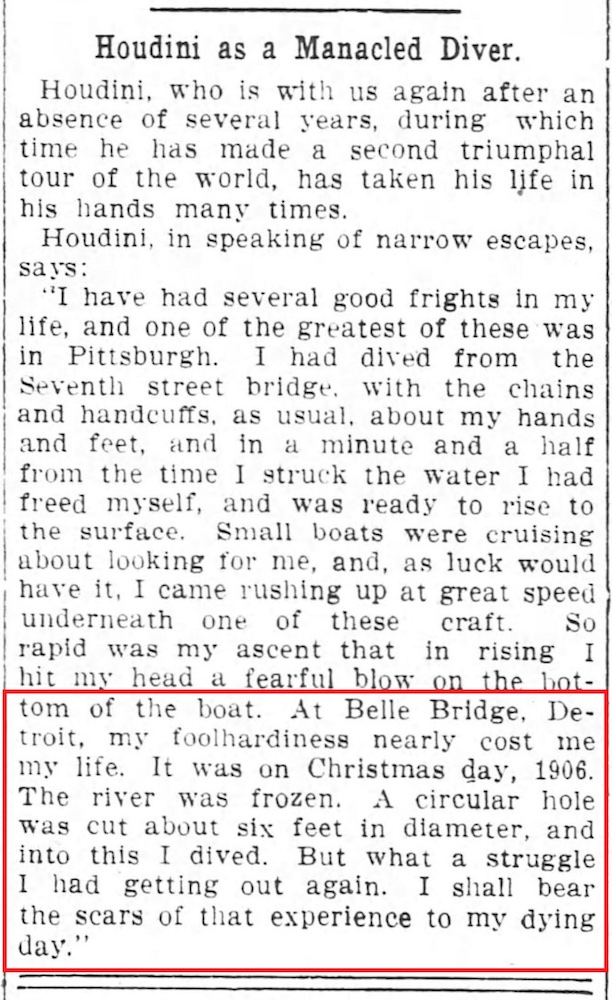
Houdini freezes the Detroit river in 1912


Recently I came across this intriguing article from the February 11, 1912 Washington Post. The quotes here come from an interview Houdini gave while appearing at the Maryland Theater in Baltimore. It's short so I'm sharing the entire thing, but it's the last part that interests me the most.

The Washington Post, Feb. 11, 1912.

While I've not done an exhaustive search, I believe this might be the first mention of any bridge jump into a frozen river through a hole cut in the ice. Here it's the Belle Isle bridge in Detroit in 1906. That was a real jump, but the river was not frozen nor was it Christmas day. Still, this appears to be the genesis of the famous myth of Houdini being trapped under the ice of a frozen river.

Houdini would tell that story in full for the first time (as far as I know) in an article he wrote for the September 1918 issue of The American Magazine called "The Thrills in the Life of a Magician". But now he relocates the action to Pittsburg and doesn't provide a specific date. It's also become an overboard box escape instead of a handcuffed bridge jump.

The dramatic story was picked up by newspapers at the time, including the Boston Sunday Post below (click to enlarge):

Boston Sunday Post, Sept. 1, 1918

Houdini told the tale again in his 1919 article for Hearst's magazine, "Nearly Dying for a Living". But it's interesting to note that this story, as with other Houdini mythology, does not appear in any of his pitchbooks. It seems to me that Houdini made a distinction between disposable media, such as newspapers and magazines, and what he considered to be the official record. His pitchbook does record that he had to "break through the ice" during a bridge jump in Breman, Germany, which is likely true. That jump was made during a snow storm.

Later biographies made no such distinction, and the full under the ice drama became part of the official record with the publication of Houdini His Life Story by Harold Kellock in 1928. Interestingly, Kellock moves the action from Pittsburg back to the Belle Isle bridge in Detroit in 1906.

Then, of course, the 1953 biopic Houdini starring Tony Curtis dramatized the incident (beautifully) and cemented it in the minds of the public. In the movie the location remained the Detroit river, but the day was changed to Halloween(!). Also, as in Houdini's telling, it's an overboard box escape.

Houdini (1953)

The first doubt was cast on the story by William Lindsay Gresham in his 1959 biography Houdini The Man Who Walked Through Walls. Ironically, Gresham had been one of the recent propagators of the myth, publishing an account with fresh embellishments in SAGA magazine the previous year. But Gresham credited Robert Lund with tracking down the original newspaper accounts of the Belle Isle stunt and calls out the inconstancies, namely that the Detroit river was not frozen. He writes:

The river was not frozen over, Houdini had a rope tied around him all the time, he got out of two pairs of cuffs and was picked up by a boat! As for escaping from under the ice—as Tom Sawyer would say, "He just let on he done it."

The story largely disappears from Houdini books after that.

However, Hollywood doesn't let the truth get in the way of a good story, and the full under the ice drama was resurrected in the 2014 Houdini miniseries biopic starring Adrian Brody, this time relocating it to the Eads bridge in St. Louis. But by this point no one was fooled.

It's fun to see how this all appears to have started in Houdini's mind back in 1912 as a way to add some color to an interview. He understood what reporters wanted!


Below are some more posts related to Houdini's adventure under the ice.

Clipping source: Newspapers.com.

Monday, June 20, 2022

Houdini catches Belle Baker's "clacque"


Last week I posted the story of Houdini and Don the Talking Dog. Today I have a new tale of Houdini and a rascally fellow vaudevillian. This time its singer Belle Baker who shared the bill with Houdini at the Maryland Theater in Baltimore during the week of February 5, 1912.

Baker was known to employe the practice of "clacque." This means hiring audience members to provide an inordinate amount of enthusiasm and applause during your act. During her run at Hammerstein's in 1911, Variety called this out, writing: "Miss Baker did nothing with her voice, expression or gestures to merit this kind of applause. She became exceedingly painful in her labored efforts during the Italian selection. Miss Baker was one of the first in New York vaudeville to use a "clacque", and she soared for a while until vaudeville "got on.""

Here Variety is once again calling her out for the practice, but this time the situation ensnared Houdini.

Variety, Feb. 10, 1912

This was certainly embarrassing for all, but it does sound like Houdini took it in stride. I do love the idea of him standing "still for two minutes until the noise subsided." And despite her sneaky ways (or maybe because of them), Baker would go on to have a long and successful stage, film, and radio career. She died in 1957 at age 63.

Here's another fun detail about this engagement. Notice that "Mr. and Mrs. Erwin Connelly" are also on the bill this week. This is actually Jane Connelly, Houdini's future co-star in The Man From Beyond, and her husband Erwin who also appeared in the film. Do you think when they were on set they reminisced about the time Belle Baker gave Harry the clacque?

Wednesday, June 15, 2022

Houdini and Don the Talking Dog

It’s sometimes easy to forget that for most of his career, Houdini was always part of a larger vaudeville show featuring a dozen other performers on the same bill. Most of those performers are now long forgotten. But looking below Houdini's name on a playbill can sometimes turn up some surprises, which is what I have today.


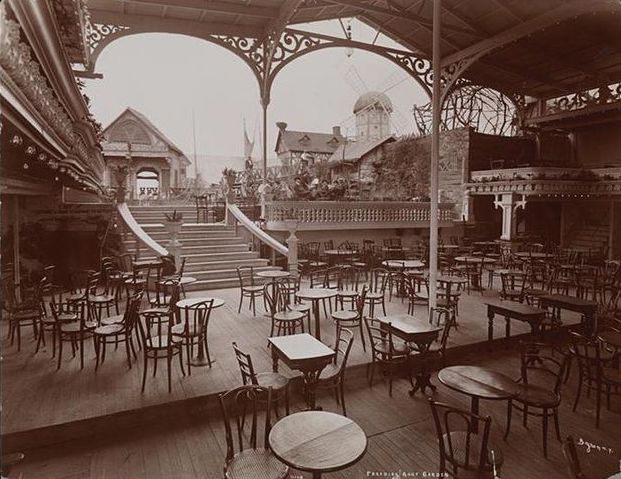
In July 1912 Houdini played a record seven weeks at Hammerstein's popular Roof Garden in New York City (pictured above). During this run that he featured his Double Fold Death Defying Mystery, did his first overboard box escape, and his first outdoor stunt in Times Square. This is also when asked for one week to be paid in gold coins so he could pour them into his mother's lap. Times were good!

But here's something about that famous engagement that doesn't get a mention in any biography. For five of those seven weeks Houdini shared the bill with a performer who rivaled him in popularity. A New York sensation, in fact. It was "Don the Talking Dog".


Below is a preview of Hammerstein's bill for the week of July 22, 1912. Notice who gets mentioned first.

New York Tribune, July 21, 1912.

This Hammerstein's engagement marked Don's debut in America. The dog had just come over on the SS Kronprinz Wilhelm, a ship Houdini also traveled on. Just like Houdini, he was seasick for most of his journey. Despite what the article says this was not Don's last week. Both he and Houdini were held over multiple times, and both clocked a total of seven weeks on the Roof.

There's a surprising amount of information online about Don the Talking Dog, and it looks like I'm not the first to have noticed his time with Houdini. The below is from Mysterious Universe and tells the rest of Don's amazing tale.

Don became a huge success in America, at one point even sharing billing with the megastar escape artist Harry Houdini and the comedian Sophie Tucker, as well as other top acts at the time, and he went on to become a celebrity endorser for Milk-Bone dog biscuits in the process. Don the Talking Dog was starting to become a household name, and even though he only spoke German, Americans totally loved him. He was soon being called “the canine phenomenon of the century,” and adding to his allure and popularity were news headlines in August of 1913 that told of Don saving a man from drowning at Brighton Beach. Don allegedly shouted the word “Help,” before swimming out to save the man, ensuring that now he was not only an entertainment star and scientific marvel, but also a bonafide hero.

Don would spend several more years performing in America, touring around to places including Boston, San Francisco, and other cities, amazing audiences and allegedly puzzling scientists and animal experts. After this, he returned to Germany to retire until his death in 1915, his last words apparently being "Say goodbye to my old pal Loney Haskell."

Below is some artwork of Hammerstein's two headliners during their second shared week. The illustration of Houdini I've never seen and it's interesting that he appears to be being tied with strips of cloth. As for Don, well, he speaks for himself!


Below are links to a few other tales of Houdini and his fellow (human) vaudevillians. And stay tuned for a story about Houdini and the rascally Belle Baker.

Want more? You can view and download all my research material for this post as a "Scholar" member of my Patreon by clicking below.

Thursday, July 29, 2021

The girl who beat Houdini

Houdini was a superstar in American vaudeville and even once held the distinction of being its highest paid performer. But vaudeville had other superstars who drew crowds and salaries that sometimes matched Houdini. One of these performers was Eva Tanguay.

Today Eva Tanguay is largely forgotten. But if you were around in Houdini's time, you would have certainly known who she was. By many accounts, Tanguay could neither sing nor dance. But that didn't dampen her enormous appeal. A profile of her at the New England Historical Society (Eva Tanguay, The Lady Gaga of Vaudeville) says:

Her celebrity was no accident, but a well-planned assault on stuffy Victorian convention. She provoked reaction, singing songs with titles like Go As Far As You Like and wearing bizarre costumes like a dress made out of pennies. The tabloids ate up stories about her love life, which included a romance with the African-American vaudeville star George Walker. You couldn’t escape her from 1904 to the early 1920s.

Like Houdini, Tanguay was a headliner on the big time Keith vaudeville circuit, thus they played many of the same theaters. This invited direct comparison. Such was the case in Boston in January 1911 as you can read below:

Boston Sunday Post, Jan. 15, 1911.

Not only was Eva beating Houdini's attendance records, but she was also surpassing his salary, making as much as $3500 per week. By 1912 Houdini had to put a spin on his claims of being Vaudeville's highest paid performer. Check out the below ad from Harrisburg, Pennsylvania, in which he now calls himself "the highest salaried male performer in the world."

Courier Sun, Feb. 25, 1912. 

After losing her fortune in the Wall Street crash of 1929, Eva Tanguay retired in 1930 and slipped into obscurity. She died on January 11, 1947 at age 68. In another Houdini parallel, in 1953 a highly fictionalized biopic was made of Eva's life, The I Don't Care Girl, starring Mitzi Gaynor. This was the same year as the Houdini biopic with Tony Curtis.


If you'd like to learn more about Eva Tanguay check out the book Queen of Vaudeville: The Story of Eva Tanguay by Andrew L. Erdman. Below is the only known recording of Eva made in 1922.


UPDATE: Today I went to the 94th Rudolph Valentino Memorial Service at Hollywood Forever cemetery (Rudy being the other big celebrity death of 1926), and I paid a visit to Ms. Tanguay.


Related:

Thursday, July 22, 2021

FLASHBACK: Houdini's first stunt in Times Square

During my 
summer slowdown I'm offering up some relevant "flashback" posts. Today we head to NYC.

It was 109 yers ago today that Houdini did his first outdoor stunt in New York's Times Square and, no, it wasn't a suspended straitjacket escape. It was something that is now largely forgotten. 

But you can remember it by CLICKING HERE and revisiting my post from 2018.

Monday, June 28, 2021

The auto chassis challenge

Here's a little-known challenge that Houdini accepted at Keith's Theater in Philadelphia on January 18, 1912. This was part of "Challenge Week" at Keith's in which Houdini accepted a different challenge every night. I'll let this clipping tell the tale.

Philadelphia Inquirer, Jan. 19, 1912.

Thanks to our friend David Charvet (who knows vintage cars as well and he knows magic), here's a look at a Marmon "Thirty-Two" motorcar. Now if could only see a photo from this challenge!


Below are some more Houdini automotive adventures.

Monday, May 3, 2021

Are there Houdini handcuffs at the bottom of the Harlem River?


Here is an account of a little-known Houdini underwater escape in New York City on April 3, 1912. Houdini had planned to leap from the Willis Avenue Bridge into the Harlem River. But police forbade a jump from the bridge itself, so a rowboat had to suffice. But there's another detail here that really stands out. Houdini left his handcuffs and irons at the bottom of the river!

New York Tribune, April 4, 1912.

This isn't the only time Houdini did an underwater escape from a rowboat, so I can't say whether the below image from Shutterstock is from this specific jump. But his age looks right. The escape was also filmed.


So what about the claim that Houdini left his manacles in the river? This is the only time I've ever heard of him doing such a thing. Did the reporter get this right? If so, I doubt it was intentional as these would have been his own special "jump cuffs." So he might have accidentally dropped them. That would mean they are still there!

Wouldn't it be something if these cuffs could be recovered? They would have instant provenance and be valuable handcuffs indeed. The original Willis swing bridge was replaced with a new one 2010, but the location remains the same. So maybe it's time to break out the scuba gear!

This week Houdini was playing the Bronx Theater, located at 149th and 3rd Avenue. This was his first and only appearance in the Bronx. The theater survived until 2010 when its auditorium was finally razed. The exterior of the building survives as part of a hotel.


Related:

Monday, June 15, 2020

Houdini's forgotten agent: Jenie Jacobs

We all know about Martin Beck's involvement in managing Houdini's early career. We also know about Harry Day who booked Houdini on his UK tours. But I recently discovered there was another agent in Houdini's life: Jenie Jacobs.

Jacobs has an interesting story herself. She grew up in a Syracuse orphanage and was "cast adrift" at age 13. She came to New York and worked her way through law school at New York University while learning stenography at night. She then entered the agency business and in time distinguished herself as one of only two female booking agents in the business (the other was in Russia). She lived with her life-long partner Pauline Cook of the vaudeville sharp-shooting team "Cook and Clinton." The two later formed their own agency.

It not clear exactly when Jacobs first entered Houdini's orbit, but to hear her tell it, it was early in his career. In a syndicated 1922 profile ("A Creator of Footlight Careers") she claimed to be responsible for Houdini's high salary. Her story doesn't quite comport with known facts, but you gotta love her last line, as I'm sure Houdini did.


It's more likely Jacobs represented Houdini after his return to the U.S. in 1905. She definitely represented Hardeen when he returned in 1907. Her name is featured prominently on Hardeen's trade advertisements, referring to her as "Miss Jenie Jacobs, The Hustling Agent." She also represented Houdini's boyhood friend and one-time Houdini Brother Joe Hayman. Joe played Vaudeville with Mildred Franklin as "Hayman and Franklin." Another familiar client was Dr. Walford Bodie, "The Famous Bloodless Surgeon and Electric Wizard."


Jacobs relationship with Houdini appears to have soured, and in 1908 she sued the magician for $2,250 in commissions owed.
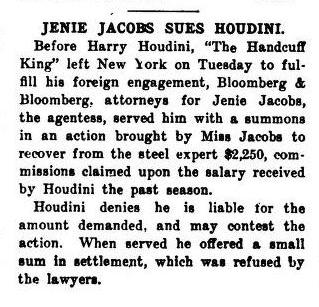
Variety, Aug. 22, 1908

It may be a testament to her skills of persuasion that she was able to reconcile with Houdini a few years later and once again act as his agent.*
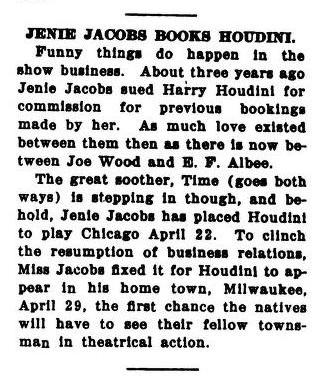
Variety, April 13, 1912

It speaks well of Houdini and Hardeen that in this male dominated age they entrusted their careers to a woman (and an apparent gay woman at that). But it's clear Jacobs had no problems asserting herself in a "mans world." She offered this advice to women:

"[This] is the particular warning I would like to hold up to women: not to let their own timidity and men's boldness bluff them into feeling that they are unable to carry on business on their own account. We must bluff a little too and keep awake."

In 1921 Jacobs launched a successful career as a theatrical producer, clocking several hits on Broadway. She also sued the all-powerful United Booking Office (UBO) for "oppression and discrimination." She continued to represent top talent, including Jack Benny, and soon branched into radio. In the 1930s she became closely affiliated with the RKO circuit. It's possible she may have again booked Hardeen at this time.

Jenie Jacobs died of cancer on February 21, 1933 at age 55. She is buried in Cypress Hills Cemetery in Brooklyn.


* UPDATE: I've since learned that Houdini and Jacobs settled their lawsuit for $1.

Related:

Saturday, June 6, 2020

This is C. Dundas Slater

Here's a rare photo of Charles Dundas Slater from the November 10, 1900 issue of The Era. Slater was the man who famously booked the shipwrecked Houdini into his Alhambra Theater in London in July 1900. The rest, as they say, is history.


A photo of Slater in 1911 appears in Patrick Culliton's Houdini The Key. But I've never seen an image of him at the time he gave Houdini his big break, so this is exciting. This photo accompanied a profile of Slater in The Era ("A Chat With Charles Dundas Slater") which praises him as "one of the most popular managers." The article also mentions Houdini who was due to return to the Alhambra after a successful tour of Germany. Slater is quoted as saying:

"Houdini is coming back to us with practically a new show, and will do his business in a more convincing way. He will dispense with the cabinet, and will do all his tricks with a small table."

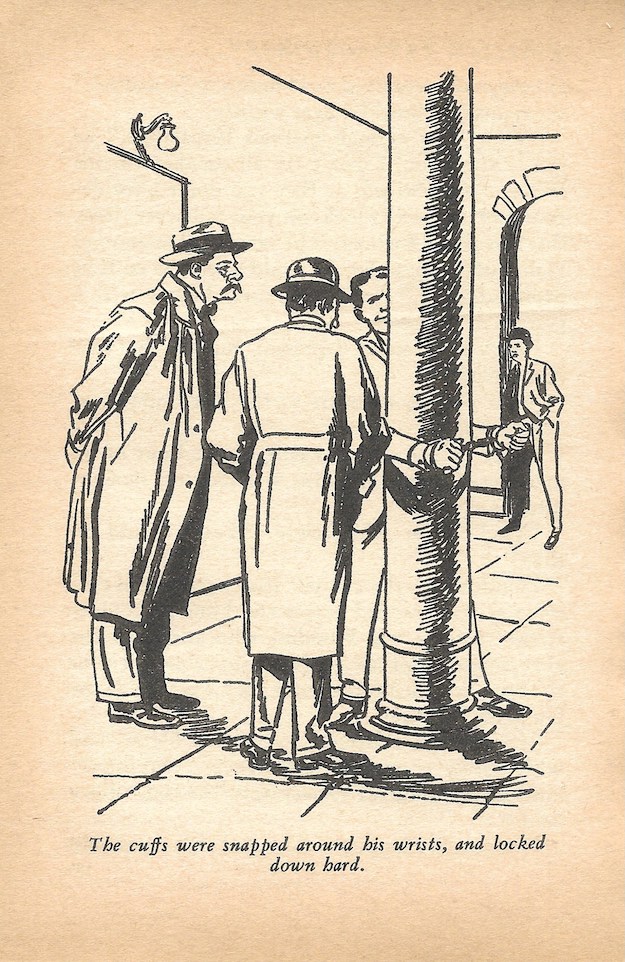
But Slater is probably most remembered for allegedly offering the young Houdini a bet that if he could free himself from Scotland Yard manacles he would book him at the Alhambra. The bet played out at the famous police headquarters with none other than Superintendent William Melville cuffing Houdini's arms around a pillar. Below is an illustration of that scene from The Great Houdini: Magician Extraordinary by Beryl Williams and Samuel Epstein. I'm presuming Slater is the man with his arms behind his back, which turns out to be a pretty good likeness!


For the record, I don't believe the story of the all-or-nothing bet, nor the fanciful version of events at Scotland Yard. But that's a topic I tackled HERE.

Slater was also portrayed on film by actor Clive Revill in The Great Houdinis (1976). Below is the Slater scene from the ABC biopic, which is a terrific bit of Houdini fiction in itself.


According to Wikipedia, C. Dundas Slater remained manager of Alhambra until 1907 (he had joined in 1898). He then managed the London Coliseum until ill health and failing eyesight affected his ability to work and he was dismissed on June 29, 1912.

On July 8, 1912, Slater ordered a taxi to drive him to Charing Cross Hospital. Whilst on the journey he shot himself in the head with a revolver.

The Bendigo Advertiser, July 13, 1912.

Related:
Translate