Last Saturday, I had the pleasure of touring the Palace Theater with the Los Angeles Historic Theater Foundation. Houdini appeared here in 1915 and 1923 when it was the Orpheum. It was here that he had his famous verbal fisticuffs with heavyweight champion Jess Willard. So this is a very historic Houdini theater! Today it is used primarily as a rental for movies and television, so getting a chance to not only see inside but also explore every part of the theater was an amazing opportunity. I could feel the spirit of Houdini in this amazing space.
The Orpheum was built in 1911 and remains very much the theater Houdini would have known. It's surprisingly shallow. But it was built for vaudeville before amplification, so the acoustics are such that someone on stage can be heard throughout the auditorium. This was the third Orpheum in Los Angeles (Houdini played the others in 1899 and 1907). It served the city until a new Orpheum was built down the street in 1926.
Los Angeles Evening Express, April 6, 1923.
One big change, which I learned about during the excellent presentation by LAHTF's David Saffer, is that the box seats that existed on both sides of the auditorium were removed when the theatre switched to all movies in 1929. They were replaced with two gigantic paintings by Los Angeles artist Anthony Heinsbergen. Jess Willard would have been sitting in one of those box seats.
While the boxes are gone, you can still see the outline of the doorway that led to the seats. This is where Willard would have slunk out as the audience of 2000 hissed him from the theater. Don't hit your head, Jess!
But it's where Houdini went after the performance that had me most excited. The star dressing room still survives! It's located just off stage right and up a flight of stairs. The other dressing rooms are located below the stage. This is a configuration I've not seen before, but I can appreciate the luxury of having a dressing room just steps from the stage and away from the other players, props, and animals.
The dressing room had a "Do Not Enter" sign on the door as work was being done inside. Fortunately, there was an open vent through which I could see inside. What appears to be the original sink survives. It also has a second connecting room. This is the largest star dressing room that I've yet seen in a theatre from Houdini's time.
An "A" above the door? Is this from Houdini's day? I'd like to think so.
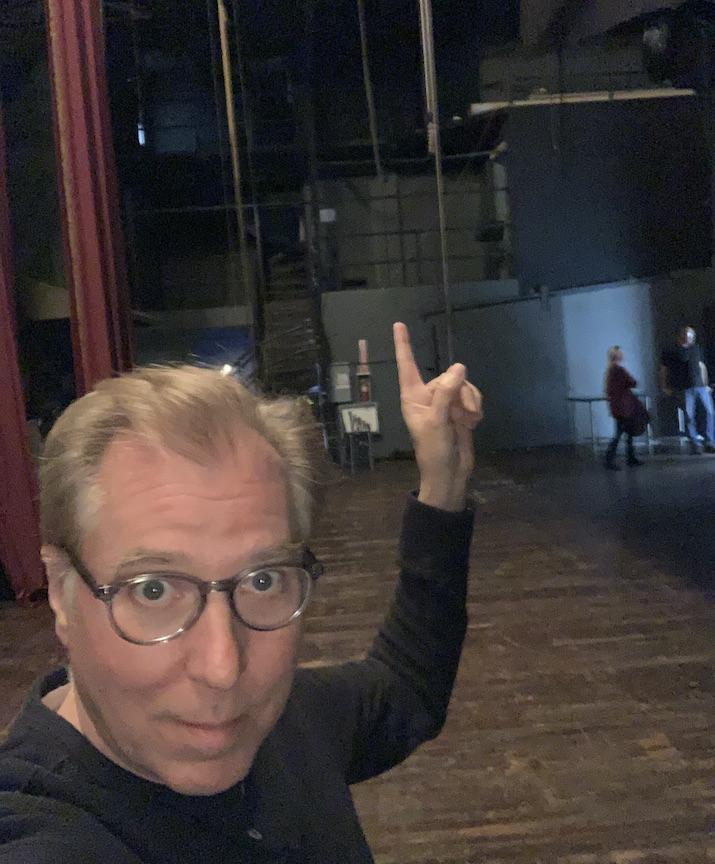
It's interesting to think that Houdini could have watched the other acts from just outside his dressing room. He had a great view. Thanks to fellow Houdini nut and artist Jenny Lerew for snapping this photo of me in Houdini's perch. You can check out Jenny's own photos on her Instagram @blackwingjen.
There was a lot more to see and learn. In fact, we spent three hours exploring the theater from top to bottom. I even wandered into a few places I later learned were off-limits. If you'd like to see more, I've uploaded a collection of 40+ photos to my Patreon below.
Thanks to the Los Angeles Historic Theater Foundation for this amazing day. The LAHFT regularly tours historic theaters and also offers talks via Zoom. Check out their website for more information and consider becoming a member.
Lastly, here's an unknown challenge from Houdini's 1915 Orpheum/Palace appearance.
Here's one that has me very excited. On Saturday, April 13, the Los Angeles Historic Theatre Foundation (LAHTF) will tour the Palace Theater in downtown Los Angeles. The Palace was originally called the Orpheum and is where Houdini performed in 1915 and 1923. It's also where he had his famous verbal joust with then-heavyweight champ Jess Willard. So this is a fantastic Houdini location!
LAHTF is thrilled to be returning to the Palace Theatre on Broadway for our signature ALL ABOUT tour. Join us for our first event of 2024 when we go behind-the-scenes from below stage to the projection booth above and everything in between.
I've twice missed out on LAHTF Palace events, so I'm thrilled to be jumping aboard this one. It will be my first time inside Houdini's L.A. Orpheum.
If you want to join the fun, you can purchase tickets via the LAHTF website.
Here's a nice video from Michael and Jessica of The Grimm Life Collective. Is this our first Houdini-Michael Jackson connection? I think so! Enjoy.
I appreciate this YouTuber's acknowledgment that there is a discrepancy in the date of the Jess Willard encounter. While every book says November 30, I've proposed it was actually November 29 (and made my case HERE). Happy to see I've broken through.
It worth noting that Houdini played this Los Angeles Orpheum again in 1923. No heavyweight champ takedowns that time, but I'm sure it was another...thriller.
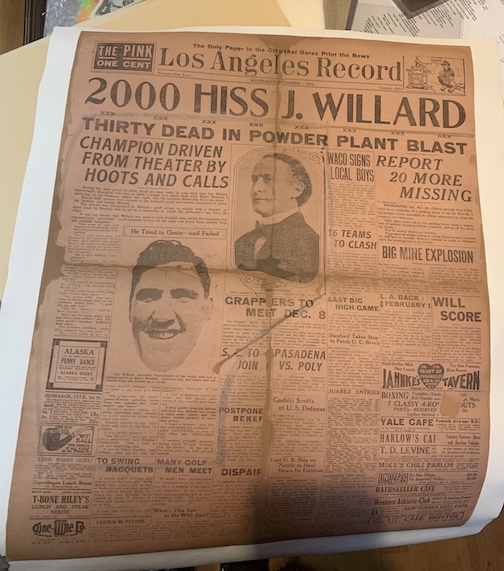
Following up on my recent post about re-dating the Houdini-Jess Willard encounter (to Nov. 29), Roger Dreyer of the Houdini Museum of New York sends over the pic of the original front page of the Los Angeles Record from his collection. I could not locate this issue while doing my research at the LA library, so this is a real treat. Look at that banner headline!
The Houdini Museum of New York has received a lot of media attention lately, due largely to their youthful new Director Rajon Lynch (RJ the Magician) who hails from Houdini's own Wisconsin. Check out the impressive profile of RJ and the museum in The New York Times. The story also includes an account of some strangeness that occurred during their own Halloween Houdini Seance.
Every biography tells the story of Houdini's contentious encounter with heavyweight champion Jess Willard at the Los Angeles Orpheum in 1915. The incident even opens the newest book, The Life and Afterlife of Harry Houdini by Joe Posnanski. And the date always given is November 30th.
But I recently found evidence that this actually took place on November 29th (Houdini's opening night). First and foremost are two reports from the Los Angeles Daily Times and the Long Beach Press (below), which are the earliest accounts of the incident that I'm aware of. Both ran on November 30th and both state that it happened "last night", which would be Monday the 29th. The Los Angeles Herald also ran a small blurb about it on the 30th.
Heck, just the existence of these disproves the November 30th date as these stories appeared before Houdini even took the stage that night.
Los Angeles Times and the Long Beach Press, Nov. 30, 1915.
There is also corroborating evidence from Willard himself. In a letter to the editor that the boxer penned to the Los Angeles Examiner giving his side of the story, Willard writes that it happened "Monday night." An account in the New York Tribune also identified it has having happened "Monday night."
So why does everyone cite Tuesday, November 30? I believe it's because everyone uses the Los Angeles Record as their source. This is the account that was widely syndicated and used in Variety. It also appears in Houdini's pitchbooks (below). As with the other stories, the Record states that it happened "last night." But the Record was late to the game, or maybe it took them a day to work up their more detailed account (likely with Houdini's input), and they did not publish until December 1st. This turned "last night" into November 30th and history was forever altered.
This wouldn't be the first time we've been fooled by a syndication dateline. I've discovered some papers would alter them, presumably to makes their reporting appear more current. One paper pushed the encounter to December 1st!
I'm continuing to seek evidence for and against this new date, but I feel confident enough to begin to using November 29, 1915 as the true date of the Houdini-Jess Willard encounter.
For years I've been trying to uncover details of Houdini's first suspended straitjacket escape in Los Angeles. While his 1923 escape is well represented in photos and newspaper clippings, his 1915 escape has proven strangely elusive. This would have been a major event with a massive crowd and snarled traffic, yet there's no mention of it in either the Los Angeles Times or the Herald. How could that be? If fact, the only clue that it ever happened at all is this short undated film clip:
This has been especially vexing as L.A. is my home and I've tasked myself with uncovering all the Houdini connections I can. I've actually been entertaining the idea that the above film is misidentified and there never was a 1915 Los Angeles escape. Maybe this is Oakland? We know Houdini did an escape there before coming to L.A.
But on a recent visit to the Magic Castle, librarian Joe Fox finally helped me crack the case. He showed me a flyer from the 1987 televised séance The Search For Houdini. Joe wondered if I had ever seen it. I told him had. In fact, I own one myself. But I haven't looked at it in years, so I popped it open anyway. There, much to my astonishment, was a paragraph about Houdini in Los Angeles with key details about the 1915 escape. As if to mock me, it referred to it as one of Houdini's "best documented" escapes. Needless to say, I went wild!
Armed now with information, I did some Internet research, but quickly discovered what I needed was not available online. For this one, I needed to go old school. So I traveled downtown to the Los Angeles Central Library's newspaper microfilm archive, and there I discovered gold!
Yes, the escape happened, and today I'm excited to share the full story along with some great unseen images.
Houdini's 1915 Los Angeles engagement began the week of November 29 at the Orpheum Theater on Broadway. It was his first appearance in Los Angeles in eight years. The Saturday before his arrival, the Los Angeles Tribune reported that he had been challenged to escape from the county jail by Sheriff John C. Cline. Houdini accepted the test for Tuesday morning, reportedly wiring: "Just out of Oakland jail; you can't put me in a cell I cannot open."
If this escape ever happened, I could find no evidence of it. Also, Houdini doing a jail break in 1915 is highly unusual. There's also no record of him doing an Oakland jail break. Instead, Houdini began the week by beating a packing crate built onstage by the shipping department of Hamburger's department store.
But then came a challenge that would take the form of a major outdoor stunt. The drama began on November 30 when Houdini appeared to take umbrage to a sentence in the Tribune's otherwise glowing review of his act. In discussing his Water Torture Cell, reviewer Monroe Lathrop noted:
But baffling as the trick is--for it must be such--across the footlights, it still gave the skeptics a chance to say that the wizard's prowess might show up less brilliantly if he were compelled to make his tests in the open, without the use of his specially constructed stage devices.
Houdini responded with a letter to the editor in the same issue:
Gentlemen--With all due respect, your review in the Morning Tribune today does me a great injustice. I assure you that every "trick" I do is on the square, and there is no collusion in any way; neither do I make my escapes by means of apparatus.
However, just to prove this to the satisfaction of your erudite critic, I am willing to perform for you, in public, away from the theater, and at such time as you may set–provided, of course, I have the permission the Orpheum, in whose contract this is provided–some trick that you may invent, select or devise.
By the end of the day, the paper had its challenge ready:
Houdini quickly accepted under the condition that firemen with a life net should be on hand in case of emergency. He told the paper, "I may not succeed in this experiment, but I'll make the effort of my life. I must say, the conditions are extreme, but then so will be the victory, provided I succeed." The date of the test was set for that Saturday, December 4th.
Of course, Houdini had developed the entire idea of the suspended straitjacket escape that same year and had already performed it in Kansas City, Minneapolis, Seattle, Portland, and Oakland. So it's obvious to us today what would not have been so obvious to the citizens of Los Angeles in 1915; that this was all a publicity stunt cooked up between Houdini and the Evening Express and Morning Tribune. One now understands why the competing newspapers chose to ignore it entirely.
But the other papers were not lacking Houdini headlines. Their pages were instead filled with reports about his wholly unplanned encounter with heavyweight champion Jess Willard during his opening night at the Orpheum (read: Houdini vs. the Pottawatomie Giant). Interestingly, no mention of the encounter appears in the Express or Tribune. They instead remained focused on their own Houdini grudge match with daily updates that built the suspense.
On December 2, the papers introduced two new players into the drama:
POLICE TO FASTEN WIZARD HOUDINI IN JACKET
Plans Complete for Actor's Attempted Escape in Front of Express Tribune Office
Two of the most expert criminal catchers and holders in the police department Detectives M. Thornberg and T.T. Toomey, sat in the Orpheum theater last night and sized up Houdini, the escape marvel. They are detailed by Chief Snively and Lieutenant Heath to put the aforesaid Houdini so securely into a police straitjacket that Houdini cannot get out of it. After seeing Houdini perform, the detectives still believe they can do it.
Thornberg and Toomey will call on Houdini Saturday forenoon at his hotel and search him. And it will be "some" search! Then they will escort him personally to the Express Tribune building, never letting him out of their sight for an instant.
When Houdini at the Orpheum was told that the police heads had assigned two special detectives to his "case" he smiled.
"Well," he declared, "I've had police chiefs try and stop me escaping, without success. I do not say that I'll escape this time, but I'll try, you may gamble on it."
The two detectives were taken to Houdini's dressing-rooms last night at the Orpheum and introduced to him. That was to give them an opportunity of "sizing him up" that they might know what manner of man they had to deal with; to get a line on his personality, as it were. After they left him they admitted that he looked like a "tough nut to crack." They were not discouraged, but all the more determined.
Meanwhile, preparations where being made at the ExpressTribune building itself, which stood at 719-721 S. Hill Street. This warranted its own story on December 3:
RIGGING FOR FEAT BY HOUDINI TO GO UP TODAY
Firemen to Erect Tackle at Express Tribune Building for Test Tomorrow
Promptly at 10 'oclock this morning the Pioneer Truck company will deliver at the Express Tribune building the rigging, block and tackle that will be erected under the supervision of Chief Eley's specially detailed firemen and from which, tomorrow at noon, Houdini, the Orpheum man of mystery, will be swung.
The object of putting it up today is twofold–that the public may see it and inspect it and that it may be thoroughly tested by the firemen, that no accident happen at the last minute. So, carefully, each rope, block and fall will be tried out and gone over by Chief Eley, with the permission of the board of fire commissioners. When they and the Pioneer Truck company under fireman's supervision have finished this job no one can doubt the thoroughness of the work. And when, from the end of the ropes Houdini dangles tomorrow, he need have no fear of anything giving way.
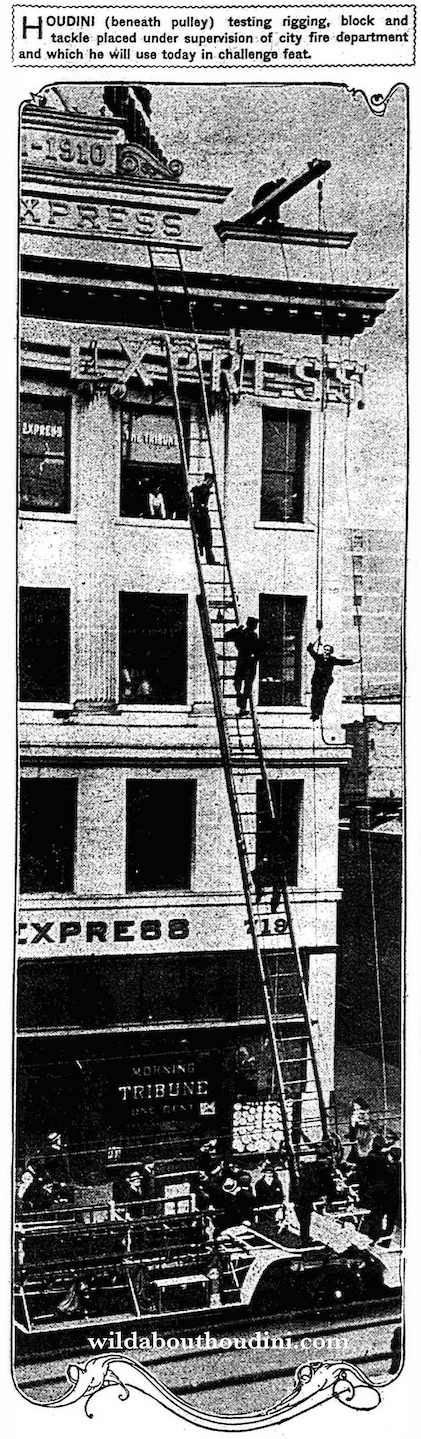
Of course, the more talk of safety precautions just reinforced the idea that danger existed and accidents can happen. Houdini himself arrived late in the day and made his own inspection along with the firemen. This drew a nice front page story and a terrific photo in the Tribune (below).
All that was left was the escape itself. Despite an overnight downpour, the stunt proceeded as planned on Saturday, December 4. Houdini arrived on the scene around noon. So did an estimated 25,000 to 35,000 spectators who filled Hill Street from Sixth to Ninth Street. Police on horseback halted all traffic into the area. The Express called it "the greatest street throng in the history of Los Angeles."
Newsreel cameramen were also on hand to record the action. In the surviving footage one can see Hardeen, who was performing at the Los Angeles Pantages this same week, assisting his brother. Maurice W. Clark, "the noted Oklahoma sporting man," acted as the official time keeper for the escape. Bess was also present.
Standing on a fire truck from the No. 7 company, Houdini was bound in a straitjacket by Thornberg and Toomey. At exactly 12:22 he was hoisted approximately 50 feet up. A photo shows that a large white sheet was hung on the side of the building directly behind Houdini. It's unclear if this was for safety reasons (Houdini had hit his head when he swung into the side of a building in Oakland), or to provide a backdrop so people could better see him doing the escape.
Houdini freed himself in two minutes and seven seconds. The papers reported this was "a minute less than he ever removed a similar shackle on the sound planking of the stage floor." The first thing he did on reaching the ground was to embrace and kiss Bess. For all the buildup, one can't help but wonder if the escape itself felt like an anticlimax, not unlike a much hyped championship bout that only lasts 30 seconds. But it didn't matter. Houdini had won.
Interestingly, Houdini would pen a letter that same day to his new friend Jack London in San Fransisco. In it he described his encounter with Jess Willard several days earlier. Hanging in a straitjacket 50 feet above the heads of 25,000 people was, apparently, business as usual and did not warrant a mention.
The next day both the Tribune and Express featured the escape on their front pages. In their account, the Express downgraded the crowd size to 15,000. The Tribune carried a spectacular five column photo of the escape, which you can see below. (And if you're wondering why there are swastikas on the page, know that in 1915 the symbol did not yet have its infamous association and, according to Wikipedia, was often used for ornamentation.)
Click to enlarge.
Houdini performed for another week at the Orpheum. He then moved on to Salt Lake City where film of his Los Angeles escape was shown before his act. He then repeated the feat in front of Salt Lake's Walker Bank Building.
It's not generally remembered that most of Houdini's outdoor stunts were presented as "challenges" coming either from the local police or newspaper. That's what makes the coverage of this particular escape so informative. It shows how Houdini crafted the story in cooperation with all the players, building suspense over the course of several days. For those who remembered Houdini doing such a stunt in their town, I suspect the memory was partly implanted because of the week long drama they experienced. This is what made Houdini, Houdini.
Having uncovered all these wonderful clippings in the L.A. Library (I guess it was one of his "best documented" escapes, if you read the right papers!), there was still one last thing left for me to do. I wanted to find the location of the escape today. Happily, my phone showed it was a mere 12 minute walk.
Today the site of the escape is a parking lot. The Express folded in 1919 and the building was demolished in 1935. None of the surrounding buildings visible in the film footage or newspaper photos appear to be the same. But the parking lot still carries the familiar address of 719 S. Hill Street.
So even though there's nothing recognizable left to see, one can still stand in this historic spot and imagine what it was like to watch Houdini do his first suspended straitjacket escape in Los Angeles on December 4, 1915. A mystery no more.
Thanks again to Joe Fox at the William Larsen Sr. Memorial Library. Also thanks to Athena Stamos for discovering The Express archive in the Los Angeles Central Library and introducing me to this amazing resource. Film clip comes from Kino's Houdini The Movie Star DVD.
This Saturday, January 27, you'll have an opportunity to go inside the Palace Theater in downtown Los Angeles as part of the annual "Night on Broadway" street festival. Why is that exciting? Because the Palace was originally the Orpheum Theater where Houdini performed in 1915 and 1923, and where he had his famous encounter with Jess Willard. The theater is normally shuttered, so this is a rare chance to see inside. Woot!
Night on Broadway is a free arts and music festival produced in celebration of Councilmember José Huizar’s Bringing Back Broadway economic development initiative. For more information visit the official website.
In 1946, Maurice Zolotow penned The Great Balsamo, a novel about a famous magician and escape artist. Even though the author states in his introduction that his character "is not a lightly doctored version of any famous magician," the similarities between Barney Balsamo and Harry Houdini are hard to escape.
First edition hardcover (1946).
The Great Balsamo was first published in hardcover by Random House in 1946. It later appeared as an abridged paperback edition from Pyramid in 1954. I admit I've never read the book cover to cover. I've only scanned it. But even a scan tells me that Houdini was first and foremost on Zolotow's mind, and that he intended Houdini to be on the mind of the reader as well. Consider his description of Barney Balsamo in the first chapter:
He was not of commanding height, but when be began to speak in a firm, harsh voice, ungrammatical, but pervaded with unanswerable conviction, he could project any illusion about himself which he wished.
At the high point of his fame, Balsamo was a stocky muscular person with a large round face, curly black hair, and eyes of a murky marbled grayness, that fixed you with an immobile translucency. You were unable to escape from the eyes. They captured you like and insect on a scientific pin. You were lost in the eyes, like round, superbly polished stones in a ring, cloudy chrysophrase stones. Before an interview or a stage appearance, he placed a few drops of belladonna in his eyes to heighten the staring intensity.
The similarities continue. Balsamo, who doesn’t drink or smoke, performs with his wife Lami as The Balsamos. Their signature trick is the substitution trunk. When times get hard, they do a spiritualistic mind reading act that uses a word/number code. Zolotow spells out their code on pages 184-185 in a way that is very reminiscent of how the first Houdini biography, Houdini His Life Story by Harold Kellock, spelled out Harry and Bessie's own secret code.
In fact, it's pretty clear that Zolotow used the Kellock biography as a source in ways that border plagiarism. Compare these two passages from Kellock and Zolotow:
Houdini His Life Story (page 90):
Toward the end of the week he came home one evening with a whole packing-box for the fire. It was so complete that he obviously hated to break it up, and before tackling it he sat for a long time staring at it. At last, with a sigh, he began to wrench it apart.
"Bess," he said, "I have a new idea for a packing-box escape. I think I can get out without using a trick box. I'll work it out some day, and it will help make us famous.
In this curious fashion the idea of his famous packing-case escape had it's inception.
The Great Balsamo (page 207-206):
Lami could not help giggling when she saw what an absurd figure he made hauling the crate. It was the first time he had ever secured a box in such unbroken condition. He seemed to be reluctant to break it up and throw it into the stove. For a long time he stared at the box, and thumped its sides, examining the way the slates were nailed together. Finally, he began to dismantle the box.
"Lami," he said, thoughtfully, "I have a new idea for a packing-box escape. I think I can get out without using a trick box. I think I know a way where I can get a committee of carpenters to come on stage and build a box right on stage and nail me into it and I can escape and still leave the box it its original condition.
This was the germ of Balsamo's celebrated packing-box escape...
The similarities continue. Advised by vaudeville manager Sam Blitzer to focus on handcuffs escape, Balsamo hits it big as "The Handcuff King and Jail-Breaker." He travels to Europe and escapes handcuffs at Scotland Yard -- yes, his hands are locked around a pillar -- and experiences his own Hodgson-like challenge. (Both these sections again lift whole passages from Kellock). Back in the U.S., Balsamo performs suspended straitjacket escapes, vanishes an elephant, and is devastated by the death of his mother. In the end, Balsamo dies in an overboard box escape gone wrong.
Abridged paperback (1954).
The Great Balsamo is peppered with mentions of classic era magicians such as Thurston, Blackstone, T. Nelson Downs, and Horace Goldin. Zolotow also identifies S.W. Erdnase as being Edward Samuel Andrews. The name "Houdini" is conspicuously absent until near the end of the book when he warrants one quick mention (his photo is named among others on the wall of a magic shop).
It's also worth noting that Houdini himself used the name "The Marvelous Balsoma" for a fictional magician in his short story, "The Magician's Christmas Eve." Houdini was no doubt drawing the name from Cagliostro, who also happens to be a hero to Barney Balsamo.
So there's no question Zolotow is offering is a veiled portrait of Houdini in The Great Balsamo. However, it's not always a flattering one. Consider this passage near the end of the novel:
"Balsamo, growing older, resembled Cagliostro more and Balsamo less. In both, cunning and evil had gradually come to dominate and corrupt the physiognomy."
So who was Maurice Zolotow and what were his feelings toward Houdini?
Born in 1913, Maurice Zolotow was a prolific show business biographer. He penned the first biography of Marilyn Monroe, as well as biographies of John Wayne and Billy Wilder. He was also a magic buff who claimed to have seen Houdini perform at Coney Island. Later in life, he became friends with magician Ricky Jay.
In his psychological study, Houdini A Mind in Chains (1976), author Bernard C. Meyer (father of Houdini miniseries screenwriter Nicholas Meyer) repeatedly references Zolotow and Balsamo, stating, "it is clear that in fashioning the erotic aspect of his novel, Zolotow drew freely upon elements in Houdini's past."
Indeed, the erotic aspect of Houdini's life appears to have fascinated Maurice Zolotow. It was Zolotow who famously said, "Houdini loved only two women, his mother and Daisy White." (In Balsamo, Daisy is Myra Wilcox.) I don't know this for a fact, but I suspect Zolotow might have also influenced Melville Shavelson's 1976 biopic, The Great Houdinis.
In October 1979, Zolotow wrote a profile of Houdini for Los Angeles Magazine. It's surprisingly negative. He starts with an account of the Jess Willard confrontation and concludes: "All of Houdini's biographers relate this and similar stories about him, as if to prove what a heroic guy he was. To me, it suggests he was an arrogant bastard."
Zolotow goes on to quote conversations with Dai Vernon, a Houdini hater of the first order, which might account for the article's negative tone. And despite excellent sources, such as Manny Weltman, the article contains several factual errors.
Zolotow's Los Angeles Magazine profile of Houdini (1979).
In the same issue, Zolotow provided a short article about "The Houdini Gary Gilmore Connection" in which he spells out the claim by murderer Gary Gilmore that he was the illegitimate grandson of the famous magician. So it's clear Zolotow liked to dish dirt on Houdini.
Maurice Zolotow died on March 14, 1991.
The Great Balsamo stands as a curiosity. It's not a great novel, nor does it really work as a "veiled" Houdini biography. The real Houdini and his life remians just so much more compelling than any fictional version. But I still think it's an interesting book and a worthy addition to any Houdini bookshelf.
Other selections from the WILD ABOUT HARRY bookshelf:
Boxing has been given its worst black eye here to-day by none other than Jess Willard, heavy-weight champion who was so badly worsted to a wordy clash with Harry Houdini, a performer at the Orpheum Theater, last night, that the audience hissed him from the house.
- Los Angeles Record
It was 100 years ago this week that Houdini had his famous encounter with heavyweight champion Jess Willard at the Los Angeles Orpheum Theater. But this battle was not with fists or even handcuffs. It was an unscripted verbal joust that, in today's parlance, went viral.
Houdini had just begun a two week engagement at the Los Angeles Orpheum (which still exists today). On the night of November 29*, 1915, Jess Willard was in the audience. Standing 6' 7" and weighing 256 pounds, Willard was known as the Pottawatomie Giant. He had knocked out heavyweight champ Jack Johnson in the 26th round of a bout in Havana to win the title in April of that year.
During his performance, Houdini called for a volunteer committee to step on-stage during an escape (the Water Torture Cell?). After several men volunteered, Houdini came to the footlights and said, "Now I need three more gentlemen on this stage and there is a man here to-night who doesn't know I'm aware of his presence. He will be enough for three ordinary gentlemen if he will serve on this committee. He is Jess Willard, our champion." The audience broke into applause.
But Willard did not leave his seat. Instead he called out, "Awm g'wan with your act. I paid for my seats here." When Houdini tried to persuade him, Willard cut him off, barking: "Give me the same wages you pay those other fellows and I'll come down."
With the audience now uncomfortably quite, Houdini answered, "Sir, I will gladly do so. Come on down––I pay these men nothing." He then may have baited the boxer by adding, "Don't crawfish."
Willard got to his feet and roared, "Aw' g'wan with the show!" He then added insults which the Los Angeles Record reported sounded like "four-flusher" and "faker."
Willard's response jarred the audience from their silence. Some began to hiss. Houdini quieted them. By his own account, he was "white with rage." He then said to Willard:
"Look here, you. I don't care how big you are or who you are. I paid you a compliment when I asked you to be one of my committee. You have the right to refuse, but you have no right to slur my reputation... let me tell you one thing, and don't forget this, that I will be Harry Houdini when you are NOT the heavyweight champion of the world."
A great wave of applause erupted. Willard attempted a response, but was drowned out by "hoots and groans." Houdini delivered a final blow by turning to the audience and saying, "I made a mistake. I asked for GENTLEMEN to step on this stage and GENTLEMEN only."
The audience again roared their approval, during which Willard left the theater.
The incident at the Orpheum captured the imagination of the city. The front page of the Los Angeles Record was headlined: 2,000 HISS J. WILLARD. The story was picked up nationally, with the Washington Times reporting: CHAMPION WILLARD HOOTED BY CALIFORNIANS.
Three days later, on December 3, Willard tried to defend himself in an open letter to the Los Angeles Examiner, which he called "the one fair paper in Los Angeles." Refusing to acknowledge Houdini by name, he referred to his act as "moth-eaten" and stated:
When I declined to come down to the stage, this should have settled the matter and the stage "hero" should have gone about his work. The only reason in the world he "worked up a scene" was because he knew my name would be a boost for him.
The newspapers continued to hound Willard who eventually left town ("Driven out" the papers reported). Houdini gleefully wrote to his sister, Gladys, that he was now greeted in the streets with, "Hello Champion" and "How is the Champion today?" Even a local business got into the act by taking out an advertisement playing on the encounter:
In Houdini!!! The Career of Ehrich Weiss, biographer Kenneth Silverman offers up a different perspective on Willard's actions that night. He speculates:
Willard's grumbling may have been nothing more than a cover for stage fright. Although he had once killed another fighter, Bull Young, in the ring, he was known to have a peaceable disposition and to be embarrassed by his awesome size. Some even thought he lacked fighting spirit.
But Houdini expert Patrick Culliton speculates that Willard's words might have been more offensive than "four-flusher." Patrick thinks he might have hurled an anti-Semitic slur across the theater. In interviews, Willard expressed views consistent with white supremacy. This might help explain the intensity of the reaction against Willard.
Willard promised to turn the matter over to his attorney, Earl Rogers, saying, "I do not believe the laws of California permit of a theatrical management signaling out a patron for the abuse that I have had to stand." But there appears to have been no legal action taken. Houdini himself delighted in the avalanche of free publicity. "I have received at least a million dollars advertising space from this fray," he told his sister.
Jess Willard lost the heavyweight title to Jack Dempsey in 1919 in one of the most severe beatings ever in a championship bout. In 1923, at age 41, he made a surprise comeback by defeating Floyd Johnson at the newly opened Yankee Stadium. After being knocked out by Luis Ángel Firpo that same year, he retired.
* UPDATE: Many sources identify the date of this encounter as November 30, but I have found compelling evidence to support November 29 as the true date.
Welcome to another year of being WILD ABOUT HARRY! When a new year turns over, I always like to think about where Houdini was in his own life and career 100 years ago. So let's kick off 2015 with a look back at what Houdini was up to in 1915.
This post is now retired.
But you will still be able to enjoy the story of Houdini in 1915 with the publication of my upcoming book.
Here's another one for those in town this week for the Los Angeles Conference on Magic History. If you are Houdini location hunting downtown, you might be excited to discover the Orpheum Theater on Broadway with full marquee and towering sign still atop the building. Of course, it was at the Los Angeles Orpheum where Houdini had his famous verbal joust with Jess Willard in 1915. But keep those cameras holstered, because you're in the wrong place!
The Orpheum Theater at 842 South Broadway was actually built in 1926. The historic Orpheum from Houdini's era is located a few blocks away at 630 South Broadway and is now called the Palace Theater. This was the site of Houdini's encounter with the heavyweight boxing champ.
Houdini actually performed in three different L.A. Orpheum theaters during his career. In 1899 he performed at the Grand Opera House at 110 S. Main St., which was the theater the Orpheum circuit used at the time. In 1903, Orpheum built their own theater at 227 S. Spring St. It was here that Houdini performed in 1907. That theater become Fischer's Lyceum in 1911 when Orpheum moved into their spectacular new theater at 630 South Broadway.
This was Orpheum's home during the Golden Age of Vaudeville. It not only saw performances by Houdini (in 1915 and 1923) but also Al Jolson, Sarah Bernhardt, the Marx Brothers, W.C Fields and Will Rogers. It was renamed The Palace in 1926 when the fourth and final Orpheum was built down the street. Today it is the oldest of the remaining Orpheum theaters in the United States.
While the first two Orpheum theaters are long gone, the Palace/Orpheum still stands. You can even still see read the Orpheum name on the facade. Today it is a rental space for film shoots and live venues.
Below are photos I took on November 3, 2013. The lobby was gated off on this day, but the good news is the theater occasionally allows tours. I will be watching for the next tour and hopefully bring you photos of the stage where Houdini bested the Champ.
Thanks to Patrick Culliton for guiding me via cellphone down Broadway to Houdini's correct Orpheum. For more on the Palace Theater visit the official website.
The Pottawatomie Giant and Other Stories is a collection of short fiction by Andy Duncan that includes a story about Houdini and heavyweight champ, Jess Willard. According to The Crimson White, Duncan recently attended a book signing, saying:
"[My inspiration was] a paragraph in the biography of Harry Houdini about him being involved with the former heavyweight champion Jess Willard, who was once very famous until he was defeated by Jack Johnson, but now is only known as a footnote to two famous men. I wanted to tell his story, but since I didn’t know it, I made it up instead."
The Pottawatomie Giant and Other Stories came out in February, but I only now just discovered it along with this photo of the author holding the book. You can see it has a nice illustration of Houdini and Willard on the back (click to enlarge).
Unfortunately, The Pottawatomie Giant and Other Stories is a little tricky to find (at a reasonable price). There is a listing on Amazon, but it's currently out of stock. In addition to the hardcover, there appears to have been a limited edition of 200 signed cloth bound copies.
Not long ago I did a post about Houdini's famous clash with boxing champion Jess Willard at the Los Angeles Orpheum in 1915. Now our friend Dean Carnegie of Carnegie: Magic Detective has uncovered this terrific advert that takes full advantage of the incident. I don't know. Think Houdini might have had something to do with this ad?
Dean has been on fire lately finding vintage Houdini ads and newspaper stores. Check out his lastest post, Houdini's Challenging Time in Trenton, which offers a terrific day by day account of Houdini's performances in Trenton, NJ, in 1912.
Every Houdini biography contains the story of how, in 1915, Houdini traded verbal blows with heavyweight champion Jess Willard from the stage of the Los Angeles Orpheum. Hearing that Willard was in attendance, Houdini invited him onstage to be part of his committee. Willard refused, calling Houdini as a "faker." The verbal battle went back and forth until Houdini delivered the knockout line: "I will be Harry Houdini when you are not the heavyweight champion of the world." (A wire release reported that he said, "I'll be in the spotlight when you are in the discard.")
CLICK TO ENLARGE
The audience of nearly 2000 sided with Houdini, and Willard left the theater, reportedly to boos and hisses. The papers also sided with Houdini, especially the Los Angeles Record, keeping the story alive for days until Willard left town. Houdini wrote gleefully to his sister Gladys that when he now walks down the street he's greeted with, "Hello champ."
I don't know. I've never been a big fan of this story. I don't think it shows Houdini in his best light. He had the advantage over a member of his audience and he certainly pressed it. In Houdini!!! The Career of Ehrich Weiss, author Ken Silverman says Willard's bluster that night might well have been a cover for stage-fright -- that outside the ring Willard was self-conscious about his enormous 6 ft. 6 1/2 in. size. I don't know much about Jess Willard, but it seems he not only found himself on the wrong side of Houdini that November day in 1915, but also the wrong side of an emerging media machine. What we would call a "media backlash" today. Also, history has only recorded Houdini's side of the story.
Now, thanks to The Culliton Papers, we can hear Willard's side. This letter he wrote to the Los Angeles Examiner on December 3, 1915 has never been transcribed or quoted (as far as I could find) in any Houdini biography. It's a pretty good counterpunch, and despite calling Houdini's act "moth-eaten" (kind of funny), it's hard to not sympathize with Willard's point about how, as paying customer, he was "entitled to decent treatment."
Willard also shows a pretty crafty understanding of media himself by not using Houdini's name in his letter, thus not giving Houdini the publicity Willard claims was the real intent behind this episode (and certainly Houdini openly boasted he'd received "at least a million dollars advertising space from this fray"). Ironically, not using Houdini's name also makes this letter hard to find via modern keyword searches, so Willard's side of the story has been lost to history. Until now.
By the way, I was surprised to learn that Jess Willard lived until 1968! But this article in the Examiner seems to be the last time he spoke publicly of his encounter with Houdini.
UPDATE: Make sure you click in and read Patrick Culliton's own comments on this. Did Willard use an anti-Semitic slur against Houdini that night that went unreported in the papers? If so, that certainly explains why Houdini and the audience turned on him as they did. Very interesting notion. Thank you, Pat!
This weekend I will post the first installment of my special series, The Culliton Papers. This first story might come as a surprise to those who think we are just Houdini's cheerleaders here at WILD ABOUT HARRY, as we'll climb back into the ring and take: "Willard's side."
The Columbus Dispatch reports that Joe Rollino - who is said to have been friends with Harry Houdini - died Monday after being hit by a car near his home in Brooklyn. He was 104.
During his storied life, Rollino not only hobnobbed with Houdini, but also watched Jack Dempsey knock out Jess Willard and was friendly with Mario Lanza. He even had a bit part in On the Waterfront.
A decorated World War II veteran, Rollino got his start as a strongman in the 1920s during the high point of the Coney Island carnival, and he billed himself as the "Strongest Man in the World." At one point, he could lift 3200 pounds.
He later made a living as a traveling boxer under the name Kid Dundee and fought in armories in cities around the country where boxing was forbidden.
Rollino would have been 105 on March 19, and was the model of health, according to friends. A vegetarian for life, he didn't drink or smoke, his friends said, and he exercised every day. He was a lifetime boxer and was part of the Oldetime Barbell and Strongmen, an organization of men who can still rip book binders at the seam.