This post is now retired. But you will be able to enjoy the story of Houdini in 1905 in my upcoming book.
- Home
- Life
- Escapes
- Magic
- Movies
- Houdini's Movies
- Les merveilleux exploits de Houdini à Paris (1909)
- The Master Mystery (1918)
- The Grim Game (1919)
- Terror Island (1920)
- The Man From Beyond (1922)
- Haldane of the Secret Service (1923)
- Velvet Fingers (1925-26)
- Medium Well Done (1937)
- Religious Racketeers (1938)
- Houdini Picture Corp.
- Film Developing Corp.
- Filming locations
- Unmade Movies
- Deconstructing Houdini '53
- Spiritualism
- People
- Beatrice Houdini
- Theo Hardeen
- Cecelia Weiss
- Mayer Samuel Weiss
- Jim Collins
- Franz Kukol
- Martin Beck
- Sir Arthur Conan Doyle
- Margery
- J. Gordon Whitehead
- Edward Saint
- Jacob Hyman
- Leopold Weiss
- Carrie Gladys Weiss
- Bernard M.L. Ernst
- Charmian London
- Jess Willard
- H.P. Lovecraft
- Sherlock Holmes
- Assistants
- Imitators
- Other magicians
- Media
- Full Bibliography
- By Houdini
- Biography
- Fiction
- Foreign
- For Kids
- Methods
- Wild About Harry Bookshelf
- Houdini His Life Story (1928)
- Houdini The Man Who Walked Through Walls (1959)
- Houdini The Untold Story (1969)
- The Life and Many Deaths of Harry Houdini (1993)
- Houdini!!! The Career of Ehrich Weiss (1996)
- The Secret Life of Houdini (2006)
- The Metamorphosis: The Apprenticeship of Harry Houdini (2012)
- The Witch of Lime Street (2015)
- The Life and Afterlife of Harry Houdini (2019)
Showing posts with label Boudini. Show all posts
Thursday, April 25, 2019
Houdini in 1905
For Houdini, the year 1905 was split into two distinct halves. The first half saw him as an established superstar in Europe. But the second half found him back in America, where in some ways he had to prove himself all over again. It was a fascinating transitional year, and one of his most combative.
Thursday, September 20, 2018
Houdini vs. Boudini: The forgotten challenge
This is an encore post from November 16, 2010 (one of my very first posts here on WILD ABOUT HARRY). I thought this was worth a revisit as today marks the 113th anniversary of the Houdini-Boudini challenge.
One of the more curious and obscure episodes in Houdini's early career was his encounter with rival escape artist, Jacques Boudini. Many cast skepticism on this "challenge," suspecting the entire thing was staged, and it very well could have been. Houdini was not above staging such encounters for publicity, and the fact that the newspaper men on the scene didn't entirely buy it could explain why Houdini never retold this story or featured it in pitchbooks, the way he boasted of besting other rivals like Cirnoc and Kleppini.
It was Milbourne Christopher who brought this episode back to life in his 1969 biography, Houdini The Untold Story
. In 2006's The Secret Life of Houdini
, authors Kalush and Sloman also relate the event, adding that Boudini was a "pupil" of Houdini's gone rogue. (They also note this is the earliest record of Houdini releasing himself from shackles while underwater.) Patrick Culliton tells me he "nursed a theory for years" that Jacques Boudini was actually Jacob Hyman, Houdini's first partner in the Brothers Houdini. But Pat surrendered this theory when he finally uncovered a photograph of Houdini and Boudini, which is reproduced in his book, Houdini The Key. [Update: He now believes Boudini may have been Leonard Hicks.]
One of my first forays into independent research (when I was 16) was to use the clues in Christopher to search the microfilm archives at Cal State University Northridge for an account of this event. What I found was this terrific article from the New York Times dated September 21, 1905 (which mistakenly calls him Bondini). I've transcribed it below so we can all relive this forgotten challenge exactly as it happened back in the day. It's Houdini vs. Boudini (or Bondini). Enjoy!
![]() |
| Houdini and Boudini. From Houdini The Key by Patrick Culliton. |
It was Milbourne Christopher who brought this episode back to life in his 1969 biography, Houdini The Untold Story
One of my first forays into independent research (when I was 16) was to use the clues in Christopher to search the microfilm archives at Cal State University Northridge for an account of this event. What I found was this terrific article from the New York Times dated September 21, 1905 (which mistakenly calls him Bondini). I've transcribed it below so we can all relive this forgotten challenge exactly as it happened back in the day. It's Houdini vs. Boudini (or Bondini). Enjoy!
New York Times
September 21, 1905
A SHACKLE BREAKING MATCH UNDER WATER
Contestants Dived 30 Feet with Wrists and Ankles BoundONE WAS NEARLY DROWNEDA Case of Professional Jealousy Between Houdini and Bondini, the Press Agent Says – Houdini Won.Landlubbers with fertile brains encroached upon the field of the marine yarn spinners yesterday with a performance that transcended anything they had ever thought of. The performance was real enough while it lasted, two minutes and forty seconds. In those two minutes and forty seconds it looked as though Jacques Bondini, who had gone down to the bottom of the harbor, (the bottom was thirty feet down,) was likely not only to break the literal shackles which bound him, but the shackles of life as well.
The performance needs further explanation. Those who witnessed it were still explaining at midnight, with no satisfactory solution in sight. The facts are these:
Harry Houdini, the "sensational perplexer and mysteriarch," professional shackle and handcuff breaker, had made a wager with Jacques Bondini that he could break manacles from his hands and ankles quicker than he. Houdini has been abroad startling Kings with his performances of handcuff breaking and making them wonder what to do next with their criminals. When recently Houdini returned to this country he found that Bondini, his erstwhile pupil, was usurping his field here. That's the story as the press agent tells it. At all events Houdini challenged Bondini to a shackle-breaking match under water. The victor was to get $500.
A group of newspaper men and artists went to Atlantic Basin on the tug Fred B. Dalzell to see the performance. The Captain of the tug is John Gannon, and the contestants made him referee.
In the Basin Capt. Gannon tied fast to a float.
The two shackle-breaking artists stripped for the contest. Houdini wore tights under his clothing. Bondini did not.
Both men were shackled in five minutes. Hand and ankle cuffs were fastened about the arms and ankles of both. Then ropes were fastened about their waists and they were lowered into the water.
There was a silence as thick as a fog aboard the Dalzell. It lasted one minute and thirty seconds, but that seemed an eternity to the watchers. Then a head appeared above the waves. It was that of Houdini. He spat out brine for a second and shouted:
"Is Bondini up yet?"
"No!" chorused the crowd on deck.
Houdini stuck his hands above water to show that he had freed them of the shackles and disappeared again.
A minute later the head of Bondini appeared above the water. He looked gloomy, and it was obvious that he was not having any luck. He was down again in a minute.
In another minute and ten seconds the head of Houdini appeared.
"Is Bondini up yet?" he asked.
The answer was discouraging, so far as Bondini was concerned, but encouraging for Houdini. Houdini went down a third time, but not until he had stuck one foot above water to show that he had unfastened his ankle bracelets, too.
Houdini came to the surface again in a minute and motioned to be pulled up on deck. Then the men holding the rope to which Bondini was tied got busy.
More dead than alive, he was hauled on board. He had to be rolled and rubbed before he came to. He had failed to unfasten either the handcuffs or the ankle bracelets.
"I swallowed some water," was only explanation.
The Dalzell then steamed back to the Battery. The principals went to 40 Greenwich Street, where it was said the money would be turned over to Houdini. Nobody saw it, but the press agent said he would surely get the $500.
The question which the skeptical were asking last night was:
"Was Bondini merely a dummy intended to show off the skill of Houdini?"
Nobody answered except the press agent.
"The real thing," said he.
Want more? You can view a second photo from the Houdini-Boudini matchup as a "Scholar" member of my Patreon.
UPDATE: Boudini is Back!
Tuesday, February 20, 2018
Houdini at the Colonial
There are several Manhattan theaters linked to Houdini history: the Hippodrome, the Palace, the Times Square, and Tony Pastor's. But you'll rarely hear the Colonial mentioned among these, even though it played a significant, but now largely forgotten, role in Houdini's career. So let's tell the story!
After Houdini played his first successful season on the Keith and Orpheum vaudeville circuits in 1899 and early 1900, he went to Europe. The plan was for him to stay for six months, and then return with a boosted reputation that came with a European tour. But he was so successful that he remained in Europe for a remarkable five years. In his absence, a proliferation of "Handcuffs Kings" sprung up in his place. In 1905, Houdini resolved to come home and conquer America. But after so many years, would America be interested in, or even remember, the original Handcuff King?
The Philadelphia Inquirer Sun reported his return on August 20, 1905:
It's no surprise to see Keith's mentioned here. Houdini's former manager Martin Beck was partnered with B.F. Keith, and their Keith-Orpheum circuit defined big time American vaudeville. So which of the many Keith's theaters would usher in Houdini's triumphant return? Surprisingly, none.
Instead, Houdini decided to play his first dates at the independently owned Colonial Theater on 1887 Broadway near 62nd Street in New York City. The Colonial was a new theater to Broadway. It had opened on February 8, 1905, and was designed in the style of a Victorian London music hall. It was creation of Fred Thompson and Elmer Dundy, the same duo behind the Hippodrome and Coney Island's Luna Park. But within two months of its opening, Thompson and Dundy sold the theater to Percy Williams, who dropped the "Music Hall" theme and ran it as a straight vaudeville house. It was Williams who landed Houdini's return.
The theater proudly promoted this "Important Engagement."
In the week proceeding his U.S. opening, Houdini made two PR stumbles. An attempt to expose rival Handcuff King, Cunning, in a Harlem theater, had led to a brawl and the arrest of Hardeen. The press sided with Cunning against the "foreign looking" interlopers. Houdini then challenged another rival, Boudini, to an underwater handcuff escape contest off Battery Park. But the few New York papers that covered the contest smelled a set-up and reported as much. So Houdini was not going into his Colonial engagement riding a wave a of glowing press, and the theater itself was not known for giving performers a break.
In Houdini The Man Who Walked Through Walls, William Lindsay Gresham described the Colonial and its reputation:
On opening night, according to Gresham, Houdini marched out onstage to the stirring Kaiser Frederic March "his chin held in, his gray-blue eyes staring directly ahead." He performed a straitjacket escape and then accepted handcuff challenges. This was basically the same act he had performed five years early on Broadway when Bess became disastrously stuck in the Metamorphosis trunk. A repeat of that certainly would have brought on the "Colonial clap." But Houdini's act, honed in Europe, delivered.
On October 8, 1905, the New York Tribune reported:
For his second week, the Colonial billing dropped "Harry" and featured him as just HOUDINI.
Following his second successful week, Houdini set out on the Keith-Orpheum circuit. His escape from the United States Jail in January 1906 firmly established him as an American superstar. It does not appear he ever played the Colonial again. [See UPDATE.]
In 1912, B.F. Keith took over the theater, altering its name to Keith's Colonial Theatre. When E.F. Albee took over from Keith five years later, it became the New Colonial Theatre. In 1923, a show at the New Colonial called Runnin' Wild introduced the dance craze called the Charleston to America.
In 1932, RKO took over the theater and began showing movies. NBC purchased it in 1956 and converted it into one of their New York television studios (Show of Shows was taped here). A decade later, ABC used the Colonial studio mainly for taping game shows.
The last owner was Rebecca Harkness, who in 1971 sunk $5 million into renovating the theatre for her ballet company (it went broke after one season). There were a few Broadway bookings in the mid-1970s, after which the building was sold off to a developer and demolished in 1977.
Today the location of the Colonial is a condominium tower with a public atrium (the David Rubinstein Atrium at Lincoln Center). Certainly this is now a worthy stop on any tour of Houdini's New York; the site of Houdini's triumphant U.S. return.
UPDATE: I recently came upon this letter of thanks Houdini published in the October 14, 1905 issue of the New York Clipper following his Colonial engagement.
Related:
After Houdini played his first successful season on the Keith and Orpheum vaudeville circuits in 1899 and early 1900, he went to Europe. The plan was for him to stay for six months, and then return with a boosted reputation that came with a European tour. But he was so successful that he remained in Europe for a remarkable five years. In his absence, a proliferation of "Handcuffs Kings" sprung up in his place. In 1905, Houdini resolved to come home and conquer America. But after so many years, would America be interested in, or even remember, the original Handcuff King?
The Philadelphia Inquirer Sun reported his return on August 20, 1905:
Harry Houdini, "the Handcuff King," who returned from Europe three weeks ago, had decided to accept the extremely liberal offers made him by American vaudeville managers. He will rest until October 1, when he will begin his American vaudeville tour. Houdini releases himself from handcuffs, leg shackles, etc. This wonderful performance will be seen at Keith's during the winter season.
It's no surprise to see Keith's mentioned here. Houdini's former manager Martin Beck was partnered with B.F. Keith, and their Keith-Orpheum circuit defined big time American vaudeville. So which of the many Keith's theaters would usher in Houdini's triumphant return? Surprisingly, none.
Instead, Houdini decided to play his first dates at the independently owned Colonial Theater on 1887 Broadway near 62nd Street in New York City. The Colonial was a new theater to Broadway. It had opened on February 8, 1905, and was designed in the style of a Victorian London music hall. It was creation of Fred Thompson and Elmer Dundy, the same duo behind the Hippodrome and Coney Island's Luna Park. But within two months of its opening, Thompson and Dundy sold the theater to Percy Williams, who dropped the "Music Hall" theme and ran it as a straight vaudeville house. It was Williams who landed Houdini's return.
The theater proudly promoted this "Important Engagement."
In the week proceeding his U.S. opening, Houdini made two PR stumbles. An attempt to expose rival Handcuff King, Cunning, in a Harlem theater, had led to a brawl and the arrest of Hardeen. The press sided with Cunning against the "foreign looking" interlopers. Houdini then challenged another rival, Boudini, to an underwater handcuff escape contest off Battery Park. But the few New York papers that covered the contest smelled a set-up and reported as much. So Houdini was not going into his Colonial engagement riding a wave a of glowing press, and the theater itself was not known for giving performers a break.
In Houdini The Man Who Walked Through Walls, William Lindsay Gresham described the Colonial and its reputation:
In one way, it was the toughest spot in town. Although vaudeville, growing respectable, had lured the family trade, there were rough elements in Little Old New York who de- lighted in rattling the performers and, if antagonized, doing everything short of ripping up the seats. Monday matinee at the Colonial was a nightmare to vaudevillians, even those who could "josh" a music hall audience into a good humor. At this lush palace of entertainment was born a tactic of audience-displeasure which has persisted to the present day at ball parks and fight arenas—the "Colonial clap." This was applause de- signed to rattle and "break up" the actors onstage by its maddening, mocking rhythm: clap, clap, clap-clap-clap.
On opening night, according to Gresham, Houdini marched out onstage to the stirring Kaiser Frederic March "his chin held in, his gray-blue eyes staring directly ahead." He performed a straitjacket escape and then accepted handcuff challenges. This was basically the same act he had performed five years early on Broadway when Bess became disastrously stuck in the Metamorphosis trunk. A repeat of that certainly would have brought on the "Colonial clap." But Houdini's act, honed in Europe, delivered.
On October 8, 1905, the New York Tribune reported:
So successful had Harry Houdini, the "Handcuff King," proved as a magnet art the Colonial Theater during the week just closed that Percey Williams has retained the lock picking specialist as the headliner of the Colonial bill for another week. Challenged as he is at every performance by spectators skeptical of the legitimacy of his feats of handcuff elusion, Houdini has thus far in every instance succeeded in escaping from the manacles, shackles and other locks with which volunteers have sought to imprison him.
For his second week, the Colonial billing dropped "Harry" and featured him as just HOUDINI.
Following his second successful week, Houdini set out on the Keith-Orpheum circuit. His escape from the United States Jail in January 1906 firmly established him as an American superstar. It does not appear he ever played the Colonial again. [See UPDATE.]
In 1912, B.F. Keith took over the theater, altering its name to Keith's Colonial Theatre. When E.F. Albee took over from Keith five years later, it became the New Colonial Theatre. In 1923, a show at the New Colonial called Runnin' Wild introduced the dance craze called the Charleston to America.
The last owner was Rebecca Harkness, who in 1971 sunk $5 million into renovating the theatre for her ballet company (it went broke after one season). There were a few Broadway bookings in the mid-1970s, after which the building was sold off to a developer and demolished in 1977.
Today the location of the Colonial is a condominium tower with a public atrium (the David Rubinstein Atrium at Lincoln Center). Certainly this is now a worthy stop on any tour of Houdini's New York; the site of Houdini's triumphant U.S. return.
UPDATE: I recently came upon this letter of thanks Houdini published in the October 14, 1905 issue of the New York Clipper following his Colonial engagement.
UPDATE: I've just discovered Houdini again played the Colonial during the week of April 15, 1907.
Related:
Monday, October 2, 2017
It's "Houdini Month" at The Magic Detective
Our great friend Dean Carnegie is having a month long celebration of Houdini on his blog The Magic Detective. Dean kicks off "Houdini Month" today with a post revealing a hitherto unknown method Houdini is said to have used for his jail escapes. This was sometime Hattie Mooser passed onto Steve Baker, who passed it on to Dean under the condition that it not be revealed until after Steve's death. Baker passed away last month, and today Dean spills the beans!
So click to learn Houdini - An Escape Revelation, and stay tuned for much more from The Magic Detective.
UPDATE: Below are the ongoing "Houdini Month" posts from Dean:
Sunday, July 2, 2017
Wild in Houdini's New York, 2017
Saturday, June 17
The last time I visited New York was in 2005. In fact, some of the Houdini sites I visited on that trip -- the Shelton, Houdini's boyhood home -- made up my very first blog posts. This was a long overdue return.
While not technically a Houdini site, while dashing to my connecting flight (which I missed), I had to stop and snap of photo of this biplane hanging in the Denver International Airport. I believe it's a "Jenny" as seen in Houdini's The Grim Game.
I touched down in New York City in the early evening. After a little dinner, I rested up for what I knew would be a big day to come. How right I was.
Sunday, June 18
It was around 11:30am that I hit the subway and zipped into Harlem, landing on Houdini's front door a half hour before the official open house. The entire area had dramatically improved since my 2005 visit, and it was improved even then. I expect that's why a house that could barely be given away in the 1970s is now on the market for a cool $4.6 million.
Again, I covered my adventure inside 278 at length HERE. But in that post I didn't mention all the friends and Houdini luminaries who attended the open house. First and foremost was the great Fred Pittella and his girlfriend Linda, whom I would spend the rest of the day with. Barry Spector shared my early tour of the upper floors. Houdini graphic novelist C.E.L. Welsh arrived for a look. Our own Perry from New Jersey stopped by. Actor Alec Mathieson helped solve a bookcase mystery. It was a thrill to meet the great magician Steve Cohen. Also there for the duration was The Witch of Lime Street author David Jaher. And the very nice Tímea Sánta was there on behalf of her husband who penned a Houdini play. Needless to say, we all took turns posing by the Houdini bookcase! I again have to give a monumental thanks to Beverley Draggon and Detria Davu of Douglas Elliman Real Estate who are handling the sale of the house and allowed us all to run wild!
I lingered until the last possible moment while Fred Pittella waited patiently in his car. I then joined Fred, Linda, and David Jaher as we traveled to the next great place of Houdini pilgrimage, his grave in Queens. Along the way we talked non-stop about our experience in the house and Houdini in general. David was also able to fill us in on the progress with the movie version of The Witch of Lime Street, for which he has just delivered the screenplay.
Despite rain in the forecast, the day turned out to be beautiful, and we arrived at the cemetery around 4:00 pm. There waiting for us was the wonderful Colleen Bak, "our girl in Queens." Finally meeting Colleen in person was a tremendous pleasure; always nice to meet someone as genuinely wild about Harry as I. Colleen knows Machpelah well, and she had warned us that the cemetery might be closed at this hour. When we arrived, the gates were indeed closed, but the lock was hanging mysteriously open. Colleen said this was very strange; she had never seen anything like this before. Thanks Harry!
When I last visited the grave in 2005 it was missing the famous bust. But now the bust has been replaced by our friends Dorothy Dietrich and Dick Brookz of the Houdini Museum in Scranton. On this day there were more than a few lipstick marks on the bust's cheek. Yeah, Harry's still got it.
The exedra was recently power washed by the Society of American Magicians who also did some restoration on the mosaic. Houdini's actual headstone was, as always, covered with rocks and trinkets left behind by visitors. I have mixed feelings about this. On one hand, I love that there is such clear evidence that Houdini is remembered and so many people feel compelled to leave behind a tribute. But I fear some of the items, such as coins and metal objects (there was a Hot Wheels on it today) leave behind rust stains and are doing damage. And playing cards, a favorite, quickly fade and just become garbage.
But even covered with rocks, it's powerful to take a moment at the headstone and think that a mere six feet away lies the mortal remains of Harry Houdini himself. Blows my mind, in fact.
During my last visit, the cemetery's abandoned administration building was still in place. This was finally torn down in 2013. This has created a much different, much more tranquil atmosphere. It's a big improvement. It also hit me how dramatically Houdini's plot stands out from the sea of graves. It's not just the bright white bust, but also the design of the exedra (by Houdini himself) that makes it strikingly unique. If Houdini wanted to be noticed, mission accomplished.
The four of us then walked a short ways into the cemetery and paid our respects to Larry Weeks, whose headstone reads "Houdini's Biggest Fan." It struck me that no visit to Machpelah will be complete without also stopping by Larry's grave, if for no other reason than to see this inscription. Just as he wished, Larry Weeks has joined Houdini in eternity.
Saying our goodbyes to Harry and the family (hey, who is "Grandma" and how is it that she's buried in America?), it was time to eat. We convinced Colleen to join us (okay, we kinda kidnapped her) and off we went to Houdini's Kitchen Laboratory located not far from the cemetery in Ridgewood. The pizza was delicious and we treated ourselves to some cold beers on a nice open patio. The decor wasn't as Houdini-centric as I would have liked. Fred said Houdini used to adorn the menu, but that has changed. But there was a King of Cards poster at the entrance, so that satisfied me. (My new pet peeve are businesses that use Houdini's name without providing any kind of a link back to the man himself. I'm looking at you Houdini Kitchenware.)
We then climbed back into the car and traveled a short distance to Fred's house to have a look at his collection. Fred has the definitive collection of material related to Houdini imitators. His house is filled with colorful posters of escapists like Brindamour, Steens, and Nicola. Fred said he had sold a large part of his Houdini collection a few years ago, but he has since added back a few items. A few?
Fred opened a door to a entire room jam-packed with Houdini treasures; photos, posters, handcuffs and books. Many images of Houdini (and Bessie) I had never seen. Fred then pulled out several huge portfolios packed with Houdini material. There was so much we couldn't even get through it all. One page after another blew my mind. There was one very intriguing photo of Houdini dancing in the street with Gladys Leslie before floodlights and a large crowd. Possibly while filming Haldane of the Secret Service? Or at the premiere maybe? On another page was a letter written by Houdini at the Princess Theater in Montreal on October 22, 1926. Yes, the very day he was punched by Whitehead. Holy smokes.
Fred also owns some truly important pieces of original Houdini apparatus. He showed us Houdini's own pair of Bean Giant Handcuffs, cleverly modified to be "Handcuff King Beaters." He also has the famous pair of mini handcuffs that Houdini made for his dog Bobby (how did I not take a pic of those?). And just when I felt like it couldn't get any more spectacular, Fred pulled out what must be one of the most unusual Houdini props in existence. It's a gigantic spirit trumpet, complete with the custom made box that it traveled in. What could this giant trumpet have been used for? Was it oversized for demonstration purposes? Or maybe it was used for a moment of humor during the 3rd act of the 3 Shows in One. I can recall no mention of a giant spirit trumpet, but there's no doubt that it was part of Houdini's show. Let the search commence!
Just when I thought we has seen it all (what could trump that trumpet?), Fred pulled out the original table and bowl Houdini used in his famous Whirlwind of Colors routine. Yes, this was the effect that Houdini famously couldn't complete during his final show and Jim Collins had to finish it for him. Now here I was with that very bowl in my very own hands! Unfortunately, all the photos I took revealed the secret, so I can't share them here. Magician's Code!
With my head still swimming, Fred returned us all to our respective homes. There have only been a few days in my life that I felt I actually hit Houdini overload. This was one of those rare, and glorious, days.
Monday, June 19
It was another beautiful day in New York, yet I spent the entire morning inside, hunched over the floor plans and photos of 278, trying to puzzle out all I had seen the day before. By 1:00 pm, I felt satisfied with my work, so I fired back out into the city to another exciting Houdini destination that I for many years I've longed to visit, the Houdini Museum of New York at Fantasma Magic.
I thought I was already pretty familiar with the museum's content from Neil McNally's terrific two-part interview with owner Roger Dreyer that he guest blogged for us HERE. But I still found myself blown away. Not only have there been notable additions, but here again were some amazing images of Houdini that I had never seen before. One remarkable shot shows him standing on a platform behind an early film camera. I believe this was taken in 1915 during his visit to Hollywood when he appears to have caught the movie bug. What a image!
Unfortunately, Roger Dreyer was not in town. When I talked to him later, he told me he wished he could have been there because he would have shown me his private office "where all the best stuff is." Well, I can't imagine anything better than what I saw in the display cases out front. In fact, you can expect some deep dives into some of the things I saw at the museum (future headline: "Houdini's secret secret").
The Houdini Museum is not far from Times Square, so I decided to go check out the Times Square Theater where, in April 1922, Houdini played The Man From Beyond and revived his vanishing elephant. It was reported a few years back that the surviving theater would be restored, but I've not heard anything since. Much to my surprise, the theater is still shuttered. But in one way this is good as you can still clearly see the theater as it was in Houdini's day.
I stood and drank in the sight, trying to teleport myself back to 1922. But it suddenly struck me that I wasn't quite as excited about this Houdini landmark as I once would have been. Yesterday I was in his bathroom for crying out loud! Did my 278 experience ruin me to this kind of thing?
Pushing on, I entered Times Square itself, where on November 5, 1917 Houdini performed his first suspended straitjacket escape in the city. Today Times Square is a sea of electronic billboards that cover the facade of every building, so there's really nothing recognizable from Houdini's time. Still, Houdini hung here.
I also went and checked out the Palace Theater, built by Martin Beck and where Houdini played on several occasions. The building is now so completely concealed behind towering advertisements for Sunset Blvd. that a photo seemed pointless. I then took shelter in a bar behind the theater as the city was swept by a sudden cloudburst. Harry crying for his lost New York maybe? Probably not.
Tuesday, June 20
It was time to head home, but I still had the morning free to hit one last Houdini site. It was such a beautiful day, that I decided to head to Battery Park, site of Houdini's 1914 overboard box escape (also the Houdini-Boudini challenge, which may have been his first open air stunt in New York City).
The only real clue I had to the location of the escape -- or at least the spot where the tugboat launched as the escape was actually performed off the Battery -- was the newspaper advertisement that alerted the public to gather "near the aquarium." Well, there's no longer an aquarium, nor was there a good match for the building seen in the photos. But there was an old fort, Castle Clinton, that seemed to be in the right spot. I did some looking around and I discovered that, in 1914, this was the aquarium, but it had been restored back into the original fortress in modern times.
But what was even more revelatory is that this building was used to process newly arriving immigrants form 1855 to 1890. This means it's very likely that the Weiss family was processed here in 1878 instead of Ellis Island as might be assumed. So I went in search of a Houdini historical site and found two!
One wonders if the memory (or awareness) of this spot as his entry point into the U.S. ran through Houdini's mind as he did his escape here in front of 15,000 cheering New Yorkers. Talk about a journey. Walking along the seafront, I noticed the Battery has a nice view of the Statue of Liberty. Too bad that none of the existing photos of the escape capture the monument in the background.
I had some fun showing park rangers at Castle Clinton the photos of Houdini's escape and the mobbed Battery. For whatever reason, this is not one of Houdini's better documented escapes, and no one I spoke to knew about the Houdini connection. But they do now, and my hope is that they might share this tidbit with tourists. If so, my work is done.
Thus ended my New York Houdini adventure for 2017. There was still much I didn't see; Bess's grave in Hawthorne, the site of Tony Pastors Theater, Payson Ave., Leo Weiss's apartment, and Houdini's New Jersey Film Lab. But those adventures I'll save for my next visit.
UPDATE: Wild in Houdini's New York (2018).
Related:
Wednesday, April 23, 2014
Alan Davies brings us Houdini in 2014
What I love about Houdini documentaries is not so much what they can tell me about Houdini (they tend to only skim the surface), but that they capture the world of Houdini at the time they are made. This is certainly the case with The Magic of Houdini with Alan Davies, which aired on ITV in the UK on Easter Sunday.
The hour long documentary, produced for ITV by What Larks!, was extremely well-done. It did not tell Houdini's story in the familiar form of most docs. It was more of an essay by Davies, a popular UK comedian and magic buff, who traveled to several Houdini locations in the UK and U.S. Davies emphasized Houdini's drive, physicality, and daring, and really captured Houdini's appeal and superstardom in an exciting and even sexy way. Considering Davies reputation (and some of the pre-promotional material), I was expecting something more comedic and maybe a bit mocking. But this is one of the most reverential Houdini documentaries ever made.
But, as I said, what I love most about docs is how they capture the Houdini world and personalities of the time, and Davies does a great job showing us Houdini in 2014. It's a world that will be familiar to readers of this blog.
![]() |
| Host Alan Davies at Mrs. Leffler's boarding house in New York. |
Davies first travels to New York City where he visits Mrs. Leffler's (or Loeffler) boarding house on East 79th Street (remarkably unchanged); Coney Island, which Davies credits as the source of Ehrich's fascination with show business (hmmm); and the Houdini Museum of New York, where he chats with owner and Houdini collector, Roger Dreyer. Roger has some fun challenging Davies to escape from a pair of Bean Giant handcuffs, even after he gives him the key (just as Houdini would do with rival Handcuff Kings).
Following Houdini to Europe, Davies visits the recently renovated Hippodrome Casino in London, site of Houdini's famous 1904 Mirror Challenge. While Master Locksmith Mick Hanzlik doesn't appear on screen, his beautiful replica Mirror Handcuffs do, and it was interesting to see the cuffs fully opened (Davies "escapes" from them).
![]() |
| With Houdini collector Kevin Connolly. |
A real treat was the appearance of Houdini collector Kevin Connolly which I believe is Kevin's first on-camera appearance. Kevin shared with Davies his collection of letters that suggest Houdini was considering a monkey gland transplant operation late in life. This certainly captured the imagination of Davies who, again, seemed especially interested in the physical Houdini.
Another very special appearance was by Richard Sherry and Dayle Krall and their amazing Water Torture Cell replica. Dayle even performs the escape on camera. I especially like how Dayle was able to provide first-hand insight into the escape. She talks about the pain of being raised by the ankles, how hard it is to capture a final breath when hanging upside down, and how the water pressure is noticeably increased when one reaches the bottom of the cell. She even says she's broken bloods vessels in her eyes while doing the escape (one wonders how many times this happened to Houdini).
| Dayle Krall in the Water Torture Cell. |
For most, the highlight of the show will be Davies' visit to David Copperfield's private museum in Las Vegas. It's noted that Copperfield "now owns over two-thirds of all surviving Houdini artifacts." Here we get a good look at Copperfield's beautifully displayed Houdini collection, and he even plays his Houdini voice recording for Davies. The hardcore will recognize it as the alternate, unedited version that isn't available online. But I think my favorite part of the Las Vegas segment was when Davies observed that Vegas is the Coney Island of its time, and that "all the showman and magicians and illusionists here today, they know they are standing on the shoulders of a tiny Hungarian."
Davies ends his journey at a staged Official Houdini Séance with several familiar faces in attendance, including 93-year-old Larry Weeks, a lifelong Houdini fan and collector (he owns the only copy of The Grim Game). Larry talks about how he saw Houdini when he was 4-years-old. It's a moving moment as Larry expresses his feelings about Houdini emotionally and beautifully, and I think I have to agree with Alan Davies that Larry was "the star of the show."
![]() |
| Larry Weeks. |
Of course, a few errors crept in, as can be expected. Davies refers to Bess as Bess Raymond (her stage name) instead of Rahner. He says "Heffler" instead of Leffler. He says Houdini arrived in London in 1904 (it was 1900). Ruth Brandon says Houdini "never had any education, he never went to school," which is wrong. Houdini went to school in Appleton, possibly as far as the 4th grade. Ken Silverman quotes Houdini's famous bridge jump diary entry as "Mom saw me do it" instead of "Ma saw me jump" (a quibble, I know). Davies calls Jacques Boudini, "Bondini" -- but it was a treat to have this obscure challenge mentioned at all. Davies also says Houdini was punched by one of the two fans who came backstage to see him. It was, of course, a later third visitor who delivered the punch.
Unfortunately, the documentary crew didn't make it as far as the West Coast (the production company told me this was originally part of the plan, but the budget wouldn't allow it), because there's certainly a world of Houdini to capture out here. But maybe next time.
All in all, The Magic of Houdini with Alan Davies is a worthy and welcome addition to the collection of Houdini documentaries, and a beautiful time capsule of Houdini in 2014. Here's hoping the show airs here in the U.S. or it becomes available on DVD soon.
![]() |
| In the Copperfield Collection. |
Special thanks to the helpful Houdini fan who was able to provide me with a copy of this doc for review.
- Houdini's NYC boyhood home today
- First look inside the new Houdini Museum of New York
- Guest Blog: The Replica Mirror Cuffs
- Houdini vs. Boudini: The forgotten challenge
- Sherry and Krall reveal working Water Torture Cell replica
- Was Houdini considering a monkey gland transplant operation?
- Hear 30 seconds of the alternate Houdini voice recording
- ITV announces The Magic of Houdini with Alan Davies
Sunday, January 8, 2012
LINK: Boudini Unmasked?
Patrick Cullition, who does not believe for a second that Jacques Boudini was a legitimate rival to Houdini as I suggested here, has posted on his website the man he now believes played the role of "Boudini" for Harry.
Click on the headline to have a look. Pat has also posted the full length photo of Houdini and Boudini in their irons. I have to admit, his candidate does look a lot like Boudini. Hmmm...
Friday, December 16, 2011
Boudini is back!
In 1905 Houdini and a rival escape artist, Jacques Boudini, had an underwater "shackle breaking match" in New York harbor. This is not one of Houdini better known encounters, and newspapers at the time, as well as magic historians today, smelled a rat. Was this a staged "challenge" to showcase Houdini's skill over a "rival"? Was Boudini a hired stooge? The outcome of the challenge certainly favored Houdini, as Boudini not only failed to escape his cuffs, but was nearly drowned.
Now the tireless Dean Carnegie over at Carnegie: Magic Detective has uncovered a remarkable page of theatrical ads from a 1907 Boston Journal that features Houdini, Thurston, The Keatons (Buster's parents), and, incredibly, Boudini! This is two years after the challenge and strongly suggests that Boudini -- and the underwater match -- was on the level.
We see in this ad that Boudini is still dogging Houdini, and even stealing the wording from Houdini's own advert: "Nobody Can Hold Him." Also, "Never Anything Like It in Boston" is a pretty aggressive statement, considering Houdini is playing his second week in the city.
Would setting Boudini up at a rival theater with this aggressive billing benefit Houdini in any way? It's true that Houdini would sometimes plant a rival act in another theatre to expose handcuff tricks, but Boudini is doing the challenge escape act ("All Challenges Accepted"), which was still relatively new in 1907 and near and dear enough to Houdini that he even forbid his brother Hardeen from accepting challenges (for a time).
I'm thinking Dean (who has been on fire lately finding amazing old Houdini newspaper clippings and photos -- like this) has given us solid evidence that Jacques Boudini was the real deal and a legitimate pain in Houdini's backside.
Click here to read the full newspaper account of the Houdini-Boudini underwater challenge.
![]() |
| Courtesy Carnegie: Magic Detective |
Now the tireless Dean Carnegie over at Carnegie: Magic Detective has uncovered a remarkable page of theatrical ads from a 1907 Boston Journal that features Houdini, Thurston, The Keatons (Buster's parents), and, incredibly, Boudini! This is two years after the challenge and strongly suggests that Boudini -- and the underwater match -- was on the level.
We see in this ad that Boudini is still dogging Houdini, and even stealing the wording from Houdini's own advert: "Nobody Can Hold Him." Also, "Never Anything Like It in Boston" is a pretty aggressive statement, considering Houdini is playing his second week in the city.
Would setting Boudini up at a rival theater with this aggressive billing benefit Houdini in any way? It's true that Houdini would sometimes plant a rival act in another theatre to expose handcuff tricks, but Boudini is doing the challenge escape act ("All Challenges Accepted"), which was still relatively new in 1907 and near and dear enough to Houdini that he even forbid his brother Hardeen from accepting challenges (for a time).
I'm thinking Dean (who has been on fire lately finding amazing old Houdini newspaper clippings and photos -- like this) has given us solid evidence that Jacques Boudini was the real deal and a legitimate pain in Houdini's backside.
Click here to read the full newspaper account of the Houdini-Boudini underwater challenge.
Sunday, October 31, 2010
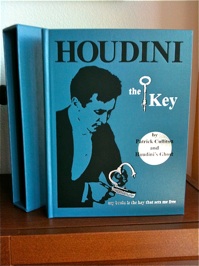
'HOUDINI THE KEY' HAS ARRIVED
What better day than Halloween to announce the publication of HOUDINI - THE KEY, Patrick Culliton’s major new book which reveals many of Houdini’s most closely guarded secrets.I’ve just picked up my copy (#25) and I can tell you the book is a stunner! It’s a mammoth 460 pages, profusely illustrated, and comes in an attractive slipcase. There are many photos I’ve never seen, including a rare shot of Houdini and Boudini in their challenge shackles and bathing suits, and sequential stills from rarely seen footage of Houdini performing the Thumb Racket. Also revealed, in photos, are the working methods of Metamorphosis, the Milk Can, and the Water Torture Cell.
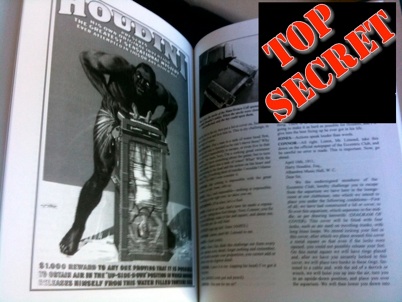
Says Patrick, “I wanted to write a textbook on how Houdini did it, a book that would open a thousand doors.”
Patrick will start shipping the book tomorrow to those who have pre-ordered. The release is limited to only 278 copies (with a majority already sold out).
If you act quickly you can still get a copy of Houdini - The Key for $195 + $12 shipping. Visit Houdini's Ghost for details on how to order.
![]() |
| The secret of the Water Torture Cell REVEALED! |
Subscribe to:
Posts (Atom)