Showing posts with label Stamp. Show all posts

Friday, November 29, 2024

Hungary issues an official Houdini stamp


The Hungarian postal service Magyar Posta revealed their new Houdini stamp at The House of Houdini in Budapest, Hungary, today. The stamp commemorates the 150th anniversary of Houdini's birth. The stamp has a face value of HUF 1,270 and was produced in conjunction with The House of Houdini and David Merlini, based on the work of Tamás Ajtai and Barnabás Baticz. The stamp folds open to reveal an image of Houdini. The inside image even includes a hidden lock that is visible under UV light. 


I think this stamp looks fantastic, and I'm thrilled to see Houdini honored in his home country. You can purchase the stamp HERE.


Congratulations to Magyar Posta and The House of Houdini!


Photo courtesy Artin Diramerján and The House of Houdini. You can see more photos from today's event on my Patreon.

Related:

Sunday, June 21, 2020

Mystifier, Fall 2002

Continuing my issue by issue look back at the Mystifier, the newsletter of the Houdini Historical Center that ran from 1991-2003.


The Fall 2002 Mystifier celebrates the coming of the U.S. Postal Service's First Class Houdini stamp. This was a personal triumph for the HHC and Sidney Radner who had lobbied long and hard for this recognition. The newsletter contains photos and a report from the HHCs own dedication ceremony on July 5. For the occasion, Wisconsin-based escape artist Mike Schroeder performed a suspended straitjacket escape.

The newsletter continues with news of a second big event; the unveiling of John Gaughan's restored Water Torture Cell. The cell was displayed at the Center for Jewish History in New York from July 3 to August 5. The newsletter includes a photo of John with the USD, which for many was probably their first look at the restoration. It also has a Q&A with John. Below is a sampling:

Mystifier: Did you understand the mechanism in the Water Torture Cell before you began?
JG: I had reworked the Water Torture Cell in 1991. If I had not had that opportunity, it would have been impossible to restore the Water Torture Cell at all. I needed to be familiar with the whole piece since it was so totally destroyed in the fire. There were only fragments remaining of the original piece. 
Mystifier: What was the most difficult part of the project? 
JG: To be faithful to the original design. Not to cut corners but to use exact materials and methods of the original. The restoration used rare Honduras mahogany with a ribbon pattern, just as in the original. I used lap joints in the construction, as in the original to allow for the expansion and contraction that would occur when it was filled with water.

The newsletter continues with the sad news of the death of Ronald J. Hilgert, HHC member and author of Houdini Comes to America (1996). The museum shop announces new items related to the Houdini stamp, such a first day covers and pins. Recent donors are listed along with the staff of the HHC, which we now see is headed by Executive Director Terry Bergen who will prove controversial.

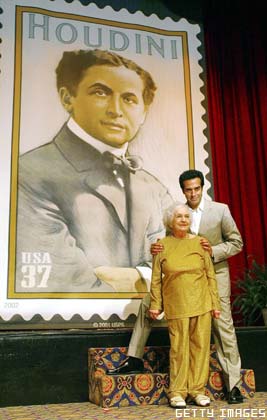
In his regular "Backstage" column, Sid (sporting a new column photo) talks about the HHC stamp event and the restored Water Torture Cell. He expresses disappointment that he was not invited to the official unveiling of the stamp in New York City. That ceremony featured David Copperfield (in a suit matching the one we see Houdini wearing in the stamp image) and Marie Blood. But Sid deems the Appleton ceremony as being the "much more impressive stamp dedication" and points out that it was covered by four TV stations.

Finally, it's worth pointing out that this issue introduces a few stylistic changes. No longer are the Contents listed on the cover. The font size is also increased (actually, the font sizes and styles are wildly inconsistent). This would also prove to be the last Mystifier printed in two colors.

Mystifier
Volume 12, Number 3
Fall 2002
6 pages

Contents:
U.S, Postal Service Recognizes Houdini!
The Water Torture Cell is Reborn!
R.I.P. Ronald J. Hilgert
Museum Shop News
Backstage with Sid Radner


Related:

Tuesday, June 2, 2020

Mystifier, Summer 2002

Continuing my issue by issue look back at the Mystifier, the newsletter of the Houdini Historical Center that ran from 1991-2003.


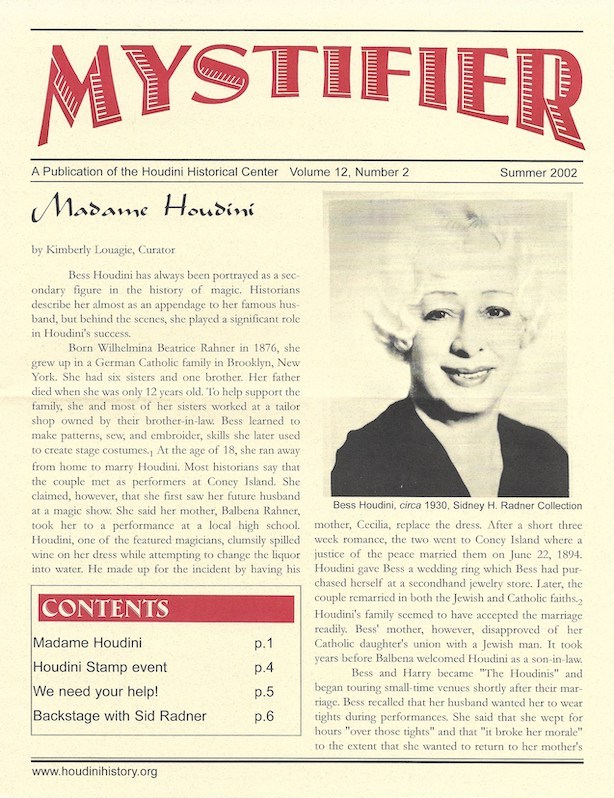
The Summer 2002 Mystifier features a lengthy profile of Bess aka "Madame Houdini" by HHC curator Kimberly Louagie. It contains mostly known information, but a gem is the reproduction in full of a letter Bess wrote to Hardeen on April 21, 1911. Letters written by Bess during Houdini's lifetime are uncommon, so this is something special. It's written to Dash in secret after Harry and his brother appear to have had a fight. I'm taking the liberty of reproducing it here:

    My dear Bro. Dash,
        Just heard that you were not coming over here, and the reason why. Now Dash, please do come over and if Harry does not pay the difference I will. Harry does not know I'm writing this. Now I want to tell you why he is sore. You know we are playing all the towns that you played, and of course there are plenty of guys always ready to tell H. about your challenges and what you did, and H. told me you had promised not to do challenges etc. Of course he is sore now, but I am sure if he sees you he'll forget all about it. Harry is working to death, he looks so old, he's quite gray and I am afraid he is over doing it all. Now please Dash come over. I'm looking forward with pleasure of seeing Elsie and Baby Harry, but I hope you will come with them, and I am ready to help to keep my word about paying the difference (you know I have a bank account). Please let me know at once if you come.
         I am as ever your loving sister Bess.

Following the Bess piece is a plea to "Friends of Houdini" for donations to the HHC by Executive Director JoEllen Wollangk. There are also details of a special party on July 5, 2002 to celebrate the upcoming Houdini stamp.

Page five contains another rare treat. It's a facsimile reproduction of an Oath of Secrecy signed by Houdini assistant John Boyd on May 7, 1913. I admit John Boyd is a new name to me.

Sid Radner's photo is omitted from his "Backstage" column this time. Sid discusses the above oath and how oaths such as these are why one doesn't read exposures from Houdini's assistants. Sid again claims all published accounts of how Houdini did his Water Torture Cell are incorrect. He then says something very intriguing regarding the Mirror handcuffs:

At the present time the secret of the London Daily Illustrated Mirror Handcuff escape is still unknown to the public. I know the answer but I am not convinced that revealing the secret serves any good purpose.

What exaclty did Sid know???

Sid finishes by saying he has been in touch with a newly discovered member of the Houdini family and that he will reveal more in a future Mystifier. (Sid sure loved to withhold, didn't he?)

The newsletter ends with the special announcement that the recently restored Water Torture Cell will be unveiled at the American Jewish Historical Society of New York. There's also a reproduction of Josolyne's illustration of Houdini's Walking Through a Brick Wall from Weird Wonders for Wizards (1925), which is a correction to the last issue which mistakenly used Gibson's illustration from Houdini's Escapes and Magic.

Mystifier
Volume 12, Number 2
Summer 2002
6 pages

Contents:
Madame Houdini
Houdini Stamp Event
We need your help!
Backstage with Sid Radner


Related:

Saturday, April 25, 2020

Mystifier, Winter 2001-2

Continuing my issue by issue look back at the Mystifier, the newsletter of the Houdini Historical Center that ran from 1991-2003.


The last issue of Mystifier for 2001 eliminates the "Quarterly" denotation and announces itself as the "Winter 2001-2" issue. It begins with a review by HHC curator Kimberly Louagie of the new book Houdini, Tarzan, and the Perfect Man. The White Male Body and The Challenge of Modernity in America by John F. Kasson. It's a book she recommends as "a great example of how authors can peel away specific aspects of Houdini's life and interpret the magician in a larger historical context." Louagie nicely summarizes the chapter on Houdini as:

Its 78 pages explains how how Houdini helped alleviate some of the tensions felt by men living in new urban communities. Kasson argues that men felt they were losing their independence to industrialization. Their environment has changed from an idealized frontier society to one dominated by corporate capitalism. Kasson sees Houdini's appeal and subsequent fame as an expression of men's need to reclaim and redefine their manhood in a modern world.

The newsletter, which only runs 4 pages this time, continues with an alert for visitors to Appleton about construction along College Ave. It notes the Travel Channel documentary featuring the HHC is set to air April 15, 2002. It also reveals the artwork for the upcoming Houdini stamp as the famous 1911 lithograph, a copy of which the museum has on display from the Tom Boldt collection.

A sign of the times, Sid Radner begins his "Backstage" column discussing the impact of 9/11 on friends of the HHC, including Anna Crankshaw, the great granddaughter of Margery, who lives near Ground Zero and actually witnessed both planes fly into the towers. Sid notes that many regulars could not travel to the Official Houdini Seance that year at the Henry Ford Museum in Detroit. But one welcome new attendee was George Hardeen, the grandson of Theo.

Sid also amusingly points out that he contacted John Edwards, who was finding popularity with his Crossing Over program at this time, and invited him to attend. To no one's surprise Edwards never responded.

Sid continues with a rundown of publicity the seance received, including various radio interviews he gave and coverage in the Fort Worth Star-Telegram featuring Arthur Moses. Sid closes with news of the official announcement of the Houdini stamp ceremony to be held on July 3, 2002.

Mystifier
Volume 11, Number 4
Winter 2001-2
4 pages

Contents:
Houdini, Tarzan, and the Perfect Man: A Review
Travel Channel Documentary to Air
Stamp Artwork Announced
Backstage with Sid Radner


Related:

Friday, April 10, 2020

Mystifier, Third Quarter 2001

Continuing my issue by issue look back at the Mystifier, the newsletter of the Houdini Historical Center that ran from 1991-2003.


The third quarter 2001 Mystifier kicks off with a review by HHC curator Kimberly Louagie of the new book Houdini's Box: The Art of Escape by Adam Phillips. While somewhat critical of the author's undeveloped ideas, in the end she still recommends the book as "a first step in delving into a very difficult discussion about Houdini's psyche." A highlight of the review is a terrific photo of Houdini in his plate glass box in Pittsburgh in 1907.

A list of new members and a gift shop update follows. We then get a terrific piece by George Hardeen introducing himself and talking about how he has only recently come to know the Houdini world. George writes:

I'm surrounded by new friendly people willing to guide me, and faces from the past who seem oddly familiar. They should. The faces are my family, and the new people are those who knew them, love them and love them still.

Sid starts his "Backstage" column with a rundown of several new books: Final Seance: The Strange Friendship between Houdini and Cohen Doyle by Massimo Polidoro; Spellbinder: The Life of Harry Houdini by Tom Lalicki; Houdini, Tarzan, and the Perfect Man: The White Male Body in the Challenge of Modernity in America by John F. Kason; and the aforementioned Houdini's Box: The Art of Escape by Adam Phillips. Sid also notes that the bestseller The Adventures of Kavalier and Clay by Michael Chabon "features repeated references to Houdini."

Sid continues with a shoutout to a Houdini article in the November 2001 Games magazine. He officially announces that the Houdini Stamp will be issued on July 3, 2002. He speaks about meeting George Hardeen, and that plans are underway to hold The Official Houdini Seance in Detroit that year.

Sid closes by announcing that a Houdini straitjacket was stolen from the Houdini Museum at the Venetian Hotel in Las Vegas. He asks for any information that could help in the recovery of the jacket and arrest of the guilty party. (I'm not sure if it was ever recovered.)

Mystifier
Volume 11, Number 3
Third Quarter, 2001
6 pages

Contents:
Houdini's Box Reviewed
New Members
Magic Items for Young Children
Seeking Hardeen
Backstage with Sid Radner


Related:

Sunday, February 2, 2020

Mystifier, Fourth Quarter 2000

Continuing my issue by issue look back at the Mystifier, the newsletter of the Houdini Historical Center that ran from 1991-2003.


The fourth quarter 2000 Mystifier begins with an excellent article by guest contributor Massimo Polidoro about Houdini's exposure of pellet reading medium Bert Reese. It's well researched and not a common story.

This is followed by a report on the HHC's recent children's Halloween event with a performance by member Rondini. Among the list of new members is the familiar name of Leonard Hevia.

Guest contributor Paul Rosen then provides a first hand report on the Houdini ride at Six Flags Great Adventure in New Jersey. Paul even describes his experience of standing in line and overhearing people talking about Houdini:

The group discussed how Houdini was punched in the stomach and died later that day in the "big water tank trick." They spoke of his ability to "Talk to the dead." And one gentlemen even knew that he was once married to Jamie Lee Curtis' mother!

The ride in set inside a mock up of 278. Paul describes the impressive decor inside and out. He then does his best to explain the ride itself:

The best way I can describe the ride is that we were given the sensation that we were somehow rotating, although we felt no ill effects of such travel. We never felt gravity kick in, even though we defied it while presumably upside down. Many people seemed to enjoy the ride.

In his "Backstage" column, Sid Radner reports on that year's Official Houdini Seance held at The Humphrey Scottish Rite Masons Center in Milwaukee, Wisconsin. He then says he and his wife Helen have purchased a condo in Florida where they will spend winters. He also reports: "There are strong rumors about a Houdini stamp to be issued by the United States Postal Service in 2002. All of us at the HHC hope this turns out to be true."

Sid signs off by wishing all a happy Christmas, Hanukkah, and New Year.

Mystifier
Volume 10, Number 4
Fourth Quarter, 2000
6 pages

Contents:
The Unmasking of Bert Reese
New HHC Event a Success
Welcome New Members
Houdini Gets Taken for (or as) a Ride
Backstage with Sid Radner


Related:

Thursday, March 14, 2019

Houdini stamp from 1951

Here's a Houdini memorial stamp issued at the joint SAM-IBM "Mid Century Convention" in New York in 1951.


Today we take Houdini merchandise for granted. There are any number of puzzles, games, and bobble heads for the asking. But in 1951, I expect this was something unique. Of course, Houdini got an official U.S. postage stamp in 2002. In fact, that stamp was first revealed at the SAM Centennial Convention in New York. So this is somewhat of a forerunner to that.

Thanks to Kevin Connolly for reminding me I had this!

Related:

Wednesday, October 17, 2018

Mystifier, Second Quarter 1995

Continuing my issue by issue look back at the Mystifier, the newsletter of the Houdini Historical Center that ran from 1991-2003.


The Second Quarter 1995 Mystifier opens with the news that a collection of photographs, clippings, and letters related to Houdini's first performing partner Jacob Hyman was donated to the HHC by Joy U. Reynolds, Hyman's great-niece. (As this was not part of the Radner collection, presumably the material is still held in Appleton.) That's the good news.

The bad news is a report on the catastrophic fire at the Houdini Magical Hall of Fame in Niagara Falls on May 1, 1995. The newsletter gives a good accounting (better than press reports at the time) of what was destroyed:

According to fire inspectors' reports, the blaze began when rubbish containing cigarette butts smoldered and eventually caught fire. As of this printing, the damages have not been fully assessed. According to Hall of Fame owner and HHC Board Member Henry Muller, "It's hard to estimate the total losses. About two-thirds of the museum is still standing, but it's a question of relative value, since the Chinese Water Torture Cell and the secret message burned." [...] Another irreplaceable item lost was a one-of-kind leather straitjacket, which was made especially for Houdini and used in Scotland. Fortunately, many items such as picks, keys, handcuffs, packing cases, and several Blackstone and Thurston illusions survived the fire unscathed.

Dr. Morris N. Young then writes about meeting Dorothy Young, and how, on his suggestion, she painted a portrait of Houdini "as she has seen him in 1926." Dr. Young says the painting was donated to the HHC for display. I don't believe I've ever seen this, but would love to!

The newsletter also includes a report on rising attendance, and that David Copperfield has joined the HHC Board. Among the "New Members" listed is one John Cox. (What took me so long?)

Sid Radner devotes the first part of his "Backstage" column to the Hall of Fame fire. He says that a planned auction of several of the illusions housed at the museum will no longer go forward. He also writes that "the loss of the Water Torture Cell could present a fresh opportunity to lobby for  Houdini postage stamp featuring the cell."

Sid then notes that James Bond author John Gardner is a member of the HHC. He reports that the HHC was recently mentioned on Jeopardy!, and that Houdini's connection to Appleton was included in the April 4, 1995 New York Times crossword. He also announces the upcoming publication of "a very important limited edition book explaining how Houdini came to America", and that there will be a new restaurant chain similar to the Hard Rock Cafe with a Houdini/magic theme.

The book, Houdini Comes To America by Ronald J. Hilgert, appeared the following year. The restaurant never materialized.

Mystifier
Volume 5, Number 2
Second Quarter, 1995
6 pages

Contents:
Recent HHC Donations
Fire: Loss of Magic History
Center Attendance Up
Museum Shop
Copperfield on HHC Board
Backstage with Sid Radner


Related:

Tuesday, March 9, 2010

New Houdini commemorative stamp and coin

The Perth Mint in Australia has issued a new stamp and coin commemorating Houdini’s first flight on that continent on March 18, 1910.

Both stamp and coin are issued today. A combo pack and several other options are available at the Australia Post website.

Celebrations commemorating Houdini’s historic first flight will be held in Diggers Rest next week. Events will include a special ceremony, a Houdini-Centenary air-show, magic performances, a one-third scale model of Houdini’s Voisin, and more. Details can be found at the Diggers Rest Houdini website as well as the Melton Shire Council website.

Thursday, June 20, 2002

Houdini honored with U.S. postage stamp

WASHINGTON - Harry Houdini, America's most famous escape artist and magician, will return to the spotlight July 3 in New York City when the U.S. Postal Service issues a new commemorative postage stamp in his honor.

The Harry Houdini stamp will be dedicated at a 10 a.m. first day of issue ceremony held in conjunction with the SAM (Society of American Magicians) 2002 Centennial Convention from July 3-6 at the Hilton New York, 1335 Avenue of the Americas.

David Copperfield, hailed as "the greatest illusionist of our time," will join David Solomon, vice president, Area Operations, New York Metro, Postal Service, in the dedication of the stamp.

The Houdini stamp will be available at the ceremony and at New York post offices starting July 3. It will be available at post offices across the country beginning July 5.

Although registration is required to attend SAM 2002, the stamp ceremony will be free and open to the public. Doors will open at 9:45 a.m., and the ceremony will take place in the Grand Ballroom. The public is also invited to attend a special lecture by Marie Blood titled "Uncle Harry and Me." Blood is the niece of Harry Houdini.

The 2002 issuance of the stamp coincides with the 100th anniversary of the Society of American Magicians. Houdini served as president of the society from 1917 until his death on Halloween, Oct. 31, 1926.

"Harry Houdini is considered one of the great magicians of our time," said Tony Curtis, who participated in the unveiling of the Harry Houdini stamp design in Las Vegas on Oct. 29, 2001. "I was privileged to play him on the screen and tried, when I made the movie, to instill all the subtleties and genius of the man."

Harry Houdini was born in Budapest, Hungary, on March 24, 1874. His family immigrated to the U.S. when he was four and settled first in Appleton, Wis. His "professional debut" occurred at the age of nine, when he appeared as a contortionist and trapeze performer at a five-cent circus staged by a friend. He went on to perform magic and escape tricks in dime museums (exhibitions that featured human oddities and curiosities for a low price), medicine shows, circuses and other small performance venues.

Houdini's name was Ehrich Weiss until he changed it in the early 1890s as a tribute to the famous French illusionist, Jean-Eugene Robert-Houdin. He began performing escape tricks on vaudeville stages in the spring of 1899, and by the following spring he had become a star known as the King of Handcuffs. Houdini astonished audiences with his daring escapes, not only from handcuffs but from straitjackets, ropes, chains, jail cells, and trunks submerged in water.

Beginning in 1915, Houdini thrilled huge crowds with his suspended straitjacket escape. In this "outside stunt" Houdini was bound in a straitjacket and a rope was tied around his ankles. He was then hoisted high above the crowd and suspended from a beam that projected from a window in a tall building. In a 1916 performance in Washington, D.C., an estimated 15,000 spectators watched Houdini free himself from this terrifying predicament.

In his later years Houdini crusaded against spiritualism and worked to expose fraudulent mediums who claimed to be able to contact the spirit world. Houdini, who believed that these people preyed on grieving families, used his knowledge as an illusionist to reveal their methods. Ironically, Houdini died on Halloween, Oct. 31, 1926. He was one of the best-known performers of the early 20th century, and his name remains synonymous with magic and escape today.

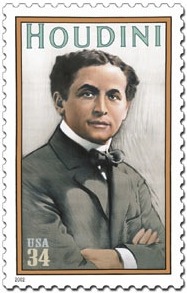
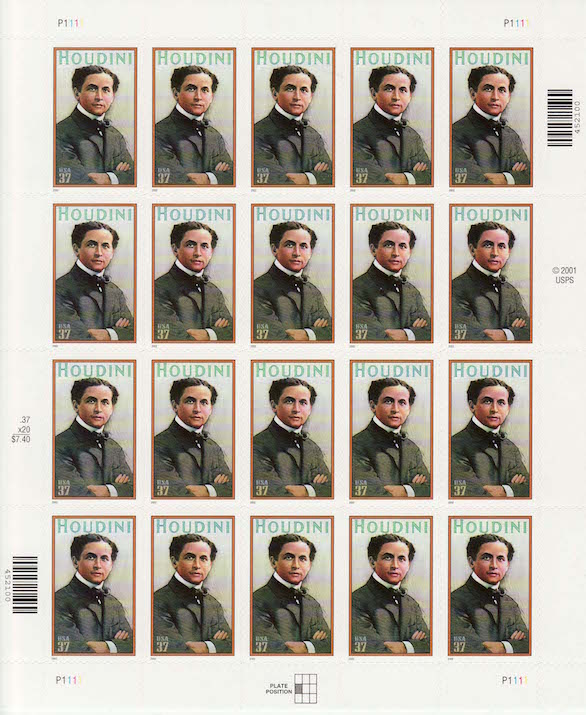
The portrait on the Harry Houdini stamp, which depicts a confident, self-assured man at the height of his career, was taken from a 1911 lithographed poster in the collection of Gary H. Mandelblatt. Designed by Richard Sheaff of Scottsdale, Ariz., the stamp contains a hidden image that-when viewed through the official U.S. Postal Service Stamp Decoder-appears to wrap Houdini in chains.

Current U.S. stamps, as well as a free comprehensive catalog, are available toll free by calling 1 800 STAMP-24. In addition, a selection of stamps and other philatelic items are available in the Postal Store at www.usps.com.


TECHNICAL DETAILS

Issue: Harry Houdini
Item Number: 452100
Denomination & Type of Issue: 37-cent commemorative
Format: Pane of 20 (1 design)
Series: N/A
Issue Date & City: July 3, 2002, New York, NY 10199
Existing Art: Collection, Gary H. Mandelblatt
Designer: Richard Sheaff, Scottsdale, AZ
Engraver: N/A
Art Director: Richard Sheaff, Scottsdale, AZ
Typographer: Richard Sheaff, Scottsdale, AZ
Modeler: Joseph Sheeran
Manufacturing Process: Offset with Scrambled Indicia
Printer: Ashton Potter (USA) Ltd. (APU)
Printed at: Williamsville, NY

This post first appeared on Houdini Lives.

Translate