Showing posts with label 1960s. Show all posts

Monday, August 10, 2026

Houdini: Master of Escape audiobook

As a kid, I really loved Houdini: Master of Escape (1960) by Lace Kendall. I call it the alternative gateway. So I was happy to see there's an audiobook edition on Spotify, read by Dean Bootcheck. 
Never has a biography been so successful at making you feel like you are really there, reliving every moment with Harry and his wife, Bess. Whether you are a student needing information for a term paper, or simply someone who enjoys a riveting tale of gritty determination, Houdini: Master of Escape will provide you with what you need.
Here's a sample.

 
Below are links to my overviews of the three major Houdini biographies for kids at this time.
  
Related:

Monday, January 26, 2026

San Francisco treats

Here are a few curiosities from the San Francisco Chronicle that I recently stumbled on. First is an ad for a television showing of Houdini (1953) in October 1969, describing him as "a cat with 9 lives." That's a new one! There's something that feels very 1969 about this.

San Francisco Chronicle, Oct 20, 1969.

Here's another one, this time from 1976. San Francisco had no shortage of adult theaters back then, and their offerings were advertised in the Chronicle. Notice the teaser copy on this ad: "The stars featured in DIRTY STORIES get into positions Houdini wouldn't dare!" Goodness.

San Francisco Chronicle, Jan 24, 1976.

Finally, there's nothing all that unusual about this 1969 clipping; I just like seeing a revival house screening of The Man From Beyond in proximity to one of my favorite James Bond films, On Her Majesty's Secret Service. Just don't make the mistake of seeing Paint Your Wagon!

San Francisco Chronicle, Dec 29, 1969.

Related:

Friday, October 17, 2025

The Voyages of Patrick Culliton

Here's something special. These three videos by Mike Clark chronicle the story of our great friend and leading Houdini expert Patrick Culliton a.k.a. "Houdini's Ghost." While Patrick's Houdini activities do get a mention, these primarily focus on his acting career and relationship with producer Irwin Allen, especially his time working on Allen's Voyage to the Bottom of the Sea. These are very well done and really interesting. Enjoy.

PART I: THE HOLLYWOOD KID
PART II: INCREDIBLE VOYAGES
PART III: TO HELL AND BACK

Thank you, Patrick!

Tuesday, October 29, 2024

The Houdini way to San Jose


It was 100 years ago today on October 29, 1924, that Houdini gave his spiritualism lecture at the Victory Theatre in San Jose, California. This was Houdini's only visit to the city. A review of the lecture in the San Jose Mercury News began:

    A missionary with a message of sanity and common sense, Houdini, a powerfully built little man in a dress suit, left no doubt in the minds of an audience at the Victory theatre last night that so-called mediums are despicable frauds. It was a wonderful evening's entertainment, the best San Jose has offered in a long time.

During the lecture, SAM member Fred P. Faltersack came onstage to assist Houdini in demonstrations. Faltersack worked at the nearby Winchester Mystery House, the world's most vivid example of how belief in spiritualism can overtake a person's life. After the lecture, Faltersack gave Harry and Bess a midnight tour of the sprawling property. Houdini was reportedly impressed with Mrs. Winchester's seance chamber. The next day, Houdini and company left for San Fransisco.


I recently took a quick trip to San Jose and had a chance to visit the various Houdini locations in the city. There's more than you might think!

First up was the site of The Victory Theatre at 45 N 1st Street (the address later changed to 57 N 1st). The Victory later became a movie theater and was renamed The Crest. In October 1953, it played the Tony Curtis Houdini biopic. So I guess Houdini returned after all! It's fun to think that someone who saw Houdini at The Crest may have also seen the real Houdini there in 1924.


The Crest remained a popular San Jose cinema until 1965, when it burned to the ground. The fire was attributed to two teenage boys. The theater was never rebuilt. 


Today, the site of the Victory/Crest is a parking lot. Ironically, an escape room currently sits at the end of the block.


Just one block over from the Victory is the site of the Empire Theater at 23 N 2nd Street. Hardeen appeared here twice in July and November 1908. The theater closed in 1926. Today, an attractive building stands on the spot, but it's unclear if this is the original theater building. (I don't think it is.)

San Jose Mercury, Nov 17, 1908

Not far from the sites of the Victory and Empire is the still-active Jose Theater at 62 S. Second Street. The Jose's vertical sign once hung outside the Victory/Crest. It was moved and re-lettered after the Victory's destruction in 1965. Theater lore holds that Houdini performed here, but I think it's being confused with the Victory. However, Terror Island played here in 1920, so it still qualifies as a Houdini location to me!

Evening News, June 11, 1920.

San Jose once again became the center of Houdini activity when the PCAM (Pacific Coast Association of Magicians) held its annual convention at the Civic Auditorium in July 1938. Bess was an honored guest and featured in their big show inside the Mongomery Theater. Here, on July 21, 1938, it was proclaimed that Halloween would henceforth be known as National Magic Day in honor of Houdini.

Evening News, July 19, 1938.

The San Jose Civic Auditorium and Mongomery Theater still stand today. So does the Hotel Sainte Claire (today the Westin), where Bess and Ed Saint stayed during the convention. The hotel sits just across the street from the Auditorium at 302 South Market Street.


Finally, the Winchester Mystery House still stands and is a very popular San Jose landmark and tourist attraction. They are proud of their Houdini connection. In their archives, they have a 1924 newspaper clipping that Houdini signed and sent to the house after his visit. A large Houdini poster also hangs in one of their dining rooms.

George Hardeen at the Winchester Mystery House in 2024.

There was a plan to hold a Houdini Seance at the Winchester Mystery House during the 1938 PCAM convention to be attended by Bess and conducted by Ed Saint. The seance was announced in newspapers and magic magazines. But it never happened. In 1976, a local SAM chapter held a 50th Anniversary Houdini seance in the house. 

Genii, July 1938. The seance never happened.

This week, Houdini seances will be held in Appleton, Scranton, Las Vegas, Chicago, and more. But if you ask me, I think this year Houdini's spirit can be found in San Jose!


Related:

Sunday, May 19, 2024

See 'From Russia With Love' in a Houdini theater


Some of you may know that James Bond is another passion (and blog) of mine. But 007 and Houdini rarely intersect. Until now!

On June 15, the Bond classic From Russia With Love (1963) will screen in 35mm at the Palace Theater in downtown Los Angeles. Of course, the Palace was originally the Orphuem where Houdini himself appeared in 1915 and 1923. The screening will be followed by a Q&A about the historic theater.

So this is a Bond and Houdini doubleheader and a rare opportunity to go inside the Palace/Orpheum. You can get more details and buy tickets at the Los Angeles Conservatory website.

By the way, when I toured the theater last month, I spotted James Bond posters on the walls of a work area. So, yeah, this place is haunted by both escape artists.

Monday, November 27, 2023

Songs Called 'Houdini': Who Did it Best?

Here's a clever video by YouTuber Naomi Cannibal that breaks down three pop songs called "Houdini," including the most recent single by Dua Lipa.


Here's another "Houdini" for your consideration. In 1962, Walter Brennan released his own "Houdini" single. You can hear it on YouTube by clicking the image below. It's plenty folksy!


Tuesday, July 25, 2023

The Master Mystery at The Silent Movie Theater

Here's an early photo of what became known as The Silent Movie Theater in Los Angeles, CA. As you can see, this photo was taken when the theater was playing Houdini's The Master Mystery.


Film buff John Hampton built The Silent Movie Theater in 1942. Hampton owned a near complete 16mm print of The Master Mystery containing far more material than what has ever been made commercially available. Patrick Culliton recalls seeing the complete serial at The Silent Movie Theater in the late 1950s and early '60s. The theater would also occasionally show The Man From Beyond and Haldane of the Secret Service.

The Silent Movie Theater closed in 1997 and John Hampton's print of The Master Mystery is today housed in the Packard Humanities Institute. It can be viewed at the UCLA Film & Television Archive, as I did in 2018.

You can read a history of The Silent Movie Theater, including details of its dark ending, at the excellent blog I Am Not A Stalker.

Hollywood Citizen News, May 3, 1947.

Wednesday, December 14, 2022

Hear Dunninger inventory his Houdini collection

David Muller, author of Growing Up With Houdini, recently sent me an extraordinary recording of Joseph Dunninger verbally cataloging his entire collection of magic and Houdini artifacts. Dunninger sold his collection to David's father, Henry Muller, in 1967. These rarities were displayed for many years at the Houdini Magical Hall of Fame in Niagara Falls, Canada. 

I shared Dunninger's 29-minute primary inventory for members of my Patreon on Monday. Today I'm posting his 8-minute "supplemental" list unlocked so anyone can listen for FREE. Just click below to go.

Wednesday, November 30, 2022

Houdini's curious cross escape

One of the more unusual pieces of surviving Houdini apparatus is his "Cross Escape." There are actually two crosses. One is gaffed for quick release and was acquired by Sidney Radner from Hardeen. Today it is owned by Teller. The other was acquired by Henry Muller from Dunninger and was displayed for many years at the Houdini Magical Hall of Fame. The photo in the right shows this latter cross as it appeared in the museum. (Fun fact: I now own that mannequin head.)

I admit this particular escape has always perplexed me. The Houdini Magical Hall of Fame described it as "a famous Houdini challenge escape," yet I've never been able to find any account of Houdini ever performing it. The quick release gaff seems more like a spiritualism or magic effect than a Houdini escape, and the overt religiousness doesn't seem to be Houdini's style. Recall how he took offense to Carl Mysto's use of a coffin onstage.

But David Muller recently sent me extraordinary audio of Joseph Dunninger going through the collection he sold to David's father in 1967, describing each piece of apparatus and its history. Here's what he says about the cross:

Dunninger: "The Houdini cross escape, used in Houdini's earlier performances. Made in his museum days. He would be tied to the cross, a screen would be placed in front of it and in a few moments he would liberate himself. It needs some repair as is obvious, but it's of very great historical value as it belonged to Houdini and was one of his first sensational escapes."

Hearing Dunninger call this an effect from Houdini's "museum days" is informative. Maybe this explains why I've not been able to find an account of it? And its similarity to a spiritualism or magic effect fits with the evolution of the escape act.

Teller also describes it as a "carnival item." In an interview Two Magicians One Mic Podcast, in which we get a glimpse of his cross in his "Houdini alcove", Teller says:

Teller: "It's a carnival item. It would be erected on stage and the person who's doing the spiel on the bally would take, usually, a runaway 13 or 14-year-old drug addicted girl, who happens to be with the carnival, and tie her neck and wrists to this cross. And then at the moment when they were trying to turn the tip and bring the whole group into the tent, all of a sudden she would just walk away from it. The ties would be gone."


The cross escape coming from dime museums or carnivals does makes sense. It's even possible Houdini didn't build the effect himself, but acquired it as he did his electric chair. But I'll keep on searching for some account of Houdini doing the escape himself.

In the 1970 BBC documentary The Truth About Houdini, Sidney Radner demonstrated his gaffed cross. This scene was cut scene from the documentary––possibly because The Magic Circle objected to the exposure––and it does not appear in any version of the doc today. But you can watch the full clip as a member of my Patreon below.


Thanks to David Muller for the Dunninger audio and Dan Bowen for the Teller interview alert.

Related:

Wednesday, June 29, 2022

We've been looking at this photo all wrong!

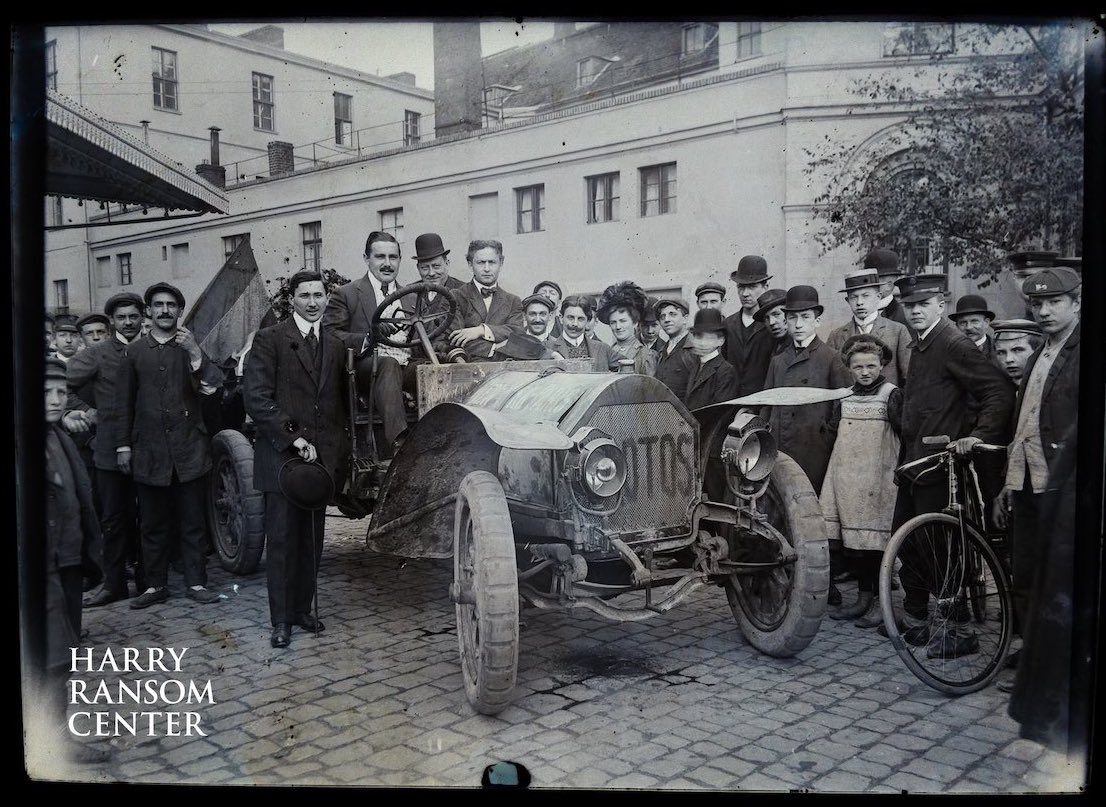
The below photo is one most people are familiar with. It shows Houdini in a car outside the Circus Busch in Berlin, Germany. This photo appears in several books. Here's how it appears in Houdini The Untold Story by Milbourne Christopher with a typical caption.


I've been looking at this photo for 40+ years, but only recently discovered that I have been looking at it all wrong! This image has never been properly identified for what it is. Now thanks to Eric Colleary and our friends at the Harry Ransom Center, I can finally share what's really going on here.

The first surprise is that Houdini is not the focus of this photo, nor is he the reason people have gathered at the theater this day. The star is the car.

Below is an unpublished photo from the Harry Ransom Center's Houdini collection taken at the same time as the more familiar image (which I can now date as 1908). Here the car is featured prominently. The high resolution also shows up new details, including an intriguing notation on the car's hood: "New York-Paris".


I ran all this past magician David Charvet, who knows classic cars as well as he knows magic. David was able to identify this car, a German Protos, as Germany's entry into the famed 1908 New York-Paris auto race. This was a huge international event that was covered by the world press for five months. The German Protos was actually the first to cross the finish line. However, due to time penalties incurred during the race and other circumstances, the American car was declared the winner.

The driver of the Protos was Hans Koeppen (right). I'm pretty sure that's him behind the wheel in both these photos. Koeppen was a national hero; so much so his unique toothbrush mustache became the fashion among service men at that time, including, reportedly, a young Adolph Hitler.

So what people are gathering outside the Circus Busch to see is the famous Protos race car and its famous driver. Houdini, who was playing the Circus Busch at this time, seems to have simply been along for the ride. I love this kind of thing! It's also a perfect example of one of the untold stories of Houdini in Germany.

One thing I haven't been able to nail down is exactly when this photo was taken. Houdini played the Circus Busch from August 31 to November 1, 1908, and the Protos was touring Germany at this time. So it would be sometime within those three months.

But, wait, it gets better! According to Wikipedia, the famous race car is still around and currently on display at the Deutsches Museum in Munich. Below is a pic. Looks like it lost its fenders and headlights, but that "Protos" grill is unmistakable.


I encourage you to read up on the 1908 New York to Paris race, which is a wild story in itself. It was also the inspiration for the 1965 comedy, The Great Race, starring Tony Curtis as the Houdini-like "The Great Leslie" (whom we first meet doing a suspended straitjacket escape). Below is a pic from the movie showing Curtis behind the wheel of his own "New York-Paris" race car. So a lot of cosmic overlaps here!


Thanks to Eric Colleary of the Harry Ransom Center for allowing me to share this rare image. Also thanks to David Charvet for his help in identifying the Protos.

BONUS: Those who subscribe to my newsletter will receive a variant Houdini-Protos image from the Harry Ransom Center collection as a WILD ABOUT HARRY EXTRA this Sunday. If you don't yet subscribe you can do so HERE.

Related:

Tuesday, April 26, 2022

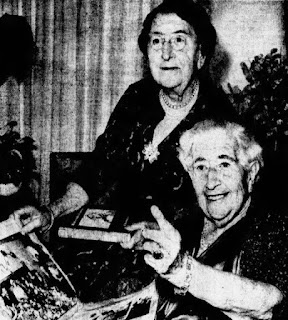
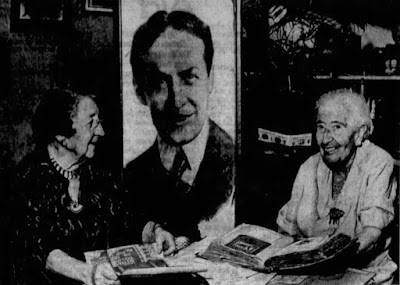
The Moosers wild memories of Houdini

Recently I came across an article in the February 17, 1967 Oakland Tribune about Hattie and Minnie Mooser and their memories of their friend, Houdini. I've read other articles about the Mooser sisters and Houdini, but this one contains stories that I have not read before...and they are pretty wild!

The article kicks off with the Moosers familiar claim that their brother, Leon, discovered Houdini in a "tent show" and booked him at the Palace, literally pushing the young magician out onto the stage. "Houdini didn't even have a tuxedo. My brother lent him his own and Houdini almost didn't go on," says Hattie.

None of this comports with any known facts about how and were Houdini got his start, and he certainly had a tuxedo from his earliest days. But I think we can blame the brother for this. The Moosers are just telling a story that has been told it to them. Leon did discover and introduce Ching Ling Foo to the U.S., so it's possible some of the Foo stories might have morphed into Houdini stories over the years?

It's when the Moosers tell of their own first-hand experiences of Houdini that things get really interesting. Following are some choice excerpts:

    Whenever the Houdinis were in the Bay Area they made their headquarters at the Aladdin Studio, a restaurant operated by the Mooser girls.
    And often Hattie would substitute for Bess in Houdini's stage performances.
    But most of the memories are of the man himself, and not the feats he performed.
    Miss Hattie recalls one damp night when Houdini ushered her quickly into a cab and directed the driver to the waterfront:
    "Not many people knew it but Houdini helped the Coast Guard round up a ring of rum runners. They often asked him to assist in an investigation because he was such a good swimmer and he trained himself to withstand cold. He would swim out to a suspected rum runner's boat, look around, and report back to the authorities."

This is certainly fodder for people who enjoy the idea of Houdini as a spy. In fact, this rum runner "mission" is presented as fact in The Secret Life Houdini. But the only source is this article. I'm more intrigued by the suggestion that Hattie would sometimes substitute for Bess onstage. And this:
    Miss Hattie recalled joining Houdini in leading a pack of newspaper man through the Winchester Mystery House one dark night. She said:
    "There were no lights in the house and we carried flashlights. Houdini was interested in the house because of his psychic research."
This is first I've heard of the Moosers being with Houdini on that midnight tour in 1924. But a pack of reporters as well? No newspaper accounts followed, so not sure what to make of this.
    Miss Hattie also remembered the time she was able to get Houdini into the Tower of Jewels at the 1915 Worlds Fair.
    "We went to dinner afterwards and he asked when my sister and I would observe our birthdays," Miss Hattie said. "I asked him why and he reached into his pocket and pulled out a handful of jewels. You know nobody took their eyes off him when he was in the tower and I have no idea how he got them."
    The jewels, of course, were glass.
Houdini was indeed in San Fransisco in 1915 and even did an overboard box escape within site of the Worlds Fair. The stories continue from Minnie:
    Miss Minnie recalled that they employed college students at their restaurant and had a difficult time keeping any silverware.
    "One day Houdini came in with a mysterious looking package," Miss Minnie said. "He called us aside and opened it. It was filled with cheap knives and forks from the five and dime. 'If you are going to let them get away with the silverware, make certain it's only the cheap stuff,' he said."
Hattie, who appears to have been the sister who was closer to Houdini, takes over with this:
    Miss Hattie also recalled a day when she sat in a darkened movie theater with Houdini to watch his first movie.
    In it he played a superman who had been frozen in ice for 300 years.
    "It was awful, just awful," she said. "And I asked him how he had ever been talked into investing in such a terrible film.
    "He shook his head sadly. He had poured most of his savings from his career in the theater into the film and lost every cent of it."
I could not find a theater playing The Man From Beyond in San Fransisco in 1923 or 1924. It would have been fun to have put Houdini inside a specific movie theater. 

Finally, there's this gem:
    "He was a brilliant man," Hattie said. "But he was very serious. He never played and he never relaxed. He had unbelievable strength and he could control every muscle in his body. He could put his foot on the floor and break the strings in his shoe without anyone knowing that he had moved his foot."
This has to be one of the best details about Houdini's strength that I've ever read.

Thank you Hattie and Minnie!


Images: Newspapers.com

Wednesday, February 2, 2022

Strange Harry

Here's an unusual photo of Houdini that ran with a review of the William Lindsay Gresham biography, Houdini The Man Who Walked Through Walls, in the London Evening Standard on March 29, 1960 (Headline: "Oh, why do they have to give Houdini away?") At least it says this is Houdini! I'm not familiar with this photo and it almost looks like a Houdini impersonator or even a wax figure. A strange Harry indeed.

Wednesday, May 19, 2021

The Steel Straitjacket

Near the end of Houdini (1953) we see Tony Curtis' Houdini challenged to escape from what the movie calls "a steel straitjacket." It's a terrific escape performed by Curtis without a cut. The "steel straitjacket" was provided by Houdini's technical advisor Joseph Dunninger, who claimed it was used by Houdini himself. Below is a photo of Dunninger with the jacket from the July 26, 1967 Middletown Journal.


The steel straitjacket was purchased along with the rest of the Dunninger collection by Henry Muller in 1967 to supply his Houdini Magical Hall of Fame in Niagara Falls, Canada. The jacket was displayed as the "Armoured Breast Plate" (it was no longer on display when I went to the museum in 1990). After the catastrophic fire of 1995 the steel straitjacket was housed in a warehouse along with the rest of the surviving collection.

One person who remembered seeing the straitjacket in the museum was magician and collector Rob Allen from Niagara Falls, New York. "I always remember seeing it on display there," says Rob. "I would always stop and look at it as I thought it was the most intriguing piece among the Houdini escaped pieces." Following the fire, Rob purchased some items from Henry's warehouse. But there was one item he always coveted. In a November 2007 issue of Magicol, Rob remembered:

After my first purchase from Henry, I met him numerous times, often taking things he owned to sell at Yankee Gatherings and Magic Collectors' Weekends. It was fun for me and I finally told Henry during one of our meetings that I wanted to buy the Steel Straitjacket although I couldn't afford to pay for it at that time.

"Rob, it's yours," he said. "It won't leave the warehouse. When you have the money you can come pick it up."

That day finally came. If I had not arranged to buy it, the Houdini Steel Straitjacket would have been shipped with the rest of the warehouse contents to Hollywood, where the items were auctioned by Butterfield & Butterfield in November 1999.

Happily, Rob still owns the steel straitjacket today. Here's a photo he shared. Still looks fantastic!


But the question remains. Did Houdini really use this? Like the iron overboard box from the movie--also supplied by Dunninger who also claimed it was Houdini's--I've never seen any photo or read any reference to Houdini doing this particular escape. But how great would it be if one day we did find a photo of Houdini in this now iconic restraint?

Until then, we'll have to be satisfied with the scene from the movie (this is copyrighted so may have ads). Enjoy.


Thanks to Joe Fox for his help with the post, and a big thanks to Rob Allen for showing us the steel straitjacket today.

Monday, January 18, 2021

The outlier

Harry Houdini Boy Magician by Kathryn Kilby Borland and Helen Ross Speicher is a book that seems like an outlier in the world of Houdini juvenile biography. Released in 1969, it offered something both familiar and unique. Stylistically it falls somewhere between Scholastic's popular The Great Houdini by Williams & Epstein and Houdini Master of Escape by Lace Kendall. Clocking in at 200 pages, it's a legitimate biography like Epstein. But with its focus on Houdini's early years and narrative style, it offers a Kendall-like reading experience. On top of this are illustrations by Fred. M. Irvin that are as vivid as those soon to appear in illustrated gems like Harry Houdini Master of Magic.

But this could be just be my own personal perception and I discovered this book relatively late in my Houdini education and I remember having trouble reconciling how there could be be yet another Houdini biography? Ha!

Harry Houdini Boy Magician was first published as a hardcover by the Indianapolis-based Bobbs-Merrill Company in November 1969 as part of their popular Childhood of Famous Americans series. The first edition (above) featured a yellow cover with a selection of Fred M. Irvin's artwork. The front boards mirror this same art. The first paperback edition (below), featured the same artwork, but without the color.

First paperback edition back and front.

Harry Houdini Boy Magician went through multiple printings and several different cover designs over the next few years. Below are several of these, some library bound, with variant cover art. Frustratingly, all their copyright pages show the original 1969 publication date, so one can't tell when they were actually released.


Notice the last book features a new title: Harry Houdini Young Magician. This book appears to be from 1974. Until I discovered this, I would have told you the title change came much later. Ironically, the cover nows features a portrait of the old Houdini.

In 1991 Aladdin Books reprinted the Childhood of Famous Americans series including Harry Houdini Young Magician. The Aladdin paperback retains the Fred Irvin illustrations, but now only in black and white. The Aladdin editions also drop the timeline and study aid found in the back of the original hardcovers.


There have been many Aladdin editions and subtle changes in cover art over the years. But, once again, the copyright pages only show the 1991 first paperback printing date, so exactly when each of these variants appeared isn't clear. Oddly, later editions credit the illustrations to co-author Helen Ross Speicher on the cover while still acknowledging Fred M. Irvin inside.


Eh?

Today Harry Houdini Young Magician can still be found in bookstores while Epstein and Kendell have long ago gone out of print. So what started out as an outlier is today the oldest juvenile Houdini biography still available to young readers. So maybe we should call it The Survivor!

Thanks to Arthur Moses for his help and sharing images from his collection.

Other selections from the WILD ABOUT HARRY bookshelf:

Monday, October 26, 2020

Everyone's first Houdini poster

Recently I was going through boxes of posters in my garage and was delighted to discover my old "Harry Houdini - King of Cards" poster reproduction. This hung on my bedroom wall from around 1976. I suspect this was the first Houdini poster for many. It sure was mine!


This reproduction is now iconic in its own right. So what's the story behind it? To tell the story right, we should probably start with the original.

King of Cards is often said to be Houdini's first poster and leads some to conclude that he started his career as a card magician. Neither is correct. While it could be said this is his first known solo poster, there are posters for "The Houdinis" that pre-date this. Houdini actually had this printed around 1898, probably at the same time as his full color Metamorphosis poster. Both posters were printed by the National Printing and Engraving Company of Chicago and both were used during the Houdinis 1898 tour with the Welsh Bros Circus. But the following year Houdini received his big break via Martin Beck and forever became the King of Handcuffs, making his King of Cards poster obsolete. Ironically, this poster, which is today is seen so often, it probably the poster Houdini used the least of any during his career. But that could be why so many copies survive.

In 1941 an original King of Cards poster featured on the cover of Genii magazine. Editor William Larsen noted: "The poster which is reproduced on the cover was found in the Houdini files by Edward Saint, Houdini Archivist, and especially rephotographed, on his instructions, for our use." The poster became known in magic circles. A mockup King of Cards poster with the image of Tony Curtis can even be spotted in Houdini (1953).

An original King of Cards and the 1941 rediscovery.

In November 1961, magician Tommy Windsor created the first reproduction of the King of Cards poster. This was well before magic poster reproductions were common, and it may have even been the first? Windsor's reproduction was printed on heavy 80 pound book paper and sold for $2.00 (postage paid). In his adverting Windsor dated the poster as 1895 and began touting it as Houdini's first. He also promoted it as a great deal, seeing as originals were known to sell for $25 and up! It appears Windsor only sold his poster for a limited time as his advertising dries up after 1961.


In 1968 Lee Jacobs again offered "Tommy Windsor's Harry Houdini King of Cards Poster" along with his own magic poster reproductions. Jacobs was a magician and publisher who operated a mail order magic business out of Pomeroy, Ohio. Presumably Jacobs had acquired Windsor's unsold stock, or he was selling them on Windsor's behalf. But in 1973 Jacobs announced that he had acquired the rights to the poster from The Tommy Windsor Studio. In the August 1973 Linking Ring Jacobs stated: "This is our finest hour. We have just completed the most beautiful poster reproduction ever and at a price you won't believe."

It's probably no exaggeration to say the Lee Jacobs King of Cards poster sold in every magic shop in the country. (I believe I got mine at Hollywood Magic.) And it was just in time for the great Houdini renaissance of the 1970s. It may have even been a contributing factor. It frequently shows up as background art in film and television. In The Life and Afterlife of Harry Houdini, Las Vegas magician Jen Kramer is quoted as saying, "I'll bet ninety percent of the kids who dream of becoming a magician have that poster on the wall, and we stare at it endlessly."

Unlike some of Jacobs other reproductions, King of Cards is approximately the same dimensions as the original. The quality of the reproduction is also excellent and the book paper gives it a lithograph look and feel. Ironically, it's now old enough that it could be confused as being an original! But there are obvious tells. Original King of Cards posters have wider borders and a large empty space at the top where performance details would be placed. Also, "NATIONAL PR. & ENG. CO. CHICAGO" is omitted from the lower right border of the reproductions. Jacobs also stamped his name and address on the backs.

As for telling the difference between the Lee Jacobs and Tommy Windsor reproductions, I'm afraid I've not seen a confirmed Windsor poster, so I don't know the differences for sure. But it's possible Jacobs trimmed the borders tighter on his posters. I did spot a "vintage" repro on eBay that had larger borders and no Lee Jacobs stamp on the back. So maybe this was a Tommy Windsor? If anyone has a confirmed Windsor, I'd love to see it.


In 1980 Jacobs issued a "NEW" King of Cards reproduction. This new poster was done on 100 pound glossy enameled stock with the color being closer to the original. While the borders are still trimmed, the Chicago Printing Company credit is restored. On the back are reproductions of two Houdini photos and a letter along with an essay by Jacobs dated February 22, 1980. The essay furthers the myth that the poster "dates from before the days when Houdini began doing the escape feats."

Even though the paper quality on the 1980 poster is heavier and less susceptible to aging, to my eye the image is slightly inferior to the earlier poster. And it's a shame to loose the lithographic look and feel. In 1980 I was excited by the extras on the back and the restoration of the printing company's name. But today I prefer my pre 1980 poster. Below you can see the two reproductions side by side front and back (original on left and 1980 on the right).


Lee Jacobs would go on to release a reproduction Buried Alive poster in 1986 which featured material on the back related to "Harry Houdini, Motion Picture Star". Jacobs died in 2003. Of his magic poster reproductions, his widow Ramona Compton said, "This may have been Lee's greatest contribution to the field of magic. And he had always wanted to be remembered for this contribution."

In 2014 the original King of Cards poster that Tommy Windsor used for that first reproduction in 1961 sold at a Potter & Potter auction for $17,000.

Today you can get beautiful King of Cards poster reproductions with the full borders and accurate colors from Nielsen Magic and others. But for me there is something magical and, yes, collectible about these earliest King of Cards reproductions from Tommy Windsor and Lee Jacobs that started it all.

Did you have a King of Cards poster? Do you remember where you got it? Please feel free to share your own King of Cards memories in the comments below.

Thanks to Magic Castle librarian extraordinaire Joe Fox for all the information and great images that turned this post from a one paragraph quickie to a King of Cards deep dive!

UPDATE: Mark Horowitz has sent this image of his original Tommy Windsor King of Cards poster. As you can see, the borders are indeed a bit wider than the Jacobs repro. These were sent to buyers folded and with an "Insurance Poster Trick." Thank you Mark for providing this final piece of the puzzle!

Translate