Showing posts with label Correspondence. Show all posts

Thursday, August 1, 2024

LINK: Houdini and Raymond: Revealing Letters

Myron the Magnificent has shared on his blog three interesting letters between Houdini and Maurice Raymond that shed light on their contentious relationship. The letters are part of the collections of The New York Public Library for the Performing Arts, Billy Rose Theater Collection. Check them out by clicking the headline above or visit Myron's Blog.

Tuesday, January 16, 2024

"I played parts years ago"

One of the great things about reading Houdini's letters is that he sometimes gets into a mood to reminisce. In these moments, you can find gold! An excellent example is a 1916 letter to Quincy Kilby in which Houdini remembers various plays he acted in during his early career. There's new info here, so enjoy this Patreon history exclusive.


Thanks to my patrons for supporting my research and content like this. Not a member? Feel free to join us!

Related:

Monday, August 14, 2023

Dark Doyle

Over the weekend our good friend Anna Thurlow, great-granddaughter of Mina "Margery" Crandon, shared with me some letters written to Dr. Le Roi Crandon during the famous Margery-Houdini seances. One letter written by Sir Arthur Conan Doyle on August 27, 1924, contains this surprisingly dark sentiment:

"Something will happen to that man H. You mark my words. Better to get between the metals when an express is due, than block the way of the spirit."

We tend to think of Doyle as the creator of the virtuous Sherlock Holmes, but he was also the creator of all the dastardly murderers from those stories. He could go there! It's hard not to see this as a veiled wish that harm come to Houdini, if for no other reason than to prove this existence of avenging spirits. Although the idea of Houdini being pushed in front of an express train seems more like a tactic a person would employ than a spirit.

Dark Doyle indeed.

Want more? You can read the full letter as a member of my Patreon.

Friday, July 14, 2023

Dash and the duplicate Water Torture Cell

We are all familiar with the letters Houdini wrote to his brother Hardeen after his mother's death in 1913. But I had never seen a letter from Hardeen back to Harry. That's why I was so excited to find a handful of such letters at the Harry Ransom Center.

The first thing that struck me was Hardeen starts off his letters with, "My dear brother Ehrich." Dash using Houdini's real name was eye-opening in itself. Then in a letter dated December 28, 1913, I found this intriguing nugget:

  A fellow by the name of Bedwin came to me a week a go and wanted to sell me the U.S.D. trick for $250. I went to see it and this fellow must have gone to see you at every performance as he has the thing built just like yours, BUT he cannot do it upside down, he only has his hands stuck out of the top, but the trick looks great. He has worked around New York a week or so, but is a bad show man and can not get any work. I offered him a hundred dollars for the trick, but he refused to take it.
    Now what do you think about it, I was going to buy it just to take it off his hands, but will wait until I hear from you.

There was no follow-up in the file and I'm not able to find any mention of a magician named Bedwin performing in New York at this time. Maybe someone else wants to run with this? I do wonder what happened to his Torture Cell?

Want more? You can read Dash's full 2-page letter, which includes some interesting personal details, as a "Scholar" member of my Patreon by clicking below.


Wednesday, June 21, 2023

Accident at the Hippodrome


On April 18, 1918, a terrible accident occurred on the stage of the New York Hippodrome during a performance of Cheer Up. While Houdini wasn't involved in the accident, he was in the theater at the time. Below is a report from the New York Sun.

The New York Sun, April 19, 1918.

The day after the accident, Houdini wrote to Harry Kellar describing what he saw and also the panic backstage, which was not covered in the newspapers. This letter is housed at David Copperfield's International Museum and Library of the Conjuring Arts and reads in part:

I was out in Mark Lueschers office when I heard awful screaming. Mark and I rushed out into the auditorium, and what an awful site. We arrived when the damage in sight of the audience has been done, then two fool firemen passing me rushed downstairs and they must have lost their head. 

Houdini goes on to explain, with a fair measure of disgust, that the firemen panicked the chorus men who then "stampeded" the chorus girls waiting in the wings. "Then there was a hellavu time," says Houdini.

Houdini volunteered to go onstage to fill the gap in the show, but "things were in too disturbed a state" and his offer was not accepted. He did express relief that the flying car did not go into the audience.

According to Houdini, the stagehand, Henry Casey, died on the way to the hospital. This was not reported in the papers. In fact, it hard to find any followup on the accident. But Axel Mirano survived and the brothers were back performing their "Flying Torpedo" act by the end of the year. The advert below from the Palace shows what their apparatus looked like.


The timing of this accident is interesting. This was within a month of the accidental shooting of magician Chung Ling Soo on the stage at the Empire Theater in London. This was also the very week Houdini planned to perform his own version of Soo's bullet catch at the Hippodrome. 

As I covered in this post, the Hippodrome management requested Houdini cancel the dangerous trick and he did. I wonder if this accident had anything to do with that? I also wonder if being in such close proximity to two stage tragedies might have spooked Houdini. He didn't want to be number three!


Want more? You can read more details about the Hippodrome accident as a "Scholar" member of my Patreon.


Thanks to David Copperfield.

Friday, June 2, 2023

Houdini takes the lid off Fleischmann’s Yeast


Ever hear the one about Harry Houdini and Fleischmann’s Yeast? Sounds like the start of a joke, doesn't it? But it's not. Houdini's family connection to Fleischmann’s Yeast is something Patrick Culliton has always talked about. But when I was at the Harry Ransom Center last year, I finally heard it from Houdini himself.

In a letter dated June 8, 1925 to Albert Davis of 351 Bridge Street in Brooklyn, Houdini writes:

    I noticed you live on Bridge Street. Many years ago my uncle, Simon Newman, he brought compressed yeast into this country and he taught the older Fleischman the business, in fact Fleischman was only one of a number of helpers and managed to get financing – my uncle having refused to form a corporation. His place was at 28 Jay Street and many a happy swim I had off the J Street Dock. By the way, the Fleischman people paid my uncle $200. a month all the rest of his life after having practically put him out of business and some how or other I attribute it has conscience money. Will tell you the whole story in person.

    It seems strange to hear that an unknown man brought compressed yeast to this country but he sold it for years and is now entirely forgotten.

Fleischmann’s Yeast is still around today. Unsurprisingly, the official company history doesn't mention Houdini's Uncle Newman. I'm also excited to learn the location of swimming spot for young Ehrich Weiss. Any Brooklyn residents want to try and track down the Jay Street Dock?

Now let's work out the rest of that joke.


Want more? You can see and read the entire original letter as a Scholar member of my Patreon.

Saturday, April 22, 2023

Martin Beck and the nine Houdini "knockers"

G, Z, A, H, S, F, H, Sh, D

Here's one for those of you who really know the players in early magic history.

In David Copperfield's phenomenal International Museum and Library of the Conjuring Arts there is a file of early correspondence between Houdini and his first manager, Martin Beck. These letters are packed with information and insight into Houdini's early rise to fame. One letter dated November 9, 1899 includes this intriguing postscript.

P. S. We are surely going east, and I just set my mind on it that I will work three times as hard to make a star out of you since the "knockers" have been at work. What others can be the knockers than our magical friends, G, Z, A, H, S, F, H, Sh, D, and other loafers? I have it as a positive fact.

Does anyone want to try and guess the nine magicians behind these initials? Remember, this is 1899, so the magician would have to have been active at this time. The only guess I have is Goldin for "G" as in a later letter Beck clearly appears to consider him as competition. But the others have me stumped. Feel free to share your guesses in the Comments below. 

Want more? I threw this one out early to my patrons and they have a few ideas that you can read as a member below. You can also view the original paragraph.


Related:

Wednesday, February 15, 2023

Houdini's copper Milk Can?


In the Houdini Collections at the Harry Ransom Center there is a thick file of letters written to Houdini by Montraville M. Wood. Wood was a Chicago inventor and associate of Thomas Edison who worked with Houdini on his Milk Can escape and other effects.

One letter offers up a surprise and a new mystery. It appears that Wood was making Houdini a COPPER Milk Can. On Sept. 10, 1909 Wood writes to Houdini saying:

I have received fifty from the Doctor and have placed the order for the Copper Can; but owing to the small sheets of copper (being tinned on one side) which is carried in stock, it will be necessary to have two seams in the body part of the can instead of one.
This whole can will be tin plated on the inside, so it will be perfectly safe, and it will be copper polished on the outside. I cannot say any particular time this will be done; but I am rushing it as fast as I can.

Wood goes on to say that the hasps would be brass and the can's collar would be 1/2" higher than Houdini's regular cans. He also says staples on the collar would be removable.

Unfortunately, there is no other correspondence related to this particular can, so I don't know if Wood ever delivered his copper can to Houdini. But the idea is a good one. So if anyone ever encounters a copper Milk Can out there, it just may be Houdini's!

Want more? You can read M.M. Wood's full letter as a member of my Patreon by clicking below.


Thanks as always to Eric Colleary and the Harry Ranson Center.

Related:

Wednesday, January 25, 2023

Early handwritten Houdini letter sells at auction

RR Auctions recently offered up several very nice Houdini lots. Chief among these were the two lots below. The auction listed these as two separate incomplete letters, but it's actually one complete letter. I think the confusion came from the fact that Houdini used his 1897 stationary for page 1 and his old 1896 stationary for pages 2 and 3. The combined lots add up to a whopping $37,528 (including Buyers Premium).


The letter is handwritten by Houdini who is pitching his act to a Mr. Hixon. If anyone has any information on Hixon, who may have been part of a firm called "Hixon & Wallen", I'd love to hear more. The content is phenomenal, probably the best early Houdini letter I've ever read. You might recall I shared a page from this letter in this post.

Congrats to the winner(s) of this incredible early Houdini treasure.

Thanks to Don Creekmore for the image. You can see close up images of the letter on my Patreon.

UPDATE: I now know these two lots did not sell to one buyer. Also sold was a handwritten press notice (below) that I think was also part of this letter. It's a shame they all didn't stay together.

Friday, January 20, 2023

Paging Professor Murat


In the Harry Ransom Center at the University of Texas at Austin (them again!), not all the Houdini treasures are in the Houdini Collections. The Ransom Center also holds a large collection of Sir Arthur Conan Doyle's correspondence. There one can find several letters he exchanged with Bess in the months after Houdini's death. These letters contain some fascinating information.

Today I wanted to highlight a paragraph from one letter dated July 8, 1927 in which Bess writes:

Was awfully pleased to hear from you. Houdini never traveled under the name of Ellington but took the name of Houdini when he was fourteen years of age. Thirty-two years ago he used the name of Professor Murat for one week as a hypnotist and then a few years later as a card magician, for a short time was known as "Cardo", but those are the only names, other than Houdini, that he ever used.

These aliases are mentioned in Silverman (sourced from this letter in the HRC), so this isn't new info. However, Bessie appears to have misspelled the name Murat. Details of his act at Daly's Star Theater in Hoboken during the week of February 10, 1896 can be found in local papers under the spelling "Morat":

Then came Prof. Morat, with his "European Sensation–Man in a Trance." He produced his "subject" and made the audience shiver as he jabbed pins and needles into the soft parts of the man's anatomy. The subject didn't seem to mind it. He was supposed to be in the state of hypnotic catalepsy.

Unfortunately, I've never been able to find any account of Houdini's time as "Cardo." Every once in a while I do a hard target search of newspaper.com for any mention of a Cardo from 1895-99 who could logically be Houdini, but so far I've come up empty. I did find a magician in 1889 named Signor LaCardo, but clearly not HH. Maybe someone else will have more luck?

By the way, Houdini also appeared at least once as "Harry Raynohr, Sleight of Hand" during his early days. Strange Bess forgot that one as she appeared on the same bill as "Beatrice Raynohr, The Melodious Little Songstress."

Want more? You can read the entire Bess letter and see the Prof. Morat clippings as a Scholar member of my Patreon. Just click the image below.

Wednesday, November 23, 2022

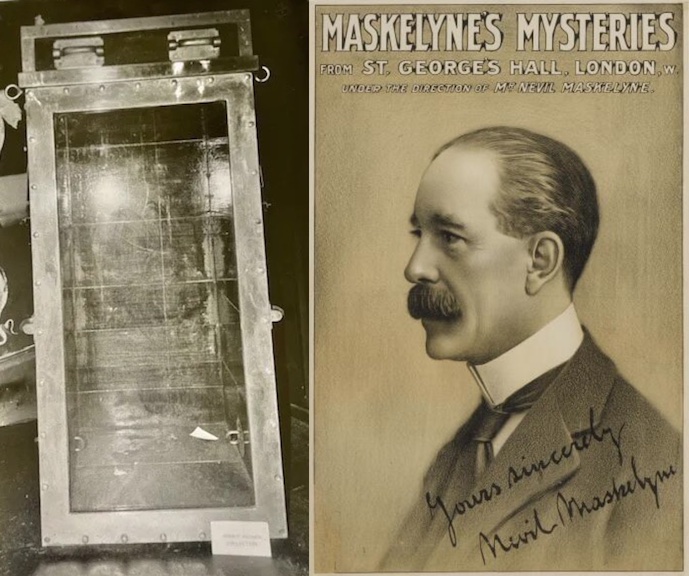
Nevil Maskelyne and the Water Torture Cell sale


Here's a tasty piece of untold magic history to chew on this holiday. In 1920 Houdini tried to sell his most famous escape, The Chinese Water Torture Cell, to magician Nevil Maskelyne. I uncovered the correspondence between the parties during my trip to the Harry Ransom Center last summer. Here's the story.

In January 1920 Houdini arrived in the UK for a five month tour. Having just completed two films in Hollywood, Houdini was convinced that his future lay in the movies. He was only making this tour to honor bookings made before the war and avoid a hefty fine. For the first time in years he revived his standard vaudeville act; Needles, straitjacket, challenges, and, of course, The Chinese Water Torture Cell.

Getting the Torture Cell back into action took some effort. Houdini recorded in his diary that he "nearly cracked my neck" in a test run of the escape. During the second week of the tour the glass cracked. Then in Liverpool, Houdini seriously injured his right ankle performing the escape. These struggles may have something to do with what happened next.

On February 6 Houdini sat down with magician and inventor Fred Culpitt (right) at the North Western Hotel in Liverpool. There they discussed the possibility of selling the Water Torture Cell to Nevil Maskelyne, who was performing his "Maskelyne's Mysteries" at St. Georges Hall in London at this time. Houdini gave Culpitt the go-ahead to approach the magician on his behalf.

Culpitt wrote to Maskelyne on February 10th, presenting the idea of a sale and laying out the specifics. Unfortunately, that letter in not in the Ransom Center file, so it's unclear if the idea was for Maskelyne to take possession of the cell immediately or at the end of Houdini's tour.

"It certainly seems as though they are interested in the proposition," Culpitt wrote to Houdini three days later. But there was one hiccup. Maskelyne's representative, George Facer, told Culpitt that Will Goldstone had offered the same effect to Maskelyne that very same week. "Of course, it does not matter to me who gets the illusion 'placed'," wrote Culpitt, "but I think it would be wise for me to know my position."

Houdini quickly wrote back clarifying that Goldston offered Maskelyne "some sort of mermaid illusion", not the Water Torture Cell. He also told Culpitt that he had attended Maskelyne's show at St. Georges Hall and Maskelyne had asked to see the escape. Houdini sent the magician two tickets to his show at the Empire Palace in Stratford. "If anything transpires, I will let you know," he assured Culpitt.

It appears nothing did transpire and that's the end of the correspondence. Houdini kept his Water Torture Cell and performed it for the remainder of his career.

It's hard to know how serious Houdini was about selling the Torture Cell. Perhaps his initial frustrations with the apparatus caused him to overreact. However, he reportedly did destroy magic apparatus that he had stored in the UK at the end of the tour and the cell was likely expensive to ship. So if Houdini really did believe he had no more use for the escape then it would make sense for him to offload it in the UK.

There's also another possibility, but this is pure speculation. Is it possible what Houdini was looking to sell was a second Water Torture Cell, perhaps the cell he had made for "Miss Trixy" in 1912? It's likely that cell would have been stored in England.

As for Maskelyne, the magician was 56 and not an escape artist, so it seems unlikely he would perform the escape himself. What he would have done with it is anyones guess. So this episode offers a fascinating "what if" of magic history.

Want more? You can read the original Houdini/Culpitt correspondence as a "Scholar" member of my Patreon.


Happy Thanksgiving!

Thursday, November 10, 2022

Movie night


I've always wondered what movies Houdini might have seen during his lifetime. He certainly lived during an exciting time in cinema history. Did he ever see The Kid or Phantom of the Opera I wonder? I do know he and Bess were regular movie goers, but apart from his own movies, I've never come across any specific mention of any movie he might have seen. Until now!

Not surprisingly, I found this at the mighty Harry Ransom Center during my visit last summer. The below letter--which can be found in the Houdini-Bess correspondence file--tells the tale and is a delightful letter to boot.

Click to enlarge.

I'm assuming Bess and her mother accepted Harry's playfully formal invitation. The theater they would have traveled to that night was the Geo. M. Cohan Theatre located at 1482 Broadway in Times Square. The photo at the top of this post shows the theater when it was playing The Ten Commandments during its record breaking run in 1924. Houdini had met the movie's famed director, Cecil B. DeMille, in Hollywood in 1919.

New York Daily News, July 6, 1924.

The Geo. M. Cohan Theatre was demolished in 1938 along with the Fitzgerald Building in which it was housed. The New York Theatre opened on the site in 1940. Today the site is occupied by the 4 Times Square skyscraper.

Related:

Monday, October 31, 2022

Collins delivers the news

Here's a telegram from Houdini's chief assistant Jim Collins sent on the evening of October 31, 1926.


Collins pretty much says it all. But if this still isn't enough for you, I've uploaded 26 newspaper front pages reporting Houdini's death to my Patreon.


Remembering
HARRY HOUDINI
on the
96th ANNIVERSARY
OF HIS DEATH
October 31, 1926

Wednesday, October 19, 2022

Bess letter reveals new detail about Houdini's death


One of the most remarkable artifacts on display in Houdini Unchained: The Legacy of Harry Houdini at Muzeo Museum and Cultural Center is a 2-page letter written by Bess Houdini during the final weeks of her life. This is when Bess, ill with tuberculosis and weighing only 72 pounds, was convalescing at the Cedar Lodge Sanatarium in Los Angeles. In the letter Bess describes her surroundings:

It is a glorious place – huge pools with gold fish – fountains – and beautiful patio with swings and sun shades – then the awful horrors – half dead men and women in wheelchairs – nurses – doctors and sick people – that's all I see all day.

Bess then goes on to deliver what I consider to be a bombshell:

I did manage to navigate to the bathroom by myself until this morning – then I fell – now I've got a nice big egg on my head – and a scolding from my nurse. Even that did not "squash" me until I saw a big huskie put an oxygen tent next to my bed – I screamed – I saw my beloved Houdini – then Ed Saint die whilst using this – and the memory was too much for me.

Some interpret this as Bess saying she saw a vision or even the ghosts of Houdini and Ed Saint, but that's not what I read. What I read is she is recalling the very real memory of the deaths of Houdini and Ed and that they both died in oxygen tents.

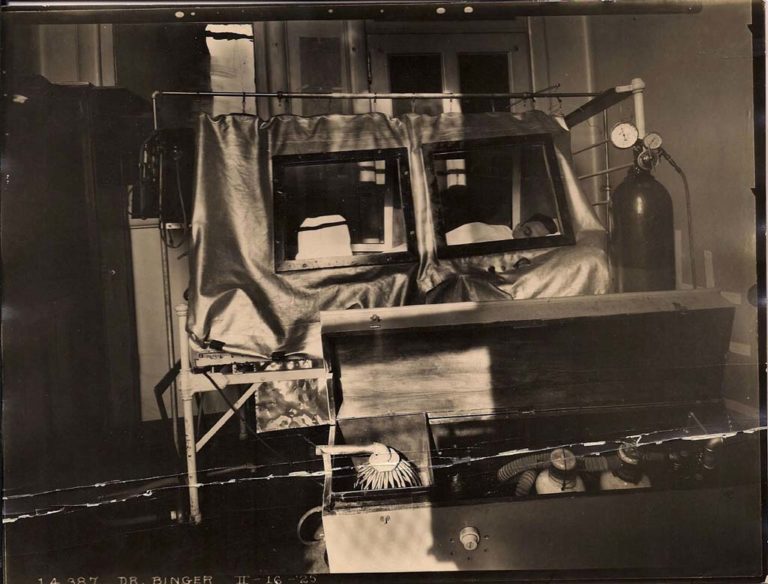
So Houdini died in an oxygen tent!!!

This is the only mention of this that I've ever heard and it certainly creates an entirely different vision of Houdini's final days and hours. Below is what an oxygen tent looked like in the 1920s.


You can read the full, heartbreaking, Bess letter at Houdini Unchained: The Legacy of Harry Houdini at Muzeo until January 22, 2023. Or you can read it as a member of my Patreon by clicking below.


Speaking of Houdini Unchained, on Sunday, October 30, I will be at Muzeo giving impromptu tours and answering questions from 12:30pm to 3:30pm. So if you're in the Anaheim area and haven't yet seen the exhibition, come on by!

Sunday, October 9, 2022

PATERON: Houdini's 12-page love letter to Bess


In my first blog post about my visit to the incredible Harry Ransom Center, I mentioned reading a 12-page stream of consciousness love letter from Houdini to Bess. To start October off with a bang, I've made the full letter available on my Pateron. Just click below and feel the love!


If you are not a patron--and this still doesn't convince you to join--that's fine. You can still see many treasures from the Harry Ransom Center via the links below, with more to come!

Related:

Wednesday, October 5, 2022

The Houdini-Jeff Bezos connection


Houdini and Jeff Bezos? Yep. While doing research at the Harry Ransom Center, I discovered an investment Houdini made late in his life which, as it turns out, has a connection of Mr. Amazon himself. Here's the story.

On June 1, 1925, Houdini purchased 30 shares of the "212 Fifth Avenue Corporation" for $3000 (Certificate No. 72) from Spear & Co. This was a 20 story commercial building located at, you guessed it, 212 Fifth Avenue in Manhattan. It was built in 1913 and faced Madison Square Park. Among Houdini's papers is this brochure pitching potential investors.

Click to enlarge.

Houdini doesn't appear to have fully understood what he had purchased, as evidenced by this letter sent from his accountant, George M. Sachs, explaining the nature of the investment. Sach's sent this on June 22, Houdini wedding anniversary. His reference to "the H.P.C." means the Houdini Picture Corporation, the failure of which is expressed in his final line. A great letter.

Click to enlarge.

It goes without saying that this was a good investment, although it's unclear if Houdini lived long enough to see any return nor what happened to his shares after his death. But the building still stands today.


That brings us to Mr. Bezos. On August 20, 2021, Curbed ran an article headlined: Why Does Jeff Bezos Love This Unremarkable Building in the West 20s So Much?  It reports:

Bezos, who may or may not be an astronaut, just purchased his fifth apartment at 212 Fifth Avenue, the New York Post reports, bringing his total spending in the former office tower to $119 million and a fairly palatial 24,551 square feet.

The article goes on to question why Bezos would buy into 212 when "there are more compelling buildings out there." But it's cheaper than properties in more upscale neighborhoods and may prove a shrewd investment for the billionaire.

Heck, Houdini could have told him that. Maybe he did?

Believe (in New York real estate).

Related:

Monday, September 5, 2022

"Darling Kadaria Wilhelmina Weiss"

I'm working hard on my first post about my visit to the Harry Ransom Center and I should have it ready this week. So today I thought I'd serve up a little appetizer. This is a postcard written by Houdini to Bess on March 28, 1903. It was the first thing I read at the Ransom Center and it's a gem.

Click to enlarge

This was one of three postcards Houdini sent Bess on this particular train journey through Germany. You'll note the time is 2:35 AM. As it turns out, Houdini could not find an open hotel and had to sleep "on the soft side of a bench" that night.

The mention of "our son" is interesting. This postcard pre-dates their dog Charlie (if we believe the story of them getting the dog in Russia), so I'm not sure what Houdini is talking about here. I also can't quite make out is his pet name signature.

Stay tuned for more.

Thursday, August 18, 2022

Yes, there was a Vanishing Elephant poster


It's one of the great white whales of Houdinidom. Was there ever a poster for his Vanishing Elephant illusion? This has long been the stuff of dreams and April fools jokes. But while doing research at the Harry Ransom Center last week, I discovered that, yes, there absolutely was a Vanishing Elephant poster!

The proof is found in a letter from Birchet "Kit" Clarke to Houdini dated March 7, 1918. The 85-year-old Clarke was a former press agent, Harry Kellar's manager, and a real character (I'll have more on him in time). His letter begins:

My dear Houdini:-

        The red poster came along this morning and is now decorating the wall before my easy chair where I can easily gaze upon it and see Jennie vanish into the upper air like "the baseless fabric of a vision."

There can be no doubt about what Clarke is talking about here. A great deal of Clarke's correspondence at this time references the Vanishing Elephant, and the name of Jennie cinches it. Clarke's description of a "red" poster with Jennie vanishing "into the upper air" brought to my mind the prototype Vanishing Elephant posters also held by the Harry Ransom Center (below). I posted about these a few years back and at that time wondered if they ever became real posters. I think we now have our answer!


Unfortunately, we still don't know what this finished poster looked like. But maybe one day one Clarke's copy or another might surface like "the baseless fabric of a vision."

Want more? You can read Kit Clarke's full 3-page letter, which includes an epic takedown of the Williamson Brothers, as a Scholar on my Patreon.

Wednesday, June 8, 2022

The mystery of "Scotch May"

In the 1969 biography Houdini The Untold Story, author Milbourne Christopher relates a curious story from the Houdinis home life. He writes:

    The star of The Master Mystery was confronted by a minor mys­tery in his own home. When Houdini was in Scotland, Bess had hired a maid, Bethel May Dove, and brought her back with them to New York. Bethel May was a conscientious worker and seemed to enjoy her work in the Houdini household. She was twenty-one and almost a part of the family. One night Bess went to Bethel May’s room to give the girl her instructions for the next day. Ten minutes later Bess passed the door again and noticed that it was open. She walked back, looked in. Miss Dove was gone; so were her clothes and her wardrobe trunk. Harry told the police he thought she might have run away to marry a soldier. He knew exactly how his elephant disappeared, but the vanishing Dove baffled him.

I don't know Christopher's source for this [see UPDATE], but Houdini confirmed the maid's existence in a letter he wrote in June 1919 to a Mr. DeVega in Glasgow. The letter is in the collection of Edwin A. Dawes and in it Houdini writes:

    Our Glasgow maid ran away with a soldier, and hope she has been lucky in her choice.
    You know we took a scotch girl along to America. Such is life.

The missing maid doesn't get much of a mention in any other biography and she has pretty much slipped into obscurity. "Such is life" indeed. But now the case may be reopened as we might have finally found the missing maid...and more!

The current issue of Marco Pusterla's Ye Olde Magic Mag contains a fascinating article about a Scottish woman named Evelyn Kaye who claimed the Houdinis were her guardians for seven and a half years. The source is an undated article from a Glasgow newspaper (Marco speculates it was probably from around 1950). The article makes quite a few mistakes, such as saying Houdini died in 1934, but Evelyn's tale is intriguing. Here's an excerpt:

    Mrs. Kaye comes of a theatrical family. Her mother, known as Jessie Crawford, was an actress in old-time melodramas at the Princess's Theater in the days of Richard Walden.  
    When Houdini first came to Glasgow to perform at the Coliseum music hall in 1912, he and his wife and secretary lodged with the family in Abbotsford Place.
    They became great friends. Two years later when the Houdinis were going to America it was agreed that they should take Jessie Crawford's delicate 12-year-old daughter with them for her health's sake.
    A year later her mother died and the child was left under the guardianship of Houdini who later made her his dresser and co-assistant with Mrs. Houdini in a number of his illusions. They always called her "Scotch May."

The article goes on to say that the one-time "Scotch May" knew the methods of Houdini's Vanishing Elephant and Walking Through a Brick Wall, but that she would never reveal Houdini's secrets. It also says she married a Glasgow optician, but was now widowed. Interestingly, she had reached out to magician Robert Harbin, who was performing at Glasgow's Pavilion Theater, and knowing Houdini had a magician brother named Hardeen, asked Harbin if he was also related to Houdini. Harbin introduced her to a newspaper reporter and that is how this article came to be.

It was our friend and long time reader Leo Hevia who made the connection to the story in Christopher. So could Evelyn Kaye be the missing maid?

There are some discrepancies. Houdini was not in Scotland in 1912. But he was there in 1913. The two women have different names, but "May" is common between them and Kaye is likely a married name. We see in the DeVega letter that she came from Glasgow, but the letter can also be read as if Houdini is talking about two different women. And the math doesn't quite work as Christopher says the maid was 21, but the newspaper account would make her closer to 18-19 at the time of her vanishing act. But none of this is fatal to the case and more fits together than not, so I think it's very likely Bethel May, Evelyn Kaye and "Scotch May" are the same person.

This opens the door to a few possibilities. On occasion, Bess would talk about having a daughter. I've always thought that was bizarre, but perhaps Bess is talking about May who is, essentially, an adopted daughter. It also may be time to re-check post 1914 photos and see if we can catch a glimpse of Scotch May herself.

Finally, if we've discovered a new member of Houdini's household, is she able to provide any fresh insight? Well, she does, and it's a bit of a bombshell! Regarding Houdini as a person, the original article reads.

    He didn't drink or smoke, Mrs. Kaye tells me, and he worked indefatigably, often taking two years to perfect a single illusion. He taught himself 12 languages, and towards the end of his life was going blind, like his mother, his sister and his brother, an X-ray research doctor.

So here we have yet another mention of Houdini's faulty eyesight. But going blind? And his mother blind??? This is first time I've ever heard that. But the mention of his sister and brother's blindness is correct. Also, this article ran while Leopold was still alive, so knowledge of his blindness, which came on later in his life, just bolsters Evelyn's insider credentials. 

So maybe she revealed a Houdini secret after-all?

Houdini going blind?

A big thank you to Leo Hevia for his research. To Marco Pusterla of Ye Olde Magic Mag for permission to quote the original article. And to Edwin A. Dawes for showing me the original Houdini maid letter.

UPDATE: Our friend Marco Pusterla has discovered that Milbourne Christopher's source for the maid story was the November 15, 1918 issue of The Sphinx. This puts the disappearance around that time. The article also confirms that Bethel May came with the Houdinis from Scotland "six years ago", which also generally matches Evelyn's account. So just more evidence that Evelyn and Bethel are one in the same. Thanks Marco!

Thursday, April 7, 2022

Houdini vs. Margery II: The rematch that wasn't

It's not generally known that Houdini and Margery almost had a second seance room encounter--a rematch, if you will--in September 1926 when Houdini brought his 3 Shows in One to Boston. But the seance didn't happen, and as with everything Houdini-Margery, both sides blamed the other.

Recently our good friend Jessica Jane Peterson lent me a book she happened upon, Margery Mediumship, Vol. 2 (1933), that contains the original correspondence between the parties. I think I can read between the lines and suss out what really happened to Houdini vs. Margery II.

On September 17, 1926, Dr. Henry Clay McComas, professor of experimental psychology at Princeton, visited Houdini in his dressing room at the Majestic Theater in Boston. McComas and several fellow investigators had attended two recent seances at the Crandons Lime Street home and had been impressed. Margery, via her dead brother Walter, was now able to identify random objects placed in a basket that would also freely levitate. The old bell box was still in use, but this time Walter could ring the bell while the box was held in the laps of the sitters, even with their backs turned.

Key to the new manifestations was that Margery was placed under strict control (i.e., restrained). Control is what brought her down during the Scientific American seances. When properly restrained by Houdini's "Margie box" and later Dr. Comstock's device, Margery/Walter could not produce any phenomena. Now she was restrained with wire and marked surgical tape and enclosed in a new glass cabinet. It seemed impossible for Margery to be responsible for any of the seance room phenomena witnessed by the committee.

McComas wanted to know if Houdini would be interested in attending a seance to observe Margery's latest manifestations. Houdini suggested a cut to the chase approach. As long as McComas provided him with a detailed description of Margery's seance, he would go in and reproduce her every effect sight unseen. The men worked up a memo to this effect:
Memorandum of conference with Houdini at his room in the Majestic Theater.
(1) Houdini stated that he could, and would be delighted to repeat the "Margery" phenomena for a group of gentlemen to be selected by Dr. McComas of Princeton.
(2) He urged that the apparatus used be the same as that used by "Margery" and to this Dr. McComas and Dr. Brown agreed.
(3) Houdini suggested that the same committee wire "Margery" into the cabinet that later wires him, and to this Dr. Brown and Dr. McComas agreed.
The Crandons agreed to the challenge. On Saturday, September 18, McComas once again attended a seance so as to provide Houdini with an exact record. A stenographer was brought in for the occasion to record every moment. Extraordinary detail was given to the process of examining and controlling Margery. The seance lasted over two hours, with Walter being his usual boisterous self and going through the same routine as before. After the seance, Margery was again painstakingly examined and all the controls where still in place.

McComas gave Houdini the record of the seance and Houdini replied with a letter back. This is when things took a turn. While Houdini agreed to the seance the following day, Sunday, September 19 (when he did not have an evening show), he said he wanted to bring along "three or four college professors" as a committee. He also wanted the option of observing Margery in action before his own attempt at duplication, which he admitted could take a few days to prepare. Houdini wrote:
You might think she does certain things in a certain way and describe it to me, whereas it will be entirely different before my eyes. [...] The lady is subtle and changes her methods like any dexterous sleight-of-hand performer or any medium I have examined. [...] It must be borne in mind that secret paraphernalia may have to be contrived to perform some of the tests. If so, I will explain these tests until I have time to get the same made.
McComas showed the letter to Margery's husband, Dr. Le Roi Crandon, who felt Houdini was now changing the conditions of the test he himself had conceived. But I think Crandon saw something else in Houdini's response. I think he saw that Houdini was on to them.

What I believe Houdini recognized in the seance transcript was that Margery had overcome her issues with control in a very simple way; she now employed seance room confederates. Hence Houdini's new requirement that he be allowed to bring along three or four of his own men. What do you want to bet those "college professors" would be named Collins, Vickery and Williamson? But Houdini was asking for a change and this allowed Crandon to balk.

The seance proceeded the next day as planned, but without Houdini. When Margery went into her trance it was Walter who seemed the most disappointed, stating:
What are you doing here? I thought I was going to have a night off and watch Houdini get tied up… He was afraid to come. He wouldn't have liked to be tied up in that cabinet; I would have talked to him.
Houdini was held over in Boston for an additional week and continued to express his interest in attending a seance. On September 20 he wrote to Crandon directly:
In view of the many rumors, some not so complimentary to me, have heard that you are perfectly willing for me to attend a number of séances during my stay here in Boston. Am inquiring whether this is the truth as I hear a great many things that may be distorted. If you would permit me to come to the séances, I would be very glad to do so, after any of my performances this week.
Crandon wrote back three days later:
In as much as the only value which could possibly be attached to your presence at Lime Street would be because it would afford some amusement to watch your attempts to duplicate these phenomena, and since this you very wisely decline to do, there seems no other compelling reason for your coming again to Lime Street.
On September 24, his last day in town, Houdini sent another message to Crandon:
Please don't use the usual tactic of waiting until I leave and then grant me permission to come to a seance. I am sending this to you special delivery, registered, and will be at the theater all day waiting your reply.
Crandon wrote back that if Houdini wanted a seance he should make arrangements through Dr. McComas. But by this time the professor was back at Princeton.

The next day Houdini left for Worcester and the great Margery rematch never occurred.

Thanks again to the magical Jessica Jane Peterson for helping unlock this story.

Translate