Showing posts with label Brindamour. Show all posts

Tuesday, June 23, 2020

Houdini in 1907


The year 1907 saw Houdini touring free of his handcuff act and image. Exotic challenges now replaced the cuffs and spectacular bridge jumps supplanted jail breaks as his new headline grabbing stunt. It was a year in which he raised his profile and his price and became an undisputed star of American vaudeville, which in itself was booming under a new monopoly that embraced him.

This post is now retired. But you will be able to enjoy the story of Houdini in 1907 in my upcoming book

Thursday, September 26, 2019

Mystifier, Third Quarter 1999

Continuing my issue by issue look back at the Mystifier, the newsletter of the Houdini Historical Center that ran from 1991-2003.


The Third Quarter 1999 Mystifier is once again made up largely of a single article by curator Kimberly Louagie on "Houdini's Rivals and Imitators." Once again it's aimed at a more general reader, but there are a few gems for the hardcore. These include a notation on a 1903 photo in which Houdini acknowledges S.S. Baldwin as "the man that gave me the handcuff idea." There's also Houdini's amusing but cheap shot at Brindamour that appeared in his Conjures Monthly Magazine:

He wrote that when he met Brindamour in 1896 he was a dance teacher. He "showed me pictures of himself in ballet costume, and seemed to be proud that he could impersonate the female sex so perfectly." Also included was Brindamour's business card with the words, "Teacher of Fancy Dancing."

The article includes a terrific photo of Jacob Hyman and his sub trunk and an unpublished shot of Hardeen on stage entering a packing case circa 1930.

The newsletter continues with the announcement of a new postcard featuring Houdini's famous Circus Busch poster. It references it as being 1908, but the image is actually the 1912 version. It's also noted that HHC attendance is up 9% for the year, and that QuickTime videos of Sid Radner have been added to the HHC website.

"Backstage with Sid Radner" features a group photo of HHC Honorary Board members at a recent dinner. Sid also notes that Tom Boldt's son, Philip, is training to do Houdini's Water Torture Cell. "An interest in Houdini may be hereditary." Sid then gives a nod to a new book, The Great Houdini by Monica Kulling. He also gives details of the upcoming Official Houdini Seance in London. He then ends with this:

An interesting potential bit of news; there may be another Houdini relative. It appears that a previously unknown family member emigrated to the United States. I am trying to pursue this matter, and will keep you informed.

I'm not sure who Sid is talking about here, and I don't recall if he ever did reveal more in an upcoming newsletter. But I guess we will find out as we continue on!

Mystifier
Volume 9, Number 3
Third Quarter, 1999
6 pages

Contents:
Handcuff Kings & Prison Breakers: Houdini's Rivals and Imitators
New Members
Museum Shop News
Video Added to HHC Web Site
Backstage with Sid Radner


Related:

Saturday, February 4, 2017

Houdini Water Torture Cell poster makes history at Potter & Potter auction

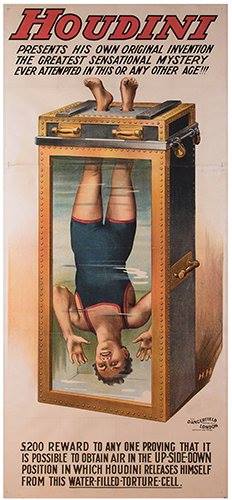
An original 1912 poster for Houdini's Water Torture Cell sold for a whopping $114,000 (including 20% buyers premium) at Potter & Potter's "The Golden Age of Magic Posters, Part II" auction today.

This makes it the highest price ever paid for a magic poster at auction. It may also be the highest price ever paid for any single piece of magic memorabilia, apart from the actual Water Torture Cell itself.

The estimate was $50,000/80,000. The poster is said to be one of only three known examples.

But this wasn't the only Houdini surprise. A King of Cards poster sold for a remarkable $24,000, a new record for that poster.

A playbill for Houdini "as a Magician" took $2,706. A broadside for a 1901 appearance in Prague brought $3,936. A playbill for Houdini's 1917 Antilles benefit took in $2,952. Even a 1-sheet for Paramount's Houdini (1953) found love at $922.

In other action, a "Hardeen Brother of Houdini" poster sold for $338. A poster for Houdini competitor Brindamour came away with $8,610. And a nice poster depicting Nicola in several Houdini-like escapes fetched $7,995.


All the posters in the auction came from the collection of Norm Nielsen. The hardcover auction catalog can be purchased from the Potter & Potter website while supplies last.

Potter & Potter's Spring Magic Auction on April 8th will conatin "a strong selection of Houdini-related material, including personal family photographs, documents, movie-related memorabilia, and letters."

UPDATE: Now we know we got this. Read: Look what's inside David Blaine's magic lair.

Related:

Thursday, December 15, 2016

Water Torture Cell poster at auction, February 4

Potter & Potter's "The Golden Age of Magic Posters, Part II" auction is set for February 4th, 2017. The just released catalog includes several Houdini posters. The most significant of these is a 1912 poster for his Water Torture Cell. This is one of only three know examples. Auction estimate is $50,000/80,000.


I can't help but correct this listing in one regard. It describes Houdini as being 5'2". According to a 1926 physical, Houdini stood 5'5.276". Why do people keep trying to shrink him?

Also at auction is a King of Cards poster, a playbill for Houdini's Grand Magical Revue, two Hardeen posters, a poster for Brindamour (described in the catalog as "Houdini’s most successful competitor"), and a nice poster depicting Nicola in several Houdini-like escapes.

All the posters in this auction came from the collection of Norm Nielsen. Norm also owned what I believe is the only surviving poster for Houdini's Overboard Box escape. Word is that poster was sold privately.

The Golden Age of Magic Posters, Part II catalog can be downloaded as a free PDF or purchased in hardcover from the Potter & Potter Auctions website.

UPDATEHoudini Water Torture Cell poster makes history at Potter & Potter auction.

Related:

Wednesday, February 10, 2016

Houdini and Brindamour: Showdown in San Francisco


Magic historian Gary Hunt, who blogs at Magic Footnotes and has made a specialty of researching escape artists of Houdini's era, has uncovered a story about Houdini and a rival "Handcuff King" that I don't think has ever appeared in print before. I'm excited to share that story today.

In September of 1907, Houdini was appearing in San Francisco at the Orpheum Theatre on Ellis Street near what's known as the Fillmore District. The Orpheum had relocated to the area while downtown was being rebuilt after the devastating earthquake and fire of 1906. Right next door to the Orpheum was another vaudeville house, The Princess.

During the final week of Houdini's engagement, a rival escape artist, Brindamour, was booked into the Princess Theater. Below is a photo from Brindamour's own scrapbook showing the side by side theaters at this time. In fact, you can see a Brindamour poster in front of the Princess.

Click to enlarge.

George W. Brindamour was born to French Canadian parents in Cannon Mills, Minnesota on April 5, 1870. A one time photographer, Brindamour began performing handcuff escapes at the turn of the century. He claimed to have been the originator of the handcuff act. With his mustache and goatee, it was said he also sometimes doubled on stage for Herrmann the Great (presumably Leon).

In 1900, when Houdini was first finding success in the U.S. under the management of Martin Beck, Brindamour twice appeared in opposition theaters in Providence and Philadelphia offering an exposé of Houdini's act. Soon Houdini was off to Europe and super stardom; but his absence allowed Brindamour to gain a foothold in America vaudeville with his own version of the handcuff act.

Gary reports that a confrontation between Houdini and Brindamour had been building during the summer of 1907. The men sniped at each other in the pages of Variety, which ran an ad touting Brindamour's $1,000 per week salary as the highest ever paid by the Western States Vaudeville Association. Rumor had it that the William Morris Agency had signed Brindamour to play against Houdini who had recently signed with a rival agency. As if to tweak Houdini even more, the Princess advertised Brindamour as "King of All Handcuff Kings." Variety predicted that "fur should fly" when the two rivals finally met in San Francisco.


So did Houdini march over to the Princess with his Bean Giant, Mirror Cuff, or one of his other "handcuff king beaters"? Did he send confederates to gum up Brindamour's act or knock down his advertising? (Recall Houdini once allegedly threatened to shoot down a balloon advertising Blackstone that flew within sight of his own theater.)

The September 21, 1907 issue of Variety reported what happened:

Jail Breakers at Peace
Despite the predictions of open warfare when the rival jail breakers (Houdini and Brindamour) came into as close a competition as they were last week in this city, the dove of peace reigned supreme over Ellis street. Both lock defiers pursuing the even tenor of their ways as though oblivious of the other’s existence.

Anticlimactic, I know, but that's also what makes this interesting. Why didn't Houdini go after Brindamour (or vice versa)?

Well, in 1907, Houdini was already looking beyond handcuffs and jail-breaking as his bread and butter. His feature that week was a challenge to escape from a box made by employees of the Emporium department store. The week prior he had escaped from a paper bag without tearing the paper. In fact, while Brindamour's was billed as King of all Handcuff Kings, Houdini's billing at the Orpheum was: "Houdini in New Sensations." So Brindamour might have seemed less of a threat to Houdini at this time, and to have engaged him would have just given him publicity. The best way to hurt Brindamour (and William Morris) was to do nothing.

But it's also possible Houdini and Brindamour might have made a truce. It's possible both men could sense that a spat over who was the superior "handcuff king" might seem trivial and petty to citizens of a city that was still digging out from one of the worst catastrophes of the 20th century.

After San Fransisco, Brindamour and Houdini never again crossed paths, and Brindamour would meet what The Santa Cruz Sentinel called his "waterloo" just a few weeks later in Sacramento.


Brindamour keep doing the handcuff escape act long after it went out of fashion. When bookings got slim, he would sometimes put on a full evening show or just do magic. He performed on all the major vaudeville circuits through the 1920s. He retired to Los Angeles in 1930 and was said to have played character roles in movies. George Brindamour passed away on July 31, 1941 at the age of 71.

Today the Orpheum and Princess are long gone, and Ellis Street has been subdivided with a shopping center and condos. (I visited the area last Halloween while I was in San Francisco for the Official Houdini Seance.) But it's fun to know that, for one week in 1907, Houdini and Brindamour shared the street as co-handcuff kings.


Thank you Gary Hunt for this story, photos, and additional background information on Brindamour.

Related posts:

Monday, February 8, 2016

The showdown is coming...

This week I will share an untold story about Houdini and George Brindamour uncovered by magic historian Gary Hunt.

Brindamour was a rival "Handcuff King" who taunted Houdini from his earliest days of success in the U.S. What happened when, thanks to an earthquake, the two were forced to share the same street?

It's "Showdown in San Francisco"... and it might not end how you think.

Translate