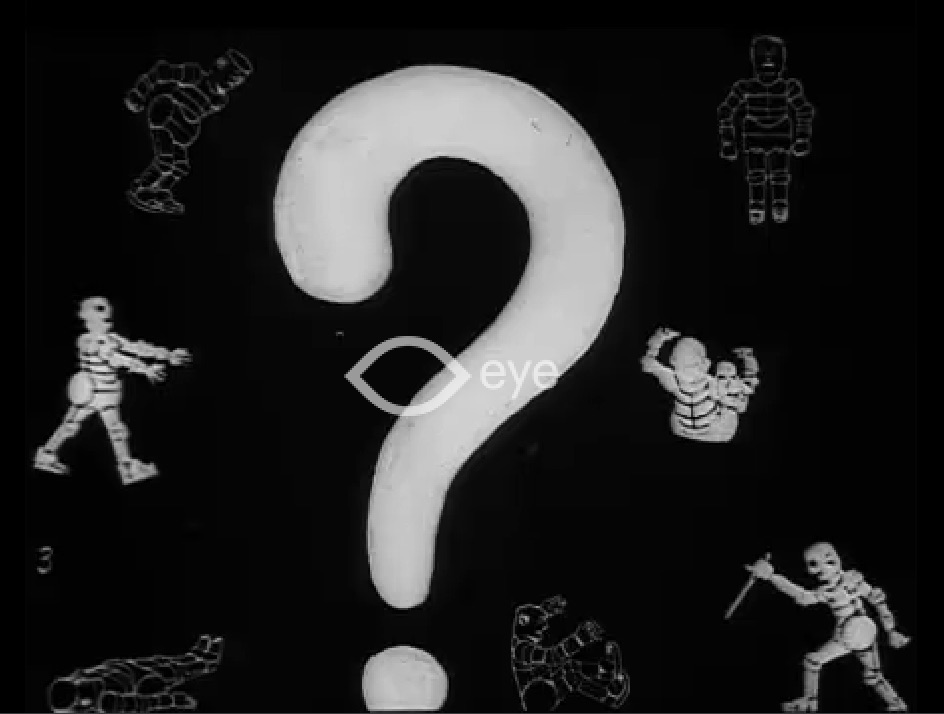
Today I can offer an update on The Master Mystery print held at UCLA Film & Television Archive. If you recall, Joe Notaro and I recently visited UCLA's Powell Library and viewed the movie in their Media Lab. While the (almost) complete movie is a revelation, the old VHS viewing copies were in bad shape, with the machine eating one tape and the second not playing at all. There was also a question regarding UCLAs ability to license the print for any potential restoration, and the mystery of where the print came from in the first place. Happily, I now have answers
Last week Joe and I returned to UCLA and viewed brand new DVDs made from the old VHS tapes. Yes, that means these precious images are now preserved as digital files. I was now able to view Episode 11 (missing from Kino), and it proved to be another fantastic installment. Joe and I agreed that this episode had the best fight scenes of the entire movie, with Houdini squaring off in an extended battle with the lead thug who menaces him throughout the movie. I especially like that Houdini is dressed in tuxedo tails during the fisticuffs.
As to the origin of the print and the question of licensing, an old friend and rare magic book dealer John Cannon of Aladdin Books gave Joe and I the scoop over lunch following the Magic Castle swap meet in Hollywood a few weeks back. (He also sold me Edward Saint's own copy of Houdini's Paper Magic, so it was a good lunch!)
Turns out the 16mm print was part of the collection of John Hampton, who ran The Silent Movie Theater in West Hollywood for many years. It was here that Patrick Culliton saw the entire serial twice in the late 1950s and early '60s, an experience he never forgot. But Hampton contracted lung cancer from his hours working with the chemicals involved in film restoration, and mounting debt forced him to sell off 3/4 of his collection, including The Master Mystery, to David Packard of the Hewlett-Packard empire. John Hampton died in early 1990 at the age of 83.
But the movie had landed at an excellent home. David Packard is a passionate champion of film preservation via his Packard Humanities Institute. The Institute works with the UCLA Film & Television Archive, who hold hundreds of films on their behalf. A full list of those films on the Packard website shows The Master Mystery as one of their "works in progress." The film had also arrived not a moment too soon. The original 16mm print was showing signs of vinegar syndrome, so a preservation negative was created, saving the film.
So there doesn't appear to be any contractual impediment to using this print for the purposes of a full restoration, but one would need to approach the Packard Institute, not UCLA. I've also learned that the library of the Douris Corporation, who own the print used for the McIlhany/Kino restoration (which has two chapters missing from UCLA/Packard), was sold to Cohen Media Group in 2011, so there's a new player in the game.
However, the overall quality of the UCLA/Packard print is a reality that hit me on this second viewing. While it's true the print is free of significant film damage, it is from a 16mm source, so it is not nearly as sharp as what one sees on Kino, which I suspect came from 35mm. In fact, it could be that Bill McIlhany, who certainly must have known about the UCLA print, decided to use the less complete Douris print precisely because the image quality was so much better. So any combined restoration would require some serious work to improve the image quality of the UCLA print, and that might be a big job. So there would need to be the money, the will, and the expertise to take on this task.
But the good news is the negative is safe, the movie is available for anyone to watch at UCLA on DVD, and Houdini's complete Master Mystery survives as we approach its 100th anniversary. A happy ending.
Thanks to Maya Smukler of UCLA, John Cannon of Aladdin Books, Joe Notaro of HHCE, and Joe Fox. Also thanks to the helpful student staff at the UCLA Media Lab.
Related:
- Home
- Life
- Escapes
- Magic
- Movies
- Houdini's Movies
- Les merveilleux exploits de Houdini à Paris (1909)
- The Master Mystery (1918)
- The Grim Game (1919)
- Terror Island (1920)
- The Man From Beyond (1922)
- Haldane of the Secret Service (1923)
- Velvet Fingers (1925-26)
- Medium Well Done (1937)
- Religious Racketeers (1938)
- Houdini Picture Corp.
- Film Developing Corp.
- Filming locations
- Unmade Movies
- Deconstructing Houdini '53
- Spiritualism
- People
- Beatrice Houdini
- Theo Hardeen
- Cecelia Weiss
- Mayer Samuel Weiss
- Jim Collins
- Franz Kukol
- Martin Beck
- Sir Arthur Conan Doyle
- Margery
- J. Gordon Whitehead
- Edward Saint
- Jacob Hyman
- Leopold Weiss
- Carrie Gladys Weiss
- Bernard M.L. Ernst
- Charmian London
- Jess Willard
- H.P. Lovecraft
- Sherlock Holmes
- Assistants
- Imitators
- Other magicians
- Media
- Full Bibliography
- By Houdini
- Biography
- Fiction
- Foreign
- For Kids
- Methods
- Wild About Harry Bookshelf
- Houdini His Life Story (1928)
- Houdini The Man Who Walked Through Walls (1959)
- Houdini The Untold Story (1969)
- The Life and Many Deaths of Harry Houdini (1993)
- Houdini!!! The Career of Ehrich Weiss (1996)
- The Secret Life of Houdini (2006)
- The Metamorphosis: The Apprenticeship of Harry Houdini (2012)
- The Witch of Lime Street (2015)
- The Life and Afterlife of Harry Houdini (2019)
Showing posts with label UCLA. Show all posts
Sunday, September 23, 2018
Friday, August 31, 2018
A Master Mystery revelation at UCLA
Two weeks ago, Joe Notaro and I met at the beautiful Powell Library on the UCLA campus. We were there for, what else, Houdini! Now, I've long known that the UCLA Film & Television Archive has a copy of The Master Mystery that is (almost) complete. But for whatever insane reason, I've not made the time to go watch it. Joe has made the time and has done some great work identifying the differences in the various available versions. So if you want to get into the details, check out Joe's blog. What I'm going to do here is share what I saw in general, and explain what a revelation it was!
For starters, August 17, 2018, was the first time I ever saw The Master Mystery. Yes, I have the Bill McIlhany VHS and the Kino DVD (both made from a print in the Raymond Rohauer Archive licensed by the Douris Corporation), and I've watched those many, MANY times. But I now realize what I was watching was not The Master Mystery at all. That is a severely truncated version of the serial that dramatically alters the structure, story, and even the spirit of what was shown to audiences in 1918 and 1919. At least that's true of the first 6 episodes, which is what I'm going to focus on here.
To set the scene, Joe arranged for us a private room with a desk and table inside the UCLA Media Lab, which is a great way to watch and study the movie. Research copies are made available on VHS, which the student staff load into a bank of players that feed the individual stations and rooms. Here you have the ability to fast forward, pause, etc., and we did a lot of that!
I already blogged about the incredible newsreel footage from Houdini's 1913 Success challenge, which is what we watched first. But then it was Master Mystery time.
The movie
Episode One is largely the same as what one sees on Kino, apart from a few additional title cards (which Joe has meticulously documented). Episode One is a pleasure to watch with a nice handcuff escape at the midpoint and rousing action that culminates with an unconscious Houdini (as Quentin Locke) being strapped into a straitjacket. That's where the cliffhanger ending occurs.
Episode 2 picks up with the conclusion of the straitjacket escape, and here's where the UCLA version begins to diverge from the commercially available versions. On Kino, Episode 2 ends with Houdini tied to the coat rack. It's an abrupt cliffhanger and a bit of a letdown as it's the first escape in that episode. But maybe that was the nature of these old serials, right? Get you where you want to be and then..."To Be Continued Next Week." This is what I've always thought, and it turns out I've been dead wrong!
In the UCLA version (the real film), the coat rack escape plays out in full in the middle of the episode. It was never a cliffhanger. In fact, this establishes the structure of what is to follow. There are three major escapes or action sequences per episode, which makes for a very different viewing experience and a heck of a lot of fun! Episode 2 continues all the way to the Bakers Dock sequence and cliffhangs (is that a term? -- it is now!) with a bound Houdini and a thug falling into the water. It was at this point I turned to Joe and said, "This is a completely different movie!" Joe's answer, "Just wait."
The next four episodes--and that's more than an hour worth of movie--are entirely new. (Only a few fragments of the Bakers Dock sequence show up in Kino.) And it's not just new escapes. There are whole plot-lines that makes The Master Mystery work story-wise in a way that it just doesn't on Kino. Again, if you want the scene by scene breakdown, check out Joe's blog. But among the things we see right away are both underwater escapes at Bakers Dock play out in full. Seeing Houdini escaping ropes and chains underwater is a beautiful thing to behold.
The Acid Vat escape, a fragment of which is only available as a extra on Kino, plays out at the end of Episode 3 and is wonderfully suspenseful as it intercuts Marguerite Marsh's Eva approaching the cabin and reaching for the doorknob, which we know will dunk Harry into the acid. So much fun. So too is the sequence in which Houdini is tied inside a rooftop water tank with the spigots turned on full. This is the escape I was most looking forward to seeing on this day, and I was not disappointed. It's spectacular! But, surprisingly, it was not the escape that left the deepest impression.That happens at the midpoint of Episode 3 when Houdini is locked inside a jail cell. There is a magnificent closeup of Houdini at the bars as he turns his intense gaze to the lock. In another closeup, the faceplate on the lock disappears and we are suddenly able to see inside the mechanism as the gears begin to unlock by some invisible force. It's a wonderfully creative way to show the escape, and there isn't anything like it in any other Houdini movie. It knocked me out.
I should stop here to say that the great Patrick Culliton saw the complete Master Mystery projected many years ago at The Silent Movie Theater in Los Angeles. Not only does he remember the three escapes per episode, but he also always mentions this jail escape. It has remained vivid in his mind for decades. Now I understand why!
Episode 4 is also a stunner, and it has an important connection to Houdini history. At the midpoint of the episode, Locke and Eva travel out on a lake to test a special diving suit. The Automaton and his collection of thugs pursue them in their own boat. (The idea of the Automaton as the leader of the gang is made much clearer in the complete version.) This is all filmed on an actual body of water, and seeing the Automaton on a skiff is wild stuff. But what's most exciting is we get to see Houdini escape from his diving suit underwater, separating it at the waist using the "quick release" mechanism of his real-world patent. Fantastic.
Characters are also introduced and developed in these episodes in important ways. Ruth Stonehouse is far better developed and is clearly featured. So to is Edna Dixon as Deluxe Dora. A great sequence is when Houdini visits Dora's luxury boudoir apartment. Here he rummages through her roll-top desk until a booby trapped box explodes in his face, blowing him back over a chair. It's a stunt Houdini clearly does himself. (It's depicted on the Episode 5 poster.) And speaking of explosions, Episode 5 into 6 features a fantastic ticking bomb sequence. When the bomb goes off, it flattens Houdini under a doorway and blows the Automaton out into the street. Yes, the Automaton is "killed" as part of the story. But when Locke and Eva later sneak into a dark lab to examine his remains, laying Frankenstein-like on a table... "It's alive!"
Episode 7 is where the UCLA version and Kino join back up. The UCLA print is missing Episodes 8 and 10 (which are available on Kino). Episode 11 is missing from Kino, but available in full at UCLA. Episodes 12-15 are the same in both. I should also note there is very little film damage visible in the original UCLA source.
What aren't so pristine are the Media Lab's current viewing copies. Time is taking its toll on these. In fact, while we were watching, the machine started eating the first tape! As you might imagine, Joe and I freaked out. Were we watching Houdini history being devoured before our eyes? The second tape--the one that contains the new Episode 11--would not play at all (so I didn't get to see that episode). Joe had watched this tape in the past, so it appears it has only recently died.
Fortunately, the original 16mm film is safely stored in the UCLA vaults, and the very helpful staff said they would look into having fresh tapes made from the source. Unfortunately, they are not set up to make digital copies, which is what really needs to be done.
So why haven't we seen this version of The Master Mystery on DVD? Why can't we stitch this and the Rohauer/Douris print together and make the complete serial available for all?
I only spoke briefly with the helpful head of the department, Maya Smukler, so I don't have all the facts, but it's clear that UCLA is not able to license this as they can their other material. Why that is will have to be investigated. But let's hope there is some way to get this out there. Because everyone should see and enjoy The Master Mystery the way Houdini made it. The way I saw it on this memorable day at UCLA.
Thanks again to Joe Notaro for finally getting me to UCLA. Also thanks to Maya Smukler, Susan Tenenbaum, and the student volunteers who helped us out.
UPDATE: A Master Mystery UCLA update.
Related:
Friday, August 24, 2018
Houdini vs. Captain Smith and the Success
Houdini's escape from the convict ship Success on June 4, 1913 is not one of his more widely known challenge escapes. This could be because no photos from the stunt have survived. Nevertheless, this is one of his great escapes, and it's a story worth telling in detail. And while no photos exist, film footage does! But I'll get to that.
The Success was a former Australian convict ship commanded by Captain David H. Smith. In 1911, it came to the United States to tour as a floating museum and tourist attraction. For fifty cents, visitors could view shackles and torture devices on deck, and go below to see cells containing wax figures of prisoners in restraints. There was also the infamous "Black Hole" in the stern of the ship; two solitary confinement cells two-feet square in which a prisoner "could neither sit down nor stand upright." Captain Smith offered $100 to any woman who could remain confined in the Black Hole for a specified period of time. A student nurse from Somerville won the contest and gained local fame by remaining a remarkable 30 hours.
In the summer of 1913, the Success arrived in New York City and docked at 79th St. and Riverside Drive. It was opened daily 10 A.M. to 10 P.M., and proved to be a popular attraction.
Meanwhile, an ocean away, Houdini was boarding his own ship, the North German-Lloyd liner Kronprinz Wilhelm. He was headed home to New York where he was set to open at Hammerstein's Victoria on June 2. Here he would present the American debut of his latest invention, The Chinese Water Torture Cell.
Always keen for publicity, Captain Smith sent a cable to Hammerstein's proposing a challenge. The cable was relayed to Houdini at sea. This resulted in the following spirited exchange:
ON BOARD CONVICT SHIP "SUCCESS"79th St. and Riverside Drive.New York City, Wednesday, May 21, 1913.Dear Sir:--Hearing you are bringing Houdini back from Europe for a special two weeks' engagement, I hereby challenge your star to escape from one of the cells on board the historical Convict Ship "Success."
If you will allow me to manacle him, lock him into one of the cells, I am ready to wager that he will not escape.
(Signed) D.H. SMITH, Captain.
Radio Mid-OceanON BOARD N.D.L. KRONPRINZ WILHELMFriday, May 23, 1913
Accept challenge any time mutually agreed upon to undergo test. Want no favors, but demand fair play.
(Signed) HOUDINI.
HOUDINI, N.D.L. KRONPRINZ WILHELM (Via Wireless)New York City, Saturday, May 24, 1913
Will give you fair play. Come to Convict Ship "Success," 79th St. and Riverside Drive, Wednesday, June 4, one-thirty P.M., prepared to undergo test, which I feel certain will be the most difficulty one you have ever undertaken.
(Signed) CAPTAIN SMITH.
The merging of these two New York summer attractions was inspired, and the challenge was well advertised. On Wednesday, June 4, Houdini arrived at the appointed time, as had a large crowd to witness the contest. The wager between Captain Smith and Houdini was set at $1000. A much later account in the Lewiston Journal claimed Houdini first escaped from shackles and a straitjacket while hanging from the ship's yard arm, but I've found no evidence to support this.
Captain Smith first brought Houdini to the Black Hole. But Houdini refused. "I wouldn't go in your Black Hole for $1000," he said. Instead, Houdini was locked in one of the "refractory" cells on the lower deck. Here the heavy cell doors were made of ancient teakwood and six inches thick. He was also manacled and secured to a ringbolt attached to the hull.
The New York Evening Telegram reported that it took Houdini one hour and forty-five minutes to escape, then:
In some mysterious way he gained his freedom through one of the portholes of the old ship, and the first news of his escape came from the hundreds aboard and ashore when, with a cry of triumph, Houdini, broken chains and fetters still clinging to legs and arms, dived into the waters of the Hudson and swam about until picked up by a boatman.
Captain D.H. Smith, who commands the Success, was as discomfited over the escape of Houdini as the latter was elated.
As I said, there are no photos from this day (that I'm aware), but there is film! Newsreels were on hand to record the event, and this footage, which has never been shown in any documentary or made available on any DVD, is housed at the UCLA Film & Television Archive. I recently had a chance to watch it along with Joe Notaro, who first revealed the existence of this footage on his blog, Harry Houdini Circumstantial Evidence. Unfortunately, UCLA does not allow photos, so (like Joe), I'll just have to describe what I saw.
The footage runs approximately two and a half minutes and starts off with various shots of the Success itself. We see a reenactment of prisoners being marched up the gangway. We also see a variety of restraints and torture implements on deck, including a Spanish Maiden (check out Houdini Escapes and Magic page 313 for a similar case).
Following a static card explaining the $1000 challenge, we see Houdini and Captain Smith posing with a group of men. Houdini is wearing a dashing hat (which can be seen here), and is grinning broadly--so much so his upper lip seems to fold over his teeth--a true Cheshire Cat grin. He looks sensational and you can really feel his charisma coming off the screen.
![]() |
| Wax figure in a Success cell. |
Houdini then pulls himself up on a dock, barefoot in sopping wet clothes. Jim Collins stands off to one side with some other unidentified men. Houdini looks powerful and fit as he hitches up his pants and tucks in his shirt. (I'm struck by how he looks very much the same as he does in the 1909 Rochester footage.) Hardeen then briefly steps into frame, waving Houdini forward with a quick jerk of his arm as if saying, "Let's go!"
The final shot shows Houdini posing in an open top car with a large group of men, including Hardeen. Houdini is still wet and grinning broadly. But what's most striking in this shot (and it took Joe and I a few viewings to catch this) is that Houdini's brother Dr. Leopold Weiss is at the wheel of the car! This is the only film footage I've ever seen of Leopold. There the film ends.
This footage offers a remarkable document of this fantastic escape, and of the Success itself. It's also likely the last film footage of Houdini before his mother's death just several weeks later, which was said to have changed him noticeably. So I feel like this escape, and this film, captures Houdini at the zenith of his powers and personal happiness. He feels youthful and exuberant, even standing still he beams. But maybe that's because he just won $1000.
The Success would continue to tour the U.S. for many years. In 1915 it arrived in San Francisco for the Panama–Pacific International Exposition (where Houdini did an overboard box escape). Below is film of Roscoe "Fatty" Arbuckle and Mable Normand visiting at the ship during the exhibition and being shown around by, presumably, Captain Smith himself.
Years later the Success was branded a hoax -- that it was never truly a convict ship. The ship finally met its end by fire near Port Clinton, Ohio, on July 4, 1946.
Today the site of the Success challenge is the 79th Street Boat Basin, operated by the New York City Department of Parks and Recreation. It's still home to boats and even the occasional floating museum ship, just like Success.
Hope you enjoyed this look back at the Success challenge and the description of the rare UCLA film footage, which I hope can be made available for all to see one day. (If you're interested, the exact catalog listing is HERE.)
But this was not the only film Joe and I watched that day. Check out: A Master Mystery revelation at UCLA.
Wax figure image is from Richard Norgard's blog The Sailing Ship Success. 79th Street Boat Basin pic courtesy of Tom Frueh.
Related:
Thursday, November 10, 2016
Houdini's underwater battle surfaces
Houdini collector Arthur Moses recently made a terrific discovery via Elif Rongen, Curator of The EYE Filmmuseum in Amsterdam. The screen caps below come from a 9 minute compilation of footage from a Dutch print of The Master Mystery. Among the clips is Houdini underwater in a diving suit fighting with another diver. This footage is missing from the current Kino DVD release of the film, so this is unseen Houdini here!
According to Joe Notaro, who recently made a thorough study of the missing Master Mystery footage, this scene was originally part of Episode Four: "The Test." (Not Episode Five, as claimed in the Kino explanatory cards.)
In the episode, Locke is testing a "self-liberating diving suit" with Eva's assistance. But beneath the waters Locke is ambushed by another diver. "There, under the sea, commenced a battle royal!" The villainous diver draws a knife and severs Locke’s oxygen tube (which is what we see in the Dutch clip). But Locke manages to escape the suit...Houdini style!
Unfortunately, the Dutch clip does not include the escape itself. However, Joe points out that an archival print in the collection of the UCLA Film Archives does include the full sequence. But UCLA does not allow copying or screen captures, so this is best look we'll get until someone embarks on a proper restoration.
There is another layer of interest here. Houdini invented a diving suit with a quick release mechanism for emergencies. It's said he did so "after word came to him that one of his best friends, a diver in Australia, was lost when his air lines were destroyed." Houdini shared his patent with the U.S. Navy, believing it could save lives. Newspapers at the time noted that the scene in The Master Mystery shows "a practical working demonstration" of Houdini's great invention.
Below are some of the unique title cards that appeared in this Dutch print, along with a newspaper advert from the time. Cinema Context records 23 screenings of "Houdini, de boeienkoning" in The Netherlands from August through October 1920.
Recently I learned that The Master Mystery may contain another Houdini icon that could exist in the cut scenes. I'll dig a little deeper and see what I can discover about that one. Stay tuned.
Thanks to Arthur Moses, Elif Rongen and Joe Notaro.
In the episode, Locke is testing a "self-liberating diving suit" with Eva's assistance. But beneath the waters Locke is ambushed by another diver. "There, under the sea, commenced a battle royal!" The villainous diver draws a knife and severs Locke’s oxygen tube (which is what we see in the Dutch clip). But Locke manages to escape the suit...Houdini style!
Unfortunately, the Dutch clip does not include the escape itself. However, Joe points out that an archival print in the collection of the UCLA Film Archives does include the full sequence. But UCLA does not allow copying or screen captures, so this is best look we'll get until someone embarks on a proper restoration.
There is another layer of interest here. Houdini invented a diving suit with a quick release mechanism for emergencies. It's said he did so "after word came to him that one of his best friends, a diver in Australia, was lost when his air lines were destroyed." Houdini shared his patent with the U.S. Navy, believing it could save lives. Newspapers at the time noted that the scene in The Master Mystery shows "a practical working demonstration" of Houdini's great invention.
Below are some of the unique title cards that appeared in this Dutch print, along with a newspaper advert from the time. Cinema Context records 23 screenings of "Houdini, de boeienkoning" in The Netherlands from August through October 1920.
Thanks to Arthur Moses, Elif Rongen and Joe Notaro.
Related:
Wednesday, April 27, 2016
Houdini haunts UCLA
Today I had the pleasure of being a guest speaker at Tom Ogden's course Boo! Ghosts and Hauntings at UCLA Extension OSHER. This class focused on magic and magicians in the world of the paranormal. Tom covered the first half with a discussion that took us from Ancient Egypt through 1950s Spook Shows and The Amazing Randi. He then gave me the second half to discuss the greatest ghostbusting magician of them all -- Houdini!It was a great group who really seemed to take an interest in the subject. I also brought along a signed copy of A Magician Among The Spirits to share with the class.
Thanks to Tom Ogden and Mark Willoughby. Be sure and visit Tom's official website.
Related:
Sunday, March 6, 2016
Puzzling together The Master Mystery
Our great friend Joe Notaro at Harry Houdini Circumstantial Evidence is attempting to reassemble, at least in words, Houdini's complete 15-part movie serial The Master Mystery.
Several versions of the 1918 serial exist on DVD, VHS, and in film archives. Joe has reviewed them all closely and believes he has now seen the complete serial. (Read: I have finally seen all of The Master Mystery.)
Joe has launched a series of posts that take a close look at each version, clarifying exactly what is missing and what is included. Below are links to each installment:
Several versions of the 1918 serial exist on DVD, VHS, and in film archives. Joe has reviewed them all closely and believes he has now seen the complete serial. (Read: I have finally seen all of The Master Mystery.)
Joe has launched a series of posts that take a close look at each version, clarifying exactly what is missing and what is included. Below are links to each installment:
Thanks to Joe for taking on this important and long overdue project. Maybe this will help aid in a true film restoration effort one day!
Related:
Related:
Thursday, October 22, 2015
Houdini at UCLA
Yesterday I had the great pleasure of being a guest speaker at Tom Ogden's class on the History of Magic at UCLA Extension. Yesterday's class focused on magic in the 20th century, and Tom kindly invited me to cover Houdini. It was a real honor and the students seemed to enjoy it.
Houdini and I took up the first hour of the class. In the second, Tom discussed other famous magicians of the 20th Century and also demonstrating several magic tricks. I was "volunteered" to be sawed in half on a classroom table, which I'm happy to report was a success! (Only afterwards did Tom admit that he's never attempted that trick before.)
Thanks to Tom Ogden and Mark Willoughby for the fun and informative day. Be sure and visit Tom's official website.
Houdini and I took up the first hour of the class. In the second, Tom discussed other famous magicians of the 20th Century and also demonstrating several magic tricks. I was "volunteered" to be sawed in half on a classroom table, which I'm happy to report was a success! (Only afterwards did Tom admit that he's never attempted that trick before.)
Thanks to Tom Ogden and Mark Willoughby for the fun and informative day. Be sure and visit Tom's official website.
Subscribe to:
Posts (Atom)