Showing posts with label Physical traits. Show all posts

Sunday, May 10, 2026

Pateron double reward in May

Every month, I offer my patrons a special reward as thanks for their support. This month, I'm offering a double reward. The first is the Third Quarter 1993 Mystifier newsletter as a searchable PDF. It's an interesting issue with an insightful article on Houdini's physical fitness routines by Zen Karate author Randall Bassett, the first printed interview with Houdini's assistant Dorothy Young, and even Houdini's horoscope! In addition, I'm offering a PDF of the 1994 Museum Catalog from the Houdini Historical Center. You see all the goodies one could get at the time.


As a reminder, on my Patreon, I offer exclusive content not found on this blog, including material from archives and private collections, as well as my latest historical findings. For example, I recently shared a translation from a 1901 Dutch newspaper interview in which Houdini offers details about his time as a locksmith's apprentice that I've never read before. But do we believe it? This one has sparked a lot of conversation in the comments.


As a patron, you will also receive thanks in my upcoming book, Handcuff King: The Conquests of Harry Houdini, 1900-1909, a special preview of that book, and an exclusive pre-order opportunity. That's all coming later this year. Oh, and you'll also be supporting all my Houdini work, which is the point of Patreon: supporting creators.

So if you are wild about Harry, joining my Patreon is a pretty good idea this year. And what better time than during a month with a double reward? So come hang with us!

Wednesday, June 8, 2022

The mystery of "Scotch May"

In the 1969 biography Houdini The Untold Story, author Milbourne Christopher relates a curious story from the Houdinis home life. He writes:

    The star of The Master Mystery was confronted by a minor mys­tery in his own home. When Houdini was in Scotland, Bess had hired a maid, Bethel May Dove, and brought her back with them to New York. Bethel May was a conscientious worker and seemed to enjoy her work in the Houdini household. She was twenty-one and almost a part of the family. One night Bess went to Bethel May’s room to give the girl her instructions for the next day. Ten minutes later Bess passed the door again and noticed that it was open. She walked back, looked in. Miss Dove was gone; so were her clothes and her wardrobe trunk. Harry told the police he thought she might have run away to marry a soldier. He knew exactly how his elephant disappeared, but the vanishing Dove baffled him.

I don't know Christopher's source for this [see UPDATE], but Houdini confirmed the maid's existence in a letter he wrote in June 1919 to a Mr. DeVega in Glasgow. The letter is in the collection of Edwin A. Dawes and in it Houdini writes:

    Our Glasgow maid ran away with a soldier, and hope she has been lucky in her choice.
    You know we took a scotch girl along to America. Such is life.

The missing maid doesn't get much of a mention in any other biography and she has pretty much slipped into obscurity. "Such is life" indeed. But now the case may be reopened as we might have finally found the missing maid...and more!

The current issue of Marco Pusterla's Ye Olde Magic Mag contains a fascinating article about a Scottish woman named Evelyn Kaye who claimed the Houdinis were her guardians for seven and a half years. The source is an undated article from a Glasgow newspaper (Marco speculates it was probably from around 1950). The article makes quite a few mistakes, such as saying Houdini died in 1934, but Evelyn's tale is intriguing. Here's an excerpt:

    Mrs. Kaye comes of a theatrical family. Her mother, known as Jessie Crawford, was an actress in old-time melodramas at the Princess's Theater in the days of Richard Walden.  
    When Houdini first came to Glasgow to perform at the Coliseum music hall in 1912, he and his wife and secretary lodged with the family in Abbotsford Place.
    They became great friends. Two years later when the Houdinis were going to America it was agreed that they should take Jessie Crawford's delicate 12-year-old daughter with them for her health's sake.
    A year later her mother died and the child was left under the guardianship of Houdini who later made her his dresser and co-assistant with Mrs. Houdini in a number of his illusions. They always called her "Scotch May."

The article goes on to say that the one-time "Scotch May" knew the methods of Houdini's Vanishing Elephant and Walking Through a Brick Wall, but that she would never reveal Houdini's secrets. It also says she married a Glasgow optician, but was now widowed. Interestingly, she had reached out to magician Robert Harbin, who was performing at Glasgow's Pavilion Theater, and knowing Houdini had a magician brother named Hardeen, asked Harbin if he was also related to Houdini. Harbin introduced her to a newspaper reporter and that is how this article came to be.

It was our friend and long time reader Leo Hevia who made the connection to the story in Christopher. So could Evelyn Kaye be the missing maid?

There are some discrepancies. Houdini was not in Scotland in 1912. But he was there in 1913. The two women have different names, but "May" is common between them and Kaye is likely a married name. We see in the DeVega letter that she came from Glasgow, but the letter can also be read as if Houdini is talking about two different women. And the math doesn't quite work as Christopher says the maid was 21, but the newspaper account would make her closer to 18-19 at the time of her vanishing act. But none of this is fatal to the case and more fits together than not, so I think it's very likely Bethel May, Evelyn Kaye and "Scotch May" are the same person.

This opens the door to a few possibilities. On occasion, Bess would talk about having a daughter. I've always thought that was bizarre, but perhaps Bess is talking about May who is, essentially, an adopted daughter. It also may be time to re-check post 1914 photos and see if we can catch a glimpse of Scotch May herself.

Finally, if we've discovered a new member of Houdini's household, is she able to provide any fresh insight? Well, she does, and it's a bit of a bombshell! Regarding Houdini as a person, the original article reads.

    He didn't drink or smoke, Mrs. Kaye tells me, and he worked indefatigably, often taking two years to perfect a single illusion. He taught himself 12 languages, and towards the end of his life was going blind, like his mother, his sister and his brother, an X-ray research doctor.

So here we have yet another mention of Houdini's faulty eyesight. But going blind? And his mother blind??? This is first time I've ever heard that. But the mention of his sister and brother's blindness is correct. Also, this article ran while Leopold was still alive, so knowledge of his blindness, which came on later in his life, just bolsters Evelyn's insider credentials. 

So maybe she revealed a Houdini secret after-all?

Houdini going blind?

A big thank you to Leo Hevia for his research. To Marco Pusterla of Ye Olde Magic Mag for permission to quote the original article. And to Edwin A. Dawes for showing me the original Houdini maid letter.

UPDATE: Our friend Marco Pusterla has discovered that Milbourne Christopher's source for the maid story was the November 15, 1918 issue of The Sphinx. This puts the disappearance around that time. The article also confirms that Bethel May came with the Houdinis from Scotland "six years ago", which also generally matches Evelyn's account. So just more evidence that Evelyn and Bethel are one in the same. Thanks Marco!

Saturday, April 23, 2022

Was Houdini about to retire the Water Torture Cell?


Here's an interesting detail from a review of Houdini's "3 Shows in One" at the Shubert Theater in Cincinnati in September 1925.

The Cincinnati Enquirer, Sept. 21, 1925.

It's somehow surprising to hear Houdini make a reference to his advancing age on stage. But what a good way to create in some extra tension. I also think he was sincere and was looking to replace the USD with a new second act escape. Sid Radner claimed it was to be his unnamed nest of boxes escape. But when Houdini embarked on what would be his final "3 Shows in One" tour the following year, he introduced his Buried Alive escape in Boston and Worcester. 

But then the Water Torture Cell returned and was still his go-to escape at the time of his death. So I guess we'll never know if or when Houdini would have finally retired the USD.

Related:

Wednesday, February 23, 2022

Handiwork

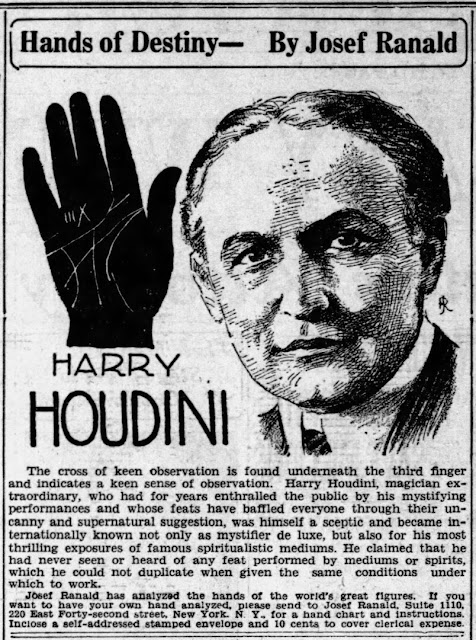
Returning to our Weird Week theme, here's one for all you aspiring palm readers. This article ran in the Moline Daily Dispatch on April 13, 1932, and offers a look at Houdini's right palm (allegedly). Note the "cross of keen observation"!


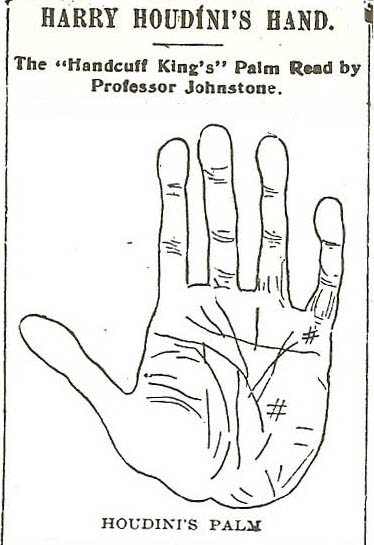
This is not the first time Houdini's palm appeared in newsprint. In 1900 a Kansas City paper reported that Houdini had his "hand examined" by a local palm-reader, Professor Paul Alexander Johnston, and ran the illustration below. This shows his left hand, so that gives us both of Houdini's palms to examine.


Does this mean Houdini believed in palmistry? Before we jump to that conclusion, let's hear from the man himself. The topic came up during Houdini's 1926 testimony before Congress, and here's what he had to say:

Mr. McLeod: Is it a fact that palmistry is a science?
Mr. Houdini: No; it is not.
Mr. McLeod: What do you call it?
Mr. Houdini: It is a fraud. How can you tell anything the lines of the hand? You can tell whether a man is a bricklayer or a bank clerk.
Mr. McLeod: And that is as far as you can go?
Mr. Houdini: That is a far as anybody can go unless they deduce from reading you.

Sounds like he's using his cross of keen observation.

Images: Newspapers.com and 'Houdini His Legend and His Magic' by Doug Henning.

Related:

Wednesday, February 2, 2022

Strange Harry

Here's an unusual photo of Houdini that ran with a review of the William Lindsay Gresham biography, Houdini The Man Who Walked Through Walls, in the London Evening Standard on March 29, 1960 (Headline: "Oh, why do they have to give Houdini away?") At least it says this is Houdini! I'm not familiar with this photo and it almost looks like a Houdini impersonator or even a wax figure. A strange Harry indeed.

Saturday, December 4, 2021

All business

Here's a portrait photo of Houdini you don't see too often. There is a more famous photo taken during this same session that shows Houdini smiling. But here he is all business. This comes from the January 1927 Spanish movie magazine, Cine-Mundial.


While most associate these photos with Houdini's Hollywood days and date them as 1919, I recently found this image used in a 1918 movie magazine. So it appears these were taken in New York and mark some of the first portraits taken of Houdini with his cut and dyed hair and without his mourning suit (yes, I still believe my theory). 

Monday, October 4, 2021

Houdini arrives in Providence


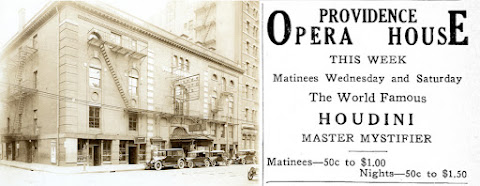
It was 95 years ago today that Houdini opened his "3 Shows in One" at the Providence Opera House in Providence, Rhode Island. He had originally been booked to appear the week of September 20. But he was extended for a third week in Boston, so that pushed the Providence engagement to the week of October 4, 1926. This would be his tenth and final appearance in the city.

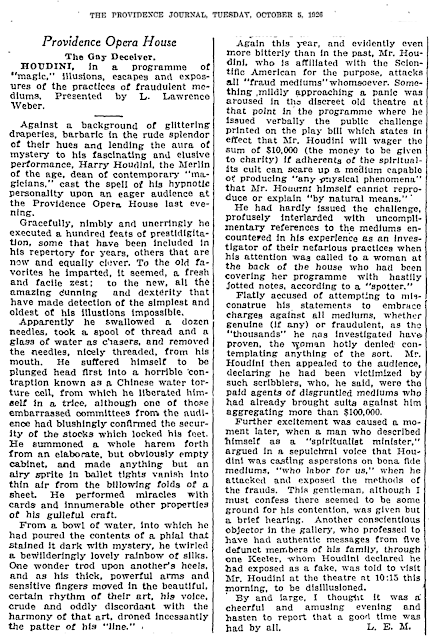
The Providence Journal gave the opening night show an enthusiastic review in the Tuesday, October 5th issue. Below is that review in full.

Click to enlarge.


The show ran nightly with matinees on Wednesday and Saturday. According to Billboard, it played to capacity business all week long.

There were also some notable events that happened off stage this week. Houdini met with H.P. Lovecraft and C.M. Eddy to discuss their collaboration on The Cancer of Superstition. He lectured to students at Brown University. Bess was also stricken with food poisoning near the end of the run, causing Houdini great worry and to stay up nights. This is typically seen as the first on a series of unfortunate incidents that would culminate with Houdini's death on Halloween 1926.

I have a particular fascination with this Providence engagement as earlier this year I acquired an original window card advertising this very week. I first shared the card during a special S.A.M. Houdini birthday celebration on Zoom back in March. Magician Dave Thomen recently shared a clip on Facebook, and I was excited to see this as it provides a look at the card pre-restoration. Not bad for 95 years old!


The Providence Opera House was located at 115 Dorrance Street at Pine Street. It was built in 1871 and could seat over 1400 people. For many years it provided family friendly entertainment and was one of the most prestigious venues in Rhode Island. It closed on March 14, 1931 with a final performance by Providence-born George M. Cohen. It was demolished soon after.

Below is Dorrance Street today. The long featureless black building on the left is where the Providence Opera House and the Narragansett Hotel once stood.


Thanks to Bill Mullins for his research tips. For more on the history of the Providence Opera House check out Rhode Tour.

Related:

Saturday, August 7, 2021

Review: Man Vs History Vs Houdini


Houdini is the subject of the third episode of the new series Man Vs History with Bil Lepp. The show had its first airing last Tuesday on HISTORY and offered up a new and refreshing approach to the Handcuff King.

Instead of a standard biography or rehash of the well-trodden spy and murder conspiracies, this episode tackles two specific claims, both rooted in reality, of how Houdini may have accomplished his feats. This first is Houdini's own claim that he dislocated his shoulders to escape from a straitjacket. The second is the recently uncovered claim by Hardeen that a bullet in his brother's hand allowed him unique dexterity in slipping off handcuffs.

Lepp's investigation brings him to Houdini collector Roger Dreyer and escape artist Matt Johnson. The interview with Roger gives us our first look inside his new Houdini Museum. Lepp also consults with a hand specialist, Dr. Daniel Osei, regarding Houdini's famous bullet injury.


Matt Johnson performs a suspended straitjacket escape at the Garret Mountain Reservation in New Jersey. I'm happy to report that he puts the jacket on as Houdini did and does not cheat it with a straitjacket fail. Good work Matt!


Lepp ultimately concludes that both claims are likely more showmanship than fact. He also quotes Houdini himself as saying, "I can dislocate my shoulders. But I do it the more complicated way without dislocating my shoulders."

Overall, the show was well researched with nice use of photos and film footage. If I had any complaint it would be that the episode wasn't all about Houdini. There is a second segment about Annie Edson Taylor's plunge over Niagara Falls in a barrel. However, this was pretty interesting in itself, and there is a Houdini-Annie connection which you can read about HERE.

No doubt this episode will repeat on HISTORY. But you can also stream it at the Man Vs History website or purchase it at Amazon Prime Video.

Related:

Friday, November 20, 2020

"Houdini cares not for showy clothes"


I love stories about Houdini the sloppy dresser, and there are no shortage of them! But I tend to associate this characteristic with the older Houdini of the 1920s. But here's an item from the May 24, 1908 Philadelphia Inquirer when Houdini was only 34 years old. There's a lot to like here, so enjoy.


For more on Houdini's fashion sense, check out the links below. 

Monday, October 5, 2020

Houdini is your new fitness coach

By his own account, Houdini committed to a life of physical fitness at age 7. In his youth he was a champion runner, boxer, and swimmer. He neither drank nor smoked. And while his favorite expression was "my brain is the key that sets me free," he also attributed his success as an escape artist to his great "physical strength and dexterity." 

Now here are two terrific articles from the June 29 and July 6, 1924 Tampa Sunday Tribune it which Houdini plays fitness coach and explains several exercise techniques to strengthen abdominal muscles, shoulders, and hands. I especially like how he instructs readers to "imagine that you are trying to free yourself from a straitjacket." I also love that the photos of the fetching 1920s fitness model "were posed under the personal supervision of Houdini." He's even able to work in a dig at spiritualism. Anyway, enjoy these gems.

Click to enlarge
"There is no limit to the things you can accomplish when your ambition is backed by strong, willing muscles."
Click to enlarge.
"Do you think you could untie a knot on your left shoulder-blade while your left hand was tied? The third exercise would help you in this situation, as it does me."
Below are a few more links related to Houdini the specimen.

Tuesday, April 21, 2020

Houdini's poor eyesight?


Potter & Potter have posted the online catalog for their May Magic Auction and it contains a generous selection of terrific Houdini rarities. But it's Lot 238 that really caught my eye. It's a letter written by Houdini to Arthur Buckle on November 28, 1903, in which he makes a startling admission:

"And to make matters worse, my eyesight, which has never been any too good, keeps me from writing after the daylight, and for me to attempt to write with the lights, that you generally find in the Provincal digs, it would only be foolhardy. So I am compelled to do all my writing by daylight!"

This is the only time I've ever heard Houdini say anything about having poor eyesight. And this is Houdini at age 29, so one can assume it only got worse. Of course, he had a blind sister (there are conflicting stories as to the cause), and his brother Leopold eventually went blind, so faulty vision may have run in the Weiss family.

I can only recall two other references to Houdini's eyesight being faulty. While I've never seen a photo of him in glasses, it's said Doug Henning owned a pair of Houdini's reading glasses given to him by Ruth Kavanaugh. And in his 2010 book, Houdini Question Reality, Dixie Dooley says magician Jimmy Grippo told him Houdini was blind in his left eye for the last two years of his life due to an accident.

Just another fascinating Houdini tidbit for us! Let's keep an eye out for anymore references to his Houdini faulty vision.

Potter & Potter's upcoming Magic Auction which will be held on Saturday, May 2nd starting at 10am, CDT. Due to Covid-19, the sale will be streamed live from Potter & Potter's gallery and held on www.potterauctions.com.

Related:

Thursday, February 13, 2020

LINK: The Hot Bid, Harry Houdini Postcard

Here's a good interview by Sheila Gibson Stoodley of The Hot Bid with Gabe Fajuri of Potter & Potter about this postcard coming up for action February 29th. This famous image, taken in Holland in 1903, continues to fascinate.

Why might Houdini have wanted to pose for these photos? What do they do for him that a fully clothed shot does not? He posed for both, of course. He understood every aspect of what that meant in the sense that it might have been a little bit scandalous. He was definitely pushing a boundary there, and stirring up interest–he’s not just shackled, he’s basically undressed. It’s titillating, but it had the added effect of proving that he was not hiding anything and he was able to escape the chains through his ability alone.

I'd also add that this image appears to me to deliberately evoke similar photographs of popular strongmen of the era, such as Eugen Sandow. These photos where considered artist studies of the "perfect physique", recalling classical Greek and Roman sculpture. So Houdini was doing what he did so well -- mixing art forms and taking it to new level; a Grecian Ideal strongman in chains from which he escapes. Electric!

Click the headline to read the full interview at The Hot Bid. Potter & Potter's "The Magic Collection of Jim Rawlins Part III" auction can be viewed HERE.

Related:

Thursday, November 21, 2019

The scent of Houdini

While working among Houdini's private papers at the Harry Ransom Center, playwright Beth Burns believed she caught a whiff of what Houdini might have smelled like. She described it as: "A nice, clean, woodsy smell—like Old Spice and shaving cream, with a note of coffee."

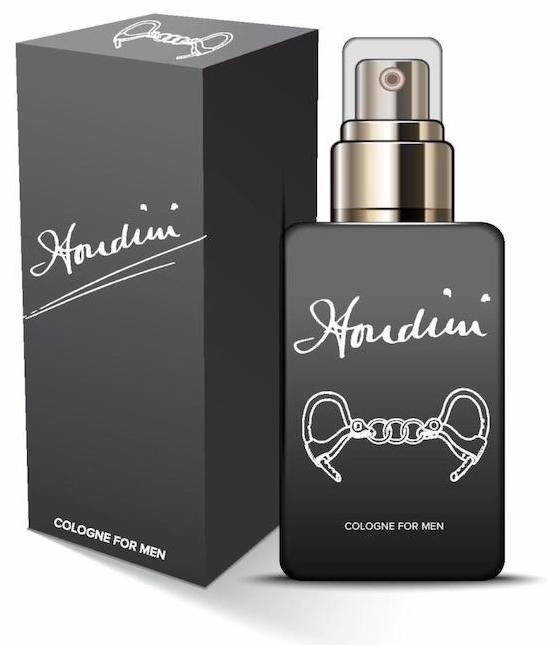
I'm not sure if that's what this new Houdini Cologne smells like. But as this is the creation of our friend and class act David Haversat, I'm sure it's just as nice. So if you're looking for a gift for the magician in your life, look no further than your nose.

Houdini - Cologne for Men will be available this Christmas and Hanukkah Season for $29.95. For pre-orders please contact houdinicologne@gmail.com.

UPDATE: Click here for details and how to purchase..

Related:

Sunday, November 17, 2019

Houdini is a Historical Hottie

Here's a fun one. This podcast by sisters Whitney and Lindsey Nelsen assess the overall "hotness" of historical figures. In this episode they rank Houdini and magician Dell O'Dell. I especially enjoyed their discussion of Houdini's physical attractiveness (4.5 out of 5) starting around the 40 minute mark. Enjoy.


For show notes and more episodes visit the Historical Hotties website.

Related:

Tuesday, April 23, 2019

Hardeen in New York

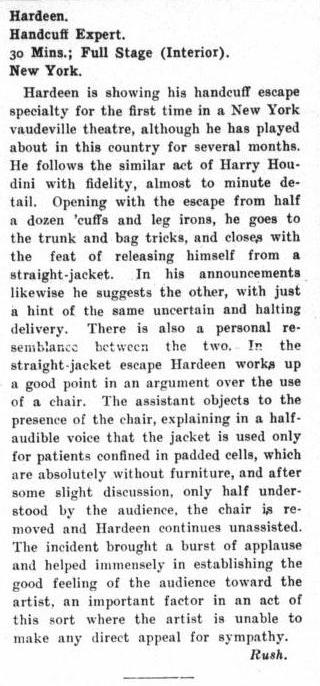
Recently I discovered details of Hardeen's first appearance (at least as "Hardeen") in New York City. He played the New York Theater's "Christmas Vaudeville Festival" during the week of December 23, 1907. (You may recall it was at the New York that Bess became trapped in the Metamorphosis trunk.) Below is an ad for that week showing Dash billed as "Wizard of the Handcuffs."


Variety reviewed Hardeen's appearance in their December 28, 1907 issue. There's a lot to like here. I especially like the mention of his voice having "just a hint of the same uncertain and halting delivery" as his brother. Here's the review in full:


New York City was a tough town to win over, even for Houdini (watch for an upcoming post about that). I don't know how often Hardeen played Manhattan, but he seemed more at home in Brooklyn and New Jersey, which he played often. As far as I know, he never attempted any kind of outdoor stunt in the city.

Related:

Friday, February 8, 2019

Houdini, Tarzan, and the Perfect Man

Recently I was watching a documentary about strongmen such as Eugen Sandow and I was reminded of this 2001 book, Houdini, Tarzan, and the Perfect Man: The White Male Body and the Challenge of Modernity in America by John F. Kasson. It offers a study of Houdini from a different perspective and is well worth adding to your library, if you haven't already.

In his exciting new book, John F. Kasson examines the signs of crisis in American life a century ago, signs that new forces of modernity were affecting men's sense of who and what they really were. 
When the Prussian-born Eugene Sandow, an international vaudeville star and bodybuilder, toured the United States in the 1890s, Florenz Ziegfeld cannily presented him as the "Perfect Man," representing both an ancient ideal of manhood and a modern commodity extolling self-development and self-fulfillment. Then, when Edgar Rice Burroughs's Tarzan swung down a vine into the public eye in 1912, the fantasy of a perfect white Anglo-Saxon male was taken further, escaping the confines of civilization but reasserting its values, beating his chest and bellowing his triumph to the world. With Harry Houdini, the dream of escape was literally embodied in spectacular performances in which he triumphed over every kind of threat to masculine integrity -- bondage, imprisonment, insanity, and death. 
Kasson's liberally illustrated and persuasively argued study analyzes the themes linking these figures and places them in their rich historical and cultural context. Concern with the white male body--with exhibiting it and with the perils to it--reached a climax in World War I, he suggests, and continues with us today.

Houdini, Tarzan, and the Perfect Man: The White Male Body and the Challenge of Modernity in America can be purchased from Amazon.com and Amazon.co.uk.

Speaking of Houdini as a specimen, this weekend I will post excerpts from a remarkable 1923 Back to Nature article in which Houdini shares his sometimes peculiar views on health and fitness. It's a good one!

Related:

Tuesday, August 14, 2018

Houdini looking dapper

Here's an unpublished Houdini photo to make one weak in the knees. It's said that off stage Houdini was a famously sloppy dresser, and there are plenty of photos that bare that out. But here he's looking downright dapper! (Although it appears he still missed a couple buttons.)


According to the auction archival website Worthpoint (where I found this image), this photo was sold by Leland Little Auction & Estates Sale Ltd. in August 2006. The auction listing says it's circa 1915, but I'd put this as circa 1922.

By the way, if you are the owner of this photo and you'd rather it not be spread online, just give a shout and I will zap this post. But I just couldn't resist sharing this uncharacteristically composed photo of Houdini. #notaslob

Related:

Thursday, June 14, 2018

Mystifier, Third Quarter 1993

Continuing my look back at Mystifier, the quarterly newsletter of the Houdini Historical Center that ran from 1991-2003.


The Third Quarter 1993 Mystifier opens with a letter by Randall Bassett, author of Zen Karate (the previous issue contained an excerpt from the book), offering insightful speculation about Houdini's need to remain physically fit and his training regiment. It's a good letter and his observations seem spot on. For example:

From what I can gather, strength and endurance were critical to most of his spectacular effects. Early on, Houdini grasped that what audiences wanted to see was a struggle--a severe test of sorts in which he would emerge victorious or...die. Anything that looked easy or was not dangerous seemed to lack dramatic impact. I further believe that Houdini felt the best way to convince the audience of the veracity of his struggle was to make it a real one whenever he could do this and not give away the secret of an illusion. But this required, I believe, his certainty that his body could keep up with his mind. It always did.

Next up is a real treat and what in 1993 was a true game changer. It's an interview with Dorothy Young (referred to here as Dorthy Young Kiamie) who toured with the Houdini show in 1925. The interview is by Ken Silverman, who was working on his own Houdini biography as this time. Much of what the interview contains we are now familiar with, but there's a paragraph in which Dorothy mentions Bess and her smoking that feels new:

I never thought of Mrs. H. as being older. We were just pals. I had breakfast with her and spent my days with her, laughing and kidding. We'd buy clothes together; she liked clothing and was always charmingly dressed. She made all my costumes, too, using gorgeous materials and making the costumes very sexy. I remember that she smoked a lot. (Houdini didn't at all.) The doctor told her to stop, that she would live ten years longer. She said she'd rather enjoy the ten years smoking.

The interview is accompanied by the "Radio Girl" photo, which was also new to the Houdini world at this time. I wasn't yet a subscriber, but I can only imagine how exciting it must have been to receive this one in the mail.

Members of the Houdini Historical Center staff and board members are then introduced with a short biography of each. Readers are also informed that the museum's new poster reprints, Coliseum, Houdini in Kaiser Wilhelm's Court, Houdini in Russia, and Houdini in the Water Torture Cell are "hot off the press" and ready to ship.

Sid Radner devotes a large section of his "Backstage with Sidney Radner" column to a 1930 horoscope of Houdini that appeared in the book Your Future, A Guide to Modern Astrology by Sidney K. Bennett aka "Wynn." Sid wryly points out:

Considering that Wynn did not known when or where Houdini was born, missing the date by 13 days and the location by a few thousand miles, it is quite remarkable how accurate the horoscope is. Or can we attribute Wynn's skills to the fact that he was doing the horoscope after Houdini's death?

Sid continues with the news that the daytime soap opera The Bold and the Beautiful has a storyline in which two characters move into Houdini's house...in Beverly Hills? He notes that the new Arnold Schwarzenegger movie The Last Action Hero has "an important Houdini connection." He concludes with the news that the BBC is in Appleton shooting a Houdini documentary to be broadcast in England in October.

Mystifier
Volume 3, Number 3
Third Quarter, 1993
6 pages

Contents:
Master of Physical Conditioning
Recollections of Houdini
Introducing HHC Staff, Board Members
Order Houdini Posters from Museum Shop
Backstage with Sid Radner

Thanks to Jay Hunter for supplying me with a scan of this issue. If anyone is willing to part with an original, this is one of only two issues that I do not own, and I'd love to complete my set.


Related:

Friday, January 5, 2018

Houdini's dye job

I mentioned this curious incident in my Houdini in 1918 post, but I thought it was worth sharing the source article from Brooklyn Life dated September 28, 1918. Not only are the details amusing, but it confirms the long held assumption that Houdini dyed his hair expressly for his work in the movies.

Click to enlarge.

Houdini was commuting daily between a studio in Yonkers, where he was filming The Master Mystery, and Manhattan, where he was appearing in the Hippodrome revue show, Everything. While it seems somewhat improbable that Houdini at age 44 would be mistaken for a juvenile, his dye job did shave years off his appearance, as you can see below. By the way, "slacker" back then meant a draft dodger.

BEFORE and AFTER.

Houdini continued to dye his hair for the remainder of his life. He never concealed this fact. On his 1919 passport application he wrote for hair color: "dyed black." But having left movies behind, he did again allow his sideburns to go white during his final years touring with his 3 Shows in One.

Related:

Saturday, September 16, 2017

Did Hardeen reveal Houdini's most secret secret?


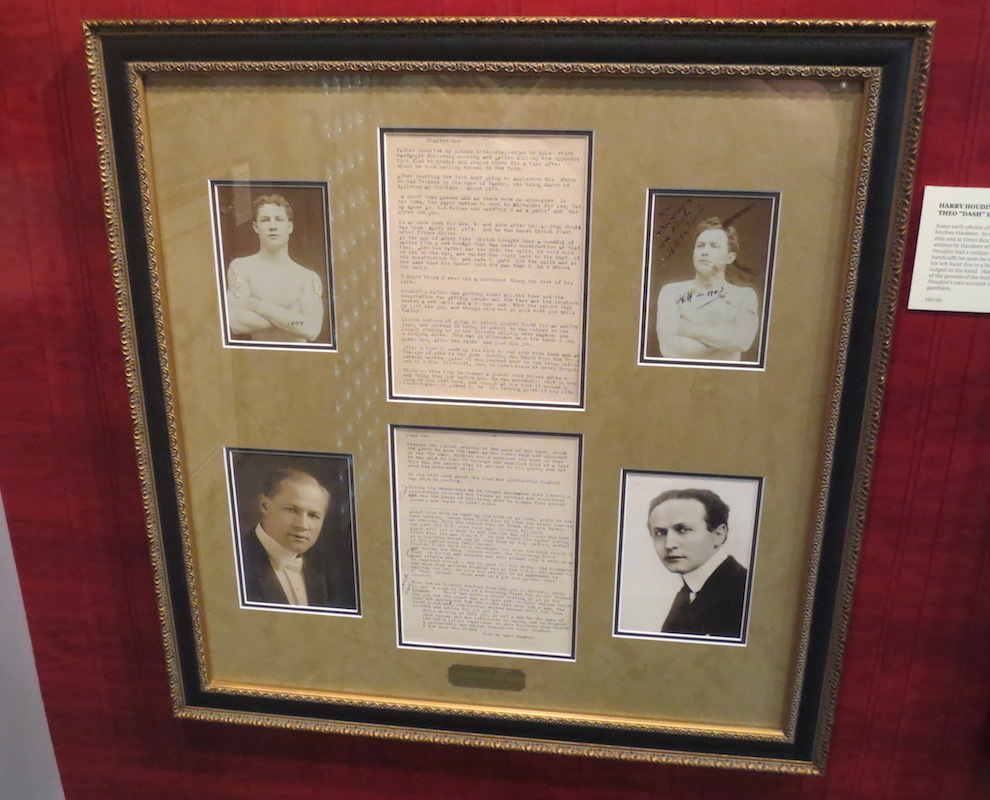
While visiting the Houdini Museum of New York last June, I saw a remarkable document on display. It consisted of two typewritten pages by Hardeen from a biography he was writing about his brother at the time of his own death. That book was to be called The Truth About Houdini, and if anyone knew that truth, it was Dash!

Among several fascinating tidbits is the following paragraph in which Hardeen apparently spills the secret of Houdini's escape abilities, which I share here with the permission of museum and document owner Roger Dreyer. [UPDATE: Bruce Averbook and The Averbook Magic Art Museum & Library now own these framed manuscript pages and photos.]

Hardeen first explains how Houdini ran away from home at the age of nine, then follows with this bombshell [spelling errors as written]:

While on this trip he became a jockey rode horses and mules &...any thing they put before him. He was accidentally shot in the palm of his left hand, and though at the time it seemed a misfortune--it proved to be the turning point of his life. Because the bullet remaing in the palm of the hand, caused the groth to seem the same as the other hand and apparently was the same. Houdini could contract the hand so that he was able to pull it through the smallest kind of hole. This was the secret that he carried to his grave, and not even his wife knew of it.
No one ever knew about the musclare contraction Houdini was able to perform.

The story of Houdini being shot in the hand is one Houdini himself told, although he set it later in his life. According to Harry, early in his career, he was taken at gunpoint by gamblers and forced to unlock the door of a casino after hours. But Houdini flung the door into the crooks and ducked inside. They took at shot at him through the door, and when Houdini threw up his hand to shield his face, the bullet lodged inside his hand, where it remained for his entire life.

Also displayed at the museum is an original x-ray photo showing the bullet in Houdini's hand. This photo has appeared elsewhere, but seeing the original is a revelation. That's because one can see the "bullet" has clearly been added or at least filled in with black ink. Possibly this was done to enhance the image. Or could it be a fake?

I admit I've never entirely bought the story of the gangsters. Seems like a bit of Houdini fiction. But possibly it was a way to romanticize or misdirect from what Dash claimed was a childhood accident. But I'm still not sure how an object inside Houdini's hand could aid in his escapes. Seems to me it would actually impede his ability to slip out of cuffs, etc.

That brings me to this intriguing footnote in Houdini's Fabulous Magic (page 19) by Walter B. Gibson and Morris N. Young:

Many people thought that Houdini could slip cuffs that were locked about his wrists, but he found that impossible. He even tried compressing the knuckles of his hands in special clamps for hours at a time, hoping to reduce their girth, but it was no avail; so he gave it up.

I've never heard about these clamp compression experiments, but it's likely the source was Walter Gibson, who knew Houdini personally. Was this Houdini once again misdirecting from his big secret? It should be noted that Houdini did slip handcuffs on occasion, sometimes in full view of the audience, and he can be seen slipping cuffs during the jailbreak sequence in The Grim Game.

Finally, it's worth noting that Houdini's left hand gave him problems as he aged. He repeatedly broke his wrist, and in 1926, he told a doctor that he only had "50% strength" in his left hand. Could all this be related to the big secret?

While Dash was not above myth-making when it came to his own career (he also claimed to have been once trapped under an ice sheet), he seemed to be the most candid of all the Weisses. He also famously took umbrage to the Harold Kellock biography, Houdini His Life Story, as being "full of lies."

Unfortunately, Hardeen never completed his Houdini biography, so all we have is this tantalizing tidbit. But what a remarkable thing to hear from the man who knew all of Houdini's secrets.

Related:

Translate