As covered in the interview, Houdini's Fabulous Magic was recently republished by Vine Leaves Press. It can be purchased on Amazon.com. You might also want to check out the official website and read Charles' own Houdini blog.
Showing posts with label Books: Methods. Show all posts
Showing posts with label Books: Methods. Show all posts
Tuesday, April 4, 2023
Charles Young talks Houdini's Fabulous Magic
Charles Young talks about his father Morris N. Young and the book Houdini's Fabulous Magic on the In the Corner Back By the Woodpile podcast. It's a great interview and Charlie even kindly mentions my site. You can listen below.
As covered in the interview, Houdini's Fabulous Magic was recently republished by Vine Leaves Press. It can be purchased on Amazon.com. You might also want to check out the official website and read Charles' own Houdini blog.
As covered in the interview, Houdini's Fabulous Magic was recently republished by Vine Leaves Press. It can be purchased on Amazon.com. You might also want to check out the official website and read Charles' own Houdini blog.

Tuesday, January 17, 2023
Houdini's Fabulous Magic is BACK
After being out of print for more than 40 years, today sees the re-release of Houdini's Fabulous Magic by Walter B. Gibson and Morris N. Young. This new edition includes a Forward by Gabe Fajuri of Potter & Potter auctions and is published by Vine Leaves Press.
Incredible escapes, fantastic sleight-of-hand-Houdini's most challenging performances are dramatically portrayed in Houdini's Fabulous Magic. Walter Gibson, co-author, was in close touch with Harry Houdini for a number of years before his death and worked with the master magician in preparing material for the book. It is with the aid of Houdini's own scrapbooks and notes that this book was written.The spectacular highlights of Houdini's career are described-and explained-here. Included are the famous escapes: escapes from a padlocked milk can filled with water; from locked jail cells; from a water-filled Chinese torture cell while suspended upside down; from packing cases weighted under water. Again, in this book, Houdini walks through a brick wall, vanishes a 10,000-pound elephant and is buried alive. Once more, Houdini and his wife Bessie mysteriously exchange places in a locked trunk-in three seconds!
And Houdini the man is not ignored. His impact on the world in the early years of the twentieth century was enormous. He was a public hero who, in his own way, helped sweep out the cobwebs of nineteenth-century thinking. While doing so, he distinguished himself as a patriot, writer, collector of magic, aviator, movie idol, philanthropist, and crusader against fraudulent spiritualistic practices.
This is a technical manual for magicians, complete with illustrations and diagrams, but it is also an astute analysis of the best of Houdini's magic and a readable biography of a man who turned himself into a legend. It is a book for would-be conjurers, for professional necromancers, for those curious about the methods and means of one of the most enchanting men of our century.

I've always loved Houdini's Fabulous Magic and I'm excited to see it return to print. You can check out my overview of the book and its publishing history HERE. I haven't seen this new edition in the flesh yet, but I'm excited to get it. I've shared some of the publishers promotional material on Patreon.

Monday, March 14, 2022
'Houdini's Fabulous Magic' returns in 2023
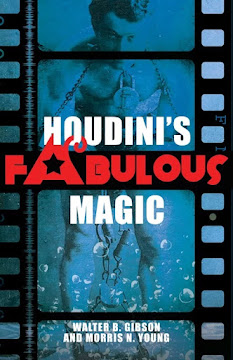
I came across this news via the website of Charles and Cheryl Young. They are the children of Morris N. Young. They are also co-authoring a work of fiction, Houdini's Last Handcuffs, for release in 2024.
I've always loved Houdini's Fabulous Magic and I'm excited to see it return to print. You can check out my overview of the book and its publishing history via the top link below.
Thursday, April 30, 2020
Patrick Culliton clarifies the price and purpose of Houdini–the Key
 Patrick Culliton's Houdini–the Key is now sold out (but not impossible to still acquire, as you'll see below). Patrick has kept the book "in print" for 10 years to ensure those who wanted it as a research tool could always get it. (He was disappointed when his earlier work, Houdini Unlocked, was quickly bought up in bulk by collectors and speculators.) Patrick is using this moment to clarify his approach to producing and selling this important work:
"Ten years ago my book Houdini--the Key was published by me (and written, illustrated, and created, page by page, by me).
I didn't want to print a big number of books because I considered it a book for the few, not the many. It did involve magic secrets and there are some good ones in there. I had a plan in case they all sold out. I printed 278 books, then, when it became obvious they were all going to sell, I did a second printing, without changing any of the contents, of 113 books.
Because I didn't want my book taken over by scalpers -- it is a rare book. It's in the Rare Books Collection at the Library of Congress. It's well-made with a cover that I created that is eye-grabbing and contains little clues for serious Houdini aficionados. It has a slipcase in matching heavy duty library buckram. I knew if it got out of my hands it would completely sell out very fast. I had made a collectible, but, I didn't want collectors to have it if they weren't going to read it. I wanted people to have the book who would use it.
So, now, ten years down the road. I have sold every one of the 391 numbered copies of Houdini--the Key.
I limited the book to one per customer and I have the name and contact information of every person who bought one. Since each book was numbered, I have a complete list of the people who bought the book and which number they got.
A bunch of my Magical heroes are on that list. And there hasn't been a single complaint."
A serious inaccuracy about the price of the book appears in Joe Posnanski's recent book The Life and Afterlife of Harry Houdini. In the book the author states that he acquired the book from Patrick for $295. But this was never a price Patrick charged anyone.
"I published the book at $195.00 and I sold every book on the list for $195.00 (except the ones I sold to some very fortunate -- and canny -- folks who trusted me with their money and got an advance price). That includes the book I sold Joe Posnanski. Joe is given to hyperbole "J. Gordon Whitehead was a great big guy -- 6 ft. 6" -- and in his book, he makes quite a bit out of meeting me at the Magic Castle and paying me $295.00 for my book. He didn't. Joe bought #36 of the second printing from me for the same price everybody else did: $195.
So for Joe to write that I charged him $295 is particularly hurtful."
But Patrick has good news for those who may have missed out in the run of 391 copies:
"But, sorry scalpers, I've got thirty books that were intended for libraries that I decided I wouldn't sell to libraries (the ones that count have them). They are available to serious students at the original price of $195.00. The book is still available, brand new and beautiful, for a few more months (or possibly years if they are slow to sell)."
So head over to houdinisghost.com and send Patrick an inquiry about purchasing one of the last 30 copies of Houdini--the Key.
Related:
Wednesday, December 12, 2018
Dover will release The Right Way to Do Wrong in 2019
The 2019 Houdini books are starting to reveal themselves, and among them will be a reprint of Houdini's first book, The Right Way to Do Wrong, from Dover. Dover has a long tradition of releasing Houdini titles. They've kept The Secrets of Houdini and Houdini on Magic in print for decades, and last year released Houdini's Paper Magic. Below is the cover art, which is worthy of a major biography!
Other books due for release in 2019 are: The Sensational Houdini's Puzzle Safe (April), Harry (April), Before Houdini (July), and paperback editions of Escaping from Houdini (August) and The Escape Artist (April). October will then see the release of the most anticipated book of them all, The Life and Afterlife of Harry Houdini by Joe Posnanski.
Related:
With this remarkable book, the legendary magician conducts a master class in crime by revealing the trade secrets of crooks. Harry Houdini is known not only as an illusionist and escaper of handcuffs and jail cells, but also as a debunker of phony spiritualists and other charlatans. His interest in exposing fakery led Houdini to interview both police and criminals around the world. The result is this captivating volume, intended to help readers avoid being victimized by pickpockets, con artists, and other thieves.

Written with verve and humor, these lively chapters recount the techniques of burglars, sneak thieves, shoplifters, and pickpockets as well as those of faith healers, fortune tellers, art forgers, card sharks, and counterfeiters. The instructive and amusing book concludes with an autobiographical essay, in which Houdini discusses the early days of his career and the experiences that contributed to his renown as the Handcuff King and Prison Breaker.
Other books due for release in 2019 are: The Sensational Houdini's Puzzle Safe (April), Harry (April), Before Houdini (July), and paperback editions of Escaping from Houdini (August) and The Escape Artist (April). October will then see the release of the most anticipated book of them all, The Life and Afterlife of Harry Houdini by Joe Posnanski.
Related:
Friday, February 17, 2017
A book that's bound to please
Here's an end-of-the-week treat from the collection of the great Kevin Connolly. This is a pre-order advertisement for Houdini's Magical Rope Ties and Escapes. Not only have I never seen this ad, but I don't think I've ever seen any ad for this book! I love the image of Houdini bound to the book here.
Published by Will Goldston in 1921, Magical Rope Ties and Escapes was only released in the UK. It was no doubt timed to take advantage of Houdini's return to the UK after six years of absence because of the war. While it's not one of Houdini's more substantial works, it does contain terrific photos of Houdini in escape action, and the frontispiece photo of Houdini and Ira Davenport seems to foretell the next chapter in his career.
Magical Rope Ties and Escapes is available today for the Kindle. A reprint is also available from Houdini's Magic Shop.
Thanks, Kevin.
Related:
 |
| Kevin Connolly Collection |
Magical Rope Ties and Escapes is available today for the Kindle. A reprint is also available from Houdini's Magic Shop.
Thanks, Kevin.
Related:
Friday, December 9, 2016
David De-Val reveals 'The Real Secret' of Houdini's cell escapes
 Here's something very exciting for those who are interested in learning the secrets behind Houdini's amazing feats.
During his career, escapologist and magician David De-Val visited and/or escaped from all of the surviving jail cells in the UK that Houdini escaped from. In doing so, De-Val claimed to have discovered Houdini's secret. In 2000, he recorded his exploits and findings in a privately printed book called Cell Escape - The Real Secret, which is a rare collectible.
Now Allan James Taylor and Rebecca De-Val have released a "new and improved" edition with all the original content from the 2000 edition along with new images and information. The first batch sold out immediately, but more are in stock and can be purchased now from the David De-Val Tribute website store.
For all you Escapologists – David De-Val’s Cell Escape – The Real Secret
“…I extensively researched Houdini’s seemingly supernatural escapes, concentrating for a period on his remarkable jail cell escapes. Many authors have put forward theories. Believe me, none have even come close to the real secret! I personally visited the jail cells in England from which Houdini performed his escapes all those years ago. Their locations were drawn from contemporary newspaper accounts made by the reporters who actually witnessed the stunt being performed. And very detailed they are – most running into many column inches. After four years of almost weekly study, at last I had his closely guarded secret! I set about proving this by duplicating his naked cell escapes at every opportunity…” - David De-Val.
For more on the life and work of David De-Val check out the David De-Val Tribute Site.
Thanks to Allan and Rebecca.
Related:
Friday, November 4, 2016
Dover will release 'Houdini's Paper Magic' in 2017

On the right is an early look at the cover art. As the book has not been printed yet, this might change, but I like what I see.
Dover's Houdini's Paper Magic can be pre-ordered at Amazon.com (U.S.) and Amazon.co.uk (UK). The release date is June 14, 2017.
Click the links below for a look back the history of Dover's other two Houdini titles, still in print and going strong!
Related:
Wednesday, October 19, 2016
REVIEW: Bob Loomis delivers a Houdini masterclass

The trick that is the focus of Bob's 20 year investigation was performed by Houdini for Sir Arthur Conan Doyle and Bernard M.L. Ernst in his New York home in 1922. Only one description of the trick exists, told by eyewitness Ernst in his 1932 book Houdini and Conan Doyle: The Story of a Strange Friendship (pages 240-245). The trick involved producing the written message "Mene, mene, tekel, upharsin" on a chalk slate suspended in the middle of a room in full view of Doyle and Ernst.
Past books have mentioned the famous feat and some have attempted to explain it, including most recently The Secret Life of Houdini. Bob examines and dismisses all previous explanations, which he shows invent or omit key descriptive information to fit their own theories. Bob assigns himself the task of explaining the trick exactly as described by Ernst.
It's clear that Bob is a researcher par excellence (he was the librarian at the Magic Circle in London). It's also clear he delights in doing research. Bob shares that joy by taking the reader step by step through every bit of his own process with lively prose. It might even be too much process for some. But even if one feels lost at times, there are gold nuggets along every part of the trail, so one never dares jump ahead.
I was especially impressed with Bob's overview of Houdini's character (the good and bad) on pages 67-89. Even if one doesn't want to take this full journey, the first section of the book is required reading for anyone with a desire to better understand Houdini. Gold, gold, gold!
So did Bob solve the mystery of Mene Tekel? Well, he certainly offers an explanation that is technically feasible, and he's backed it up with proof that the methods -- and there are several methods at work -- were all familiar to Houdini. The explanation is not simple or elegant. It requires divergent elements to work perfectly in sync, and the possibility of failure seems remarkably high. Maybe that's why Houdini only performed it once.
One aspect of the explanation that I don't think Bob nailed as well as others is how Houdini acquired the message that Doyle wrote several blocks from Houdini's house. Bob offers several scenarios in which confederates on the street could have gotten a peek at the message. But it just seems high risk for Houdini to leave such an essential part of the trick in the hands of others and chance. It also just seems a little improbable that such a complicated and seemingly nonsensical message could be gotten from a glance or by watching the end of a pencil. And would Houdini really be able to canvas the entire neighborhood with confederates, including policemen? Well, this is Houdini we're talking about, so maybe!
In the end, whether or not you fully agree with all of Bob's findings, you'll still agree that this is a remarkable book. In Houdini's Final Incredible Secret, Bob Loomis not only teaches us how Houdini did it, but he also gives a lesson in how to research Houdini and magic history in a meticulous and ethical way. It's a book that deserves a standing ovation.
You can purchase Houdini's Final Incredible Secret at Amazon.com (U.S.) and Amazon.co.uk (UK).
Related:
Wednesday, July 27, 2016
How Houdini planned to (not) go over Niagara Falls

But this doesn't mean he didn't consider the idea. In the book Houdini's Escapes, Walter B. Gibson reveals that Houdini made notes on a "Niagara Falls Escape" that would see him going over the falls in a packaging box. Gibson says Houdini's notes were "merely suggestions that had not reached the point of practical solution" and that it would have been a "trick test."
Here are the notes as Houdini recorded them:
The idea is to be nailed in a packing case, thrown over Niagara Falls, and eventually make an escape!
So that the crowd can see that I am being nailed into the packing case, the nailing is done on a platform, into which I can slide after the box is nailed up.
The best way would be to have the platform on a large wagon, which is drawn down to the landing place, where I get into the water according to opportunity.
Or else get back into the box when placed on wagon, and be found there, having failed to escape (being "knocked out" coming over the falls).
This can be worked into an extra good idea and needs doing some time.
It's not surprising that Houdini would not plan to actually go over the Falls. That would be suicide. But it is a little surprising that he would entertain the idea of an outdoor stunt that would be a fake -- more magic trick than escape. It's also interesting to see that he that considered a "failure" would be just as effective an outcome. No doubt he saw the enormous publicly value of such an exploit.
But it's possible the reason he never brought the idea to fruition is that a "trick test" just didn't seem like a very Houdini thing to do.

Despite never doing his stunt, Houdini's connection to Niagara Falls remains strong. Not only did he shoot The Man From Beyond on the rapids, but for years Clifton Hill on the Canadian side was home to the Houdini Magical Hall of Fame. Ironically, the museum housed Houdini's overboard packing box, which may have been the very box Houdini would have used for his Niagara Falls Escape.
Related:
Thursday, September 24, 2015
The best forgotten Houdini book
Continuing my examination of books about Houdini using images and insights from my own collection.
 Houdini's Fabulous Magic by Walter B. Gibson and Morris N. Young is the best forgotten Houdini book. I say that because when one thinks of books on Houdini's methods, one tends to turn to Houdini The Key by Patrick Culliton, The Secrets of Houdini by J.C. Cannel, or even Gibson's earlier work, Houdini's Escapes and Magic. Maybe because Fabulous Magic contains some reprinted material from the earlier Gibson book it tends to be thought of as a somewhat recycled work. But it's actually one of the very best books on Houdini's major feats and methods and maybe the best book for the layperson. It also contains historical tidbits that aren't found elsewhere. So let's remember it today!
Walter B. Gibson and Dr. Morris Young make an excellent team. Gibson knew Houdini and Young had one of the best Houdini and magic collections in the world (it's now in the Library of Congress). So Houdini's Fabulous Magic is packed with rare images on almost every page. It was certainly the best illustrated Houdini book up to that time. Also, for me, it feels like Gibson is finally willing to part with secrets that he had kept to himself – or at least out of print – for years.
The chapters on Houdini's challenge handcuff act and jail escapes are among the best, offering a whole host of clever methods that Houdini employed beyond the "key in a kiss." A clue to why these chapters are especially strong might be found in the acknowledgements:
Goldstein is likely the source of the following story of a jail escape. It's not something I've read elsewhere, and I love how it shows that Houdini and Hardeen could work together spontaneously:
Houdini's Fabulous Magic also includes a final chapter "About Houdini" which features autobiographical excerpts by the great magician himself. And while the book has a very good chapter on the Water Torture Cell, it doesn't reveal the method. Some secrets should be kept.
Publication history:
Houdini's Fabulous Magic was first published in hardcover in 1961 by Chilton Book Company. The cover art has Houdini's name running vertically down a dark green background, somewhat recalling a spirit slate. As far as I know, it was only published in the United States. The book went through at least five hardcover printings with the same dust jacket artwork (I have a 5th dated August 1968).
The one and only paperback edition (that I know of) was published by Barns & Noble Books in 1977.
Houdini's Fabulous Magic would benefit from the great Houdini renaissance of the mid 1970s. The book was reprinted in a new hardcover by Bell Publishing. This time the jacket featured the famous image of Houdini in handcuffs (dated 1903 in the book itself) against an orange background. The copyright page only references the 1961 edition, but it appears this hardcover might have been released in October 1976.
Bell later released another hardcover edition with new dust jacket art that added the descriptive: "His own scrapbooks reveal the secrets of 38 major illusions." Once again, the year of publication is unclear because the copyright only references the 1961 edition. But from my own recollection, this grey jacketed edition replaced the orange edition in my local magic shop around 1978.
Houdini's Fabulous Magic long ago vanished from print. But if one is interested in learning Houdini's methods, hunting down one of these old copies would be a fabulous way to do so.
 Houdini's Fabulous Magic by Walter B. Gibson and Morris N. Young is the best forgotten Houdini book. I say that because when one thinks of books on Houdini's methods, one tends to turn to Houdini The Key by Patrick Culliton, The Secrets of Houdini by J.C. Cannel, or even Gibson's earlier work, Houdini's Escapes and Magic. Maybe because Fabulous Magic contains some reprinted material from the earlier Gibson book it tends to be thought of as a somewhat recycled work. But it's actually one of the very best books on Houdini's major feats and methods and maybe the best book for the layperson. It also contains historical tidbits that aren't found elsewhere. So let's remember it today!
Walter B. Gibson and Dr. Morris Young make an excellent team. Gibson knew Houdini and Young had one of the best Houdini and magic collections in the world (it's now in the Library of Congress). So Houdini's Fabulous Magic is packed with rare images on almost every page. It was certainly the best illustrated Houdini book up to that time. Also, for me, it feels like Gibson is finally willing to part with secrets that he had kept to himself – or at least out of print – for years.
The chapters on Houdini's challenge handcuff act and jail escapes are among the best, offering a whole host of clever methods that Houdini employed beyond the "key in a kiss." A clue to why these chapters are especially strong might be found in the acknowledgements:
Reminiscences of early Houdini days were personally provided by Lewis Goldstein, only living member of the Houdini show during the Handcuff Era of the early 1900s. Goldstein also worked with the Hardeen company during that same period, and the authors appreciate his first-hand recollections.
Goldstein is likely the source of the following story of a jail escape. It's not something I've read elsewhere, and I love how it shows that Houdini and Hardeen could work together spontaneously:
On one occasion, Houdini went to look over a jail cell accompanied by his brother Hardeen. The lock was formidable, but of the spring latch type. While the police chief was asking Houdini why he didn't try to make the escape then and there, Houdini suddenly decided that he would.
Houdini whispered a quick word to Hardeen and while Houdini was being searched, Hardeen pulled a sheet of paper from a notebook, wadded it tightly, and edged close enough to the door to jam the wad into the latch socket. Houdini was put into the cell naked, keyless, and presumably defeated; but the police chief and the jailer had scarcely turned away before they heard the door clang again behind them and there was Houdini free!
Houdini's Fabulous Magic also includes a final chapter "About Houdini" which features autobiographical excerpts by the great magician himself. And while the book has a very good chapter on the Water Torture Cell, it doesn't reveal the method. Some secrets should be kept.
Publication history:
Houdini's Fabulous Magic was first published in hardcover in 1961 by Chilton Book Company. The cover art has Houdini's name running vertically down a dark green background, somewhat recalling a spirit slate. As far as I know, it was only published in the United States. The book went through at least five hardcover printings with the same dust jacket artwork (I have a 5th dated August 1968).
The one and only paperback edition (that I know of) was published by Barns & Noble Books in 1977.
 |
| First hardcover (1961) and first paperback (1977). |
Houdini's Fabulous Magic would benefit from the great Houdini renaissance of the mid 1970s. The book was reprinted in a new hardcover by Bell Publishing. This time the jacket featured the famous image of Houdini in handcuffs (dated 1903 in the book itself) against an orange background. The copyright page only references the 1961 edition, but it appears this hardcover might have been released in October 1976.
 |
| Bell hardcovers from the 1970s. |
Bell later released another hardcover edition with new dust jacket art that added the descriptive: "His own scrapbooks reveal the secrets of 38 major illusions." Once again, the year of publication is unclear because the copyright only references the 1961 edition. But from my own recollection, this grey jacketed edition replaced the orange edition in my local magic shop around 1978.
Houdini's Fabulous Magic long ago vanished from print. But if one is interested in learning Houdini's methods, hunting down one of these old copies would be a fabulous way to do so.
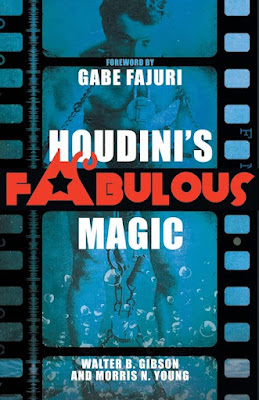
UPDATE: In 2023 Vine Leaves Press reprinted Houdini's Fabulous Magic in paperback with a new Forward by Gabe Fajuri.
Enjoy these other selections from the WILD ABOUT HARRY bookshelf:
- "This book is full of lies" - Houdini His Life Story
- The secrets of The Secrets of Houdini - The Secrets of Houdini
- "Had Houdini lived he would have written this book" - Houdini's Escapes and Magic
- The gateway biography - The Great Houdini
- An alternative gateway - Houdini Master of Escape
- The first great Houdini biography - Houdini The Man Who Walked Through Walls
- The textbook - Houdini The Untold Story
- The perennial - Houdini on Magic
- The Fantastic Four - The Original Houdini Scrapbook, Houdini His Art and Magic, Houdini A Pictorial Life, Houdini His Legend and His Magic
- The Brandon book - The Life and Many Deaths of Harry Houdini
Sunday, March 22, 2015
Don't bite on these...
You might have noticed these new Houdini "books" listed on Amazon for pre-order. They have wordy titles such as, Houdini and the Art of Illusion and Disillusion, and show prices as high as $26 with page counts as low as 24.

For those who might be confused, know that these are just excerpts from the 1932 book The Secrets of Houdini by J.C. Cannell, which is in the pubic domain. The book has been carved up and is being offered here hidden under new titles, and it isn't the first time. Disillusion indeed!
No need to take this bait. You can get a brand new copy of The Secrets of Houdini by J.C. Cannell for $9.38 on Amazon HERE.
Read my history of the Cannell book: The secrets of The Secrets of Houdini.
For those who might be confused, know that these are just excerpts from the 1932 book The Secrets of Houdini by J.C. Cannell, which is in the pubic domain. The book has been carved up and is being offered here hidden under new titles, and it isn't the first time. Disillusion indeed!
No need to take this bait. You can get a brand new copy of The Secrets of Houdini by J.C. Cannell for $9.38 on Amazon HERE.
Read my history of the Cannell book: The secrets of The Secrets of Houdini.
Monday, August 4, 2014
Ed Sams on Houdini and alchemy
If you missed this when it was first released in 2005, Ed Sams 54-page "chapbook" study, Red Magic: Houdini's Secret, has been re-released as an eBook and in paperback by Yellow Tulip Press.
In Red Magic, the author suggests that Houdini's power and continued appeal lies with his knowledge of alchemy and the practices of ancient alchemists; that he "incorporated their most mysterious allegories in his stage acts and publicity stunts," conquering air, fire, land, and water. It's a well-researched book that's worth reading. This new edition is of higher quality and features more photos than the 2005 printing.
Purchase Red Magic: Houdini's Secret from Amazon.com.
Truth or trickery? This is the fascinating history of a true man of mystery who charmed, confounded and inspired legions of fans, both during life and after death. Most intriguing of all was Houdini’s secret: the red magic that was hinted to be both supernatural and commonplace. Was Houdini’s secret his means of projecting and protecting such superhuman powers? Or was such power no more than the secret itself?

In Red Magic, the author suggests that Houdini's power and continued appeal lies with his knowledge of alchemy and the practices of ancient alchemists; that he "incorporated their most mysterious allegories in his stage acts and publicity stunts," conquering air, fire, land, and water. It's a well-researched book that's worth reading. This new edition is of higher quality and features more photos than the 2005 printing.
Purchase Red Magic: Houdini's Secret from Amazon.com.
Tuesday, July 1, 2014
Houdini now partying in Russia
A new reprint of the 1927 book, Houdini's Book of Magic and Party Pastimes, has been published in Russia by Izdatelskii Dom Meshcheriakova. While Russian readers can purchase the book here, it is also available on Amazon.com.

Houdini's Book of Magic and Party Pastimes was first published by Stoll & Edwards, Co., New York, in 1927. The copyright reads: "Beatrice Houdini, Executrix of the Estate of Harry Houdini." Much of the content comes from Houdini's "Red Magic" column. As far as I know, this Russian edition is the first reprinting.
Thanks to Andrey Fedorov for this discovery and Kevin Connolly for sharing it on his blog Houdini Himself.
Houdini's Book of Magic and Party Pastimes was first published by Stoll & Edwards, Co., New York, in 1927. The copyright reads: "Beatrice Houdini, Executrix of the Estate of Harry Houdini." Much of the content comes from Houdini's "Red Magic" column. As far as I know, this Russian edition is the first reprinting.
 |
| Original 1927 edition. |
Thanks to Andrey Fedorov for this discovery and Kevin Connolly for sharing it on his blog Houdini Himself.
Tuesday, March 25, 2014
Spanish 'Miracle Mongers and Their Methods'

Traficantes de milagros y sus métodos was officially released yesterday, Houdini's birthday, and is available now via Amazon.es (Spain), Amazon.com (U.S.), Amazon.co.uk (UK) or The Book Depository (which offers free shipping worldwide).
Below is a nice promotional video for the book from the Nórdica Libros website. I think these illustrations by Barrenetxea makes this one a must buy.
Monday, October 28, 2013
Download Houdini's 'Miracle Mongers' FREE for 24 hours

All this week the Conjuring Arts Research Center is offering a free Houdini book every day leading up Halloween. Each new title becomes available 1:26pm (EST) and is available for only 24 hours. Additionally, all Houdini items at the CARC store are marked down 50%.
Head on over to the Conjuring Arts Research Center and download your free PDF of Miracle Mongers and Their Methods.
Saturday, October 26, 2013
Download 'Elliott's Last Legacy' now

All this week CARC is offering a free Houdini book every day leading up Halloween. Each new title becomes available 1:26pm (EST) and is available for only 24 hours. Additionally, all Houdini items at the CARC store are marked down 50%.
Elliott's Last Legacy contains the work of champion card manipulator Dr. James William Elliott, who died before he completed this book. Elliott's collaborator, Clinton Burgess, turned to Houdini for assistance in finishing it and getting it published. Houdini enlisted the aid of Oscar Teale and published the book through his own "Adams Press Print." Houdini also penned the introduction.
Burgess later complained that Houdini had featured his name on the cover as editor while relegating his own name to a small "complied by" credit inside. (I own an inscribed copy in which Burgess has written below his name, "author and compiler".) The dispute grew so heated that Houdini eventually had Burgess removed from the S.A.M. for "conduct unbecoming a member." But if Burgess wanted Elliott's work to have a legacy, then Houdini's name certainly did the trick.
Head on over to the Conjuring Arts Research Center and download your free PDF of Elliott's Last Legacy.

Friday, October 25, 2013
Download 'Handcuff Secrets' for FREE
 You can now download a PDF of Houdini's 1910 book Handcuff Secrets FREE for the next 24 hours from the Conjuring Arts Research Center.
This is part of CARC's special 7-day "Houdini Palooza" in which they are offering a free PDF of a different Houdini book every day leading up Halloween. Each new title becomes available 1:26pm EST and is available for only 24 hours (click here to see the list of all the titles).
Additionally, all Houdini items at the CARC store are marked down 50% during this same time.
So head on over to the Conjuring Arts Research Center website and begin to harvest these free Houdini Halloween treats.
Thursday, September 19, 2013
Harlan and Bessie will teach you the Needles

Here's an unpublished photo of Bess Houdini with Harlan Tarbell, author of the famous Tarbell Course in Magic. Not long ago Dean Carnegie at The Magic Detective revealed how it was almost the Houdini Course in Magic. Reportedly, Houdini was originally approached by the publishers to author the series. Houdini was too busy and instead recommended Tarbell. The rest is magic history.
So why have I pulled this photo from our new Hinson Endowment prematurely (I'll replace it with a better quality version later)? Because I thought this was a fun way to let you know that the Conjuring Arts Research Center is offering the original 1926–1929 Tarbell Correspondence Course as free PDF until September 22. This is the 11th and final offering in their Summer Reading Program, which also saw a free PDF of The Memories of Robert-Houdin.
This 1243-page PDF contains many references to Houdini and some escape methods. It also has 4-pages on the working method for Houdini's classic Needles!
LESSON 27
First in this lesson, I give you the Famous Needle Trick. The eminent Houdini featured this wonderful effect on his vaudeville programs. He studied it detail by detail from the standpoint of SHOWMANSHIP, and in his hands it became a masterpiece. You, too, must study this effect carefully to make your presentation of it a thing which will make your audiences long remember you.
CLICK HERE to get a free copy of the Houdini...er, I mean, Tarbell Course before September 22 when it disappears.
Saturday, July 27, 2013
Two new books promise great escapes
Speaking of escapology, two new books on the subject have recently appeared on Amazon. First up is How to Hack Handcuffs Like Houdini: For Magicians, Law Enforcement & Urban Survivalist by Shawn C. Evans. Here's the description:
The second book is Escape or Die: An escape artist unlocks the secret to cheating death by Anthony Martin, "founder of Ambassador in Chains ministry." This one seems to be a biography mixed with the motivational. Here's the description:
Not sure what the author here means about Houdini's escapes being "illusion" and not "true escapes", but maybe that's all part of the whole motivational thingy.
Do you know that you can open a pair of standard handcuffs with a drinking straw? Do you know the 3 “universal” handcuff keys that all escapologists should have in their toolkit? Do you know which handcuff key is ideal to use with sleight-of-hand techniques? Written for Magicians, Law Enforcement and Urban Survivalist, this book describes in detail the novel methods to “hack” open handcuffs --- from picking & shimming with household items, to the interesting use of HIPS devices. Chapter 1: Short History of Handcuffs. Chapter 2: Handcuff Nomenclature. Chapter 3: Escape / Hacking Methods Chapter 4: Handcuff Keys. Chapter 5: Single vs. Double Lock. Chapter 6: Shimming Techniques. Chapter 7: Picking Techniques. Chapter 8: HIPS Devices. Chapter 9: GOAH Stage Method. Chapter 10: Tricked Handcuffs.
The author is a Summa Cum Laude graduate of psychology and a life-long student of magic. He has created over 65 marketed magic effects and currently operates the website: www.mimesis-magic.com. The author is known as the coin guy who “splits” cards and is the sole craftsman who makes all the gaffed & gimmick cards for the popular Mimesis Card Workshop.

The second book is Escape or Die: An escape artist unlocks the secret to cheating death by Anthony Martin, "founder of Ambassador in Chains ministry." This one seems to be a biography mixed with the motivational. Here's the description:
Few sane people would want to be locked in shackles, enclosed in a box, and thrown from a plane at 15,000 feet for fun. But for renowned escape artist Anthony Martin, whose fascination with locks began as a young boy, it’s all in a day’s work.
Whether shackled in a bag with a python, padlocked in a cage beneath a frozen lake, or buried in a coffin under a ton of sand, Anthony regularly faces the risk of serious injury or death. However, unlike Houdini, who used illusion, Anthony’s exploits are all true escapes.
Interweaving stories of his over thirty years of daredevil feats with lessons he’s learned in the “school of hard locks,” Anthony unlocks the mystery of life after death—something Houdini had sought in séances to no avail. What happens when we die? Once we pass through the door of death, what’s on the other side?
Through fascinating parallels with his death-defying adventures, Anthony reveals the keys to making the greatest escape. With the lessons he shares in Escape or Die, you’ll be well-equipped to take a leap of faith and defeat death once and for all.

Not sure what the author here means about Houdini's escapes being "illusion" and not "true escapes", but maybe that's all part of the whole motivational thingy.
Subscribe to:
Posts (Atom)