Showing posts with label Bernard Ernst. Show all posts

Tuesday, August 29, 2023

The Mama message has returned!


The original spirit message from Houdini's mother delivered via "automatic writing" by Lady Doyle during the famous Atlantic City seance has been unearthed in David Copperfield's International Museum and Library of the Conjuring Arts. The 17-page message survives complete, along with a cover page written by Houdini. While never lost, the message has remained largely unseen, and its existence was not generally known.

As detailed in this post, the Doyles believed Houdini had been wholly convinced by the message. But Houdini was troubled by the lack of specifics and that the pages were written in English. He and his mother only communicated in German. He eventually told the Doyles that he did not believe the message had come from his mother.

Nevertheless, Houdini appears to have kept the message for the rest of his life. The first two pages were reproduced in the 1932 book Houdini and Conan Doyle: The Story of Strange Friendship by Bernard M.L. Ernst and Hereward Carrington. But after that, the original message seemed to vanish and only transcriptions survived.

I now think it's possible these pages passed from Bernard Ernst to magician and collector John Mulholland. David Copperfield acquired the Mulholland Collection in 1991, which seeded the magnificent museum he has today. So Mama has been home the entire time!

Thanks to Bruce Averbook for making this find and David Copperfield for allowing me to share. You can watch video of the discovery on my Patreon.


Related:

Friday, September 24, 2021

'Houdini's Lost Diaries' will be revealed Tuesday


This Tuesday, September 28, a major new BBC produced Houdini documentary by award winning filmmaker Simon George will debut as part of History's Great Mysteries on the HISTORY channel. It's called Houdini's Lost Diaries. As the title implies, the filmmakers were granted unique access to the diaries still held and tightly controlled by the descendants of Houdini's lawyer Bernard Ernst.

I was involved with this as an occasional consultant and will be appearing onscreen along with heavyweights such as Mike Caveney and Patrick Culliton (yes, "Houdini's Ghost" appeared for this one!). I've not seen the finished film, but I did see various incarnations of the script. So I know they did mine gold from the diaries! While I interpreted some entries differently from the filmmakers, I'm optimistic they will temper the sensationalism that HISTORY requires (and their promo suggests) and we'll finally get a Houdini doc that breaks new ground and provides fresh insight. Guess we'll find out together!

Houdini's Lost Diaries airs this Tuesday on HISTORY. I believe it will stream free on the website for a week. You'll also be able to buy the episode via Amazon Prime.

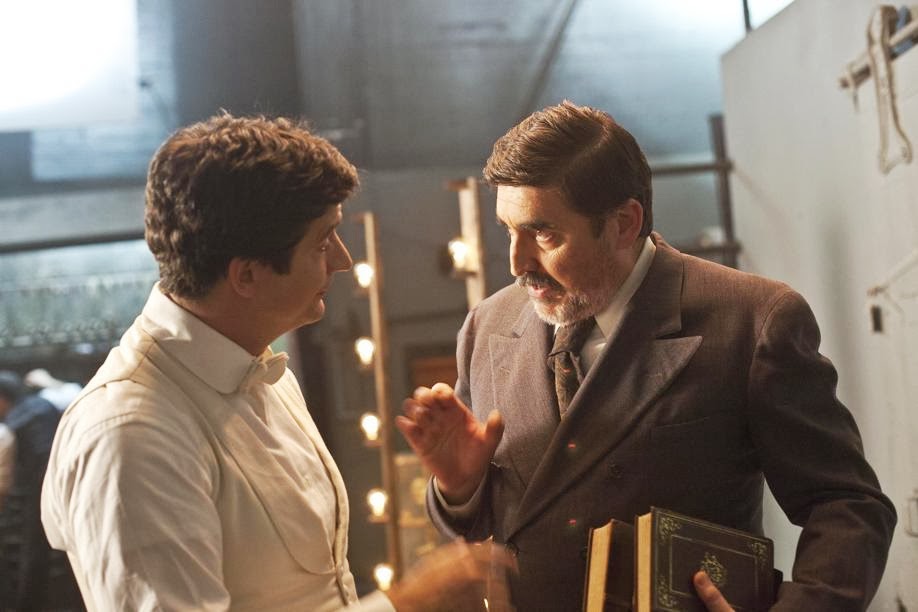
Below is a behind the scenes photo courtesy of actor and magician Paul Zenon who participated in several of the reenactments. What the heck is going on here? It's all in the diaries!


UPDATE: My review and where to watch: Opening up 'Houdini's Lost Diaries'.

Thursday, November 26, 2020

Illustrated gems

Harry Houdini Master of Magic by Robert Kraske was released in 1973 by Garrard Publishing Company as part of their "Americans All" series. Aimed at young readers, it's a serviceable biography running 94 pages. When I first discovered this book in my Junior High school library, I had already read Kellock, Epstein, Gresham, and Christopher. So I knew the story. But this book still captivated me as it offered up an electric new experience. Illustrations!


Thanks to the artwork by Victor Mays, here I could finally see seminal moments of Houdini's life (and mythology) that I had only read about in other books. Here was Ehrich Prince of the Air on his backyard trapeze; the Brothers Houdini performing metamorphosis on a side show platform; young Ehrich pouring coins into his mother's lap; Houdini tied to horse; and the infamous dressing room punch, accurately depicted with Houdini laying on his cot. And that beautiful frontispiece! I was obsessed with this book, and I can't tell you how many times I checked it out, or just ducked into the library during lunch to soak in these images once again. 


The Garrard edition of Harry Houdini Master of Magic was only available to school libraries, which made it all the more precious. A paperback edition was released by Scholastic and remains in print today. But it lacks the Victor Mays illustrations! It was not until the 1990s and the coming of eBay that I was finally able to land a copy of the hardcover for myself. 

The non-illustrated paperback editions of Kraske.

Another book that gave me the same jolt as Kraske was Escape King: The Story of Harry Houdini (1975) by John Ernst with illustrations by Ray Abel. The author is the grandson of Bernard M.L. Ernst, Houdini personal lawyer, and according to the jacket blurb, he grew up "hearing many stories about the magician." So that in itself makes this is a pretty interesting piece of Houdniana!


Escape King's illustrations are pen and ink, so a very different style from the more realistic images in Kraske. But they still pack the same wallop. Here we see the vanishing elephant and the Siberian Transport Prison Van. And finally someone had to nerve to draw Houdini in the nude! Escape King was released in hardcover and paperback by Prentice-Hall.


Two more standouts from this era are The Great Houdini (1977) by Anne Edwards with illustrations by Joseph Ciardiello, and the harder to find The Great Escaper (1978) by David Warren with illustrations by Annabel Large. Large's illustration are full color beauties! Ciardiello's illustrations are pen and ink similar to Escape King. While most are taken from actual photos, the final two-page image of Houdini in all his full evening show glory is a joy.


[If you're wondering why I'm not including The Great Houdini by Williams & Epstein, it's because I consider that a text biography rather than a book driven by illustrations. Likewise with Harry Houdini Boy Magician by Borland & Speicher, which I plan to devote a standalone post.]

The 1990s and 2000s saw many new illustrated Houdini books featuring the artwork of Allan Eitzen, Anne Reas, Leonid Gore, Rick Geary, Eric Valasque, Nick Bertozzi, Matt Collins, John Mantha, Chris Lane, Pat Kinsell, Betty Raskin, Bill Farnsworth, and more. I suspect some of these books packed the same visual punch that the books of '70s did for me.


Did you have a favorite illustrated Houdini book? Let us know in the comments below.

HAPPY THANKSGIVING

Other selections from the WILD ABOUT HARRY bookshelf:

Saturday, July 4, 2020

Houdini's fabulous 4ths


The Weiss family landed in America on July 3, 1878, passing through the Castle Garden Emigrant Landing Depot in New York City (Ellis Island was not yet built). Yes, this means the first full day in America for the 4-year-old Ehrich Weiss was, appropriately enough, Independence Day.

There's no record of how the family spent the day, although it's likely they initially stayed at the home of Cecelia's sisters, Rose and Sally, who had immigrated to America in 1865-66 and lived in New York City. So there's little doubt young Ehrich got to experience some kind of Fourth of July celebrations on that day in 1878.

Ironically, the first record of how Houdini spent a Fourth of July comes from Russia. In 1903 Houdini and Bess traveled to Moscow where he famously escaped from the Siberian Transport Prison Van among other feats. They happened to be in Russia during the Fourth of July. So how did they celebrate this most American of all holidays in the land of the Czar? Houdini himself told readers in his New York Dramatic Mirror column:

Although yesterday was the Fourth of July in America, it is only June 21 here in Russia, but just the same our American Consul, Smith, invited all the American performers who were in Moscow to a celebration on the grounds of the consulate, over which waved a large American flag, while the Russians looked over the fence and wondered what the "always-in-a-hurry Americans" were up to. Among the guests were the Manhattan Quartette, Smith and Doretto, Weston of loop the hoopology, four of the Florida Girls, Miss Walcott, Mrs. Harry Houdini and myself. There were many speeches, but not a single firecracker or report of a gun was heard, and without these it did not seem at all like the Glorious Fourth to me.

A more traditional Independence Day celebration for Houdini was July 4, 1922. Harry and Bess attended a party at the home of Houdini's lawyer Bernard Ernst in Sea Cliff, Long Island. What happened that day Houdini would call "the most remarkable coincidence that ever happened to a mortal man", and he would share the story during his lectures on Spiritualism. In his 1924 book, A Magician Among the Spirits, he related the story in full.

[...] Not only are mediums alert to embrace every advantage offered by auto-suggestion but they also take advantage of every accidental occurrence. For instance, my greatest feat of mystery was performed in 1922 at Seacliffe, L. I., on the Fourth of July, at the home of Mr. B. M. L. Ernest. The children were waiting to set off their display of fireworks when it started to rain. The heavens fairly tore loose. Little Richard in his dismay turned to me and said:
    "Can’t you make the rain stop?"
    "Why certainly," I replied and raising my hands said appealingly, "Rain and Storm, I command you to stop."
     This I repeated three times and, as if by miracle, within the next two minutes the rain stopped and the skies became clear. Toward the end of the display of fireworks the little fellow turned to me and with a peculiar gleam in his eyes said:
     "Why, Mr. Houdini, it would have stopped raining anyway."
     I knew I was risking my whole life's reputation with the youngster but I said:
    "Is that so? I will show you."
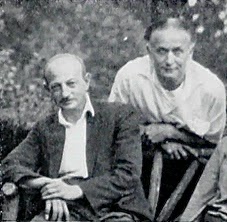
Houdini and Ernst in Sea Cliff.
    Walking out in front I raised my hands suppliantly toward the heavens and with all the command and force I had in me called:
    "Listen to my voice, great Commander of the rain, and once more let the water flow to earth and allow the flowers and trees to bloom."
     A chill came over me for as if in response to my command or the prayer of my words another downpour started, but despite the pleading of the children I refused to make it stop again. I was not taking any more chances.

May you have a rain free fabulous Fourth!

Related:

Thursday, October 31, 2019

Did Houdini see his mother's ghost?


Here's a new story to conclude our special Halloween week of GHOST POSTS. I don't believe this is mentioned in any biography, and it's pretty wild. Did Houdini see his mother's ghost at the time of her death?

The following comes from the 1932 book Houdini and Conan Doyle: The Story of a Strange Friendship by Bernard M.L. Ernst and Hereward Carrington.

It is true that certain odd incidents occurred in his life, but these he was always inclined to "explain away" by that blessed word—coincidence! Thus, he narrated to the editors of this book how he saw a vivid apparition of his mother, the very night she died—he being in Germany at the time, and she in New York. (He was quite unaware of her illness.) This he acknowledged as really happening, but he put it down to coincidence—quite ignoring the fact that "coincidences" of the type had long since been mathematically proved far too numerous to account for in this manner.

Bernard Ernst was Houdini lawyer and close confidant and can be considered a trusted source. (Carrington less so.) So if Ernst says Houdini said this, then Houdini said this! What I wouldn't give to learn more details.

Hope you enjoyed my week of GHOST POSTS. Yes, this was a gimmick, but as you can see below, Houdini himself understood that the power of the word "Ghosts" to get ones attention. Especially on Halloween.


Remembering
HARRY HOUDINI
on the
93rd ANNIVERSARY 
OF HIS DEATH
October 31, 1926

Related:

Thursday, January 31, 2019

The Landrah Corporation?

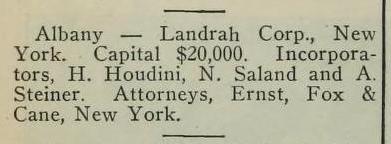
Here's a mystery for the end of the month. This appeared in the November 12, 1924 issue of The Film Daily and shows Houdini formed something called the "Landrah Corporation" that year. I have no idea what this was!


The only other reference I can find is a similar incorporation notice in the October 29, 1924 issue of Variety. This one is harder to read, but it does give a touch more information, including that the business is related to "pictures."


By 1924 Houdini was putting movies behind him, so it seems odd for him to be starting any new "picture" enterprise. Or maybe this has something to do with the dissolution of his various movie companies?

This is as deep as I've gone, so I figured I'd throw it out to the research wolves. Another Houdini mystery to chew on!

Related:

Friday, June 29, 2018

Bill Kalush has been to the mountaintop


It's official. William Kalush now knows more about Houdini that anyone living (if he didn't already). That's because Bill, who co-wrote the 2006 biography, The Secret Life of Houdini, was recently granted unique access to Houdini's private diaries.

Last weekend Bill gave a talk about the diaries at the Cincinnati Magic Collectors conference (aka "Gathering of the Vultures"). I've only heard snippets about what Bill shared, but what I've heard has blown my mind!

The diaries start in 1904 and are handwritten with some typed inserts. Houdini appears to have added to his original entries over time. Bill showed several photos from the diaries, many that featured images of unknown posters. One photo shows Bess sitting at wheel of Houdini's Voisin bi-plane. Bill also showed ads that Houdini placed trying to sell the plane in 1910. There was also photo of a cabinet that Bill described as a possible precursor to the Water Torture Cell.

The diaries also revealed the existence of two hitherto unknown assistants; Thomas Clarke Pendrigh, who worked with Houdini for two years, and Harry Wittaker, who stole Houdini's secrets and went out on his own (and failed miserably). Houdini supported a female escape artist known as Oceana. He had gaffed cuffs made by Froggatt & Company. He once struggled 80 minutes inside a U.S. Navy boiler. And Bess once left £40,000 worth of jewelry in a cab in England. (Later recovered.)

One bombshell was the revelation that Houdini might have had a half sister named Peppi (possibly a daughter of Mayer Samuel before his marriage to Cecilia). Also, Chung Ling Soo told Houdini he had three wives, including a Jewish one.

During the Q&A, someone asked Bill if the diaries contained any information about Houdini being a spy. They did not.

While Bill said he could not reveal who owns the diaries, it's pretty well known that the family of Bernard M.L. Ernst, Houdini's lawyer, have held a collection of diaries since Houdini's death. So I'm assuming that's what Bill saw. The family have only provided limited access to select researchers in the past. In fact, Bill could not even get access to the diaries when he was writing his own book.

Here's hoping Bill will share what he learned in some larger way, perhaps in an upcoming issue of Gibecière, the journal of his own Conjuring Arts Research Center. But, for now, I'm perfectly happy knowing that someone has been to this particular mountaintop, and confirmed it is indeed a place of special knowledge.

Thanks to an attendee tipster, Bill Kalush, and Phil Schwartz at the excellent Thayer Magic forums for the info.

Related:

Thursday, May 24, 2018

Mystifier, Second Quarter 1993

Continuing my look back at Mystifier, the quarterly newsletter of the Houdini Historical Center that ran from 1991-2003.


The Second Quarter 1993 Mystifier begins with an article by HHC Curator Moira Thomas celebrating the second year of The Harry Houdini Assembly of the Society of Young Magicians. Says Thomas:

Because our SYM chapter is sponsored by the HHC, we feel a real commitment to helping our members understand the history of magic. In addition to teaching Houdini's life story, we present information about other great magicians like Kellar, Thurston, Ching Ling Foo, and Robert-Houdin.

The newsletter goes on to announce that four new poster reproductions, struck from originals in the Radner collection, are now available for purchase in the gift shop (one is pictured on the front page above). This is followed by an extended excerpt from Zen Karate by Randall Bassett called "Houdini's Health and Fame." In the introduction to the piece, Dr. Morris Young writes:

In his book, Randy cites Houdini as a prime example of someone who developed the physical and mental concentration necessary to acquire advance karate skills. During his research, the author questioned me about Houdini and examined the Houdini diaries which the Bernard Ernst estate has retained from the magician's estate.

This is, as far as I know, the first time Houdini and karate have been linking. And how about that confirmation that Houdini's diaries are still held by the Ernst estate? [Shhhh.] Page three features a section of photos from the Radner collection. While familiar to us today, these images would not have been as familiar to 1993 readers.

In his "Backstage with Sidney Radner" column, Sid discusses his belief that, had he lived, Houdini would have launched a new crusade exposing the tricks of professional gamblers. Sid talks about his own exposures of cards cheats while he was with the Criminal Investigation Division (CID) of the U.S. Armed Forces. He then goes on to say that a special steel engraved panel commemorating Houdini will be placed on a wall at Ellis Island in New York, thanks to the efforts of HHC menber Paul Rosen of Lawrenceville, N.J. (Except the Weiss family came through Castle Garden in Battery Park, not Ellis Island.)

In this extra long column, Sid announces the publication of Manny Weltman's important work, Houdini: Escape into Legend, The Early Years 1862-1900. He also tells of how Hardeen got his nickname "Dash" (at least the story Hardeen told him); that David Copperfield recently did a suspended straitjacket escape over fire; and that bottles of "Houdini Beer" are now collector's items as the Appleton based brewery that produced it has lost in least.

Mystifier
Volume 3, Number 2
Second Quarter, 1993
4 pages

Contents:
Center Sponsors SYM Chapter
Houdini's Health and Fame
Photos from the Radner Collection
Backstage with Sid Radner

Thanks to Jay Hunter for supplying me with a scan of this issue. If anyone is willing to part with an original, this is one of only two issues that I do not own, and I'd love to complete my set.


Related:

Wednesday, October 19, 2016

REVIEW: Bob Loomis delivers a Houdini masterclass

Houdini's Final Incredible Secret by Bob Loomis is a masterclass in the study of Houdini and magic history. It's really one of the most remarkable works ever produced on any single magician. This densely packed 323 page book is about a single magic trick that Houdini performed once. That's it! How can that be a book? Well, imagine spending a week in Houdini's home, getting to know every aspect of his personality and his environment, and then travel with him step by step in the trial and error development of a single perfect magic feat. Yes, that's a book!

The trick that is the focus of Bob's 20 year investigation was performed by Houdini for Sir Arthur Conan Doyle and Bernard M.L. Ernst in his New York home in 1922. Only one description of the trick exists, told by eyewitness Ernst in his 1932 book Houdini and Conan Doyle: The Story of a Strange Friendship (pages 240-245). The trick involved producing the written message "Mene, mene, tekel, upharsin" on a chalk slate suspended in the middle of a room in full view of Doyle and Ernst.

Past books have mentioned the famous feat and some have attempted to explain it, including most recently The Secret Life of Houdini. Bob examines and dismisses all previous explanations, which he shows invent or omit key descriptive information to fit their own theories. Bob assigns himself the task of explaining the trick exactly as described by Ernst.

It's clear that Bob is a researcher par excellence (he was the librarian at the Magic Circle in London). It's also clear he delights in doing research. Bob shares that joy by taking the reader step by step through every bit of his own process with lively prose. It might even be too much process for some. But even if one feels lost at times, there are gold nuggets along every part of the trail, so one never dares jump ahead.

I was especially impressed with Bob's overview of Houdini's character (the good and bad) on pages 67-89. Even if one doesn't want to take this full journey, the first section of the book is required reading for anyone with a desire to better understand Houdini. Gold, gold, gold!

So did Bob solve the mystery of Mene Tekel? Well, he certainly offers an explanation that is technically feasible, and he's backed it up with proof that the methods -- and there are several methods at work -- were all familiar to Houdini. The explanation is not simple or elegant. It requires divergent elements to work perfectly in sync, and the possibility of failure seems remarkably high. Maybe that's why Houdini only performed it once.

One aspect of the explanation that I don't think Bob nailed as well as others is how Houdini acquired the message that Doyle wrote several blocks from Houdini's house. Bob offers several scenarios in which confederates on the street could have gotten a peek at the message. But it just seems high risk for Houdini to leave such an essential part of the trick in the hands of others and chance. It also just seems a little improbable that such a complicated and seemingly nonsensical message could be gotten from a glance or by watching the end of a pencil. And would Houdini really be able to canvas the entire neighborhood with confederates, including policemen? Well, this is Houdini we're talking about, so maybe!

To his great credit, Bob takes Ernst at his word and accepts that Houdini not only had to fool Doyle, but Ernst as well (who remained with Houdini at all times). But I'm not entirely convinced Ernst was an innocent observer. He was Houdini's lawyer and confidant (consigliere?) in all matters. My own feeling is he was in on the trick. This would help explain some things. But there I go twisting the stated facts to fit my own ideas, just as others have done in the past. As I said, Bob doesn't give himself that luxury. As impossible as it all seems, Bob shows us that the impossible was possible.

In the end, whether or not you fully agree with all of Bob's findings, you'll still agree that this is a remarkable book. In Houdini's Final Incredible Secret, Bob Loomis not only teaches us how Houdini did it, but he also gives a lesson in how to research Houdini and magic history in a meticulous and ethical way. It's a book that deserves a standing ovation.

You can purchase Houdini's Final Incredible Secret at Amazon.com (U.S.) and Amazon.co.uk (UK).

Related:

Friday, May 13, 2016

Guest blog: The Houdini Museum of New York, Part I

Recently our friend and frequent contributor Neil McNally traveled to New York where he visited the remarkable Houdini Museum of New York in Fantasma Magic. Neil was able to interview owner Roger Dreyer about what is now one of the largest public displays of authentic Houdini memorabilia in the world. I'm very excited to share PART ONE of that interview today.

by Neil McNally

If you ever find yourself in New York City at the corner of 33rd Street and 7th Avenue look up. On the face of the towering Sports Plaza office building, you might just be able to make out the confidant visage of Harry Houdini staring down at you. Or more to the point, a row of vintage Houdini magic posters taking up one row of office windows. This impressive display is what greeted me one rainy December afternoon as I made my way to “Fantasma Magic,” home to the “Houdini Museum of New York.”

As the elevator doors open you are greeted by a vintage fortune telling machine. Inside his glass cage is Zoltan who is more than happy to share his wisdom with you…for a small fee of course. Push past two metal doors, and you will find yourself transported to a golden age of New York magic. It’s an age that harkens back to a simpler and more innocent time where legends like Al and Jackie Flosso would hawk their magical wares and educate those who were willing to learn.

Fantasma Magic is the brainchild of businessman and Houdini collector Roger Dreyer. After the bulk of his Houdini collection, second only to David Copperfield’s, was used in the travelling exhibition Houdini: Art and Magic he decided to set up a more permanent museum of his own in the foyer of his own magic shop.

It is here that I was able to meet with Mr. Dreyer and get a personal and insightful tour of his collection. It’s a collection that has to be seen to be believed. But, in the world of Harry Houdini you wouldn’t want it any other way.

Can you tell me a bit about your collection and the Houdini Museum of New York?

"Everything is from my personal collection with the exception of a lone item from the Society of American Magicians which is Houdini’s second bust that was created and then stolen in 1976...and then magically reappeared at the Nassau County Police Department. There’s another story unto itself right there.

Our whole goal (at the museum) is to motivate children to be the next legends of magic or the next Harry Houdini. We have a lot of inspirational talks and different lectures and performances where we even let the kids try on the actual Houdini handcuffs…We’re very proud of a lot of the unique items that we have on display. Many people say this is the largest permanent collection of Houdini items that is on display seven days a week where people can visit."

In terms of the museum setting itself, it’s very obvious that you were going for a very classic magic feel for the displays. Tell us a bit about that.

"The Houdini Museum of New York has only been in this current location for 2 ½ years. Fantasma Magic has had a small Houdini display since 2006. But, it really took off with the help of the architect David Rockwell (who had worked on the now defunct Hugh Jackman Houdini musical) who came in and designed our museum for us. It’s with customized, beautiful burgundy wall paper and gold sparkled floors with a really cool type of magic mini-theater."

What initially got you into collecting?

"In the past I was inspired by Al Flosso whom I used to work for as a kid (at Martinka Magic). From him, I would get paid a lot in antique magic which I would collect for years. When I started collecting Houdini in the 90s, I ended up trading a lot of this rare apparatus with other magicians. So, it was a lot of fun acquiring it from people who knew Houdini, relatives of Houdini, as well as through other magic collectors…

A lot of my items came from the estate of Jack Chanin. Many came from Bernard Ernst’s collection…and the Sidney Radner auction. Also, much of it came from Stanley Palm who knew Marie Hinson (Bess Houdini’s sister). So, we have been very fortunate."

As we began to walk throughout the museum, Roger excitedly began to point out the many highlights of the collection and how he obtained them.

"The initial pieces of our collection range from a Robert-Houdin letter, which of course was the inspiration of Jacob Hayman naming Houdini from that...We have the famous 1895 photo of Houdini as the King of Cards…We have pictures of Jacob Hayman as the Brothers Houdini doing the barrel escape. Over here is a picture of Houdini in Atlantic City when he was sixteen.

We have something rare. Not only do we have Houdini’s escape mailbag that we actually got from Jack Chanin. Jack Chanin’s father used to run a barbershop in Philadelphia and Houdini once left the mailbag there and never came to pick it back up after the show. During the Sid Radner sale, I was able to buy a whole bunch of Houdini’s picks and equipment. One of them was a mailbag bolt…so this is Guy Jarrett’s own bolt that he designed for Harry Houdini that Houdini used with the reverse thread (for the mailbag escape).

We also have the last trick that Houdini performed onstage for “The Whirlwind of Color.” Houdini collapsed at the end of the first act and this trick was actually finished by his assistants when Houdini was rushed to the hospital."


One of the more unique aspects of the Houdini Museum of New York are its interactive elements. Situated by the framed exhibits is an animatronic straight jacketed Houdini that drops from the ceiling upside down…only to magically escape moments later.

"What’s kind of cool about our venue is that we have Houdini coming down every fifteen minutes where kids can see him…Then at the end Houdini does in fact get out of the straight jacket. (Looking at the animatronic Houdini as it escapes from its straight jacket) And yes ladies and gentlemen Harry Houdini has escaped!"


Join us next time for PART TWO when Roger talks more about his thoughts about Houdini, magic history and collecting, and the renowned Houdini escape coffin.

Roger Dreyer photo from New York Daily News. All other photos by Neil McNally.

More by Neil:

Wednesday, July 8, 2015

Former home of Bernard Ernst sold


A house in Sea Cliff, New York, that once belonged to Houdini's lawyer and close confidant Bernard M.L. Ernst, has sold after coming on the market for the first time in 50 years.

Houdini visited Ernst at his Sea Cliff vacation home many times. This is where the magician famously stopped a rain storm on command during a 4th of July party. The house porch was also once the scene of seance conducted by Houdini in which he levitated a table for Ernst and his wife (a detailed description of this seance can be found in Kellock, page 305).

Houdini and Ernst in Sea Cliff.
After Houdini's death, Bernard Ernst (who was one of Houdini's pallbearers) succeeded him as President of the Society of American Magicians. He also oversaw publication of Houdini's Escapes and Magic as well as co-authoring Houdini and Conan Doyle. Bess dedicated Houdini His Life Story to Ernst as "Houdini's Dearest Friend and Advisor."

Mrs. Ernst sold the house in 1943 and a Public Auction of "Household Furniture and Furnishings" was held at that time. One wonders if any Houdini photos, letters or treasures slipped out into the world via this auction? Ironically, the auction took place the day before Halloween.

Congrats to the new owner. And if you ever want to hold a seance, you know where to find us.

Thanks to John E. and Barbara.

Related:

Thursday, June 19, 2014

Houdini's greatest secret

Today it is general knowledge that Houdini was born in Budapest, Hungary, and immigrated to America along with his family as a child. Houdini's story is a classic tale of an immigrant making good, and today it is fashionable to say that part of Houdini's appeal was that he symbolized for his audiences the immigrant/individual who was able to break free of the "bonds" of oppression. But that might actually be a very modern read on Houdini.

Because during his own career, Houdini always claimed to be an American, born April 6, 1874, in Appleton, Wisconsin. [*SEE UPDATE.] In fact, it's more likely Houdini symbolized for his audience a new breed of 20th Century American supermen. This was especially the case in Europe where Houdini was billed as "The Elusive American" and had posters that showed him wearing shorts made of the Stars and Stripes (and this before Rocky Balboa). An American superman was certainly how Houdini wanted to be seen.

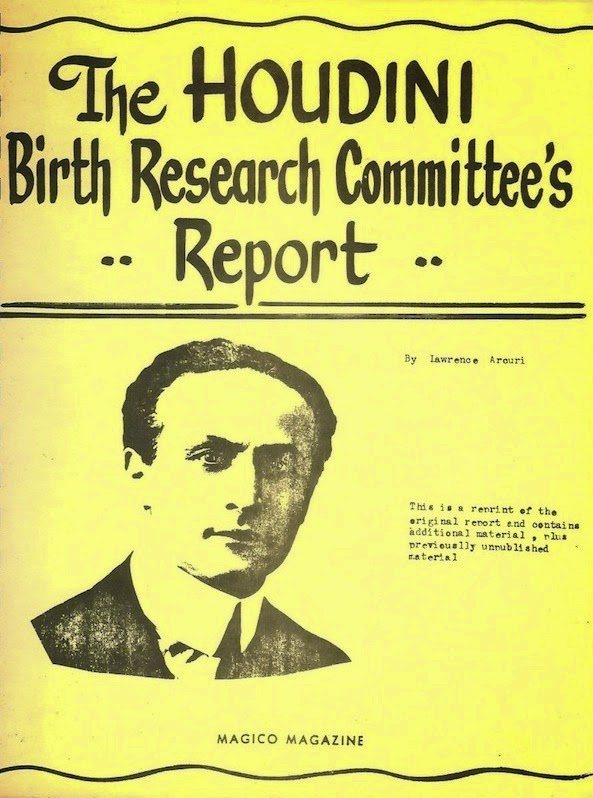
So it must have come as a surprise to those who had known or had seen Houdini in life to learn that he wasn't an American after all. Many first learned the truth of Houdini's Hungarian birth 33 years after the magician's death with the publication of Houdini: The Man Who Walked Through Walls by William Lindsay Gresham in 1959. Some in the magic world still didn't accept it until 1972 when the S.A.M. National Council investigated the issue and published their conclusions in The Houdini Birth Research Committee's Report (above).

But the truth of Houdini's real birthplace and birth date was actually first uncovered and revealed in December 1932 in a German magic magazine, Die Magie. Patrick Culliton recently translated and reproduced that historic article on his website, Houdini's Ghost. It makes for interesting reading, especially the passage below in which the author talks about trying to publish this historic finding in an American magic publication and being rebuffed:

I believed that I was rendering our American friends a service and sent the original excerpt from the register together with the reproductions of the above-mentioned letters and pictures, to the S. A. M. [Society of American Magicians] for publication in SPHINX. To my great astonishment, I received from Mr. B. M. Ernst, President of the S.A.M. a cool letter of rejection with the statement that he could in no case accept that my conclusions were correct, and since it could only have been an error, he also advised me, in a tone that seemed disconcerting, against the publication of this material.

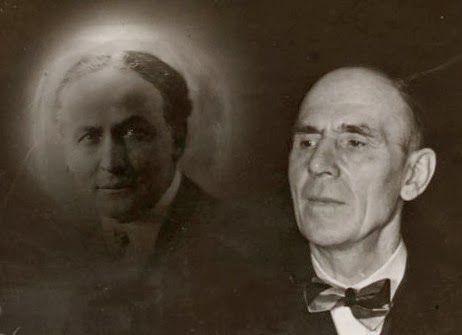
What the Die Magie writer apparently didn't know was that Bernard Ernst (right) was Houdini's lawyer and close confidant who continued to look after the Houdini estate and Bess at this time. It has been said that Ernst and Bess feared that the Life Insurance companies who had paid out on Houdini's policies (Bess' main income) would have grounds to void the policy and stop payments if it was shown that Houdini had "falsified" his nationality on the original application. This could very well be. But could Ernst have also been protecting the myth of Houdini as an American superman? He might have had unique knowledge of how important this was to Houdini. Regardless, it's very interesting to see proof of a genuine conspiracy of silence on the topic of Houdini's birth at this time.

Here's another related thought. Before 1903, Houdini would list the year of his birth as 1873. This changed to 1874 with the new passport application he filed in Europe when he officially designated Appleton/America as his birthplace (Hardeen did the same thing). Why the change? Could it be that Houdini got a look at his birth certificate when he travel to Budapest during his European tour and discovered his real year of birth? If it was easily accessible in 1932, it would have been no problem for Houdini to get a copy in 1900. It must have come as a shock for Houdini to learn that he was actually a year younger than he always thought.

Below is copy of the birth record taken at the Registrar's office at the Pest Jewish Community on November 9, 1932 and referred to in the Die Magie article -- the document that revealed Houdini's greatest secret.


* UPDATE: In his early career, Houdini did acknowledge his European birth. His American identity came during his first trip to England. More here.

Related:

Tuesday, February 11, 2014

The man who kept Houdini's secrets


Is 2014 the year of Jim Collins? After decades behind the scenes, Houdini's chief assistant and trusted mechanic will be stepping into the spotlight in at least two major Houdini projects this year.

This month David Crabb will play Collins on stage in New York in the Axis Theater Co. production, Nothing on Earth (Can Hold Houdini). Then, later this year, Collins will appear in HISTORY's Houdini miniseries played by Evan Jones. In fact, it's looking like Jones/Collins will be the third lead behind Adrien Brody and Kristen Connolly.

So with all this upcoming Collins action, I thought it was time to share this remarkable artifact from the collection of Jon Oliver. This is Jim Collins' last paycheck from Houdini. As you can see, it was issued by "Houdini Attractions, Inc." on November 8, 1926 (a week after the magician's death) in the amount of $40. Collins endorsed the check and deposited it on November 16.

Click to enlarge.

You'll notice that this is Check No. 1. That's because "Houdini Attractions, Inc." was a new company incorporated during the final weeks of his life. I like that the first order of business was to cut Collins a check. He was, after all, the man who kept Houdini's secrets.

Jim Collins would go on to assist Hardeen into the '30s and '40s. He died in Philadelphia on March 6, 1942 at age 59.

Thanks to Jon Oliver for the image and to Patrick Culliton for Collins' death date. For more, check out this thread at The Magic Cafe which has some interesting information about Collins as well as comments from relatives.

Related posts:

Wednesday, August 14, 2013

A sober recap of Drunk History's Houdini episode


Last night Drunk History aired a segment about Houdini in an episode titled, "Detroit." For those who aren't familiar with the Comedy Central series, Drunk History features soused storytellers talking about real history while well-known actors perform their inebriated version of events. It's pretty funny stuff.

In last night's episode, Ken Marino and Alfred Molina played Houdini and Sir Arthur Conan Doyle respectively. The storyteller was Lucius Dillon, who was very, very drunk. The Houdini segment was the last, longest, and drunkest of the show. It was broken up by a commercial break.

For all the frivolity of their approach, Drunk History actually did a good job with their Houdini history -- far more responsible and accurate than some of the recent offerings from the cable networks (yes, Brad Meltzer's Decoded, I'm still talking about you). While there were no egregious inaccuracies, I can offer up a few picky points of clarification. So let's do this thing.

1234...

Houdini and Bess (played by Maria Blasucci) did indeed work briefly as spirit mediums early in their careers. However, they did a stage act, not private consultation as depicted in the reenactment. Also, I don't know where that bit about Bess posing as a "Bible salesman" to glean personal information came from. That must have been the booze talking.

Atlantic City 1922 is the correct date and location of the Houdini-Doyle seance. However, the show depicted Houdini as performing there with Doyle visiting him backstage. In reality the Houdinis were vacationing with the Doyles when the big seance went down.

The seance with Lady Doyle (played by Sarah Burns) was depicted as being spoken communication, whereas in reality it was all done via "Automatic Writing." In fairness, Dillon did say the communication would be done with "handwriting", but it was much funnier having the Burns/Dillon wildly articulate the ghostly words from Houdini's mother. Houdini did indeed ask if his mother's ghost could read his mind, and Lady Doyle did make the sign of the cross on the top of her notepad. The show depicted Houdini as blowing his top at the seance, but in reality he kept his feelings to himself at that sitting.

Houdini did wear disguises to seances (here's one) and aggressively exposed mediums on the spot. Whether or not he flipped them a double bird on his way out the door...only the spirits know.

1234...

The dressing room assault by J. Gordon Whitehead (here played by show creator Derek Waters) was not quite as abrupt as depicted in the reenactment. Houdini was also reclining on a couch at the time of the blows. The reenactment suggested a stricken Houdini went right from his dressing room to his final performance, but in reality the assault happened while Houdini was in Montreal. He traveled to Detroit to give his last performance two days later.

Houdini did indeed perform his final show at the Garrick Theater with a 104 degree temperature and a burst appendix (which probably ruptured on the overnight train ride to Detroit), although his appendicitis would not be discovered until he was operated on the next day. Houdini final performance was not as sloppy as shown in the reenactment, although the interior agony of it might have been very accurate for what Houdini himself was experiencing. There was indeed a man in the audience who had seen Houdini before (not sure about "8 times") who sensed that something was wrong. Others who had not seen Houdini thought the show was pretty good.

Houdini did die in Grace Hospital in Detroit on Halloween, although the Doyles were not by his bedside. Houdini died with his brother Hardeen by his side. His doctors at the time were noncommittal about whether the blows caused the fatal infection. That would be fought about between his lawyer, Bernard Ernst, and the New York Life Insurance Co. for the next year. Ernst ultimately succeeded in pinning the cause of Houdini's final illness on the blows, which enabled Bess to collect double indemnity for accidental death. The debate as to whether Houdini was suffering from appendicitis before the blows continues to this day.

The "10 year compact" is something that might need to be tackled in a fresh post at some point, because exactly what Harry and Bess arranged is not so straight forward as that. But for now, yes, Houdini and his wife arranged a codeword that would identify him should he come back. Bess did give up on seances after 10 years and she did say, "Ten years is long enough to wait for any man." And, yes, Bess's hair was white by then.

So there's your sober recap of Drunk History. Kudos to the show for treating our man right and doing a good job with the history while still having a lot of fun.

Cheers.

Houdini and the Doyles in Atlantic City at the time of the seance.

Monday, April 29, 2013

Houdini escapes D.C.

Here's a nice way to wrap-up coverage of the Washington Symposium on Magic History. My friend and fellow Houdinite, Jeff Abraham, alerts me to this photo of Houdini's suspended straitjacket escape in Washington, D.C. on January 12, 1922. You'll notice this is different from the more familiar shot showing him bound in the jacket. In this photo he has just broken free!


This is an original 4 X 5 photograph that's available for purchase at Gotta Have It! for $1,950. Handwritten in pencil on the back is, "Return to, BML Ernst, 25 W.43rd St. NYC." (Bernard Ernst was Houdini's lawyer.)

That's a pretty steep price for an unsigned photo, if you ask me. But, hey, it's Washington, it must be inflation!

Thank you Jeff.

UPDATE: The Gotta Have It! auction states this is Houdini doing a suspended jacket escape in front of the Washington Herald newspaper building. But this is actually the B.F. Keith's Theater in the Riggs Building on the southeast corner of 15th and G Streets.

Saturday, December 8, 2012

Brother's keeper

While in Fort Worth for the Official Houdini Seance this year, I was able to examine a very interesting letter in the collection of Arthur Moses. The letter is from Houdini's lawyer, Bernard Ernst, in regards to Houdini's brother, Theo Hardeen.

On August 4, 1926, Ernst writes Houdini that:

"In accordance with your instructions I will not draw any further checks for salary to Mr. Hardeen unless you instruct me to do so."

The correspondence indicates that Houdini had written his own letter to Hardeen on August 3, presumably delivering this same information.

So what is this all about?

All I can think of is that Hardeen was still drawing a salary as an executive of Houdini's Film Developing Corporation. Houdini had convinced his brother to give up his stage career to help run the fledgling film laboratory in 1917. While this makes sense, it's surprising that the FDC is still in existence in 1926. It could be that cutting off Hardeen's salary was the very last gasp at what had been a long slow decline for the company.

It's also possible that this had nothing to do with the FDC and Houdini was simply supporting his brother as he had supported other family members during various periods of their lives. But the word "salary" leads me to believe this was somehow business related.

Interestingly, this is just a few months before Houdini's death. Hardeen would inherit the bulk of his brother's props and go back to performing the following year, openly advertising himself as Houdini's brother and successor (the fact that they were brothers was not overtly promoted during Houdini's lifetime).

But in light of this letter, I can help but wonder whether Hardeen would have dusted off his Milk Can and returned to the stage even if Houdini had lived?

Saturday, November 24, 2012

1934 Houdini Magic kit sells on eBay

A 1934 magic kit officially licensed by Beatrice Houdini and Bernard Ernst has sold on eBay for $204. These kits are a nice early example of Houdini tie-in magic merchandise. I was fortunate to examine a few of these in the Arthur Moses collection during my recent Texas adventure. This particular kit was noted as being an "estate find."


Thanks to Kevin Connolly at Houdini Himself for the tip.

Saturday, November 3, 2012

Report: The Official Houdini Séance 2012

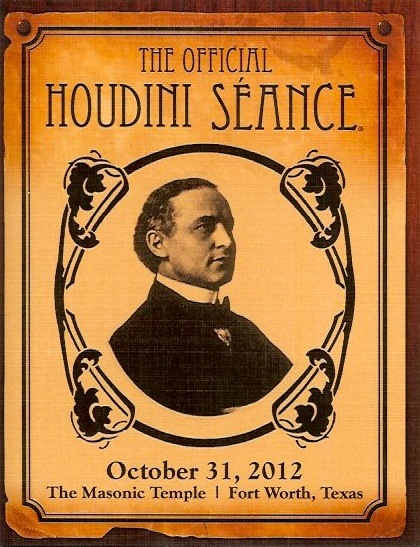
Last Wednesday I had the extreme honor of attending and participating in the 2012 Official Houdini Séance in Fort Worth, Texas. The event was held at The Masonic Center on Halloween and was organized by mega collector Arthur Moses and Derek Kennedy in cooperation with William Radner. For me it was a non-stop two day mind-blowing journey into the world of Houdiniana like I've never experienced. I will try to sum it all up here with the help of some terrific images provided by some new friends I made on this trip.

Day 1

I flew into Fort Worth a day early and had the great pleasure of staying in the home of Arthur and Linda Moses. Having acclimated myself to living a shoe-box size apartment across from a bustling movie studio, staying in a big, beautiful, quiet suburban house was an unexpectedly wonderful experience in itself. Oh, it was also nice to step out my bedroom door and be greeted with a gigantic 8-sheet Houdini Buried Alive poster!

But nothing prepared me for Arthur's magnificent "Houdini Room." I had seen videos and photos of the room, but I was still knocked back on my heels when I stepped through the door. Below is a stitched together photo courtesy of Scott Wells of The Magic Word. And this is just the first floor!

The Houdini Room. Photo by Scott Wells.

Overwhelmed? I was too. In fact, after spending an hour going through the bookshelves and artifacts on the first floor (and recording this podcast with Arthur and Scott for Magic Word), I found I couldn't muster the psychic energy to tackle the second story where two more full rooms of treasures reside. But this was also because the evening guests had begun to arrive, and it was time to meet some legends.

Arthur had invited all the VIP ticket holders to come over and enjoy some genuine Texas BBQ and to see his collection. Among the VIP attendees was Tom Boldt of Appleton, Wisconsin, who has been integral in arranging the Official Houdini Séances along with Sidney Radner for many years. He is also a very nice guy. Also on hand was Robert Somerdin from Florida, a top collector of Houdiniana (and pin ball machines) who had me gaping at his descriptions of what is in his collection. I was also thrilled to meet William Radner, son of Sidney Radner, who had brought along many clippings and photos from his father's collection. After we had finished our BBQ, Bill brought out the legendary "Séance Cuffs". For those following me online (via Wild About Harry on Twitter, Facebook, or Instagram), you saw this pic of the magic moment.
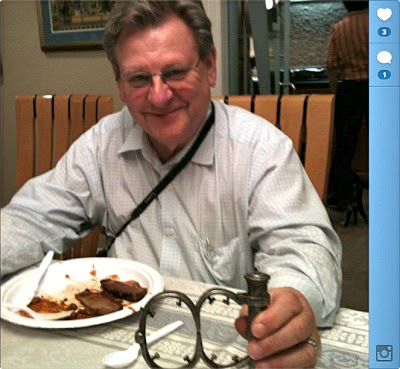
"Bill Radner, the Séance Cuffs, and Texas BBQ! It's on."

One disappointment for all of us was that Official Séance regulars Fred Pittella and Larry Weeks were unable to travel due to Hurricane Sandy and would not be able to take their traditional places at the séance table. I've never met these men and I was sorry I wouldn't get the chance on this trip. Hopefully I'll get another chance in the future.
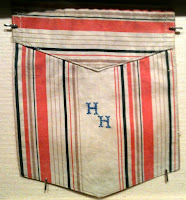
Houdini's pajama pocket.
After we finished our delicious dinner, the group enjoyed Arthur's Houdini Room. Fortified by food, I was now able to take on the second story. Here I saw Houdini's pajama pocket -- which he was wearing when he died -- his wallet, a case full of pitchbooks, countless photos, original posters, and a solid wall of periodicals neatly filed and classified (remember Arthur is the author of the definitive Houdini Periodical Bibliography). Part of the fun of experiencing something like this collection is how you can be knocked out by not just the major stuff -- like the Houdini straitjacket or the Houdini sidewalk stand -- but little things as well. For example, Arthur has on his wall a photo of Houdini in shackles dressed in what appear to be circus tights. While I've seen photos of Houdini imitators in this kind of garb, I've never seen a photo of Houdini dressed this way. It really blew my mind.

In that same mind-blowing category was a menu and an actual boutonniere from Harry and Bessie's Silver Wedding Anniversary dinner at The Alexandria Hotel in Los Angeles. There was also a fascinating letter from Bernard Ernst to Houdini regarding Hardeen's "salary" that I will do a full blog post about in the future.

We all lingered late into the night, talking Houdini and enjoying the collection and company. Arthur also presented us with our special gift bags that included a very cool heavy duty antique-looking padlock with the 2012 Official Houdini Séance logo. Inner Circle members also got some beautiful padlock bookends. I finally fell into bed around 2AM, looking forward to THE big day.

Day 2 - Halloween

I rose around 8:30am and joined Arthur, Linda, and Scott Wells (who was also staying at Arthur's house) at the breakfast table in time to see Arthur's interview air on ABC's Good Morning Texas. It was a very good segment that showed off the Houdini Room and also promoted the seance event. I was thrilled to learn that there would be close to 200 people attending.

Arthur Moses and Scott Wells watch the Good Morning Texas report.

It was then time for me to earn my keep as I scooted around Fort Worth with Arthur, helping make final arrangements and set up the séance room at the stunning Masonic Center. Not only was this a visually exciting setting for a séance, but also appropriate in that Houdini himself was a Freemason. I also had the terrifying pleasure of helping Arthur load the priceless Houdini sidewalk stand into his van (it would be displayed, along with the Houdini straitjacket, at the event). I couldn't help but think of how Jim Collins and James Vickery might have carried the sign in exactly this same way to set up in front of a theatre. We're all still working for Mr. H!

The day seemed to fly by and before we knew it the event was suddenly upon us! Guests, dressed formally, began to arrive around 7pm. The VIP ticket holders gathered in the lower ballroom for cocktails and appetizers. I was scrambling to get all my equipment set-up and in working order in the main room, but I was still able to slip downstairs and enjoy the company and food. I knew my presentation was going up first, so I was pumped to finally see "my" audience.
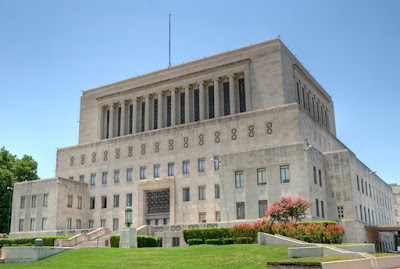
The Masonic Center in Fort Worth, Texas.

The séance room (chamber?) was beyond amazing when it was all finished. The photo below, courtesy of Bill Radner, captures it somewhat; but factor in the eerie organ music by Michael Reed playing from the balcony, the flickering candles, the chairs draped in black, and the armed security guard standing by the sidewalk stand and straitjacket. (The huge Houdini straitjacket poster is actually a backdrop from the stageplay Ragtime and belongs to Ash Adams, who was the MC for the evening.) The atmosphere was incredible -- almost funeral-like -- and the nearly 200 assembled guests all seemed to be speaking in whispered tones. A perfect setting for a séance on Halloween!

The Official 2012 Houdini Seance. Photo by William Radner.

With everyone settled into their seats, the evening began with Master of Ceremonies, Ash Adams -- an award winning magician with over 20 years experience -- welcoming everyone and giving a brief history of the Masonic Temple and also about Houdini's two visits to Fort Worth in 1916 and 1923. Ash set a spooky Halloween mood and challenged Houdini, just as he had been challenged by the people of Fort Worth during his visits, to again make an escape tonight.

Ash then introduced me, and I presented what I called a Houdini History Presentation, but the official program carried the much more impressive title, "Understanding Houdini in the 21st Century." I was really eager to give a good, entertaining talk that would appeal to both the hardcore Houdini experts in the room as well as the general audience members who might not know a thing about Houdini. I think my presentation went over very well; aided greatly by a Keynote slide show where I was able to share several rare images, including a beautiful unpublished photo of Houdini and Bess provided by David Haversat and a terrific photo of Houdini being tied to a stake by two Native Americans provided by Jon Oliver (I also snuck in one of the unpublished bear trap photos from the Motion Picture Academy Library's Grim Game file).

Much to my relief, the length of my talk seemed to be exactly right (I feared I would go on forever -- I had 90 slides!). I then showed two pieces of film footage -- the 1907 Rochester bridge jump and the 5 minute clip from The Grim Game. The Grim Game footage was a last minute addition when I saw how well it went over at the Hollywood Egyptian screening last week. Including it was a good call. Once again, the audience gasped when the planes crashed.

MC Ash Adams on stage. Photo by William Radner.

Having accomplished my mission of filling everyone's head with as much Houdini history as I thought they could stand, I was happy to sit back and enjoy the rest of the program. Bill Radner took the stage next and spoke about his father and the importance of the séances throughout the years. He then showed a video clip of Sidney talking about the Bean Giants, the Séance Cuffs, and a special key Houdini used to unlock any handcuff. The audience seemed to really enjoy this, and it was a wonderful to have the great Sidney Radner there in the room with us.

Jamie Salinas. Photo by William Radner.
Following Bill came magician Jamie Salinas, a skilled sleight of hand artist and a regular performer at The Magic Castle, who did magic tricks and also escaped from a straitjacket, which received a terrific reception. Then came magician and sideshow entertainer Shel Higgens, who did a spectacular sword swallowing act balanced atop a free standing ladder. It was a unique performance that worked wonderfully well in the big hall and provided a real unexpected treat for the audience (and for me as I had no idea of what he was going to do).

Closing out the first half of the evening was the recording of Houdini's Voice, generously provided by Tom Interval of HoudiniMuseum.org. It was a perfect way to bring the theme of the evening back to the spirit of Houdini. Frankly, I think Houdini was watching over us all. I was amazed at just how our completely unrehearsed "show" came off without a single hitch and how each presenter seemed to compliment and blend into the next. It was a darn good show!

Then followed a 15 minute intermission in which the guests -- a little less intimidated by the room now -- took photos of themselves standing beside Arthur's Houdini memorabilia and the séance table. But now came the big event of the evening...

The Séance

Following intermission the guest all retook their seats. Ash Adams again set the mood, explaining in a very serious tone the "rules" of the séance. Each of the "Inner Circle" attendees, including myself, were introduced one by one. Filling in for Larry Weeks and Fred Pittella was our MC, Ash Adams, and Kathy Tayefeh of Magic Etc. who also runs a local Fort Worth Spook Show attraction and is highly sensitive to ghostly phenomena. We all remained standing behind our chairs as medium Scott Wells was introduced. He entered dramatically from the parted curtains onstage. Scott then took over, instructing us to take our seats. Under a single spotlight, Scott explained a little Houdini history and what we would be attempting to do tonight.

The Inner Circle participants.

The séance commenced and Scott attempted to contact the spirit of Houdini in a way that would have made Edward Saint proud. He also encouraged everyone at the table to speak up if they experienced anything unusual. During his pre-talk he also told the assembled crowd to share anything that happened to them after the seance.

Now, believe it or not, the séance was not without a few odd occurrences. A program on the table appeared to move, as did a chair up on stage. However, from where I was sitting, I didn't see either happen, so I can't speak to these. Kathy Tayefeh did see what she described as some kind of a red cloud or energy in an upper balcony. After the séance some audience members claimed they had also seen this. Directed to the spot, I said I could see the vague figure of a man perched at the rail peering down at the table. I thought this was pretty strange, until it was pointed out that there were people watching the séance from up there. Doh! (But, you know, when the lights came on, the people up on the balcony were NOT what I had seen during the séance. Not even close. Just saying...)

However, I think all the odd "phenomena" might have been evidence of the true power of suggestion and the intense and spooky atmosphere that had been so successfully conjured by Scott and everything about that room.

After a final appeal, Scott then closed the séance and the guests went downstairs to enjoy a final reception back in the ballroom. There Bill Radner told me he already had an idea about where to hold the séance next year and that I would definitely be invited to participate. (Yes!)

All in all, it was a spectacular evening and a very successful Official Houdini Seance, even if once again Houdini didn't join the show.
As the night drew to a close, I helped break down and transport some of the artifacts back to Arthur's house. I once again had the pleasurable terror of moving the Houdini sidewalk stand back into the Houdini Room.

I then settled back with a beer and enjoyed a post séance wrap-up conversation with Arthur, Scott, and Jamie Salinas (our newest house guest), until I literally couldn't keep my eyes open any longer.

Day 3

My last day would only be a half day, but it was still great fun. Joe Notaro, who runs Harry Houdini Circumstantial Evidence and had come out from Los Angeles for the event, joined us at Arthur's house for breakfast and Scott Wells conducted a wrap-up podcast with the group. We then went into the Houdini Room, where I got to enjoy seeing Joe have the same near heart-attack reaction to the room that I had had. With time running out, I poured through a few final binders of amazing Houdini artifacts, but I never really scratched the surface of Arthur's amazing collection. In fact, I never even touched the full wall of Houdini periodicals. Maybe next time.

We then had some fun putting on Jamie's straitjacket and posing in front of the Houdini sidewalk stand.
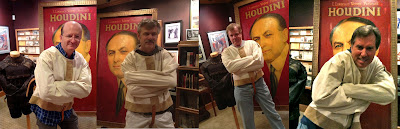
The Great Houdinis: Moses, Notaro, Wells and Cox.

It was agony when noon arrived and we had to leave for the airport. As we were both heading back to LA, Joe and I traveled together in my little (Toyota Yaris) rocket of a rental car. But it was on this 40 minute drive to the Dallas-Fort Worth airport that the strangest -- even spooky -- phenomena of the entire trip occurred...

We didn't talk about Houdini once.

Here are some more images from The Official Houdini Seance, 2012:

John Cox and Tom Boldt. Photo by William Radner.
Arthur Moses and Robert Somerdin. Photo by William Radner
Ash Adams, Scott Wells and a hobo. Photo by William Radner
Derek Kennedy and Bill Radner. Photo by William Radner
Scott Wells does a pre-seance interview. Photo by William Radner

Translate