
Banner AI generated.
Showing posts with label Arthur Ford. Show all posts
Showing posts with label Arthur Ford. Show all posts
Monday, March 23, 2026
LINK: Skeptics Dictionary and the Arthur Ford hoax
Here's a nice, quick reference summary of the Arthur Ford Houdini message scandal. This is something I've never quite covered in detail here on the blog, so when I find something that can provide the basic story, I'm happy to pass it along. Click the headline or the image below to go.


Wednesday, July 3, 2024
William V. Rauscher (1932-2024)

William V. Rauscher (1932-2024)The Reverend Canon William V. Rauscher was a magician, a psychic researcher, a biographer, and an Episcopal priest who served as rector of Christ Church in Woodbury, New Jersey, for 36 years. For four years Bill served as president of Spiritual Frontiers Fellowship (SFF), an organization focused on the implications of psychic phenomena for religion. At its peak SFF had 6000 members.
Bill was a member of the International Brotherhood of Magicians, Order of Merlin Excelsior. He was also a collector of magic and owned and performed the Flight of Time, the last illusion invented by Harry Houdini. He wrote 17 biographies of magicians. Bill maintained friendships with psychics, debunkers, fraudulent mediums, and the sixth man who walked on the moon, Edgar Mitchell, of whom he wrote a biography. He had psychic experiences himself but also exposed fraud in Spiritualism. He played a key role in publication of The Psychic Mafia, a most amazing exposé in the history of Spiritualism.
Rauscher received five writing awards from The Linking Ring, the magazine of the International Brotherhood of Magicians (I.B.M.) and had been a member of the organization for 75 years. He was elected to the Society of American Magicians (S.A.M.) Hall of Fame. In 1996 the New England Magic Collectors Association honored him for his many contributions to the art of magic. In 1991 he received the Milbourne Christopher Foundation award for his contributions to magic, noting his performing and writing, and in 2007 he was honored with the Christopher Literary Award. In 2023 he received the Lifetime Achievement Award from the Magic Castle’s Academy of Magical Arts in Hollywood. That same year he was honored with the prestigious John Neville Maskelyne Prize for noteworthy contributions to the art or literature of magic from London’s Magic Circle.
Today we remember our friend Bill, an amazing person who touched the lives of so many.
 |
| Rauscher the Magician performing Houdini's Flight of Time. |
Houdini buffs will know Bill Rauscher as the author of The Houdini Code Mystery, Hardeen: Monarch of Manacles, and co-author of Arthur Ford: The Man Who Talked With The Dead. Bill knew Arthur Ford well. He also lectured on the Houdini Code and controversy.
I'm honored to have known Bill. He was always generous with his time and information. He was one of the rare Houdini truth seekers. He will be missed.
UPDATE: You can now read his full obituary in The Philadelphia Inquirer.
Related:
Tuesday, November 7, 2023
The Magic Detective starts Season 6 with a double dose of Houdini

First up is a look at the infamous Arthur Ford Houdini seances of 1928-29. I've never really tackled the Ford seances and scandal here on my blog, so I'm happy to let Dean tell the story.
Ep 96: The FIRST Houdini Seance
Ep 96: The FIRST Houdini Seance
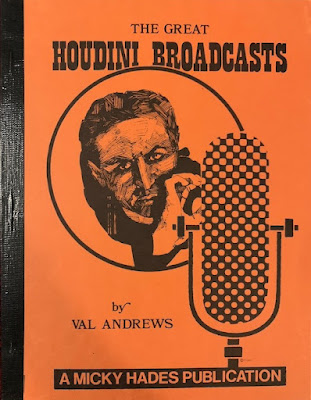
Dean has also posted a reading of the 1981 manuscript The Great Houdini Broadcasts by Val Andrews. Dean gives it an old-time radio feel and plays all the parts himself. It's pretty fun.

Monday, September 4, 2023
Walter Gibson interviewed in 1973
The Amazing Kreskin interviews the legendary Walter B. Gibson on his show The Amazing World of Kreskin in 1973. This is the entire episode. Walter talks about his friend and employer, Houdini, starting at 00:14:05.
Recall that Kreskin was said to have been writing a book about Houdini around this time (never published).
Tuesday, January 8, 2019
Bill Rauscher on Arthur Ford and the Houdini Code
Today marks the 90th anniversary of the infamous Arthur Ford seance in which he revealed the coded Houdini message before Bess and assembled press at 67 Payson Ave. in New York.
I've never really tackled the Houdini Code and its controversy here on WILD ABOUT HARRY, but I wanted to put up something for this anniversary, so below is a full lecture by William V. Rauscher who wrote the book The Houdini Code Mystery and knew Arthur Ford personally. What he has to say about Ford and events of 1929 is pretty interesting. Enjoy.
Related:
I've never really tackled the Houdini Code and its controversy here on WILD ABOUT HARRY, but I wanted to put up something for this anniversary, so below is a full lecture by William V. Rauscher who wrote the book The Houdini Code Mystery and knew Arthur Ford personally. What he has to say about Ford and events of 1929 is pretty interesting. Enjoy.
Related:
- LINK: The Day Houdini (Almost) Came Back from the Dead
- Bess goes Beyond and Back
- August MAGIC believes in Rosabelle
Sunday, April 30, 2017
Dave Koenig makes the case for Houdini's Ghost
Dave Koenig aka Professor Slim King was interviewed on the Shadow Nation podcast today. Dave takes the controversial position that Houdini really did return from the grave in the Arthur Ford seances of 1929. I'm a skeptic, but I like Dave, so have a listen and maybe you will...believe.

You can check out more at Dave's Facebook page Houdini's Ghost. Below are some links related to the Arthur Ford seances.
Related:

You can check out more at Dave's Facebook page Houdini's Ghost. Below are some links related to the Arthur Ford seances.
Related:
Tuesday, August 23, 2016
Bess goes Beyond and Back

In the 1970s, Utah-based Sunn Classics Pictures produced a series of feature documentaries that investigated subjects such as Bigfoot and the Loch Ness Monster (The Mysterious Monsters), Biblical mysteries (In Search of Noah's Ark), and even The Lincoln Conspiracy. As a kid, I loved these, and the pseudoscience documentaries that today populate the History and Discovery channels own a debt to Sunn's productions.
In 1978, Sunn released Beyond and Back, which "dared to investigate" the question of life after death. While on-screen host Brad Crandall promised "one of the most extraordinary films of our times", Beyond and Back is more well-known today for making critic Roger Ebert's list of all-time "Most Hated" films.
But Beyond and Back contains a nice surprise for Houdini buffs. It includes a three and a half minute segment about Houdini with real footage, a reenactment of the Arthur Ford séance, and actress Beverly Rowland as Bess (she later appeared in Halloween 4: The Return of Michael Myers). Oddly, they add the words "learn" and "idea" to the end of the Houdini Message Code. For the record, the real code was: Answer (B), tell (E), pray-answer (L), look (I), tell (E), answer-answer (V), tell (E).
The full film is available on YouTube, but I've excerpted just the Houdini sequence below.
Beyond and Back was released on VHS, but I don't believe it ever made it to DVD. As with all their documentaries, Beyond and Back was released as a tie-in paperback. For a review of film, check out one of my favorite blogs, Every 70s Movie.
Related:
Related:
Friday, August 19, 2016
LINK: The Day Houdini (Almost) Came Back from the Dead

Of course, this remains controversial as the Ford seances are still used today by pro-spiritualists as "proof" that Houdini made good on his death bed promise to return from the grave. The story behind the story is that Bess provided Ford with the code in a moment of romantic and alcoholic weakness, but that's a story we'll save for another time.
Click here or on the headline to have a read at the CSI-Center for Skeptical Inquiry website. Next week I will share a unique little something that relates to the Ford seances.
Illustration from Ghost Stories: Houdini's Great Escape.
Related:
Thursday, February 7, 2013
Houdini - Hollywood ghost
This is a segment about Houdini from the 1986 documentary Hollywood Ghost Stories. It contains nice footage of Houdini performing card flourishes in a 1926 Pathe short and sound footage of Bess Houdini from Religious Racketeers (a.k.a. Mystic Circle Murder). We also get to see the Laurel Canyon estate at its most overgrown.
But the segment also contains a whopper when Psychic Researcher Gordon Rattray claims Bess, a "devout Christian", was pressured by her church to retract the Arthur Ford Houdini message. Of course, Bess was Catholic, and how devout she was at the time of the Ford seances is debatable. And I've never heard of any church involvement in the matter.
Audio is low so you'll want to boost it all the way up. Enjoy the spooky.
But the segment also contains a whopper when Psychic Researcher Gordon Rattray claims Bess, a "devout Christian", was pressured by her church to retract the Arthur Ford Houdini message. Of course, Bess was Catholic, and how devout she was at the time of the Ford seances is debatable. And I've never heard of any church involvement in the matter.
Audio is low so you'll want to boost it all the way up. Enjoy the spooky.
Hollywood Ghost Stores is hosted by John Carradine and is definitely a product of its time. The DVD can still be found on Amazon.com. It can also be rented on Netflix.
You can see more videos like this at the WILD ABOUT HARRY YouTube Channel.
You can see more videos like this at the WILD ABOUT HARRY YouTube Channel.
Wednesday, January 16, 2013
The Margery Files: Inside man
This week WILD ABOUT HARRY is showcasing rarities from the private Libbet Crandon de Malamud Collection, courtesy of Anna Thurlow, the great granddaughter of "Margery" the Medium.
While know Margery and Dr. Crandon enlisted J. Malcolm Bird and Heward Carrighton as informants during their seances with Houdini in 1924. But is it possible that they also had an "inside man" at the infamous 1929 Arthur Ford seance in which Houdini's spirit was said to have returned and delivered the coded message to Bess? Apparently they did indeed. The evidence comes from a remarkable find in The Margery Files.
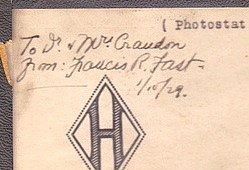
This is an original photostat of the letter Beatrice Houdini signed after the seance affirming that Ford had delivered the correct coded message. This letter was sent to press outlets and has appeared in print before. But what makes this copy especially interesting is that it was sent the day after the seance to "Dr. & Mrs. Crandon" by Francis R. Fast, who was part of the inner circle. This is the first evidence I've ever seen that shows Margery was looped into the Ford seances by someone on the inside.

Fast also appears to have been an acquaintance of Sir Arthur Conan Doyle. After Ford claimed to have made contact with Houdini's mother during a Feb 8, 1928 seance, Fast sent a coded message to Conan Doyle informing him of the event. Doyle passed the information onto Margery, referring to Fast and Ford as "our people."
Fast went on to pen The Houdini Messages in 1929, a detailed account of the Arthur Ford seances. In it he reproduces Bess's letter as the frontispiece. In regards to Margery, Fast tips his hat on the final page in his one and only mention of the medium:
The letter Bess signed on that fateful day in 1929 was used against her (and Houdini by extension) by pro-spiritualist forces for years. Of course, Bessie isn't really saying that Houdini delivered the code from beyond. She's just saying that the correct code was delivered by Ford. How he got the code is another story.
In 1934 Bess would issue a new statement firmly renouncing the Houdini messages.
Tomorrow we'll move out of the paper archives for something a little different, as we build to our grand finale on Friday. You'll want to be sitting down for this one...
Francis Fast background from The Houdini Code Mystery by William V. Rauscher and The Secret Life of Houdini by William Kalush and Larry Sloman. Bess retraction letter from Houdini His Legend and His Magic by Doug Henning and Charles Reynods.

While know Margery and Dr. Crandon enlisted J. Malcolm Bird and Heward Carrighton as informants during their seances with Houdini in 1924. But is it possible that they also had an "inside man" at the infamous 1929 Arthur Ford seance in which Houdini's spirit was said to have returned and delivered the coded message to Bess? Apparently they did indeed. The evidence comes from a remarkable find in The Margery Files.
This is an original photostat of the letter Beatrice Houdini signed after the seance affirming that Ford had delivered the correct coded message. This letter was sent to press outlets and has appeared in print before. But what makes this copy especially interesting is that it was sent the day after the seance to "Dr. & Mrs. Crandon" by Francis R. Fast, who was part of the inner circle. This is the first evidence I've ever seen that shows Margery was looped into the Ford seances by someone on the inside.
 |
| Busted! |
So who was Francis R. Fast? Fast was a wealthy patron and close friend of Arthur Ford. He and Ford actually shared an apartment. It was Fast, along with John W. Stafford, Associate Editor of the Scientific American, who travelled to Bessie's home on January 6, 1929, to tell the widow (recovering from her famous fall) that Ford had contacted Houdini via his spirit guide "Fletcher." After this, Bess agreed to sit with Ford. Even though he was a stranger to Bess, Fast was at each of the Ford sittings.
Fast also appears to have been an acquaintance of Sir Arthur Conan Doyle. After Ford claimed to have made contact with Houdini's mother during a Feb 8, 1928 seance, Fast sent a coded message to Conan Doyle informing him of the event. Doyle passed the information onto Margery, referring to Fast and Ford as "our people."
Fast went on to pen The Houdini Messages in 1929, a detailed account of the Arthur Ford seances. In it he reproduces Bess's letter as the frontispiece. In regards to Margery, Fast tips his hat on the final page in his one and only mention of the medium:
Enough has happened in these latter years in the way of outstanding demonstrations of psychic phenomena to give anyone ample reason to alter any preconceived notions about these things, what with the clear-cut and as yet unassailable results in the "Margery" case alone, on which the whole argument for the survival and communication may rest secure for all of time.
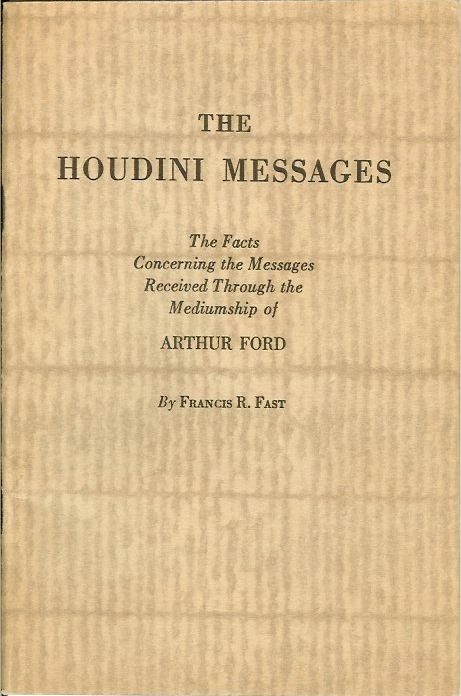
The letter Bess signed on that fateful day in 1929 was used against her (and Houdini by extension) by pro-spiritualist forces for years. Of course, Bessie isn't really saying that Houdini delivered the code from beyond. She's just saying that the correct code was delivered by Ford. How he got the code is another story.
In 1934 Bess would issue a new statement firmly renouncing the Houdini messages.
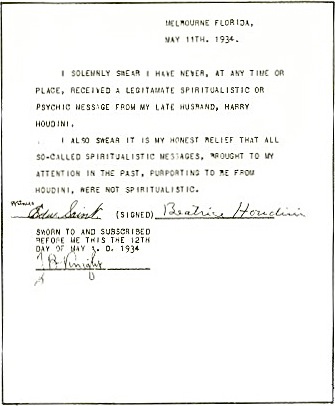 |
| Bessie's retraction. |
Tomorrow we'll move out of the paper archives for something a little different, as we build to our grand finale on Friday. You'll want to be sitting down for this one...
Francis Fast background from The Houdini Code Mystery by William V. Rauscher and The Secret Life of Houdini by William Kalush and Larry Sloman. Bess retraction letter from Houdini His Legend and His Magic by Doug Henning and Charles Reynods.

Thursday, January 3, 2013
LINK: Kaleidoscope: Houdini, 1960s Radio Show
Our friend Tom Interval at HoudiniMuseum.com has kicked off the New Year with a terrific exclusive; an episode of the 1960s radio show, Kaleidoscope, about Houdini. The show provides an especially thorough description of the Arthur Ford seances. It's a terrific and somewhat ghostly blast from the past, so click the headline to have a listen at Houdini Museum.


Wednesday, August 29, 2012
"This book is full of lies"
Today I continue my series looking back at books written about Houdini with images from my own collection.
The first comprehensive Houdini biography was published by Harcourt, Brace and Co. on June 7, 1928. The book was Houdini, His Life Story by Harold Kellock from the Recollections and Documents of Beatrice Houdini. Hardeen famously inscribed a copy of the book with the sentence: "This book is full of lies."
Yes, Life Story contains wild embellishments and outright fictions, such as Houdini being trapped under he ice during a bridge jump and the full "acid on the dress" story of Houdini and Bess's first meeting. The book crystallized much of the mythology Houdini had been building up for years in his pitch-books; mythology that took years to unravel.
But this was the way Houdini wanted his story told. Like Walter Gibson's Houdini's Escapes and Magic, this was a book that Houdini would have written had he lived. At the time of his death he had already dictated several chapters of an autobiography, and the photos used in the book are noted as being expressly set aside for the purpose of publication in a book.
However, Life Story also includes a great deal of candid recollections by Bess that have the feel of truth about them. The book shows Bess, especially in her youth, to have been a real firecracker. There's a great story about Bess telling the abusive manager of Kohl & Middleton's Dime Museum to "go to hell" after learning that Harry had saved up $100 for his handcuff challenge. "We have one hundred dollars and we don't need your old dime museum," she said. Many of these stories don't make it into later biographies. This is the book that gives us the best portrait of Bess during Houdini's lifetime.
It's also nice that the original dust jacket features a photo of Houdini performing his Needles trick. Here, in 1928, Houdini is portrayed, first and foremost, as a magician, not as a death-defying escape artist. This can be held up as another piece of evidence that refutes the revisionist notion that in his own lifetime Houdini was somehow not considered a magician. Of course he was.
This book also infamously reprints on page 105 the secret mind reading code that the Houdinis use in their early act. This was used against Arthur Ford during the 1929 Houdini message debacle, pointing out that the code which formed the bases for the "Rosabelle Believe" test message was available to the public.
Houdini His Life Story would stand as the only comprehensive Houdini biography until William Lindsay Gresham's Houdini The Man Who Walked Through Walls was published in 1959. Unfortunately, Life Story was never published as a mass market paperback and fell out of print following the Blue Ribbon edition of 1930 (right). Apart from a print-on-demand edition by Kessinger Publishing in 2003 (which now sells for a shockingly high price on Amazon), the book remains out of print to this day.
It's a shame that this unique book has remained generally unavailable since 1930. Sure, it's "full of lies", but it contains Bessie's authentic voice and is also as close to a Houdini autobiography as we'll ever get.
Also enjoy:
The first comprehensive Houdini biography was published by Harcourt, Brace and Co. on June 7, 1928. The book was Houdini, His Life Story by Harold Kellock from the Recollections and Documents of Beatrice Houdini. Hardeen famously inscribed a copy of the book with the sentence: "This book is full of lies."
 |
| 1928 first edition by Harcourt, Brace. |
Yes, Life Story contains wild embellishments and outright fictions, such as Houdini being trapped under he ice during a bridge jump and the full "acid on the dress" story of Houdini and Bess's first meeting. The book crystallized much of the mythology Houdini had been building up for years in his pitch-books; mythology that took years to unravel.
But this was the way Houdini wanted his story told. Like Walter Gibson's Houdini's Escapes and Magic, this was a book that Houdini would have written had he lived. At the time of his death he had already dictated several chapters of an autobiography, and the photos used in the book are noted as being expressly set aside for the purpose of publication in a book.
However, Life Story also includes a great deal of candid recollections by Bess that have the feel of truth about them. The book shows Bess, especially in her youth, to have been a real firecracker. There's a great story about Bess telling the abusive manager of Kohl & Middleton's Dime Museum to "go to hell" after learning that Harry had saved up $100 for his handcuff challenge. "We have one hundred dollars and we don't need your old dime museum," she said. Many of these stories don't make it into later biographies. This is the book that gives us the best portrait of Bess during Houdini's lifetime.
It's also nice that the original dust jacket features a photo of Houdini performing his Needles trick. Here, in 1928, Houdini is portrayed, first and foremost, as a magician, not as a death-defying escape artist. This can be held up as another piece of evidence that refutes the revisionist notion that in his own lifetime Houdini was somehow not considered a magician. Of course he was.
 |
| 1930 Blue Ribbon edition |
Houdini His Life Story would stand as the only comprehensive Houdini biography until William Lindsay Gresham's Houdini The Man Who Walked Through Walls was published in 1959. Unfortunately, Life Story was never published as a mass market paperback and fell out of print following the Blue Ribbon edition of 1930 (right). Apart from a print-on-demand edition by Kessinger Publishing in 2003 (which now sells for a shockingly high price on Amazon), the book remains out of print to this day.
It's a shame that this unique book has remained generally unavailable since 1930. Sure, it's "full of lies", but it contains Bessie's authentic voice and is also as close to a Houdini autobiography as we'll ever get.
Also enjoy:
Thursday, March 8, 2012
Houdini article in Skeptical Inquirer

The article is called "The Day Houdini (Almost) Came Back From The Dead" and is about the infamous 1928-29 Houdini seances by Arthur Ford. Nothing new or revelatory, but it's a good article that recounts the history of the seances and controversy with some nice photos.
Thanks to Arthur Moses for the alert.
Tuesday, April 12, 2011
When Madame Houdini spoke
 In 1937, having successfully set up a Houdini biopic at Paramount, Bess Houdini and Edward Saint turned their attentions to developing a second movie that would be starring vehicle for Bessie herself.
The film was to be called Madame Houdini Speaks. The idea was, having fulfilled her ten year "imposed silence", Bess would finally sound off on her views about spiritualism in a dramatic feature film. Saint claimed the film "will go into immediate production" and promised:
"The sensational picture will be packed with ghostly dynamite that will blast the fakes, frauds and humbugging religious racketeers hiding behind the cloak of spiritualistic superstition. Madame Houdini will play the part of herself on the screen and her long experience in tracking down the miracle mongers will be vividly portrayed in the spooky and mystic-laden production."
This is quintessential Edward Saint -- press agent-cum-carnival barker. However, there was more to this project than bluster. The film had a real producer in Fanchon Royer, "one of Hollywood's outstanding independent women producers", and a director in Frank O'Conner, who was also writing the Paramount Houdini biopic. A friend of the family, O'Conner was said to have performed with Houdini in vaudeville and "knew the great magician well."
The film was given a special "Magicians Preview" on April 12, 1938, where it received an especially positive (polite?) review from Richard Frohmann in Goldston's Magical Quarterly. Said Frohmann:
"Although Religious Racketeer makes no pretense at being a million dollar production, it tells a good story in an arresting and memorable manner. Mrs. Houdini plays an outstanding part in the story, and it is clear that her stage experience has stood her in good stead. The film is undoubtedly good-class entertainment for discriminating filmgoers, and never once borders on bathos or unreality."
Religious Racketeer premiered at Shea's Century Theater in Buffalo, New York on July 7, 1938. It then played limited engagements, typically as part of a double bill. In 1940 it was reissued as Mystic Circle Murder.
 Predictably, the film sparked controversy in spiritualist circles. According to a report in Genii, the film was "hissed down by believers from Lillydale" (a "spirit camp"), who packed the Buffalo theater for its first showing. They later denounced the film in their journal, Psychic Observer, reproducing a letter from Bess "in her own hand" in which she states she had received a genuine message from Houdini (I expect they were talking about this letter).
The only available print of Religious Racketeer -- which was released on DVD in 2006 by Alpha Video as Mystic Circle Murder -- runs only 68 minutes, a far cry from its originally reported 90 minute running time. Unfortunately, in this print, the epilogue with Bess is abruptly cut off. Did she have more to say? It appears so. In fact, she may have delivered a fairly lively last word. Evidence for this exists in a review in The Jinx, which quotes Bess in the epilogue as calling mediums "those leeches."
 -- runs only 68 minutes, a far cry from its originally reported 90 minute running time. Unfortunately, in this print, the epilogue with Bess is abruptly cut off. Did she have more to say? It appears so. In fact, she may have delivered a fairly lively last word. Evidence for this exists in a review in The Jinx, which quotes Bess in the epilogue as calling mediums "those leeches."
Hopefully, the cut epilogue will one day be rediscovered and restored so we can hear Madame Houdini speak.
Thanks to Marc Wanamaker of the Bison Archives for the information on the Grand National Studio.
Want more? You can see an opening day "World Premiere" newspaper ad for Religious Racketeer as a member of my Patreon.

Saturday, March 19, 2011
Making the great Great Houdinis
 |
| Unused promo art for The Great Houdinis (from the collection of MSW) |
Anyone who has spent any time reading this blog knows I have a bit of a thing for the 1976 ABC TV movie, The Great Houdinis. Maybe that’s because it aired during the first year of my burgeoning interest in Houdini. Maybe it’s because it’s damn good! One thing that has always puzzled me is where exactly this film was shot. Even actress Adrienne Barbeau was unable to recall which studio was used. Houdini expert Patrick Culliton was able to provide some information, but the filming of this movie has always been a mystery… until now.
The Great Houdinis, ABC Production #7602, shot for 20 days between April 28 and May 25, 1976. The film utilized five major locations, with the final location set for a major scene that was either cut or never filmed (we’ll get to that). The film was directed by writer/producer Melville Shavelson. His production manager was Don Goldman. Assistant directors were F. A. Miller and Penny L. Vaughn. The executive at ABC who oversaw the production was Marty Katz.
The title was The Great Houdini! (singular) up until at least the April 13th draft of the script. By the final revision on May 17, it had become The Great Houdinis (plural). The change might have been a reflection of how writer-director Shavelson viewed his story. "It's as much a love story as it is a story about a magician," he would say. (Update: According to Patrick Culliton, the title was changed when Sally Struthers was signed to play Bess as part of her deal.)
 |
| Two scripts show change in title (click to enlarge). |
On April 28, 1976, the cameras rolled on The Great Houdinis at its first location:
Wilshire Ebell Theater, 4401 W. 8th Street, Los Angeles, CA (April 28 to April 30, 1976)

The first day of shooting involved all the complex stage escape apparatuses. The first scene shot was The Milk Can Escape. Then the Water Torture Cell action was shot, with star Paul Michael Glaser failing to escape as a horrified Sally Struthers (Bess) looks on. Abb Dickson provided the cell, which would be touted in some media as “the original cell,” which of course is not correct.
 |
| Harry Blackstone Jr. helps prepare Paul Michael Glaser for the Milk Can escape (Photo by Patrick Culliton, Genii) |
The first day wrapped by filming another escape which only appeared in the opening credits -- Houdini's escape from a casket after Bess passes him a key -- or "feke" as the script calls it -- in a kiss. This was arbitrarily noted as taking place in the Hippodrome in 1920. Houdini expert Patrick Culliton was also on set that day playing Houdini’s assistant Franz Kukol. Artist Dave Stevens, famous for The Rocketeer
 , accompanied Culliton and spent the day taking behind the scenes photos (some of which can be viewed on Patrick's website, Houdini's Ghost).
 One hundred and fifty extras were brought in on Day 2 to act as audience members. All audience reactions to the various stage escapes and spirit exposes were shot on this day. Glaser and Struthers then filmed the scene in which Harry helps Bess with her French during Metamorphosis, which is described as taking place in a “French Theater” in 1900. Harry Blackstone, Jr., who received credit as technical advisor on the film, appeared in the scene as a police officer. Newsreel footage was then shot projected against a backdrop screen on the stage.
All the backstage scenes were shot in the third and final day at the Ebell, starting with Harry coming to see his brother, Theo Hardeen (Jack Carter), at what is supposed to be Hammerstein's. This was also Adrienne Barbeau’s first day of shooting. Filmed was Daisy and Bess's conversation backstage in 1926 ("I tried. Not a damn thing."), along with the moment that Bess bumps into the hanging witch and says, "Sorry, Mama."
Queen of Angels Hospital, 2301 Bellevue Ave., Los Angeles, CA (May 3, 1976)
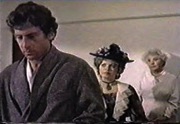 After a few days off, the production moved for a single day to Queen of Angels Hospital near downtown Los Angeles. Here one of the movie's best dramatic scenes was shot -- when Bess comes to see Harry after his nervous breakdown and pulls him from his funk by suggesting they make spiritualist exposes "part of the act." This was also the first day of shooting for the legendary Vivian Vance, playing Minnie the nursemaid. Vance, of course, is best known for her role as Ethel on I Love Lucy
 .
.The Queen of Angels Hospital closed this location in 1989. After remaining vacant for many years, it became The Dream Center, a Pentecostal Christian Church mission, in 1996.
 |
| Queen of Angels, now The Dream Center, today |
Home of Peace Memorial Park & Mausoleum, 4334 Whittier, Los Angeles, CA (May 4 to May 5, 1976)
 |
| Home of Peace Memorial Park doubles for Machpelach |
 |
| Where is this bust today? |
One thing to watch for in this scene -- even though Bess/Struthers kneels and plants flowers in front of the exedra, as she enters the plot one can spot a fairly accurate reproduction of Houdini's tombstone sitting approximately where it does in the real cemetery plot.
20th Century Fox Studios, 10201 West Pico Boulevard, Los Angeles, CA (May 6 to May 21, 1976)
 |
| The 20th Century Fox lot with The Great Houdinis shooting locations marked in red |
On May 6, production moved into the historic 20th Century Fox Studios in Century City. Here the bulk of the filming would take place over the course of the next two weeks. The production would utilize Stage 5, Stage 20 and Stage 4, as well as shooting on the studio's two remaining exterior sets (Fox sold their large backlot in 1961).
 |
| On the Hello Dolly street |
 street set. Here, the scene where Harry and Bessie are "riding in style" in a horse-drawn buggy was filmed, as was Houdini stopping to admire Queen Victoria’s dress in a store window. At the same time, on the adjacent "Brownstone Street," the exteriors of 278 were shot, including the spooky Halloween night scenes that involved creating wind and rain effects. Also filmed was Reverend Ford’s arrival by taxi near the end of the film.
Only a small section of the Hello Dolly street (seen here in 1976) remains on the Fox Lot today. But the Brownstone Street (aka "New York Street") still looks very much as it did in the film.
 |
| Brownstone Street as seen in the film and today |
Soundstage 20 was also put into action on the first day of lot shooting. Here, the scene in which Bess gets trapped in the sub truck and Harry has to chop her free was shot. Over the following days, stage 20 would also house a train car set where Harry tells Bess what it means to be a magician, and she tells him she’s pregnant (shot on May 7). Stage 20 was also home to the Scotland Yard sets (jail cell and Melville’s outer offices). The Scotland Yard scenes would all be shot on May 12.
 |
| 278 was housed on Stage 4 |
The 28,274 sq. ft. Soundstage 5 was used for a wide variety of single scene locations. It was here on May 7 that Houdini exposes Margery the Medium (Barbara Rhoades). The stage also housed the Congressional hearing room where Bess, under oath, confesses that she still loves Harry (May 10). The legendary Nina Foch appears in this scene as the Rev. Le Veyne. Stage 5 was also the site of the Budapest Hotel, where Harry throws a “Royal” reception for Mama, and Bess rebelliously sings “Onward Christian Soldiers,” shot on May 14.
 |
| Cushing fresh off the set of Star Wars |
 |
| The Weiss home was on Stage 5 |
Shooting on the Fox lot wrapped on May 21 with, appropriately enough, the fatal dressing room punch, shot on Stage 20.
Malibu Pier, 23000 Pacific Coast Highway, Malibu, CA (May 24, 1976)
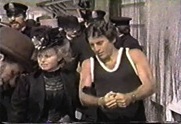
 |
| Malibu Pier in The Great Houdinis (top). The pier doesn't look any different today (bottom) |
Belmont Amusement Park, 3000 Mission Park, San Diego, CA (May 25, 1976)
The final day of principle photography for The Great Houdinis was planned for the Belmont Amusement Park in San Diego, which was to double for Coney Island. Here a scene in which Harry proposes to Bess aboard a roller coaster would be filmed.
While it appears in the script, this scene didn’t make it into the final film. Was this scene cut, or never shot? This is something I haven’t yet to be able to discover, but it seems unlikely that a TV movie would cut a scene that took this much effort and expense to film. It’s my guess the scene and location were scrapped, and the last day was used instead to complete a schedule that may have run over (update).
 |
| Belmont Park was scheduled to double Coney Island |
The Great Houdinis was edited by John Woodcock and scored by Peter Matz, who would also serve as musical director for Doug Henning’s second World of Magic TV special.
ABC promoted The Great Houdinis with an impressive four page photo spread in the popular gossip magazine, Preview (October 1976), as well an article in TV Guide that claimed to reveal the secret of the Water Torture Cell (it doesn't). The image of Glaser reenacting Houdini's famous semi-nude chained pose was used extensively in advertising. A novelization, written by Shavelson, was released in both the U.S. and UK. In the UK the book was serialized in Reveille, and also released in hardcover with photos of the real Harry and Bess Houdini.
 |
| The original TV Guide ad for the October 8, 1976 airing. |
The Great Houdinis aired on October 8, 1976 as part of ABC’s Friday Night Movie. In some markets it aired from 8-10, others from 9-11 (including Los Angeles). Competition that night was from the 1975 John Wayne movie, Brannigan, on CBS and The Rockford Files with James Garner on NBC. In some markets the final line, "I believe the son-of-a-bitch loved her," was edited out. It would repeat once on April 6, 1977 (April 6 was the day Houdini celebrated his birthday, which may or may not have been coincidental). For this '77 broadcast the title was changed to the singular, The Great Houdini, which is what the movie is better known by today.
Reviews were generally good, although, as had been the case 23 years earlier with Paramount's HOUDINI, the magic community took the film to task for its inaccuracies. David Lustig, who performed as La Velma and knew Houdini well, said watching the film made him "feel nauseated." Another reviewer called the film "an object lesson in the abuse of dramatic license."

A very big thanks to The Magic Castle's William Larsen, Sr. Memorial Library and librarian Bill Goodwin for helping me uncover the story of the making of my favorite Houdini biopic. Also thanks to Patrick Culliton, MSW, Dean Carnegie (Magic Detective), and Steve Santini.
Tuesday, November 2, 2010
Thurston versus Houdini? Not really

First and foremost, this is a superbly researched and entertaining biography of Howard Thurston. It’s fascinating to read the story of a magician whose life and career parallels Houdini’s. (It’s also sad to move with Thurston beyond 1926 and wonder what could have been.) I’ll leave it to others to review the book properly (Genii is preparing a review for an upcoming issue), but know that once again Jim Steinmeyer has produced a MUST BUY book about magic history.
Now, as far as the “versus Houdini” aspect to the book...
I suspect this subtitle is just a bit of thematic misdirection. Yes, Houdini was well-known for his ferocious battles with fellow conjures (those who stole his act or spoke ill of him in public), but aside from a perceived slight in Chicago and one testy encounter at an SAM meeting, Howard Thurston wasn’t one of them.
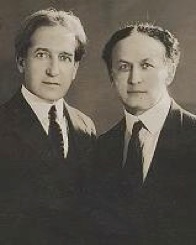 While they may have been rivals in their hearts, Houdini and Thurston seem to have gotten along relatively well as they had much in common. Both men came up through the sideshow and circus route (they met at the 1893 Chicago Exhibition at the dawn of their respective careers), both were Masons, Thurston was vice president to Houdini during his presidency at the SAM, and both shared a close personal relationship with Harry Kellar. As Thurston didn’t perform escapes, and Houdini rarely performed magic, there was little opportunity for them to cross swords. Houdini even promoted Thurston as Kellar’s successor over frontrunner Paul Valadon in the pages of his Conjurers Monthly Magazine, and loaned Thurston money when the conjurer was down on his luck (although he did refuse him a second loan years later).
 So while this isn’t book loaded with juicy untold battles between the two superstars of magic (Blackstone seems to be the true combatant of both men), it still offers the Houdini scholar some stories of the man that haven't been reveled before -- including the aforementioned SAM incident (related to Steinmeyer by Walter B. Gibson who was there). Also interesting is the revelation that Bess Houdini first met Arthur Ford the night Thurston debated the spiritualist “minister” at Carnage Hall in 1927. And the story that opens the book -- Thurston inviting Houdini on stage during a performance of his famous levitation -- showcases both men in their best light.
The Last Greatest Magician in the World: Howard Thurston versus Houdini & the Battles of the American Wizards will be released on February 3, 2011. Pre-order now on Amazon
 .
.
Monday, October 25, 2010
The Houdini Messages variant
Super collector and friend of our site Arthur Moses (Houdini Speaks Out ) checks in with his recent discovery of a variant edition of The Houdini Messages by Francis R. Fast. Says Arthur:

) checks in with his recent discovery of a variant edition of The Houdini Messages by Francis R. Fast. Says Arthur:“Here's something interesting I recently acquired... There are multiple 1929 printings of the little pamphlet "The Houdini Messages" by Francis Fast ( I currently have prtg #1, 2, 4, 7). This one shows 1929 fourth printing USA but then it shows copyright Australia 1937 and on the back cover (scan not shown to you) it's imprinted "Butterfield & Lewis Ltd. Print. Sydney 70263" These covers are also plain where-as the other variants are sort of a light stripe back-ground. As you can see this has also been signed by [Arthur] Ford. If anyone knows anything further, I would be happy to hear from them.”
Subscribe to:
Posts (Atom)