Showing posts with label Kansas City. Show all posts

Friday, September 18, 2026

Connecting with Houdini in Kansas City (and St. Joe)


Last week I was invited to Kansas City, Missouri, to participate in the events commemorating a new Houdini historical marker. I had an amazing time thanks to the incredible generosity of all the members of IBM Ring 129 and SAM Assembly 38. I also saw a heck of a lot of historic Houdini locations, because Kansas City has many Houdini connections.

DAY 1
My primary task this trip was to deliver a talk at the Kansas City Central Library about Houdini in Kansas City. In return, the IBM and SAM paid my expenses and treated me like a king. I flew in the day before, and my discoveries started almost immediately. I was booked into the large downtown Marriott Hotel, but my room was actually across the "skybridge" in what's called the Muehlebach Tower. Muehlebach!? I immediately recognized that name as having a Houdini connection. I knew the building that replaced Houdini's second Orpheum has the name Muehlebach on the outside. Was I near that historic site?

Turns out, I was! This new tower is actually connected to the historic Muehlebach Hotel, which used to buttress the Orpheum Theater. When the Orpheum was razed, the Muehlebach built their convention hall on the spot. I dropped my bags and went out to explore and, yes, the building was right next door. My first Kansas City Houdini location. Houdini appeared here in 1915 and twice in 1923. While the newer building (built in 1966) is no beauty, it appears to be the same size as the Orpheum, and the Muehlebach vertical signage echoes the Orpheum's sign blade. So you get a great sense of the theater's footprint here.


While the historic Muehlebach Hotel is currently empty and undergoing renovation, the beautiful original lobby is accessible. I explored the space and wondered whether Houdini ever stayed here. It was next door to the Orpheum, so it made sense that he would. However, I have no evidence of this, and Houdini has a stronger connection to the nearby Savoy Hotel, so it was just wishful thinking that I could be staying where Houdini stayed.

That evening, Dennis Burks, the mastermind of this entire historic marker project, and Jason Moore, who created a commemorative Houdini Coin for this event, took me out to dinner at the Savoy Grill. It's said that whenever Houdini came to Kansas City, he had a steak at the Savoy Grill. So did we, and it was delicious! The restaurant is still much the same as it was in Houdini's day, and it feels like a time capsule. You can really feel Houdini's presence here.


The Savoy Grill is located inside the historic Savoy Hotel, where Houdini stayed during his 1900 and likely his 1907 appearances in Kansas City. (I'm unsure where he stayed in 1899.) A famous story, reported in the Kansas City Globe in 1900, says that a mischievous traveler recognized Houdini in a phone booth in the Savoy lobby and locked him inside. Houdini did not find this funny.

Now, many such stories were reported in the papers during Houdini's career, and I believe most were just publicity. But I think this one actually happened. While the inside of the Savoy has been modernized, some features from the old lobby, such as the glass rotunda and reception desk, both mentioned in the Globe article, survive. The exact location of the phone booth is unknown, but it's said the Globe article used to hang on the wall beside it. No one who works there now remembers that.


Another surprise discovery was that the first Kansas City Orpheum, where Houdini appeared in 1899, 1900, and 1907, was located right across the street from the Savoy. This is where Houdini got his all-important try-out in 1899. It was also where he escaped from handcuffs in full view of the audience for the first time (Escaping Obscurity page 314). I hadn't expected to find this right across from the Savoy, and you've never seen someone get so excited about a parking garage!


DAY 2
My talk wasn't until 6 PM, so I had the whole day to explore the city. One thing I quickly discovered was that all the Houdini locations are clustered within just a few square blocks. This was the heart of Houdiniland! My first stop was just a few blocks from my hotel. This is the old Fire Headquarters, where Houdini, Hardeen, their wives, and the 4 Picolo Midgets (also performing at the Orpheum that week) took a series of famous photos. You can see one on pages 80–81 of Doug Henning Houdini: His Legend and His Magic. You will see more in my own upcoming book, Handcuff King: The Conquests of Harry Houdini, 1900–1909. The building is still here and looks exactly the same. I passed by this sacred spot many times during the week.

The Kansas City Athletic Club, where Houdini escaped from handcuffs in their pool in 1907, was located right next door to the Fire Station. That's two major Houdini locations side by side! That building is long gone. Today it is the Kansas City Police Department's Foot Division. But I recently acquired a postcard capturing both buildings. It arrived after my talk, and it's too late to add to my book, so I will share it here.


The next stop was the site of the Shubert Theater, where Hardeen performed in 1907. Houdini and Hardeen both performed in the city that week (the first time the brothers competed head-to-head in the same city). Today it is the parking lot for the Central Library, where I would be giving my talk. The parking lot even has a photo of the Shubert on the outside.


Nearby is the historic Coats House Hotel, aka Kansas City's most haunted hotel. Harry and Bess performed here in 1899 for a Manufacturers Association dinner. Today, it is an apartment building, so it's not accessible, but I wonder if that dining room survives?


I then passed through the intersection of 10th and Main and got an early look at the historic marker. Next stop was the Mainstreet Theater, the only Houdini location not clustered in this area. But it's an easy 10-minute walk down Main Street and, best of all, it's the only Kansas City Houdini theater that still survives. It still looks very much as it did in Houdini's time, at least on the outside (it is now a multiplex). Houdini appeared here in January 1924. It was his last Kansas City appearance.


I returned to my hotel and worked the photos I had just taken into my presentation. Before I knew it, the time had arrived. Dennis, as always, offered to pick me up and drive me the few blocks to the library, as it was threatening to rain. But I loved the idea of walking past the fire station on my way, so I went on foot and made it to the Central Library just moments before the rain started to come down.


It's been a while since I've given a talk for a general audience (these days it seems like I'm always talking to magicians), so it was fun to work in some general biographical beats, and there was plenty of Kansas City content to fill the 40 minutes. In fact, I had to cut a few things. But I think the talk went over really well. I even received a standing ovation! Thank you, Kansas City. And thank you to the Kansas City Central Library.

DAY 3
On this day, I got a very special treat. Dennis Burks picked me up at my hotel and took me to St. Joseph, Missouri, which has some important Houdini history and locations. But our first stop was at a future magic location. This is the private museum and theatre that David Sandy and Lance Rich are building in St. Joseph. Lance and David gave us a full walk-through of the current construction and explained what they have planned. It's stunning! They also have some important historical magic props already on site, which I will keep secret, but these were amazing to see. This place is going to be a new magical mecca!


After lunch, thanks to David Sandy, we got an impromptu tour of the historic Missouri Theater in downtown St. Joseph. Not a Houdini theatre, but a beautiful old theatre lovingly cared for by the city and Frank Polleck. Look at the auditorium ceiling.


Lance then gave us a tour of the Houdini locations he'd sussed out. First was the site of the Rock Island building and A.O.U.W. Hall, where Houdini performed his very first spirit exposures in 1897, and later gave his own “Startling Spiritualistic Seance” in 1898. Today it is a parking lot, but this is an important Houdini location and very exciting to see.


Directly across the street at the intersection of 5th and Edmond was Bert Martin's Eden Musee, where in 1898 Houdini and Bess performed not just their magic act, but also appeared as part of Mr. and Mrs. Lester Franklin’s Dramatic Company in the play Ten Nights in a Bar Room (Escaping Obscurity page 137). Just up the block is the site of the Wonderland Musee Theatre, where The Houdinis performed in 1896. These St. Joseph locations are tough to nail down because most are long gone, but we think the surviving building below might have housed the Wonderland Museum.


Lance also went the extra mile and located the Schroder photo studio, where Houdini took a portrait that became his famous "King of Cards" poster. He also located the Banning Studio, where Houdini took a series of photos showing him escaping from a rope chair with the aid of a helpful spirit. These aren't just the first photos showing him doing any kind of escape; they're also his first spirit photos. Some great history in St. Joe. Thank you, Lance!

The day was not over. After a change of clothes (I just had to wear my Houdini poster-print shirt from the SAM convention), we went across the state line into Lanexa, Kansas, for some authentic KC barbecue at Zarda Bar-B-Q with the members of IBM Ring 129 and SAM #38. Here I received a big surprise. Jason Moore presented me with his Houdini commemorative coins, including the larger size, of which only 10 were made. David Sandy then made me an honorary member of Ring 129's "Sorcerers' Circle." I even got a medallion and ribbon, which now hangs proudly in my office. Very honored. By the way, Jason is selling a limited quantity of his coins HERE.


If you have ever joined one of Lance and David's Magic Collectors Corner zooms, you know they love to host games, and they had one for us tonight. It was a Houdini-themed trivia game, and it was a blast. No, I didn't play. I was the lifeline if a player got stumped on a question. All they had to say was, "David, I need to go to the John." I also handed out the last of my Handcuff King promo cards to everyone who answered a question correctly. It was Team Houdini vs. Team Hardeen, and just like in life, Team Houdini came out on top.

DAY 4
This was the big day! I got a little work done in the morning (my new book is at the printer, and we're finishing up the cover and slipcase designs), but the magic hour of 2 PM quickly arrived. We worried it might rain, since it had been on and off all week, but the skies were crystal clear! As always, I walked past the fire station and library and joined the crowd at 10th and Main for the unveiling of the historic Houdini marker.

Despite the heat, a good-sized crowd had gathered, and the ceremony opened with remarks by Dennis Burks, followed by me. Kelly Rusk, IBM Ring 129 President, read the Kansas City Proclamation recognizing September 2026 as Harry Houdini Month. Matt Gurley, SAM Assembly 38 President, read an email from the national President Michael J. Heckenberger. The marker itself was then unveiled to applause. As you can see, it's fantastic!


David Sandy then took over as emcee, and Lance Rich performed a suspended straitjacket escape using their compact equipment. If you are wondering why Lance wasn't 100 feet in the air, know this isn't 1915, and getting permission from the city to do such a stunt is a magic trick even Houdini couldn't pull off today. So this was a perfect solution, and still thrilling. (You can watch video of the escape on my Patreon.) Congratulations, Lance! And congratulations, Dennis Burks, for making this all happen. 


We were officially finished, and someone suggested grabbing a bite to eat. I decided not to join because I had plans to eat that evening with my aunt and uncle, who live just outside the city. Also, I had just received a message from the Kansas City Library. Jason Moore had tipped me off that the library has the Kansas City Post on microfilm, which hasn't been digitized or put online yet. The library called to say they had pulled the years I wanted and they were waiting for me on their top floor.

I had only a little over an hour before the library closed, so I dove into the microfilm and reviewed all the papers from the weeks Houdini performed in 1915, 1923, and 1924. I was actually surprised at how little there was overall, but I did land on one significant article, and it made my trip!


This is yet another story of Houdini being ambushed by a "Cynic," and this time locked in his hotel room. But Houdini easily escaped with a quip. But the best part is that the hotel is identified as being the Muehlebach! Room 525, to be exact. Yes, I was staying (more or less) at Houdini's hotel, and the old lobby now had new significance. It was my last discovery of the trip and the last piece of the Kansas City puzzle. Houdini was here!


Thanks to Dennis Burks, Jason Moore, Rod Sipe, David Sandy, Lance Rich, and everyone associated with IBM Ring 129 and SAM Assembly 38 for giving me the Kansas City Houdini experience of a lifetime!

Want more? You can read the entire Kansas City Post article about Houdini's hotel room escape as a member of my Patreon below.

Saturday, September 12, 2026

New Kansas City Houdini historical marker revealed

Here's the magnificent new Houdini historical marker unveiled yesterday at the corner of 10th and Main in Kansas City, MO. This commemorates Houdini's very first suspended straitjacket escape at this site on September 8, 1915.


This historic marker was the brainchild of Dennis Burks, who organized with his local IBM Ring 129 and local SAM Assembly 38 to make this a reality. Funding for the marker was provided through grants from the SAM Magic Endowment Fund and the IBM Endowment and Development Fund.

Yesterday's ceremony was opened with remarks by Dennis, followed by words from me explaining Houdini's suspended straitjacket escape and the significance of the marker. Kelly Rusk, IBM Ring 129 President, then read the Kansas City Proclamation recognizing September 2026 as Harry Houdini Month. Matt Gurley, SAM Assembly 38 President, read an email from the national President Michael J. Heckenberger and the text of the historical marker. The marker itself was then unveiled to applause. As you can see above, it's a beauty!

But the best was yet to come. Magician David Sandy took over as emcee and introduced St. Joseph magician and escape artist Lance Rich, who performed his own suspended straitjacket escape. The crowd loved it. You can watch the video that I shot of the escape on my Patreon below.

It was a terrific event that came off without a hitch. It had been raining in Kansas City all week, but for this one day the skies cleared and it was beautiful. Harry wouldn't have had it any other way!

Related:

Monday, September 7, 2026

The week Kansas City is Wild About Harry!


This week, Kansas City and the local chapters of the SAM and the IBM are celebrating Houdini and his very first suspended straitjacket escape. In fact, September 2026 is officially "Harry Houdini Month" in Kansas City! The upcoming events have already received some nice publicity from KCUR, the Kansas City Star, and an especially good piece at News Press NOW. Here's a rundown:

Wednesday, September 9 at 6:00 PM
Kansas City Central Library
I will be giving a one-hour lecture on "Houdini's Kansas City Connections" at the Kansas City Central Library in the Helzberg Auditorium. Kansas City has a lot of terrific Houdini history, and I'm looking forward to sharing the full story. You can find more details at kclibrary.org. The talk will also be live-streamed via the library's YouTube channel.
Friday, September 11 at 2:00 PM
Corner of 10th and Main Street
A historic marker commemorating the site of Houdini’s first suspended straitjacket escape on September 8, 1915 will be unveiled in a ceremony that will feature remarks from the local SAM and IBM presidents and a reading of the Kansas City Proclamation signed by Mayor Quinton Lucas, officially recognizing September 2026 as Harry Houdini Month. I will also be on hand to say a few words. The unveiling ceremony will conclude with a live suspended straitjacket escape attempt by magician Lance Rich.

This week's events represent a long-term effort by Dennis Burks, the local IBM Ring 129, SAM Assembly 38, and the city to preserve Houdini’s Kansas City legacy. Funding for the historic marker has been provided through grants from the SAM Magic Endowment Fund and the IBM Endowment and Development Fund.

LINK: St. Joseph magician steps into Houdini’s history with upcoming Kansas City escape attempt

This is a standout article about the upcoming Kansas City Houdini events, Houdini in St. Joseph, MO, and our friend Lance Rich, who plans to recreate Houdini's suspended straitjacket escape on the exact site of Houdini's historic 1915 escape. 

Friday, August 21, 2026

Next stop: Kansas City

The Houdini Centennial celebrations continue next month with a major event in Kansas City, Missouri, that I'm excited to be part of.

On September 11 at 2:00 PM, the local chapters of the Society of American Magicians (SAM) and the International Brotherhood of Magicians (IBM) will unveil a historic marker in the courtyard at 10th and Main Streets in Kansas City commemorating the site of Houdini’s first suspended straitjacket escape on September 8, 1915. I've seen photos of the marker, and it's a stunner!

The public ceremony will feature remarks from the local SAM and IBM presidents and a reading of the Kansas City Proclamation signed by Mayor Quinton Lucas, officially recognizing September 2026 as Harry Houdini Month. I will also be on hand to say a few words. The unveiling ceremony will conclude with a live straitjacket escape performed by magician Lance Rich.

But wait, there's more!

Two days before the unveiling, on September 9 at 6:00 PM, I will be giving a one-hour lecture on "Houdini's Kansas City Connections" at the Kansas City Central Library, located just up the street from the site of Houdini’s 1915 escape. Kansas City has a lot of terrific Houdini history, and I'm looking forward to sharing the full story. You can find more details at kclibrary.org. 


This project represents a longterm effort by the local SAM Bob Klamm Assembly 38 and IBM Heart of America Ring 129 to ensure Houdini’s Kansas City legacy is preserved. Funding for the historic marker has been provided through grants from the SAM Magic Endowment Fund and the IBM Endowment and Development Fund.

Hope to see you in Kansas City!

Thursday, October 5, 2023

Jessica Jane finds Houdini in Kansas City

Our friend and fellow Houdini nut Jessica Jane was in Kansas City yesterday with The Foolers. Jessica owns a fantastic original photo of Houdini, his dog Charlie, and a fellow performer taken in Kansas City in 1907. So she went in search of the photo's location and posted her adventure on Instagram. Enjoy!


Tonight, Jessica and The Foolers are at Houdini's historic Orpheum Theater in Wichita.

Friday, April 2, 2021

Kansas City's last Houdini theater

Yesterday I had the great pleasure of joining the members of IBM Ring 129 for a discussion of Houdini in Kansas City. Turns out Kansas City is a "five star" Houdini destination as it's a city where he performed all his major stunts and still has a surviving Houdini theater. (Which I did not know before I researched this presentation.)

Houdini made his first appearance in Kansas City at the original Orpheum theater located at W 9th and May Streets. Houdini played here in 1899, 1900 and 1907. In 1914 Orpheum built a new theater at 1214 Baltimore Ave. This is where Houdini appeared in 1915 (when he did his first ever suspended straitjacket escape) and twice in 1923. Both those theaters are now long gone.


But Houdini came back to Kansas City one last time for the week of New Year's 1924. This marked his third Kansas City appearance inside of 12 months. This time he didn't appear at the Orpheum, but instead played the Mainstreet theater at 14th and Main Street.


The Mainstreet opened on October 30, 1921. It had a seating capacity of 3000, making it the largest theater in Kansas City. While it was part of the Orpheum Circuit, the Mainstreet was a "Junior Orpheum" that offered more shows a day and featured a movie as the primary attraction. It was the future, but a Junior Orpheum was not typically where a headliner like Houdini appeared. 

However, during his 1923-24 vaudeville tour, Houdini did play Junior Orpheums in Los Angeles, San Francisco, Urbana, and, as it turns out, Kansas City. And we're certainly glad he did! Because the Mainstreet theater still stands today and still looks very much as it did in Houdini's day.


The Mainstreet has seen several owners and renovations during its 100-year history. In 2007 it was placed on the National Register of Historic Places. In 2012 it became an Alamo Drafthouse. After shutting down due to COVID, last month it was announced that Alamo was filing for Chapter 11 and the theater was closing permanently. So the future is now uncertain. But here's hoping the Mainstreet finds new tenants. Not only is it a beautiful old theater, but it's a Houdini Theatre!

A postscript. When Houdini played the Mainstreet you had quite a choice of other entertainment that same week. You could see Alexander "The Man Who Knows" at the Pantages. Or you could see the 4 Marx Brothers at the Missouri in their first Broadway hit, I'll Say She Is. What a week in KC!


Thanks again to Lance Rich and all the members of IBM Ring 129. Be sure and check out Lance's From the President's Desk column this month where he shares a High School essay he wrote about Houdini. It's great stuff.

Related:

Tuesday, November 12, 2019

LINK: Harry Houdini made history right here in Kansas City

The Martin City Telegraph has a very well researched article by Diane Euston about Houdini's history in Kansas City. KC was important stop on Houdini's tour, and has the distinction of being the first city to witnesses his suspended straitjacket escape on September 8, 1915. The article includes what's credited as a photo of that very escape (right). Diane also recounts a 1907 underwater escape at the Kansas City Athletic Club that's entirely new to me!

So click the headline and have a read at the Martin City Telegraph.

Related:

Friday, June 22, 2018

To Gladys from Bess Houdini

Fifteen years ago Bill Bremer, a postcard collector in Texas, unearthed a cache of 36 postcards sent to Houdini's sister, Carrie Gladys Weiss. All this week I am sharing select cards from this remarkable collection. [Read the full story of Bill's find here.]

Today I wrap things up with three incredible cards from Bess Houdini herself. This is appropriate as today is Harry and Bess's anniversary (I didn't even plan it that way). There is so very little written by Bess during Houdini's lifetime that anything in her hand is gold, and these cards have some great content. So let's get at 'em.

The first card is from Kansas City on Sept. 8, 1915. It's addressed to Gladys at 315 West 98th St. in New York, where she and Leopold now resided. The card was written while Houdini was on a coast to coast vaudeville tour that year.

Kansas City - MO
9-8-15
Lots of love to you both. I wish I was in Flatbush where I belong
Ever your sister
Bess

When Bess speaks of "Flatbush," she is taking about home. Harry and Bess had moved out of 278 and in with the Hardeens in Flatbush the previous year. So she appears to be homesick. Or maybe her comment here has something to do with the date. Sept. 8, 1915 was the day Houdini performed what is believed to be his first suspended straitjacket escape. So perhaps her wish to be elsewhere is a sign of her nervousness that day?

Bess seems to have found peace a month later in Seattle, Washington, where she sent this card on October 20, 1915.

Hello Gladys
I've got a lovely little flat here and am some busy.
Lots of love to all
Bess

It's interesting that she says I've got a lovely little flat, not we. This card was sent while Houdini was playing the Orpheum Theater at 3rd & Madison in Seattle.

In Bill's collection there is a third card from Bess, this one sent to Leopold from Denver, Colorado, on December 30, 1915.

Dear Doc
Merry Xmas and a very Happy New Year.
Harry is doing his outside stunt to-morrow (Thurs.) and Friday this state goes dry, two historical events. Say isn't it too bad Bro. Bill doesn't live here now.
Lots of love
Bess

Bess seems to have recovered from any nervousness about Houdini's suspended straitjackets escapes, at least enough to be able to quip that his upcoming escape (from the Denver Post building on Dec. 30) was a "historical event." Of course, she turned out to be right about this!

Her mention of the state going "dry" refers to a prohibition on alcohol that Colorado and six other states (Iowa, Oregon, Washington, Idaho, Arkansas, and South Carolina) instituted on December 31, 1915. Bess mentioning brother Bill in this context is likely a joke as Bill was said to be quite a drinker (his nickname was "Lobster Bill").

Please join me in thanking Bill Bremer for sharing with us his incredible find. Below are links to all the posts.

Related:

Saturday, August 20, 2016

The saga of Houdini and Dr. A. M. Wilson

I've been so swamped this summer that I let an important Houdini 100th anniversary slip past. On June 15, 1916, Houdini appeared on the cover of The Sphinx, the official magazine of the Society of American Magicians. Why is this special? What's so unusual about the most famous magician of his time appearing on the cover of a popular magic magazine? Therein lies the story.


Houdini had a rocky relationship with the S.A.M. when he first joined the fledgling organization in February 1903. When he launched his Conjurers' Monthly Magazine in 1906, Houdini lobbied the S.A.M. to make it the new official organ instead of Dr. A.M. Wilson's The Sphinx. Apart from wanting his new magazine to have instant legitimacy, he also had personal reasons.

Dr. A. M. Wilson was an assistant and pupil to magician Robert Heller, who once performed for Abraham Lincoln. Wilson took over as editor of The Sphinx in 1904. Wilson was a magic traditionalist who didn't care for escapology in general and Houdini in particular. His magazine rarely mentioned the exploits of the Handcuff King, and when Houdini complained, Wilson simply reminded him that he could take out an advertisement at the normal rate.

When The Sphinx ran an (erroneous) report that the Western Vaudeville Circuit was going to relegate handcuff acts to their ten cent houses, Houdini blew his stack. Houdini lambasted Wilson, accusing him of "petty spite" and jealously and called him a "dog in the manger." Wilson countered: "Houdini is yet a young man with much to learn. I am sorry for him that money has become his god and self-conceit has caused him to idolize himself." He then vowed, "I will never again mention his name in The Sphinx, no matter how great the provocation."

Their private correspondence was even more incendiary. In one letter, dated May 20, 1908 and today housed in the Harry Ransom Center, Wilson writes, "...you are that type of Jew that has made the noble Hebrew race–God's chosen people–an execration in every country of the world." Houdini wrote back, "As to your slur against my religion, let me suggest to you that such things are best omitted from your letters."

Houdini had been having issues with the S.A.M., even beyond their support of The Sphinx as their official magazine, but his feud with Wilson appear to have been the last straw. In the July 1908 issue of Conjurers he announced:

Harry Houdini has resigned from the Society of American Magicians, and is no longer a member.

When Houdini folded his Conjurers Magazine that same year, Wilson wrote that had been "inevitable" as the magazine "was intended primarily as an advertisement for the owner." He then took the gloves off:

Can anyone with a modicum of reason or common sense compare Houdini's or any other such act with that of David Devant, Servais LeRoy, F. E. Powell, Kellar or Thurston?
Magic is an art, a science that requires brains, skill, gentlemaness and talent of high order. Brick walls, torture cells, straightjackets, handcuffs, etc., demand nothing but physical strength and endurance, nerve, gall, bluster, fakes and fake apparatus, etc., ad libitium, heralded by circus band advertising. In my opinion, magic is brought into disrepute by all such. Their place is in the side show or dime museums.

The Houdini and Wilson feud extended to others. When Thurston asked Houdini for a $250 loan, Houdini reminded him that when they were both playing Chicago, Thurston invited Wilson to his show. "I told him to go to Wilson for the money." Houdini ended friendships if someone wrote for The Sphinx. He even darkly claimed to have a list of names of 300 married women with whom Wilson "was holding criminal relations as an adulterer and fornicator."

In June 1915, Houdini and Wilson came face to face in Martinka's Magic Shop in New York. Houdini was preparing to step back into the S.A.M., and he asked Wilson "what crime I had committed to make him write in such terms about my brothers and my work." Wilson reminded Houdini of a 12-page letter he had written to their mutual friend, Don Turley, slandering him using the most "vile and obscene language." Turley's mother had called Wilson and read him the letter in full. Houdini assured him he had never written a 12-page letter about anyone in his life.

Houdini then reached out to Don Turley, who lived on the west coast, asking him about this alleged letter. Turley assured him he received no such letter, and, furthermore, his mother at that time did not even own a telephone, so how could she have called Wilson? Houdini sent Turley's response to Wilson, diplomatically suggesting, "some indigenous individual or individuals [...] with double-dealing methods has poisoned your mind against me."

A few months later, Dr. Theodore Blakesy, an amateur magician who admired both men, brought them together in his Kansas City office while Houdini was in town. One hour later the two men emerged arm and arm, bonded by a mutual love and knowledge of magic. "I apologized to Houdini; he made amends," said Wilson. "Now we are friends, as we should have been years ago."


At long last, Houdini appeared on the cover of The Sphinx that following June. The cover photo includes the inscription: "To My Friend Dr. A.M. Wilson. With sincerest best wishes and compliments of the season. Harry Houdini Xmas 1915." For the magic world, this was an announcement that the long feud was finally over.

In his column, Dr. Wilson explained:

I made a mistake in accusing Houdini of attacking me, and did not discover the mistake until last June, when I made ample and satisfactory apology to Mr. Houdini, since when we have been good friends and he has sent me a two-year subscription, and, as you see, has his picture in this Sphinx.

The profile of Houdini in the magazine itself (provided by Houdini himself) is a praise-fest, even by Houdini standards. Headlined "Houdini (Has legalized the name)", it plays 16 years of catch-up, ticking off Houdini's triumphs one by one. Among those is a claim that I don't think has ever appeared anywhere else:

Inventor of the Wardrobe Trunk, for which he never received any royalty, and which is now being made by almost every trunk firm that tries to be up-to-date.

Wilson's acquiescence to Houdini was so total (and so one-sided), that it makes me wonder if the reconciliation might have been forced on him by the S.A.M. in a bid to pacify Houdini and bring him back into the organization. Indeed, Houdini would rejoin the S.A.M. the following year and become its president, building the club into the national magic organization that it is today.

But even if the friendship was initially forced, the men did genuinely get along from this point forward. Wilson even became somewhat of a father figure to Houdini. In the 1920s, Houdini arranged a lavish S.A.M. banquet, and as part of the evening's entertainment, he surprised the magicians by "teleporting" Dr. Wilson, then in his 70s, from Kansas City to New York via a "radio" cabinet (possibly the genesis of his later Radio of 1950 illusion). In 1926, Houdini enlisted Wilson's help in drawing up the curriculum for his proposed University of Magic. He even gave Wilson a key to his home so he could come and go as he liked.


Houdini appeared on the cover of The Sphinx again in 1924 and after his death in 1926. In that November issue, Wilson wrote:

I knew his heart, his longings, desires, ambitions, all were noble and uplifting. I would that every one could have learned to know him as I did after our reconciliation. There is no one to take his place in the hearts of one who knew him; no one to fill the void in the world of mystery.

Dr. A.M. Wilson remained editor of The Sphinx until his own death in 1930.

Thanks to Arthur Moses for providing Dr. Wilson's May 1908 editorial. Sphinx cover images from my own collection. This post was updated in 2023 using new information from the Harry Ransom Center.

Related:

Monday, March 2, 2015

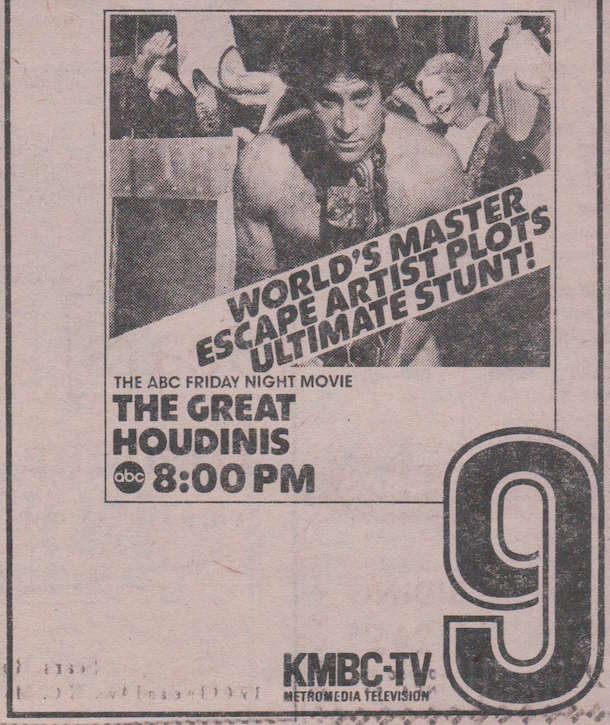
The Great Houdinis on KMBC

Here's an ad for the TV biopic The Great Houdinis on KMBC-TV in Kansas City. I'm not sure of the date of this ad, but considering the title is still plural, it could be for the original October 1976 airing. The movie became The Great Houdini after its initial showing.


While one can find various TV Guide ads for the Tony Curtis movie, ads for The Great Houdinis are less common. This one I've never seen before, so I thought it was worth the share.

This image come from the Pintrest page belonging to Blue Topaz which is devoted to all things related to Starsky & Hutch.

Related:

Friday, July 4, 2014

Houdini in "VELVET FINGERS"


We are all familiar with the famous film footage of Houdini doing card manipulations late in his career. Little is known about this footage, except that it was made by Pathe in 1926. But while doing some unrelated research, I stumbled on two newspaper advertisements that appear to show exactly when and where this short film played and, most excitingly, the title: "Velvet Fingers."

These ads appeared in The Hutchinson News on April 1st and 2nd, 1926, and advertised the line-up of movies at the Royal Theater in Kansas City. The main feature was the Ralph Lewis newspaper drama, The Last Edition. But look below and you'll see among the short subjects on the bill is HOUDINI in "VELVET FINGERS." The second ad has the more descriptive "HOUDINI in an array of tricks." It seems almost certain that "Velvet Fingers" and the famous Houdini card flourishes footage are one in the same.


Unfortunately, I can't find any other record of a short called "Velvet Fingers" (there was a serial with this title in 1920). Might the theater have invented the title? Hard to know. But the Our Gang short that is billed above the Houdini movie was indeed called "Better Movies."

Royal in Kanas City where "Velvet Fingers" played in 1926.

It's intriguing to wonder just how many tricks in the "array of tricks" existed in the full short. In the surviving film, we see Houdini demonstrate a 32 card forward and back palm, an armspread turnover, a waterfall, and an amazing armspread toss and catch. Houdini was featuring these flourishes in his 3 Shows In 1 at this time, so this is really the only footage that exists of Houdini doing his stage act. Pretty cool.

As far as I know, this short no longer survives complete. Some footage appeared in 1950 feature documentary, The Golden Twenties. The most complete selection of footage can be found on the 3-DVD set "Vintage Magic Films" produced by The Miracle Factory. I once had the fantasy that this could have been a sound short, but certainly that would have been advertised, so I have to put that wish to bed.

And now here's a short clip from "Velvet Fingers."


Related:

UPDATE: Readers Bill Mullins and Joe Notaro have uncovered some clippings that confirm the title and give us even more details about the full footage:

Motion Picture News, March 20, 1926:
Pathe Review No. 12 brings Houdini to the screen as a master manipulator of playing cards in a novelty called "Velvet Fingers."

Greensboro NC Record, March 21 1926:
HOUDINI'S VELVET FINGERS
Houdini, master magician, brings to the screen his grace and form in handling playing cards in a current issue of the Pathe Review. He also presents an expose of some of the card tricks by means of which card sharps have mulcted the public of millions of dollars. Slow motion analyses "the gambler's cut," in which the middle and bottom of the deck are transposed, leaving the top as it was; the "forearm rifle" in which Houdini makes a whole deck of cards obey his orders and the "forearm toss," in which every card stays in its place as if under hypnotic control, and other stunts that make the cards almost sit up and talk. [typos as in original]

UPDATE 2: Was this footage originally part of a 1925 short produced by Red Seal Pictures? Click to read: The Houdini card manipulation movie mystery deepens.

Translate