Showing posts with label J. Malcolm Bird. Show all posts

Wednesday, February 12, 2025

Margery lost her prize 100 years ago today


It was one hundred years ago today that the Scientific American committee, on which Houdini famously served, denied Mina Crandon aka "Margery" their $2500 prize for proof of genuine psychic ability. The committee had sat with the medium in July and August of the previous year. Below is part of a story that ran in The Republican on February 12, 1925.

The Republican, Feb 12, 1925.

J. Malcom Bird, the head of the committee who had been a Margery champion and partisan even before the investigation had begun, blamed Houdini for the failure.

Detroit Free Press, Feb 13, 1925.

The verdict came down during a busy week for Houdini. He was playing two theaters in New York at the same time; the Hippodrome in Manhattan and The E.F. Albee in Brooklyn. A police escort sped him between the two vaudeville houses.


Houdini remained relatively quiet on the final verdict. But he had been making his case against Margery for over a year, first with his Margery pamphlet and later with two exposure lectures in Boston. For him, this was vindication.

This wasn't the end of investigations of Margery. In June 1925, a committee of Harvard scholars sat with the medium. After witnessing her retrieve objects from her lap to aid in her manifestations, they concluded she was fraudulent. The American Society for Psychical Research investigated her in 1926 and also concluded that the phenomena she produced was fraudulent.

Related:

Thursday, May 19, 2022

The Pecoraro Files

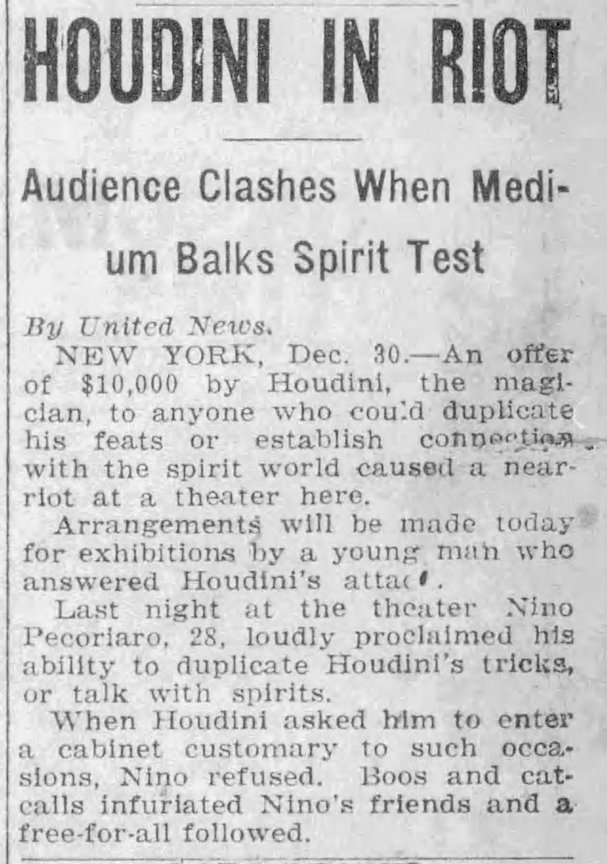
Here's a news item that was widely syndicated in late December 1925. This occurred during Houdini's 3 Shows in One at the National Theater on 41st Street in New York City. An evening with Houdini was never dull!

The Cincinnati Post, Dec. 30, 1925.

Nino Pecoraro (misspelled Pecoriaro in the above) was an Italian spiritualist who claimed his spirit guide was the deceased medium Eusapia Palladino. Pecoraro's reputation was greatly bolstered when he impressed Sir Arthur Conan Doyle during a seance at the offices of the American Psychical Institute in New York City in 1922. However, Doyle was dismayed when full details of the seance appeared in newspapers the next day "with the copyright mark below it, to show that it had been duly paid for."

The incident at the National wasn't Houdini's first encounter with Pecoraro. In 1923 the famed "boy medium" was tested by the Scientific American committee on which Houdini served. Houdini was on tour and did not attend the first two tests, during which Pecoraro impressed the committee with his ability to manifest ghostly phenomena while securely bound. The head of committee, J. Malcolm Bird, who would later collude with Margery, even wondered if the smell of garlic on the Italian's breath could be "celestial garlic." No joke.

Things looked good for Pecoraro. That is until Houdini arrived for the third test on December 18. He was mortified to see the committeemen securing Pecoraro with a single piece of long rope. Houdini cut the rope into pieces and tied the medium himself. That put an end to Pecoraro's ghost show and his shot at the Scientific American prize. (For an excellent account of all this check out The Witch of Lime Street by David Jaher.)

While Houdini biographies all contain the story of the Scientific American tests, none of them mention this follow-up incident at the National. Was it really a "riot"? One thing I find intriguing is the photo below. This shows Houdini and Pecoraro around the time of this confrontation. In fact, Houdini and the young medium took a series of portraits together at a New York photo studio. Why would they do this? Were they planning a public test, as alluded to in the article, that never came to pass? Could the theater incident have been a publicity stunt that got out of hand? There may be an untold story here.


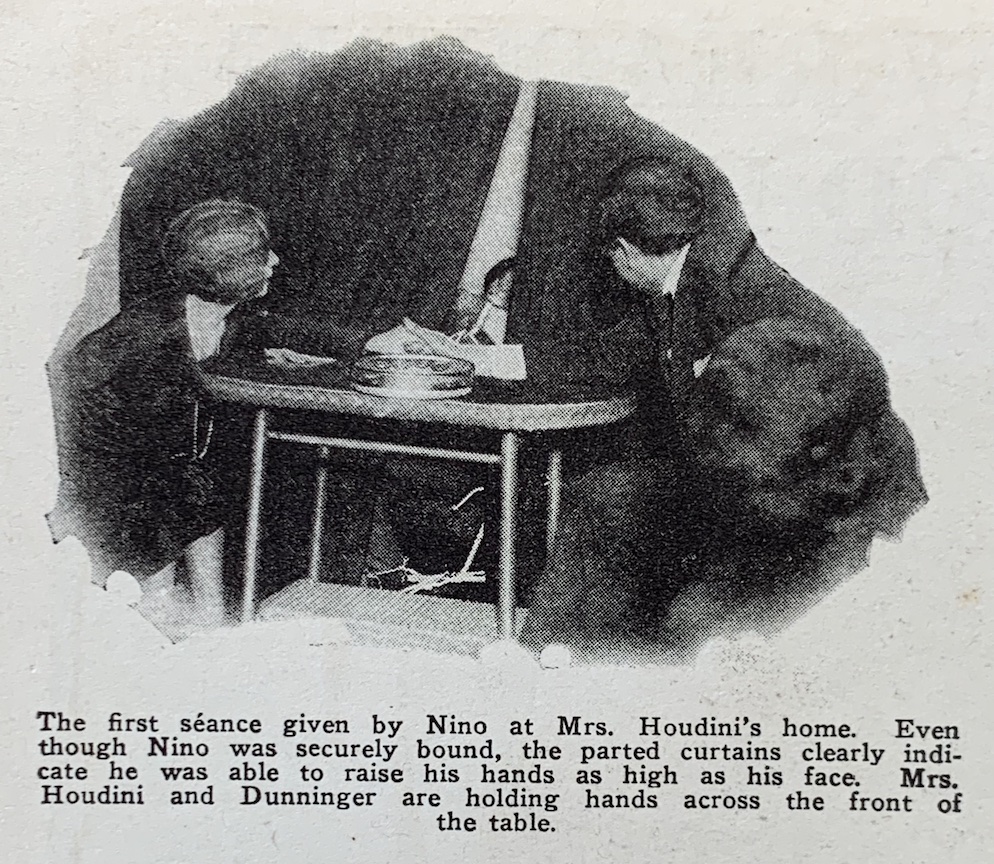
After Houdini's death, Pecoraro gave Bess a private seance at her home on Payson Ave. Joseph Dunninger was also in attendance. Nino went through his regular routine but failed to deliver the all important Houdini Code to Bessie.


In 1928 Pecoraro was at it again. This time the medium offered to produce Houdini's physical spirit at the offices of Science & Invention magazine which offered a $21,000 prize for genuine spirit phenomena. Bess attended the seance and cameramen surrounded Pecoraro's cabinet, ready to snap a photo of the master magician. Nothing happened. "Not Even for $21,000 Would Houdini Show Himself at Seance" read a newspaper headline the next day.

A few days later Joseph Dunninger recreated Pecoraro's seance using trickery for better results. The photo below shows "Houdini" making his reappearance with Bess looking on. Pecoraro's manager, Charles E. Davenport, asserted that Dunninger had mediumistic powers even if he didn't know it.


In 1931 Pecoraro finally confessed to being a fraud. He demonstrated his methods, which included producing a message from Houdini, at a New York press conference. The resulting United Press story is pretty amusing.

The Ogden Standard Examiner, April 9, 1931.

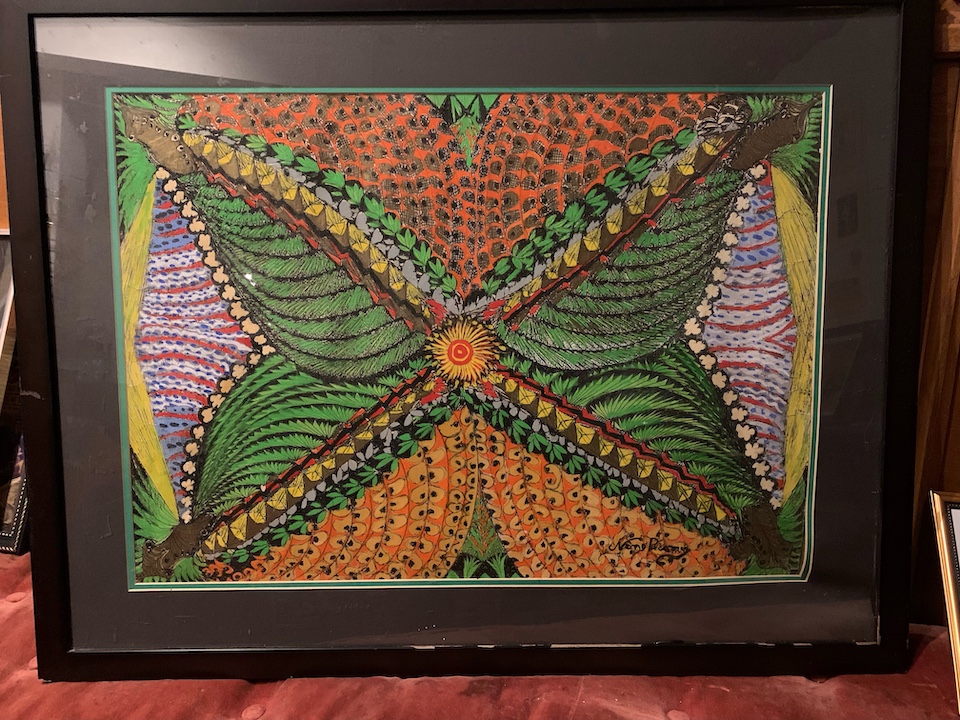
It's unclear if Pecoraro ever did become a cement salesman, but he did continue to paint. In fact, two of his paintings are on exhibit at the Houdini Museum in Scranton, PA.

On April 27, 1973, Pecoraro collapsed while walking with a friend in Naples and died on his way to the hospital. He was 74.

Painting by Nino Pecoraro at the Houdini Museum in Scranton.

Thanks to the Houdini Museum in Scranton for the photo of their Nino painting. Other images come from Houdini: A Pictorial Life by Milbourne Christopher, Houdini's Sprit Exposes by Joseph Dunninger, and Newspapers.com.

Tuesday, June 25, 2019

Houdini combats "fake news"

Fraudulent spirit mediums tried many ways to derail Houdini's campaign of exposing their tricks, even spreading rumors of his own conversation. Here's an article from the March 8, 1925 Pittsburgh Post Gazette in which Houdini disputes such a claim.


Of course, Houdini had his own tactics, and it not impossible he invented rumors just to debunk them and garner the press. Houdini hated J. Malcom Bird, and this offered him a nice platform to publicly criticize him. This was what Margery claimed when stories surfaced that she had put a "curse" on Houdini.

So is Houdini combating or creating "fake news" here? Only the spirits know.

Related:

Thursday, December 14, 2017

Margery materializes on eBay

A remarkable edition of J. Malcolm Bird's Margery The Medium was recently listed on eBay where it sold for a Buy It Now of $1,200 (at least I think it did -- I can't quite tell from the ended auction). What makes this copy so special is it's signed by Margery herself (as Mina Stinson Crandon) and also includes a special stamp quoting her deceased brother and spirit guide, Walter. Only one other example of this stamped book exists in the collection of Dr. Bruce Averbook. It also still has the original dust-jacket.


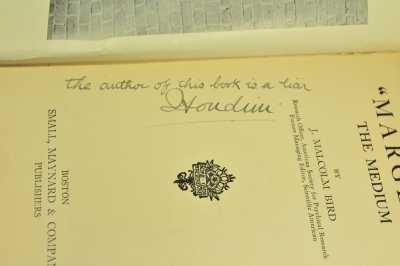
Houdini was no fan of this book. He once inscribed a copy: "The author of this book is a liar." (That copy sold for $3,900.) Indeed, author J. Malcolm Bird was in charge of the Scientific American committee investigating Margery's alleged powers, on which Houdini served. But Bird was infatuated with Margery and was secretly suppling the Crandons with information the entire time.

Related:

Sunday, October 25, 2015

REVIEW: The Witch of Lime Street is no fraud

When The Witch of Lime Street was first announced back in 2007, there was some skepticism among Houdini buffs (myself included). The press reported a "high six figures" advance for a book by an author no one in the Houdini world had ever heard of. Indeed, David Jaher (spelled Jehar in the original reports) had never written a book before, and while he was said to be a screenwriter, he had no produced credits. Furthermore, he worked as a professional astrologer. It didn't help that the release date was continually postponed. Originally set for release in 2010, it jumped to 2012, 2013, 2014, and finally 2015. So you couldn't blame Houdini buffs for suspecting The Witch of Lime Street might turn out to be as fraudulent as, well, "the Witch of Lime Street" herself!

Having now read David Jaher's 436-page The Witch of Lime Street: Séance, Seduction, and Houdini in the Spirit World, I'm happy to report that all our fears were unfounded. The book is a triumph! It's exhaustively researched, beautifully written, and easily stands as one of the best books ever written on Houdini's anti-spiritualism crusade. It is certainly the finest work ever produced on Mina Crandon a.k.a. "Margery" (admittedly, there have only been two others). It also might be one of the best books ever produced on the subject of Spiritualism itself. For those wishing to better understand Houdini's encounters with Margery and his participation in the Scientific American committee, this is now essential reading.

For me, the "test" of the book was in how the author handled the infamous ruler incident. This is the controversy over how a folding carpenter's ruler got inside the Margery control box during one of her seances with Houdini. Margery believers blame Houdini. Houdini supporters blame Margery. And informed magic historians -- especially those who don't care for Houdini -- quickly cite a damning quote from Houdini's chief assistant Jim Collins (which first appeared in Gresham) confessing that he "chucked it in the box" on the boss's orders. So which side would the author take?

Well, not only does David treat the ruler controversy objectively, describing all that occurred without inserting his own opinion (a relief in this day of opinions as fact!), he also reveals the source of the Collins quote as magician Fred Keating, a Margery convert who had been J. Malcolm Bird's select magician committee member during the seances preceding Houdini's arrival in Boston (the full extent of Keating's involvement was something I didn't know until this book). So not only did David pass my test with flying colors, he also took a step to debunk something that has been used to indict Houdini (and Collins) in the past. Bravo!

While there isn't a single momentous revelation in the book (no, Margery was not a government spy), there are dozens of small ones. Among these is the mind-blower that Margery channeled her spirit guide Walter during a radio broadcast in January 1934. That is one recording I'd love to hear! Jaher takes us a few more troubling steps down the road that suggests Margery's husband, Dr. Le Roi Crandon, may have been involved in child abductions -- maybe even murder -- which was first uncovered by Bill Kalush in The Secret Life of Houdini. This is weird and troubling stuff, and while it is still unclear exactly what was going on, it appears Houdini himself might have been pursuing the case via his English agent, Harry Day. Jaher also delves into the seductive side of Margery (a favorite topic), and even reveals that Margery did try to work her "applesauce" against Houdini in her own son's bedroom at Lime Street. (You can bet I'll be doing a post about that one soon.)

As to Houdini himself, Jaher's portrayal feels very similar to that of Ken Silverman in his masterful Houdini!!! The Career of Ehrich Weiss. It's not wholly positive or worshipful, but it feels honest and true, showing us Houdini at his best, worst, or usually somewhere in-between. One thing I didn't care for was the author's continued use of "The Great Houdini." Houdini himself never used this moniker, and it seemed like an unnecessary Hollywood flourish in an otherwise controlled and scholarly work.

For such a weighty topic, the book flows beautifully. I especially enjoyed the brevity of the chapters. Here I think Jaher's skills as a screenwriter came into play. Not for any ability to create fiction, but for an ability to condense information into packets of dramatic movements that carry the reader along. The book never bogs down or meanders. It's what one would call "a quick read."

It's when Jaher moves outside of his area of core research (1920-25) that he falls into a few familiar traps and errors do creep into the text. He says Houdini appeared in the Welsh Bros. Circus as the "Wild Man of Borneo." It was actually the "Wild Man of Mexico." (Borneo comes from the movies.) He suggests the sea monster challenge took place underwater. It was a stage escape (but Houdini sometimes told an underwater version). And the provider of Houdini's last meal of Farmers Chop Suey was Dr. Daniel Cohen, not Dr. Kennedy. But these types of forgivable errors appear in all Houdini biographies. I spotted no whoppers, nor did David indulge in any wild speculations. Instead, the author finds his story -- which is as thrilling as any Hollywood fiction -- in the facts.

So while it may have taken a few years longer than we expected and, yes, it's a skeptical work written by an astrologer, The Witch of Lime Street: Séance, Seduction, and Houdini in the Spirit World by David Jaher is a major contribution to the world of Houdini scholarship and a gift for all Houdini buffs.

Oh, and the dust jacket glows in the dark! That alone makes it a must for your Houdini bookshelf.

The Witch of Lime Street: Séance, Seduction, and Houdini in the Spirit World can be purchased at Amazon.com (U.S.) and Amazon.co.uk (UK). It's also available as an Unabridged Audiobook.

Related:

Saturday, February 21, 2015

BBC Radio: The Witch of Beacon Hill

On September 30, 1989, BBC Radio 4 aired as part of their Saturday Night Theatre The Witch of Beacon Hill by Paul M. Levitt. The radio drama featured the voices of John Woodvine at LeRoi Crandon, Shelley Thompson as Margery, Kerry Shale as J. Malcolm Bird, and Nigel Anthony (right) as Houdini.

You can listen to the full 1:25:52 program at Internet Archive.

Thanks to Mark Schwartz for this discovery.

Saturday, December 7, 2013

Houdini miniseries reveals more cast, characters

Mate Haumann as Kelly, Scott Alexander Young as Hereward Carrington, and
(UPDATE) Luca Bercovici as Dr. Crandon.

The IMDb page for HISTORY's Houdini miniseries has been updated with more cast and characters. Newly listed are Máté Haumann as "Kelly", Scott Alexander Young as "Mr. Carrington", and George Mendel as "Mr. Bird."

I don't know who Kelly might be, but Mr. Carrington and Mr. Bird are almost certainly Hereward Carrington and J. Malcolm Bird. Both were members of the Scientific American committee that investigated Mina Crandon aka Margery the Medium, and both men worked against Houdini as secret informants for the medium. While I assumed the miniseries would feature Margery, this is the first real conformation of that.

It's also my guess that these actors -- who all hail from Eastern Europe -- add their names to the official Houdini IMDb page only after their scenes have been completed. The fact that Young and Mendel's name were added just today tells me they probably recently wrapped the Margery scenes. Might that mean we'll soon learn who's playing the famous medium herself?

Houdini stars Adrien Brody as Houdini and Kristen Connolly as Bess. The 4-hour miniseries is being directed by Uli Edel from a script by Nicholas Meyer. Houdini is an A&E Studios Lionsgate co-production. It will air over the course of two nights on HISTORY in 2014.

UPDATE: You can now add Luca Bercovici as "Dr. Crandon" to the roster. Of course, this would be Margery's husband, Dr. Le Roi Crandon.

Related posts:

Monday, July 15, 2013

Houdini Spiritualism scrapbook found in a California flea market

The lost Houdini scrapbook (and me).
Today I'm thrilled to share news of a truly incredible find. An antique dealer in Southern California has discovered a hitherto unknown Houdini scrapbook that has possibly gone unseen for 83 years.

This amazing book, which Houdini compiled and labeled as "IMPORTANT SCRAP BOOK - MISCELLANEOUS CLIPPINGS," is jam-packed with newspaper clippings about Spiritualism and Houdini's own spirit-busting activities. Many of the clippings have annotations in Houdini's own hand. The majority of the material is from 1925 with a few clippings from early 1926. The scrapbook contains many clippings chronicling Houdini's exposure of Margery the Medium and several related to Sir Arthur Conan Doyle.

While the scrapbook is devoted specifically to spiritualism, there are also several semi-related curiosities, such as a clipping about Friedrich von der Trenck (see: Is this Houdini in a past life?), a random Thurston advert, a story about whether pets live on after death, and a page devoted to Houdini's performance before the Roosevelt grandchildren, which is the only full account of this I've ever read (watch for a post about this soon). There are also two letters addressed to Houdini, one of which the magician has annotated, and a lengthy article about Houdini in French from a Montreal newspaper. Eerie to think that J. Gordon Whitehead almost certainly read this article.

So what's the story behind this amazing find?

A few weeks ago, I received an email from Mike, a long-time California antique dealer, saying he believed he had found a Houdini scrapbook at a local flea market. Frankly, it sounded too good to be true. But the photos he sent were intriguing, and he said an expert dealer had concurred that it was a Houdini scrapbook. He then graciously invited me to come have a look for myself.

So, on the following Sunday, I set off to see what I thought couldn't be. Well, I knew on first sight that the unbelievable was true. This is, unquestionably one of Harry Houdini's original scrapbooks. In fact, I think this might be one of Houdini's most important scrapbooks (hence the title) as it's really a tool for the magician to use in his battles against spiritualists. Many of the damning incidents that Houdini would cite against mediums (suicides related to seances, etc.) as well as stories of their underhanded methods are collected here. And then, of course, there's all the Margery material.

In fact, the importance of this scrapbook might be why it went missing from the collection of over 100 Houdini scrapbooks currently in the Library of Congress, and why it wound up on the West Coast. Mike has no provenance for the book, but it could be that Edward Saint brought this book with him to California when he and Bessie relocated here in the 1930s. Spiritualism was still a hot issue for the couple, and having Houdini's research scrapbook was probably a valuable tool. After Saint's death, the scrapbook could have been sold or given to a magician or Houdini enthusiast by Bess, and then went into storage where it's been for an unknown number of years.

Amazingly, this is the first Houdini item Mike has ever discovered in his 30 years of collecting. "It was a good day," he says.

The exciting news for collectors is that Mike is planning on selling this. He says he would like this important Houdini artifact to go to someone who "will appreciate it and look after it" and also "share it in some way with other Houdini enthusiasts." He has not yet decided whether to sell it through a national auction or privately, but he is open to hearing from interested collectors.

Now, I'm not brokering this and I don't know what price Mike has in mind (I made him the best offer I could), I'm just volunteering to put him in touch with fellow Houdini collectors as thanks for letting me see this amazing scrapbook and share the news of its discovery here on WILD ABOUT HARRY.

You can reach Mike by sending me an email via my CONTACT PAGE. I will forward all emails to him and keep all correspondence confidential.

Now put on your drool cups and enjoy these photos of Houdini's long-lost Spiritualism scrapbook!


UPDATE: Nice to see this news getting picked up around the web. Here are some links:

Tuesday, March 26, 2013

Margery "liar" book makes an honest $3,900

A copy of the 1925 book "Margery" The Medium twice signed by Houdini sold for $3,900 in a Martinka auction on Sunday. What makes this copy especially attractive is that Houdini has written across the title page, "The author of this book is a liar."


The author, J. Malcolm Bird, was the chairman of the Scientific American committee that investigated Margery. He was very close to the Crandons -- staying in their home during the investigation -- and acted as Margery informant during the seances. Committee member Dr. Walter Franklin Prince famously said of Bird, "If he wishes to achieve the authority in psychical research which I invoke for him, must hereafter avoid falling in love with the medium."

The auction noted the condition of the book as "very good with a split to the front endpaper which occurred at the annual Houdini Seance." Included was a letter explaining the chain of ownership and photos of the book being examined Anna Thurlow, the great granddaughter of Margery (who graciously gave us an interview here).

Among the other Houdini items sold in the auction were an original portrait shot of Houdini and Bess ($598), a signed photo of Houdini in hat ($1,609), and a signed portrait of Houdini smiling ($1,647).

A magic wand said to have belonged to Hardeen received 11 bids and reached $971, but did not meet the auction's reserve.


Thanks to Joseph Holland and Norman Bigelow for the tips.

Saturday, January 26, 2013

The Margery Files revisited - the first seance

Today we have a very special encore presentation of "The Margery Files." Once again Anna Thurlow, the great granddaughter of Mina Crandon a.k.a. Margery the Medium, is giving us an exclusive look at rare artifacts from the private Libbet Crandon de Malamud Collection. Says Anna: "You have drawn such a lovely narrative with these artifacts it just feels wrong to not include this."

These are Dr. Crandon's actual notes on the first Houdini-Margery seance held on July 23, 1924. What makes this seance of particular interest is it was the only one held at the Crandons home at 10 Lime Street in Boston. Later sittings were moved to the Charlesgate Hotel where Scientific American committee member Dr. Daniel Comstock (who founded Technicolor) kept an apartment. Perhaps this is why this one sitting had the most detailed notes by Dr. Crandon. It's also maybe why this sitting produced the most spiritualistic phenomena.

This fascinating two-page document provides a moment by moment account of what occurred in the darkened room. I love how it describes when Houdini had control of Margery's hands he "explored each arm to the shoulder to insure that it was her two hands." (A lot of touching went on during these things.) The notes are signed by Houdini and the other attendees; J. Malcolm Bird, O.D. Munn, and R.W. Conant, the assistant to Dr. Comstock who couldn't attend. "Psyche" is Margery.

Click to enlarge.
Click to enlarge

Houdini explained much of this phenomena in his booklet, Houdini Exposes the tricks used by the Boston Medium "Margery." Margery's ringing of the Bell Box -- here called a "contact board" -- was done by her foot (I covered some of that here). The floating megaphone that landed at Houdini's feet on his command was actually sitting on top of Margery's head, like a dunce cap, and flung with a snap of her neck. Of this particular method Houdini would later write, "This is the slickest ruse I have ever detected."


However, the third paragraph describes phenomena involving an "illuminated plaque" – a piece of cardboard that was placed atop the Bell Box -- which moves and actually levitates. This is downplayed in most accounts of the seance. And while Houdini included an illustration of the plaque in his Margery booklet (near the back), he doesn't mention the phenomena in his actual account of the seance, nor does he make any attempt to explain it. Maybe the "ruse" was so simple he didn't feel a need to expose it? Or maybe he couldn't? Hmmm...

Also, some accounts of the sitting say Margery's Victrola (which played Drdla's Souvenir) mysteriously "started and stopped" during the seance. However, I don't see this reflected in the notes. To me it appears that the Victrola winds down naturally during the length of the sitting, and when it stops (once) Dr. Crandon gets up to restart it. I don't believe this is a record of any Victrola-related phenomena. I just think Dr. Crandon is chronicling everything that happened during the seance so it's clear who had "control" of Margery at all times. Houdini also makes no mention of the Victrola in his accounts.

This is the pleasure of being able to do research from primary sources that one can make fresh discoveries and refine past interpretations. Once again, thanks to Anna Thurlow for sharing these amazing artifacts and allowing all of us to play the role of research detective among...The Margery Files!

Click here for a page with links to all seven installments of The Margery Files.

Tuesday, January 15, 2013

The Margery Files: Subtle betrayals

This week WILD ABOUT HARRY is showcasing rarities from the private Libbet Crandon de Malamud Collection, courtesy of Anna Thurlow, the great granddaughter of "Margery" the Medium.

Today I bring you another round of "photo play" between Houdini and the Crandons. This photo from "The Margery Files" and was taken during the July 24, 1924 seance, which was Houdini's second sitting with the famous medium. It's an original photograph that might be strangely familiar, but we'll get to that.

This photo shows Houdini "controlling" the left side of Margery with the electric bell box between his feet. Note that Houdini has rolled up his pants leg. That's because he had sensitized his leg by wearing a surgical bandage all day so that he could detect the slighted moment of Margery's own leg in the dark. "She made so bold a sliding movement with her ankle to reach the box that I think she was under the impression that I was badly fooled or was going to help her like the others," Houdini later wrote.


It's not clear who took this photo (possibly Dr. Crandon), but it appears to have been among a second set of photos that Houdini sent to Margery. Below is a never-before-published letter from Houdini to Margery that bares this out. This followed their correspondence in my previous post. Here Houdini's tone is a little more formal, but it's interesting how he states that he is "honestly not a skeptic" and how "Harmony must reign."

Click to enlarge.

I can't help but think Houdini is purposely lulling Margery into a false sense of security here when he promises to cause her no "inconvenience of physical discomfiture." What must she and Dr. Crandon have thought when Houdini arrived at the August sessions with the formidable "Margie Box" in tow?

On the back of the photo we again find the handwriting of Dr. Crandon. Normally Dr. Crandon always sat to the right of his wife during seances, but here he identifies the second control as J. Malcolm Bird. Bird was a fellow member of the Scientific American committee and was a houseguest of Crandons during the seances. He was also deeply in the tank for Margery. "Either he is as dum [sic] as I think he is, or the good time he is having causes him to mislead the public," Houdini wrote to Bess.


Dr. Crandon's reference to Houdini's notes of the "experiment" is also interesting. Crandon would collect and keep all the notes from Margery's sitters just in case they made public comments that contradicted what they had experienced in the seance room. Dr. Crandon told Sir Arthur Conan Doyle, "I have the material to crucify them, and they know I shall not hesitate to treat them surgically if necessary."

Now, the reason this shot looks familiar is it was used by Houdini as the bases for a damning illustration in his pamphlet, Houdini Exposes the tricks used by the Boston Medium "Margery". Here Houdini shows Margery's foot about to ring the bell box, which is sitting at a much more advantageous angle here.


Of this second round of "photo play", Anna Thrulow, great granddaughter of Mina Crandon and our generous guide through The Margery Files, has these thoughts:

"I feel like the two photo episodes - Bird using a photo of Margery taken by Houdini for purposes Houdini did not support, and Houdini using a photo of himself and Margery taken by the Crandons for purposes they did not support - adds some background to the subtle betrayals Margery and Houdini inflicted on each other, despite their (I think) initial mutual respect."

Indeed, the story of Houdini and Margery is filled with "subtle betrayals". In light of his letter, Houdini's use of the Margie Box could be seen as another. However, I also agree with Anna that one can sense a certain level of mutual respect between to the two master tricksters. It's a dichotomy. But maybe that's why the story of Houdini and Margery is still so compelling. It seems the truth still out there.

Speaking of the truth, tomorrow will rewrite a little postmortem Houdini history when The Margery Files exposes Margery's Inside man. And if you think I'm talking about Bird or Hereward Carrington; not so Fast...

Additional references: Houdini!!! The Career of Ehrich Weiss by Kenneth Silverman; The Secret Life of Houdini by William Kalush and Larry Sloman.


UPDATE: Houdini's copy of the same photo can be in Doug Henning's Houdini His Legend and His Magic along with Houdini's own notes on the back (page 87). The photo is now in the Jon Oliver Collection.

Monday, January 14, 2013

The Margery Files: Photo play

It's a very special week here at WILD ABOUT HARRY. This week we are Wild About Margery. Today I'm honored to share the first of several genuine artifacts from the Libbet Crandon de Malamud Collection, courtesy of Anna Thurlow, the great granddaughter of "Margery" herself.

Let's kick things off with Margery's own uncropped copy of what is certainly one of the most famous photos ever taken of her. It was used as the frontispiece in the book "Margery" The Medium by J. Malcolm Bird, and has appeared (cropped) in various books and articles over the years. But not many people know that this photo was taken by Houdini. It was one of a series of shots Houdini and Margery took together on July 24, 1924, some of which show a very different relationship than what has come down in history (remember this post?).

In a way, the story of this famous photo is the story of Houdini and Margery's curious relationship in microcosm. So lets look at three incredible artifacts from The Margery Files. First, the photo itself:


One revelation here is that the photo was taken not in front of Margery's home at No. 10 Lime Street, but in front of No. 11. There's also some very telling information on the back of the photo. But before we get to that, let's look at the amazing, never-before-published correspondence between Houdini and Margery about this famous photo set:

Click to enlarge.

Click to enlarge.

Not quite the combatants of legend, eh? What's even more remarkable is this exchange is after the July 1924 sittings in which Houdini detected Margery's methods and Margery knew that she had been caught (thanks to her informant, J. Malcolm Bird).

But here we see Houdini being disarming, cordial, even charming. He almost comes off sounding like a fan. But maybe he's just trying to reassure her that he's not going to come racing into the seance room and expose her at first blush during their upcoming August sittings (or come in with a big giant box to control her). Maybe he'll even play ball?

Margery in return is offering Houdini what I'm sure she sensed he enjoyed most: flattery. I especially love her line; "I am glad to able to say I know 'The Great Houdini'". But she's also being coy -- so casual and confident in her abilities that she isn't even sure when Houdini is scheduled to come sit with her. No advanced preparations necessary, you see.

So is this the sign of burgeoning friendship, or two seasoned gladiators showing civility before doing battle? Our generous patron, Anna Thurlow, great granddaughter of Margery, offers her own thoughts:

"It does seem to be a respectful and rather admiring tone, doesn't it? Quite different from their public conflict. It is also one of the very few exchanges from Margery to anyone (usually Dr. Crandon intercepted and assumed the responsibility of replying to her personal letters, often to the frustration of her corresponders), which says to me that this particular exchange meant a lot to her. Also, her tone in the letter is consistent with the family legend I grew up with - hugely respectful of Houdini. That is quite different from the tone Dr. Crandon reveals in his writing and correspondence, which is often derogatory."

Indeed, it appears Dr. Le Roi Crandon, Margery's husband and manager in psychic matters, at some point "intercepted" this photo as well. Because on the back we find in his handwriting:


No mention of Houdini taking the photo here. In fact, Dr. Crandon seems to be going out of his way to remove any connection to Houdini. Here he is assigning Copyright to "Small, Maynard Co.", who published J. Malcolm Bird's "Margery" The Medium in 1925. He is even going as far as stipulating that "Credit must be given." He wanted to make sure Houdini saw the slight -- which, it turns out, he did.

Because deep in a special locked room of the William Larsen Sr. Memorial Library at The Magic Castle is Houdini's own copy of "Margery" The Medium. The book contains an annotation on the frontispiece photo -- this very same photo that Houdini took, shared with Margery, and promised not to use himself...

"Photo by Houdini & no credit given."

The battle is joined. And there's more to come. Especially as we next explore Subtle betrayals.

Additional thanks to Bill Goodwin and Lisa Cousins at the Magic Castle's William Larsen Sr. Memorial Library for allowing me to photograph Houdini's copy of "Margery" the Medium.

Translate