Showing posts with label Egotism. Show all posts

Friday, May 7, 2021

No hard feelings

One of the things Hollywood gets wrong about Houdini is showing him bellowing onstage how no one ("Not even God!!!") can hold him a prisoner. But had Houdini done this in reality, audiences would have surely turned on him and rooted for such a braggart to fail. While Houdini was a boaster off-stage, on-stage he actually presented a more humble persona. He would famously say to his audience, "I don't know if I'm going to get out of this, but I assure you I am going to give it my best." He presented himself as the underdog and audiences rooted for him.

Of course, Houdini always did escape. But he also went out of his way not to humiliate his challengers. No escape was ever presented as easy, even when it was. Houdini would frequently say he had never faced such a well-made packing case or a more expert rope tie. He left good will in his wake.

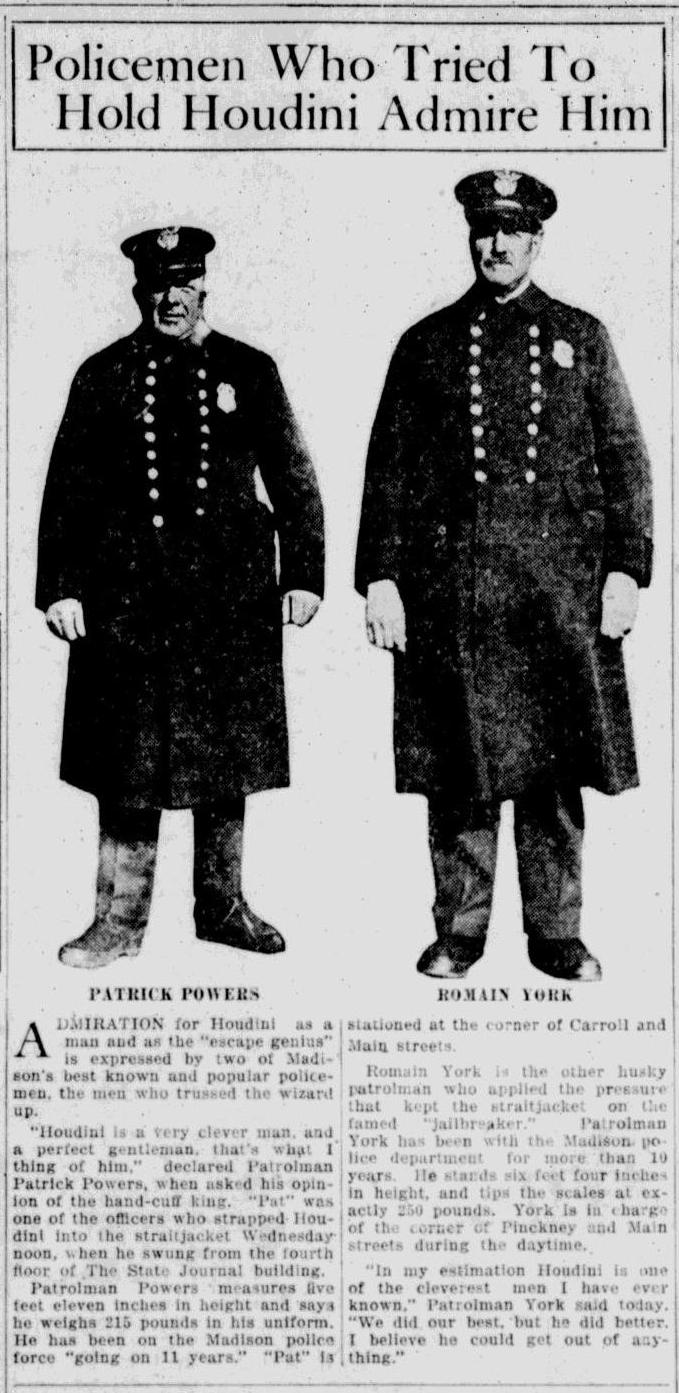
The below is a nice example of this. This ran in the The Wisconsin State Journal following Houdini's suspended straitjacket escape from the State Journal building in Madison on January 23, 1924.

Click to enlarge.

Of course, there were exceptions, such as William Hope Hodgson in Blackburn. And later in his career Houdini did do some on-stage boasting. A 1922 review in the Baltimore Evening News complained, "Houdini spends about 10 minutes telling of his greatness, then performs two tricks that he has been showing for years." But in this case he was boasting of past triumphs.

Okay, so maybe Hollywood got it half right.

Friday, March 26, 2021

Houdini shares his stage in Boston


There's a joke you'll sometimes hear that is supposed to be from Houdini's time. It goes:

-What kind of magicians did Houdini like?
-Dead ones.

This is in part a reference to Houdini's well-known practice of visiting the graves of dead magicians. But it also plays into a belief that Houdini "hated all other magicians" and could never bear to share the spotlight with anyone. This has always rubbed me the wrong way. While Houdini certainly hated his imitators (many with good reason), he was close friends with most of the major magicians of his day, including his chief competitor Howard Thurston. It's also doubtful Houdini would work so hard to build up the Society of American Magicians as its 'Most Illustrious' president if he "hated magicians."

But as to the charge that Houdini couldn't share the spotlight, here's something even I found surprising. On September 14, 1926, Houdini turned the entire first act of his "3 Shows in One" over to local magicians. An account of exactly who those magicians were and the tricks they performed can been read below:

Boston Globe, Sept. 14, 1926.

This wasn't the first time Houdini did this. On February 18, 1926 he invited local magicians in Philadelphia to perform as a special feature during his run at the Chestnut Opera House.


So maybe we need to rethink the old joke. How about...

-What kind of magicians did Houdini like?
-S.A.M. magicians.

Okay, not as funny. But at least it's true.

Monday, August 5, 2019

Jules Traub remembers Houdini

Recently Joe Gargano shared with me a story about meeting Jules Traub in the 1980s. Traub performed magic professionally as Stuart Jules. He also worked briefly for Houdini. I love a good "eyewitness" story, so I'll let Joe tell his tale:

Jules Traub in 1968.
It was September 1988, and my wife and I were in Coronado on our honeymoon. My wife was laying out by the pool, and I in my typical fashion was too antsy to sit still, so I decided to go into San Diego to look through some antique shops. I was in a shop, and talking to the owner, who of course asked what I was looking for. I told him magic and Houdini memorabilia, and he told me that he knew this man that had worked for Houdini. The man was into Art Glass and would come into the shop periodically. I asked if he could put me in touch with him and he told me he would try and contact him and would call me if he reached him. 
A short while later he called me and gave me the gentleman's number. I called him and he invited me over. His name was Jules Traub. He was a magician in New York as a young man, and I believe he subsequently owned Fun Inc. in Chicago. He had a very dignified and refined air about him, even at that age. He did have COPD, and I could see the struggle in his breathing at times. 
He told me that when he was 17 or 18, he was working in a magic shop in New York, I don't recall if he told me which one. As he told it, "I was at the counter wrapping up a package to send out. I was tying the package and I had wrapped the string around the package and had brought the string up to tie it at the top. As I was doing this the door to the shop opened and a couple of men walked in but I didn't look up as I was in the process of making the first tie. The men approached the counter and were just in front of me, and I said: Mister, would you mind putting your finger here so I can tie this not? And in a loud voice the man says, 'Everywhere I go, people want to tie me up.' I looked up and it was Houdini."
He was there with Jim Collins, as they were getting ready for the 1926-27 tour. They were there to get some things, and as Houdini was busy, Collins told Traub that they needed some help on the tour, someone to help with loading and unloading and putting things on stage. He asked Traub if he would be interested and he was and went on that last short fateful tour. 
His recollections of Houdini, was that he was very egotistical, and didn't like his pushy, boastfulness. Jules seemed to like Hardeen much better as he felt he was more kind and personable. He also felt Hardeen was a better magician, and kept up a correspondence with Hardeen for many years. He showed me letters that he had from Hardeen. 
He was very kind, and generous in sharing stories of his past. He also told me a very funny story not related to Houdini, but to Max Malini, with him and Dai Vernon in New York. It was a wonderful visit with a kind man willing to share his personal memories.

Thank you Joe. And thanks to Joe Fox at the William Larsen Sr. Memorial Library at the Magic Castle for finding me a photo of Jules (from the Jan. 1968 Genii).

Related:

Saturday, August 20, 2016

The saga of Houdini and Dr. A. M. Wilson

I've been so swamped this summer that I let an important Houdini 100th anniversary slip past. On June 15, 1916, Houdini appeared on the cover of The Sphinx, the official magazine of the Society of American Magicians. Why is this special? What's so unusual about the most famous magician of his time appearing on the cover of a popular magic magazine? Therein lies the story.


Houdini had a rocky relationship with the S.A.M. when he first joined the fledgling organization in February 1903. When he launched his Conjurers' Monthly Magazine in 1906, Houdini lobbied the S.A.M. to make it the new official organ instead of Dr. A.M. Wilson's The Sphinx. Apart from wanting his new magazine to have instant legitimacy, he also had personal reasons.

Dr. A. M. Wilson was an assistant and pupil to magician Robert Heller, who once performed for Abraham Lincoln. Wilson took over as editor of The Sphinx in 1904. Wilson was a magic traditionalist who didn't care for escapology in general and Houdini in particular. His magazine rarely mentioned the exploits of the Handcuff King, and when Houdini complained, Wilson simply reminded him that he could take out an advertisement at the normal rate.

When The Sphinx ran an (erroneous) report that the Western Vaudeville Circuit was going to relegate handcuff acts to their ten cent houses, Houdini blew his stack. Houdini lambasted Wilson, accusing him of "petty spite" and jealously and called him a "dog in the manger." Wilson countered: "Houdini is yet a young man with much to learn. I am sorry for him that money has become his god and self-conceit has caused him to idolize himself." He then vowed, "I will never again mention his name in The Sphinx, no matter how great the provocation."

Their private correspondence was even more incendiary. In one letter, dated May 20, 1908 and today housed in the Harry Ransom Center, Wilson writes, "...you are that type of Jew that has made the noble Hebrew race–God's chosen people–an execration in every country of the world." Houdini wrote back, "As to your slur against my religion, let me suggest to you that such things are best omitted from your letters."

Houdini had been having issues with the S.A.M., even beyond their support of The Sphinx as their official magazine, but his feud with Wilson appear to have been the last straw. In the July 1908 issue of Conjurers he announced:

Harry Houdini has resigned from the Society of American Magicians, and is no longer a member.

When Houdini folded his Conjurers Magazine that same year, Wilson wrote that had been "inevitable" as the magazine "was intended primarily as an advertisement for the owner." He then took the gloves off:

Can anyone with a modicum of reason or common sense compare Houdini's or any other such act with that of David Devant, Servais LeRoy, F. E. Powell, Kellar or Thurston?
Magic is an art, a science that requires brains, skill, gentlemaness and talent of high order. Brick walls, torture cells, straightjackets, handcuffs, etc., demand nothing but physical strength and endurance, nerve, gall, bluster, fakes and fake apparatus, etc., ad libitium, heralded by circus band advertising. In my opinion, magic is brought into disrepute by all such. Their place is in the side show or dime museums.

The Houdini and Wilson feud extended to others. When Thurston asked Houdini for a $250 loan, Houdini reminded him that when they were both playing Chicago, Thurston invited Wilson to his show. "I told him to go to Wilson for the money." Houdini ended friendships if someone wrote for The Sphinx. He even darkly claimed to have a list of names of 300 married women with whom Wilson "was holding criminal relations as an adulterer and fornicator."

In June 1915, Houdini and Wilson came face to face in Martinka's Magic Shop in New York. Houdini was preparing to step back into the S.A.M., and he asked Wilson "what crime I had committed to make him write in such terms about my brothers and my work." Wilson reminded Houdini of a 12-page letter he had written to their mutual friend, Don Turley, slandering him using the most "vile and obscene language." Turley's mother had called Wilson and read him the letter in full. Houdini assured him he had never written a 12-page letter about anyone in his life.

Houdini then reached out to Don Turley, who lived on the west coast, asking him about this alleged letter. Turley assured him he received no such letter, and, furthermore, his mother at that time did not even own a telephone, so how could she have called Wilson? Houdini sent Turley's response to Wilson, diplomatically suggesting, "some indigenous individual or individuals [...] with double-dealing methods has poisoned your mind against me."

A few months later, Dr. Theodore Blakesy, an amateur magician who admired both men, brought them together in his Kansas City office while Houdini was in town. One hour later the two men emerged arm and arm, bonded by a mutual love and knowledge of magic. "I apologized to Houdini; he made amends," said Wilson. "Now we are friends, as we should have been years ago."


At long last, Houdini appeared on the cover of The Sphinx that following June. The cover photo includes the inscription: "To My Friend Dr. A.M. Wilson. With sincerest best wishes and compliments of the season. Harry Houdini Xmas 1915." For the magic world, this was an announcement that the long feud was finally over.

In his column, Dr. Wilson explained:

I made a mistake in accusing Houdini of attacking me, and did not discover the mistake until last June, when I made ample and satisfactory apology to Mr. Houdini, since when we have been good friends and he has sent me a two-year subscription, and, as you see, has his picture in this Sphinx.

The profile of Houdini in the magazine itself (provided by Houdini himself) is a praise-fest, even by Houdini standards. Headlined "Houdini (Has legalized the name)", it plays 16 years of catch-up, ticking off Houdini's triumphs one by one. Among those is a claim that I don't think has ever appeared anywhere else:

Inventor of the Wardrobe Trunk, for which he never received any royalty, and which is now being made by almost every trunk firm that tries to be up-to-date.

Wilson's acquiescence to Houdini was so total (and so one-sided), that it makes me wonder if the reconciliation might have been forced on him by the S.A.M. in a bid to pacify Houdini and bring him back into the organization. Indeed, Houdini would rejoin the S.A.M. the following year and become its president, building the club into the national magic organization that it is today.

But even if the friendship was initially forced, the men did genuinely get along from this point forward. Wilson even became somewhat of a father figure to Houdini. In the 1920s, Houdini arranged a lavish S.A.M. banquet, and as part of the evening's entertainment, he surprised the magicians by "teleporting" Dr. Wilson, then in his 70s, from Kansas City to New York via a "radio" cabinet (possibly the genesis of his later Radio of 1950 illusion). In 1926, Houdini enlisted Wilson's help in drawing up the curriculum for his proposed University of Magic. He even gave Wilson a key to his home so he could come and go as he liked.


Houdini appeared on the cover of The Sphinx again in 1924 and after his death in 1926. In that November issue, Wilson wrote:

I knew his heart, his longings, desires, ambitions, all were noble and uplifting. I would that every one could have learned to know him as I did after our reconciliation. There is no one to take his place in the hearts of one who knew him; no one to fill the void in the world of mystery.

Dr. A.M. Wilson remained editor of The Sphinx until his own death in 1930.

Thanks to Arthur Moses for providing Dr. Wilson's May 1908 editorial. Sphinx cover images from my own collection. This post was updated in 2023 using new information from the Harry Ransom Center.

Related:

Tuesday, October 28, 2014

Edmund Wilson describes Houdini

The New Republic is celebrating its 100th Anniversary by posting memorable articles from its past, including a June 24, 1925 piece about Houdini by Edmund Wilson. Wilson was a major literary figure and was also interested in magic. (He later reviewed Houdini His Life Story.) Edmund's opening paragraph gives one of the best physical descriptions of Houdini I've ever read. I've excerpted it below:

Houdini is a short strong stocky man with small feet and a very large head. Seen from the stage, his figure, with its short legs and its pugilist's proportions, is less impressive than at close range, where the real dignity and force of his enormous head appear. Wide-browed and aquiline-nosed, with a cleanness and fitness almost military, he suggests one of those enlarged and idealized busts of Roman generals or consuls. So it is rather the man himself than the showman, the personality of the stage, who is interesting. Houdini is remarkable among magicians in having so little of the smart-aleck about him: he is a tremendous egoist, like many other very able persons, but he is not a cabotin. When he performs tricks, it is with the directness and simplicity of an expert giving a demonstration and he talks to his audience, not in his character of conjuror, but quite straightforwardly and without patter. His professional formulas—such as the "Will wonders never cease!" with which he signalizes the end of a trick—have a quaint conventional sound as if they had been deliberately acquired as a concession to the theatre. For preeminently Houdini is the honest earnest craftsman which his German accent and his plain speech suggest—enthusiastic, serious-minded, thoroughgoing and intelligent.

Thanks to Eric Fry for the link and info on Edmund Wilson.

Saturday, August 2, 2014

When Houdini got it wrong


Here's an item from the February 23, 1926 Reading Times that shows things didn't always go smoothly for Houdini during the Spiritualist exposé portion of his full evening show. Although, I'm not sure which is worse; Houdini having to admit he was wrong, or the newspaper referring to him as "the little magician." Enjoy.


I'm guessing the "girl detective" here was Rose Mackenberg.

Thanks to Patrick Culliton, Houdini's Ghost, for sharing this one.

Related:

Thursday, June 5, 2014

Houdini on being "not too tall"

I once heard a recorded interview with a man who saw Houdini give one of his spiritualism lectures. He didn't know what Houdini looked like, and his first reaction on seeing the famous magician was; "Oh, he's a short guy."

Houdini stood 5 feet 5.276 inches (according to a 1926 physical). Until now, I've never heard Houdini make reference to height. But recently I spotted this paragraph in an interview with Houdini published in the Adelaide Daily Herald on April 16, 1910 while Houdini was touring Australia. Characteristically, he viewed his size as an advantage, especially in regards to athletics. Says Houdini:

"It is good for me that I am not a tall man. Why? Because I must be quick! and a tall man is always slow. It is so all through the profession. The best men are not too high. A tall man is easy going, good-natured; a short man is sometimes good-tempered, more often not so. All the mean, cunning men that I have known—short! All the keen, eager, ambitious men—short! And for work—the tall man has too much to carry, he is too far from the ground, he cannot lose and recover balance as it is necessary, in a flash."

In this same candid interview, Houdini gives more vital statistics (adding a couple inches to his height), and also addresses the perception of egotism:

"You will think that I am vain to tell you these things. But I am a Magyar, and Magyars are vain. American born. Magyar descended; my parents came from Austria; my father was a clergyman in Wisconsin. My name, Ehrich Weiss; my height about 5 ft. 7 in; weight about 12 stone; 36 this month of April. Only 36, but I feel old; I have done too much in order to be, in my poor little way, Columbus."

You can read the full interview by A.G. Stephens at Trove, an amazing archive of Australian newspapers created and maintained by the National Library of Australia.

Thanks to "Anonymous" who turned me onto Trove. Photo of T. Nelson Downs and Houdini (on tiptoes) from Houdini A Pictorial Life by Milbourne Christopher.

Friday, May 30, 2014

Rick D. Wasserman is Houdini

Here's a sensational photo of actor Rick D. Wasserman in full costume and makeup as Houdini in the new Malibu Playhouse production, Flim Flam: Houdini and the Hereafter. This photo is by Brian McCarthy and is one of several posted to the Malibu Playhouse Facebook page. I love this!

(Photo: Brian McCarthy)

Wasserman, who says he's been reading every book and watching every documentary he can on Houdini (as well as working on his sleight of hand with technical advisor Jim Bentley), recently shared his thoughts about Houdini on his blog, Conjuring Harry. Says Rick:

"What makes him so fascinating? Why is he so adored? How did he reach the heights? I believe he was compelled to. Driven. He was obsessed with perfection, attention, respect, and notoriety. He was noted as being a uncontrollable egotist, focused only on ensuring his name went down in history much as it has. Perhaps it was being a child among four brothers that he developed this hunger for attention, and this drive was powerful even from a young age. Druglike, the more attention he received, the more he needed. He was further compelled to become the most well-known something by a need to prove himself an intellectual despite little formal education, a need to make-up for the shame he may have felt when his Rabbi father was dismissed from his job, a need to make sure his mother would never want for anything according to his father’s dying wish, and a need to prove to the world he was the best among the thousands of imitators. This is a key to playing Houdini."

Flim Flam: Houdini and the Hereafter is written by Gene Franklin Smith and directed Thomas James O'Leary. The play is set to debut at the Malibu Playhouse on June 20 with an "Opening Night Gala". The play will then run through August 3rd. (I have a ticket for opening night and will be reviewing it here on WAH.)

Other cast includes Melissa Kite as Bess, Sabra Malkinson as Mina Crandon (aka Margery), Cameron Mitchell Jr as Dr. Leroi Crandon, Peter Van Norden as Sir Arthur Conan Doyle, and Gigi Bermingham as Lady Jean Conan Doyle.

Tickets may be purchased through the box office, online at malibuplayhouse.org or by calling 323-960-7711. There will be previews on June 18th and 19th. Malibu Playhouse is located at 29243 Pacific Coast Highway, Malibu, CA 90265.

For more information visit the Malibu Playhouse website. You can also follow them on Facebook and Twitter.

Saturday, April 26, 2014

Houdini in 1950

Last week I did a post about Houdini's "Radio of 1950" illusion. Today I thought I would be interesting to follow up with a look at Houdini in 1950. This article by Lloyd E. Jones appeared in the magic magazine, The Bat (No. 83, November 1950), and assessed Houdini's fame and legacy at the half-century mark.

Not only does this article feature a photo of Houdini in Oakland that I've never seen, but it's a nice gauge of the magic community's feelings about Houdini at this time. It's filled with the same kind of backhanded praise that one stills hears today. It's also fun to read that "Hollywood still talks of a picture of his life." Of course, only three years later, Paramount's Houdini would be made with Tony Curtis, and would do much to propel Houdini as the most famous name in magic for the second half of the century.

Click to enlarge.

It's now 50+ years later and things haven't much changed. Houdini was clearly The 20th Century's Man of Magic, and he's now marching his way comfortably through the 21st Century. As the article says, "There is no use butting one's head against such a solid wall."

You can read this entire issue via The Conjuring Arts Research Center's amazing Ask Alexander search engine.

Saturday, March 22, 2014

Blackstone gives Bessie a lift

Here's a remarkable period photo of Harry Blackstone Sr. levitating Bess Houdini. I picked this up on eBay where I was surprise to see it cycle unsold twice. I've never seen this image before, and it's a really great shot featuring two true legends of magic. Although I can't quite tell if this is an actual performance of levitation or a photo composite (possibly done for a convention?).


Of course, this isn't Bessie's first time being floated. While touring Canada early in their careers, the Houdinis performed a version of the Trilby levitation.

The irony of this photo is that Blackstone was a rival to Houdini. The men clashed several times. Once when Blackstone floated a large balloon advertising his show near a theater where Houdini was playing, Houdini considered shooting it down, but feared that would just draw more attention to it. He even filed a complaint with the National Variety Artists to stop Blackstone from performing his overboard box escape. In return, Blackstone frequently took swipes at Houdini's ego. In Milbourne Christopher's Panorama of Magic (1962), the author recalls:

The first time Blackstone visited my apartment he went from room to room, stopping now and again to examine a print, a painting or a book more closely. Finally, as he came to the colorful lithographs, he said: "Houdini used to have a place like this. The only difference is that all of his pictures were of Houdini."

After the deaths of Houdini and Thurston, Blackstone became the preeminent magician of his day, and really the last great stage magician of the Golden Age of Magic. He died in 1965 at age 80 in an apartment just blocks from The Magic Castle in Hollywood.

For more on the career of Harry Blackstone, check out the first part of an excellent profile by Michael Lauck over at iTricks: Blackstone: The Last Great Stage Show.

Sunday, October 13, 2013

Vernon now bashing Houdini from beyond

The October 2013 Magic Castle Newsletter has launched a new column, "Storytime with The Professor", featuring memorable tales told by the late Dai Vernon. The inaugural story is about, what else, Houdini, and in it Vernon recounts how S.A.M. members once "tricked" Houdini into going into a closest at the New York Hippodrome and locked him inside. "We pulled this trick on him because he was such a terrible egotist," said the man who's own ego was pretty well developed.

Of course, this Houdini locked in a closet story is told numerous times and always the teller is the one who managed the deed. The location changes as well. It's sometimes a closet, sometimes a phone booth, sometimes a pay toilet, and sometimes an automobile. The best evidence for a "Houdini locked in" tale is a newspaper account of a man named E.P. Wilkins locking Houdini in a phone booth at the Savoy Hotel. This is reproduced in The Original Houdini Scrapbook by Walter B. Gibson (page 166).

So either locking Houdini inside closets was a regular activity, or the old Houdini hater Vernon metamorphosed Wilkins story with himself in the lead role. One wonders if the famous story of Vernon fooling Houdini with a card trick might have also been an self-aggrandizing invention (or, at least, exaggeration). For all the scrutiny given to events in Houdini's career, this Vernon story gets a big pass. But did anyone actually witness it? Did Vernon ever tell this story when Houdini was alive? And would Harry Houdini really have been fooled by The Ambitious Card?

The October newsletter also contains a brief about Kristen Connolly's visit to the Magic Castle with Tom Interval and myself last month. Kristen is playing Bess in History's 4-hour Houdini miniseries currently shooting in Budapest. At least we know that story is true.

Sunday, May 5, 2013

A new twist in Houdini vs. Houdina


The story of Houdini's altercation at the Houdina Company in New York is well-known. It's a Rashomon-like tale in which, according to the owners, Houdini burst into their office wild-eyed, accused them of using his name, and started to break the place apart.

Houdini's version of the story is that he and his secretary, Oscar Teale, went down to the Houdina office to object to the use of the name because he was receiving their bills. He was threatened by four "Gorillas" and a scuffle broke out.

Said Houdini, "Two of the men started towards me and two were behind. Teale was thrown up against the wall, staggering. Had no idea I was smashing up chandeliers. All I thought was to save myself. I picked up a chair and acted in real life the scenes that I have portrayed before the camera."

The incident made the New York Times on July 22, 1925:


But now our friend Dean Carnegie at The Magic Detective has uncovered a remarkable third version of the story. Dean has been in contact with the son of Francis P. Houdina (a fictitious name) who says the entire thing was staged!

You'll have to visit Dean's site to read the details of this latest twist in our Rashomon tale, but this is a major discovery. My only reservation is that, as you can read above, the incident resulted in legal action. Sure, Houdini frequently staged events...but to involve the legal system in a publicity stunt? Seems even Houdini wouldn't have crossed that line.

Nevertheless, Dean's evidence is compelling and this is a true scoop, so click on over and read Clearing the name of HOUDINA at The Magic Detective.

Wednesday, January 2, 2013

Houdini and Hilliar

MagicPosterGallery.com
William J. Hilliar was a magician and author who edited Billboard's "Magic and Magicians" page for many years. He was also close friends with Houdini. "That friendship will always stand out as one of the dominating factors in my life," said Hilliar.

In 1933 Hilliar penned a multi-part series of articles for Billboard titled, "Is Harry Houdini Trying To Communicate With Me?" Hilliar's story of fading photos and strange photographic blurs is mildly interesting (Kalush relates part of it in Secret Life, pages 532-533), but what I found much more captivating were his personal recollections of Houdini himself. These are wonderful slice of life moments that offer us a candid glimpse of what Hilliar calls "the human side of Houdini."

William John Hilliar was born in Oxford, England in 1876. Inspired at age 14 by seeing Bosco, he became a professional magician and magic author. He ghost-wrote Modern Coin Manipulation for T. Nelson Downs and Howard Thurston's Card Tricks. In 1902 he moved to the U.S. where he founded The Sphinx magazine and published Modern Magician's Hand Book. Hilliar was said to be so skilled that he once substituted on stage for Thurston with no one in the audience realizing the switch.

Hilliar first met Houdini in England shortly after the "Handcuff King" had catapulted to fame there. In the first entry of his Billboard series, Hilliar recalls the experience:

One cold, shivery, foggy morning in London I was walking with Tommy Downs, when suddenly out of the mist appeared a shadowy form, short, stocky, enveloped in a long overcoat, carrying in one had a tin can. We stopped and Downs introduced us. Houdini invited me to his home--a small bedroom in the same house in which Tommy and I lived, at 11-12 Keppel street, and explained his haste by saying that he had "walked all over London" to get a pot of good coffee for his wife.

Hilliar says that he, Houdini, Downs, Thurston and The Great Lafayette would "mingle for hours" in his room on Keppel Street -- "it being next to the dining room I suppose it was the handiest." It was during one of these bull sessions that Houdini explained to Hilliar his "secret" plan to trip up his imitators:

One day he said: "So many imitators are springing up that when I leave the Alhambra to play the biggest houses in Continental Europe some think they are going to reap a rich harvest on the name I have created, but I am going to play poker and fool them. I have a brother in America, Theodore Weiss, and I have cabled for him to come over. I am letting into the secret." Theodore came, and as Houdini prepared to leave for Paris, announcements appeared in the London papers that the "real" American handcuff king -- Hardeen -- was on the way to show Houdini up!

Hilliar lost contact with Houdini until 1917 when he covered his suspended straitjacket escape in Time Square as his first assignment for Billboard (Hilliar says that Houdini was assisted by Harry Kellar?). The men renewed their friendship, but Hilliar noted that Houdini was a man changed by grief:

His mother had died in the meanwhile and he often talked of her to me. Over at his Brooklyn home I have sat and talked with him while he was lying on an old faded and bedraggled sofa which, with tear-dimmed eyes he told me was his mother's and that he could almost feel her presence. We often discussed spiritualism and what it would mean to him if he could get a message from his departed loved one.

By the way, Hilliar referring to Houdini's "Brooklyn home" is not a mistake. This was most likely when Houdini and Bess were living with the Hardeens in Flatbush. But while Hilliar was noticing Mama's "bedraggled sofa", Houdini was alarmed by the lock on the door of Hilliar's West 43rd Street apartment when he paid his friend a visit:

He suddenly stopped, apparently glued to the floor, and shouted as he pointed at the door, "Hilliar, where did you get that lock?" I told him it was there when I rented the place and that, although it was of unusual shape, I had paid no attention to it. He gave me one look of mingled scorn and distrust and said: "There are only two locks like that in the world. I have the other one and I'm going to get this." And he did. He went to the janitor, bought the lock and took it home. At intervals, after this incident, he would question me regarding the lock, eventually confiding to me that these were the only locks he had ever see that he could not open without special keys.

Hilliar addresses the charge that Houdini was a "supreme egotist", saying that it was made "chiefly by those who had tried to double-cross him or had attempted to impede his long and hard climb to the pinnacle of fame." Hilliar says one day he "chided him about this egotism" and Houdini provided this explanation:

"It's not egotism, Hilliar, it's Houdini-ism. I implicitly believe in myself and as all I have to sell is myself I am going to protect my name at all hazards and will fight to the last ditch to keep the name of Houdini a household word. If the world believes me to be the greatest magician of all times, well, I believe it too. Always believe in yourself and trample underfoot parasites who may try to undermine your foundations, and you will win out provided you are on the level. I may have played the part of an egotist at times, but I was merely assuming the character for reasons."

When Houdini traveled back to post-war England in 1920, he promised to visit Hilliar's parents, who had not seen their son in many years. Houdini penned a remarkable letter to Hilliar on January 11, 1920 relating the experience. Of the letter, Hilliar wrote, "if ever there was a human document penned here it is." A few excerpts below:

"So in Harry Day's Rolls-Royce I went to Ilford and knocked at the door. A lady came and opened it. 'Is Mrs. Hilliar home?' I asked. 'Yes.' 'Is Mrs. Hilliar home?' 'Yes, I'm Mrs. Hilliar.' 'Well,' said I, 'here I am after traveling just about 15,000 miles and I bring you a message from your son William, and, he told me to give you a kiss for him.' Your dad came upon the scene just as I put my arms around you dear old mother and kissed her for you. She had tears of joy in her eyes, saying happily, 'How just like him to do such a thing.'"

Stirred up, Houdini ends the letter in full-blown Mama mode:

"Be sure to write them as often as possible. Your mother said: 'He does not write as often as I'd like,' so sit down and write her a long, loving letter, for, Bill, some day that will be impossible, and like my own sainted God-fearing sweet mother she will be unable read letters from you. So sit right down and tell your mother how much you love and worship her and it will help her beguile the long hours away until she can again enfold you in her honest-to-God loving embrace."

Hilliar states that he "could write indefinitely of the human side of Houdini--the Houdini that the world and very few magicians ever knew." In his Billboard series he also shared the last words Houdini ever spoke to him. Apart from advising Hilliar to stop drinking highballs -- "They'll get you in a year or so" -- Houdini made a remarkable prediction of his own longevity. But I'm going to save that quote for another post.

Tragically, William J. Hilliar committed suicide on November 15, 1936 just before his 60th birthday.

Billboard, October 28, 1933 (click to enlarge)

Thanks to researcher extraordinaire Diego Domingo for finding this remarkable series that ran in Billboard from October 28, 1933 to January 27, 1934. Also thanks to the always awesome Lisa Cousins for alerting me to these and making copies. Hilliar background from Magicpedia.

Monday, December 24, 2012

Quotable Houdini


"It's not egotism, Hilliar; it's Houdini-ism."

-- Houdini to his friend William J. Hilliar after Hilliar "chided him about his egotism." From Billboard, November 25, 1933.

Thursday, September 20, 2012

Genii & Houdini: October 1972

In October 1972, Genii The Conjurors' Magazine produced a beautiful "Special Houdini Issue." It started with a cover that featured a terrific unpublished photo of Houdini in handcuffs. However, a certain poison was starting to course through the Genii editorial offices regarding Houdini, and that can also be sensed in this issue.


The force behind this issue was Houdini collector, Manny Weltman, who provides photos and articles from his formidable collection. The magazine also reprints Weltman's article from the February 1971 issue of Westways, "Houdini The Man From Beyond...or waiting for Harry".

The issue also reprints Houdini's article about his straitjacket escape from a 1908 Conjurers Monthly Magazine (also reprinted in The Original Houdini Scrapbook by Gibson in 1976), and an autobiographical article written by Houdini reprinted from The Magician Annual 1909-10. An article by William Larsen, Sr. on "The Great Handcuff Escape Act" is also included with photos from the Weltman collection, including the famous nude photo of Houdini emerging from a jail cell.


The first hint of trouble appears in Bill Larsen's The Genii Speaks column. Larsen writes:

The fact that HOUDINI is a household word today speaks well of the man no matter what people say about him. By this I mean I've heard so many stories about Houdini over the years that one really doesn't know what to believe. Undoubtedly he was a great showman and fine performer. He died two years before I was born and therefore I cannot talk about the man.

This is certainly a tonal change from past Houdini issues in which Larsen paid great homage to Houdini as the man who "has done more to popularize magic than any living magician." So what's going on?

Well, by this time Dai Vernon was deeply involved in the West Coast magic scene. Known as The Professor, he was a fixture at The Magic Castle and contributed a regular column to Genii called "The Vernon Touch." He was also a well-known and very vocal Houdini hater. Vernon doesn't conceal his feelings even in this Special Houdini Issue. He opens his column with:

Although Houdini was, without doubt, the world's greatest handcuff king and also a great showman, he was not one of the "greats" that I admired by any stretch of the imagination. He was a supreme egotist, true, but we must be honest and say that it was this egotism that made Houdini the famous person he was and still is today!

Vernon goes on to talk about Hardeen, whom he enjoyed as being more "down to earth" than his brother, and also notes that Bess Houdini was godmother to his eldest son, Edward.

I suspect it's the influence and reverence for Dai Vernon that is responsible for Genii becoming a little gun shy in regards to Houdini from this point on. In fact, there would not be another issue devoted to him for over 20 years.

Coming next: November 1975


Monday, November 22, 2010

RKO 589: Discovering Hollywood's first Houdini film

Part I: "Paul Muni would make an ideal Houdini."

Recently I had the extreme pleasure of traveling to the Warner Bros. Corporate Archive to examine the long forgotten file on what could very well be Hollywood's first attempt to make a movie based on the life of Harry Houdini.

The file was discovered by archivist Steven Bingen, a fellow Houdini buff and all around good guy (as well as the author of the upcoming book, MGM: Hollywood's Greatest Backlot). Steve encouraged me to have a look. He didn't have time to examine the file himself, but he was pretty certain it predated Paramount's 1936 Houdini The Great. Besides, this wasn't a Paramount project. This file had come from a box in the archives of the late great RKO Studios (and I have a particular fascination with RKO).

RKO Studios at Melrose and Gower in Hollywood (now part of Paramount)

So, early on a Monday, I set off to the massive Warner Bros. Corporate Archive Research Center in Sun Valley, where Steve was waiting with an old file box from the vaults. From inside he pulled the thick file for "RKO 589" (the production number) and said it was very likely that no one had laid eyes on this in 50 years. He left me to have at it, and asked me to let him know if I found anything interesting.

The first thing I saw blew my mind.
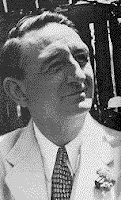
Fulton Oursler
The film was to be called Now You See It, and was based on a 59-page story treatment titled The Master Magician by Fulton Oursler. It was dated September 1, 1932. Hardcore Houdini historians should recognize the name. Fulton Oursler was a noted writer and editor for Macfadden Publications (publishers of Photoplay and True Detective), who in the 1920s aided Houdini in his crusade against fraudulent mediums. He even crusaded himself, under the pseudonym Samri Frikell. Near the end of his life, Houdini confided in Oursler that he thought spiritualists were out to kill him, and warned Oursler was also on their hit list. It was Oursler who, two weeks before Houdini’s death, received the ominous and oft-quoted message from a medium who prophesied, "The waters are black for Houdini,” and “his days as a magician are over.”

I confess I didn't instantly recognize the name. But it didn't matter. A notation on an undated studio synopsis told me exactly what I needed to know about Oursler, and confirmed that I was holding something very special in my hands indeed. It read it full:

The leading character in this story is founded on Houdini, with whom Oursler was very well acquainted. An actual medium is the heavy. Oursler himself has participated in the unmasking of spirit mediums, and, if the story is approved, will cooperate in working out the technical detail in the exposure of the mediums and of certain of Houdini's tricks. The picture is designed as a mixture of mystery and melodrama with a topical atmosphere. Paul Muni would make an ideal Houdini.

Paul Muni
Paul Muni! How many times did we all wonder who might have played Houdini, had the earliest Paramount picture gone forward in the 1930s? At least with this project we know exactly whom the studio had in mind. And Muni, best known for the Howard Hughes hit Scarface, would have been a superb choice.

Unfortunately, the main character in Now You See It would not be named Houdini. Possibly there were life rights concerns. Oursler would instead call his magician Harry Pinetti. The author explained: “Houdini, whose real name was Weiss, stole his name from the master magician of the French Empire, Robert-Houdin. Penetti [sic], whose real name was Mendel, stole his name from Pinetti, the glittering court magician of Louis XVI and Marie Antoinette.”

In his original treatment, Oursler fleshes out the character of Pinetti in some detail. Interestingly, he does so in the past tense, clearly recalling the deceased Houdini instead of introducing a living main character. Coming from a man who knew Houdini well, Oursler's description is fascinating and revealing:

Pinetti was a truly remarkable man. He was a showman whose genius for showmanship and self-advertising, for flamboyant effects that crashed the front page, exceeded Barnum and all his tribe. Pinetti was a man of keen intelligence. Without formal schooling he had educated himself. He had a mocking sense of humor and could turn any situation to his own advantage. He was a master of the deadly art of ridicule. There was a strain of cruelty in him at such times.
Physically he was a Greek god, with muscles of an athlete and the grace of a panther. He could have been a champion wrestler or boxer, runner or jumper. He was first of all a superb human animal. He did not smoke nor drink nor swear. He was devoted to his mother and loved his wife with a tender affection of a father toward a child. But he could hate with the ferocity of a python.
His interests were boundless. He had probed into aviation, languages, music; and he had an ambition for social advancement. He wanted to have a finger in every pie and believed that he was capable of reaching the top in any field. In other words, Pinetti the Great was an egomaniac, and that was the quality that made him great. If his faith in himself were ever destroyed, his soul would be blown to smithereens. When his egotism was not crossed, he was good hearted, gentle and kind.
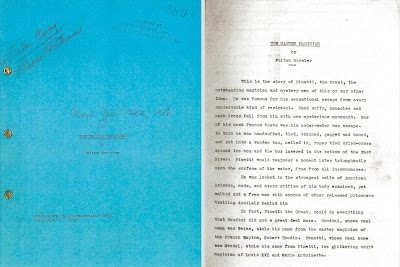
Fulton Oursler's original 59-page treatment for The Master 
Magician (aka Now You See It) dated September 1, 1932

Now You See It opens with the struggling Harry Pinetti performing handcuff and chain escapes in a sideshow. When he’s told his father is dying, Pinetti rushes to his side. The father assures his grief-stricken wife that their son Harry will one day pour gold into her lap. After his father dies, Pinetti’s mother implores him to give up show business. But Pinetti “tenderly refuses” and sets off on a tour of the “tank towns.”

While performing in Kennett Square, Pinetti meets the equally destitute Antonia Scott, aka “Tommy,” in a tavern. (Oursler notes: “Here I plan to show first Houdini’s expert trick of pitching his hat at a nail and never missing, even at incredible distance.”) Pinetti gives her a job in his show, testing her loyalty by hiring men to offer her bribes if she’ll reveal his secrets. He even has her kidnapped and threatened. Tommy remains loyal throughout, and her final reward is an offer of marriage.
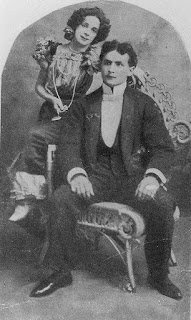
"The Great Pinettis"
After the wedding, a theatrical manager tells the Pinettis that Europe is “crazy over mystery and magic,” and that they would do well to make the trip. To get the money for passage, Pinetti marches into a safe manufacturer’s workshop and cracks their best safe. He then tells them he’ll reveal how he did it for $5000. (Oursler notes: “If this will not play believably, other kind of incident can be substituted. The purpose is to show Houdini’s supreme trait – a boundless resourcefulness which came to full heat only when Houdini was faced with apparently insolvable difficulties.”)

Aboard ship, Pinetti amazes the passengers with his feats, including an escape from an “old Chinese torture cell.” But in Europe, Pinetti and Tommy fail to find bookings and are reduced to performing in the streets. Even his escape from a Russian Siberian Transport Prison van fails to get him bookings, when Russian authorities censor news of the escape and banish him from the country. And now the young couple has a baby.

In desperation, Pinetti aggress to be chained in a box and thrown into the Seine. The escape is a sensation, and Pinetti becomes the talk of the Folies Bergeres. Then comes an offer of $5000 a week to return to New York. Pinetti agrees only if his first week’s salary is paid in gold.
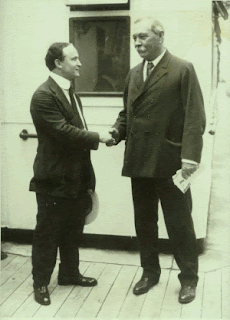
Sir Gilbert Crewe, I presume
Pinetti returns to New York and is a hit at the Palace. In the audience is the eminent British scientist, Sir Gilbert Crewe, who is also “the St. Paul of spiritualism.” Crewe believes Pinetti is a true medium. But Pinetti laughs off the suggestion, saying he believes all mediums are frauds. Pinetti receives his salary in gold and rushes home to pour it into his mother’s lap. But he is too late. She has died.

Pinetti goes into a “profound depression” and starts attending séances in hopes of reaching his late mother. But all he finds is fraud. He also starts to perform more and more dangerous escapes, to Tommy’s increasing alarm. Finally Sir Gilbert invites Pinetti to a séance with “the greatest of all mediums,” a “dangerously beautiful” young woman named Evelyn. The séance is impressive, until Pinetti shines a flashlight on the scene and exposes Evelyn as a fraud. She begs Pinetti not to publically expose her. He refuses and drives her out of town.

Pinetti becomes the great enemy of spiritualism, offering $10,000 for any manifestation he cannot reproduce. When he learns Evelyn is now performing in Washington, D.C., he travels to the capitol to introduce an anti-spiritualist bill in Congress. He puts on a raucous demonstration at the hearings, once again exposing and humiliating Evelyn, and ending his friendship with Sir Crewe. Afterwards Evelyn plots with her boyfriend, Leighton Stark, “the complete destruction of Pinetti.”

Stark kidnaps Pinetti’s son. Evelyn then informs Tommy that the boy will be released unharmed, if she tells them Pinetti’s secrets – especially the method by which he plans to escape the path of the Mercury Limited after he’s bound to the tracks by iron bands (an upcoming stunt). Worried for her son, Tommy relents and tells them all.
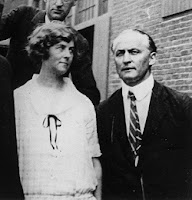
Houdini and his "Evelyn"
Pinetti is nearly killed in the train stunt. He escapes only by breaking his leg. (Oursler cautions: “The method he uses again involves how much exposure will be countenanced by the Society of American Magicians.”) When Pinetti returns home, he finds that Tommy has taken poison and left a suicide note confessing her betrayal. Pinetti goes after the maid, Emilie, blaming her for allowing the kidnapping. He strikes her down, leaving her in a comatose state from which doctors cannot revive her.

Mad with grief, Pinetti vows to kill Evelyn “with my own hands, slowly, painfully, pleading for mercy.” Using all his magical skills, he terrorizes her in her duplex apartment. As she swims in her rooftop pool, Pinetti pulls her underwater. Stark arrives and drains the pool, but Pinetti is gone. Pinetti then shows himself to Stark and Evelyn, “his eyes glowing with a mad light.” He tells them he’s created a “mechanical” version of himself, which is establishing an alibi 50 miles away.

As Pinetti is about to kill them both, the telephone rings. On the other end, Pinetti hears the voice of the deceased Tommy, begging him to think of their son and not commit murder. The voice from beyond snaps Pinetti back to his senses. He rushes home to find the source of the call. The doctors tell him it was the maid, Emilie, who had risen up in a “strange trance” and spoken in Tommy’s voice over the phone. Pinetti embraces his son as we FADE OUT.

Pretty wild stuff, eh? Clearly many of the episodes are taken right out of Houdini’s life, with some dramatic embellishments. Sir Gilbert Crewe is obviously Sir Arthur Conan Doyle. Evelyn is clearly the infamous Margery (aka Mina Crandon). And I can’t help but think about The Automaton from The Master Mystery when Pinetti speaks of his “mechanical man.” However, Houdini's expert hat-throwing skill is news to me!
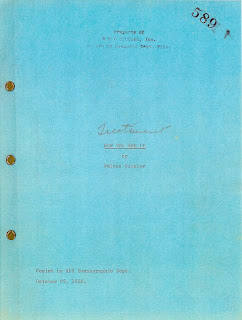
Oursler's revised treatment
Perhaps the story was a bit too dark for the studio. Perhaps it was also too expensive. Instead of moving on to a screenplay, Oursler worked on a revised treatment, which he delivered October 29, 1932.

The trip to Europe was now gone. Instead, Pinetti escapes his box in San Francisco Bay. Gone too is the testing of Tommy, her suicide, and the conflict with Evelyn. In fact, the medium isn’t even in this treatment. Instead Lady Crewe gives Pinetti a séance in which she brings back his dead father. But with these missing elements also went much of story, which now ends abruptly with Pinetti coming home with his bag of gold and finding his mother dead. Oursler may have lightened the tone and cut back the scope, but this new approach did not move the project forward (it's also possible this treatment is simply unfinished).

For that, the studio would turn to a new writer, Kubec Glasmon, who penned the James Cagney hit The Public Enemy (1931). Glasmon would skillfully reconcile the two Oursler treatments and bring in even more Houdini lore. And then a third writer would attempt to resurrect the project years later, by turning Harry Pinetti into…Howard Thurston?

But we will save all that for PART II.

A very big THANK YOU to Steven Bingen for all his help in making this discovery possible. For information on the amazing Warner Bros. Corporate Archive Research Center, visit the official website.
Saturday, November 20, 2010

HOUDINI (1998)

On Sunday, December 6, 1998, writer/director Pen Densham (who produced the 1979 documentary, Houdini Never Died) realized a dream when his cable film HOUDINI aired as a “TNT Original” movie. The film was supported with strong advertising, making the broadcast a cable television event. The network even broadcast two “encore” presentations immediately after the debut.

HOUDINI, which was filmed under the title, Believe, stars Johnathon Schaech as Houdini, Stacy Edwards as Bess, and Mark Ruffalo as Theo (Hardeen). Shimada also makes a cameo appearance as a street magician. Production design is magnificent, as is the musical score, and while not the best of the Houdini biopics, it has much to recommend it.

Notably, HOUDINI is the first Houdini biography to tackle and dramatize the issue of Houdini’s egotism. Certainly in this way Schaech’s manic and abrasive Houdini is far different from Tony Curtis or Paul Michael Glaser. Of course, it also makes him less likable and more alienating. But as Bessie says in the film, “I fell in love with Ehrich Weiss. I put up with Houdini.”

While Houdini takes plenty of dramatic license (Houdini’s mother never kissed or held him?), it still does a good job of weaving in Houdini history. It's the first Houdini film to give an accurate account of how he and Bess met. In HOUDINI we see them come together as fellow performers; Bessie as part of the Floral Sisters and Harry performing with brother Theo as The Houdini Brothers (okay, they were “The Brothers Houdini,” but that’s a quibble). We also get to see the death bed promise young Ehrich makes to his father. Jim Collins (Karl Makinen) and Martin Beck (George Segal) play their critical rolls in Houdini’s life and career. Even Houdini’s authorship of The Unmasking of Robert-Houdin is given a mention.

Hardeen gets a larger role in HOUDINI than he's ever had in any biopic. But as with Houdini's relationship with his mother, the filmmakers twist the brothers relationship for their own dramatic needs. Here Houdini creates "Hardeen" as a way to repress his brother's own magic ambitions. "It would be just too confusing; two Houdinis," Harry tells him. This film also sets up a class division between the two, with Houdini performing before royalty and Hardeen performing at a Union Hall. But it is nice that part of the dramatic arc for Theo in this film is to forgive his older brother for stealing the spotlight, and it's effective when he "exposes" the final Houdini seance just as Bess is starting to believe.

The film starts to get somewhat loose in its history in the final third, with Houdini suddenly ensconced in a throne-like office space and, yes, failing to escape from the Water Torture Cell after being punched in the stomach. The great Hollywood myth of the USD contributing to Houdini’s death continues here. Unbelievable.

But the film keeps the pedal to the metal in its depiction of Houdini’s stunts, eager to show Houdini as the original king of “extreme” (is that still a thing?). Standouts are the suspended straightjacket escape and a rather flamboyant depiction of the Milk Can. Jim Bentley and Jim Thompson are credited as magic consultants.

The framing device for HOUDINI is a live radio seance. This is presumably the 1936 final Houdini seance which was held on the roof of the Knickerbocker Hotel in Hollywood. Here it is presented on a theater stage, probably for budgetary or production reasons. Oddly, the film climaxes with Houdini making a star-child-like return from the dead. It’s a bit off the reservation, but it’s well written and beautifully performed, and does give the movie an emotional and, yes, magical conclusion.

Densham explains his ending by saying, “Well, you can look at it three ways: Either he dreamed it, or she dreamed it, or it really happened. I have my own theory, but I’d prefer not to say.”

HOUDINI was nominated for three Emmys: Outstanding Hairstyling for a Miniseries, Outstanding Sound Editing for a Miniseries, and Outstanding Makeup for a Miniseries. Judy Crown won the Emmy for Hairstyling at the 51st Primetime Emmy Awards held September 12, 1999 in Los Angeles.

HOUDINI was released on VHS in 2000, but it has yet to appear on DVD. While Death Defying Acts was released in 2008 making it the most recent Houdini film, HOUDINI was the last straight-ahead biopic of the great magician. Let's hope it isn't the last.
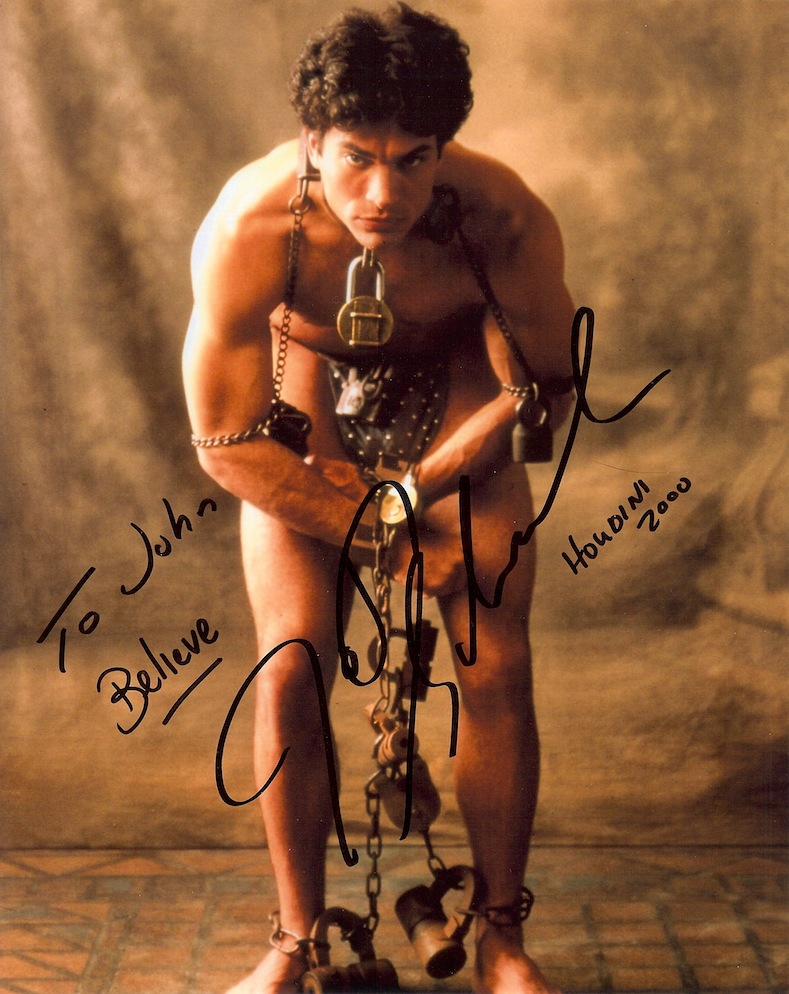
UPDATE: HOUDINI is now available on DVD.


Johnathon Schaech as Houdini

Also enjoy:

Translate