Showing posts with label Harry Day. Show all posts

Sunday, September 6, 2020

Beat the heat with Hardeen

Today is going to be a hot one in Southern California. It's forecast to be 114℉ in my own Burbank. Even Catalina "Terror" Island shows 107℉, which I didn't think was possible. Coincidently, yesterday I stumbled on this ad from almost exactly 114 years ago. Despite being "the hottest day of the summer" in the UK, people still packed the non-air conditioned Ealing Hippodrome to see Hardeen! Imagine what they would have endured for Houdini?

Music Hall and Theatre Review, Sept. 7, 1906.

Notice this ad shows Hardeen was also managed by Harry Day in the UK. I love the inclusion of "my pal." That seems very Dash.

Stay cool.

Friday, July 27, 2018

Aaron Faber has Houdini's pocket watch for sale

An 18K gold pocket watch given to Houdini by his English agent, Harry Day, is currently on sale at the Aaron Faber jewelry gallery in midtown Manhattan for a cool $45,000.

The watch is described as a "hunter cased minute repeating chronograph with calendar and moon phases" and carries the inscription "To My Dear Pal, Houdini, From His Sincere Friend, Harry Day, May 1914." This was near the end of Houdini's last tour of the UK before the outbreak of World War I, so it's possible this was a farewell gift from Day.

The watch had sold for $25,000 at a Bonhams auction in June 2012. According to the auction listing (which is still viewable), after Houdini's death, the watch was given to his nephew, Harry White (I'm not sure who that is). Aaron Faber acquired the watch from the collector who purchased it at the Bonhams auction.

Aaron Faber is located at 666 5th Ave, New York, NY 10103. The watch can be viewed by appointment.

Thanks to John Hinson for the alert.

Related:

Friday, May 27, 2016

Houdini in 1900

This Memorial Day marks the 116th anniversary of Houdini's first trip to Europe on May 30, 1900. To mark the occasion, here's a look back at that all-important
year.
This post is now retired. But you can read the story of Houdini in 1900 in my book, Handcuff King: The Conquests of Harry Houdini, 1900–1909. 

Sunday, October 25, 2015

REVIEW: The Witch of Lime Street is no fraud

When The Witch of Lime Street was first announced back in 2007, there was some skepticism among Houdini buffs (myself included). The press reported a "high six figures" advance for a book by an author no one in the Houdini world had ever heard of. Indeed, David Jaher (spelled Jehar in the original reports) had never written a book before, and while he was said to be a screenwriter, he had no produced credits. Furthermore, he worked as a professional astrologer. It didn't help that the release date was continually postponed. Originally set for release in 2010, it jumped to 2012, 2013, 2014, and finally 2015. So you couldn't blame Houdini buffs for suspecting The Witch of Lime Street might turn out to be as fraudulent as, well, "the Witch of Lime Street" herself!

Having now read David Jaher's 436-page The Witch of Lime Street: Séance, Seduction, and Houdini in the Spirit World, I'm happy to report that all our fears were unfounded. The book is a triumph! It's exhaustively researched, beautifully written, and easily stands as one of the best books ever written on Houdini's anti-spiritualism crusade. It is certainly the finest work ever produced on Mina Crandon a.k.a. "Margery" (admittedly, there have only been two others). It also might be one of the best books ever produced on the subject of Spiritualism itself. For those wishing to better understand Houdini's encounters with Margery and his participation in the Scientific American committee, this is now essential reading.

For me, the "test" of the book was in how the author handled the infamous ruler incident. This is the controversy over how a folding carpenter's ruler got inside the Margery control box during one of her seances with Houdini. Margery believers blame Houdini. Houdini supporters blame Margery. And informed magic historians -- especially those who don't care for Houdini -- quickly cite a damning quote from Houdini's chief assistant Jim Collins (which first appeared in Gresham) confessing that he "chucked it in the box" on the boss's orders. So which side would the author take?

Well, not only does David treat the ruler controversy objectively, describing all that occurred without inserting his own opinion (a relief in this day of opinions as fact!), he also reveals the source of the Collins quote as magician Fred Keating, a Margery convert who had been J. Malcolm Bird's select magician committee member during the seances preceding Houdini's arrival in Boston (the full extent of Keating's involvement was something I didn't know until this book). So not only did David pass my test with flying colors, he also took a step to debunk something that has been used to indict Houdini (and Collins) in the past. Bravo!

While there isn't a single momentous revelation in the book (no, Margery was not a government spy), there are dozens of small ones. Among these is the mind-blower that Margery channeled her spirit guide Walter during a radio broadcast in January 1934. That is one recording I'd love to hear! Jaher takes us a few more troubling steps down the road that suggests Margery's husband, Dr. Le Roi Crandon, may have been involved in child abductions -- maybe even murder -- which was first uncovered by Bill Kalush in The Secret Life of Houdini. This is weird and troubling stuff, and while it is still unclear exactly what was going on, it appears Houdini himself might have been pursuing the case via his English agent, Harry Day. Jaher also delves into the seductive side of Margery (a favorite topic), and even reveals that Margery did try to work her "applesauce" against Houdini in her own son's bedroom at Lime Street. (You can bet I'll be doing a post about that one soon.)

As to Houdini himself, Jaher's portrayal feels very similar to that of Ken Silverman in his masterful Houdini!!! The Career of Ehrich Weiss. It's not wholly positive or worshipful, but it feels honest and true, showing us Houdini at his best, worst, or usually somewhere in-between. One thing I didn't care for was the author's continued use of "The Great Houdini." Houdini himself never used this moniker, and it seemed like an unnecessary Hollywood flourish in an otherwise controlled and scholarly work.

For such a weighty topic, the book flows beautifully. I especially enjoyed the brevity of the chapters. Here I think Jaher's skills as a screenwriter came into play. Not for any ability to create fiction, but for an ability to condense information into packets of dramatic movements that carry the reader along. The book never bogs down or meanders. It's what one would call "a quick read."

It's when Jaher moves outside of his area of core research (1920-25) that he falls into a few familiar traps and errors do creep into the text. He says Houdini appeared in the Welsh Bros. Circus as the "Wild Man of Borneo." It was actually the "Wild Man of Mexico." (Borneo comes from the movies.) He suggests the sea monster challenge took place underwater. It was a stage escape (but Houdini sometimes told an underwater version). And the provider of Houdini's last meal of Farmers Chop Suey was Dr. Daniel Cohen, not Dr. Kennedy. But these types of forgivable errors appear in all Houdini biographies. I spotted no whoppers, nor did David indulge in any wild speculations. Instead, the author finds his story -- which is as thrilling as any Hollywood fiction -- in the facts.

So while it may have taken a few years longer than we expected and, yes, it's a skeptical work written by an astrologer, The Witch of Lime Street: Séance, Seduction, and Houdini in the Spirit World by David Jaher is a major contribution to the world of Houdini scholarship and a gift for all Houdini buffs.

Oh, and the dust jacket glows in the dark! That alone makes it a must for your Houdini bookshelf.

The Witch of Lime Street: Séance, Seduction, and Houdini in the Spirit World can be purchased at Amazon.com (U.S.) and Amazon.co.uk (UK). It's also available as an Unabridged Audiobook.

Related:

Friday, October 31, 2014

Halloween 1936: The Final Houdini Seance

"This is a Houdini night, with the spotlight of the public on Houdini; with the whole world paused to see or hear Houdini step on this side of the curtain." - Edward Saint
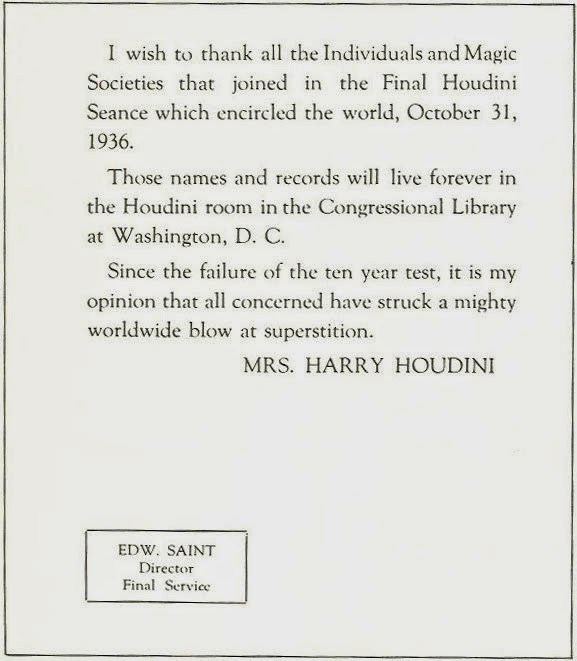
Today is the 88th anniversary of the death of Houdini. Today also marks the anniversary of The Final Houdini Seance on October 31, 1936. This was Bess Houdini's tenth and final attempt to contact her husband from beyond the grave, and it was held with great fanfare in Hollywood 78 years ago tonight. So instead of a post today about Houdini, I thought I'd look back at this first public Houdini seance and the first posthumous Houdini mega event.

Plans for The Final Houdini Seance were first revealed in April of 1936, and the original conception was quite different. Bess and Edward Saint (her business manager and partner) announced that the seance was to be held on a mountaintop -- "as near the heavens as possible" -- and the idea was to not only contact Houdini, but Howard Thurston and Charles Carter as well. (Thurston had died that month.) The widows of both famous magicians would participate.

Said Bess, "Now that Houdini, Carter and Thurston have joined forces on the other side of the grave, I am going to make, here in Hollywood, the one supreme effort to contact these great magicians and maybe together one of them may 'come through'."

Eventually the idea of a 3-ring seance was abandoned and the focus narrowed to Houdini. The location also shifted from the proposed mountaintop to the roof of the Hollywood Knickerbocker Hotel on Ivar Street off Hollywood Blvd. There was also talk of a national radio hookup to broadcast the seance live, but it's unclear if this happened.

Golden invitations were sent to some 300 guests and reporters, and Saint worked tirelessly to promote the seance. He even petitioned (unsuccessfully) to have the lights of New York's Broadway dimmed and one minute of silence observed on Halloween as a tribute to Houdini. A week before the seance, Ed and Bess checked into a suite at the Knickerbocker. Bess wrote to her niece Marie (Blood) that she was "all a jitter about it--and will be so glad when it is all over."

According to William Larsen Sr., who would make up part of the Inner Circle and later toured with a lecture about the seance, the night was uncommonly cold -- "most of the invited guests were as numb as though they'd been dead as long as Houdini" -- and some of the attendees "had the foresight to prepare for the occasion by stopping in at the Knickerbocker cocktail bar." There was also a private offer made to Saint by local magicians, as Larsen recalls:

Now it seems that Dr. DiGhilini, a well-known West Coast mystery worker and a few other outstanding magicians didn't really believe anything was going to happen. They feared that the invited guests and the waiting world were doomed to bitter disappointment. So, they offered their services to help better matters. It would be excellent, they told Dr. Saint, to get Houdini's handwriting on the slate and they could assure its appearance there. Or, to cause a dove to fly up from the center of the table, seemingly created out of nothing. Dr. Saint refused these generous offers. The seance was to be conducted on a strictly legitimate lines. The tricks of the conjurors were taboo.

The rooftop has been carpeted for the event and bleachers set-up for the public and reporters. The seance table was set near the edge of the roof with the HOLLYWOODLAND sign (as it read in 1936) visible behind Bess and Ed, who sat side by side in two large chairs. On the table before them were the famous Mirror Handcuffs interlocked with another pair of cuffs, a bell, and a spirit trumpet. Between them sat "The Houdini Shrine" with a light bulb that burned red above a portrait of the great magician.

The Inner Circle was made up of: Judge Charles W. Fricke, President of the California Assembly of the S.A.M.; Earl Rybolt, President of Los Magicos; William Larsen Sr., Editor and Publisher of Genii; Jacob Hyman, Houdini's first performing partner and boyhood friend; Floyd G. Thayer, well-known magic dealer; Reverend Dr. Acorn, President of the local association of Spiritualist Churches; Gerald Kosky, National Vice Present of the S.A.M.; Caryl S. Fleming, President of the Pacific Coast Association of Magicians; and Dr. Vernon Herbst, Psychiatrist and student of occult sciences. Honor guards where L.O. Gunn and Harry Mendoza, members of the S.A.M. and Los Magicos.

From the start, the seance was promoted as being a "worldwide" attempt to contact Houdini, and Saint arranged for 12 other seances throughout the United States, Canada, England and Australia to begin at the exact same time. Hardeen was heading up a circle in New York City, and Houdini's longtime British agent Harry Day oversaw a circle in London.

At 8:30, the proceedings began with the playing of Pomp and Circumstance (the music which opened Houdini's full evening show). Inner Circle attendee Caryl Fleming later described the dramatic moment for Goldston's Magical Quarterly:

A majestic march emanating from the concealed speakers of a powerful public address system broke the silence--all lights on the roof were extinguished except the ruby light over the shrine--the members of the inner circle rise to their feet--the assemblage does likewise--all standing at attention while the little widow, Mrs. Beatrice Houdini was ushered to her place and seated by her manager, Edward Saint, a life-long friend, who then took his place, the music died down and all reseated themselves and then --- silence -- hushed almost oppressive hopeful silence.

Saint then begin the seance, pleading with Houdini to give a sign. During the proceedings, Saint mentioned a hidden "locked vault" that contained valuable papers and a lapel given to Houdini by Harry Kellar. The vault had not been located, and Saint asked the spirit of Houdini to reveal the secret location. (This vault remains a mystery to this day.)

Saint begged Houdini to appear for over an hour. Fleming records that, "Dr. Saint spoke, his voice rising to a mad, sobbing pitch. Sobs could be heard too from some of the friends in the audience." Bess would later say, "He invoked, and he invoked--good Lord, how that man invoked." During a lull, one paper reported that the sound of a saxophone could be heard "sobbing" from the street below.
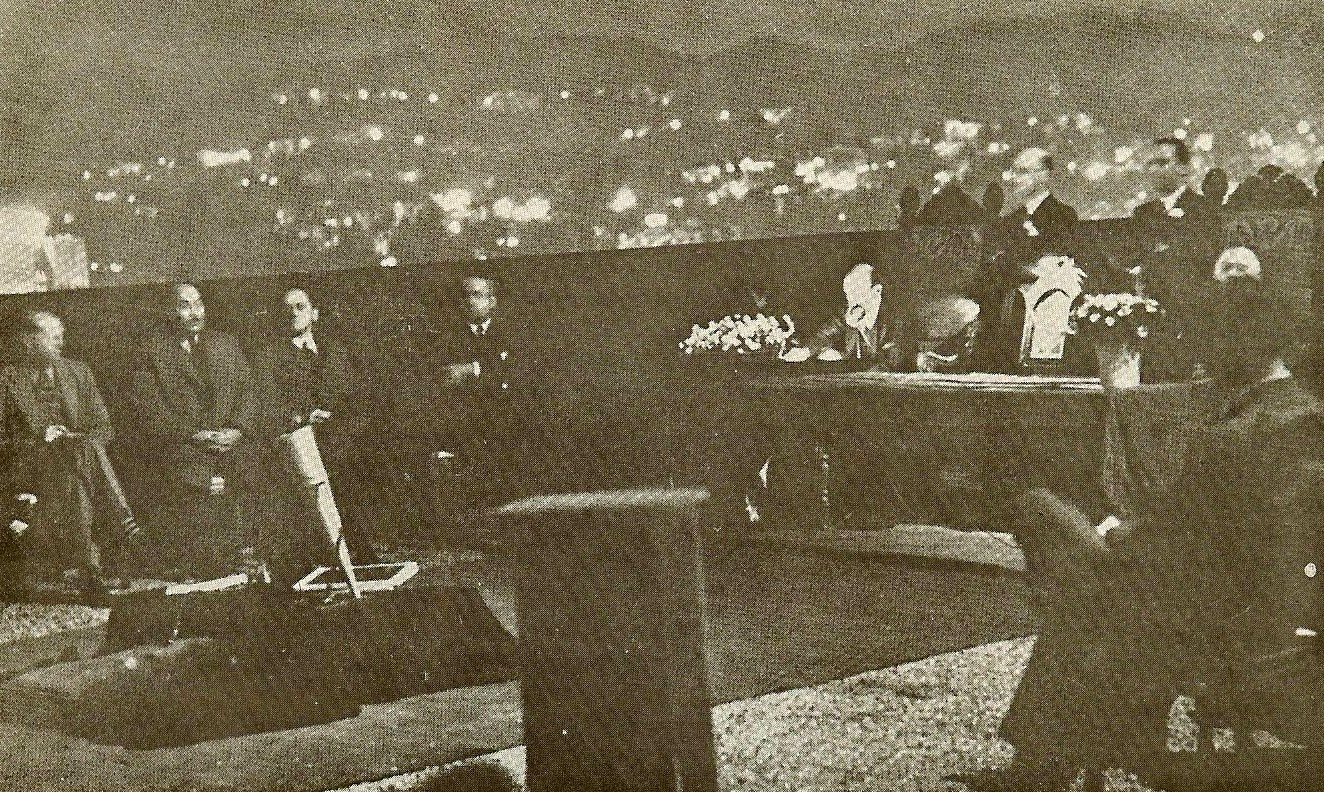
This UPI photo shows the seance in progress.

Finally, Saint turned to Bess and delivered these famous final words.

Saint: Mrs. Houdini. The zero hour has passed. The ten years are up. Have you reached a decision?"
Bess: Yes. Houdini did not come through. My last hope is gone. I do not believe that Houdini can come back to me, or to anyone. After faithfully following through the Houdini ten year compact, after using every type of medium and seance, it is now my personal and positive belief that spirit communication in any form is impossible. I do not believe that ghosts or spirits exist. The Houdini shrine has burned for ten years. I now reverently turn out the light. It is finished. Good night, Harry.

With that Bess closed the doors on the Houdini shrine, which extinguished the red light, and she left the rooftop escorted by Saint. It was then that it began to rain from what had been a clear sky. The rain lasted just long enough to drench those left on the rooftop, and then it suddenly stopped. Larsen remembers:

To people who do not live in California, this may not seem strange. But California does not have "showers" as do the East and Mid-West. The country is rainless for months. When rain comes, it rains for days. A brief, heavy rain is an unheard-of phenomena. Was it a sign? Were the Gods displeased? Was Houdini displeased? Probably it meant nothing for the newspapers failed to mention it. Still, I often wonder.

So was the Final Houdini Seance on the level? Arnold Furst said when asked what they would have done had Houdini returned that night, Ed and Bess laughed, and Ed said: "Bess would have dirtied her pants if that had happened!"

Just like seances held today, the Final Houdini Seance was a mix of sincerity and self promotion. While Bess had spoken of their being a "compact" between her and her husband, there was never a time frame given, and the idea of a 10-year cut-off was probably invented for this seance. It also appears this was the first Houdini seance held on Halloween. Records of other seances held by Bess in New York show them taking place in the Spring.

Bess and Ed had also recently set-up a movie about Houdini at Paramount. The Final Houdini Seance might have been an attempt to show the studio that Houdini was still relevant and a part of the popular imagination. In this regard, it was a great success. The seance did make headlines across the country. (It would still take 17 years for the Houdini movie to be made.)

As might be expected, the seance drew some criticism from spiritualists. Dr. Ed James Irvine wrote in The Billboard: "It was absurd to try to communicate with the spirit of Houdini recently when there was an audience of more than 200 morbid curiosity seekers knowing little or nothing about psychism. Inasmuch as Houdini manifested himself to Mrs. Houdini through Arthur Ford, a New York medium, on a previous occasion, I do not see why it is necessary for his spirit to come back again in order to give proof of spirit return."

Hudson Records release (1959).
The Final Houdini Seance was recorded and released by Thayer Magic on an LP narrated by George Boston. It's likely what we hear on the record was actually done in the studio after the seance and not a recording from the rooftop, which would not have yielded clear audio. This might explain why Bess's closing words are sometimes quoted differently in press accounts than from what we hear on the recording. The record was re-released by Hudson Records in 1959 and again by Mark56 in 1975.

In 1986, a special 50th Anniversary reenactment of the Final Houdini Seance, organized by Manny Weltman, was held at the Variety Arts Center (a sister club to the Magic Castle), which I had the pleasure of attending. Bess was portrayed by original seance attendee Geri Larsen (Jaffe) and Edward Saint was played by Stefan Krayk. True to the script, Houdini failed to return.

Today The Knickerbocker Hotel still stands in Hollywood and looks much as it did in 1936. It is now a private retirement home and is closed to the public. (Yes, I have tried to get on the roof, and, no, it isn't happening.) For many years a photo of Houdini graced the wall of the hotel's restaurant.

The Knickerbocker today.

Ironically, what was supposed to be the "final" Houdini seance kicked off what has became a cottage industry of Halloween Houdini seances that continue to this day. This year seances will be held in Danvers, Scranton, Las Vegas, Sonoma, York, and dozens of other locations, both public and private. While some claim to be a continuation of the "official" or "original" Houdini seance, the truth is there is no true continuation. Part of the intent of the Final Houdini Seance was to put an end to such attempts and close the chapter on Houdini's own investigations into the possibility of spirit communication. As Bess said herself, "It is finished."

But the Houdini seances today are, paradoxically, more about celebrating the life of Houdini, and also about having some spooky fun on Halloween. In this way, I guess they are indeed continuations -- inspired by and modeled on Bess and Edward Saint's flamboyant and famous Final Houdini Seance of 1936.


Thanks to Mark Willoughby for the use of the remarkable unpublished photos of the Final Houdini Seance from his collection.

You can listen to the recording of the Final Houdini Seance at Tom Interval's Houdini Museum YouTube Channel.

Sources:
  • Charvet, David. Beatrice Houdini, MAGIC Magazine, October 1995.
  • Fleming, Caryl S. The Tenth and Final Houdini Seance, Goldston's Magical Quarterly, Vol. 3, No. 3 Winter 1936.
  • Larsen, William. The Final Houdini Seance, Genii Magazine, Vol. 21, No. 2, October 1956
  • Silverman, Kenneth. Houdini!!! The Career of Ehrich Weiss, Harper Collins, 1997.
Related:

Thursday, March 20, 2014

LINK: Close to Houdini

The David De-Val Tribute Site has reproduced a fascinating article written by De-Val in a 1985 issue of Escapism in which he reports on a visit with Kathleen Owen, the assistant to Houdini's English agent, Harry Day.


Mrs. Owen knew Houdini and relates some truly unique and personal information, including that Houdini carried with him at all times a small polished wooden box containing mementos of his mother ("he would worry if it was out of his sight"), that he "swore occasionally, but not a lot," and that Harry Day did not like Bess.

Click on over and have a read, and also have a browse of some of the other De-Val articles on this excellent tribute site.

Thanks to Andy Robertson.

Wednesday, January 2, 2013

Houdini and Hilliar

MagicPosterGallery.com
William J. Hilliar was a magician and author who edited Billboard's "Magic and Magicians" page for many years. He was also close friends with Houdini. "That friendship will always stand out as one of the dominating factors in my life," said Hilliar.

In 1933 Hilliar penned a multi-part series of articles for Billboard titled, "Is Harry Houdini Trying To Communicate With Me?" Hilliar's story of fading photos and strange photographic blurs is mildly interesting (Kalush relates part of it in Secret Life, pages 532-533), but what I found much more captivating were his personal recollections of Houdini himself. These are wonderful slice of life moments that offer us a candid glimpse of what Hilliar calls "the human side of Houdini."

William John Hilliar was born in Oxford, England in 1876. Inspired at age 14 by seeing Bosco, he became a professional magician and magic author. He ghost-wrote Modern Coin Manipulation for T. Nelson Downs and Howard Thurston's Card Tricks. In 1902 he moved to the U.S. where he founded The Sphinx magazine and published Modern Magician's Hand Book. Hilliar was said to be so skilled that he once substituted on stage for Thurston with no one in the audience realizing the switch.

Hilliar first met Houdini in England shortly after the "Handcuff King" had catapulted to fame there. In the first entry of his Billboard series, Hilliar recalls the experience:

One cold, shivery, foggy morning in London I was walking with Tommy Downs, when suddenly out of the mist appeared a shadowy form, short, stocky, enveloped in a long overcoat, carrying in one had a tin can. We stopped and Downs introduced us. Houdini invited me to his home--a small bedroom in the same house in which Tommy and I lived, at 11-12 Keppel street, and explained his haste by saying that he had "walked all over London" to get a pot of good coffee for his wife.

Hilliar says that he, Houdini, Downs, Thurston and The Great Lafayette would "mingle for hours" in his room on Keppel Street -- "it being next to the dining room I suppose it was the handiest." It was during one of these bull sessions that Houdini explained to Hilliar his "secret" plan to trip up his imitators:

One day he said: "So many imitators are springing up that when I leave the Alhambra to play the biggest houses in Continental Europe some think they are going to reap a rich harvest on the name I have created, but I am going to play poker and fool them. I have a brother in America, Theodore Weiss, and I have cabled for him to come over. I am letting into the secret." Theodore came, and as Houdini prepared to leave for Paris, announcements appeared in the London papers that the "real" American handcuff king -- Hardeen -- was on the way to show Houdini up!

Hilliar lost contact with Houdini until 1917 when he covered his suspended straitjacket escape in Time Square as his first assignment for Billboard (Hilliar says that Houdini was assisted by Harry Kellar?). The men renewed their friendship, but Hilliar noted that Houdini was a man changed by grief:

His mother had died in the meanwhile and he often talked of her to me. Over at his Brooklyn home I have sat and talked with him while he was lying on an old faded and bedraggled sofa which, with tear-dimmed eyes he told me was his mother's and that he could almost feel her presence. We often discussed spiritualism and what it would mean to him if he could get a message from his departed loved one.

By the way, Hilliar referring to Houdini's "Brooklyn home" is not a mistake. This was most likely when Houdini and Bess were living with the Hardeens in Flatbush. But while Hilliar was noticing Mama's "bedraggled sofa", Houdini was alarmed by the lock on the door of Hilliar's West 43rd Street apartment when he paid his friend a visit:

He suddenly stopped, apparently glued to the floor, and shouted as he pointed at the door, "Hilliar, where did you get that lock?" I told him it was there when I rented the place and that, although it was of unusual shape, I had paid no attention to it. He gave me one look of mingled scorn and distrust and said: "There are only two locks like that in the world. I have the other one and I'm going to get this." And he did. He went to the janitor, bought the lock and took it home. At intervals, after this incident, he would question me regarding the lock, eventually confiding to me that these were the only locks he had ever see that he could not open without special keys.

Hilliar addresses the charge that Houdini was a "supreme egotist", saying that it was made "chiefly by those who had tried to double-cross him or had attempted to impede his long and hard climb to the pinnacle of fame." Hilliar says one day he "chided him about this egotism" and Houdini provided this explanation:

"It's not egotism, Hilliar, it's Houdini-ism. I implicitly believe in myself and as all I have to sell is myself I am going to protect my name at all hazards and will fight to the last ditch to keep the name of Houdini a household word. If the world believes me to be the greatest magician of all times, well, I believe it too. Always believe in yourself and trample underfoot parasites who may try to undermine your foundations, and you will win out provided you are on the level. I may have played the part of an egotist at times, but I was merely assuming the character for reasons."

When Houdini traveled back to post-war England in 1920, he promised to visit Hilliar's parents, who had not seen their son in many years. Houdini penned a remarkable letter to Hilliar on January 11, 1920 relating the experience. Of the letter, Hilliar wrote, "if ever there was a human document penned here it is." A few excerpts below:

"So in Harry Day's Rolls-Royce I went to Ilford and knocked at the door. A lady came and opened it. 'Is Mrs. Hilliar home?' I asked. 'Yes.' 'Is Mrs. Hilliar home?' 'Yes, I'm Mrs. Hilliar.' 'Well,' said I, 'here I am after traveling just about 15,000 miles and I bring you a message from your son William, and, he told me to give you a kiss for him.' Your dad came upon the scene just as I put my arms around you dear old mother and kissed her for you. She had tears of joy in her eyes, saying happily, 'How just like him to do such a thing.'"

Stirred up, Houdini ends the letter in full-blown Mama mode:

"Be sure to write them as often as possible. Your mother said: 'He does not write as often as I'd like,' so sit down and write her a long, loving letter, for, Bill, some day that will be impossible, and like my own sainted God-fearing sweet mother she will be unable read letters from you. So sit right down and tell your mother how much you love and worship her and it will help her beguile the long hours away until she can again enfold you in her honest-to-God loving embrace."

Hilliar states that he "could write indefinitely of the human side of Houdini--the Houdini that the world and very few magicians ever knew." In his Billboard series he also shared the last words Houdini ever spoke to him. Apart from advising Hilliar to stop drinking highballs -- "They'll get you in a year or so" -- Houdini made a remarkable prediction of his own longevity. But I'm going to save that quote for another post.

Tragically, William J. Hilliar committed suicide on November 15, 1936 just before his 60th birthday.

Billboard, October 28, 1933 (click to enlarge)

Thanks to researcher extraordinaire Diego Domingo for finding this remarkable series that ran in Billboard from October 28, 1933 to January 27, 1934. Also thanks to the always awesome Lisa Cousins for alerting me to these and making copies. Hilliar background from Magicpedia.

Tuesday, June 12, 2012

Houdini's watch sells for $25,000

An 18K gold pocket watch given to Houdini by his English agent, Harry Day, sold at Bonhams today for $25,000 (including buyers premium). The watch beat its auction estimate of $10,000 - $15,000.

Described as a "hunter cased minute repeating chronograph with calendar and moon phases", the watch carries an inscription showing it was given to Houdini by Day in May 1914. This was right at the time Houdini was performing his "Grand Magical Revue" in England. It was also Houdini's last tour of the UK before the outbreak of World War I, so it's possible this was a farewell gift from Day.

According to the auction, after Houdini's death the watch was given to his nephew, Harry White.

Monday, June 11, 2012

Genii & Houdini: October 1942

Continuing our look back at the history of Houdini on the cover of Genii, The Conjurors' Magazine, here we have Vol. 7, No. 2 from October 1942. This time the cover art -- "prepared under the personal direction of Edward Saint, Houdini Archivist" -- commemorates Houdini's historic first flight in Australia. Perhaps in a reference to the War effort, editor William Larsen writes, "With Australia the scene of so much aerial activity today, we consider the cover drawing most appropriate to the times."


The issue contains 8 pages of Australian newspaper clippings about Houdini's historic flight in 1910. It also features Bessie's final memorial page, and a reproduction of a "Trick idea in Houdini's handwriting, written June 9, 1926."

This issue is also notable in that it contains the obituary of Jacob Hyman, Houdini's first performing partner, written by Edward Saint. It also has an article by his brother, Joe Hyman, titled "Strange Coincidence". In it Joe talks about how his bust of Houdini mysteriously fell and broke shortly after Houdini's death, while an identical bust belonging to Houdini's English agent Harry Day also broke days later.


In his intro to this issue, Larsen writes, "Each year Genii dedicates its October number to the Houdinis: Harry and Beatrice. This marks the seventh year that we have done so. The doing of it gives us pleasure and us proud."

But changes were to come...

Coming next: October 1943

Wednesday, May 16, 2012

Houdini's pocket watch at auction

A 18K gold pocket watch given to Houdini by his English agent, Harry Day, will be auctioned by Bonhams on June 12, 2012. This watch is described as a "hunter cased minute repeating chronograph with calendar and moon phases" and carries an inscription showing it was given to Houdini by Day in May 1914.

This was right at the time Houdini was performing his "Grand Magical Revue" in England. In fact, it was in May 1914 that he purchased his famous Walking Through A Brick Wall illusion. It was also Houdini's last tour of the UK before the outbreak of World War I. In June he would sail home on the Imperator and not return until December 1919, so it's possible this was a farewell gift from Day (who would soon become Colonel Harry Day).

According to the auction, after Houdini's death the watch was given to his nephew, Harry White. I'm not sure who Harry White was.

The auction estimate is $10,000 - $15,000. The auction lot is #43 in the Fine Watches and Wristwatches Auction 20003.

Click here to view the auction page at Bonhams.

Thanks to Kevin Connolly and Dick Brookz for the alert.

Translate